
By Palestine Chronicle Staff
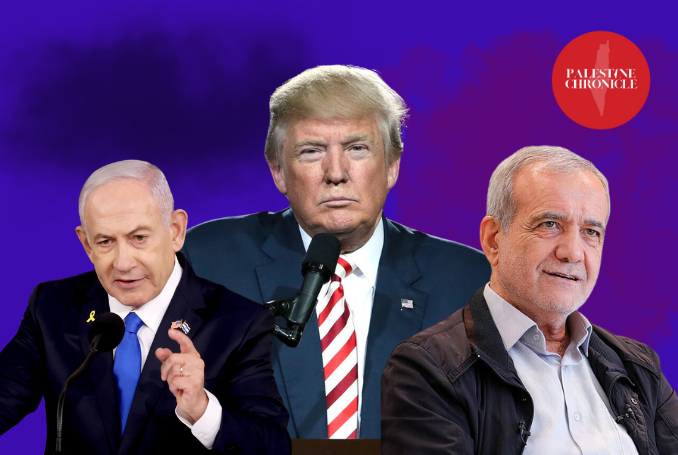
Trump reportedly received calls of concern from both Netanyahu as well as bin Salman ahead of the expected strike.
Limited military capability as well as warnings from key allies in the region are among the reasons for US President Donald Trump pulling back on attacking Iran, according to an Axios report.
Last Wednesday, top military, political, and diplomatic officials in Washington and the Middle East expected that the US would strike in Tehran. But by the afternoon, the report cited two US officials as saying, it was clear that Washington had stood down and the order was not going to be issued.
“Insufficient military hardware in the region, warnings from allies like Israel and Saudi Arabia, concern among top aides about the implications and effectiveness of the strike options, and secret backchannel talks with the Iranians,” Axios stated as reasons for the pullback.
The report explained that since the war with Iran in June last year, many US troops and assets had been relocated to the Caribbean and East Asia.
‘Theater Was Not Ready’
It cited some officials as saying that “the theater was not ready”, limiting American capability “both for an attack and for the scenario of a wider conflict if Iran retaliated.”
A White House official, however, claimed the US had enough hardware available in the region “if he (Trump) were to choose them.”
Call from Netanyahu, MBS
Israeli Prime Minister Benjamin Netanyahu himself called Netanyahu earlier in the day.
The report stated that Netanyahu “told Trump that Israel was not ready to defend itself from Iran’s likely retaliation, especially since the U.S. didn’t have enough assets in the region to help Israel intercept Iranian missiles and drones.” This confirms the concern raised by some US officials.
An advisor to the Israeli leader also reportedly said that Netanyahu was concerned that the US’s plan was neither strong nor effective enough.
Axios also cited another source as saying that Saudi Crown Prince Mohamed bin Salman also spoke to Trump, voicing concern about the regional consequences for such an attack.
Araghchi’s Intervention
A diplomatic backchannel between US envoy to the Middle East Steve Witkoff and Iranian Foreign Minister Abbas Araghchi is also cited as a reason for the developments.
The report said that Araghchi had over the weekend reached out to Witkoff “to discuss a diplomatic path to de-escalation.”
Two US officials said that on Wednesday morning, Araghchi texted Witkoff, “committing to hold off on planned executions of protesters and stop the killing.”
Trump held a meeting in the afternoon where he decided not to order the attack.
“It was really close,” another US official was quoted as saying. “The military was in a position to do something really fast, but the order didn’t come.”
Iranians’ Influence
A White House official confirmed that the messages received from the Iranians “had an impact, but it wasn’t the only reason.”
“The president is guided by his superb instincts,” the official stated.
On Friday, Trump told reporters, “Nobody convinced me. I convinced myself.”
The report noted that while Trump has held off on attacking Iran, at least in the near term, a military operation against Iran should not be ruled out. It cited US officials as saying that another decision could be made within weeks.
“The truth is, nobody knows what President Trump will do with respect to Iran besides the President himself,” White House press secretary Karoline Leavitt told the news site.
(PC, Axios)

No comments:
Post a Comment