
The Australian Parliament has passed a new hate crimes law that could potentially throw critics of Israel in prison for years, reports Joe Lauria.
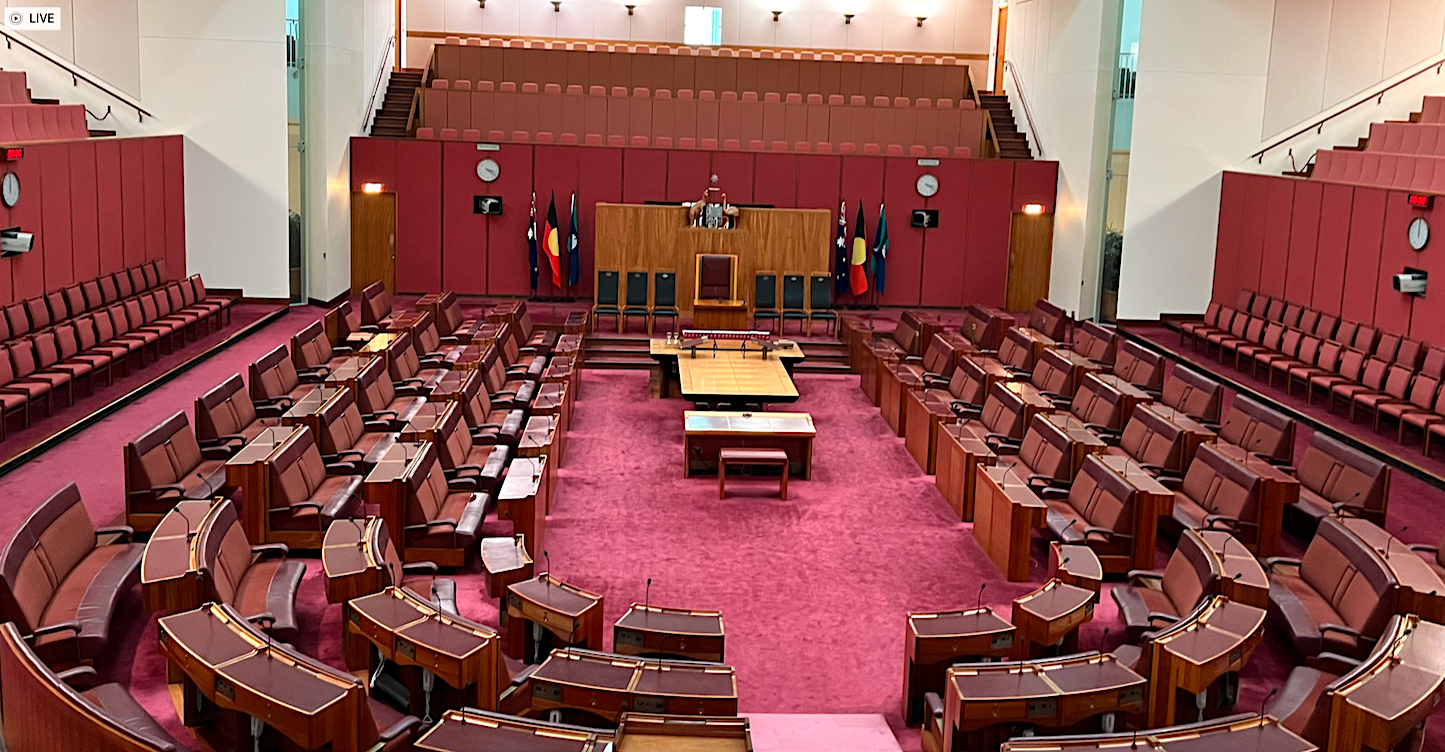
The Australian Senate chamber. (Joe Lauria)

The Australian Parliament has adopted a potentially nation-altering hate crimes bill that allows an intelligence agency and the government to collaborate in virtual secrecy to list “hate groups” whose members and supporters could then be imprisoned, according to the text of the law and to senators who voted against it in a late-night session on Tuesday.
The law could allow peaceful organizations protesting against Israel to be listed without due process as hate groups in a hidden procedure involving the attorney general, the home affairs minister, the federal police minister and the Australian Intelligence Security Organisation (ASIO), which is the national domestic intelligence agency similar to the F.B.I.
Asked by the Australian Broadcasting Corporation (ABC) four times whether a group accusing Israel of genocide could be designated a “hate group,” federal Attorney-General Michelle Rowland ultimately said she would rely on the advice of ASIO & the police in such a case.
The law says the Australian Federal Police minister “is not required to observe any requirements of procedural fairness in deciding whether or not the AFP Minister is satisfied” that a group should be banned. Nor is a conviction for a hate crime required for proscription.
When asked to respond to critics who say the new law is “too broad, lacks procedural fairness and is the sort of stuff you see in authoritarian states,” Rowland said:
“I would say that we are responding to one of the worst things we have seen in this country’s history and indeed the worst terror attack on Australian soil and that demands that the Parliament take measures that ensure that our citizens are kept safe and that we directly address antisemitism.”
Rowland said there was judicial review available and Parliamentary disallowance. But in response to the question, she is essentially justifying a law that is like one you see in an authoritarian state, perhaps because, critics fear, Australia is becoming one.
Watch the interview with Rowland:
For example, The Guardian‘s Australian edition warned, “Criticism of Benjamin Netanyahu may be an offence under Australia’s new hate speech laws.”
Australia’s foreign minister, Penny Wong, was asked the same question about whether a group who accused Israel of genocide would be prosecuted. She deflected from the question at first and then said,
“What this legislation does is that it enables a minister to determine and proscribe that a group is a hate group. … But that is not a political decision. That is a decision that is done on the advice of security agencies … So I just want to say to your viewers and to you that what we are trying to do is to crack down on groups who seek to incite hatred for the purposes of engaging in incitement and criminal activity. We are not seeking to crack down on people’s differences of political debate.”
The reporter followed up by asking again whether groups would would be able to say that Israel is committing genocide.
“I’m not going to get into hypotheticals about what can and cannot be said,” Wong responded with a typical device politicians use to avoid answering a question. The reporter persisted and she said, “Well, the government’s position is that the State of Israel has a right to exist and we seek two states,” implying that Israel’s right to exist empowers the Australian government to imprison its critics in a secretive process.
It is precisely the hypothetical situation of the Zionist Lobby denouncing a peaceful, anti-genocide group that is then banned and its members imprisoned, which people are extremely alarmed about. And that is why mainstream reporters are asking the question.
That Wong refused to dismiss the possibility of the arrests of anti-genocide protestors who are labeled supporters of a banned group should send a chill down the spine of anyone who values freedom of speech.
Supporters committing a crime are defined as a person who “intentionally provides to an organisation support or resources” to help engage in a hate crime and “to expand or to continue to exist” while knowing it was a banned group.
The language in the Combatting Antisemitism, Hate and Extremism (Criminal and Migration Laws) Bill 2026 says its purpose is to:
” … protect the Australian community or part of the Australian community against social, economic, psychological and physical harm … , and from the promotion of violence, by prohibiting organisations that engage in, prepare or plan to engage in, or assist the engagement in, or advocate engaging in, conduct constituting a hate crime …”
The economic harm could lead to groups advocating Boycott, Divestment and Sanctions (BDS) against being criminalized.
A hate crime is defined in essence as
“conduct … that involves publicly inciting hatred of another person (the target) or a group of persons (the target group) because of the race or national or ethnic origin of the target or target group and that: … would, in all the circumstances, cause a reasonable person who is the target, or a member of the target group, to be intimidated, to fear harassment or violence, or to fear for their safety. “
Greens Lead Opposition
The bill passed the House of Representatives by 96 to 45 during the day on Tuesday, and the Senate at night by 38 ayes and 22 nays. Greens Sen. David Shoebridge forcefully condemned the most dangerous aspect of the bill in a speech before the vote.
“Much of this bill … includes scapegoating migrants and attacking peaceful protests and protest groups, and it’s not a legitimate response to the Bondi attack,” he said. “It wrongfully conflates caring about international law, protecting the vulnerable and having a conscience about world events with the cruel ugliness of antisemitism …” Shoebridge said:
“Again, we see how failures at ASIO and our security agencies are being used to weaponise against multicultural Australia and then to give those very agencies more and more secret powers. This parliament should be coming together now to make laws that bring communities together and that have their confidence and support.
Instead, we have a last-minute major-party deal to create laws that can criminalise large segments of the community who are following their conscience and their hearts to stand up against genocide. … The rushed changes expand the conduct that can lead to organisations being banned and their members—including ‘informal members’, whatever that means—going to jail for 15 years.”
[WATCH: Senator Shoebridge joined CN Live! on Thursday to discuss the new law.]
An amendment submitted by independent Sen. Lidia Thorpe sought to refute a definition of antisemitism that conflates criticism of Israel and Zionism with hatred of Jews, but it was defeated.
No Bill of Rights
Unlike the United States, Australia has no Bill of Rights in its Constitution protecting freedom of speech, assembly and other rights.
Much as Israel would want it, a law such as this adopted in Australia would still be difficult to pass in the U.S. on paper, despite the Israel Lobby’s hold over the U.S. Congress.
The First Amendment would allow legal challenges to the law’s provisions to imprison a person solely for their speech, especially if no harm has resulted. The Australian law’s use of what a “reasonable person” would feel to determine whether someone is intimidated without actually being harmed would likely be stuck down as unconstitutional in the U.S.
The U.S. Supreme Court in Brandenburg v. Ohio (1969), ruled that speech advocating hatred or even violence is protected unless it is directed at inciting “imminent lawless action” and is likely to produce such action.
Promoting hatred, even if it causes fear, is allowed in the U.S., where laws protect the free speech of even Nazis and the Klu Klux Klan.
As the U.S. does not criminalize hate speech as a separate category the racial vilification aspects of the Australian law would not stand.
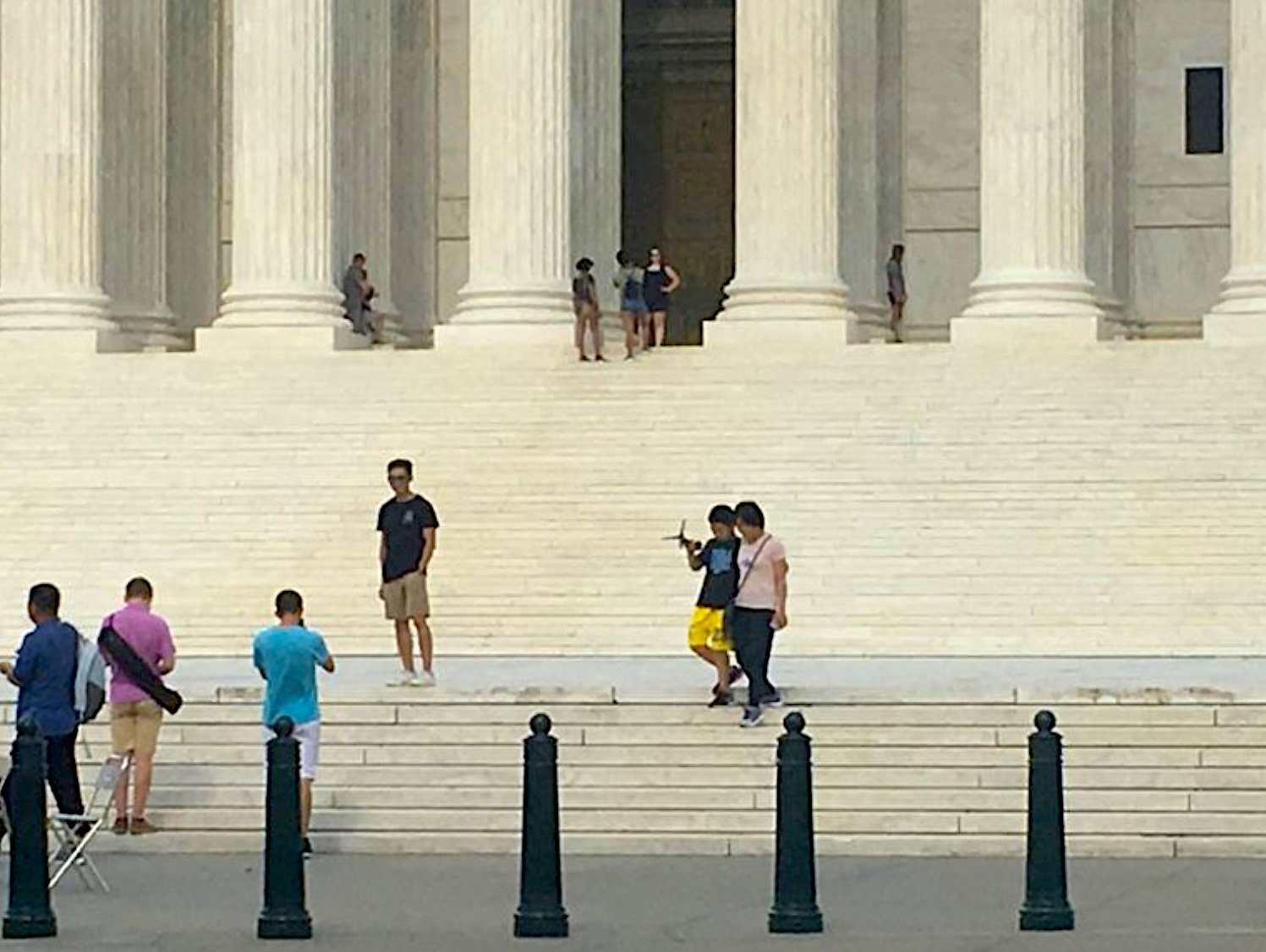
The U.S. Supreme Court building. (Joe Lauria)
Proscribing and banning groups would violate the constitutional protection of freedom of assembly and association.
The U.S. Constitution also prohibits what it calls ex-post facto, or retroactive laws. The Australian hate crimes law passed this week is littered with language like this about acts that were “engaged in before a provision referred to … commenced and would have constituted an offence against the provision had the provision been in force at the time the conduct was engaged in. ”
This means a 20 year old tweet that was not a crime when it was written becomes one under this bill. Article I, Section 9, Clause 3 of the U.S. Constitution explicitly states: “No Bill of Attainder or ex post facto Law shall be passed.”
Bill Rushed Through
The Labor government sent this complex bill to Parliament on Jan. 13 — one month after the Dec. 14 Bondi terrorist attack — and gave Parliament exactly one week to get it passed. It allowed only 48 hours for public submissions on the 144-page bill.
When the opposition Liberal-National Coalition objected to the bill’s clear restrictions on free speech the Labor government turned to the next largest party in Parliament — the Greens. The Greens were at first split on whether to reject the entire bill for the same free speech reasons or to demand amendments.
The party was able to get Labor Prime Minister Anthony Albanese to split off the hate crimes portion from the firearms provisions of the omnibus bill, something Albanese had previously refused to do. Albanese then turned to the opposition Liberal-National coalition to make a deal between them on Monday.
The rest of Parliament was given just 12 hours to study it on Tuesday and vote.
Joe Lauria is editor-in-chief of Consortium News and a former U.N. correspondent for The Wall Street Journal, Boston Globe, and other newspapers, including The Montreal Gazette, the London Daily Mail and The Star of Johannesburg. He was an investigative reporter for the Sunday Times of London, a financial reporter for Bloomberg News and began his professional work as a 19-year old stringer for The New York Times. He is the author of two books, A Political Odyssey, with Sen. Mike Gravel, foreword by Daniel Ellsberg; and How I Lost By Hillary Clinton, foreword by Julian Assange.

No comments:
Post a Comment