Showing posts with label Abqaiq. Show all posts

Thursday, October 03, 2019

Yemeni Defenders’ Shock and Awe Resistance

Hit on Saudi Aramco sends chills through global colonial hegemony

Brecht Jonkers
On September 14, the world experienced a shockwave. The mujahidin of Yemen struck the world’s largest oil refinery complex in a highly successful drone strike on Abqaiq and Khurais in Saudi Arabia.
It is not possible to overstate the importance of the strike on Saudi Aramco facilities in the grand scheme of things. Yemen has been a forgotten and underreported conflict ever since the Saudi-Emirati-US alliance invaded the impoverished country in March 2015. It is a war so vile, so destructive, and so bereft of any justification, that the imperialist mainstream media outlets have decided to not even try to justify it. Rather, they have opted for silence. Ignore it and people will not notice, is their policy.
For four and a half years, the aggressors have subjected impoverished Yemen’s civilians to constant bombings. Nearly half of the country’s landmass has been occupied. There is constant infighting and mass murders in the occupied east and south of Yemen. The Saudi-UAE invaders provide open support to terrorist organisations such as al-Qaeda and Da‘ish. Despite all this being known publicly, there is barely a peep in the major media outlets of the US, UK, or the rest of Europe.
But all that changed in one swift operation by the forces of the National Salvation Government of Yemen, often called “the Houthis” by the imperialist media. As many as 10 drones were reported to have struck the Abqaiq and Khurais petroleum refineries. The economic damage to the Kingdom is devastating. More than half of the petroleum production and export of the Wahhabi state was cut down in a single day, making Riyadh lose out on as much as 5.7 million barrels of crude oil exports daily.
According to specialist consultancy agency Energy Aspects, the Saudi kingdom also suffered a setback of 18% in natural gas production and as much as 50% in ethane and liquified gas output. The massive decrease in available crude oil, combined with damage to the refinery, have had the additional effect of causing a shortage of refined petroleum products. These are needed to repair and run the refinery’s machinery.
In stark irony, Energy Aspects reported that it is highly likely that Saudi Arabia, the kingdom founded because of oil and entirely dependent on it, will be forced to import gasoline, diesel and fuel oil just to keep its own oil-based economy afloat.
While the royals and their ministers in Riyadh guaranteed that the Abqaiq and Khurais facilities were up and running again by September 16, experts estimate that full recovery will take at least two weeks. That is, if no further retaliatory strikes are carried out from the land of Sheba. That does not take into account the hydrogen sulphur that has been released by the fires when the strike occurred. This is likely to directly reduce the efficiency of pumping installations.
The results of the Yemeni retaliation against their invader’s bread and butter were felt around the world. Oil prices jumped by no less than 20% on the global markets, forcing the US to announce a release of its own strategic petroleum reserves in order to avoid a major economic disaster.
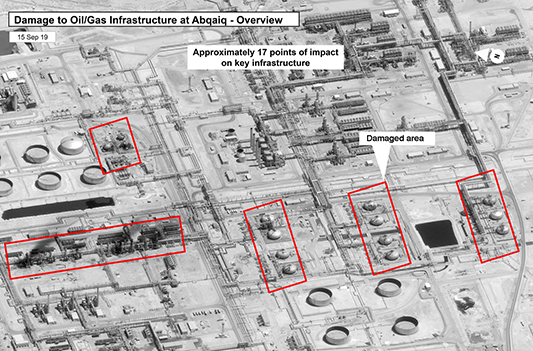
Aerial image of the points of impact of Yemeni retaliatory drone/ cruise missile attack on Saudi oil production infrastructure at Aramco facilities in Abqaiq, 9-14-2019. Reports now coming in from investigators indicate this was a sophisticated attack, perhaps taking months to plan, and waiting on the ideal conditions to execute: lead drones first took out the US Patriot radar installations and then follow on cruise missiles hit the intended targets. The accuracy of the drone/ missile strikes suggests that oil workers sympathetic to Ansarullah, or Yemeni agents posing as workers placed cell phones in appropriate places to act as homing beacons. Regardless, the fact that the US, with its billion dollar surveillance equipment and satellite technology, still has not determined where the drones/missiles came from over ten days after the attack took place, and could not protect the economic lifeline of the entire developed world indicates that US power is no longer invincible and Muslim military parity is fast becoming a reality.
Naturally, accusations from Riyadh and Washington went straight to the Islamic Republic of Iran, claiming Tehran was behind the strikes. And reflecting raw racism, they claimed the proud people of Yemen are “too backward” to pull off an attack of this magnitude. However, unbiased analysis of the facts show that Yemen most definitely could, and would, retaliate against their aggressors in such a spectacular manner. The accusation against Iran was also meant to divert attention from Saudi incompetence and the failure of US-supplied billion-dollar-a-piece Patriot missile batteries to intercept incoming drones.
It must be borne in mind, this is not the first airstrike, be it by missiles or by unmanned aircraft, that the Republic of Yemen has carried out against the Najdi invaders. While counterattacks deep inside Saudi territory have been taking place ever since the start of the war, the year 2019 has seen a surge in successful high-profile retaliations.
On May 14, the Saudi regime was forced to stop pumping crude oil in its main pipelines across the country, following Yemeni drone strikes against two Aramco facilities west of Riyadh. On June 12, a missile strike launched from inside Yemen hit Abha International Airport, which was in use by the Saudi military at the time, exploding right in the arrivals hall and causing major damage. It is noteworthy that Abha is over 100 km from the Yemeni border. The airport was hit again just five days later and yet again on July 2, destroying a hangar for military planes. Together with the Saudi military airbase of Khamis Mushayt in ‘Asir province, the airport of Abha has been struck multiple times in the past few months. This reflects the total incompetence of Saudi air defence systems.
The month of August 2019 started with a double missile and drone attack against two very different Saudi targets. First, a joint missile and UAV strike at a camp of Saudi-backed mercenaries in the southern port city of Aden killed dozens of collaborators. And then the Yemeni mujahidin hit a Saudi military base in Dammam city, in the Eastern province of Saudi Arabia that is hundreds of kilometres away from the Yemeni border.
On August 17, an attack took place that can be seen as a general rehearsal of sorts for the Abqaiq and Khurais strikes. Using a fleet of drones, Yemen’s revolutionaries attacked the Shaybah oil refinery. The massive refinery unit, located no less than 1,100 km from Yemen, was chosen specifically for its proximity to the United Arab Emirates (UAE). In one attack, the Yemeni revolutionaries not only proved their capacity to strike deep inside Saudi Arabia and hit its economic lifeline, but also sent shivers down the spine of the Emirate rulers.
“The UAE must quit the Saudi-led aggression if it wants to save its glass towers,” Yemeni military spokesman Yahya Sari‘ warned in crystal clear terms after the mid-September strikes.
The Yemeni struggle for independence and liberty has been a source of inspiration for years. Yet after September 14, the war against the US-Israeli-Saudi-UAE-led aggressors has entered a new phase. It may lead to the collapse of Bani Saud’s rule over the Kingdom. Should that happen, it would be widely celebrated by committed Muslims worldwide.
 

Brecht Jonkers


Tuesday, October 01, 2019

How Holes in the Burning Saudi Oil Fields Narrative Could Draw the US Into a War With Iran


It is inconceivable to the United States that a “rag-tag” force like Yemen’s Houthis might, with home-made weapons, outdo the hundred-billion-dollar might and sophistication of the state-of-the-art systems Washington has lavished upon the Saudis.


Tensions between Saudi Arabia and Iran are escalating to new heights, drawing the United States into a confrontation with the Islamic Republic after a sophisticated attack targeted Saudi Arabia’s Aramco oil facility — the largest oil processing facility in the world — knocking out half of the country’s oil capacity, or more than 5 million barrels a day, and leaving the oil fields in flames. 


The attack was nothing the Kingdom had seen before or expected: According to U.S. and Saudi intel, 18 drones and seven cruise missiles were launched and went undetected by both American and Saudi radar systems. The weaponry even went unnoticed by the U.S. military base nearby, the Prince Sultan Airbase, which is guarded by an American Patriot missile defense system and over 500 U.S. military personnel.
You better believe an attack at this level targeting a crossroad for global oil supplies did more than ruffle a few feathers. 
Panic not only struck the Kingdom and the international economy, where oil prices spiked 19 percent — the highest ever recorded one-day increase — but U.S. and Saudi politicians, as well as a chorus of mainstream pundits, began to beat the drums of war targeting an old foe: Iran. 
Saudi and U.S. military analysts have presented satellite images of where the missiles landed in the oil fields, purporting to show that the drones/missiles came from the direction of Iran. However, some experts are already countering these claims, pointing out that the images show impact points that are indeed west-northwest, which is the opposite direction of Iran. 
Despite providing no substantial evidence and citing so-called anonymous intelligence — you know, the same intelligence that, to justify war with Iraq, claimed Iraq had weapons of mass destruction and that Saddam was working with al-Qaeda — the corporate media has amplified and endorsed the Saudi and Trump administration’s claims to manufacture consent for an all-out war with Iran. 
NBC and CNN repeated the official line that Iran was likely behind the attack, and CNBC took Saudi officials’ words as gospel, without once questioning this government narrative that is setting us up on a warpath with the Islamic Republic. 
Saudi Arabia said it would “forcefully respond to these aggressions.” Meanwhile, President Trump announced that the U.S. was “locked and loaded” and ready to retaliate, then escalated tensions by announcing that he was introducing a “substantial” new round of sanctions, thereby further revving up the economic war against Iran.
And Iran is not taking these threats of war very lightly.
Indeed, while the media is choking up the airwaves with pro-war and anti-Iranian propaganda, what’s been lost or perhaps purposely left out from this coverage is who actually took responsibility for this attack and why. 
Yemen’s Ansarullah Houthi movement immediately claimed responsibility. Houthi military spokesman Brigadier Yahya Saree announced, “We assure the Saudi regime that our long hand can reach any place we want at any time we choose.” 
This wouldn’t be the first time Yemen’s resistance movement launched an attack on Saudi soil. 
Just last year, Saudi officials said they intercepted more than 100 missiles fired from Yemen. 
The Houthis, quite obviously, have no interest in conquering Saudi Arabia or even damaging their warring neighbor apart from what is needed to counter and deter ever-increasing Saudi attacks and defend what is left of Yemen.
Ansarullah has spent the last five years resisting the U.S./Saudi-backed bombardment of Yemen, which has created the worst humanitarian crisis in the world — leaving over 100,000 dead, over 23 million people starving, a cholera health crisis, and a human trafficking epidemic. 
The humanitarian crisis kills a Yemeni child every 10 minutes from preventable diseases, starvation and malnutrition.
Saudi Arabia enforced an illegal blockade, preventing food and medical supplies from entering the war-torn nation and effectively weaponizing humanitarian aid after taking a key seat on a UN human rights panel. 
Perhaps if the media did their job in reporting these facts, it would be an embarrassment for the U.S. military machine. It would expose the utter failure of billions of dollars worth of Saudi and American military defense systems against a grassroots resistance movement taking on the Goliath of the U.S.-Saudi backed Coalition’s genocidal war against the Middle East’s now poorest country. 
But this conflict goes further back than 2015. The U.S. has occupied Yemen in its pursuit of expanding its military empire under the guise of the war on terror. Since 2002, the U.S. has been drone bombing Yemen, setting up military outposts and torture facilities while exploiting the nation’s rich mineral resources. 
Yemen was once called a living museum, a cradle to many civilizations and home to some of the world’s oldest human carved landscapes and architectural structures that date back to the time of Christ. Yemen is considered the richest country in the region in terms of minerals, culture and history. 
But today UNICEF described its economy and society as on the verge of collapse. 
The military occupation of Yemen has given the people there a death sentence so the U.S. can rattle its saber at Iran to justify the expansion of its military empire that feeds the maw of the military industrial complex. 
Blaming Iran for an attack on the world’s largest oil processing site suits the interests of American allies in the region, including Saudi Arabia and Israel, which have directed Trump’s foreign policy in the Middle East that has included isolating Iran. 
The story presented to Western audiences by the mainstream corporate media is rationalized by a carefully crafted and false narrative that the U.S.-backed, Saudi-led war against Yemen, which has dropped over 50,000 bombs on that country — bombs made and supplied by the USA– is to prevent an expanding Iran that is arming the Ansarullah Houthi movement. 
But leaked internal documents show that many of these connections made by military intelligence were deliberately fabricated, and Yemenis are actually capable of manufacturing their own modern weapons. This shows how the Houthis in Yemen are apparently more capable than the Saudis have been in manufacturing the weapons they have used to pulverize Yemen, which are being sold to the kingdom by the US at a rate of $8 billion. 
Just as the U.S. claimed that all their interventions during the Cold War were to defend against Soviet aggression, now any region in the Middle East the Empire wants to expand, exploit and occupy is conveniently labeled an Iranian outpost, justifying more wars.
Beyond this, it is of course “inconceivable” to the United States that a “rag-tag” force like Yemen’s Ansarullah Houthis might with home-made weapons outdo the hundred-billion-dollar might and sophistication of the state-of-the-art systems Washington has lavished upon the Saudis. Almost as embarrassing as losing to the North Vietnamese — so that couldn’t be what happened.
For decades, manufacturing consent for war by using false pretexts has been seized by both parties, whether Democratic or Republican. Both have spread disinformation to demonize an entire nation in order to drum up support for war. 
Now, with the Saudi oil fields burning, the disinformation campaign moves into high gear — ignoring or selectively reporting not just key physical evidence but also the whole context of the humanitarian crisis in Yemen that has given rise to the desperate measures to which the Houthis have been forced to turn to — a right to self defense under the Geneva conventions. 
If the media cared to report on this context it would expose the U.S. coalition as a paper tiger, which would mean that all of the blood & billions spent by Washington in the Middle East was essentially for nothing. It would also show the world that a united front organizing against war does work. 
After landing in Saudi Arabia last week, Mike Pompeo scolded the media for asking about the Houthis claiming responsibility for the attack. His response was that they are liars and when referring to them you should call them the lying Houthis — this coming from the man who on video admitted to lying and deception while heading the CIA.
And just as before, it is not the politicians like Pompeo that pay for their lies, but the ordinary people, who pay with their lives. 
Feature photo | Smoke rises from an Aramco crude oil processing facility in Abqaiq, Saudi Arabia, Sept. 14, 2019. Photo | Planet Labs
Mnar Muhawesh is founder, CEO and editor in chief of MintPress News, and is also a regular speaker on responsible journalism, sexism, neoconservativism within the media and journalism start-ups.

Monday, September 23, 2019

Zarif: Whoever starts war will not be the one who finishes it

U.S. 'posturing' by sending troops to Saudi Arabia, Iranian FM says 

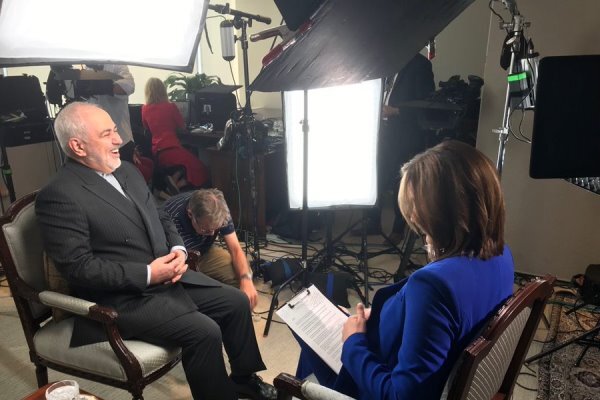
TEHRAN - Iranian Foreign Minister Mohammad Javad Zarif has said any country that starts a war against Iran  “will not be the one who finishes it”  as he said  the U.S. is "posturing" by sending troops and defense equipment to Saudi Arabia following the September 14 attacks on a major Saudi Arabia oil facility.
"I think it's posturing. I think it's all going the wrong direction in addressing this issue," Zarif said in response to a question on how Iran sees the development in an interview that was set to air Sunday on CBS' "Face the Nation."
The Trump administration has blamed Iran for the attack by the Yemenis on Saudi Arabia’s Abqaiq plant and its Khurais oil field that adversely affected up to half of the supplies from the world’s biggest oil exporter.
President Donald Trump on Friday approved the deployment of U.S. troops and missile defense equipment to Saudi Arabia and the United Arab Emirates.
Secretary of State Mike Pompeo on Thursday said the attacks were an "act of war" while Trump announced he would "substantially increase" sanctions on Iran.
Zarif denied that Iran had anything to do with the attacks and said if the United Nations launches an impartial investigation into the attack “the outcome will be that it was not launched from Iran"
“We are confident that if the United Nations carries out an impartial investigation the outcome will be that it was not launched from Iran," Zarif remarked.
The chief diplomat has already said linking Iran to the attack on the Saudi oil facilities is a “maximum deceit” in line with Washington’s “maximum pressure” on Tehran. On Friday, Zarif also said “even the Saudis themselves don't believe the fiction of Iranian involvement” in the attacks on the Aramco oil facilities, citing Saudi Arabia’s retaliation attack on Hodaideh in Yemen as a reason.
Asked by CBS if he was confident Iran could avoid a war, Zarif said, "I'm confident that we will not start one but I'm confident that whoever starts one will not be the one who finishes it."
"That means that there won't be a limited war," Zarif said, echoing his previous comments that a military strike on Iran by the United States or Saudi Arabia would result in an “all-out war."
Major General Hossein Salami, the chief of the Islamic Revolution Guards Corps (IRGC), also threatened on Saturday that any country that attacks Iran will see its territory become the “main battlefield”. He added, “Whoever wants their land to become the main battlefield, go ahead.” The general also said Iran will claim responsibility for anything it does.
Zarif says U.S. made it clear he was not welcome at UN
Zarif also said that the U.S. made it clear he was not welcome at the United Nations General Assembly in New York City next week that he planned to attend, despite being approved for a visa waiver.
"Well not necessarily, because the United States is under obligation, being the host of the UN headquarters to issue visas to member states. So they made it very clear in a letter that they attached to my visa that I'm not eligible to get a visa, but they're doing it on a waiver basis. So they want me to know that I'm not supposed to be here," Zarif stated.
The United States under President Trump has put an extreme pressure on Iran. He abandoned the 2015 nuclear deal, officially called the Joint Comprehensive Plan of Action (JCPOA), in May 2018 that was struck under his predecessor Barack Obama.
He has introduced a total ban on Iran’s oil export, Iran’s main source of income. Since abandoning the JCPOA, the Trump administration has been trying to strangulate the Iranian economy. Iran has called the U.S. sanctions pressure “economic terrorism”.
Trump on Friday said he has ordered sanctions on Iran’s central bank at “the highest level.”
Trump, who had initially imposed the sanctions applied to Iran’s “national bank,” said the new penalties on Iran mark the “highest sanctions ever imposed on a country.”
The president’s remarks at the White House came two days after he announced via Twitter that he had instructed Treasury Secretary Steven Mnuchin “to substantially increase Sanctions on the country of Iran!”
Zarif says Iran is “confident that if the United Nations carries out an impartial investigation into” the attack on the Saudi oil facilities, “the outcome will be that” the drones were “not launched from Iran." 
Many analysts believe that the regime of Benjamin Netanyahu is behind Trump’s illegal approach toward Iran. Netanyahu was one of the chief opponents of the nuclear deal and has been repeatedly claiming that Iran is bent on building nuclear weapons. 
Zarif has referred to recent remarks by former U.S. Secretary of State Rex Tillerson about how Israelis have played Trump, saying Tillerson’s remarks confirms that the B-Team took Trump for an “easy mark”.
“Even President Trump’s former Secretary of State now confirms what we have long pointed out: #B_Team took @realDonaldTrump for an easy mark who could be lied to and pushed to war—and the US military as their personal mercenary,” Zarif said in a tweet on Saturday.
“Some still do, despite his firing of one member,” he added.
Tillerson said on Wednesday that Israeli officials “played” Trump in their conversations with him, warning that a “healthy amount of skepticism” is needed in dealings with Netanyahu.
The comments came during a panel discussion at Harvard University in which Tillerson, who was fired by Trump last year, touched on a variety of themes from his tenure, including Iran, his hiring freeze at the State Department and the unpredictable nature of Israel’s longest-serving prime minister, Netanyahu. 
“They did that with the president on a couple of occasions, to persuade him that ‘We’re the good guys, they’re the bad guys,’” Tillerson said, according to the Harvard Gazette. “We later exposed it to the president so he understood, ‘You’ve been played.’”
The “B-team” is a term thrown into popular usage by Zarif. It refers to a group of politicians who share an inclination toward potential war against Iran, and the letter “b” in their names. They include Benjamin Netanyahu, Saudi Crown Prince Mohammed bin Salman, Abu Dhabi Crown Prince Mohammed bin Zayed Al Nahyan, and, former U.S. national security advisor John Bolton. 
Bolton was fired on September 10.