Motivation coupled with innovative engagement tactics
Ayman Ahmed
The Ansarullah Islamic movement in Yemen has astonished most observers as it has withstood the five-year onslaught waged by a coalition of heavily armed states. A grassroots movement established in the 1990s as an Islamic youth group named Muntada al-Sha‘b al-Mu’min, it used to organize summer camps and offer social programs. Now it is a regional player with global influence. How did the movement grow and then manage to withstand daily attacks by armies of several countries equipped with the most sophisticated weapons?
The Ansarullah was forced to fight six wars against the Western-backed autocratic regime of ‘Ali ‘Abdullah Salih between 2004 and 2010. The Salih regime saw their social and political work as a long-term threat and resorted to crushing the emerging movement by using military force. This policy was shortsighted and backfired in the long run. True, initially the Salih regime gained the upper hand militarily, but the regime’s resorting to military force against the Ansarullah compelled them to build a military organization. Also, armed conflicts with the Salih regime gave the movement much-needed combat experience.
Uprising Today, an independent online news website, which focuses on Yemen from the perspective of the resistance, regularly posts combat footage of Ansarullah forces. The footage reveals that the Yemeni resistance has turned its disadvantages into battlefield advantages.
By analyzing reports from open sources it is clear that the terrain is the most effectively utilized tool of Ansarullah and the biggest disadvantage of its adversaries. It is rare to see Ansarullah fighters driving vehicles or even walking on roads during combat operations. The Yemeni forces generally move on foot through terrain inaccessible to vehicles. This makes it difficult for the overweight Saudi soldiers to counterattack Yemeni soldiers in a swift operation and use their numerical superiority to overwhelm them. Hostile terrain severely limits the logistic ability of the invading forces to move large numbers of troops toward the combat zone.
The Yemeni forces operate as small mobile groups to carry out attacks. This mode of operations allows them to appear and disappear quickly. It has the additional advantage that this eliminates the bureaucratic chain of command system used by conventional armies. Group leaders can make necessary decisions on the spot without losing time to consult the high command. This also does not allow the Saudis and their allies to utilize their electronic superiority to intercept communications between field commanders and the higher chain of command, thus creating an intelligence-gathering gap in tactical intelligence.
Motivation is an important factor that enables armies to achieve victory. Ab-sence of motivation among the Saudis and their local mercenaries is evident from viewing video footage of attacks on Saudi outposts within the dark Kingdom and their established outposts inside Yemen. In many instances it can be seen clearly how Saudi soldiers simply abandon their posts when they come under heavy fire even though they possess far heavier weapons. They can hold on to their positions until air support arrives. All they need to do is establish a defense perimeter and keep firing until the US-supplied jets arrive to bail them out. Instead, the Saudis simply run away. The Yemeni forces’ high motivation is demonstrated by the fact that they frequently engage the Saudi military in close combat rendering their long-range weapons useless and denying them the use of heavy artillery.
The Ansarullah fighters are also rarely seen utilizing tanks and other heavy combat vehicles, knowing full well that it exposes them to Saudi air attacks. Additionally, in open desert terrain, tanks are easy targets for armies that possess long-range artillery, something the Saudis have in abundance, thanks to supplies by their NATO masters.
A map of the imposed war on Yemen and the alignment of forces fighting to gain control of a historically independent territory that has been laid waste because of its geostrategic value to the dominant power culture and its proxies in the area. Through Ansarullah’s mounting victories and unbending resilience to the scorched earth tactics of the enemy, the aggressors are finally willing to talk peace.
The Yemenis have managed to modify conventional military tactics in very unconventional ways. Their use of drones in almost guerrilla-style operations highlights how the Yemenis managed to jam billion-dollar Saudi air defenses and utilize drones as long-range weaponry mainly geared toward scoring political points.
The military ingenuity of the Yemenis is demonstrated by the fact that the Saudi regime has not been able to score any major military victory despite possessing large stockpiles of weapons supplied by the world’s leading arms merchants. The Ansarullah’s political astuteness is another factor in reinforcing their military performance.
With backing of the Yemeni masses, once they took over the capital Sana‘a, the Ansarullah managed to create an inclusive Islamic system. They have not imposed their vision on the people. It is important to remember that Zaydi Muslims do not constitute a majority in Yemen yet the fact that a minority Islamic school of thought is able to govern Yemen reflects the movement’s broad support across all segments of society. In contrast, the Saudi-UAE mercenaries are constantly fighting one another over petty issues.
As reported by Rune Agerhus, Chairman of International Solidarity Committee with Yemen (ISCY) and editor-in-chief of Uprising Today Media, “in late March of 2019, the “Supreme Political Council” of the “National Salvation Government” (established by Ansarullah-led authorities in Yemen’s capital city to fill the political vacuum) released a comprehensive reform plan titled the “National Vision to Build the Modern Yemeni State.” In 82 pages, it outlines the movement’s goals and vision for improving the conditions in Yemen, dubbed “the world’s most fragile state” by the Fund for Peace’s Fragile States Index.
The document begins with a summary of its purpose, goals, vision, and mission, “A modern, representative, stable and unified Yemen which rests on having strong institutions, the realization of justice, the pursuit of development and a dignified life and standard of living for Yemeni citizens, the protection of the independence of the nation and seeking world peace and appropriate equal cooperation with the other countries of the world.”
Ansarullah’s experience in combining military and political struggle to wrestle state control from the clutches of an autocratic system is an unparalleled event among Islamic movements over the past 20 years. This rare phenomenon will surely motivate other Islamic movements to learn from the successful experience of Ansarullah.
As the global world order undergoes rebalancing and becomes multipolar, three powerful Muslim countries with elected leaders — Turkey, Iran, and Pakistan — could potentially engineer a groundbreaking development by returning Makkah and Madinah (collectively known as the Haramayn) to the Muslim Ummah. This article will examine the potential variables of this grand hypothetical move.
The Saudi regime has never been as vulnerable in its history as it is today. It is experiencing internal strife, external military humiliation and its relationship with its chief patron and protector, the US, is rocky. None of this would matter much to the Muslim world if the Saudi regime did not occupy Makkah and Madinah.
The Najdi Bedouins’ importance to the US is primarily due to their control of Makkah and Madinah. It gives Washington the ability to project “Islamic” soft power through Saudi machinations.
Today the corrupt and despotic essence of the Saudi regime is no longer disputed by Muslims anywhere. Muslims worldwide view the Bani Saud regime as one of the primary obstacles to progress in the Muslim world. The arch-enemies of Islamic revival and Muslim liberation, like the Zionist regime of Israel and the despot of Egypt, ‘Abd al-Fattah al-Sisi, are best friends of Bani Saud.
Muslims see the antics of the Najdi Bedouins as an embarrassment and a blemish on the name of Islam. They want them banished to the backwaters of Najd. They can resume herding their camels and live in tents as they did before they erupted from Dar‘iyah in 1744. Few informed Muslim and non-Muslim analysts would question this.
In 2015, Crescent International wrote about the necessary preemptive steps to protect Makkah and Madinah from takfiri terrorists. One of our proposals was to “internationalize” Makkah and Madinah, “as these places belong to all the Muslims equally and cannot be treated as family or state property. Muslim states could come up with a mechanism that would allocate two or three states managerial responsibility for managing Hajj and ‘Umrah for a period of four years. These states would provide the management and security personnel for Hajj and ‘Umrah along with 50% of the budget. The remaining 50% of the costs would be provided by all other Muslim states. Once the states complete their four-year term, they could propose their candidacy for managing Hajj and ‘Umrah only after eight years. This mechanism of course would require basic common sense and flexibility by Muslim statesmen.”
The proposal to reclaim the Haramayn from the clutches of Bani Saud cannot occur without other states’ military intervention. Such a scenario, however, is unlikely to take place at present but in the near future it cannot be ruled out completely as the collapse of the Saudi regime will be messy. In such a scenario, Muslim states will have to pay attention to Hajj being accessible for all Muslims.
Once the Saudi regime begins to experience internal destabilization, the primary internal battle will be between two ideological twins, the Bani Saud regime and its non-loyal takfiri/salafi branch. Should this happen, the three Muslim countries with leadership that has popular legitimacy could reconfigure the geopolitical landscape of the Muslim world.
Assuming that Pakistan, Turkey and Iran decide to secure Makkah and Madinah from their illegitimate annexation by the Saudi regime, there are four key questions that need to be considered:
How would the Muslim world react?
What would the US reaction be?
Is there a legal basis for it? and,
Will it be feasible?
The first question is simple. The Muslim world would be euphoric to see joint Muslim action in eliminating the rule of one of the most corrupt regimes over Islam’s most sacred sites. Most Muslims agree that the Saudi regime is antethical to Islam and the fact that this horde of criminals is in control of Islam’s two most important sites is seen as an embarrassment to all Muslims.
Muslims would also view a joint albeit hypothetical action by Turkey, Iran, and Pakistan as a positive political development. It would be viewed as a first proper cooperative action by states representing Muslim interests. While the Muslim Ummah longs for unity, foreign installed rulers in Muslim countries are assigned by their masters to create disunity. Thus, any action manifesting active unity would be a very welcome policy in the Muslim world.
Any action against the Saudi regime must take into account US reaction. Bani Saud are in power primarily because of Washington’s military, political, and diplomatic support. The US would not allow the Saudi regime to collapse without trying to save it. The only instance that would prevent the US from intervening on behalf of Bani Saud is if Muslims declare that the action only concerns Makkah and Madinah. The Americans would simply not be able to intervene. Action against the Saudi regime that is limited to liberating Makkah and Madinah only would be strictly an intra-Muslim issue. No US politician would be able to sell the policy of US soldiers dying for Makkah and Madinah. This would be seen as heresy by secular and Christian segments of the American society. A coalition of Muslim states taking bold action to restore the sacred status of Makkah and Madinah would be a bulletproof political case. Even the Wahhabi palace scholars would not be able to call on the US to intervene. What would their “fatwas” declare? We want the US army to institute tawhid in Makkah and Madinah?
The legality angle of a potential action by Pakistan, Turkey, and Iran revolves primarily around politics and public relations. The so-called international law can be interpreted in many different ways. Powerful states determined to act can interpret international law in a way that suits their interests. NATO member states do this regularly. How can the US interpret its illegal actions in Iraq as legal but Muslim states cannot legalize their actions against one of the most despotic regimes in the world that has illegally usurped Islam’s most sacred sites? A small financial chip-in by Pakistan, Turkey, and Iran can flood the airwaves of international media with legal experts who can explain the necessity of the action within the required legal parameters.
The aspect of feasibility of removing Bani Saud from Makkah and Madinah is straightforward. From a military perspective, the combined forces of Pakistan, Iran, and Turkey will simply walk over the pathetic cabal of armed thugs known as the Saudi army. Their military humiliation in Yemen is clear proof that the Saudi military has no backbone.
The above factors indicate that there is fertile political and social ground to liberate Makkah and Madinah. The only obstacle to joint action is mustering the political will to make the much-needed decision. Reliance on Allah (swt) by the leadership of these Muslim countries and their sincere concern for Muslim interests can usher an unprecedented change in the Muslim world if Makah and Madinah were to return to all Muslims.
Impetuousness and dual-loyalty: the stuff has-beens are made of
Yusuf Dhia-Allah
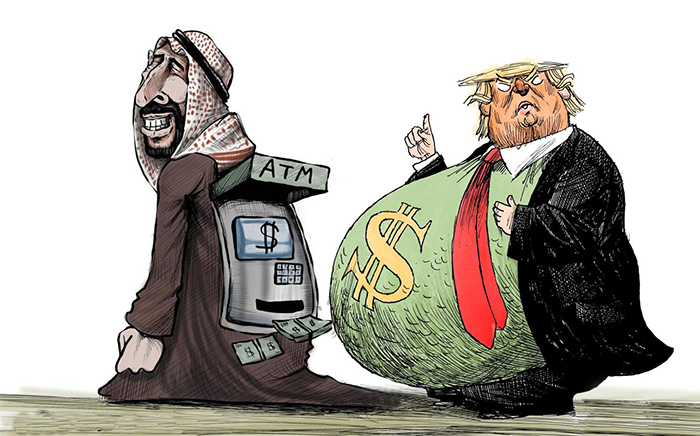
When Saudi Crown Prince Muhammad bin Salman (MbS) is nervous, his thick lower lip begins to quiver uncontrollably. People’s nervousness shows in different ways. His American master Donald Trump narrows his eyes and twitches them when nervous while Narendra Modi constantly licks his lips with his snake-like tongue.
Whatever the particular form of nervousness of an individual, there are plenty of reasons why MbS feels nervous these days. Those around him say that MbS’ quivering lower lip makes him resemble a camel. The beast of the desert has reason for its lips to quiver — it wants to grab food and is part of its physiological makeup — but what about MbS, the beast of the palace?
His list of troubles is long and he has only himself to blame. At home he has disrupted all the old equations that had served Bani Saud well for more than eight decades even if it was detrimental to the people of the Arabian Peninsula. Abroad, he has made too many enemies from Islamic Iran, Yemen, Syria, and Turkey to Qatar. Perhaps, the United Arab Emirates (UAE) may also be added to this list now.
Bin Salman simply does not have the mental capacity to deal with all these challenges at once. He is not even able to manage one of these on his own. After bombing dirt-poor Yemen for more than four years, killing nearly 100,000 people and destroying much of the country’s infrastructure, the Yemenis have struck back with a vengeance.
The September 14 Yemeni drone strikes on the Kingdom’s oil facilities in Abqaiq and Khurais have knocked the bottom out of Saudi Arabia’s oil-based economy. And the US-supplied missile defence shield at the cost of billions of dollars was exposed as useless against $15,000 drones.
The entire Saudi establishment that essentially revolves around one man — MbS — is in turmoil. They have scurried to the Americans for help. The hundreds of billions of dollars worth of weapons the Saudis have purchased, mostly from the US, simply cannot protect them from inexpensive drones.
The Americans have offered the same old solutions that have already failed: more weapons worth billions of dollars and a few hundred soldiers. The US-built billion-dollar-a-piece Patriot anti-missile batteries have not proved too patriotic. If they cannot intercept $15,000 drones, what use are these fancy missiles? But MbS is now totally under the thumb of the Americans and the Zionists. Unless he keeps forking out more billions, the Americans will abandon him and he will be toast. His shelf life is in any case, close to expiring.
At home he is in a race against time aware that his father, King Salman is in poor health and could drop dead any day. MbS wants to consolidate his position by eliminating all rivals, real or imagined, as long as his father is alive, even if in a severe state of dementia. With the king around, other members of the family who are much senior to MbS will not raise objections. All decisions, while taken by MbS, are presented in the name of the king. Based on the long established tradition, other members of the family defer to seniority. So the king’s mere presence, even in a state of dementia, prevents other members of the family from challenging MbS.
Once the king is dead — how long can he last — all bets are off. There is bound to be opposition to MbS from different quarters. The upstart crown prince has rubbed far too many princes and others the wrong way. He is also placing loyalists in sensitive positions in hopes they will serve and protect him. This may be misplaced optimism.
It is, however, his troubles abroad that are beginning to have serious repercussions for developments at home. The daring drone strikes launched by Yemen’s Ansarullah revolutionaries at the financial nerve centre of Saudi Arabia — Aramco — has shaken MbS to his slippers. Aramco was about to be offered for International Public Offerings (IPO) and MbS had hoped to garner $1.5 to $2 trillion. With its refineries reduced to smoldering wreckage and its oil exports slashed by 50%, Saudi Arabia is heading for trouble despite optimistic statements made on its behalf by American officials and media.
The war on Syria, in which Saudi-backed mercenaries played a leading role, is on the verge of ending. The US-Zionist-Saudi-Turkish instigated regime change conspiracy in Syria has been defeated. While others may be able to withstand the consequences of this defeat, for the Saudis, the blowback will be severe. Coupled with their defeat in Yemen, it is not difficult to envision the looming crisis. Even their Emirati cousins have abandoned them in Yemen. MbS must be spending sleepless nights these days.
What Saudi Arabia means to the United States; the latter has no permanent friends, no enduring loyalties. So long as you can service its greed and insatiable appetite for power and privilege, you are useful, but if you become too feeble or unreliable to do that, then you are expendable. It will look for others but the days of easily finding sellouts are becoming fewer and far between. The blindest of all are the ones who, despite all possible historical evidence to the contrary and countless warnings from the All-Seeing and All-Hearing, can’t see the obvious. They bought the American Iraq war delusion that overwhelming air power, state of the art signal intelligence, shock and awe, scorched earth, and a civilian horror show would make quick work out of those “back in the Stone Age” Yemenis. But now, they are seeing the end of their own delusion.
And then there is the artificially-created crisis with Qatar. Again, MbS was the architect of this foolish policy aimed at bringing tiny Qatar to its knees. Instead, Qatar has not only stood its ground, thanks to timely help from Iran and Turkey, MbS has got egg all over his face. Foolishness, however, has no limits especially when underpinned by unbridled power.
It is, however, the Ansarullah drone strikes on Aramco facilities that have caused great panic in Saudi ruling circles. They thought they were invincible against lowly Yemen. The strikes have exposed Saudi vulnerability. By their own public statements, they have been shown to be American puppets. Here is a September 18 tweet from Khalid bin Salman, younger brother of MbS and also deputy defence minister of the Kingdom (MbS being defence minister),
We appreciate the United States’ longstanding position on defending its allies and core interests in the region against unprovoked acts of aggression as affirmed today by the President and Vice President as well as former Presidents including Obama.
The Saudi deputy “defence” minister admits the Kingdom cannot defend itself. It is totally dependent on the US for protection, hence his profuse appreciation of “the United States’ longstanding position on defending its allies and core interests in the region against unprovoked acts of aggression…” The young and equally inexperienced deputy defence minister even resorted to outright lies by claiming the region is subjected to “unprovoked acts of aggression.”
What have Bani Saud been doing in Yemen since March 2015, a war launched by Khalid’s older brother MbS? They have murdered nearly 100,000 Yemenis, most of them civilians, and have caused a cholera epidemic that has afflicted at least one million children — the worst cholera epidemic in history, according to the UN. Almost the entire Yemeni population of 24 million is on the verge of starvation.
Bani Saud, and especially the Bin Salmans expect the Yemenis to surrender to their genocidal policies. The Yemenis refuse to do so and have shown that they are prepared to hit back their tormentors hard. No amount of Saudi propaganda, even if amplified by their paid agents in the US, can obfuscate the fact that MbS and his cohorts are guilty of war crimes.
The rest of the world may overlook these war crimes for material interests but the Yemeni victims are not prepared to suffer in silence. It is payback time and the Saudis are going to pay big time. We may be witnessing the twilight zone of Bani Saud rule.
Grisly murder reveals Western double standard — again
Tahir Mustafa
Last year’s brutal murder of the Saudi insider Jamal Khashoggi had a mixed impact on the Bedouin kingdom. His crime was that he had turned on his masters in Riyadh who feared he might spill more beans about their misdemeanors than the tidbits he had revealed in his media columns.
From the regime’s perspective, the cost of Khashoggi’s brazenly barbaric murder was worth it. This is not because the journalist was a champion of free speech until his fallout with the regime. Khashoggi was one of the principal apologists and justifiers of the Saudi regime’s crimes on the international scene.
Provided a platform by the Washington Post for which he wrote a weekly column, Khashoggi did not pose any serious threat to the regime. Instead, he was seen as a threat because his example could motivate other insiders to turn against the brutal and corrupt royal family.
Many people have wondered why the Saudi regime killed Khashoggi in such a brazen manner by chopping him to pieces after luring him to the Saudi Consulate in Istanbul on October 2, 2018. He could easily have been killed in a staged hit-and-run operation with plausible deniability. Or, the Saudis could have secured the help of their bosom-pals, the Zionists, who are masters at carrying out such operations. But they chose to carry out this dastardly crime on their own.
Many analysts explain Khashoggi’s murder by attributing it to Saudi stupidity and arrogance. While there is some truth to this, it does not accurately reflect the whole picture. Based on Crescent International’s decades of experience in reporting the regime’s affairs and talking to people both distant and close to the regime’s circles, our assessment is that the Saudis deliberately murdered Khashoggi in the manner they did. It was meant to send a message to potential defectors and the Saudi society at large.
Some people argue that the murder greatly damaged the Saudi regime’s reputation in terms of global public opinion. This is true. The regime’s survival, however, is not dependent on global opinion. It is backed and sustained in power primarily through Western military and political support, along with instilling fear in its own population.
Bani Saud rightly surmised that Western regimes would not use the human rights card against them as was the case, for instance, against Mu’ammar al-Qadhdhafi of Libya. The Saudi assessment was that it did not really matter what the BBC or Amnesty International (AI) said about their human rights abuses. These would only matter if such reports were utilized by Western regimes to launch a military operation against Riyadh. That is highly unlikely. Therefore, murdering their ex-insider pays off. It acts to discourage opponents inside the country and will discourage other insiders from defecting, seeing Kha-shoggi’s horrible fate.
The above analysis about Saudi brutality can be traced to Muhammad bin Salman’s (MbS) assumption of power. The case of prominent Saudi scholar, Shaykh Salman al-‘Awdah offers a clear example. Once MbS decided to impose a siege on Qatar in 2017 in order to punish the tiny shaykhdom, he expected every public figure to back his ill-conceived policy. When Shaykh Salman al-‘Awdah wrote on Twitter that he prayed to Allah (swt) to reconcile the hearts of the Qataris and Saudis and reconcile their differences, he was immediately arrested. It is highly unlikely that MbS follows al-‘Awdah’s Twitter account. What is more likely is that the crown prince had issued instructions to the Kingdom’s security services to immediately arrest anyone who dares to deviate even slightly from his policies.
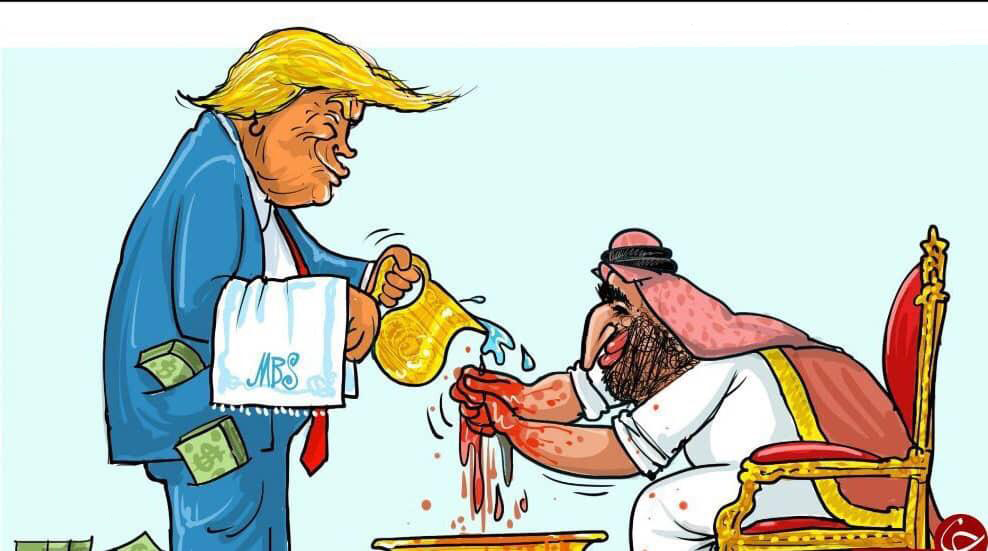
Trump: You understand that our media will have to condemn you in public, you know, for appearances sake… but we’re good. How much will you pay us to maintain this charade… you know it won’t be easy for us… we have a reputation to maintain, and our Israeli friends won’t be able to have all that free healthcare and free education without your generous support? MbS: We have more money than God. A little birdie: But what about the Palestinians, the Ummah… Trump, MbS: We know how to make people shut up, don’t you know?
Has this Saudi policy paid off? In the short term, the Western-backed Saudi kingdom’s brutal murder of Khashoggi has brought some benefit. There is no visible sign of any serious domestic dissent and dissidents abroad feel they are within the reach of Saudi security operatives and could be abducted. There have been several kidnapping cases of high profile dissident Saudi royals from Europe. They have simply disappeared.
In the long run, however, if the Kingdom faces internal instability, which is only a matter of time, the Khashoggi case will be used as leverage to ramp up the opponents’ media campaign against it. Once the Saudi kingdom begins to experience domestic disturbances, its brutal tactics will also limit the Western regimes’ from providing open support to a regime that chopped-up a journalist in its own diplomatic mission.
At the moment though, the backing of Western regimes to the Saudi brutes still brings in the much-needed cash to their semi-war economies. For example, last year at the peak of the Khashoggi case when it was still on everyone’s mind, the “Davos in the desert” economic event still went on, even if some Western executives stayed away. A year after the Khashoggi saga, Western countries and corporations are continuing to do business with the dark Kingdom. In May 2019, business insider reported that “global index giants FTSE Russell, S&P, Dow Jones Indices, and MSCI are folding Saudi Arabia’s stock market into accessible emerging-market indexes this year.” This and other economic indicators clearly show that the Khashoggi case did not have any significant negative economic impact on the Saudi regime. For Western regimes and their corporate affiliates, making money takes priority over all other considerations.
At present, it seems the primary challenge to the Saudi regime does not come from its domestic crimes, but from external misadventures. The Saudi humiliation in Yemen, its blunder with Qatar, and its poor relations with Turkey and Iran will sooner or later converge with the negative internal dynamics present in the Kingdom. Once external instability factors converge with internal ones, Riyadh will become a battle zone from which the royal family will not be able to escape unscathed.
MbS has created too many complex problems for the regime both internally and externally. Neither the US or Israel — patron saints of Bani Saud — can solve these easily. Thus, the Saudis are left virtually alone to clean the mess they have created. And they simply do not have the wherewithal to do so.
The hour of reckoning is fast approaching. After eight years of Zio-Euro-American proxy wars in virtually all the Arabian republics, the mass-media-produced civil wars are winding down. Notice that the Arabian kingdoms were spared such civil conflict. The takfiri project, founded on the Wahhabi creed that was considered their ace, is becoming a spent force. Saudi Arabia, the Zio-Euro-American front man, has been exposed like never before. Its diplomats have proven that they are the subordinates of their controllers — particularly their bosses in Washington and Tel Aviv. Saudi officials, if they could think straight, would realize that they have placed themselves internally in a pickle and externally in a tight spot.
The ruling nucleus family, descending from King Salman to his children, is tightening its grip on power: Muhammad bin Salman (MbS) is minister of defense; his younger brother Khalid (KbS) is deputy minister of defense. For the first time since 1960, another son of Salman — stepbrother of MbS — is running Aramco. Comfortable times have gone and Saudi decision makers are grabbing the major levers of power in the Kingdom because they sense that they are approaching turbulent times.
For the first time, Hamas has come out and stated that its representative in Saudi Arabia has been detained for over five months now. Saudi detention policies have also rounded up other Palestinians living in that worried Kingdom. September, two years ago, is when these family royals arrested scores of their most famed ‘ulama’. One year ago this October is when MbS’ gangs choked and chopped up the journalist Jamal Khashoggi — an ex-confidant of theirs.
The Saudi imposed war in Yemen has been dragging on now for over four-and-a-half years — sapping Saudi morale and draining its treasury. Now the US, after its failed Yemeni military intervention on behalf of the Saudis, is interfering diplomatically to extricate the Saudi fumbling family from its mini-Vietnam. American officials have contacted Ansarullah to find a way out for the slowly disintegrating Saudi kingdom. The ballistic missiles being launched from Yemen into the Kingdom of Saudi Arabia have inflicted immense below-the-radar damage on Saudi military bases and their civilian supportive infrastructure.
The Saudi playboy politicians are crying uncle in their private meetings and their classified diplomatic communiqués. MbS’ right-hand man, Sa‘d al-Qahtani who supervised the gory dismemberment of Jamal Khashoggi is said to have committed suicide. We don’t know if that is really the case; there is always the possibility that he is still alive and has been given a new identity and sent off to some distant place where he will “live happily ever after.” The trial of that squad of Saudi assassins who literally slaughtered Khashoggi is forgotten and they are nowhere to be seen or heard of. It’s only a matter of time before the proverbial executioner’s sword decapitates the criminals in high office belonging to the downcast Saudi criminal kingdom. The Saudi deep-state — if we can call it that — is run by the CIA and Mossad, relying on their boy Bandar bin Sultan, whose daughter has become the Saudi ambassador in Washington, DC.
Why is this happening to the wretched royals in Arabia? The short answer is that they were brainwashed by Israel-firsters to fear the Shi‘is and programmed to purchase and amass as much military hardware as possible, thereby hemorrhaging their economy and draining their potential. If the Saudi imbeciles were confident of their “Islamic superiority,” something they teach in their self-centered textbooks, they could have easily sat down with their Shi‘i neighbors and worked things out. But their Wahhabi-cum-Salafi dogma placed them in a hollow ivory tower that now has no escape route except for them to jump to their death.
In the meantime, and it is the best kept secret in town, the Saudis have reached the end of their line because of the incremental buildup over the years of the Islamic Resistance in Lebanon in particular and, generally speaking, in a geographical tract that extends from Kashmir to Palestine. Some of these battle-ready areas are soft while others are hardened due to the imposed wars upon them from — you guessed it — the Zio-Euro-American axis. The more this growing Islamic Resistance trains and arms, the more the weakest component of that axis will give in — and in this case the weakest member of that axis is the crumbling kingdom of shaytani Arabia. The royal morons of Arabia have dug their own grave: by pretending to be superior to other Muslims and by affirming their inferiority to their Yankee and Likudnik masters.
The Muslim East is approaching a new age. The months and years ahead will prove this Islamic Resistance to be correct. The more the military pressure increases on Israel, the closer the Saudi royals will get to the abyss. The Islamic Resistance in Lebanon is beginning to shoot down Israeli UAVs over (south) Lebanon. Northern Israel is going on high alert due to the firepower and potential outbreak of hostilities between Islamic liberation forces and Zionist colonization forces. The war criminal Netanyahu is huffing and puffing that he will go to war against the Islamic Resistance in Ghazzah — little does he know that he will be blowing his own house down. The Islamic Resistance in Ghazzah has fired off its first explosive drone against the Zionist belligerents. Iraq has closed off its airspace to prevent Zionist airstrikes against the Islamic Resistance in Iraq. The cross-border fire across the Lebanese-Israeli demarcation line has new rules of engagement: if Israel strikes at Lebanon, forces in Lebanon will no longer turn the other cheek; they will strike back in accordance with the mutual commandment: an eye for an eye…
The civil war that was imposed by the Zio-American war axis in Syria and Iraq throughout the past two decades will eventually mission-creep into Israel. Israel succeeds when its wars against its enemies are massive in firepower and short in duration. But who says that Israel’s enemies are going to prosecute a war on Israel’s terms? What if the next outbreak of hostilities between a nuclear Zionist Israel on one side and an Islamic paramilitary force alongside a revolutionary irregular force on the other continue for months and years. Will the Zionist ice-cream military recruits and potato-chip regular forces be able to defeat populations that have graduated from economic sanctions and adapted to austerity living conditions?
The Israeli soldiers are cowards. Their military and civilian establishments are in a weak position. To demonstrate this helpless condition, the Israeli foreign ministry suspended most of its diplomatic activities around the world because of budget restraints: they don’t have enough money! The Times of Israel as well as other Israeli newspapers reported this.
There is a serious deficit in the ministry’s budget. This comes at a time when the Islamic Resistance is riding high and the annual meeting of heads of state at the United Nations is underway. This diplomatic paralysis means that diplomats cannot shuttle around the globe as they used to, initiatives and new diplomatic arrangements have to be postponed, foreign diplomats and journalists cannot be accommodated as was the case in years past. Even some maintenance projects are put on hold. All of this pressure building up on a stressed ethno-racist nation state is awaiting the final push to take down that evil Zionist tribal-state.
Don’t think for one moment that the sacrifices of the Muslim populations are in vain. The Zio-Euro-American master plan to fight and kill the Muslims into submission is backfiring on them. The Muslim injured body is rising from the Himalayas to the Mediterranean. Future Muslims owe those who fell in war and those unknown soldiers a tribute. Their legacy lives on…
For with Allah rests all power of decision, first and last, and on that day [of victory] will the committed Muslims have cause to rejoice in Allah’s support, for He gives support to whomever He wills, since He alone is Almighty, Very Merciful (30:4–5).
Hit on Saudi Aramco sends chills through global colonial hegemony
Brecht Jonkers
On September 14, the world experienced a shockwave. The mujahidin of Yemen struck the world’s largest oil refinery complex in a highly successful drone strike on Abqaiq and Khurais in Saudi Arabia.
It is not possible to overstate the importance of the strike on Saudi Aramco facilities in the grand scheme of things. Yemen has been a forgotten and underreported conflict ever since the Saudi-Emirati-US alliance invaded the impoverished country in March 2015. It is a war so vile, so destructive, and so bereft of any justification, that the imperialist mainstream media outlets have decided to not even try to justify it. Rather, they have opted for silence. Ignore it and people will not notice, is their policy.
For four and a half years, the aggressors have subjected impoverished Yemen’s civilians to constant bombings. Nearly half of the country’s landmass has been occupied. There is constant infighting and mass murders in the occupied east and south of Yemen. The Saudi-UAE invaders provide open support to terrorist organisations such as al-Qaeda and Da‘ish. Despite all this being known publicly, there is barely a peep in the major media outlets of the US, UK, or the rest of Europe.
But all that changed in one swift operation by the forces of the National Salvation Government of Yemen, often called “the Houthis” by the imperialist media. As many as 10 drones were reported to have struck the Abqaiq and Khurais petroleum refineries. The economic damage to the Kingdom is devastating. More than half of the petroleum production and export of the Wahhabi state was cut down in a single day, making Riyadh lose out on as much as 5.7 million barrels of crude oil exports daily.
According to specialist consultancy agency Energy Aspects, the Saudi kingdom also suffered a setback of 18% in natural gas production and as much as 50% in ethane and liquified gas output. The massive decrease in available crude oil, combined with damage to the refinery, have had the additional effect of causing a shortage of refined petroleum products. These are needed to repair and run the refinery’s machinery.
In stark irony, Energy Aspects reported that it is highly likely that Saudi Arabia, the kingdom founded because of oil and entirely dependent on it, will be forced to import gasoline, diesel and fuel oil just to keep its own oil-based economy afloat.
While the royals and their ministers in Riyadh guaranteed that the Abqaiq and Khurais facilities were up and running again by September 16, experts estimate that full recovery will take at least two weeks. That is, if no further retaliatory strikes are carried out from the land of Sheba. That does not take into account the hydrogen sulphur that has been released by the fires when the strike occurred. This is likely to directly reduce the efficiency of pumping installations.
The results of the Yemeni retaliation against their invader’s bread and butter were felt around the world. Oil prices jumped by no less than 20% on the global markets, forcing the US to announce a release of its own strategic petroleum reserves in order to avoid a major economic disaster.
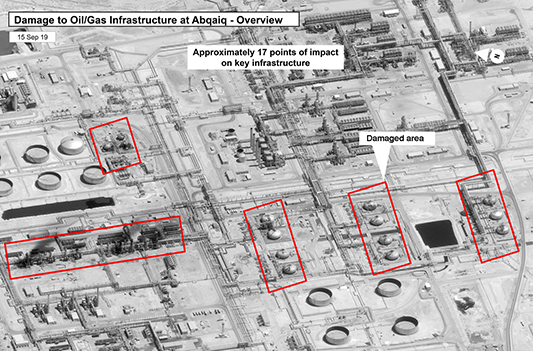
Aerial image of the points of impact of Yemeni retaliatory drone/ cruise missile attack on Saudi oil production infrastructure at Aramco facilities in Abqaiq, 9-14-2019. Reports now coming in from investigators indicate this was a sophisticated attack, perhaps taking months to plan, and waiting on the ideal conditions to execute: lead drones first took out the US Patriot radar installations and then follow on cruise missiles hit the intended targets. The accuracy of the drone/ missile strikes suggests that oil workers sympathetic to Ansarullah, or Yemeni agents posing as workers placed cell phones in appropriate places to act as homing beacons. Regardless, the fact that the US, with its billion dollar surveillance equipment and satellite technology, still has not determined where the drones/missiles came from over ten days after the attack took place, and could not protect the economic lifeline of the entire developed world indicates that US power is no longer invincible and Muslim military parity is fast becoming a reality.
Naturally, accusations from Riyadh and Washington went straight to the Islamic Republic of Iran, claiming Tehran was behind the strikes. And reflecting raw racism, they claimed the proud people of Yemen are “too backward” to pull off an attack of this magnitude. However, unbiased analysis of the facts show that Yemen most definitely could, and would, retaliate against their aggressors in such a spectacular manner. The accusation against Iran was also meant to divert attention from Saudi incompetence and the failure of US-supplied billion-dollar-a-piece Patriot missile batteries to intercept incoming drones.
It must be borne in mind, this is not the first airstrike, be it by missiles or by unmanned aircraft, that the Republic of Yemen has carried out against the Najdi invaders. While counterattacks deep inside Saudi territory have been taking place ever since the start of the war, the year 2019 has seen a surge in successful high-profile retaliations.
On May 14, the Saudi regime was forced to stop pumping crude oil in its main pipelines across the country, following Yemeni drone strikes against two Aramco facilities west of Riyadh. On June 12, a missile strike launched from inside Yemen hit Abha International Airport, which was in use by the Saudi military at the time, exploding right in the arrivals hall and causing major damage. It is noteworthy that Abha is over 100 km from the Yemeni border. The airport was hit again just five days later and yet again on July 2, destroying a hangar for military planes. Together with the Saudi military airbase of Khamis Mushayt in ‘Asir province, the airport of Abha has been struck multiple times in the past few months. This reflects the total incompetence of Saudi air defence systems.
The month of August 2019 started with a double missile and drone attack against two very different Saudi targets. First, a joint missile and UAV strike at a camp of Saudi-backed mercenaries in the southern port city of Aden killed dozens of collaborators. And then the Yemeni mujahidin hit a Saudi military base in Dammam city, in the Eastern province of Saudi Arabia that is hundreds of kilometres away from the Yemeni border.
On August 17, an attack took place that can be seen as a general rehearsal of sorts for the Abqaiq and Khurais strikes. Using a fleet of drones, Yemen’s revolutionaries attacked the Shaybah oil refinery. The massive refinery unit, located no less than 1,100 km from Yemen, was chosen specifically for its proximity to the United Arab Emirates (UAE). In one attack, the Yemeni revolutionaries not only proved their capacity to strike deep inside Saudi Arabia and hit its economic lifeline, but also sent shivers down the spine of the Emirate rulers.
“The UAE must quit the Saudi-led aggression if it wants to save its glass towers,” Yemeni military spokesman Yahya Sari‘ warned in crystal clear terms after the mid-September strikes.
The Yemeni struggle for independence and liberty has been a source of inspiration for years. Yet after September 14, the war against the US-Israeli-Saudi-UAE-led aggressors has entered a new phase. It may lead to the collapse of Bani Saud’s rule over the Kingdom. Should that happen, it would be widely celebrated by committed Muslims worldwide.
A devastating drone strike on ARAMCO’s largest oil processing facility in Abqaiq in occupied Arabian Peninsula has delivered a humiliating blow to the Saudi regime and its patrons.
With smoke billowing, the Saudi interior ministry could not deny the strike and confirmed that the facilities in Abqaiq and Khurais were burning.
Videos circulating online showed smoke rising above the company's facility in Abqaiq along with the sound of gunfire.
The gunfire was probably the result of Saudi military’s incompetence that does not realize that the drones already reached their targets and are no longer in the air.
On September 14, the people’s government of Yemen, led by the Islamic movement, AnsarAllah, announced that the movement used 10 drones to strike the oil facilities of the autocratic Bani Saud regime.
Yahya Saree, spokesperson of Yemen’s revolutionary government said in a statement read on Al Masirah TV that "These attacks are our right, and we warn the Saudis that our targets will keep expanding… We have the right to strike back in retaliation for the air strikes and the targeting of our civilians for the last five years."
According to ARAMCO’s website, Abqaiq oil processing facility is "the largest crude oil stabilization plant in the world."
The successful attack deep inside the Arabian Peninsula is a clear sign that the Saudi regime is a paper tiger and vulnerable.
With all the money, weapons and NATO support, the Saudi regime has failed to bring down the government of Yemen despite subjecting it to a tight siege.
Yousef Mawry, a Yemeni-American journalist with 10 years’ experience in the field, had predicted since the start of Saudi aggression in March 2015 that the AnsarAllah movement will take the war into the dark kingdom and its strategic ideological priority is the liberation of Makkah and Madinah from Saudi clutches.
Some people dismissed Mawry’s statements as illusionary especially those that followed him on his Facebook page.
Ansarullah movement is the only contemporary Islamic socio-political organization that has implemented military and political jihad simultaneously on the domestic level and won.
Ansarullah not only dismantled the puppet regime, it also came to political agreement with forces outside of its immediate constituency and forced the US occupation forces to evacuate al-Anad air base in southwest Yemen.
No Islamic movement since the Islamic Revolution in Iran had managed to achieve this.
The Saudis and their NATO patrons would, therefore, not leave one of the poorest countries in the world alone.
No matter what happens, it is evident that Yemen will play a big role in changes that are bound to reach the Arabian Peninsula occupied by the US-backed Bani Saud clan.
As Muslims ponder the role of the Najdi Bedouins, we need to remind ourselves of a hadith (‘Hadith of Najd’ reported by Bukhari in Vol 9, Book 88, hadith #214) of the noble Messenger (pbuh) who once prayed: “O Allah, bless our Sham (Syria) and bless our Yemen.”
His Companions inquired: “What about Najd, O Messenger of Allah (pbuh)?”
The noble Messenger (pbuh) again mentioned Sham and Yemen in invoking his blessings but ignored Najd.
The Companions again inquired about Najd. After repeating this three times, the noble Messenger (pbuh) said: “A great fitna will emerge from Najd that will try to destroy Islam and my Ummah.”
Muslims need to pay close attention to this hadith and formulate their understanding of events based on its wisdom.


 Brecht Jonkers

 Crescent International