Motivation coupled with innovative engagement tactics
Ayman Ahmed
The Ansarullah Islamic movement in Yemen has astonished most observers as it has withstood the five-year onslaught waged by a coalition of heavily armed states. A grassroots movement established in the 1990s as an Islamic youth group named Muntada al-Sha‘b al-Mu’min, it used to organize summer camps and offer social programs. Now it is a regional player with global influence. How did the movement grow and then manage to withstand daily attacks by armies of several countries equipped with the most sophisticated weapons?
The Ansarullah was forced to fight six wars against the Western-backed autocratic regime of ‘Ali ‘Abdullah Salih between 2004 and 2010. The Salih regime saw their social and political work as a long-term threat and resorted to crushing the emerging movement by using military force. This policy was shortsighted and backfired in the long run. True, initially the Salih regime gained the upper hand militarily, but the regime’s resorting to military force against the Ansarullah compelled them to build a military organization. Also, armed conflicts with the Salih regime gave the movement much-needed combat experience.
Uprising Today, an independent online news website, which focuses on Yemen from the perspective of the resistance, regularly posts combat footage of Ansarullah forces. The footage reveals that the Yemeni resistance has turned its disadvantages into battlefield advantages.
By analyzing reports from open sources it is clear that the terrain is the most effectively utilized tool of Ansarullah and the biggest disadvantage of its adversaries. It is rare to see Ansarullah fighters driving vehicles or even walking on roads during combat operations. The Yemeni forces generally move on foot through terrain inaccessible to vehicles. This makes it difficult for the overweight Saudi soldiers to counterattack Yemeni soldiers in a swift operation and use their numerical superiority to overwhelm them. Hostile terrain severely limits the logistic ability of the invading forces to move large numbers of troops toward the combat zone.
The Yemeni forces operate as small mobile groups to carry out attacks. This mode of operations allows them to appear and disappear quickly. It has the additional advantage that this eliminates the bureaucratic chain of command system used by conventional armies. Group leaders can make necessary decisions on the spot without losing time to consult the high command. This also does not allow the Saudis and their allies to utilize their electronic superiority to intercept communications between field commanders and the higher chain of command, thus creating an intelligence-gathering gap in tactical intelligence.
Motivation is an important factor that enables armies to achieve victory. Ab-sence of motivation among the Saudis and their local mercenaries is evident from viewing video footage of attacks on Saudi outposts within the dark Kingdom and their established outposts inside Yemen. In many instances it can be seen clearly how Saudi soldiers simply abandon their posts when they come under heavy fire even though they possess far heavier weapons. They can hold on to their positions until air support arrives. All they need to do is establish a defense perimeter and keep firing until the US-supplied jets arrive to bail them out. Instead, the Saudis simply run away. The Yemeni forces’ high motivation is demonstrated by the fact that they frequently engage the Saudi military in close combat rendering their long-range weapons useless and denying them the use of heavy artillery.
The Ansarullah fighters are also rarely seen utilizing tanks and other heavy combat vehicles, knowing full well that it exposes them to Saudi air attacks. Additionally, in open desert terrain, tanks are easy targets for armies that possess long-range artillery, something the Saudis have in abundance, thanks to supplies by their NATO masters.
A map of the imposed war on Yemen and the alignment of forces fighting to gain control of a historically independent territory that has been laid waste because of its geostrategic value to the dominant power culture and its proxies in the area. Through Ansarullah’s mounting victories and unbending resilience to the scorched earth tactics of the enemy, the aggressors are finally willing to talk peace.
The Yemenis have managed to modify conventional military tactics in very unconventional ways. Their use of drones in almost guerrilla-style operations highlights how the Yemenis managed to jam billion-dollar Saudi air defenses and utilize drones as long-range weaponry mainly geared toward scoring political points.
The military ingenuity of the Yemenis is demonstrated by the fact that the Saudi regime has not been able to score any major military victory despite possessing large stockpiles of weapons supplied by the world’s leading arms merchants. The Ansarullah’s political astuteness is another factor in reinforcing their military performance.
With backing of the Yemeni masses, once they took over the capital Sana‘a, the Ansarullah managed to create an inclusive Islamic system. They have not imposed their vision on the people. It is important to remember that Zaydi Muslims do not constitute a majority in Yemen yet the fact that a minority Islamic school of thought is able to govern Yemen reflects the movement’s broad support across all segments of society. In contrast, the Saudi-UAE mercenaries are constantly fighting one another over petty issues.
As reported by Rune Agerhus, Chairman of International Solidarity Committee with Yemen (ISCY) and editor-in-chief of Uprising Today Media, “in late March of 2019, the “Supreme Political Council” of the “National Salvation Government” (established by Ansarullah-led authorities in Yemen’s capital city to fill the political vacuum) released a comprehensive reform plan titled the “National Vision to Build the Modern Yemeni State.” In 82 pages, it outlines the movement’s goals and vision for improving the conditions in Yemen, dubbed “the world’s most fragile state” by the Fund for Peace’s Fragile States Index.
The document begins with a summary of its purpose, goals, vision, and mission, “A modern, representative, stable and unified Yemen which rests on having strong institutions, the realization of justice, the pursuit of development and a dignified life and standard of living for Yemeni citizens, the protection of the independence of the nation and seeking world peace and appropriate equal cooperation with the other countries of the world.”
Ansarullah’s experience in combining military and political struggle to wrestle state control from the clutches of an autocratic system is an unparalleled event among Islamic movements over the past 20 years. This rare phenomenon will surely motivate other Islamic movements to learn from the successful experience of Ansarullah.
Hit on Saudi Aramco sends chills through global colonial hegemony
Brecht Jonkers
On September 14, the world experienced a shockwave. The mujahidin of Yemen struck the world’s largest oil refinery complex in a highly successful drone strike on Abqaiq and Khurais in Saudi Arabia.
It is not possible to overstate the importance of the strike on Saudi Aramco facilities in the grand scheme of things. Yemen has been a forgotten and underreported conflict ever since the Saudi-Emirati-US alliance invaded the impoverished country in March 2015. It is a war so vile, so destructive, and so bereft of any justification, that the imperialist mainstream media outlets have decided to not even try to justify it. Rather, they have opted for silence. Ignore it and people will not notice, is their policy.
For four and a half years, the aggressors have subjected impoverished Yemen’s civilians to constant bombings. Nearly half of the country’s landmass has been occupied. There is constant infighting and mass murders in the occupied east and south of Yemen. The Saudi-UAE invaders provide open support to terrorist organisations such as al-Qaeda and Da‘ish. Despite all this being known publicly, there is barely a peep in the major media outlets of the US, UK, or the rest of Europe.
But all that changed in one swift operation by the forces of the National Salvation Government of Yemen, often called “the Houthis” by the imperialist media. As many as 10 drones were reported to have struck the Abqaiq and Khurais petroleum refineries. The economic damage to the Kingdom is devastating. More than half of the petroleum production and export of the Wahhabi state was cut down in a single day, making Riyadh lose out on as much as 5.7 million barrels of crude oil exports daily.
According to specialist consultancy agency Energy Aspects, the Saudi kingdom also suffered a setback of 18% in natural gas production and as much as 50% in ethane and liquified gas output. The massive decrease in available crude oil, combined with damage to the refinery, have had the additional effect of causing a shortage of refined petroleum products. These are needed to repair and run the refinery’s machinery.
In stark irony, Energy Aspects reported that it is highly likely that Saudi Arabia, the kingdom founded because of oil and entirely dependent on it, will be forced to import gasoline, diesel and fuel oil just to keep its own oil-based economy afloat.
While the royals and their ministers in Riyadh guaranteed that the Abqaiq and Khurais facilities were up and running again by September 16, experts estimate that full recovery will take at least two weeks. That is, if no further retaliatory strikes are carried out from the land of Sheba. That does not take into account the hydrogen sulphur that has been released by the fires when the strike occurred. This is likely to directly reduce the efficiency of pumping installations.
The results of the Yemeni retaliation against their invader’s bread and butter were felt around the world. Oil prices jumped by no less than 20% on the global markets, forcing the US to announce a release of its own strategic petroleum reserves in order to avoid a major economic disaster.
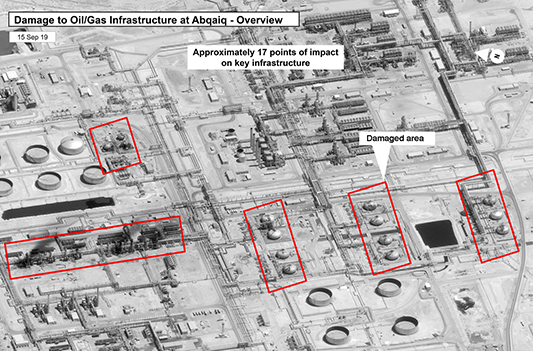
Aerial image of the points of impact of Yemeni retaliatory drone/ cruise missile attack on Saudi oil production infrastructure at Aramco facilities in Abqaiq, 9-14-2019. Reports now coming in from investigators indicate this was a sophisticated attack, perhaps taking months to plan, and waiting on the ideal conditions to execute: lead drones first took out the US Patriot radar installations and then follow on cruise missiles hit the intended targets. The accuracy of the drone/ missile strikes suggests that oil workers sympathetic to Ansarullah, or Yemeni agents posing as workers placed cell phones in appropriate places to act as homing beacons. Regardless, the fact that the US, with its billion dollar surveillance equipment and satellite technology, still has not determined where the drones/missiles came from over ten days after the attack took place, and could not protect the economic lifeline of the entire developed world indicates that US power is no longer invincible and Muslim military parity is fast becoming a reality.
Naturally, accusations from Riyadh and Washington went straight to the Islamic Republic of Iran, claiming Tehran was behind the strikes. And reflecting raw racism, they claimed the proud people of Yemen are “too backward” to pull off an attack of this magnitude. However, unbiased analysis of the facts show that Yemen most definitely could, and would, retaliate against their aggressors in such a spectacular manner. The accusation against Iran was also meant to divert attention from Saudi incompetence and the failure of US-supplied billion-dollar-a-piece Patriot missile batteries to intercept incoming drones.
It must be borne in mind, this is not the first airstrike, be it by missiles or by unmanned aircraft, that the Republic of Yemen has carried out against the Najdi invaders. While counterattacks deep inside Saudi territory have been taking place ever since the start of the war, the year 2019 has seen a surge in successful high-profile retaliations.
On May 14, the Saudi regime was forced to stop pumping crude oil in its main pipelines across the country, following Yemeni drone strikes against two Aramco facilities west of Riyadh. On June 12, a missile strike launched from inside Yemen hit Abha International Airport, which was in use by the Saudi military at the time, exploding right in the arrivals hall and causing major damage. It is noteworthy that Abha is over 100 km from the Yemeni border. The airport was hit again just five days later and yet again on July 2, destroying a hangar for military planes. Together with the Saudi military airbase of Khamis Mushayt in ‘Asir province, the airport of Abha has been struck multiple times in the past few months. This reflects the total incompetence of Saudi air defence systems.
The month of August 2019 started with a double missile and drone attack against two very different Saudi targets. First, a joint missile and UAV strike at a camp of Saudi-backed mercenaries in the southern port city of Aden killed dozens of collaborators. And then the Yemeni mujahidin hit a Saudi military base in Dammam city, in the Eastern province of Saudi Arabia that is hundreds of kilometres away from the Yemeni border.
On August 17, an attack took place that can be seen as a general rehearsal of sorts for the Abqaiq and Khurais strikes. Using a fleet of drones, Yemen’s revolutionaries attacked the Shaybah oil refinery. The massive refinery unit, located no less than 1,100 km from Yemen, was chosen specifically for its proximity to the United Arab Emirates (UAE). In one attack, the Yemeni revolutionaries not only proved their capacity to strike deep inside Saudi Arabia and hit its economic lifeline, but also sent shivers down the spine of the Emirate rulers.
“The UAE must quit the Saudi-led aggression if it wants to save its glass towers,” Yemeni military spokesman Yahya Sari‘ warned in crystal clear terms after the mid-September strikes.
The Yemeni struggle for independence and liberty has been a source of inspiration for years. Yet after September 14, the war against the US-Israeli-Saudi-UAE-led aggressors has entered a new phase. It may lead to the collapse of Bani Saud’s rule over the Kingdom. Should that happen, it would be widely celebrated by committed Muslims worldwide.
If we are to believe what the Saudi crown prince told CBS news in an interview aired on September 29, Mohammad bin Salman (MbS) has turned into a peacenik.
He said that war with Iran would entail a “total collapse of the global economy.”
Instead, he called for a “peaceful” resolution of differences with the Islamic Republic.
Bin Salman said a “political and peaceful solution is much better than the military one” to mend strained relations with Tehran.
One can almost visualize Bin Salman wearing bell-bottoms and a bandana around his forehead to secure his long wig from flying off in the desert wind. It would also make him look like a real hippie.
Playing guitar and singing, together with Yuko Ono on a Riyadh stage, “All we are saying is give peace a chance!”
John Lennon must be turning in his grave to see Bin Salman impersonating him.
While we await more details of Bin Salman’s peace overtures, the question arises, what has led to this sudden change of heart—and tone—by one of the most belligerent Saudis in living memory?
It was in May 2017 that Bin Salman threatened to take the war to Iran. Soon thereafter, it became clear that the Saudi regime was supporting and financing terrorist outfits, including MKO to carry out criminal acts inside Iran.
On September 22, 2018, as Iran was marking the anniversary of Saddam Husain’s invasion of the nascent Islamic Republic (launched on September 22, 1980), Saudi-sponsored terrorists struck the southwestern city of Ahvaz that left 25 people dead and over 60 others wounded.
Two terrorist outfits, al-Ahwaziya and Daesh, both financed by Saudi Arabia, claimed responsibility for the September 22 terrorist attack on a military parade in the provincial capital.
Shortly thereafter, the London-based “Iran International”, a Saudi-funded TV channel, allowed al-Ahwaziya’s spokesman to go live on air to defend the dastardly crime.
The British daily, The Guardian, has reported that the channel receives an estimated $250 million annually from the Saudi regime.
But Bin Salman’s recent peace overtures, however, have been forced by successful drone strikes on Aramco facilities on September 14 and the latest spectacular military operations carried out by Yemen’s revolutionary Ansarallah movement against Saudi forces in Najran.
Three brigades of Saudi forces were wiped out together with their equipment, and thousands of soldiers captured. Ansarallah also captured huge amounts of Saudi military hardware in the three-day operation launched on September 28.
Since September 14, the Saudis and their American masters have blamed Iran for drone strikes on Aramco despite Iran’s vigorous denials and Ansarallah claiming responsibility.
Ansarallah’s spectacular military strike in Najran has proved beyond doubt that they can mount successful military operations inside Saudi Arabia.
The Saudis have been made to realize their vulnerability. If the war on Yemen continues, there is serious risk of the Saudi regime collapsing completely, hence Bin Salman’s desperate peace overtures.
Whether he means it or not will be become apparent based on how the regime responds to its continuing war on Yemen. If Bin Salman orders a halt to attacks on Yemeni civilians that would indicate he is serious about peace.
Continuing the war would result in short-circuiting the life of the Bani Saud regime.
Veteran Arab journalist Abdel Bari Atwan says Yemen’s Houthi movement has completely changed the equation in its war with Saudi Arabia by taking the fight into Saudi territory in such devastating fashion.
The huge fires started by Saturday’s drone attacks on the Abqaiq and Khurais oil production and processing facilities in eastern Saudi Arabia may have been brought under control. But big questions remain unanswered about where the ten pilotless aircraft came from and how they managed to reach their targets apparently undetected and hit them with such devastating accuracy.
These were no ordinary targets. They were among the most strategically important – and one would have assumed most closely protected — locations in the country. The two oilfields and their related plants have a capacity of more than seven million barrels of crude oil per day and process some 70% of Saudi Aramco’s petroleum output.
Saturday’s attack, which at a stroke cut the country’s oil production by more than half, was the third on Aramco facilities this year. In May seven drones targeted two pumping stations on the main east-west oil pipeline and in August the massive Shayba oilfield was attacked.
In claiming responsibility for the latest (and by far most serious) drone raid, Yemen’s Houthi Ansarullah movement offered possible partial answers to the above questions.
Houthi spokesman Yahya Sarie’ said the operation was carried out after a “careful process of intelligence surveillance” of the sites. He did not elaborate about how and by whom this surveillance was carried out, nor did he comment on this apparent breakthrough in the Houthis’ intelligence capabilities.
Neither did he explain how, if the drones were launched from Yemeni territory, they managed to make the 1,000 km-plus journey without refuelling or being detected.
He did, however, make a point of praising “honourable and freedom-loving people” inside Saudi Arabia for their contribution to the operation. This sounded like a reference to the participation of members of Saudi Arabia’s persecuted Shia minority, who are concentrated in the Eastern Province in the attack, or at least in the intelligence/surveillance process that preceded it.
The drones seem unlikely to have been launched from within Saudi Arabia itself. It would have been very difficult to smuggle such large devices into the Kingdom or assemble them there. They were probably fired from a neighbouring country: Iraq is increasingly being identified as the most likely source (the drones that struck the east-west pipeline were also widely reported to have come from there).
There has also been speculation they may have been clandestinely launched from Bahrain, or from a ship sailing off the Saudi Gulf coast.
Resistance Axis
But the precise source of the missiles is immaterial. Since the start of the Saudi-led war on Yemen, the Houthis have become increasingly closely aligned with the regional “Resistance Axis” comprising Iran and Syria and their allies in Iraq, Lebanon and other Arab countries. They no longer attempt to conceal this: their envoys now visit Tehran openly and their leaders express pride about their relationship with the Islamic Republic.
Sarie’, meanwhile, warned that Ansarullah’s list of targets inside Saudi Arabia is “growing by the day,” meaning that more such attacks can be expected until Riyadh ends its war and lifts its blockade of Yemen.
This warning should be seen in the context of two other highly significant warnings that were issued in recent days: the declaration by Hassan Nasrallah, leader of Lebanon’s Hezbollah, that his movement has new options available for countering U.S. attempts to cripple it and its allies; and the reaffirmation by Iranian leader Ali Khamenei’s advisor Ali Akbar Velayati that if his country is prevented from exporting oil through the Persian Gulf, no other country will be allowed to do so either.
The Houthis are closely aligned with Iran
The Houthis have changed the rules of engagement. The message they delivered with the latest attacks is, in their own words, that they will continue striking targets deep inside Saudi Arabia until the country’s leadership realises that “killing more Yemenis will not force them to their knees.”
Saudi fire-fighters may have put out the flames in Abqaiq and Khurais. But the dense smoke from the fires continues to shroud the region, and to conceal, at least for now, many questions about the future of the struggle raging in the Middle East, not just in Yemen but throughout the region.
In the meantime, a question is worth asking: Who is going to buy a stake in Saudi Aramco now? The Saudi government is desperate to offer shares in the giant corporation for sale. But even if they ever go on the market, how much will they fetch? Is it as coincidence that the attacks were launched just as Riyadh was stepping up efforts to proceed with a share offering?
Those unsophisticated mountain-dwelling Yemenis are clearly not as stupid as their enemies think.
A devastating drone strike on ARAMCO’s largest oil processing facility in Abqaiq in occupied Arabian Peninsula has delivered a humiliating blow to the Saudi regime and its patrons.
With smoke billowing, the Saudi interior ministry could not deny the strike and confirmed that the facilities in Abqaiq and Khurais were burning.
Videos circulating online showed smoke rising above the company's facility in Abqaiq along with the sound of gunfire.
The gunfire was probably the result of Saudi military’s incompetence that does not realize that the drones already reached their targets and are no longer in the air.
On September 14, the people’s government of Yemen, led by the Islamic movement, AnsarAllah, announced that the movement used 10 drones to strike the oil facilities of the autocratic Bani Saud regime.
Yahya Saree, spokesperson of Yemen’s revolutionary government said in a statement read on Al Masirah TV that "These attacks are our right, and we warn the Saudis that our targets will keep expanding… We have the right to strike back in retaliation for the air strikes and the targeting of our civilians for the last five years."
According to ARAMCO’s website, Abqaiq oil processing facility is "the largest crude oil stabilization plant in the world."
The successful attack deep inside the Arabian Peninsula is a clear sign that the Saudi regime is a paper tiger and vulnerable.
With all the money, weapons and NATO support, the Saudi regime has failed to bring down the government of Yemen despite subjecting it to a tight siege.
Yousef Mawry, a Yemeni-American journalist with 10 years’ experience in the field, had predicted since the start of Saudi aggression in March 2015 that the AnsarAllah movement will take the war into the dark kingdom and its strategic ideological priority is the liberation of Makkah and Madinah from Saudi clutches.
Some people dismissed Mawry’s statements as illusionary especially those that followed him on his Facebook page.
Ansarullah movement is the only contemporary Islamic socio-political organization that has implemented military and political jihad simultaneously on the domestic level and won.
Ansarullah not only dismantled the puppet regime, it also came to political agreement with forces outside of its immediate constituency and forced the US occupation forces to evacuate al-Anad air base in southwest Yemen.
No Islamic movement since the Islamic Revolution in Iran had managed to achieve this.
The Saudis and their NATO patrons would, therefore, not leave one of the poorest countries in the world alone.
No matter what happens, it is evident that Yemen will play a big role in changes that are bound to reach the Arabian Peninsula occupied by the US-backed Bani Saud clan.
As Muslims ponder the role of the Najdi Bedouins, we need to remind ourselves of a hadith (‘Hadith of Najd’ reported by Bukhari in Vol 9, Book 88, hadith #214) of the noble Messenger (pbuh) who once prayed: “O Allah, bless our Sham (Syria) and bless our Yemen.”
His Companions inquired: “What about Najd, O Messenger of Allah (pbuh)?”
The noble Messenger (pbuh) again mentioned Sham and Yemen in invoking his blessings but ignored Najd.
The Companions again inquired about Najd. After repeating this three times, the noble Messenger (pbuh) said: “A great fitna will emerge from Najd that will try to destroy Islam and my Ummah.”
Muslims need to pay close attention to this hadith and formulate their understanding of events based on its wisdom.
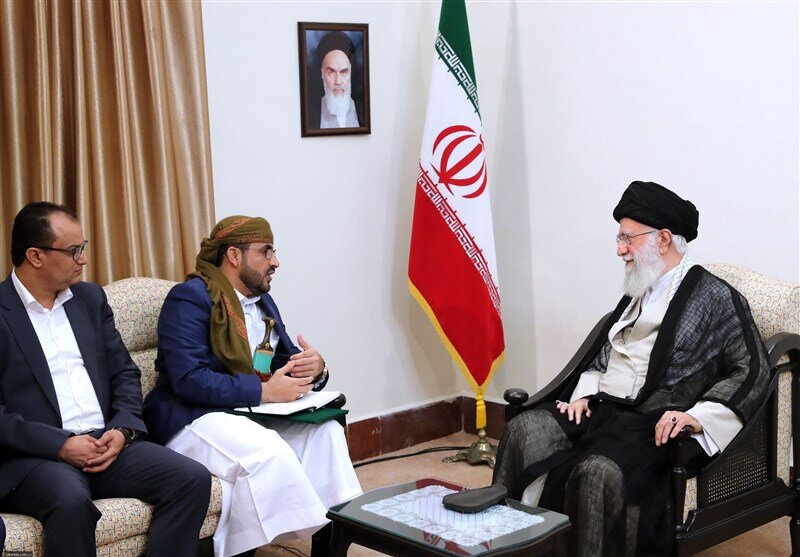
TEHRAN - Over the last few days, the media all over the world have put their focus on a meeting between Ayatollah Ali Khamenei, Leader of the Islamic Revolution and a delegation of Yemeni resistant group, Ansarullah. Different think tanks are now trying to analyze this important meeting from a variety of aspects.
The meeting was particularly important in the following respects:
The attendants
According to official protocols and formalities, this delegation was not as high as others who meet the Leader. In fact, it was the first time that Ayatollah Khamenei had a face to face meeting with a spokesperson of a people-based resistant movement.
Anyhow, the Leader greeted them like a high-level official delegation and all the standard formalities that are applied in meetings between the highest international officials were also observed in this meeting, and there were even more intimacy and warmth between the two parts. This shows the importance of Yemen and the resistance of its people for the Leader and the Islamic Republic of Iran.
The time of the meeting
The meeting was held in one of the most critical points in Yemen’s modern history. Four years and four months of brutal attacks, the invaders of Yemen are now starting to turn on each other as their alliance is falling apart. Last week, the last strongholds of Saudi Arabia in Yemen collapsed by their closes ally, the United Arab Emirates (UAE). Saudis also lost the control of Aden which was previously the capital of Mansour Hadi’s puppet government.
Delivery of a message
Over the meeting, a letter from Abdul-Malik al-Houthi, the leader of Ansarullah was handed to Ayatollah Khamenei who immediately opened the letter and read it. Obviously, the Leader could have read the message later but he did this as a gesture to show his affection for the revolutionary movement of Yemen. Contrary to this, two months ago when the Japanese Prime Minister tried to deliver a message from the United States president to the Leader, he refused to receive the message altogether.
The subject of the meeting
Over the meeting, Mohammed Abdulsalam, the spokesman for Ansarullah delivered the warm regards of the movement’s leader, Abdul-Malik al-Houthi and other Yemeni people who are fighting the invaders. He told Ayatollah Khamenei, “We regard your leadership as the continuing leadership after the Prophet Muhammad (S) and his successor Imam Ali (AS). Your attitude of seeking justice for the oppressed Yemenis is the same policy of Imam Ali (AS) and the founder of the Islamic Republic, Imam Khomeini, this is the source of great blessing and hope for all the people.”
For his turn, the Leader said that “every devoted nation who believes in God and the reality of divine promises, will definitely win. On this basis, victory will surely be with the oppressed and faithful people of Yemen.”
It is not the first time that the Leader is making such as firm prediction, as he made the same true promise before Lebanon’s Hezbollah went into its 33-day war with the Zionists. Ayatollah Khamenei also warned about the danger of Yemen’s division. He said that invaders including Saudi Arabia and UAE are trying to divide Yemen, but the people should stand firmly against this scheme and defend a united, undivided and autonomous Yemen.
Ayatollah Khamenei added protecting the Yemeni territorial integrity in view of its diverse religious and ethnic diversity entails intra-Yemeni dialogue.
This advice was based on Yemen’s social structure as the country consists of different ethnic and religious groups and some of the tribe who reside in southern parts are willing to get separated from the country. UAE, on the other hand is supporting these movements, so the country is at risk of getting divided and the only solution, as the Leader said, is an intra-Yemeni dialogue.
Accreditation of Yemen’s revolutionary government
The people-based government of Yemen constitutes of Ansarullah and its other revolutionary allies including the government, the Parliament and public committees and organizations that were established after the revolution, but it is still not accepted as an official government by the world countries and international organizations; conversely, the official status is given to Mansour Hadi’s government which is now practically ended as he has fled the country and lives in exile.
The meeting between the Leader and the Ansarullah delegation was an ending to the policy of ignoring the legal government of Yemen which is born out of revolution and changing its De facto status to a De jure one in both regional and international arenas.
Yemen’s defenders keep stacking up victories, pushing back the invaders from both Saudi Arabia and the United Arab Emirates (UAE) on all fronts. Not only are the Saudi-led attackers and their mercenaries pummelled on the southern frontline of Yemen, they are also being pushed closer to the key port city of Aden. In the north, deep inside Saudi territory itself, the Yemeni Armed Forces and Popular Committees are scoring significant victories across a broad front, liberating large swaths of Najran and Jizan from Saudi control. The word “liberating” is definitely applicable here, for although the two aforementioned provinces are officially part of the Saudi kingdom, they are a key part of Greater Yemen that were occupied by the Wahhabi hordes as recently as 1934, after being part of Yemen for millenia.
While Saudi Arabia may have the most technologically advanced military in the Arabian world, and the UAE may arguably be one of the richest states in the world, they are both wholly incapable of taking on Yemen, the poorest country in the Muslim East. A veritable Vietnam War scenario seems to be unfolding in the south of the Arabian Peninsula, in which sheer determination, tenacity, and faith in Allah (swt) are triumphing over the material power of the invaders.
Over the past month, the valiant defenders of the land that was once known as Blessed Arabia have taken massive steps forward. It has become impossible even for those who support the genocidal Saudi invasion to ignore their exploits.
And there is one place under Bani Saud rule that will never forget what the wrath of Yemen feels like: Abha International Airport, in Saudi Arabia’s ‘Asir province.
In the early hours of the morning on June 12, the civil airport, which had been co-opted for military use by the Saudi air force, was struck with a precision strike by the Yemeni Missile Forces. A completely new and unheard of cruise missile developed in utmost secrecy by the Yemeni Armed Forces, blew up the control tower of the airfield and put it out of commission.
The success of the mission was undeniable. Soon after the attack, images surfaced online of flight schedules to Abha being changed and planes headed for the airport being rerouted or forced to return. In clear contrast with the mass murders that routinely go hand in hand with Saudi air strikes in Yemen, the pinpoint accuracy of the strike on the tower resulted in zero mortality. Less than a week after the attack, even Saudi state media admitted that a devastating retaliation strike had indeed taken place.
The official spokesman of Ansarullah, Muhammad ‘Abd al-Salam, reacted to the missile strike in crystal clear and foreboding words, stating that “The continued aggression, the blockade, the closure of Sana‘a Airport, the [Saudi] rejection of a political solution and peaceful choices make it imperative for our people to defend themselves.”
As much of a shock as the launching of the cruise missile on Abha was, the humiliation that the Saudi airbase would suffer was far from over. Just two days after the missile strike, Yemen launched a drone strike directly targeting and destroying the radar system of Abha Airport. The attack was carried out using Qasif-2K drones, which are rigged to self-destruct and rain down shrapnel at their target. This is a relatively cheap but hugely effective guerrilla tactic that Yemen has used for years. Abha International Airport, now without its control tower and radar system, was rendered utterly incapacitated, and the Saudi regime was completely humiliated.
The following day (on June 15), another wave of Qasif-2K drones hit both the airport of Jizan and Abha once again. At Jizan airport, the control room of Saudi unmanned aerial vehicles (UAVs) program was destroyed, whereas in Abha the Yemeni drones destroyed a petrol station. Both airports were later confirmed to have been temporarily put out of service, as attested to by air navigation monitoring centers.
Yet for all the damage that has been inflicted on the Saudi war machine, it was still not over. As if to defy imagination, the Yemeni Armed Forces struck again on June 17. And not only did they carry out another unmanned aerial attack, they also succeeded in hitting the exact same Abha International Airport again. And just like happened twice before in the course of less than a week, air traffic to and from the ‘Asir provincial capital was temporarily, but completely, halted.
On June 19, Yemen’s defenders launched yet another cruise missile, this time striking a major Saudi power plant in al-Shaqiq area of Jizan province. The missile strike caused extensive damage to the plant, in yet another retaliation for continued Saudi war crimes.
File photo of a Qasif-2K combat drone that was developed domestically by the Yemeni army. Speaking during a press conference in the capital Sana’a, Brigadier General Yahya Sari‘ said Yemeni drones had attacked Saudi positions at the airports in Jizan and Abha, destroying the control room for Saudi unmanned aerial vehicles program. He added that these new drones could accurately strike designated targets with a large payload of explosive materials. Saudi Arabia and a number of its worldwide allies launched a devastating military campaign against Yemen in March 2015, with the aim of crushing the country’s Huthi Ansarullah movement. To date some 90,000 Yemenis have been killed and a record 22.2 million are in danger of starvation by the end of the year.
On the same day, dozens of Saudi troops and foreign mercenaries were killed in a Badr-F missile strike that struck right in the middle of a military gathering in Najran. Reports stated that dozens of ambulances were seen rushing to the scene to tend to the wounded, confirming how successful the strike was.
On June 20, the official spokesperson of the Yemeni Armed Forces, Brigadier General Yahya Sari‘, announced that Jizan International Airport had once again been attacked by Yemeni combat drones, this time striking the hangar bay of Saudi unmanned aerial vehicles. It is a fitting irony that the once feared drones of the US-Saudi war machine, so often used to target civilians and non-military infrastructure in Yemen, are now being destroyed by a new and highly efficient series of Yemeni unmanned aircraft.
The abundance of highly efficient and precise Yemeni air strikes taking place in such a short period of time, has fulfilled the promise that the Leader of the Yemeni Revolution, Sayyid ‘Abd al-Malik al-Huthi made in April, when he vowed that vital Saudi facilities would be attacked if the invaders did not cease attacking Hodeydah.
On June 20, Yahya Sari‘ issued this threat once again in crystal clear terms, warning that the missiles and drones of Yemen can strike anywhere in Saudi Arabia at any time. “We have advanced technologies that US-made and other interceptor systems deployed in Saudi Arabia cannot deal with,” the general warned, adding that “Our strikes will not be confined to just ‘Asir, Najran, or Jizan.”
It cannot be overstated just how important it is to stress that despite all the odds Yemen is winning the war. It may defy comprehension to many news pundits and self-declared analysts across the world but Yemen will be victorious, insha’allah.
Yemen is proof of the truth that the Majestic Qur’an tells us in Surah al-Nisa’, “And Allah knows best who your enemies are; and none can supervise as Allah does, and nonce can give support as Allah does” (4:45).
TEHRAN- Yemen’s Houthi Ansarullah movement has strongly condemned Saudi Arabia over beheading 37 of its nationals, stressing the Riyadh regime had the U.S. carte blanche for the “heinous” mass executions.
The political bureau of the movement, in a statement, said the sentences were carried out because the individuals had committed no sin other than reject Al Saud’s injustice and tyranny. The statement highlighted that the policy of killing and suppression of people with an iron fist is a criminal approach long being exercised by the Saudi regime, adding that the ruling family in Riyadh has resorted to such a practice in a bid to cling to power, Press TV reported. “The history of the Saudi regime is awash with criminality. Brutal crimes being committed by the Saudi regime against its own nationals and other nations are a proof for its downfall and moral bankruptcy ... Without support from America, the Saudi regime would not have dared to commit such crimes,” Ansarullah pointed out. The Yemeni movement then called upon all freedom-loving people around the world to reject Saudi Arabia’s repressive and aggressive policies, and to criminalize the Riyadh regime’s suppression of its own people as well as its ongoing atrocious military onslaught against Yemen. The Arabic-language Saudi daily newspaper Okaz, citing a statement issued by the interior ministry, reported that the executions were implemented Tuesday “on a number of culprits for adopting extremist terrorist ideologies and forming terrorist cells to corrupt and disrupt security as well as spread chaos and provoke sectarian strife.” The statement added that the executions took place in the capital Riyadh, the Muslim holy cities of Mecca and Medina, the central province of Qassim, oil-rich and Shia-populated Eastern province and the kingdom’s southern province of Asir. Amnesty International later censured the mass executions, saying they mark an alarming escalation in Saudi Arabia’s use of the death penalty. It added that among those put to death was a young Shia man, identified as Abdulkareem al-Hawaj, who was convicted of offenses related to his involvement in anti-regime protests that took place while he was under the age of 16. “Today’s mass execution is a chilling demonstration of the Saudi Arabian authorities’ callous disregard for human life. It is also yet another gruesome indication of how the death penalty is being used as a political tool to crush dissent from within the country’s Shia minority,” said Lynn Maalouf, the Middle East Research Director at Amnesty International.
TEHRAN - The year 1397 is over with all its ups and downs. Realization and consolidation of the victory of the resistance front in Syria, Lebanon's general election victory on March 8th, the crystallization of the political power of the Iraqi Popular Forces, the military and political victory of Ansarullah in Yemen and Zionist withdrawal in the war against Hamas, all raised the “Flag of Resistance” in the region and world.
In the beginning of 1397, US National Security Advisor John Bolton and U.S. Secretary of State Mike Pompeo, aiming to curb Iran and the axis of resistance, and even trying to destroy them, terribly failed in their continuous mission against the resistance forces that brought the White House defeat.
The 1397 was a year that not only revived the name of “resistance”, but also transformed it into a comprehensive discourse on international order. The blatant action of the U.S. and Britain in boycotting groups such as the al-Nujaba Movement in Iraq and Lebanon's Hezbollah is also the result of Washington and its allies’ intense anger against the axis of resistance.
The regional, military, and political victories of the resistance front will never be limited to 1397. Undoubtedly, in 1398 and in the years to come, we will continue to build solid ties that “Resistance” has created for the blessing of the blood of its martyrs.
The U.S., Israel, economic, political and military blitz will intensify against the resistance front next year. The West, Israel, and Saudi Arabia, will play the role of “foot soldiers” of the enemies. However, this years’ experience has shown that as much as “action of resistance enemies” is more intense against this popular and spiritual front, the resistance response and subsequently the costs of defeat of the West and the Zionist regime will be heavier.
In 1397, the resistance front monitored the intelligence movements of the White House and its allies and failed to surrender as “redefining ISIS in the West Asia region” and “normalizing the relations between Arabs and the Zionist regime”. In the New Year, the resistance front will continue this clever observation, and will show a strong response to any “tactic” and “American-Zionist” strategy. In contrast, the U.S. has no longer been able to pay progressive deficits in the West Asia region. Damascus, Sanaa, Baghdad and Beirut have become a clear indicator of the failure of regional macroeconomic policies.
In such a situation, Trump and his allies are only seeking to reduce the cost of their failure in the region. The bloody and dangerous game that the Democrats and Republicans in the U.S. shared jointly in the region have now become the Achilles heel of the U.S. foreign policy. It is not unreasonable that even Western media outlets report the failure of the West and Arab leaders in Syria. American puppets the Saudi Crown Prince Mohammed bin Salman are very worried about such issues. The nightmare of Washington, Tel Aviv, and their mercenaries in the region are still on the way.


 Brecht Jonkers

 Crescent International