Showing posts with label Yemen Conflict. Show all posts

Thursday, October 03, 2019

Yemeni Defenders’ Shock and Awe Resistance

Hit on Saudi Aramco sends chills through global colonial hegemony

Brecht Jonkers
On September 14, the world experienced a shockwave. The mujahidin of Yemen struck the world’s largest oil refinery complex in a highly successful drone strike on Abqaiq and Khurais in Saudi Arabia.
It is not possible to overstate the importance of the strike on Saudi Aramco facilities in the grand scheme of things. Yemen has been a forgotten and underreported conflict ever since the Saudi-Emirati-US alliance invaded the impoverished country in March 2015. It is a war so vile, so destructive, and so bereft of any justification, that the imperialist mainstream media outlets have decided to not even try to justify it. Rather, they have opted for silence. Ignore it and people will not notice, is their policy.
For four and a half years, the aggressors have subjected impoverished Yemen’s civilians to constant bombings. Nearly half of the country’s landmass has been occupied. There is constant infighting and mass murders in the occupied east and south of Yemen. The Saudi-UAE invaders provide open support to terrorist organisations such as al-Qaeda and Da‘ish. Despite all this being known publicly, there is barely a peep in the major media outlets of the US, UK, or the rest of Europe.
But all that changed in one swift operation by the forces of the National Salvation Government of Yemen, often called “the Houthis” by the imperialist media. As many as 10 drones were reported to have struck the Abqaiq and Khurais petroleum refineries. The economic damage to the Kingdom is devastating. More than half of the petroleum production and export of the Wahhabi state was cut down in a single day, making Riyadh lose out on as much as 5.7 million barrels of crude oil exports daily.
According to specialist consultancy agency Energy Aspects, the Saudi kingdom also suffered a setback of 18% in natural gas production and as much as 50% in ethane and liquified gas output. The massive decrease in available crude oil, combined with damage to the refinery, have had the additional effect of causing a shortage of refined petroleum products. These are needed to repair and run the refinery’s machinery.
In stark irony, Energy Aspects reported that it is highly likely that Saudi Arabia, the kingdom founded because of oil and entirely dependent on it, will be forced to import gasoline, diesel and fuel oil just to keep its own oil-based economy afloat.
While the royals and their ministers in Riyadh guaranteed that the Abqaiq and Khurais facilities were up and running again by September 16, experts estimate that full recovery will take at least two weeks. That is, if no further retaliatory strikes are carried out from the land of Sheba. That does not take into account the hydrogen sulphur that has been released by the fires when the strike occurred. This is likely to directly reduce the efficiency of pumping installations.
The results of the Yemeni retaliation against their invader’s bread and butter were felt around the world. Oil prices jumped by no less than 20% on the global markets, forcing the US to announce a release of its own strategic petroleum reserves in order to avoid a major economic disaster.
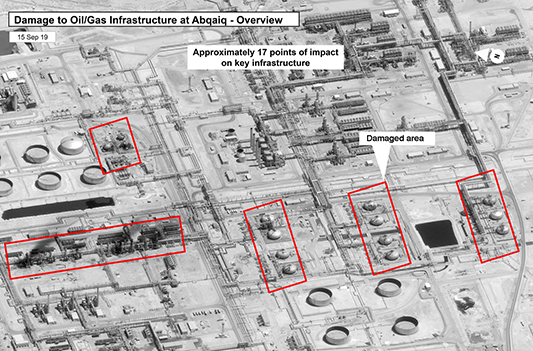
Aerial image of the points of impact of Yemeni retaliatory drone/ cruise missile attack on Saudi oil production infrastructure at Aramco facilities in Abqaiq, 9-14-2019. Reports now coming in from investigators indicate this was a sophisticated attack, perhaps taking months to plan, and waiting on the ideal conditions to execute: lead drones first took out the US Patriot radar installations and then follow on cruise missiles hit the intended targets. The accuracy of the drone/ missile strikes suggests that oil workers sympathetic to Ansarullah, or Yemeni agents posing as workers placed cell phones in appropriate places to act as homing beacons. Regardless, the fact that the US, with its billion dollar surveillance equipment and satellite technology, still has not determined where the drones/missiles came from over ten days after the attack took place, and could not protect the economic lifeline of the entire developed world indicates that US power is no longer invincible and Muslim military parity is fast becoming a reality.
Naturally, accusations from Riyadh and Washington went straight to the Islamic Republic of Iran, claiming Tehran was behind the strikes. And reflecting raw racism, they claimed the proud people of Yemen are “too backward” to pull off an attack of this magnitude. However, unbiased analysis of the facts show that Yemen most definitely could, and would, retaliate against their aggressors in such a spectacular manner. The accusation against Iran was also meant to divert attention from Saudi incompetence and the failure of US-supplied billion-dollar-a-piece Patriot missile batteries to intercept incoming drones.
It must be borne in mind, this is not the first airstrike, be it by missiles or by unmanned aircraft, that the Republic of Yemen has carried out against the Najdi invaders. While counterattacks deep inside Saudi territory have been taking place ever since the start of the war, the year 2019 has seen a surge in successful high-profile retaliations.
On May 14, the Saudi regime was forced to stop pumping crude oil in its main pipelines across the country, following Yemeni drone strikes against two Aramco facilities west of Riyadh. On June 12, a missile strike launched from inside Yemen hit Abha International Airport, which was in use by the Saudi military at the time, exploding right in the arrivals hall and causing major damage. It is noteworthy that Abha is over 100 km from the Yemeni border. The airport was hit again just five days later and yet again on July 2, destroying a hangar for military planes. Together with the Saudi military airbase of Khamis Mushayt in ‘Asir province, the airport of Abha has been struck multiple times in the past few months. This reflects the total incompetence of Saudi air defence systems.
The month of August 2019 started with a double missile and drone attack against two very different Saudi targets. First, a joint missile and UAV strike at a camp of Saudi-backed mercenaries in the southern port city of Aden killed dozens of collaborators. And then the Yemeni mujahidin hit a Saudi military base in Dammam city, in the Eastern province of Saudi Arabia that is hundreds of kilometres away from the Yemeni border.
On August 17, an attack took place that can be seen as a general rehearsal of sorts for the Abqaiq and Khurais strikes. Using a fleet of drones, Yemen’s revolutionaries attacked the Shaybah oil refinery. The massive refinery unit, located no less than 1,100 km from Yemen, was chosen specifically for its proximity to the United Arab Emirates (UAE). In one attack, the Yemeni revolutionaries not only proved their capacity to strike deep inside Saudi Arabia and hit its economic lifeline, but also sent shivers down the spine of the Emirate rulers.
“The UAE must quit the Saudi-led aggression if it wants to save its glass towers,” Yemeni military spokesman Yahya Sari‘ warned in crystal clear terms after the mid-September strikes.
The Yemeni struggle for independence and liberty has been a source of inspiration for years. Yet after September 14, the war against the US-Israeli-Saudi-UAE-led aggressors has entered a new phase. It may lead to the collapse of Bani Saud’s rule over the Kingdom. Should that happen, it would be widely celebrated by committed Muslims worldwide.
 

Brecht Jonkers


Wednesday, October 02, 2019

What has forced MbS to become a peacenik?

Crescent International
If we are to believe what the Saudi crown prince told CBS news in an interview aired on September 29, Mohammad bin Salman (MbS) has turned into a peacenik.
He said that war with Iran would entail a “total collapse of the global economy.”
Instead, he called for a “peaceful” resolution of differences with the Islamic Republic.
Bin Salman said a “political and peaceful solution is much better than the military one” to mend strained relations with Tehran.
One can almost visualize Bin Salman wearing bell-bottoms and a bandana around his forehead to secure his long wig from flying off in the desert wind. It would also make him look like a real hippie.
Playing guitar and singing, together with Yuko Ono on a Riyadh stage, “All we are saying is give peace a chance!”
John Lennon must be turning in his grave to see Bin Salman impersonating him.
While we await more details of Bin Salman’s peace overtures, the question arises, what has led to this sudden change of heart—and tone—by one of the most belligerent Saudis in living memory?
It was in May 2017 that Bin Salman threatened to take the war to Iran. Soon thereafter, it became clear that the Saudi regime was supporting and financing terrorist outfits, including MKO to carry out criminal acts inside Iran.
On September 22, 2018, as Iran was marking the anniversary of Saddam Husain’s invasion of the nascent Islamic Republic (launched on September 22, 1980), Saudi-sponsored terrorists struck the southwestern city of Ahvaz that left 25 people dead and over 60 others wounded.
Two terrorist outfits, al-Ahwaziya and Daesh, both financed by Saudi Arabia, claimed responsibility for the September 22 terrorist attack on a military parade in the provincial capital.
Shortly thereafter, the London-based “Iran International”, a Saudi-funded TV channel, allowed al-Ahwaziya’s spokesman to go live on air to defend the dastardly crime.
The British daily, The Guardian, has reported that the channel receives an estimated $250 million annually from the Saudi regime.
But Bin Salman’s recent peace overtures, however, have been forced by successful drone strikes on Aramco facilities on September 14 and the latest spectacular military operations carried out by Yemen’s revolutionary Ansarallah movement against Saudi forces in Najran.
Three brigades of Saudi forces were wiped out together with their equipment, and thousands of soldiers captured. Ansarallah also captured huge amounts of Saudi military hardware in the three-day operation launched on September 28.
Since September 14, the Saudis and their American masters have blamed Iran for drone strikes on Aramco despite Iran’s vigorous denials and Ansarallah claiming responsibility.
Ansarallah’s spectacular military strike in Najran has proved beyond doubt that they can mount successful military operations inside Saudi Arabia.
The Saudis have been made to realize their vulnerability. If the war on Yemen continues, there is serious risk of the Saudi regime collapsing completely, hence Bin Salman’s desperate peace overtures.
Whether he means it or not will be become apparent based on how the regime responds to its continuing war on Yemen. If Bin Salman orders a halt to attacks on Yemeni civilians that would indicate he is serious about peace.
Continuing the war would result in short-circuiting the life of the Bani Saud regime.

Tuesday, September 03, 2019

Yemen War Reaches Riyadh!

Precision Yemeni drones bringing the war to an end
Yusuf Dhia-Allah
The Saudi rulers must be getting a creepy feeling that the war they launched in Yemen more than four years ago is beginning to hit them much closer to home. On August 26, Yemeni drones attacked military targets in the Saudi capital Riyadh causing great panic.
Yemen’s resistance army and its allied fighters from Popular Committees launched a squadron of domestically-manufactured Íammad-3 (In-vincible-3) combat drones to strike an “important military target” in Riyadh. The drones targeted hangars of Saudi warplanes and Apache attack helicopters as well as other military sites at the airport, according to reports by the Arabic-language al-Masirah television network.
Brigadier General YahyaSari‘, spokesman for the Yemeni Armed Forces said that the drones struck their designated targets with great precision. He emphasized that the strikes were in response to continued Saudi-led alliance’s crimes and aggression against Yemen, and its ongoing blockade of the poorest country in the Arab world.
There was no immediate response from the Saudi criminals about these latest strikes, perhaps greatly embarrassed that they are now being struck in the very heart of the Kingdom. The pleasure-loving Saudis must be terrified.
The Saudi-led war has caused more than 60,000 civilian deaths, a million children suffering from cholera, and the starvation of nearly the entire Yemeni population of 24 million. Virtually the entire infrastructure of Yemen has also been destroyed. These constitute crimes against humanity.
Despite such horrendous suffering inflicted on them, the Yemeni resistance has not given up. Instead, it has intensified its efforts and is fighting back with courage and determination. Reflecting the new tempo in resistance to Saudi-led aggression, only a day earlier (August 25), Yemeni resistance forces and their allies had launched a barrage of Badr-1 short-range missiles at strategic sites inside Jizan Regional Airport (aka King ‘Abdullah bin ‘Abd al-‘Aziz Airport). This airport has been targeted a number of times already causing great panic among the ill-motivated and incompetent Saudi forces. They would rather be drinking qahwah or tea prepared for them by their Indian or Pakistani servants.
Saudi soldiers find themselves in a bind. While their bone lazy compatriots enjoy themselves in air-conditioned malls in Riyadh and Jeddah or attend concerts at which Western singers perform, they are stuck in an unwinnable war that Muhammad bin Salman launched four years ago. It was supposed to make him a hero. The war was launched on the assumption that it would be over in a matter of weeks and Bin Salman would be hailed as a hero. Instead, the Yemenis have proved tough fighters and ground Bin Salman’s grandiose ambitions into the dust.
The August 25 retaliatory strikes were launched shortly after Yemen’s resistance forces mounted an offensive against the positions of Saudi forces and Saudi-sponsored militiamen loyal to Yemen’s former president ‘Abd Rabbuh Mansur Hadi in the Kingdom’s southwestern region of Najran. Sari‘ said Yemeni and allied resistance fighters launched a newly-developed Nakal (Retribution) missile at the strongholds of Saudi troops and their mercenaries in al-Sadis area of the region, leaving dozens of them dead or injured, al-Masirah television reported. Targets in al-Asir province have also come under attack from Yemeni resistance forces.
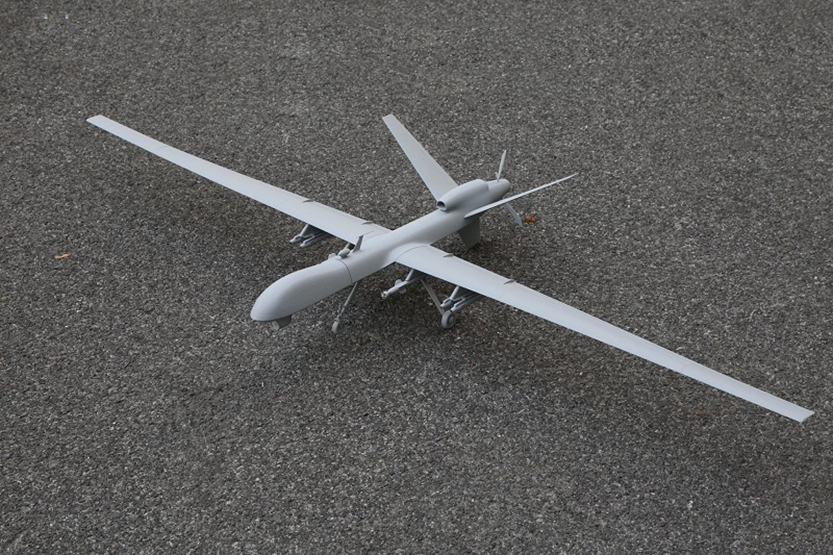
A recently obtained photograph of a Hammad-3 drone, which is domestically manufactured by the Yemeni resistance. Having a range of some 1,500 km, it was successfully deployed against military installations in Dubai and Saudi Aramco infrastructure in the eastern part of Saudi Arabia, forcing a hurried withdrawal of all official UAE forces in the Yemeni theater of war. Specifically designed to hit a preprogrammed target, and not radio-controlled like a cruise missile, this drone is nearly invisible to sophisticated radar-tracking systems, giving the resistance a strategic advantage in prosecuting the war to the heartland of the aggressors.
There are unmistakable signs that Saudi-backed militias in Yemen see the writing on the wall and realize the war is lost. This is reflected in the defections that are taking place from their ranks. On August 23, it was reported that Lieutenant Colonel Maqbul ‘Ali Ghanim Qahtan, commander of artillery in the 156th Brigade in Jawf Province, had joined the Yemeni armed forces. His soldiers joined him and they all surrendered their weapons to Ansarallah fighters, pledging to join the resistance to defend Yemen from the invaders. Not long ago, 2,000 mercenaries from the pro-Hadi forces had fled, abandoning their posts, according to Brigadier General Sari‘.
When defections in the ranks of fighters begin, they have a demoralizing effect on other soldiers. This is what is happening to Saudi-backed militias that have also started to fight among themselves.
In the southern port city of Aden that has been under the control of Saudi-led forces, fighting erupted between pro-UAE and pro-Hadi forces. While the UAE has withdrawn the bulk of its forces from Yemen realizing the futility of the war and knowing full well it cannot be won, they have continued to support a breakaway faction calling itself the Southern Transitional Council (STC). Headquartered in the Atiq district of southern Shabwah Province, pro-Hadi militants were reported to have taken control of the UAE-sponsored STC, according to a report by al-Jazeera TV network last month.
The STC struck back soon thereafter. On August 20, STC militias seized two military camps near Zinjibar, capital of Yemen’s southern province of Abyan. Militants loyal to Yemen’s fugitive ex-president Hadi controlled the two camps before they were overrun by the STC. Muhammad Salim, a commander of the pro-Hadi forces in Abyan, was killed during clashes with the STC, according to reports from the area.
Saudi Arabia and the UAE are supposedly allies in the war on Yemen but militias loyal to them regularly get into fights reflecting disarray in their ranks. The STC appears determined to break away from the rest of Yemen recreating the Southern Yemen Republic as it was before the two parts merged in 1990.
It was this fear of break-up that prompted the United Nations Special Envoy for Yemen Martin Griffith to warn the Security Council on August 20 that war-ravaged Yemen faced the threat of breaking apart. He said that unless an agreement ending the persisting conflict was found immediately, “the fragmentation of Yemen is becoming a stronger and more pressing threat.” He added, “The stakes are becoming too high for the future of Yemen, the Yemeni people, and the wider region. Yemen cannot wait.”
The disparate militias in Yemen are essentially mercenaries paid for by Saudi Arabia or the UAE. Until the latter’s forces were present in Yemen, their southern puppets were kept in check through large handouts. They were corralled into fighting the Yemeni resistance forces. With the bulk of UAE forces withdrawn from Yemen, the various militias have turned their guns on each other.
Far from installing the fugitive ex-president Hadi back in power, the Saudi-led coalition has brought Yemen to the brink of disintegration. Its repercussions will be felt in Saudi Arabia as well. The Ansarallah fighters have vowed that they intend to reclaim the southern part of Saudi Arabia that was illegally occupied by Saudi forces in 1934. The provinces of Jizan and al-Asir are Yemeni territory that they want back.
The way the war is progressing, that cannot be ruled out. That may also put paid to the oppressive rule of Bani Saud. They have caused havoc not only in the Kingdom but also in the rest of the Muslim world and even beyond.