Showing posts with label Houthis. Show all posts

Saturday, November 23, 2019

Saudi Arabia’s Paradigm Shift In Dealing With Yemen’s Houthis

Destruction caused by a Saudi-led coalition airstrike in Sanaa in August 2017
By Khalid Al-Karimi
Saudi Arabia has lately adopted a fresh policy on dealing with Yemen’s Houthi group. Over the last five years, the Saudi-led Arab collation has failed to win the battle, and a military victory in Yemen remains a remote possibility.  Changing course, then, appears to be urgent and unavoidable given the fact that the five years of ground fighting and airstrikes have proven ineffective and counterproductive.
Now, Saudi leadership has opted for talks with the Houthis, whom the Saudis view as a proxy of Iran. The Kingdom has also considered the Houthis a terrorist organization and an outlawed militia, but now it is willing to engage in talks with them in a bid to stem their destructive attacks and repeated border incursions.
While the Saudi-Houthi talks are an optimistic sign, it will not be a magic wand for putting out the flames of a war that rendered Yemen as home to the worst humanitarian crisis. This rapprochement is a double-edged development. It is likely to stop Houthi attacks on Saudi vital facilities, but the Houthis will also benefit politically.
The ongoing negotiation is led by Oman, a Gulf country that has remained neutral since the eruption of Saudi-led conflict in Yemen. According to recent reports, the Saudi-Houthi talks revolve around a buffer-zone along the Yemen-Saudi border, and reopening Sanaa International Airport which stopped operating in 2016 when Saudi Arabia shut it down, except for limited humanitarian and United Nations flights. Saudi Arabia also wants the Houthis to end their ties to Iran and dismantle their ballistic capabilities.
The Saudis are interested in rapprochement with the Houthis especially in the wake of the Houthi September attack on oil giant Aramco, and the inability of the Saudis’ sophisticated defense system, including the patriot missiles, to defend it, and and the Abqaiq and Khurais oil installations. The attacks knocked out almost 50 percent of the Aramco’s production plants. At the time, Houthis confidently assumed responsibility for the attack, saying they can launch more should Saudi Arabia continues its military operations in Yemen, particularly airstrikes.
The Saudi-led Arab coalition’s original plan to wipe out Houthi influence in Yemen. However, Anwar Gargash, minister of foreign affairs of UAE, a leading member of the Arab coalition fighting the Houthis in Yemen recently pointed out that the Houthis will have a role in Yemen’s future. “Houthi militias have wreaked havoc on the country, but they are a part of Yemeni society and they will have a role in its future,” he said. Such a statement would not have been said a couple of years back.
Concerning rapprochement
The Houthis are seemingly not yet prepared to put their weapons down, retreat from some locations, or make substantial concessions to the U.N.-recognized Saudi-backed Yemeni government. But the group may acquiesce to stop sending missiles to Saudi territories as long as Saudi Arabia discontinues airstrikes on Yemen and allows reopening Sanaa International Airport.
The internationally recognized Yemeni government has opposed the recent Saudi-Houthi behind-the-scene talks. The government deems any direct Saudi-Houthi dialogue as a gain for the Houthi movement and a disregard for the government legitimacy. Abdel-Aziz Jubari, an adviser of President Abdu Rabbu Mansour Hadi, said they were not informed about the start of talks between their Saudis and Houthis. The concern, he added, is that the Saudis could reach a deal with the Houthis and leave territories including Sanaa under the Houthi control. “That would be a grave mistake and the Saudis would deeply regret it.”
At the same time, since the conflict began ion 2015, the Yemeni government has failed to find a political or military solution and the ensuing humanitarian crisis has complicated this quagmire. Meanwhile, it is at loggerheads with the southern separatists, who recently signed a Saudi-sponsored power-sharing deal in Riyadh.
The bottom line is that any Saudi-Houthi talks will intend to address the tactical concerns of both sides, but it will not necessarily mean lead to a wider peace in Yemen. Instead, all parties to the conflict should engage in unconditional serious peace talks and lay the groundwork for lasting and comprehensive solution.
Khalid Al-Karimi is a freelance reporter and translator. He is a staff member of the Sana’a-based Yemeni Media Center and previously worked as a full-time editor and reporter at the Yemen Times newspaper.

Thursday, October 03, 2019

Yemeni Defenders’ Shock and Awe Resistance

Hit on Saudi Aramco sends chills through global colonial hegemony

Brecht Jonkers
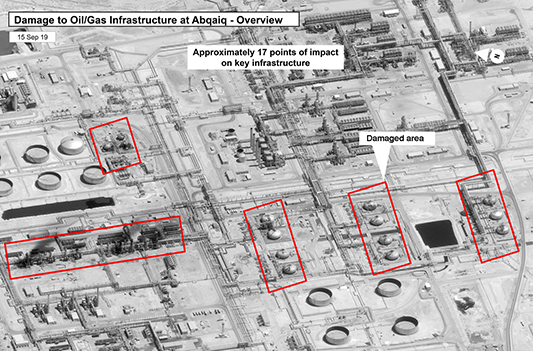
On September 14, the world experienced a shockwave. The mujahidin of Yemen struck the world’s largest oil refinery complex in a highly successful drone strike on Abqaiq and Khurais in Saudi Arabia.
It is not possible to overstate the importance of the strike on Saudi Aramco facilities in the grand scheme of things. Yemen has been a forgotten and underreported conflict ever since the Saudi-Emirati-US alliance invaded the impoverished country in March 2015. It is a war so vile, so destructive, and so bereft of any justification, that the imperialist mainstream media outlets have decided to not even try to justify it. Rather, they have opted for silence. Ignore it and people will not notice, is their policy.
For four and a half years, the aggressors have subjected impoverished Yemen’s civilians to constant bombings. Nearly half of the country’s landmass has been occupied. There is constant infighting and mass murders in the occupied east and south of Yemen. The Saudi-UAE invaders provide open support to terrorist organisations such as al-Qaeda and Da‘ish. Despite all this being known publicly, there is barely a peep in the major media outlets of the US, UK, or the rest of Europe.
But all that changed in one swift operation by the forces of the National Salvation Government of Yemen, often called “the Houthis” by the imperialist media. As many as 10 drones were reported to have struck the Abqaiq and Khurais petroleum refineries. The economic damage to the Kingdom is devastating. More than half of the petroleum production and export of the Wahhabi state was cut down in a single day, making Riyadh lose out on as much as 5.7 million barrels of crude oil exports daily.
According to specialist consultancy agency Energy Aspects, the Saudi kingdom also suffered a setback of 18% in natural gas production and as much as 50% in ethane and liquified gas output. The massive decrease in available crude oil, combined with damage to the refinery, have had the additional effect of causing a shortage of refined petroleum products. These are needed to repair and run the refinery’s machinery.
In stark irony, Energy Aspects reported that it is highly likely that Saudi Arabia, the kingdom founded because of oil and entirely dependent on it, will be forced to import gasoline, diesel and fuel oil just to keep its own oil-based economy afloat.
While the royals and their ministers in Riyadh guaranteed that the Abqaiq and Khurais facilities were up and running again by September 16, experts estimate that full recovery will take at least two weeks. That is, if no further retaliatory strikes are carried out from the land of Sheba. That does not take into account the hydrogen sulphur that has been released by the fires when the strike occurred. This is likely to directly reduce the efficiency of pumping installations.
The results of the Yemeni retaliation against their invader’s bread and butter were felt around the world. Oil prices jumped by no less than 20% on the global markets, forcing the US to announce a release of its own strategic petroleum reserves in order to avoid a major economic disaster.
Aerial image of the points of impact of Yemeni retaliatory drone/ cruise missile attack on Saudi oil production infrastructure at Aramco facilities in Abqaiq, 9-14-2019. Reports now coming in from investigators indicate this was a sophisticated attack, perhaps taking months to plan, and waiting on the ideal conditions to execute: lead drones first took out the US Patriot radar installations and then follow on cruise missiles hit the intended targets. The accuracy of the drone/ missile strikes suggests that oil workers sympathetic to Ansarullah, or Yemeni agents posing as workers placed cell phones in appropriate places to act as homing beacons. Regardless, the fact that the US, with its billion dollar surveillance equipment and satellite technology, still has not determined where the drones/missiles came from over ten days after the attack took place, and could not protect the economic lifeline of the entire developed world indicates that US power is no longer invincible and Muslim military parity is fast becoming a reality.
Naturally, accusations from Riyadh and Washington went straight to the Islamic Republic of Iran, claiming Tehran was behind the strikes. And reflecting raw racism, they claimed the proud people of Yemen are “too backward” to pull off an attack of this magnitude. However, unbiased analysis of the facts show that Yemen most definitely could, and would, retaliate against their aggressors in such a spectacular manner. The accusation against Iran was also meant to divert attention from Saudi incompetence and the failure of US-supplied billion-dollar-a-piece Patriot missile batteries to intercept incoming drones.
It must be borne in mind, this is not the first airstrike, be it by missiles or by unmanned aircraft, that the Republic of Yemen has carried out against the Najdi invaders. While counterattacks deep inside Saudi territory have been taking place ever since the start of the war, the year 2019 has seen a surge in successful high-profile retaliations.
On May 14, the Saudi regime was forced to stop pumping crude oil in its main pipelines across the country, following Yemeni drone strikes against two Aramco facilities west of Riyadh. On June 12, a missile strike launched from inside Yemen hit Abha International Airport, which was in use by the Saudi military at the time, exploding right in the arrivals hall and causing major damage. It is noteworthy that Abha is over 100 km from the Yemeni border. The airport was hit again just five days later and yet again on July 2, destroying a hangar for military planes. Together with the Saudi military airbase of Khamis Mushayt in ‘Asir province, the airport of Abha has been struck multiple times in the past few months. This reflects the total incompetence of Saudi air defence systems.
The month of August 2019 started with a double missile and drone attack against two very different Saudi targets. First, a joint missile and UAV strike at a camp of Saudi-backed mercenaries in the southern port city of Aden killed dozens of collaborators. And then the Yemeni mujahidin hit a Saudi military base in Dammam city, in the Eastern province of Saudi Arabia that is hundreds of kilometres away from the Yemeni border.
On August 17, an attack took place that can be seen as a general rehearsal of sorts for the Abqaiq and Khurais strikes. Using a fleet of drones, Yemen’s revolutionaries attacked the Shaybah oil refinery. The massive refinery unit, located no less than 1,100 km from Yemen, was chosen specifically for its proximity to the United Arab Emirates (UAE). In one attack, the Yemeni revolutionaries not only proved their capacity to strike deep inside Saudi Arabia and hit its economic lifeline, but also sent shivers down the spine of the Emirate rulers.
“The UAE must quit the Saudi-led aggression if it wants to save its glass towers,” Yemeni military spokesman Yahya Sari‘ warned in crystal clear terms after the mid-September strikes.
The Yemeni struggle for independence and liberty has been a source of inspiration for years. Yet after September 14, the war against the US-Israeli-Saudi-UAE-led aggressors has entered a new phase. It may lead to the collapse of Bani Saud’s rule over the Kingdom. Should that happen, it would be widely celebrated by committed Muslims worldwide.
 

Brecht Jonkers


Sunday, September 22, 2019

Houthis change rules of engagement with devastating attack on Saudi Arabia

By
 5Pillars

Veteran Arab journalist Abdel Bari Atwan says Yemen’s Houthi movement has completely changed the equation in its war with Saudi Arabia by taking the fight into Saudi territory in such devastating fashion.
The huge fires started by Saturday’s drone attacks on the Abqaiq and Khurais oil production and processing facilities in eastern Saudi Arabia may have been brought under control. But big questions remain unanswered about where the ten pilotless aircraft came from and how they managed to reach their targets apparently undetected and hit them with such devastating accuracy.
These were no ordinary targets. They were among the most strategically important – and one would have assumed most closely protected — locations in the country. The two oilfields and their related plants have a capacity of more than seven million barrels of crude oil per day and process some 70% of Saudi Aramco’s petroleum output.
Saturday’s attack, which at a stroke cut the country’s oil production by more than half, was the third on Aramco facilities this year. In May seven drones targeted two pumping stations on the main east-west oil pipeline and in August the massive Shayba oilfield was attacked.
In claiming responsibility for the latest (and by far most serious) drone raid, Yemen’s Houthi Ansarullah movement offered possible partial answers to the above questions.
Houthi spokesman Yahya Sarie’ said the operation was carried out after a “careful process of intelligence surveillance” of the sites. He did not elaborate about how and by whom this surveillance was carried out, nor did he comment on this apparent breakthrough in the Houthis’ intelligence capabilities.
Neither did he explain how, if the drones were launched from Yemeni territory, they managed to make the 1,000 km-plus journey without refuelling or being detected.
He did, however, make a point of praising “honourable and freedom-loving people” inside Saudi Arabia for their contribution to the operation. This sounded like a reference to the participation of members of Saudi Arabia’s persecuted Shia minority, who are concentrated in the Eastern Province in the attack, or at least in the intelligence/surveillance process that preceded it.
The drones seem unlikely to have been launched from within Saudi Arabia itself. It would have been very difficult to smuggle such large devices into the Kingdom or assemble them there. They were probably fired from a neighbouring country: Iraq is increasingly being identified as the most likely source (the drones that struck the east-west pipeline were also widely reported to have come from there).
There has also been speculation they may have been clandestinely launched from Bahrain, or from a ship sailing off the Saudi Gulf coast.
Resistance Axis
But the precise source of the missiles is immaterial. Since the start of the Saudi-led war on Yemen, the Houthis have become increasingly closely aligned with the regional “Resistance Axis” comprising Iran and Syria and their allies in Iraq, Lebanon and other Arab countries. They no longer attempt to conceal this: their envoys now visit Tehran openly and their leaders express pride about their relationship with the Islamic Republic.
Sarie’, meanwhile, warned that Ansarullah’s list of targets inside Saudi Arabia is “growing by the day,” meaning that more such attacks can be expected until Riyadh ends its war and lifts its blockade of Yemen.
This warning should be seen in the context of two other highly significant warnings that were issued in recent days: the declaration by Hassan Nasrallah, leader of Lebanon’s Hezbollah, that his movement has new options available for countering U.S. attempts to cripple it and its allies; and the reaffirmation by Iranian leader Ali Khamenei’s advisor Ali Akbar Velayati that if his country is prevented from exporting oil through the Persian Gulf, no other country will be allowed to do so either.
The Houthis are closely aligned with Iran
The Houthis have changed the rules of engagement. The message they delivered with the latest attacks is, in their own words, that they will continue striking targets deep inside Saudi Arabia until the country’s leadership realises that “killing more Yemenis will not force them to their knees.”
Saudi fire-fighters may have put out the flames in Abqaiq and Khurais. But the dense smoke from the fires continues to shroud the region, and to conceal, at least for now, many questions about the future of the struggle raging in the Middle East, not just in Yemen but throughout the region.
In the meantime, a question is worth asking: Who is going to buy a stake in Saudi Aramco now? The Saudi government is desperate to offer shares in the giant corporation for sale. But even if they ever go on the market, how much will they fetch? Is it as coincidence that the attacks were launched just as Riyadh was stepping up efforts to proceed with a share offering?
Those unsophisticated mountain-dwelling Yemenis are clearly not as stupid as their enemies think.

Monday, July 01, 2019

Saudi War on Yemen: The Victims Strike Back

Yemeni high-tech weaponry destroys invaders’ strategic assets

Brecht Jonkers
Yemen’s defenders keep stacking up victories, pushing back the invaders from both Saudi Arabia and the United Arab Emirates (UAE) on all fronts. Not only are the Saudi-led attackers and their mercenaries pummelled on the southern frontline of Yemen, they are also being pushed closer to the key port city of Aden. In the north, deep inside Saudi territory itself, the Yemeni Armed Forces and Popular Committees are scoring significant victories across a broad front, liberating large swaths of Najran and Jizan from Saudi control. The word “liberating” is definitely applicable here, for although the two aforementioned provinces are officially part of the Saudi kingdom, they are a key part of Greater Yemen that were occupied by the Wahhabi hordes as recently as 1934, after being part of Yemen for millenia.
While Saudi Arabia may have the most technologically advanced military in the Arabian world, and the UAE may arguably be one of the richest states in the world, they are both wholly incapable of taking on Yemen, the poorest country in the Muslim East. A veritable Vietnam War scenario seems to be unfolding in the south of the Arabian Peninsula, in which sheer determination, tenacity, and faith in Allah (swt) are triumphing over the material power of the invaders.
Over the past month, the valiant defenders of the land that was once known as Blessed Arabia have taken massive steps forward. It has become impossible even for those who support the genocidal Saudi invasion to ignore their exploits.
And there is one place under Bani Saud rule that will never forget what the wrath of Yemen feels like: Abha International Airport, in Saudi Arabia’s ‘Asir province.
In the early hours of the morning on June 12, the civil airport, which had been co-opted for military use by the Saudi air force, was struck with a precision strike by the Yemeni Missile Forces. A completely new and unheard of cruise missile developed in utmost secrecy by the Yemeni Armed Forces, blew up the control tower of the airfield and put it out of commission.
The success of the mission was undeniable. Soon after the attack, images surfaced online of flight schedules to Abha being changed and planes headed for the airport being rerouted or forced to return. In clear contrast with the mass murders that routinely go hand in hand with Saudi air strikes in Yemen, the pinpoint accuracy of the strike on the tower resulted in zero mortality. Less than a week after the attack, even Saudi state media admitted that a devastating retaliation strike had indeed taken place.
The official spokesman of Ansarullah, Muhammad ‘Abd al-Salam, reacted to the missile strike in crystal clear and foreboding words, stating that “The continued aggression, the blockade, the closure of Sana‘a Airport, the [Saudi] rejection of a political solution and peaceful choices make it imperative for our people to defend themselves.”
As much of a shock as the launching of the cruise missile on Abha was, the humiliation that the Saudi airbase would suffer was far from over. Just two days after the missile strike, Yemen launched a drone strike directly targeting and destroying the radar system of Abha Airport. The attack was carried out using Qasif-2K drones, which are rigged to self-destruct and rain down shrapnel at their target. This is a relatively cheap but hugely effective guerrilla tactic that Yemen has used for years. Abha International Airport, now without its control tower and radar system, was rendered utterly incapacitated, and the Saudi regime was completely humiliated.
The following day (on June 15), another wave of Qasif-2K drones hit both the airport of Jizan and Abha once again. At Jizan airport, the control room of Saudi unmanned aerial vehicles (UAVs) program was destroyed, whereas in Abha the Yemeni drones destroyed a petrol station. Both airports were later confirmed to have been temporarily put out of service, as attested to by air navigation monitoring centers.
Yet for all the damage that has been inflicted on the Saudi war machine, it was still not over. As if to defy imagination, the Yemeni Armed Forces struck again on June 17. And not only did they carry out another unmanned aerial attack, they also succeeded in hitting the exact same Abha International Airport again. And just like happened twice before in the course of less than a week, air traffic to and from the ‘Asir provincial capital was temporarily, but completely, halted.
On June 19, Yemen’s defenders launched yet another cruise missile, this time striking a major Saudi power plant in al-Shaqiq area of Jizan province. The missile strike caused extensive damage to the plant, in yet another retaliation for continued Saudi war crimes.

File photo of a Qasif-2K combat drone that was developed domestically by the Yemeni army. Speaking during a press conference in the capital Sana’a, Brigadier General Yahya Sari‘ said Yemeni drones had attacked Saudi positions at the airports in Jizan and Abha, destroying the control room for Saudi unmanned aerial vehicles program. He added that these new drones could accurately strike designated targets with a large payload of explosive materials. Saudi Arabia and a number of its worldwide allies launched a devastating military campaign against Yemen in March 2015, with the aim of crushing the country’s Huthi Ansarullah movement. To date some 90,000 Yemenis have been killed and a record 22.2 million are in danger of starvation by the end of the year.
On the same day, dozens of Saudi troops and foreign mercenaries were killed in a Badr-F missile strike that struck right in the middle of a military gathering in Najran. Reports stated that dozens of ambulances were seen rushing to the scene to tend to the wounded, confirming how successful the strike was.
On June 20, the official spokesperson of the Yemeni Armed Forces, Brigadier General Yahya Sari‘, announced that Jizan International Airport had once again been attacked by Yemeni combat drones, this time striking the hangar bay of Saudi unmanned aerial vehicles. It is a fitting irony that the once feared drones of the US-Saudi war machine, so often used to target civilians and non-military infrastructure in Yemen, are now being destroyed by a new and highly efficient series of Yemeni unmanned aircraft.
The abundance of highly efficient and precise Yemeni air strikes taking place in such a short period of time, has fulfilled the promise that the Leader of the Yemeni Revolution, Sayyid ‘Abd al-Malik al-Huthi made in April, when he vowed that vital Saudi facilities would be attacked if the invaders did not cease attacking Hodeydah.
On June 20, Yahya Sari‘ issued this threat once again in crystal clear terms, warning that the missiles and drones of Yemen can strike anywhere in Saudi Arabia at any time. “We have advanced technologies that US-made and other interceptor systems deployed in Saudi Arabia cannot deal with,” the general warned, adding that “Our strikes will not be confined to just ‘Asir, Najran, or Jizan.”
It cannot be overstated just how important it is to stress that despite all the odds Yemen is winning the war. It may defy comprehension to many news pundits and self-declared analysts across the world but Yemen will be victorious, insha’allah.
Yemen is proof of the truth that the Majestic Qur’an tells us in Surah al-Nisa’, “And Allah knows best who your enemies are; and none can supervise as Allah does, and nonce can give support as Allah does” (4:45).

Monday, January 07, 2019

Yemen peace talks are destined to fail because of Saudi Arabia and the U.S.

By
 
Yousef Mawry

5Pillars

More than 10,000 people have been killed since the war started in 2015.
Any meaningful peace talks in Yemen are destined to fail due to the wider agenda of regional and international powers, namely Saudi Arabia and the United States, writes journalist Yousef Mawry.
The ideal of journalistic objectivity is a mere joke when trying to accurately report about the war in Yemen; an insult to human intelligence and the lives of millions of Yemenis who are suffering in the conflict.
Objective journalism has become the total opposite of what it was intended to be. Most “journalists” who are actively covering the war in Yemen, are merely repeating the opinions of the global elite without taking any moral position to check powers, provide context and perspective and pursue the hard truth.
Not adhering to these core morals and principles when reporting the war in Yemen will result in journalists becoming a mouthpiece for the hegemonic powers and a conduit for deception. This is why the world today remains in a state of dilemma trying to decipher who is right and who is wrong, who is good and who is bad when it comes to the players on the ground in Yemen.
The issue is when reporters are desperately trying to maintain the “objective position” they eventually stop telling the truth in fear of being accused of taking sides and being labeled pro-Houthi or pro-Saudi.
One of the main reasons why the war in Yemen is entering into year five is because of the recycling of misinformation spewed by reporters on the ground and abroad who care more about gaining social media followers then telling the Truth, with a capital T. If your argument is “well no-one really knows what the truth is” then you haven’t done your job as a reporter.
To try and shed some light on the overall conflict, here is my assessment of the balance of power in Yemen and why negotiations will ultimately fail. This is based on my research, analysis, opinion and years of experience reporting in Yemen.
Why peace negotiations in Yemen will fail
Any UN-backed peace deal between Houthis and the government of President Abdrebo Mansour Hadi can and will be used against the Houthi movement to justify military actions against them now or in the future.
The conflict in Yemen is not between the Houthis and the “Yemeni government.” Realistically, there is no Yemeni government. The internationally recognized government led by embattled President Abdrebo Mansour Hadi is nothing more than a Saudi political entity that was put in power to maintain and preserve the interests of Saudi Arabia and the western powers just like the previous government of former ruler Ali Abdullah Saleh.
The Houthi takeover of the Yemeni capital in 2014 was a direct overthrow of the Saudi backed government. Saudi Arabia reacted the same way it would have if a major Saudi city was taken over by a foreign country. There is no new information here. It is common knowledge that President Abdrebo Mansour Hadi is in the pocket of the Saudi royal family. The war started because the Houthi movement removed a Saudi puppet from power not because they overthrew a legitimate Yemeni government. If that was the case, Saudi Arabia wouldn’t have got involved in the first place since it had no horse in the race. There are those who believe that the Houthi takeover of Sana’a is an Iranian takeover which forced Saudi Arabia to get involved militarily, but for now, let’s just stick to what we do know and not dwell in parroting the allegations by Saudi Arabia.
The Saudi-led coalition’s agenda is to eventually get the Houthis to withdraw their forces from Hodeidah, Taiz, and Sana’a so that the coalition forces can then launch a military offensive by land, air and sea to try and pin the Houthis to the north of the country.
The international community recognizes the government of President Mansour Hadi as the legit authority in Yemen. They view the Houthis as an armed rebel movement that took power by force. They also claim the Houthis are an Iranian backed group that takes its orders from Tehran. The United Nations does, however, recognize the Houthis as a political group who have the right to participate in the formation of a new Yemeni government but they should not have their own military that could tip the scale of power.
The fact is, the United Nations and the Western-backed Arab states know very well that true power lies with the group who has the military power. The UN and Saudi Arabia are hell-bent on getting that power transformed to a “friendly government” – one that will maintain Saudi and US interests in Yemen.
The war is heading into its fifth year because the Houthis don’t seem to play by their rules. The Houthis are defying world powers by sticking to their guns and declaring from day one they will not lay their arms down until Saudi Arabia and its allies accept the new reality in Yemen. And that is the reality of an independent Yemeni nation that calls its own shots, make its own deals and trades and doesn’t answer to the US or Saudi Arabia.
You know, kind of like the right of every free nation. But reversing the decades of colonial servitude comes with a hefty price, and the Yemenis seem to be paying for it with their lives as the war continues.
Whoever controls Hodeidah province will have the upper hand in the war
If the Houthis withdraw their forces from Hodeida, it will then be used as another base for coalition forces to advance towards the Yemeni capital and try eliminating the Houthis.
The seaport of Hodediah is the economic lifeline for Yemen. Whoever manages the port controls 90 percent of the country’s food and medical supplies. Its closure could lead to starvation and famine. The “World’s Worst Humanitarian Crisis” in Yemen is a direct result of the imposed blockade on the port by the Royal Family. They did this with the aim of destabilising the economy and starving the people so the Houthis can be blamed for this and eventually lose creditably among the Yemeni population in the north. If the Houthis withdraw their forces from Hodeidah, as stipulated in the new peace agreement, the siege will be lifted. But there is a card being played here. This is an insidious plan by the coalition forces and their allies to 1. Get the Houthis out of Hodeidah, and 2: Alleviate the humanitarian crisis so that when they launch an all-out military operation against the Houthis there will still be a route for humanitarian aid to enter the country. If this happens the coalition forces will have the green light to continue military offensive without having to worry about the international community condemning them for starving millions of Yemenis.
The Houthis will not relinquish control of the Yemeni capital
The Houthis are prepared for war if negotiations fail. With that in mind, should they compromise military power and control over strategic areas if everything seems to be threading towards a fallout in negotiations?  Withdrawing their military forces from Sana’a would be like putting a gun to their head.
The Houthis know that Saudi Arabia and its allies will not hesitate for an instant to remove them from power by force if the opportunity grants itself. No matter what happens during negotiations, the Houthis will not hand over their weapons or withdraw from the Yemeni capital.  In point blank, unless Saudi Arabia is willing to accept losing control of Yemen the war will continue one way or the other.
Iran will support any regime change that is not controlled by Saudi Arabia
Iran supported the revolution against Ali Abdullah Saleh in 2011 and supported the Houthi revolution against President Abdrebo-Mansour Hadi that began in 2014. But this support was political and through media coverage. There is no evidence to prove that Iran has in any way directly supported the Houthis militarily. One frequently hears that Iran is sending weapons and money to the Houthis, but that is physically impossible considering the Saudi-imposed blockade from land, air, and sea. Before the blockade, the coalition government was in power and it would have foiled or seized any armed shipments from Iran to the Houthis.
The only thing Iran could benefit from with a regime change is economic gains. Iran wants to boost its economy and it needs to open trade with countries in the region who don’t take their orders from Saudi Arabia. If a pro-Houthi government is in power you can expect the two countries to trade with one another which could improve the economy for both nations. This would really anger Saudi Arabia.
In the four years of war, the Houthi movement has only gotten stronger and has gained more popularity across the country. Hate them or love them, the new reality in Yemen is the Zaydi group are the most dominant force on the ground and will most likely run the political affairs of the country. They have won the fight on the ground and now the negotiations table is set for a precarious game of chess.
Yousef Mawry is a Yemeni-American journalist who was formerly based in the Yemeni capital of Sana’a. He has nearly 10 years of professional experience and has his own media office where he produces, edits and directs short films and documentaries.

Saturday, December 22, 2018

With Truce Already Violated by Saudis, Yemenis Ask What Peace Talks Actually Achieved

“Although [the talks in Sweden were] the first successful negotiation, an agreement without the reopening of the Sana’a International Airport, the paying of government staff salaries, and the neutralization of the Central Bank is meaningless.” — Yemeni journalist Mohammed al-Asadi


SANA’A, YEMEN — (Report) Last week’s peace talks in Sweden between the Saudi-led coalition and Yemen’s Houthis was cause for celebration for many the world-over who hoped to finally see an end to Yemen’s bloody war. But many of Yemen’s people hedging their bets and have expressed frustration over the results of the week-long talks in Rimbo, talks that leaders on both sides of the conflict viewed as a victory.
Mohammed Fayed — a 45-year-old displaced father originally from the Saada province, who now resides in Sana’a — told MintPress that the agreement reached in Sweden could not end three years of war on Yemen, especially in Hodeida.
Mohammed al-Asadi, a Yemeni journalist, said:
Although it was the first successful negotiation, an agreement without the reopening of the Sana’a International Airport, the paying of government staff salaries, and the neutralization of the Central Bank is meaningless.”
The failure to reopen the Sana’a International Airport has been a sticking point in negotiations and, according to many Yemenis, will result in the deaths of thousands of innocent civilians — including children — in Yemen’s northern districts, as the airport is one of the primary conduits used by Yemenis to travel abroad for critical medical care unavailable in Yemen. The Saudi coalition has imposed a years-long blockade on the Sana’a Airport.
Before the war began, thousands of Yemenis traveled abroad — mostly through the Sana’a Airport — for medical treatment each year; 60 percent of the patients were women and children. Saudi Arabia’s ongoing blockade of Yemen includes medical supplies and means that the number of patients requiring life-saving overseas treatment will grow.
On Saturday an 11-year-old boy, Mohammed Nasser, died a result of kidney failure. He was unable to travel out of Yemen through the southern districts that are under Saudi-led coalition control. Like Mohammed, about 200,000 patients in the south districts — including cancer, heart, and renal-failure patients — need to travel outside of Yemen to seek life-saving treatment.
Saudi coalition representatives have insisted on relocating Yemen’s international airport to coalition-controlled Aden, relegating the Sana’a International Airport to local use instead of reopening it as an international airport.
For their part, the Houthis have offered to have Yemeni planes flying through the Sana’a Airport inspected in Jordan and Egypt, as they consider Saudi coalition-controlled city of Aden unsafe for opponents of the coalition. The Houthis say that reopening Sana’a International Airport is an important humanitarian objective, necessary to transport sick and wounded residents as well as food supplies.
Many civilians have been unable to return to Yemen through the coalition-controlled southern districts after leaving the country to seek medical treatment abroad. Some patients have been prevented from returning home and others have reportedly been arrested, tortured or even killed under the pretext that they supported the Houthis or oppose the presence of the coalition in Yemen.  
With agreement not reached during the peace talks in Sweden, the issue of the reopening of Sana’a International Airport was postponed until January 2019 when another round of talks is planned. This caused great frustration for many Yemenis, who hoped the talks would result in the lifting of the coalition’s blockade on the Sana’a Airport.
“The country with the biggest problem in 2019 is going to be Yemen,” said Mark Lowcock, the head of the UN Office for the Coordination of Humanitarian Affairs (OCHA), in a press conference in the Swiss city of Geneva on Tuesday.  
Peace talks in Sweden also failed to produce agreement on the paying of government staff salaries and the neutralization of the Central Bank. The Saudi coalition took over the central bank in the early days of the war and has blocked the paying of salaries for Yemen’s civil servants, exacerbating the humanitarian crisis in Yemen, already the worst in the world.
Mohammed Jahaf — a 28-year-old civil servant employed by the Yemen Economic Corporation in Sana’a who, like two million other Yemenis, faces destitution, as his salary has gone unpaid for more than two years — saw the peace talks in Sweden as a waste of time.

Analysts and ordinary Yemenis differ of value and success of talks

Despite their unpopularity among residents in Yemen, the Rimbo talks are regarded by most Yemeni analysts as having progressed better than anticipated. These observers see Rimbo as an encouraging breakthrough after four years of deadly impasse and hope the talks will pave the way to progress on Yemen’s major humanitarian issues.
Numerous prior negotiations between Yemen’s Ansar Allah and the Saudi coalition have failed, including peace talks in Switzerland earlier this year that failed spectacularly after the Saudi-led coalition refused to allow the evacuation of wounded Houthi personnel for treatment abroad. Previous talks also broke down in 2016, when 108 days of negotiations in Kuwait failed to yield a deal.
The Houthis see the Rimbo agreement as a victory for the Yemeni nation, as the Saudi-led coalition was obliged to sit for talks with Ansar Allah, the political wing of the Houthis. Houthi chief negotiator Mohammed Abdulsalam says the truce is a defeat for Saudi Arabia as it forces them to stop their aggression, allows existing local protectors who thwarted the Saudi offensive to be in charge of Hodeida, and allows the Yemeni nation to regain access to food, medicine, and other basic supplies.
The agreement essentially places the strategic port city of Hodeida under the military control of the UN; and, while Houthi military forces will withdraw from Hodeida city and the port, they will retain political control of the city. The Saudi-led coalition and its local mercenaries, on the other hand, must withdraw from all sites in southern Hodeida that have been occupied during the coalition military campaign that began in June.
The Houthis also see the talks as an end to international isolation, as they have for the first time been given international recognition and a seat at the table with other nations. They have also shown that they have been steadfast in the face of the military invasion from one of the most well-funded and well-equipped military alliances on earth and are still willing to extend their hands towards peace with the enemy.

Peace in Yemen may be elusive

Some Yemenis have accused the Houthis of making concessions to Saudi Arabia and abandoning Hodeida, while others believe they made sacrifices necessary to alleviate the suffering of the people. Ahmed Saif Hashed, a member of Yemen’s parliament, went so far as to accuse the Houthis of abandoning Yemen’s popular revolution in return for participation in a national government
Other Yemenis see the outcome of peace talks in Sweden as simply being confidence-building measures, the first steps to ending the dire humanitarian situation. They see the talks as actually having netted very little, as profound differences still remain. The unresolved issues of humanitarian corridors, a prisoner swap, and the reopening of the defunct Sana’a International Airport still remain and, functionally, the only breakthrough achieved in the talks was over the fate of Hodeida.
Even the agreement over the control of Hodeida has been subject to much disagreement. While both sides have agreed to a UN role in the port, they differ on who should run the city. The Houthis want Hodeida declared a militarily neutral zone, saying they retain political charge of the city, but Saudi-backed forces argue political control of the city is a matter of “sovereignty” and that they should be handed political control.
Deep-rooted political divisions also remain around the presidency, a united government, early elections, the outcome of the National Dialogue Conference (NDC), a weapons handover, the building of a single national army, and future relations with the countries currently fighting in Yemen. These multiple divisions combine to make peace elusive in the near term according to many observers.
Others say the willingness of both sides to show flexibility in Sweden reflected their zeal for ending, or at least alleviating, the suffering of Yemeni people — saying that the cooperation will open a window to further constructive talks in January and better understanding between the warring parties to end the war.  Mohammed Fayed, however, believes that peace in Yemen will be achieved only if international pressure on the Saudi alliance continues.
The starvation, death, and epidemics that are rampant in Yemen cannot be resolved without addressing the Saudi role in causing them. At a time when Yemen’s former government of Abdrabbuh Mansur Hadi views Saudi Arabia and the United Arab Emirates as friends and allies, most Yemenis see them as an occupying enemy.
For the time being, these considerations have been put on the back burner as the fragile ceasefire in Hodeida has already been shattered. Since peace talks ended last week, the Saudi-led coalition has already conducted 50 airstrikes and Saudi artillery has fired more than 300 mortar shells into Hodeida’s residential areas, killing five more civilians.
Top Photo | A man reads al-Thawra newspaper at Souq al-Melh marketplace in the old city of Sana’a, Yemen, Dec. 11, 2018. Yemen’s warring sides agreed Thursday to an immediate cease-fire in the strategic port city of Hodeida, where fighting has disrupted vital aid deliveries and left the country on the brink of starvation in the 4-year-old civil war. Hani Mohammed | AP
Ahmed AbdulKareem is a Yemeni journalist. He covers the war in Yemen for MintPress News as well as local Yemeni media.

Saturday, November 17, 2018

US, Britain Push Yemen Ceasefire as Tactic to Defeat Houthis

US, Britain Push Yemen Ceasefire as Tactic to Defeat Houthis
FINIAN CUNNINGHAM 

At first glance, it may seem like a positive move. The Trump administration and London are both putting pressure on Saudi Arabia and the United Arab Emirates to implement a ceasefire in Yemen’s atrocious war. Washington and London are also calling for warring sides to enter into peace negotiations within a month.
What’s wrong with that, you may ask? Well, as Houthi rebels who took over Yemen at the end of 2014 are saying, the country has been under aggression for the past three years from a Saudi-led coalition supported militarily by the US, Britain and France. The unrelenting war on the poorest country in the Middle East has led to the world’s worst humanitarian crisis in decades, with over half of the population – some 14 million people – at risk of starvation, according to the UN.
Therefore, the appropriate legal and moral course of action now is not merely a ceasefire or talks. It is for the Western-backed Saudi, Emirati coalition to immediately halt its criminal aggression against Yemen. In short, stop the foreign interference in Yemen’s sovereign affairs.
US Secretary of State James Mattis and Britain’s Foreign Minister Jeremy Hunt appear to be impelled by humanitarian concern for the massive human suffering in Yemen with their recent calls for cessation of hostilities.
But a more nuanced reading of their exhortations suggest that the real concern is to burnish the blood-soaked image of the Saudi coalition that their governments support, and, secondly, to inveigle the Houthis into a negotiations framework that will result in undue foreign influence over Yemen’s politics.
Last week, Washington announced that it was suspending mid-air refueling flights for Saudi and Emirati warplanes that have been pounding Yemen since March 2015, which has resulted in a horrendous death toll among civilians. The indiscriminate killing of the Saudis and Emirati air strikes has been amply documented, albeit downplayed by Western media. The latter keep repeating a figure of 10,000 dead in Yemen – a figure which has bizarrely remained unchanged for at least the past two years. The real death toll from air strikes is unknown but likely to be near 50,000.
American, British and French military support for the murderous operations in Yemen should have stopped months, even years ago, if official humanitarian concerns were genuine.
The question is: why the sudden effort by Washington and London, as well as Paris, to call for a ceasefire and follow-on political talks?
One factor, no doubt, is the barbaric murder of Saudi journalist Jamal Khashoggi by assassins linked to the House of Saud. Turkish authorities believe that Khashoggi was brutally murdered in the Saudi consulate in Istanbul on October 2, his body hacked to pieces and dissolved in industrial-strength acid. Audiotapes obtained by the Turkish authorities have implicated the Saudi Crown Prince Mohammed bin Salman in the murder plot against the dissident journalist.
The gruesome details of Khashoggi’s killing and the blatant lies that the Saudi rulers have issued to cover up their barbarity have heaped immense pressure on Washington, London and Paris over their close ties with the House of Saud. Public outrage has demanded that sanctions be imposed on Riyadh, such as cancelling multi-billion-dollar arms deals.
It seems significant that the acute disgrace over the appalling Khashoggi affair and the association of the US, British and French governments with such a despotic Saudi regime has in turn prompted these Western powers to mount a damage-limitation exercise in public relations.
This is where the Yemen war provides an opportunity for the Western powers and their Saudi clients to salvage their tarnished public image.
By pushing for a ceasefire in Yemen, Washington, London and Paris can claim to be “getting tough” with the Saudis for the sake of alleviating “humanitarian suffering”. By appearing to respond to the Western calls for a ceasefire, the Saudis can then also claim they are relenting out of humane concern.
However, such pleas have not stopped Saudi and Emirati-backed militia on the ground besieging the Yemeni port city of Hodeida on the Red Sea, for which 80-90 per cent of the entire population in the country rely on for food and other vital supplies. In other words, the Western-backed Saudi coalition is using starvation tactics to bring the Houthi rebels and the wider Yemeni population to their knees. That is a monstrous war crime.
What Mattis is calling for in terms of ceasefire is for all heavy weapons in Yemen to be put under the control of United Nations peacekeepers. Washington is also demanding that the Houthis rebels withdraw from the country’s border with Saudi Arabia, from where the rebels have mounted missile attacks which have gravely harassed the Saudis, including in the capital Riyadh. The Houthis have struck Saudi territory in response to the air strikes.
So, what the Americans, British and French are striving for is, firstly, a respite from the sordid publicity over the Khashoggi killing. If the “humanitarian appeal” over Yemen succeeds to placate Western public outrage, then these governments will be able to continue business-as-usual selling the Saudi regime lucrative weapons contracts.
Secondly, by drawing the Houthi rebels into “peace negotiations” that will also burnish the Western and Saudi public image, as well as – equally importantly – forcing the rebels into accepting a compromise on their revolutionary government. By entering negotiations with the Saudi-backed remnants of the exiled Yemeni leader Mansour Hadi, the Houthis will inevitably have to accept making concessions and allowing an accommodation with the ousted, discredited regime.
Mansour Hadi, who has been living in exile in Saudi Arabia since the Houthis seized power, was reviled by most Yemenis for his corruption and being a puppet of the Saudis and Americans. His exiled clique is routinely and mendaciously referred to by Western media as the “internationally recognized government of Yemen”.
When he fled the country in ignominy in early 2015, the Houthi rebels had succeeded in spearheading a popular revolt. The rebels profess a branch of Shia Islam, but there was every indication that they had a relatively democratic program for pluralist governance.
The Saudi and American sponsors of the ousted Mansour Hadi reacted to the overthrow of their puppet by launching an air war on Yemen in late March 2015 – a war which has continued unremittingly ever since, with Britain and France also joining the profitable slaughter by suppling warplanes and missiles.
Another lie told by Western media is that the rebels are proxies of Iran, a lie which is used to “justify” the Western-backed criminal war against the country. Iran supports the Houthis diplomatically, but there is no evidence of arms supplies. Even if there was, so what? That wouldn’t justify aerial bombardment of the country and its people.
The devastation inflicted on Yemen and its people has largely been ignored by Western news media. Despite the lack of coverage, the Western public have nevertheless become aware of the horror and their governments’ complicity. Harrowing images of skeletal children dying from starvation and lack of basic medicines have shamed Washington, London and Paris into taking some action, however despicably inadequate and long overdue.
The recent impetus for a ceasefire and talks in Yemen coming from the US and its Western allies is not due to humanitarianism. It’s a cynical PR exercise to whitewash bloodied images – both theirs and that of their Saudi client regime. The Yemen war has been shown to be a sickening charnel house in a futile bid for Western regime change against the Houthi revolution. By forcing the Houthis into negotiations, the Western powers hope to achieve their regime change objective by another tactic – and gain PR capital at the same time.
If Washington, London and Paris were really serious about ending the suffering in Yemen, they would simply demand that the aggression stops immediately, so that the Yemenis are allowed to determine their own political future without foreign interference. But the Western powers will not do that because their interference in Yemen, along with the Saudis, is the very reason why this criminal war of aggression started and grinds on.

FINIAN CUNNINGHAM

Finian CUNNINGHAM
Former editor and writer for major news media organizations. He has written extensively on international affairs, with articles published in several languages