Showing posts with label Women. Show all posts

Sunday, September 29, 2019

Trump Is Deserving of an Impeachment Inquiry, Many Times Over

"At some point, we have to stand up to him and let him know that the line has been drawn, and you will go no further."


Trump has been accused of rape, sexual assault and sexual harassment by at least 24 women. (Photo: Jim Watson/AFP/Getty Images)
House Speaker Nancy Pelosi has launched an impeachment inquiry against President Donald Trump. “The president must be held accountable,” she announced Tuesday. Pelosi has been pressured for months on impeachment, from congressional and grassroots progressives. An intelligence community whistleblower raised concerns over a phone call last July that Trump held with Ukraine’s new president, Volodymyr Zelenskiy, pushing more moderate Democrats to support an impeachment inquiry. Trump admitted that he asked Ukraine to investigate his political rival, former Vice President Joe Biden, and his son Hunter Biden, and ordered withholding of Ukrainian aid. Such behavior may rise to the “high crimes and misdemeanors” standard for impeachment. But isn’t Trump already deserving of an impeachment inquiry, many times over?
The policy agenda that Donald Trump is pursuing based on climate science denial amounts to an impeachable offense.
On May 17, 2017, less than three months into Trump’s presidency, Democratic Congressmember Al Green of Houston was the first to take to the House floor calling for Trump’s impeachment. Within days, Green, who is African American, was receiving death threats. One voicemail threatened: “You ain’t gonna impeach nobody, you [bleep]. Try it, and we’ll lynch all you [bleep]. You’ll be hanging from a tree.”
On Wednesday, the day after Pelosi announced the impeachment inquiry, Green, appearing on the “Democracy Now!” news hour, agreed that the Ukrainian issue was an impeachable offense. “I would also mention the emoluments clause,” he added, “with the president benefiting from persons who are staying in his hotels. … I would also never forget the racism, the bigotry, the xenophobia, the homophobia, the Islamophobia.”
The case for an emoluments impeachment is ever-growing, it seems. Foreign delegations and lobbyists regularly stay at Trump International Hotel in Washington, D.C., and spend lavishly there. Ukrainian President Zelenskiy, according to the declassified transcript released by the White House Wednesday, let Trump know that he stayed at Trump Tower in New York’s Central Park.
Trump has been accused of rape, sexual assault and sexual harassment by at least 24 women. These accusations alone certainly provide cause for an impeachment inquiry. Trump has retaliated against many of these women, threatening to sue them or crassly insulting them as not his “type.” Trump himself has admitted, on the notorious “Access Hollywood” tape, that he forces himself on women. “When you’re a star … you can do anything,” Trump said.
The authority to wage war, to direct the U.S. military to kill people, is the presidential power that demands the most intense oversight, by Congress and by the public.
The policy agenda that Donald Trump is pursuing based on climate science denial amounts to an impeachable offense. He is accelerating environmental destruction, leading to irreversible, catastrophic climate change. The Trump administration pulled out of the Paris climate agreement, and tirelessly rolls back environmental regulations while boosting the extraction and sale of fossil fuels. “We are in the beginning of a mass extinction, and all you can talk about is money and fairy tales of eternal economic growth. How dare you,” 16-year-old Swedish climate activist Greta Thunberg said, ferociously reprimanding the adults gathered at the United Nations Climate Action Summit Monday. Showing up at the summit for 14 minutes, Trump mocked Thunberg on Twitter, saying she looked like “a very happy young girl looking forward to a bright and wonderful future.”
The authority to wage war, to direct the U.S. military to kill people, is the presidential power that demands the most intense oversight, by Congress and by the public. Trump ran for president promising to withdraw from foreign wars, but has delivered the opposite. Recently in Afghanistan, the U.S. launched a drone strike that killed 30 civilians—pine nut farmers resting in the shade—and participated in a nighttime raid that killed an estimated 40 civilians, prolonging the longest war in U.S. history.
Trump continues to support Saudi Arabia’s devastating bombing of Yemen that has killed thousands of civilians. A recent Saudi bombing of a community college killed at least 109 people there. Millions of Yemenis are at risk of starvation in what is described as the world’s worst humanitarian crisis. Congress has twice passed bipartisan legislation to block arms sales to the Saudis, which Trump has vetoed. He has also ordered more troops to Saudi Arabia to protect its oil facilities and lavishes praise on Saudi Crown Prince Mohammed bin Salman. Oct. 2 marks the first anniversary of the brutal murder and dismemberment of Washington Post columnist Jamal Khashoggi in a Saudi Consulate in Turkey, which the CIA concluded was ordered by bin Salman. Trump’s warmongering is an impeachable offense in itself.
Trump’s refusal to support gun control legislation, mass shooting after mass shooting; his prolific lying; his relentless attacks on the press; his elimination of critical programs in our social safety net; his discrimination against trans people in the military and in schools; his Muslim ban, his separation of families and caging of children—all are worthy of an impeachment inquiry. As Congressmember Al Green said, “At some point, we have to stand up to him and let him know that the line has been drawn, and you will go no further.”

Thursday, June 27, 2019

Story of First Muslim Woman Who Cycled the World

By
 IFP Editorial Staff

Poupeh, an Iranian lady who has gone down in history as the first Muslim woman to have cycled around the world, recounts how her wanderlust and love for peace pushed her to begin a solo journey to different world continents with a bicycle.
Poupeh Mahdavi Nader began a journey fifteen years ago by cycling around the world which took her about one year and a half, 16 months and 4 days to be exact.
Mahdavi Nader has become the first ever Muslim woman who has cycled around the world. She also served as a peace envoy in the first conference of the International Peace Youth Group in South Korea in 2004. She was given the Champion of Peace by the UNESCO in 2007.
Also in 2007, Poupeh made a one-week attempt in the US Congress to prevent the closure of Yahoo accounts in Iran. Here you can read an excerpt of Shahrvand newspaper’s interview with the Iranian cyclist.
Q: Tell us about your travels. How did you decide to turn into a world tourist?
A: I used to tread Iran on foot at age 20 to 22. Since my childhood, I had two dreams in mind: Becoming a world tourist and then owning a two-storey house with one storey for myself and the other one serving as an orphanage. One of my dreams came true soon. But the other one was traveling around the world. So, I began mountaineering seriously in my 20s and went to mountains in my free time. Then I began to tread Iran on foot with a backpack.
Q: Let’s talk about the turning points of your travels. At age 28, you decided to travel around the world. Please tell us about your experiences while cycling around the world.
A: Before beginning my journey, I consulted with Dr. Sharyar Rouhani. He advised me to follow up my dream, saying if you don’t go after your dreams, you would deeply regret in your later life. That was enough for me because I got my reply. So, I immediately began my planning and embarked on my journey with the main theme of: In the Name of Love, Friendship and Global Peace.
Q: Money plays a key role in such project. How much money did you have?
A: Yes, I had to find a sponsor. I spent eight months to find a sponsor but all to no avail. I went to a bicycle store and said I can make advertisement for you in exchange for a free bicycle. My offer was rejected. So, I borrowed some money to buy a bicycle and began my long journey with only 350 dollars.
Q: The US launched its war on Iraq exactly on the same day that you decided to start your journey. Did the subsequent insecurity ever discourage you?
A: It seems to me that it was the Almighty God’s miracle that a girl who decided to embark on such a long journey was named Poupeh, was a Shiite Muslim from Iran, and the journey coincided with a deadly war. The war was enough to dissuade a person and put her or him into trouble. But if you do your best and ask God to help you, you will become successful. When the war broke out, most of my friends called me to dissuade me. When I decided to begin my journey, the TVs showed footages of American soldiers walking along the Turkey- Iraq border. I could face them within three weeks. I didn’t want to begin my journey and cut it short immediately. So, I waited for another 14 days and finally decided to begin the journey not through Turkey or Greece. I purchased a plane ticket to Italy and flew there and called for a meeting with Pope John Paul II. Finally, I managed to meet Cardinal Renato Martino who served as the chairman of Vatican’s Pontifical Council for Justice and Peace. I thought it would be the best step for achieving peace: to visit the center of Christianity in the world as a Muslim woman and begin my journey from there.
Q: Tell us about your itinerary.
A: I travelled to Italy, France, the Alps, the UK, America, Saudi Arabia, India, Nepal, China, Tibet and South Korea.
Q: It is said that during your trips, you usually hold some courses training people how to make cheap trips.
A: Yes. Since I have the experience of making journeys with the lowest cost, I like to share them with people who are interested in traveling. I teach them how to make money during their journey and survive harsh conditions.
Q: As a person who has visited most countries in the world, have you ever wanted to live in another country?
A: When I arrived in northern California, the Iranian diaspora there thanked me for what they called brining honor to all Iranians and gave me a full scholarship. They also promised to provide me with a house and a good car and job. But like all other people, I only live once, so I decided to remain in my own country.

Tuesday, April 16, 2019

Workshop on Women’s Studies Discusses Feminism, Hijab and Objectification of Women

Exploring themes as important in today’s world as feminism, the neo-liberal and radical kinds of it, capitalism and how it exploits women’s labor, a nine-day workshop was held in Qom, Iran at the University of Religions and Denominations. This program was organized by the international department of URD by the joint efforts of the Director General of the International Relations and Cooperation, Dr. Mahdi Salehi and the Director of International Short Courses, Dr. Zahra Sharif.
This workshop, titled Women’s Studies in Islam and Iran, invited participants from several countries, the most prominent of which were Germany, Austria, Switzerland, Australia, Lebanon, Macedonia, Tunisia, Pakistan and Iran. The VP of Iran in Women and Family Affairs, Dr. Masoumeh Ebtekar, delivered a speech in the opening ceremony of the workshop, followed by a visit to the university’s library.
The themes touched by the professors all focused on women as an integral part of the society and how different cultures and religions perceived them. Professor Günter from Albert Ludwig’s Universitat Freiburg, Germany discussed with the participants the modern role models that the media and culture present for women in comparison with Islamic teachings and Mrs. Abedi spoke about the status of women in Iranian literature and arts. Dr. Badreh, a faculty of the Islamic Azad University in Tehran, lectured about Islam and feminism, discussing how gender justice and equity were preferred in an Islamic point of view over gender equality and similarity.
Opening ceremony via URD
The most distinguished lecture of the session, however, was by Dr. Mohammed Sami’ee from the University of Tehran. Dr. Sami’ee discussed modern day orientalism, capitalism and how it affects family life. He discussed imperialist ideas, making reference to Rudyard Kipling’s The White Man’s Burden and how women and family structures occupied central roles in the reforms imposed by imperialist powers. Family, he stressed, was something that suffered the most at the hands of modern-day capitalism. He explained how the West’s idea of liberalizing women promoted such suffering of family life, all in the favor of the capitalists to profit from. Fatima Nesr, a Lebanese-German participant of the course from Albert-Ludwigs remarked that:
“In my opinion, the biggest problem women face is that they are not aware of their value and that is not dependent on the country or the culture you live in. In general, as Dr. Sami’ee said, in today’s world women are sold as commodities and that’s how they grow up. They will always have in mind that they have to look a certain way and behave a certain way otherwise they’re not ‘good enough for the market’ and that is a huge problem.”
Another important lecture was delivered by Professor Liselotte Abid from the University of Vienna on the topic of veiling and modesty in different religions. She pointed out that hijab wasn’t something unique to Islam. Rather, it was practiced by Christians and orthodox Jews in pre-Islamic periods. She made references to the portraits of different Christian and Jewish religious figures including Saint Anna, Saint Mary and others. A visit to the Institute of Research on Women and Family was also scheduled, in which the participants met with Dr. Alasvand and listened to her talk about the status of women in the first three Islamic centuries. Other important lectures included talks on the status of women in Islamic legal system by Dr. Tofiqi; women’s social activities during the Islamic Republic era by Dr. Shakuri Rad; women in Iranian media by Dr. Qasemi; chastity in religions; gender in the Qur’anic narratives by Dr. Dehqan and women and higher education by Dr. Hoseini Muqaddam and Dr. Fereiduni.
Dr. Rifaat Lenzin, a participant of this course and a lecturer at the University of Berne, Switzerland remarked that: “For me, as a Muslim based in Europe, the Iranian approach to the topic of women’s rights and feminism was most interesting. As a scholar of Islamic studies, I profited most from the lectures on gender in Qur’anic narratives and of the status of women in the Islamic legal system.”
Dr. Luna Farhat, affiliated with the Islamic University of Lebanon said that these lectures “gave an insight on the modern status of women in Iran [and] also presented approaches that differ from the ones given by western scholars.”
This workshop also consisted of a cultural tour of Esfahan, Matinabad and Tehran to give the participants a brief insight into the Iranian culture and traditions, which the participants seemed to like a lot.
“This country will always stay in my memory not only because of its beautiful mountains, unique and breathtaking canvas and extraordinary buildings or ability or art but mostly because of its people, their kindness and their hospitality,” remarked a participant after the tour.

Iran, Indonesia call for boosting ties in women’s and family affairs


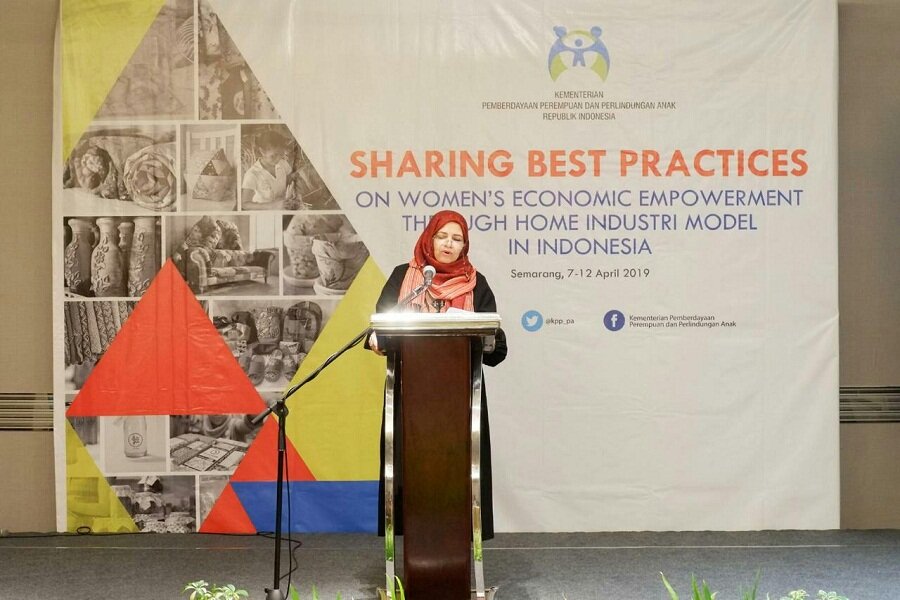
TEHRAN – The Indonesian Ministry of Women Empowerment hosted the first meeting for implementing the memorandum of understanding signed by Iran and Indonesia in women’s and family affairs.
Zahra Javaherian, a senior advisor to President Hassan Rouhani, attended the meeting which was held at the Indonesian city of Semarang, IRNA reported.
During the five-day meeting, which started on April 8, the two sides exchanged information and experiences on women’s empowerment and developing women’s activities in economic affairs.
Officials from the Interior Ministry, Ministry of Foreign Affairs, and the Red Crescent Society participated in the meeting.
Increasing life expectancy in women from the age of 56 to 75, decreasing maternal mortality rate, women’s empowerment in economy and removing gender inequalities in women’s affairs are among the measures done by the Islamic Republic of Iran during the last 40 years, elaborated Javaherian. 
An amount of $46 million for women’s insurance and developing women’s employment share of management positions is also allocated, she added. 
The MOU was signed by Iranian Vice President for Women’s and Family Affairs, Masoumeh Ebtekar, and Indonesian Minister of Women’s Empowerment and Children Protection, Yohana Susana Yembise, in Iran, in July 2018.
The MOU aims at empowering women, supporting children and promoting the resilience of family based on equality, respect and mutual benefit.
The MOU includes 9 clauses with the purpose of developing women’s role in policymaking and supporting women and children against violence.
It also follows the aim of increasing women’s role in business and technology, especially information technology, promoting women’s economic empowerment in the family and exchange of experiences about women and children.
The MOU is valid for two years and can be extended for the same period.

Monday, March 11, 2019

Int’l Women’s Day: Celebrating women’s resilience in the face of adversity

By Syed Zafar Mehdi

TEHRAN _ On Friday, February 08, International Women’s Day was observed across the world with a solemn pledge to espouse the cause of women’s empowerment and women’s rights.
The day was marked by street rallies, conferences, award ceremonies, protests and lengthy statements from world leaders, human rights campaigners and others.
Social media was flooded with messages from netizens, highlighting the importance of acknowledging and celebrating the achievements of women and addressing the challenges that persist.
In Western countries, the day is marked every year with tremendous fanfare, even though terms like ‘women’s empowerment’ and ‘women’s rights’ have different connotations there, which most often are not in sync with the ideas of empowerment, freedom and rights in our part of the world.
In Middle East and South Asia, the day often reminds of women’s day-to-day struggles and the kind of insurmountable odds they have to overcome to achieve their dreams.
In most of these countries, the challenges facing women are primarily because of foreign invasions, military occupations, age-old stereotypes and denial of basic rights.
Yet, these gritty women have smashed odds and made their presence felt in different spheres.  
“Happy International Women's Day for Palestinian women who have fought Israeli apartheid, brutality, and aggression with their bare hands,” tweeted ‘Women for Palestine’, with hashtag #FreePalestine.
It is pertinent to note that women in Palestine have been at the forefront of struggle for liberation of occupied territories from Zionists. They have paid the heavy price of defiance but haven’t given up.
In Afghanistan, where the U.S.-led war and occupation has stretched into its 18th year, women have over the years broken the shackles of patriarchy and become a force to reckon with.
“Happy International Women’s Day, especially to brave Afghan women that have been bearing the brunt of political shenanigans, primitive culture and senseless war for decades in Afghanistan,” wrote a Twitter user Fatima.
Many Afghan women took to Twitter and Facebook on Friday to speak against the lack of women’s representation in ongoing ‘peace negotiations’ between Taliban and U.S. officials.
In an interview with Tehran Times last week, former Afghan parliamentarian Farkhunda Zahra Naderi said lack of women’s participation in the peace process will render it useless and ineffective.
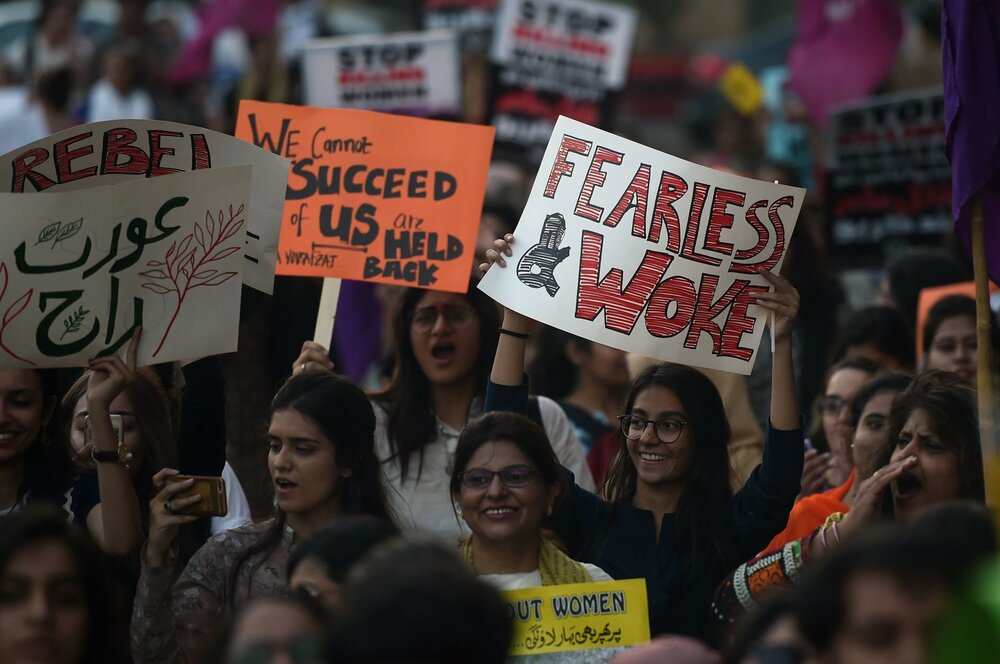
In Pakistan, International Women’s Day was marked by nationwide ‘Aurat March’ (women’s march) on Friday, the objective of which was to celebrate the achievements of women and protest against the continued violence against them.
“Happy International Women’s Day to all the wonderful women around the world. These two strong and incredible women whom I adored the most. Epitome of women struggle in Pakistan are missed immensely today,” tweeted Ariba Jalbani, sharing pictures of former Pakistani premier Benzair Bhutto and human rights activist Asma Jehangir, both of whom were killed by terrorists.
Meanwhile, Krishna Kumari Kohli, a lower-caste Hindu woman elected as Pakistan’s senator chaired a session of the Pakistani parliament to commemorate the International Women’s Day.
In India, where #MeToo movement grabbed headlines recently, in which many women came out with harrowing stories of sexual harassment at workplace, the day was observed quietly.
However, in a startling move, India’s Supreme Court granted bail to Babu Bajrangi, who had been convicted for his involvement in anti-Muslim pogrom in Indian state of Gujarat in 2002.
“Babu Bajrangi getting bail today is the best tribute our judiciary can pay to women on the eve of International Women’s Day. Well done, India,” tweeted Bobby Naqvi, editor at GulfNews.
In Yemen, women continue to press for their participation in peace negotiations between the various warring factions.
“Women & children make up 75% of internally displaced people in Yemen and yet have no voice in peace negotiation. On #InternationalWomensDay help lift their voices,” tweeted one Maysam Ali.
In Saudi Arabia, women have been silently suffering for decades, as they are denied basic rights and their voices are muzzled with coercion and intimidation by the Kingdom’s rulers.
Many women are languishing in jails without trail. On Friday, Walid Alhathloul wrote an article in The Guardian, calling for the release of his sister from Saudi captivity.
“International Women’s Day, we celebrate the many achievements of women and stand together to demand equal rights,” he wrote. “My sister, Loujain, is one of these brave gender equality activists – and for that she is now in jail. She has dedicated her life to gaining basic women’s rights in our home country of Saudi Arabia, focusing mainly on the women’s driving ban, male guardianship and domestic abuse.”
Alhathloul said her sister has spent the last 10 months in a Saudi jail and has been subjected to “brutal torture and sexual harassment”.
“This International Women's Day, support the fierce women who are challenging the status quo in Saudi Arabia & have lost their freedom because of it. Make a fierce choice, fight with them,” tweeted Amnesty.
In Kashmir, women have been the worst victims of conflict over the past thirty years. There are thousands of widows and half-widows (women whose husbands disappeared) today.
“What can one say on Women's International Day when average Kashmir women' life, their children, their home and hearth, their privacy, their dignity, their calm, their safety and security all lie in tatters,” wrote Prof. Hameeda Nayeem, a prominent civil society activist in Indian-held Kashmir on her Facebook.
“I could only pray to God to liberate us from the current situation so that we could also sing songs in unison with the free and advanced women of the world,” she added.

Sunday, March 03, 2019

US Women Activists Blast Trump for His Anti-Iran Policies

Visiting Tehran, members of an anti-war NGO based in the US criticize the Washington administration for abandoning the multilateral 2015 nuclear deal and re-imposing bans on Iran, saying such a move is the outcome of extensive lobbying by the Israeli and Saudi regimes, America’s staunchest allies in the Middle East.
Speaking at a press conference in Tehran’s Milad Tower on Wednesday, activists from Code Pink: Women for Peace, a grassroots peace and social justice movement working to end US funded wars and occupations, denounced Washington’s anti-Iran policies, which are backed by the regimes in Tel Aviv and Riyadh.
“Both Israel and Saudi Arabia did tremendous amount of lobbying to try to stop the Iranian nuclear deal from being signed. The Israelis got as a compensation more of our tax dollars and the Saudis got as compensation US support for the destruction of Yemen,” said Medea Benjamin, Code Pink co-founder.
Here are some photos from our ongoing peace delegation to . Follow along with our daily blog posts here: http://codepink.org/iranblogs   
82 people are talking about this
Tensions intensified between Tehran and Washington last year, when President Donald Trump unilaterally pulled the US out of the nuclear accord, officially named the Joint Comprehensive Plan of Action (JCPOA), and unleashed the “toughest ever” sanctions against Iran.
Since then, the US has been trying to coerce the Europeans into following its lead and withdrawing from the nuclear accord with Iran.
Elsewhere in her remarks, Benjamin raised the alarm at the possibility of a new war in the Middle East.
“We are worried about the US going to war with Iran, we are worried about the US bombing Iran. We are worried about another disastrous war in the Middle East and we don’t want to be party to that,” she said.
“We don’t want to be involved in another war. It is almost 20 years now that the US has invaded and occupied countries in the Middle East. It’s been such a disaster for the people of this region. we don’t want to see it get even worse,” she added.
Ann Wright, another Code Pink member, condemned illegal American sanctions and vowed efforts towards changing the Trump administration’s hostile approach on Iran.
“We do not want our government in the United States to be having the sanctions put on Iran. It’s the United States who abrogated the framework agreement treaty. We are here to say to the Iranian people we are going to work hard in the United States to get our government to change its policies,” she said.
Earlier this week, Code Pink activists met with Iranian Foreign Minister Mohammad Javad Zarif and students at University of Tehran.

Sunday, January 20, 2019

Why are so many Muslim women able to relate to feminism?


HAMZAH ZAHID

The answer is partly that genuine inequalities have not been addressed in Islamic terms, though they could well have been.
Feminism and Islam is a hot topic. Some Muslim women are finding a platform to voice their exasperation with today’s Muslim community, claiming it be to patriarchal and in places misogynistic. In doing so, many of our sisters have synergised with a feminist discourse, using it to bolster and construe their critique. A counter-narrative has emerged from some Muslim men, which asserts that feminism is a corrupting force and we should be wary of it.
Thus, a debate has emerged on the yays and nays of feminism. Is it Islamic? Does it take someone closer or further away from Allah? Are current interpretations of Islam patriarchal?
As fascinating as these questions are, I propose that we step back and ask a different question; why are so many Muslim women able to relate to feminism?
Somebody who is critical of feminism may well answer by saying that Muslim women are being swayed by a Western narrative on women’s rights and are thus moving away from what is perceived to be an Islamic narrative. Perhaps there’s some truth to this. However, it is not the only explanation.
Another answer, one that is seldom considered, is that many Muslim women have been alienated by their own community. They have been denied many important rights (lack of access to mosques, centres of knowledge, scholars etc.), and crucially, they have not seen the current discourse (or lack thereof) in the Muslim community as sufficiently addressing this problem. There are plenty of statements floating around – ‘Muslim women are queens’, ‘Islam liberated women 1,400 years ago’, but given the above examples, the manner in which parts of the Muslim community treat women is contradictory to these statements.
It is this incongruity that has beautified feminism for Muslim women; it’s a narrative which calls out inequality, and grants companionship in a shared struggle. In other words, they have found in feminism what they were not able to find in the discourse of today’s Muslim community. This is why some Muslim women have taken so well to feminism.
This is quite a shame, because many of these inequalities have already been spoken about openly in Muslim communities centuries before feminism existed. For example, Ibn Hazm (d. 456 AH/1064), the great Andalusian jurist wrote a treatise of the lawfulness of women praying in the mosque. His opinion would put him at odds with many mosques today. Likewise, we know of a huge number of female hadith scholars – Shyakh Akram Nadwi has documented at least 9,000 female hadith scholars over Islamic history. So clearly Muslim societies have allowed, if not encouraged, women to access and even pursue knowledge.
One can find many such examples of discussions and debates over the course of the Islamic community. All of these have comfortably been discussed within an Islamic narrative. Today however, these issues are now seen as being debates instigated by feminism. If the Muslim community had done a more thorough job of bringing to light these previous discussions, would as many Muslim women associate with feminism? Probably not, and yet, these inequalities could very well have been addressed via a natural and healthy discussion from within an Islamic framework. Maybe Muslim women would then never have felt the need to adopt feminism.
That isn’t to say that all of the questions raised by contemporary feminism have existed in previous Islamic discourse. Many issues are a product of modernity, and so would not have been considered. Although not all of feminism has and can be discussed within an Islamic framework, some topics that can genuinely be conducted in an Islamic discourse (i.e. with a view to obeying God and His Messenger) can and should be discussed.  This includes key inequalities, such as lack of access of mosques, unequal access to knowledge and higher moral culpability in the eyes of the community.
There are other issues that cannot be discussed within Islam, and as well as perspectives that challenge Islamic orthodoxy. One example is to delegitimise interpretations of scripture that have been upheld across centuries of Islamic scholarship, because they seem, prima facie, to be patriarchal, or are advocated by men. This is the consequence of not having addressed women’s rights adequately in the first place. The parts of feminism that are unhelpful now hold traction within the Muslim community as a result of the overall appeal of feminism, which, as we’ve seen, has in part come from not taking proper action to address women’s rights as ordained by Islam.
It is then entirely agreeable for both sides of this discussion to look to curing religious ignorance as a solution to the legitimate problems brought forward by feminism and the problematic elements of feminism. This will lead to our discourse being construed in terms of obeying God, the ultimate purpose of our existence. In our obedience to God, we will, God-willing, be better equipped to uphold God’s justice towards both men and women, whilst being better able to dodge the harmful aspect of feminism and indeed modernity at large.
Anybody who is passionate about this debate owes it to themselves and their beliefs to pursue Islamic knowledge. Fortunately, Islamic knowledge is becoming increasingly accessible, with erudite scholars creating institutes that enable both men and women to connect with our titanic scholarly history. Pursuing knowledge does not mean resigning from one’s career or issuing fatawa for a living; you can take your knowledge with you, and have it bless your daily-living with wisdom and piety. This really is the solution to this conundrum.
When we step back and ask the question of why some Muslim women associate so strongly with feminism, the answer is partly that genuine inequalities have not been addressed in Islamic terms, though they could well have been. The acceptance of feminism also brings some problematic elements that challenge the standing of Islamic orthodoxy. To prevent this, and of course to better uphold the Islamic rights of Muslim women, we must cure religious ignorance. Only then will we be able to escape the divisive polemics that threaten to disunify the Ummah even more than it already is.
“Verily, women are the twin halves of men.” (Abu Dawud, Tirmidhi)
HAMZAH ZAHID
Hamzah is currently an economist by profession. He is also a student of knowledge, studying a traditional Islamic syllabus. He combines what he learns with a very broad range of academic interests, including philosophy, sociology and psychology. He believes passionately in using a multi-disciplinary approach to vivify his understanding of Islam. 

Saturday, October 06, 2018

The Old Road; A Thrilling Drama on Violence against Women

By
 Mahdi Arman

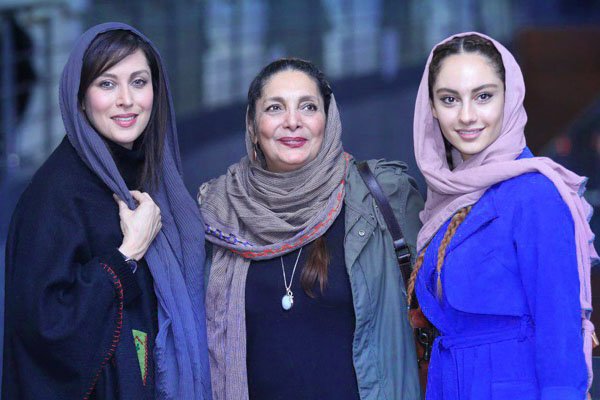
Iranian actresses Mahtab Keramani (left) and Tarlan Parvaneh (right) along with Manijeh Hekmat, the director of the film "The Old Road" (2018)
Manijeh Hekmat, a prominent Iranian filmmaker, in her latest work “The Old Road,” has addressed the social problem of violence against women, at a time when the issue has turned into a matter of discussion for thinkers around the world.
Hekmat, who has won numerous awards in Iran and other countries, has made her latest feature film about fighting violence against women, which is her main social concern.
“The Old Road” is Hekmat’s fourth feature film after being a decade away from filmmaking. In recent years, she has been working as a producer and distributor, but last year she participated in the Fajr Film Festival with “The Old Road” as the latest film as a director.
Iranian actress Mahtab Keramati, who has been a UNICEF National Ambassador in Iran since 2006, plays the main role of the film as a victim of violence. Karamati, who has a history of engagement in humanitarian activities, education of children, and awareness raising about AIDS, is the smart choice of Hekmat to play the role of a victim of violence against women in this film. The Old Road, featuring Keramati and Atila Pesyani, has been screened as of September 30 in Iranian cinemas.
In her previous works, Hekmat addressed the social problems of women in the community and family. For example, her “Women’s Prison” in 2000 won many awards.
Violence against women is one of the most important social problems and a clear instance of human rights violation. Many victims of such violence do not want to disclose it for a variety of reasons. Showing examples of such violence and making the society aware of them can be the first step to contain the social ill. Meanwhile, the media can play an effective role in informing the public.
Video Player
00:00
00:33

Mahdi Arman
Mahdi Arman is an Iranian journalist who works as the head of the Iran Front Page (IFP) news website's Business Department. He also has a special interest in the latest social and cultural developments in Iran and the world.