
By Robert Inlakesh
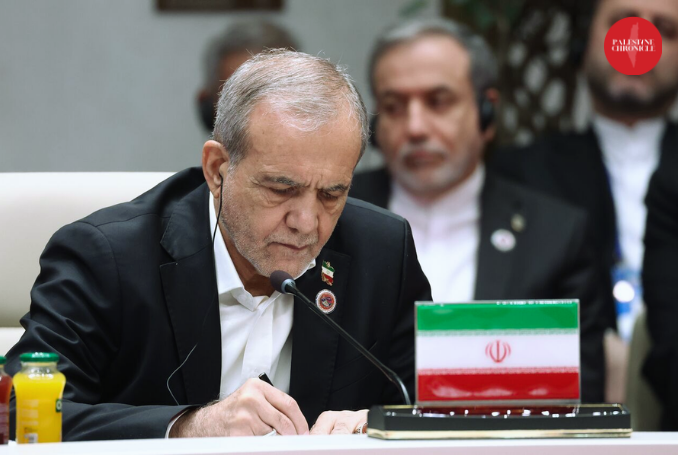 Iranian President Masoud Pezeshkian. (Photo: IRNA)
The longer the war remains in a state of tit-for-tat low-intensity war, the more time the Iranians have to prepare and are able to keep the stranglehold on the global economy.
The United States has, through its own hesitancy, fallen into a strategic trap; meanwhile, the Iranians have used the time afforded to them to replenish their munition stockpiles and work to establish dominance across multiple arenas of conflict.
On April 7, after 40 days of all-out regional war, the decision to engage in what was supposed to be a two-week temporary ceasefire came under major scrutiny from supporters of both sides. While US President Donald Trump was clearly backing down from his pledge to destroy Iranian civilian infrastructure on a massive scale, many supporters of the Islamic Republic approached the ceasefire with great skepticism.
As time has gone on, the picture has become much clearer as to what the predicament of the two sides is. While the elected Reformist government inside the Islamic Republic sought to negotiate and demonstrate rationality to international allies, the nation’s armed forces remained on high alert and never considered the war over. This process had drawn a lot of internal criticism towards the Reformist leaders, especially when negotiations with the US were ongoing.
The Trump administration, on the other hand, was caught between a rock and a hard place. A path forward either meant expanding the scope of the war or engaging in a surrender agreement. Due to the influence of the Israeli Lobby and Israel itself, the Trump administration and the President were unable to actually go through with any deal.
During the first round of negotiations, Washington would not move an inch, and thus they decided to engage in low-level hostilities. Tehran, in response, tightened its control over the Strait of Hormuz. Then, Trump declared he was imposing a blockade on Iranian ports, on top of Iran’s own blockade, a strategy that has been implemented twice and failed both times to make a difference in the Iranian negotiating stance.
When the Memorandum of Understanding was signed on June 17, this was an American acknowledgment of defeat. However, the agreement was never going to work. The main issue was the fact that Israel refused to withdraw from southern Lebanon and end hostilities on all fronts. Instead of pressuring Tel Aviv to withdraw, Washington drafted another agreement between its puppet government in Beirut and the Israelis on June 26. This agreement’s signing was the moment the MoU with Iran collapsed, because it enabled the Israeli occupation force to remain inside Lebanese territory as long as Hezbollah had not been disarmed.
What the US-Israeli alliance was attempting to do was stir internal chaos within Lebanon, creating a civil war between Hezbollah and the Lebanese Army. Donald Trump publicly called for Syrian President Ahmed al-Shara’a to invade Lebanon in order to fight Hezbollah on multiple occasions. Despite a traceable military buildup along the Syrian-Lebanese border, no such attack has occurred yet, and the Lebanese Army has not engaged in armed clashes with Hezbollah either. A similar strategy aimed at disarmament was pushed in Iraq and even in Gaza; interestingly enough, the head of the Saudi-proxy forces in Yemen, Rashad Al-Alimi, also employed the language of disarmament as a policy they sought to impose in the case of Ansarallah.
Disarmament of Iranian-allied movements has not happened anywhere in the region and isn’t as easy as using political puppets or pressure on movements through threatening their civilian populations in order to achieve this goal.
During this time, multiple exchanges of fire between Iran and the United States have taken place. While the US strikes have generally been rather lackluster, proving ineffective at changing the reality in the Strait of Hormuz and focused on the south, the Iranian responses have grown more and more intense with each round.
What is key to understand is that as this has all transpired, the Strait of Hormuz has been almost totally closed since early March of this year. The US has drained its Strategic Petroleum Stockpiles and despite countless attempts at market manipulation, gas prices continue to skyrocket.
With the US unable to commit one way or another, another major development has also occurred: the war in Yemen has again escalated, and this time the Ansarallah-led government’s forces are making rapid advances. Saudi Arabia previously exported around 6 million barrels of oil per day through the Red Sea, but this has now been almost entirely cut off and made much more expensive when they do manage to use the Suez Canal route.
Bab al-Mandab is now closed to Saudi shipping; the Strait of Hormuz is almost completely closed also, as the United States continues to simply wait things out. The economic pressure game is one that, quite frankly, the Iranians know how to endure much better than their opponents.
Therefore, the US is now being squeezed and must make some kind of a decision soon. It cannot simply wait around, going in circles, indefinitely. No amount of declarations of victory from Trump are going to change his situation. This means, in simple terms, that he either escalates the war or ends it.
Escalating the war on Iran is only going to be done in one major way, that is going after the Iranian State’s civilian infrastructure. This was the original intention of the Israelis when encouraging this war in the first place; they sought to cripple Iran. Militarily, there is no option that the US or the Israelis have that will secure a victory; the only means of “winning” they will have any chance with is to cripple the nation’s infrastructure and then hope that this will eventually lead to a Syria-style collapse of the State.
For the US, the reason why they have been so hesitant in taking this step is that they understand the consequences of such a move. Iran will retaliate to such strikes by going after the vital infrastructure belonging to key US allies across the region and can easily devastate them. Tel Aviv views this possibility as positive as it will cripple their economic competitors, but will have to calculate just how much damage it is able to sustain to its own infrastructure before it is too late.
There is then the other option that could be on the table, which demonstrates severe desperation: the use of tactical nuclear weapons. Conventional weapons have failed to properly destroy Iran’s nuclear facilities and missile cities, so the use of unconventional weapons may be on the table. If this happens, it also may fail to achieve the desired results, which means that Pandora’s box will have been opened with no real way to achieve a follow-up. Evidently, this is the most extreme outcome possible, and its probability is unknown.
In the end, the United States government has failed to defeat Iran and its allies. The big problem is, the decision to acknowledge that defeat is not likely to be made in Washington, but instead in Tel Aviv. Israel doesn’t feel as if enough has yet been done and it has not itself been sufficiently deterred from another round of all-out war.
Donald Trump and his administration are totally incompetent, which is why the war should truly be viewed as the Iran-Israel War. Yes, the United States has the capabilities to make it possible, but there is a total absence of real leadership in Washington. When the Israelis feel as if they are done with the war, it will likely come to a close.
The longer the war remains a tit-for-tat, low-intensity conflict, the more time Iranians have to prepare and maintain their stranglehold on the global economy. Regardless of whether the Islamic Republic’s leadership had planned things out this way or not, they remain the side holding all of the cards.

– Robert Inlakesh is a journalist, writer, and documentary filmmaker. He focuses on the Middle East, specializing in Palestine. He contributed this article to The Palestine Chronicle.

No comments:
Post a Comment