Showing posts with label iran sanctions. Show all posts

Saturday, August 31, 2019

From the perspective of China, Iran is a major partner: Adib-Moghaddam

By Javad Heirannia

TEHRAN-Professor Arshin Adib-Moghaddam, Chair of the Centre for Iranian Studies at the London Middle East Institute believes that “From the perspective of China, Iran is a major partner, not only in terms of hydrocarbon imports, but also because of a comparable strategic vision of a multipolar world order and a new EurAsian century which is behind the One Belt initative.”
Professor in Global Thought and Comparative Philosophies and Chair of the Centre for Iranian Studies at the London Middle East Institute, also adds that “Hence, China will try to facilitate any type of trade with Iran, whenever possible.”
Here is the full text of the interview:
Q: We have recently witnessed the resignation of German Designated head of Europe-Iran trade entity (INSTEX). In this regard, the long overdue implementation mechanism will be postponed again. Don’t you think that the resignation happened so that the Europeans can buy enough time?
A: I think the European Union has a genuine interest in keeping the JCPOA alive and INSTEX has been an important mechanism to that end, despite its flaws in terms of the financial incentives for Iran. Indeed, what we are witnessing is a firm EU-centred stance on the Iran file, which is what we have advocated for a long time. The EU needs to work in accordacne with its own interests, rather than following what every US administration says. This seems to be happening now, and Iran is a major object of that new orientation in international politics. Of course, Iran needs to keep its side of the bargain to make that diplomacy work.
Q: Is it possible that the special purpose vehicle for trade with Iran goes behind commercial export of pharmaceutical, medical devices and agri-food goods and covers oil trade? As you know Al-Monitor cited three anonymous sources as saying French President Emmanuel Macron had raised the establishment of a $15 billion credit line.
A: The details can only be worked out, once INSTEX is operative. President Macron has pursued important diplomatic initiatives, and as he has an interest in safeguarding the JCPOA, as indicated, he will try everything possible to that end.
Q:  How do you evaluate the future of INSTEX as the US has threatened to put sanctions on foreign companies if it goes behind food and medical supplies?
A: The ability of the United States to enforce these sanctions is questionable. In general, Iran should not overestimate US power which is waning pretty much all over the world, not least because of the misguided policies of the Trump administration. This is a fact and easily discernable for scholars of global history and world politics.
Q: US extended Iran nuke sanction waivers for 90 days. What are the reasons behind this decision?
A: The inability to enforce sanctions as indicated. Current US policies towards Iran must be interpreted as a marketing ploy. Once one looks through the advertisement, the mediocrity of the displayed product becomes visibile.
Q: Iran’s Arak reactor renovation is China’s responsibility. But if chines want to import the redesigning equipments (from Europe), they do need more time. It seems that 90 day wavers will reduce China’s power of risk taking and prevent it from doing the commitments. Do you think that Beijing will take the risk?
A: Again, I would analyse the specific policies within the wider framework of strategy. From the perspective of China, Iran is a major partner, not only in terms of hydrocarbon imports, but also because of a comparable strategic vision of a multipolar world order and a new EurAsian century which is behind the One Belt initative. Hence, China will try to facilitate any type of trade with Iran, whenever possible. I think the commitment to the Arak reactor is a part of that approach.

Wednesday, August 28, 2019

China Boycotts Saudi Shrimp, Will Buy From Iran Instead

The move comes despite efforts by the U.S. to stop Iran from trading with the outside world, so as to strangle the country economically.

China will stop buying shrimp from Saudi Arabia, which they say is diseased. China will instead buy from Iran, in defiance of U.S. sanctions meant to isolate the Middle Eastern country. The news follows reports that China is increasing its purchase of Iranian oil, also in violation of U.S. sanctions. 
Shortly after the ban, China confirmed that they had granted market access to 40 Iranian companies to begin exporting shrimp. China has formally banned shrimp imports from Saudi Arabia after a batch was found with white spot syndrome virus (WSSV). China quickly moved to stop the virus spreading into their country. 
The move comes despite efforts by the U.S. to stop Iran from trading with the outside world, so as to strangle the country economically as punishment for their nuclear programme, and their opposition to U.S. and Saudi foreign policy in the region. 
Iran is hoping that seafood exports can be a growth industry, and help the country overcome U.S. economic attacks. The country already exports 22,000 tonnes of shrimp worth around $150 million. They are planning to boost that to 60,000 tonnes. 
This is the second recent instance of China defying U.S. sanctions. On Tuesday China's General Administration of Customs (GAC) said that Chinese imports of Iranian oil increased by 8% between the months of June and July. This despite the fact that in May there was a tightening of U.S. sanctions on Iran. 
U.S. sanctions have had a devastating economic effect on those targetted, usually for opposing U.S. interests in their given region. It makes trading and accessing financial markets difficult or even impossible. 
Therefore, those that are sanctioned, such as Venezuela, have been welcoming of countries such as China and Russia who are willing to, and strong enough, to defy aggressive unilateral measures by the Trump administration.   

China Ignores US Sanctions, Increases Imports of Iranian Oil

Communist Party of China National Congress

"Facing this situation, China as a responsible country agrees to work with Iran and other countries to work together for multilateralism, the basic rules of international politics and uphold the rightful interests of each country,"

China has increased their purchases of Iranian oil by 8%, despite attempts by the U.S. to sanction its purchase, and force countries to drop Iran as a supplier. 

Nevertheless, China has chosen to ignore the Trump administration’s unilateral coercive measures. China is currently Iran’s largest customer for oil, and have long opposed US sanctions and aggression against the country. According to figures released on Tuesday by China's General Administration of Customs (GAC), Chinese imports of Iranian oil increased by 8% between the months of June and July. This increase came just as the U.S. attempted to ramp up pressure against Iran and isolate the country in the Middle East region. Sanctions against Iran were tightened in May, precisely to stop countries trading with the Islamic Republic. 
"Facing this situation, China as a responsible country agrees to work with Iran and other countries to work together for multilateralism, the basic rules of international politics and uphold the rightful interests of each country," said Wang Yi, one of the country's top diplomats, in response to the new figures. 
Furthermore, China has said it is prepared to defend their ties with Iran if the U.S. decides that it will retaliate for ignoring the sanctions. 
Petroleum analysts at OilPrice.com have said; “If there is any further pushback from the U.S. on any of these Chinese projects in Iran, then Beijing will invoke in full force the ‘nuclear option’ of selling all or a significant part of its $1.4 trillion holding of U.S. Treasury bills, with a major chunk of the paper due to be sold in September on this basis” 
Likewise, Iran has celebrated their ties with China. Speaking from Beijing, Foreign Minister Mohammad Javad Zarif has said that Iran is very excited by China’s ‘Belt and Road Initiative’ and that it is “to be the future of our region and our global interactions”
China is also working with other countries that the U.S. has attempted to sanction, such as Venezuela, where China has delivered humanitarian aid, and economic investment, despite the US imposing a blockade on the country. 

Thursday, June 20, 2019

Rouhani: U.S. sanctions are ‘crime against humanity’

Partial suspension of nuclear commitments is Iran’s least reaction

TEHRAN – President Hassan Rouhani said on Wednesday that the U.S. sanctions against Iran constitute examples of “crime against humanity and economic terrorism” because they have targeted ordinary people’s “lives and needs”.
“It should not be said that the U.S. has imposed sanctions on us, because they are not sanctions. They are crime against humanity. They could be called sanctions if they targeted some of our sensitive industries, but they are crime against humanity and economic terrorism when they target the people’s lives and needs,” he said in a cabinet meeting.
He said that Iran’s partial withdrawal from implementing its obligations under the 2015 nuclear deal, the Joint Comprehensive Plan of Action, is within the framework of the deal.
“All are on the belief that Iran has practiced strategic patience and logic and its actions have been based on international law and its latest action in reducing its commitments is based on terms 26 and 36 of the JCPOA,” he said.
Pointing to 60-day deadline set by Iran to keep the JCPOA, he said that after the deadline the country will take further actions.
“We act based on law and within the framework of regulations and we will take new actions after 60 days which started on May 8 if our demands are not met. However, if they fulfil their commitments within the 60 days, everything will return to previous state and there will be no problem,” Rouhani stated.
He noted, “Despite what certain other countries say, what we are doing is the least we could do.”
On May 8, Iran announced a partial withdrawal from some aspects of the pact, saying that the country would no longer adhere to some of the limits on its nuclear activities. It also threatened to step up uranium enrichment if an agreement is not made within 60 days to shield it from the sanctions’ effects.
Behrooz Kamalvandi, spokesman for the Atomic Energy Organization of Iran (AEOI), announced on Monday that Iran’s stockpile of enriched uranium will exceed 300 kilograms by June 27.
‘U.S. has been defeated in its policy against Iran’
 Rouhani also said that the U.S. policy of exerting pressure against Iran has been defeated.
“Today, nobody doubts that the U.S. anti-Iran plots, which began last year with the sanctions aiming at making people disappointed about the system, has completely failed,” he said.
He noted that the U.S. sought to isolate Iran, however, it failed and made itself insolated.
Rouhani said U.S. officials have admitted the failure of policies against Iran. “In their important meetings with world leaders, the Americans have admitted to failure.”
He added, “Even the U.S. president has told a world leader that it is Bolton [U.S. National Security Adviser John Bolton] who is doing all these and we thought that if we put pressure on Iran, we can bring it to its knees, but now he has understood that he was wrong.”

Thursday, June 13, 2019

Abe’s Tehran Visit Reminiscent of Japan’s Historic Bypass of UK Bans

By IFP Editorial Staff
The visit of Japanese Prime Minister Shinzo Abe to Tehran amid the current heightened tensions in Iran-US relations serves as a reminder of a historic move by Japan’s government in the years after the World War II to circumvent the brutal sanctions imposed by the Great Britain on Iran’s national oil industry, an op-ed by Iranian newspaper Shargh said.

The op-ed by Ne’mat Ahmadi, a lawyer in Tehran, has referred to the ongoing visit of Abe to Tehran to discuss the US sanctions on Iran and the possible waivers that the country may receive from the US to purchase Iran’s oil, and argued that Abe’s visit reminds Iranians of a historic move by Tokyo in 1950s to sign a contract with the national government of Iranian Prime Minister Mohammad Mosaddegh to purchase Iran’s oil despite the brutal sanctions put by the Britain.
“In those days, Iran was going through harsh days similar to these days. Britain as the world’s then superpower had sanctioned Iran’s oil industry, putting Iran in a deep trouble to first find customers for its oil and then assigning a maritime transportation firm to transport its oil in the global market,” the op-ed noted.
Like what we see from the US today, the UK at that time had sustained back to back defeats from Iran in various economic, political and legal areas, and thus began to adopt harsh measures against Iran including the imposition of economic sanctions on Iran’s oil industry to hamper the efficiency of the national government of Mosaddegh.
The outrage of the UK with Iran reached its climax in 1951 after members of the Iranian parliament voted to nationalize the oil industry in the country, putting an end to Britain’s 40-year monopoly over the oil in the country. In reaction, the UK government adopted its anti-Iran measures and dispatched its vessels to the Persian Gulf. It also withdrew its nationals from Iran and put its forces stationed in Iran on high alert.
“It seemed Britain was preparing for a military attack on Iran. It planned to occupy oil-rich areas in southern Iran. The US government protested the plan. The second phase of Britain’s anti-Iran measure was waging a psychological war against Iran paving the way for the 1953 coup in the country which led to the overthrow of Mosaddegh government,” the op-ed said.
According to Ahmadi, the most significant anti-Iran measure adopted by the United Kingdom was imposing economic sanctions on Tehran to exert more pressure on the country’s national government.
“To this end, Iran’s properties in London were confiscated and no oil equipment was sold to the country. The UK sanctions had the support of UK’s allies including the US. Meanwhile, to make up for the shortage, the US rushed to expand Saudi Arabia’s oil exports so much so that the Saudi exports were increased by 60 percent. On the other hand, Kuwait and Venezuela raised their exports by 94 and 15 percent respectively.”
As the last blow on Iran, the UK government announced that since Iran owes a huge amount of money to London, any purchase of Iran’s oil amounts to purchase of a stolen good. So, all oil tankers were warned against transporting Iran’s oil into the global market. But Italy and Japan were respectively the first and second ones to purchase Iran’s oil amid international sanctions.
“And now the visit of Japan’s prime minister reminds us of those historic days. During those days, Japan rising from the rubbles of the World War II was in an urgent need of oil. So, the Japanese made a contract with Iran to purchase oil. The contract was made after Italy’s victory to bypass the UK’s sanctions on Iran. The conservative Japanese government sent its oil tankers to purchase Iran’s oil despite the presence of the UK’s military vessels in the Persian Gulf. Iran gave a 50 percent discount to any side daring to bypass the brutal sanctions of the UK.”
According to Ahmadi, the UK sanctions seemed harsher compared with today’s US sanctions on Iran’s oil industry. “If the 1953 coup hadn’t taken place, Japan and Italy as two major losers of the World War II could serve as reliable markets for Iran’s oil and they were ready to play the role due to their animosity with the US and its allies.”
The Iranian lawyer finally concluded that the visit of Abe should be viewed as the repetition of the historical event. Today, Iran can use the visit as a winning card in its dealing with the US and find a way to break the brutal sanctions imposed on the country.

Tuesday, May 07, 2019

As the U.S. pushes Iran to the brink, Tehran may need to get tough

In a meeting held on 28 April, Iran’s deputy foreign minister and a key negotiator of the nuclear deal, Abbas Araghchi, told a European delegation that Iran "has given enough time to make up for repercussions of the US withdrawal from the deal and now the time has come for action".
False narratives
By withdrawing from the nuclear deal and pursuing the ill-advised policy of "maximum pressure", President Donald Trump has taken US hostilities against Iran to the highest level.
On Sunday, US National Security Advisor John Bolton said that the US was deploying a carrier strike group and a bomber task force to the Middle East to send a clear message to Iran that any attack on US interests or its allies will be met with “unrelenting force".
Two American senators, Richard Durbin and Tom Udall, warned the Congress against attempts at disseminating false narratives about Iran’s failure to meet its international obligations.
"The Trump administration’s Iran policy, built on the ashes of the failed Iraq strategy, is pushing us to take military action aimed at regime change in Tehran,” they said.
Mohammad Javad Zarif, Iran’s foreign minister, also said that Trump’s aim "is to bring us to our knees to talk” - but the "B-Team" consisting of Bibi (Netanyahu), (John) Bolton, (Mohammed) Bin Zayed, and (Mohammed) Bin Salman want "regime change at the very least" and the "disintegration of Iran".
The nuclear deal known as the Joint Comprehensive Plan of Action (JCPOA) was achieved after 12 years of intensive negotiations between Iran and the six world powers and was presented in the form of a United Nations Security Council Resolution 2231.
By unilaterally withdrawing from the deal, the United States is the only party that violated the terms of the agreement. Last month it declared Iran’s elite Revolutionary Guard Corps as a terrorist organisation and decided to bring Iran's oil exports to zero.
These attempts suggests that the White House is laying siege to Iran in ways similar to the way the Bush administration did as it prepared to wage an illegal war against Iraq. 
A European failure
And all this is happening when Iran has fully abided by the terms and conditions of the UNSC resolution 2231. The UN nuclear watchdog, policing Iran's deal with major powers, has issued 14 reports attesting that Iran has fully implemented the terms of the deal
Since the US departure from JCPOA, the Europeans' efforts to facilitate trade have failed. Today Iran’s oil exports are 2.5 million less barrels per day, falling to half of what it used to export prior to the US withdrawal.
Iran’s supreme leader, Ayatollah Ali Khamenei, had vowed that if the United States "tears up" the nuclear agreement, “we will set it on fire”. Furthermore he reiterated that the US and Israel are plotting and acting against Iran in all areas and "in the face of the enemy’s battle formation against the Iranian nation, the nation should take up battle formation likewise".
Iran's two options
With the US constantly increasing sanctions and pressures, with other world powers failing to provide assurances for the JCPOA’s economic benefits, Iran’s patience is running out. It is left with two options: A gradual withdrawal from the JCPOA or an  immediate departure from Non-proliferation Treaty (NPT) and the JCPOA simultaneously.
“We welcome the EU political stances, but political supports are not solely enough to save the deal,” said the deputy foreign minister. Iran and the remaining signatories to the deal will hold a JCPOA meeting in Brussels on Tuesday to discuss unilateral US sanctions. 
Based on article 26 and 36 of JCPOA, if the EU and US re-introduce or re-impose the nuclear related sanctions, Iran can cease its commitment under the deal in whole or in part.
While an appropriate response on the part of Iran against these violations seems necessary, its complete withdrawal from the nuclear deal will have the following consequences.
Major consequences
First, In case of Iran withdrawal from the UN Security Council Resolution 2231, the US will try to activate six prior resolutions, which include unanimous sanctions by all world powers and members of the Security Council and push for suspension of Iran’s uranium enrichment and heavy water activities.
Second, in the absence of resolution 2231, the US-Israel axis would launch heavy political propaganda campaign claiming that Iran’s nuclear programme is a threat to the peace and security of the world as states in article 6 of the UN Charter.
Third, since Iran is a member of the Non-Proliferation Treaty (NPT), the Trump administration will use the treaty as an instrument to push the IAEA functionaries to put unusual inspection demands on the table.
In the event that Iran resists unreasonable inspection demands, the US will propagate the Israeli prime minister’s false claims that Iran is seeking a nuclear bomb. 
Fourth, by withdrawing from the nuclear deal, the US would try to convince the other world powers that Iran is violating NPT. Hence, the withdrawal option is a loss for Iran and a win for the "B-Team". 
More bargaining powers
The second option is to send an official memorandum to the six world powers (excluding the United States) who were involved in the negotiations for the nuclear deal, as well as the UN general secretary and the director of IAEA, indicating that if they fail to uphold their part of the bargain within a given deadline, Iran will withdraw from the Non Proliferation Treaty (NPT) and the JCPOA simultaneously.
Iran’s foreign minister has already alluded last month to this option. "[The] Islamic Republic’s choices are numerous, and the country’s authorities are considering them... and leaving [the] NPT is one of them," he said.
Both options are risky. The possibility of military confrontation exists in both options, but the latter is more effective because the United States will no longer be able to use the NPT as an instrument against Iran.
In return, withdrawing from the NPT will bolster Iran’s position on the negotiation table more than ever by giving it more bargaining power.
The United States will then have to beg Iran to join the NPT and nuclear deal once again. 
The views expressed in this article belong to the author and do not necessarily reflect the editorial policy of Middle East Eye.
Seyed Hossein Mousavian is Middle East security and nuclear policy specialist at Princeton University and a former spokesman for Iran’s nuclear negotiators. His book, The Iranian Nuclear Crisis: A Memoir, was published in 2012 by the Carnegie Endowment for International Peace. His book, Iran and the United States: An Insider’s View on the Failed Past and the Road to Peace, was released in May 2014.
(Source: Middle East Eye)

Sunday, March 03, 2019

US Women Activists Blast Trump for His Anti-Iran Policies

Visiting Tehran, members of an anti-war NGO based in the US criticize the Washington administration for abandoning the multilateral 2015 nuclear deal and re-imposing bans on Iran, saying such a move is the outcome of extensive lobbying by the Israeli and Saudi regimes, America’s staunchest allies in the Middle East.
Speaking at a press conference in Tehran’s Milad Tower on Wednesday, activists from Code Pink: Women for Peace, a grassroots peace and social justice movement working to end US funded wars and occupations, denounced Washington’s anti-Iran policies, which are backed by the regimes in Tel Aviv and Riyadh.
“Both Israel and Saudi Arabia did tremendous amount of lobbying to try to stop the Iranian nuclear deal from being signed. The Israelis got as a compensation more of our tax dollars and the Saudis got as compensation US support for the destruction of Yemen,” said Medea Benjamin, Code Pink co-founder.
Here are some photos from our ongoing peace delegation to . Follow along with our daily blog posts here: http://codepink.org/iranblogs   
82 people are talking about this
Tensions intensified between Tehran and Washington last year, when President Donald Trump unilaterally pulled the US out of the nuclear accord, officially named the Joint Comprehensive Plan of Action (JCPOA), and unleashed the “toughest ever” sanctions against Iran.
Since then, the US has been trying to coerce the Europeans into following its lead and withdrawing from the nuclear accord with Iran.
Elsewhere in her remarks, Benjamin raised the alarm at the possibility of a new war in the Middle East.
“We are worried about the US going to war with Iran, we are worried about the US bombing Iran. We are worried about another disastrous war in the Middle East and we don’t want to be party to that,” she said.
“We don’t want to be involved in another war. It is almost 20 years now that the US has invaded and occupied countries in the Middle East. It’s been such a disaster for the people of this region. we don’t want to see it get even worse,” she added.
Ann Wright, another Code Pink member, condemned illegal American sanctions and vowed efforts towards changing the Trump administration’s hostile approach on Iran.
“We do not want our government in the United States to be having the sanctions put on Iran. It’s the United States who abrogated the framework agreement treaty. We are here to say to the Iranian people we are going to work hard in the United States to get our government to change its policies,” she said.
Earlier this week, Code Pink activists met with Iranian Foreign Minister Mohammad Javad Zarif and students at University of Tehran.

Tuesday, January 22, 2019

Jordan Rejects US’ Call for Joining ‘Arab NATO’ against Iran

By
 IFP Editorial Staff
 

US Secretary of State Michael R. Pompeo meets with King
Abdullah II ibn Al Hussein of Jordan in Washington, D.C.,
on November 13, 2018. / Photo by State Department
A new report suggests that Jordan has rejected US Secretary of State Mike Pompeo’s call on Amman to join an Arab military coalition against Iran, arguing that it is not going to fan the flames of tension in the region any more.
The report by Alkhaleej Online, quoting sources close to the Jordan government, said the US has requested Jordan on several occasions to join the alliance which is going to be built up in the next couple of weeks against the Islamic Republic and Lebanon’s Hezbollah movement.
“The negative response by the Jordanian government to Pomepo’s request has been resolute and decisive,” Alkhaleej Online said.
According to the report, given its bad experience of war on Syria which had serious fallouts, Jordan has no intention to join any regional or international alliance in the future.
“Meanwhile, Jordan has told the US officials that the country is set to improve its relations with all of the neighbouring states. Meanwhile, Jordan plans to mediate between the Houthis and Yemen’s former government to protect Yemenis’ interests,” the report added.
Earlier, Jordanian Foreign Minister Kamel Abu Jaber announced that his country is revising its regional and international stances to better protect its national interests. To this end, he said, Jordan has no plan to join any new alliance in the future.
In an interview with Alkhaleej Online on Jordan’s ties with Iran, Hamed Al-Kharisha, Head of Strategic Studies Centre in Jordan, said Amman has always sought to improve relations with the regional states but “we should also take into account the country’s relations with the US. In overall, Jordan is trying to establish a new framework without entering any new regional alliance.”
He went on to say that Jordan has reached the conclusion that economic interests are more important compared with political issues. “Jordan is seeking to play the role of a regional firefighter and do whatever in its power to prevent regional tensions like what we see in Yemen and Syria.”
Al-Kharisha underlined that Jordan is against any anti-Iran policies and said Amman is seeking to normalize its ties with the regional states.
Jordan recently called for returning its ambassador to Qatar after recalling him under the pressure of Saudi Arabia last year. A former deputy prime minister has also called for improving ties with Tehran.

Saturday, December 01, 2018

Iran Sanctions Dead on Arrival

Short-term pain will result in long-term gain

Kevin Barrett


With fierce roars and sharpened claws, the Trump regime announced it would “drive Iran’s oil exports to zero.” That was supposed to have happened by the end of the first week of November 2018.
But as it turned out, like all of Trump’s insane threats, this, too, was meaningless. Shortly before the “most biting sanctions ever imposed” were scheduled to come into effect, Trump exempted Iran’s leading oil customers! The list of countries that buy Iranian oil begins with China, India, and Korea, which together purchase almost half of the total output. Next on the list are Turkey, Italy, and Japan. All six countries — and a few others — have been exempted from Trump’s sanctions.
Why would Trump tear up his own sanctions? Because few if any of Iran’s customers were planning to respect them. As Bloomberg reported on August 2, China — by far Iran’s largest oil recipient — forcefully rebuffed Trump’s request to stop buying Iranian crude.
Tehran’s second biggest oil customer is India. In early October, one month before Iran’s oil trade was supposed to be driven “to zero,” India announced that it too would ignore US sanctions.
In July, before China and India rebuffed Trump, Turkey had led the way in rejecting the American plan to sanction Iran. Turkish Foreign Minister Mevlut Cavusoglu called the planned sanctions “inappropriate.” Then in early November, shortly before Trump issued the exemptions, Turkish President Recep Tayip Erdogan reiterated his country’s refusal to abide by US sanctions, saying “we do not want to live in an imperialist world.” By adding Turkey to its list of exemptions a few days later, the Trump regime seemingly admitted that it was no longer capable of maintaining that imperialist world.
Even US-occupied Europe, which usually plays lapdog to the hectoring American hegemon, has vociferously opposed Trump’s Iran sanctions. Though European governments have not succeeded in forcing their biggest corporations to violate Trump’s sanctions, they have taken steps that threaten to render the sanctions ineffective in the future. The Europeans have begun bundling smaller banks’ and corporations’ transactions with Iran so they can be sent via Europe’s central banks, which are (they assume) too big for Trump to sanction. At the same time the Europeans are initiating their own clearing mechanism outside of the US-dominated SWIFT system. These moves, which parallel efforts of Russia, China, Turkey, and other nations to exit the dollar-denominated international trading system, could finish off an already declining US empire.
The worldwide rebellion against the Trump-Pompeo-Bolton economic war on Iran even extends to the US, where Obama’s former Secretary of State John Kerry enraged the Trump regime by repeatedly meeting with Iranian Foreign Minister Javad Zarif. Current Secretary of State Mike Pompeo called Kerry’s meetings with Zarif “unseemly and unprecedented… beyond inappropriate” while Trump tweeted that “John Kerry had illegal meetings with the very hostile Iranian regime… he told them to wait out the Trump Administration!”
Iranian leaders, of course, do not need John Kerry to tell them that they have absolutely no reason to talk to the gang of lunatics, idiots, and Israeli agents gathered around American moron-in-chief Donald Trump. How can one talk to a president who tweets, “To Iranian President Rouhani: Never, ever threaten the United State again or you will suffer consequences the likes of which few throughout history have ever suffered before. We are no longer a country that will stand for your demented words of violence & death. Be cautious!” Trump’s equally deranged National Security Advisor John Bolton has issued similarly rabid statements, among them a threat to make Iran “pay a price few countries have ever paid.”
The Rahbar of Iran, Imam Seyyed Ali Khamenei is a thoughtful, sincere, spiritual man of his word — the polar opposite of Trump. He knows that Trump is a bloated narcissistic windbag whose words are full of proverbial sound and fury, signifying nothing. One simply cannot imagine these two men meeting, or even being together in the same room; it would be like matter meeting antimatter.
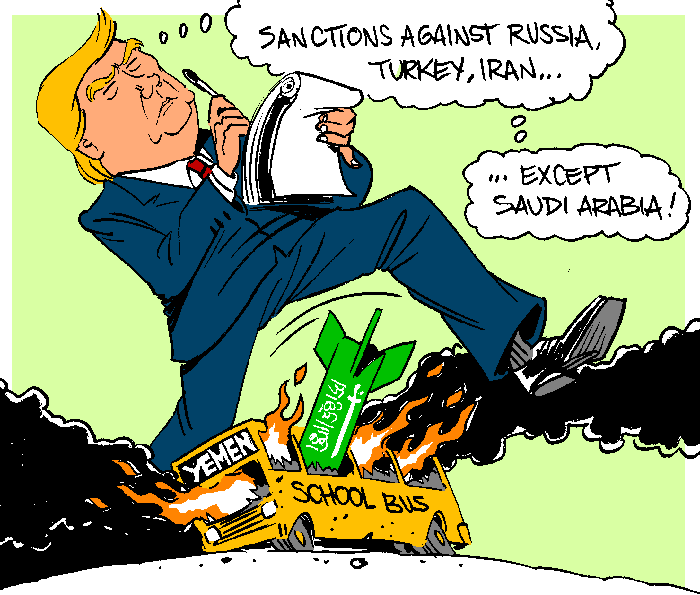
An artist’s rendering of what US sanctions are all about: not principle but national interest at a given moment in time according to the perceptions of the transiently wealthy and powerful. So long as you endorse the expansion of US geopolitical influence and dominance by any means necessary, it doesn’t matter if you starve an entire country to death (Yemen), if you murder one of your own citizens in cold blood at your own embassy (Khashoggi), if you proliferate terror networks all around the world (ISIS, al-Qaeda), if you abandon the indigenous residents of the Holy Land after they were ethnically cleansed (Palestinians), and if you incite sectarian wars in the region in which millions get displaced and hundreds of thousands lose their lives and livelihoods (Syria, Iraq).
But what John Kerry may not understand, or may not wish to understand, is that Iran is not just waiting out Trump, it is waiting out the whole US-Zionist empire. As whistleblowing former World Bank economist Peter Koenig says, “the US dollar is rapidly losing its status as the world’s reserve currency. When some 20 years back more than 90% of all reserves were held in US dollar denominated securities, today that figure has shrunk to less than 60% — and is going down as we speak.” Eventually (perhaps within a 10–15 year time frame) demand for the dollar will crash as dollar-holders realize that America’s debt, which has exploded well past 100% of GDP, is unrepayable — and rush for the exits, hoping to avoid being the last one holding worthless American currency. That moment will mark the end of America’s ability to pay for its military machine, which costs more than the next eight countries’ militaries combined.
When the US is forced to close its foreign military bases and bring its troops home, the Muslim East will change dramatically. Regimes that only exist because they are propped up by the US, notably “Saudi” Arabia and Israel, will likely collapse.
While Islamic Iran waits out Trump and the American empire, it is in some ways being strengthened by the very sanctions designed to hurt it. Though ordinary Iranians do feel the pain of pinched pocketbooks, shortages of medicines, and medical equipment, and less-than-optimally safe airliners, the Iranian nation as a whole is being forced to increase its productivity rather than depend entirely on oil earnings and other raw materials exports. The result is a “resistance economy” geared toward domestic manufacturing rather than raw materials exports exchanged for foreign manufactured goods. That stimulates Iran’s manufacturing sector in the same way that tariffs would. And though European investors pulling out of Iran’s automobile industry this year has been painful, in the medium to long term a more Iranian-run industry, unburdened by debt, could be poised to make big gains, and keep the profits in Iran, when Trump’s sanctions fade.
As it builds its resistance economy, Iran is also accumulating moral capital and worldwide support. Iran’s principled opposition to Trump plays well in a Trump-loathing world. Its courageous refusal to surrender in the face of vicious and criminal sanctions that violate international law is appreciated around the globe. It has been said that the best possible public relations strategy is to choose a deeply unpopular enemy, but Iran has not even had to make such a choice, because the highly unpopular Donald Trump has done the job himself.
When the story of the emerging multipolar world is written, Iran will be cast in a heroic role. And somewhat later, when the story of the 15th century AH Islamic Awakening is written, the Islamic Republic of Iran will likewise be viewed as a nation whose top leadership forged an uncommonly principled example of Muslim self-determination.

Friday, November 09, 2018

Iran sanctions divide Trump administration

Iran sanctions divide Trump administrationThe New York Times

By Hormoz Baradaran*

Washington’s reimposed sanctions on Iran exacerbated deep divisions in the Trump administration, putting US top officials at loggerheads over how to minimize the damage to American allies that are thirsty for Iranian oil.
White House national security adviser, John Bolton, tricked Trump into trouble by emboldening him to withdraw from the JCPOA without having a back-up plan. When the US president terminated the deal unilaterally on May 8, the Trump cabinet was divided into two opposite camps: Trump-Bolton axis vs. the Treasury Secretary Steve Mnuchin and State Secretary Mike Pompeo. The two groups clashed over the consequences of breaking an international deal.
As a ringleader of Iran hawks, Bolton pushed for a tougher stance and stringent sanctions on Iran. But the Mnuchin-Pompeo axis sided with Europeans and chose not to instantly cut off Iran’s access to the financial service SWIFT and not cutting Iranian oil flow to world markets because they saw these ideas as missions impossible.
Last Friday, internal fissures within the Trump administration deepened when the Trump-Bolton axis finally bowed to the other camp, with Bolton not participating in the rollout of the White House plan to reimpose sanctions on Iran, lifted under the 2015 nuclear deal.
In an interview with the Washington Examiner, a senior Republican congressional aide called it a “fiasco” for Bolton and other hawks who were hoping to organize an international campaign against Iran. Frustrated desires and dashed hopes compelled Bolton to stay out of the picture.
Sanctions have come back but overblown claims of their impacts have primarily taken a toll on Americans, not Iranians. For the first time since the end of Cold War, the US is haplessly struggling to make an international consensus on Tehran.
The invasion of Iraq in 2003 revealed the first signs of global opposition to US bullying but this time foreign countries are openly voicing their frustration and proactively forging a different path on Iran. Tehran has remained committed to the nuclear deal and morally has the upper hand. So, there are no grounds to punish it. On the contrary, it is the Trump administration that has broken internationally established norms and laws.
While Asian buyers of Iran oil succeeded in securing US waivers, Europeans are setting up a special mechanism to continue trade with Iran, free from US sanctions. Embroiled in disputes with the United States, Asia and the EU have come to the conclusion that it is time to start telling America: Enough is enough!
Opposition from other parts of the world have put Trump in an embarrassing position on how to engineer a political and moral comeback on the international arena. By issuing waivers to eight countries to continue purchasing Iranian oil, it seems that the Trump administration has kicked the can down the road until it could find a way to fix its tarnished image and heal the divisions in the White House.
*Hormoz Baradaran is an Iranian journalist.