YOGYAKARTA, (MNA) – Built in the 8th and 9th centuries, Borobudur is one of the most famous Buddhist temples in the world. The site was abandoned in the 15th century and it took some 400 years to be re-discovered and restored with the help of UNESCO. The temple, inscribed in UNESCO World Heritage List in 1991, is now considered one of the major tourist attractions in Indonesia.
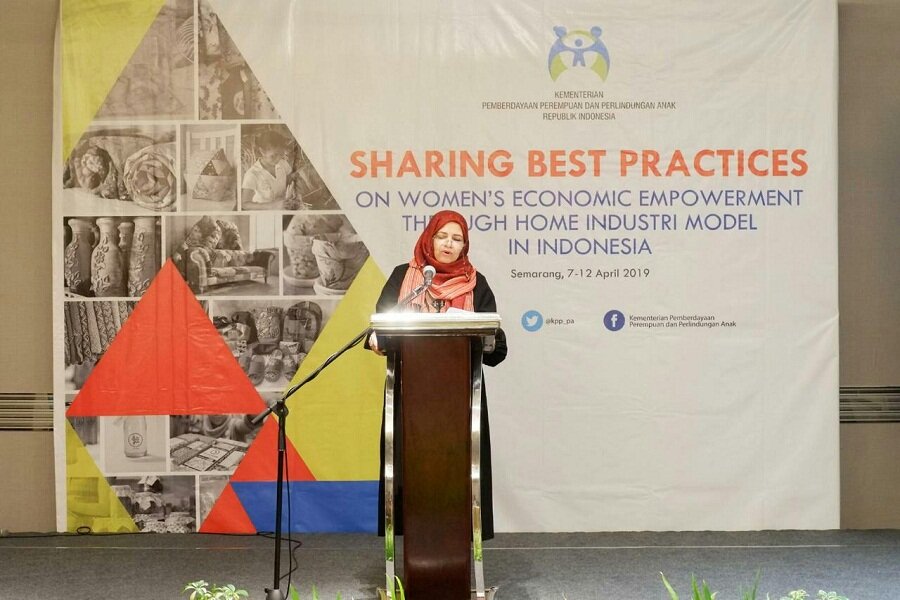
TEHRAN – The Indonesian Ministry of Women Empowerment hosted the first meeting for implementing the memorandum of understanding signed by Iran and Indonesia in women’s and family affairs.
Zahra Javaherian, a senior advisor to President Hassan Rouhani, attended the meeting which was held at the Indonesian city of Semarang, IRNA reported.
During the five-day meeting, which started on April 8, the two sides exchanged information and experiences on women’s empowerment and developing women’s activities in economic affairs.
Officials from the Interior Ministry, Ministry of Foreign Affairs, and the Red Crescent Society participated in the meeting.
Increasing life expectancy in women from the age of 56 to 75, decreasing maternal mortality rate, women’s empowerment in economy and removing gender inequalities in women’s affairs are among the measures done by the Islamic Republic of Iran during the last 40 years, elaborated Javaherian.
An amount of $46 million for women’s insurance and developing women’s employment share of management positions is also allocated, she added.
The MOU was signed by Iranian Vice President for Women’s and Family Affairs, Masoumeh Ebtekar, and Indonesian Minister of Women’s Empowerment and Children Protection, Yohana Susana Yembise, in Iran, in July 2018.
The MOU aims at empowering women, supporting children and promoting the resilience of family based on equality, respect and mutual benefit.
The MOU includes 9 clauses with the purpose of developing women’s role in policymaking and supporting women and children against violence.
It also follows the aim of increasing women’s role in business and technology, especially information technology, promoting women’s economic empowerment in the family and exchange of experiences about women and children.
The MOU is valid for two years and can be extended for the same period.
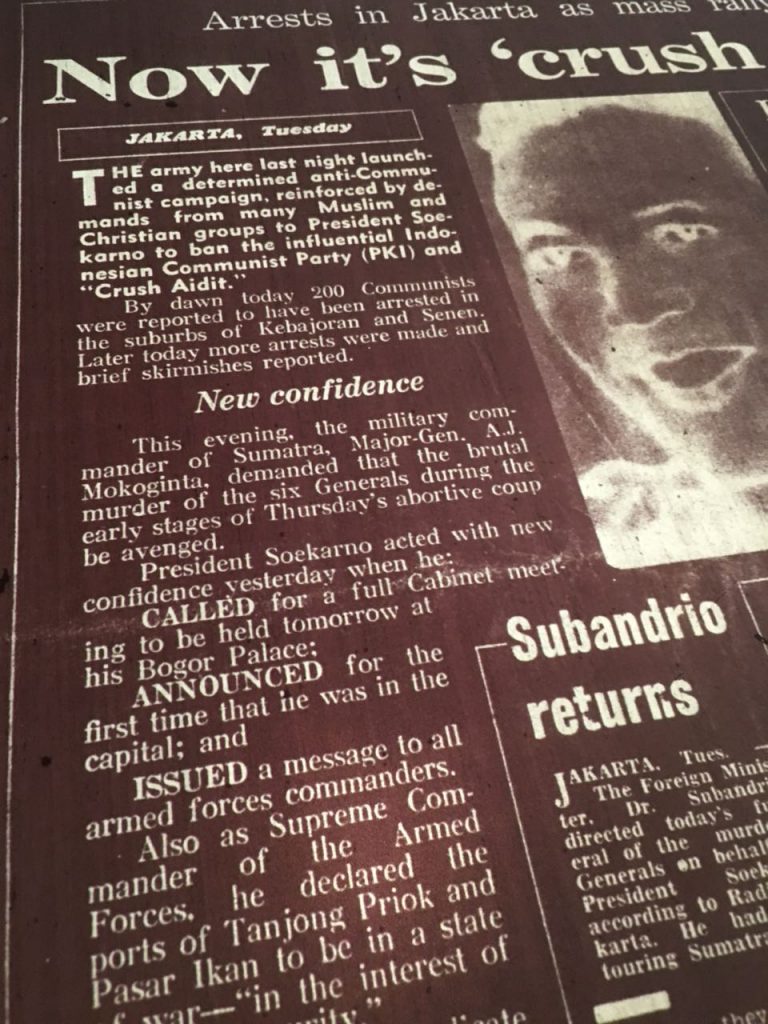
I’m sitting at the splendid building of the Singapore National Library, in a semi-dark room, microfilm inserted into a high-tech machine. I’m watching and then filming and photographing several old Malaysian newspapers dating back from October 1965.
These reports were published right after the horrible 1965 military coup in Indonesia, which basically overthrew the progressive President Sukarno and liquidated then the third largest Communist party on Earth, PKI (PartaiKomunis Indonesia). Between one and three million Indonesian people lost their lives in some of the most horrifying massacres of the 20th century. From a socialist (and soon to be Communist) country, Indonesia descended into the present pits of turbo-capitalist, as well as religious and extreme right-wing gaga.
The United States, United Kingdom, Australia, Holland and several other Western nations, directly sponsored the coup, while directing both the pro-Western treasonous factions in the military, as well as the religious leaders who stood, from the start, at the forefront of the genocide.
All this information is, of course, widely available in the de-classified archives of both the CIA and U.S. State Department. It can be accessed, analyzed and reproduced. I personally made a film about the events, and so have several other directors.
But it isn’t part of the memory of humanity. In Southeast Asia, it is known only to a handful of intellectuals.
In Malaysia, Singapore or Thailand, the Indonesian post-1965 fascism is a taboo topic. It is simply not discussed. “Progressive” intellectuals here are, like in all other ‘client’ states of the West, paid to be preoccupied with their sex orientation, with gender issues and personal ‘freedoms’, but definitely not with the essential matters (Western imperialism, neo-colonialism, the savage and grotesque forms of capitalism, the plunder of local natural resources and environment, as well as disinformation, plus the forcefully injected ignorance that is accompanied by mass amnesia) that have been shaping so extremely and so negatively this part of the world.
In Indonesia itself, the Communist Party is banned and the general public sees it as a culprit, not as a victim.
The West is laughing behind the back of its brainwashed victims. It is laughing all the way to the bank.
Lies are obviously paying off.
No other part of the world has suffered from Western imperialism as much after WWII, as Southeast Asia did, perhaps with two exceptions, those of Africa and the Middle East.
In so-called Indochina, the West murdered close to ten million people, during the indiscriminate bombing campaigns and other forms of terror – in Vietnam, Cambodia and Laos. The above mentioned Indonesian coup took at least 1 million human lives. 30% of the population of East Timor was exterminated by the Indonesian occupation, which was fully supported by the West. The Thai regime, fully subservient to the West, killed indiscriminately its leftists in the north and in the capital.The entire region has been suffering from extreme religious implants, sponsored by the West itself, and by its allies from the Gulf.
But the West is admired here, with an almost religious zeal.
The U.S., British and French press agencies and ‘cultural centers’ are spreading disinformation through local media outlets owned by subservient ‘elites’. Local ‘education’ has been devotedly shaped by Western didactic concepts. In places like Malaysia, Indonesia, but also Thailand, the greatest achievement is to graduate from university in one of the countries that used to colonize this part of the world.
Victim countries, instead of seeking compensation in courts, are actually admiring and plagiarizing the West, while pursuing, even begging for funding from their past and present tormentors.
Southeast Asia, now obedient, submissive, phlegmatic and stripped off the former revolutionary left-wing ideologies, is where the Western indoctrination and propaganda scored unquestionable victory.
*
The same day, I turned on the television set in my hotel room, and watched the Western coverage of the situation in Idlib, the last stronghold of the Western-sponsored terrorists on Syrian territory.
Russia has called for an emergency UN Security Council meeting warning that the terrorists might stage a chemical attack, and then blame it, together with the West, on the forces of President Bashar al-Assad.
NATO battleships have been deployed to the region. There can be no doubt – it has been a ‘good old’ European/North American scenario at work, once again: ‘We hit you, kill your people, and then bomb you as a punishment’.
Imperialist gangsters then point accusative fingers at the victims (in this case Syria) and at those who are trying to protect them (Russia, Iran, Hezbollah, China). Just like in a kindergarten, or a primary school; remember? A boy hits someone from behind and then screams, pointing at someone else: “It was him, it was him!” Miraculously, until now, the West has always gotten away with this ‘strategy’, of course, at the cost of billions of victims, on all continents.
That is how it used to be for centuries, and that is how it still works. That is how it will continue to be, until such terror and gangsterism is stopped.
*
For years and decades, we were told that the world is now increasingly inter-connected, that nothing of great importance could happen, without it being immediately spotted and reported by vigilant media lenses, and ‘civil society’.
Yet, thousands of things are happening and no one is noticing.
Just in the last two decades, entire countries have been singled-out by North America and Europe, then half-starved to death through embargos and sanctions, before being finally attacked and broken to pieces: Afghanistan, Iraq, Libya to mention just a few. Governments of several left-wing nations have been overthrown either from outside, or through their own, local, servile elites and media; among them Brazil, Honduras and Paraguay. Countless Western companies and their local cohorts are committing the unbridled plunder of natural resources in such places as Borneo/Kalimantan or the Democratic Republic of Congo (DRC), totally ruining tropical forests while murdering hundreds of species.
Are we, as a planet, really inter-connected? How much do people know about each other, or about what is done to their brothers and sisters on different continents?
I have worked in some 160 countries, and I can testify without the slightest hesitation: ‘Almost nothing’. And: ‘Less and much less!’
The Western empire and its lies,has managed to fragment the world to previously unknown extremes. It is all done ‘in the open’, in full view of the world, which is somehow unable to see and identify the most urgent threats to its survival. Mass media propaganda outlets are serving as vehicles of indoctrination, so do cultural and ‘educational’ institutions of the West or those local ones shaped by the Western concepts. That includes such diverse ‘tools’ as universities, Internet traffic manipulators, censors and self-censored individuals, social media, advertisement agencies and pop culture ‘artists’.
*
There is a clear pattern to Western colonialist and neo-colonialist barbarity and lies:
‘Indonesian President Sukarno and his closest ally the Communist Party of Indonesia (PKI) were trying to build a progressive and self-sufficient country. Therefore, they had to be stopped, government overthrown, party members massacred, PKI itself banned and the entire country privatized; sold to foreign interests. The overwhelming majority of Indonesians are so brainwashed by the local and Western propaganda that they still blame the Communists for the 1965 coup, no matter what the CIA archives say.’
Mossadegh of Iran was on the same, progressive course. And he ended up the same way as Sukarno. And the whole world was then charmed by the butcher, who was put to power by the West – the Shah and his lavish wife.
Chile in 1973, and thereafter, the same deadly pattern occurred, more evidence of how freedom-loving and democratic the West is.
Patrice Lumumba of Congo nationalized natural resources and tried to feed and educate his great nation. Result? Overthrown, killed. The price: some 8 million people massacred in the last two decades, or maybe many more than that (see my film:Rwanda Gambit). Nobody knows, or everyone pretends that they don’t know.
Syria! The biggest ‘crime’ of this country, at least in the eyes of the West, consisted of trying to provide its citizens with high quality of life, while promoting Pan-Arabism. The results we all know (or do we, really?): hundreds of thousands killed by West-sponsored murderous extremists, millions exiled and millions internally displaced. And the West, naturally, is blaming Syrian President, and is ready to ‘punish him’ if he wins the war.
Irrational? But can global-scale fascism ever be rational?
The lies that are being spread by the West are piling up. They overlap, often contradict one another. But the world public is not trained to search for the truth, anymore. Subconsciously it senses that it is being lied to, but the truth is so horrifying, that the great majority of people prefer to simply take selfies, analyze and parade its sexual orientation, stick earphones into its ears and listen to empty pop music, instead of fighting for the survival of humanity.
This essay is just a series of thoughts that came to my mind, while I was sitting at a projector in a dark room of the Singapore National Library.
A rhetorical question kept materializing: “Can all this be happening?” “Can the West get away with all these crimes it has been committing for centuries, all over the world?”
The answer was clear: ‘But of course,as long as it is not stopped!”
And so, A luta continua!
*Andre Vltchek is a philosopher, novelist, filmmaker and investigative journalist. He has covered wars and conflicts in dozens of countries. Three of his latest books are Revolutionary Optimism, Western Nihilism, a revolutionary novel “Aurora” and a bestselling work of political non-fiction: “Exposing Lies Of The Empire”. View his other books here. Watch Rwanda Gambit, his groundbreaking documentary about Rwanda and DRCongo and his film/dialogue with Noam Chomsky “On Western Terrorism”. Vltchek presently resides in East Asia and the Middle East, and continues to work around the world.
I put myself down for a visa to work at the Hajj as a cleaner just so I can get into the country. It was the only way
- Ismail Mahmud, pilgrim
Ismail Mahmud left his home in Minya, Egypt, and headed for a neighbourhood cafe to write his will. He was diagnosed with a life-threatening illness two years ago and knew his time in this world was short. He had one final wish: to complete the Hajj in Saudi Arabia, but obtaining a visa to do so has come at a high price. "My sons were not happy when I sold these fields, but we had no choice," said Mahmud, a 59-year-old primary school teacher. "The economic conditions in Egypt have become very difficult and they refused to give me a visa, even with a note from my doctor. It was the only way to pay for my dream to do the Hajj."
Mahmud refused to wait and see whether his name would be picked out of a government-run lottery, entitling him to attend. Instead, he went one step further.
"Everyone said getting picked by the government was impossible unless you paid high officials, but I just couldn't afford it," he said. "So I put myself down for a visa to work at the Hajj as a cleaner just so I can get into the country. It was the only way."
The problem with Hajj quotas
Like thousands of Egyptians, Mahmud has waited years to go to the Hajj. His situation is not uncommon, with millions of Muslims worldwide turning to private travel agents or other means via the black market.
The Hajj is one of the five pillars of Islam and one which allMuslims are obligated to complete at least once, meaning that visas are hotly contested.
Those who undertake the five-day pilgrimage are absolved of all their past sins, meaning many look to attend during their old age.
How do Saudi authorities decide who can attend Hajj each year? (AFP)
Saudi Arabia sets the quotas, based on the population of Muslims in each country, which in turn - through governments or private travel companies - allocate places for their citizens.
The long wait times, which can be up to 10 years or longer in some countries, lengthened after Riyadh cut the overall quota of visas by 20 percent in 2009 to accommodate expansion work in the grand mosques in Mecca and Medina. It has now reversed the decision, so an additional million pilgrims can now attend the pilgrimage, which this year begins on 30 August.
The rise in numbers comes after the Gulf kingdom suffered a decline in oil prices as well as the lowest number of pilgrims in a decade in 2016. It will boost the economies in Mecca and Medina.
The lottery of obtaining a visa
The governments in most Muslim-majority countries allocate the largest chunk of their places via a random lottery and give the rest to private travel agents. In the UK and elsewhere, tickets are sold via private travel agents on a first-come, first served basis, depending on eligibility.
The biggest problems come in countries such as Indonesia, which is usually awarded the largest number of visas - it has a Muslim population of 260 million.
Indonesia is given the highest quota of Hajj visas by the Saudis (AFP)
Like many countries with inflated waiting times, it celebrated the addition of an extra 10,000 places on top of the 220,000 already allocated by praising the Saudi authorities.
Indonesia uses a lottery system to allocate the majority of its places: each applicant pays $2,000 to be considered - the average monthly wage is around $1,200 - and is then put on a waiting list. Even so, locals still face a wait of up to 39 years, meaning some pilgrims die before they win a place.
Other countries take tough measures to be fair and reduce waiting times. Jordan only has 7,000 places to fill this year. Its rules include automatically accepting prospective pilgrims who were born in 1945 or before and demanding that potential pilgrims swear on the Quran that they have never previously attended the Hajj.
The year-of-birth rule is adjusted annually to give elderly applicants a better chance of winning a place, meaning that next year those born on or before 1946 will be eligible to attend. Exceptions are granted to male guardians, such as a son or husband, who are accompanying a female pilgrim.
Bouthaina Naser, 40, a housewife from the north of Jordan, has tried numerous times to obtain a visa, without success. She began thinking about the Hajj after being diagnosed with cancer five years ago and every year since has applied for a visa.
Frustrated at the Jordanian restrictions, she was forced to turn to the black market to achieve her "dream of doing the Hajj".
"I tried three times to buy Hajj visas from the black market and through people who knew someone selling them from the Saudi embassy," she told MEE. "The Jordanians should allow people to attend if they have the financial ability to go and assess it on a case-by-case basis."
Claims of corruption
Critics accuse the Saudi authorities of politicising the Hajj and helping create a global black economy in visas, with the allocation process in some countries being described as rife with corruption and unfair to poorer pilgrims.
Pakistan, which receives the third-highest quota, was recently rocked by a corruption scandal after prospective pilgrims accused officials of giving a portion to private companies in exchange for bribes.
A Bangladeshi family at dawn at the plain of Arafat, outside Mecca, in 2000 (AFP)
In Bangladesh, the high court has demanded an investigation into how the government managed this year's allocation after some travel agents delayed submitting visa applications in the hope of receiving cheaper rates on accommodation in Mecca and Medina. It has left some Bangladeshis who won on the lottery still uncertain as to whether they will be attending.
Madawi al-Rasheed, a Saudi academic based at the London School of Economics, told Middle East Eye that the al-Saud clan had created a "black economy around the world which is centred on the Hajj".
"The lack of transparency in Saudi Arabia, especially with the quota system, has helped create a black market and trade in visas," she said.
"There is a black market in visas where Saudi embassy employees from around the world sell visas illegally and give them to their friends. They have a certain interest in getting certain people in and excluding others or putting them on a waiting list for the rest of their lives."
Hajj: An arena for political fighting
Riyadh justifies the quota it sets as a means to ensure the safety of all pilgrims. The Hajj has been hit by numerous incidents over the years, which have resulted in the deaths of pilgrims, usually through overcrowding.
The most recent incident, a stampede in 2015, left at least 2,000 people dead, although the final death toll has been disputed.
Some observers have characterised the quota system as a means for Riyadh to influence Muslims around the world. Rasheed said that the Saudis have historically used the Hajj "as a political tool" after it took control of the two holy sites in the early 1920s.
The stampede at Mina in 2015 left more than 2,000 pilgrims dead (AFP)
"Access to the Hajj and performing the ritual is dependent on the will of the Saudi regime," she said. "The main reason is so it is able to control Muslim countries because the Hajj is one of the pillars of Islam, and every Muslim is under the obligation to do it if they can.
"If a Muslim is anti-Saudi or voices criticism of Saudi then they are banned from coming. We saw this happen with Rachid Ghannouchi, the leader of Ennahda [a political party] in Tunisia, when he tried to do the Umrah [attend Mecca outside Hajj] from London, the Iranians last year, and the Qataris this year."
Iranian pilgrims were told by their government not to attend the Hajj in 2016, the first time it has done so, after pre-existing tensions worsened between Tehran and Riyadh. Diplomatic relations hit an all-time low after more than 450 Iranian pilgrims were killed during the 2015 disaster.
Mehdi Beyad, a PhD candidate at SOAS in London who focuses on the geopolitics of the Middle East, told MEE that Tehran had politicised this incident and had historically used the Hajj as a "marker for broader political conflicts".
Just as you cannot divorce Saudi politics from its approach towards Hajj, the same goes for Iran
- Mehdi Beyad, academic
"Just as you cannot divorce Saudi politics from its approach towards Hajj, the same goes for Iran, for instance with the 1987 incident where Shia pilgrims were killed in clashes with Saudi security forces," said Beyad.
Beyad said: "This incident is seen as a rallying cry for Iranians and Shias more widely, and the competing narratives over it illustrate the broader way in which Hajj has become an arena where states battle for legitimacy and try to connect their identities to it.
"Beyond stated security concerns, by appearing to take a stand over Hajj different states can project themselves as protectors of their professed communities, call into question the capabilities and legitimacy of others, and use Hajj as a marker for broader political conflicts."
For Mahmud, the politics behind the award of a visa has left him frustrated and resentful.
"Each year the Hajj keeps getting more expensive, and I don't know how long I will have," he said. "These restrictions are making hard-working people like me and others lie to complete my God-given right to visit the Masjid al-Haram and the Prophet's mosque.