Showing posts with label Islamic Republic of Iran. Show all posts

Sunday, December 15, 2019

As the Islamophobia index increases: On being Muslim in America

By Yuram Abdullah Weiler
“I think the real question is not whether America is afraid of Islam (and its adherents) but whether Muslims should be afraid of the US and Americans especially in this post-9 /11 world.” —Attorney Diana Mae Cabili
Being Muslim in America carries the risk of being reviled, insulted, discriminated against, humiliated publicly or, worse yet, physically attacked. Despite having been a part of the American landscape since 1501, Muslims have faced discrimination, suspicion and hatred bordering on public hysteria, especially since the 9/11 attacks. With the ascendancy of Donald Trump and his virulent anti-Muslim diatribes, the prospect of a McCarthy-era-like internment of Muslims in the United States does not appear to be off the table given current policy trends.
Make no mistake about it; Islamophobia in the U.S. not only is on the rise but also is condoned public policy. The Institute for Social Policy and Understanding (ISPU) with support from the Bridge Initiative of the Alwaleed Center for Muslim-Christian Understanding at Georgetown University has developed the National Index of Islamophobia based on responses to various survey questions designed to uncover the deep-seated beliefs of respondents in five particular anti-Muslim stereotypes, which regrettably are often utilized by U.S. political leaders during campaigns to gain voter support. 
These five anti-Muslim stereotypes are that most Muslims living in the United States: are more prone to violence than other people; discriminate against women; are hostile to the United States; are less civilized than other people, and are partially responsible for acts of violence carried out by other Muslims. These five stereotypes are linked to constituent support for policies, enacted by government officials, which discriminate specifically against Muslims, such as the surveillance of mosques, racial profiling and heightened security scrutiny of Muslims at airports.
Here in the quiet border community of Las Cruces, New Mexico, people seem to be generally tolerant and supportive of Muslims. Perhaps this is because Hispanic Americans are five times as likely to hold positive views of Islam and Muslims as negative views.  Ironically, the only place where I have been even questioned aggressively about my Shi'a Islamic faith and connection to the Islamic Republic has been at the local mosque. But Las Cruces appears to be an exception to a general U.S. trend towards increasing Islamophobia. Over one quarter of Americans surveyed in a recent poll conducted by the ISPU endorsed negative stereotypes of Muslims and Islam. In fact, White Evangelicals are twice as likely to hold negative views of Muslims as positive ones.
As a Muslim living in the United States, I, too, have been discriminated against. Past employers have made it difficult for me to do salaat at the proper times, and have even suggested that I do the prayer in a filthy janitor’s closet so as not to bother or distract other employees. I have been threatened with loss of employment for exhibiting support for the oppressed Palestinians, who have been the perpetual targets of Israeli violence. I have been reprimanded for speaking out against possible U.S. military action against Iran.  I have been told that I should be shot for simply wearing a small flag of the Islamic Republic of Iran on my jacket. All this and more has taken place in the alleged bastion of human rights and religious freedom known as the United States of America.
However, I am not alone. Seventy-five percent of my brothers and sisters in Islam believe there is a great deal of discrimination against Muslims in the United States. Nearly the same number of Muslims is worried by the actions of the current U.S. president, and do not feel Islam is considered to be part of mainstream American society. About half feel that being Muslim in America has become more difficult and have themselves personally experienced an act of discrimination. Yet in spite of their Islamophobic environment, nearly nine out of ten Muslims in America claim to be proud to be Muslim and, astoundingly, proud to be American.  I myself, while proud to be a Muslim, do not profess membership in the latter group, seventy percent of whom still hold fast to the American dream.
Unfortunately, Islamophobia seems to be a commonality uniting a number of disparate hate groups in the United States. The Southern Poverty Law Center, a forerunner in confronting racial, ethnic and religious hatred, has identified 33 Islamophobic groups operating openly on Facebook, all of which engage in anti-Muslim imagery and promote Islamophobic stereotypes to attract members.  Some of these hate groups actually have avoided being screened out for hate speech and Islamophobic content by claiming to be educational forums. For example, the group “Infidels United for Truth” claims to be “for the education and sharing of information globally about the dangers of Radical Terrorism and how it is affecting all of the world.”
Professor of computer science at Elon University Megan Squire has done preliminary research on Islamophobia and has found it to be a common thread among hate groups. Squire’s findings indicate that those groups holding anti-Muslim and anti-immigrant views do have significant common membership. Moreover, analysis of the data shows that “anti-Muslim ideologies, in particular, can serve as a bridge between mostly disconnected communities, such as between anti-government and white nationalist communities.”
Yet the categorization of Islamophobia as merely “anti-Muslim” animosity overlooks the systemic racism inherent in the Orientalist world view that permeates and, in fact, predates the creation of the United States. Concerning this danger professor of law at the University of Detroit Mercy Khaled A. Beydoun warns, “To reduce Islamophobia to ‘anti-Muslim animus’ and nothing more overlooks its expansion and penetration into American culture, news, media, law, and political parlance.” As clearly evidenced by the “Muslim ban,” the Trump regime has endorsed Islamophobia as state policy, which legitimatizes anti-Muslim stereotypes widely held by private U.S. citizens. 
To see the systemic nature of Islamophobia in the United States, it is only necessary to note that Muslims are viewed as a “racial and socioeconomic monolith.”  In other words, Americans tend to view Muslims as a race, just like Blacks, Native Peoples, or Japanese, and given the endemic nature of racism in the U.S., we see that Islamophobia is another virulent strain of racism. The IPSU concurs, noting that “Islamophobia is just one branch on a bigger tree of bigotry.”
Continuing with the IPSU’s tree metaphor, we can understand that merely loping off the branch of Islamophobia does next to nothing to cut down the tree of American racism that nourishes its growth.   Fertilized by Facebook and other social media, the ugly branch of Islamophobia, after pruning, will not only sprout anew but also more vigorously than before. The same holds for another branch sprouting from the same tree, Iranophobia.
As far as Facebook is concerned, it is no exaggeration to call it fertilizer for the tree of bigotry, as can be seen by the central role played by Zuckerberg’s social media platform in the genocide of the Rohingya Muslims of Myanmar. According to Marzuki Darusman, chairman of the U.N. Independent International Fact-Finding Mission on Myanmar, Facebook has “substantively contributed to the level of acrimony and dissension and conflict, if you will, within the public.” U.N. Myanmar investigator Yanghee Lee, concurring, noted, “I’m afraid that Facebook has now turned into a beast, and not what it originally intended.” Similarly, Equality Labs, a South Asian community technology organization, found that most hate speech violations on Facebook India are Islamophobic, and 93 percent remain posted.
Given that Islamophobia and Iranophobia are both flourishing branches on this mammoth tree of systemic American bigotry, it is self-evident that the tree itself must be felled and the stump of residual racism uprooted. Muslims should not be afraid of the United States and Americans, as Ms. Cabili has suggested in the epigram. Instead, we Muslims must carefully sharpen the Ax(is) of Resistance, uniting in our Islamic Revolution to cut down the tree of bigotry once and for all.

Thursday, December 12, 2019

Austrian ambassador visits tourist sites in western Iran

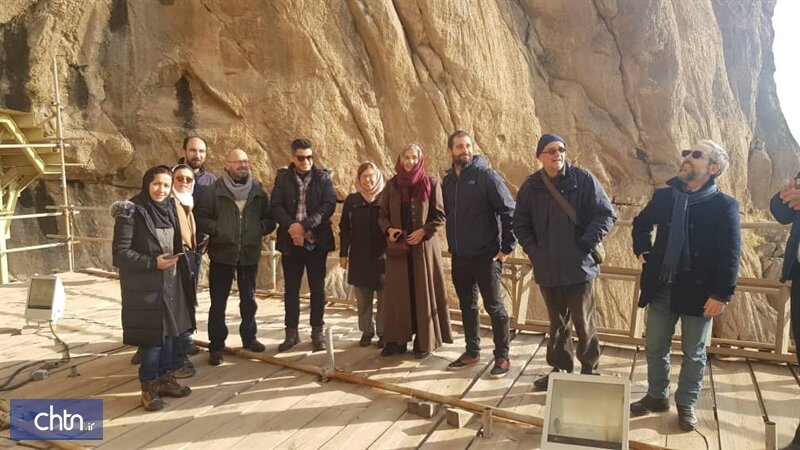
TEHRAN – Vienna’s ambassador to Tehran Stefan Scholz on Tuesday visited several travel attractions in Kermanshah province, western Iran.
Scholz, who was accompanied by his family and some embassy staff, toured the UNESCO-registered Bisotun and Taq-e Bostan amongst other sites, CHTN reported.
Inscribed into the base of a towering cliff, Taq-e Bostan comprises extraordinary Sassanian bas-reliefs of ancient victorious kings divide opinions, while Bisotun is a patchwork of immense yet impressive life-size carvings depicting the king Darius I and several other figures.  It was the first cuneiform writing that was deciphered in the 19th century.
On the sidelines of this visit, the Austrian envoy expressed his satisfaction over sightseeing in the province, the report said.
Regarding the visits, a local tourism official noted that visits by foreign diplomats and authorities to Kermanshah province’s attractions could motivate more international arrivals in the region.
Scholz said in October that he believes U.S. sanctions against Iran will be no obstacle in the path of Austrian tourists to travel to the Islamic Republic.
“Austrian arrivals in Iran is not affected by the sanctions and threats,” the envoy told ISNA.
In an interview with the Tehran Times in September, the ambassador remained commonalities and the history of relations between the two nations, saying “Austria and Iran have a long history in common. It’s an incredible special profile that distinguishes us from many other countries. We have 700 years of documented contacts, 500 years of partnership and about 60 years of full diplomatic relations.”
In November 2018, the Trump administration reinstated sanctions on Iran, mainly the ones that had been lifted under the 2015 nuclear deal, in order to batter Iran’s economy.

Sunday, December 01, 2019

Islamic Iran and the Jewish People

Editor

Islam’s position on the Jewish people is very clear. They are referred to as “People of the Book,” like the Christians. Muslims are called upon to live in peace with them as long as they do not threaten peace and security of the Muslims or the state they are living in. Throughout history, Muslims have strictly adhered to these lofty principles. Whenever the Jewish people suffered persecution in Europe, they found refuge among Muslims, hence the presence of Jewish communities in countries like Morocco, Tunisia, Turkey, Iran, etc.
While this should be public knowledge, the problem is that pro-Israeli groups conflate Zionism with Judaism. Given the West’s unremitting hostility to the Islamic Republic of Iran because of its determination to maintain its independence and dignity, it has been accused of every kind of misdemeanor. One vile Zionist allegation is that Islamic Iran and its leaders are “anti-Semitic.” This is a smear and ordinarily would not be worthy of a response but because of its seriousness it needs to be addressed.
This is what Imam Seyyed Ali Khamenei of Iran did in a public address on November 14 to Muslim ambassadors and participants at the Islamic Unity Conference. He pledged Islamic Iran’s unwavering support for Palestinian rights and called upon other Muslim countries to follow suit, describing Palestine as the greatest challenging facing the Muslim Ummah.
The Imam then touched on the subject of Zionist attempts to “distort” statements by the Father of the Islamic Revolution, the late Imam Khomeini and Iranian officials about the “elimination of Israel.” He explained, “We are in favor of Palestine and its independence and salvation, but the elimination of Israel does not mean the elimination of the Jewish people. We are not against them, as a large number of Jewish people live safely in our country. The elimination of Israel means the elimination of the fake Zionist regime. The Palestinian people — be they Muslim, Christian, or Jewish — who are the original inhabitants of that land, should be able to choose their own government,” the Imam elaborated.
For the record, Zionist Israel has been trying to entice the Iranian Jewish community to leave Iran and settle in Israel. The Zionist regime has even offered them tens of thousands of dollars in bribes. To their credit, the Jewish community in Iran has refused to go. They have their own member of parliament representing their specific interests in Iran’s Majlis along with a regular member of parliament for the larger constituency. Further, their places of worship are not only protected but they also receive government assistance in maintaining them.
Compare this with the Zionist mistreatment of the Palestinian people, the indigenous and innocent inhabitants of Palestine. While killing and brutalizing Palestinians, the Zionists indulge in vile propaganda that is designed to obfuscate because they cannot defend the horrific record of the Zionist regime. Pro-Israeli groups outside throw dirt at others hoping some of this would stick to those they accuse.

Our challenge to the Zionists is simple: if you think you are civilized, give the Palestinians the same rights that you enjoy. Then we will acknowledge that you are worthy of respect. Until then, you remain illegal occupiers of others’ land and they have every right to resist your colonization. Such resistance cannot be scandalized by the false allegation of anti-Semitism.

Iran Exposes US Failure in the Muslim East

Irregular warfare requires partners, not proxies

Tahir Mahmoud
In October 2019, the Washington based al-monitor.com reported that Mick Mulroy, the Pentagon’s top Middle East policy official said that “the Pentagon is trying to put the finishing touches on a plan to use irregular warfare tactics to temper Iran’s military escalation in the Middle East.”
The website further quoted Mulroy as saying, “every time we [US] deploy conventional forces they [Iranians] actually take unconventional action… so conventional overmatch has not deterred… new strategy would involve economizing our force allocation and operations to deny Iran strategic success.”
The Pentagon official’s plan would not be so comical were it not for the fact that it comes from a nuclear power with the largest military budget in the world. The US military spending between October 1, 2019 and September 30, 2020 is $989 billion. The US spends more on its military than the next top nine spenders combined.
Mulroy’s statement is an indirect admission that Washington’s vast military spending is unable to achieve US objectives and is, therefore, a colossal waste of money. The self-proclaimed superpower is forced to copy its regional military strategy from a country that has been under severe sanctions for over 40 years. Let that sink in for a moment.
Ever since the Islamic Revolution in 1979, the US and Iran have been in a constant cold-war type confrontation. With far greater financial resources and a cabal of other countries backing Washington’s policies against Islamic Iran, Tehran today is a regional power and far stronger than it was 40 years ago. This is an undeniable reality.
Will the US be able to abort Iran’s rising influence by adopting irregular warfare? Before addressing this question, it is important to remember that Washington has already tried this approach in Iraq and failed completely. Today, Iran’s political and economic presence in Iraq is much greater than even a decade ago.
In 2012, Crescent International wrote about the role of US Special Forces in Washington’s imperial designs. In our seven-year-old analysis we indicated that “Special Forces Operations (SFOs) have been increasingly used as a key component of US military counterinsurgency strategy since Barack Obama became president… the Islamic Awakening in the Arab world discredited and weakened US-backed autocrats in the Muslim world and made them less usable in the current regional political and social settings. They are no longer viewed as assets by the US, but liabilities. The increasing emphasis on special operations forces will therefore require the cultivation of new fifth columns by the US… the old class of US proxies will be irritated and try to sabotage the work of the emerging new informant caste.”
With the above in mind, let us first look at what the Pentagon means by “irregular warfare.” Cutting through the jargon, this means that the US will rely more on proxies to confront Iran and will build them up from behind the scenes. This is not a new strategy; Washington tried this in Syria, Yemen, and Lebanon over the past seven years. It did not work; the Americans are terrible at such things. In Syria, this approach was a disaster. In 2016, the Los Angeles Times reported that “in Syria, militias armed by the Pentagon fight those armed by the CIA.”
Even in Europe, where the US presence is much more entrenched and local populations view America quite favorably, its irregular approach in Ukraine failed. Moscow was able to create a strong bloc of irregular proxies through its so-called hybrid warfare strategy to upset Washington’s design of absorbing Ukraine into NATO’s security structure.
Washington’s desire to copy Iran’s irregular approach is flawed from a strategic perspective. Ever since Tehran assisted the establishment of Hizbullah in Lebanon, Western powers have been obsessed with copying this approach to establish their own reliable and determined proxy to take on Iran in a sustained and long-term confrontation. The closest they got was the creation of the Wahhabi-indoctrinated militias in Syria. The Western powers closed their eyes to the egregious crimes of these militias in the Syrian conflict and gave Turkey the green light to open its border for foreign takfiri fighters to enter and exit Syria freely. This policy was a complete failure and has been acknowledged by even those observers who have limited understanding of the region.
The US and its allies assumed that Hizbullah, Ansarullah or the People’s Moblization Units’ (PMU’s) loyalty to Islamic Iran is politically motivated and thus essentially Machiavellian. Therefore, the West assumes that all it needs to do to build its own “Hizbullah” is to throw money at various disenfranchised political groupings. This is precisely why the US and its allies failed in Syria, Lebanon, Iraq, and Yemen. In all these theaters of operations, Islamic Iran’s allies are connected to Iran through an existential and ideological bond. This is something Western powers will not be able to achieve with any of their proxies. The brutal history of Western colonialism and neo-colonialism plays a large part in this. Western regimes are greatly distrusted and those working with them are automatically considered to be sellouts by the wider population in the Muslim world.
One of the primary reasons for the US resorting to irregular warfare is because the Donald Trump regime realizes that it lacks political and military clout to actively pursue its agenda directly. While some may challenge this analysis by pulling out quantitative economic and military data of the US, it must be remembered that wars are won primarily through achieving political goals. Yes, the US destroyed thousands of villages and towns and killed millions of human beings in Vietnam, but it lost the war because it failed to achieve its political objectives. The same phenomenon has occurred in Afghanistan, where even after occupying the country for 18 years, Washington is begging the Taliban for a face-saving retreat.
In Afghanistan and Iraq, the US can destabilize the situation through irregular warfare activities, but it cannot put in place a functional American project. This was best illustrated when the Iraqi Kurdish independence bid failed in 2017. Even though the Iraqi Kurdish autonomous region was for decades backed and financed by the US and Israel, Washington and the Zionists failed to realize their goal to divide the region by creating an independent Kurdish state. The Kurdish independence project re-mains a destabilizing leverage of the West but it cannot bring it to successful conclusion. This reflects the limits of Western power in the region.
The primary advantage for the US in resorting to increased irregular warfare on a grander scale than it has already done is the destabilization factor. Washington has the ability to destabilize the region as it is currently doing in Iraq and Lebanon but the net result will be similar to what has happened in Syria. After eight years of NATO destabilization, today Syria is far more tightly embedded within Iran’s regional bloc than it was prior to 2011.
With Trump in the White House, US credibility even among its allies has been significantly reduced. The transactional worldview of the current US regime does not allow it to form a dedicated core of regional proxies.

Thursday, November 28, 2019

Time for Afghan Groups to Knit Ranks against US Occupiers

By: Kayhan Int’l 

The pivotal position of the Islamic Republic of Iran in the region and beyond is an established fact, whether the chief intruder in this region of ours, that is, the US, likes it or not.
In other words, peace can neither prevail nor can it become durable, unless the US leaves the region or its occupation forces are driven out.
The instability stretching from Afghanistan in the East till the Levantine states in the West, and including the Persian Gulf and the Arabian Peninsula, is because of the illegal presence of American troops, or more properly the CENTCOM terrorists.
In such a situation, it is incumbent on the governments of regional countries, as well as the influential political groups to hold talks amongst themselves to try to resolve the outstanding issues.
Iran, in view of its strategic geographical location and its role as moderator in the face of American hooliganism, is ideally placed to help negotiations succeed.
As part of this policy, the Islamic Republic on Tuesday played host to a senior official of Afghanistan’s Taleban militia, Mullah Abdul-Ghani Baradar.
The Deputy Political Chief and Head of the Political Office of Taliban in Qatar, during his in-depth talks in Tehran with Foreign Minister, Dr. Mohammad Javad Zarif, discussed a wide variety of issues of mutual interest including the peaceful resolution of the Afghan crisis, as well as the problems facing Afghan refugees in Iran.
Abdul-Ghani Baradar, who is highly distrustful of the US, was of the opinion that there is no point in holding talks with his namesake and compatriot, President Ashraf Ghani, whom he regarded as an American appointee in Kabul, rather than an independent person.
Iran may not agree with such views, but nonetheless, as Dr. Zarif pointed out to Mullah Baradar, the Islamic Republic is willing to support dialogue between all Afghan parties with the participation of the Afghan government.
Iran’s position on the resolution of the chronic crisis of Afghanistan is clear. The US should leave and since it is an occupying power that has destroyed this Muslim country, it has no legitimate excuse to prolong its unwarranted presence.
In other words, as long as Afghan remains under American occupation, and as long as Washington meddles in its affairs, no peace is possible.
At the same time, the Taleban militia should renounce violence and sectarian terrorism, if it really wants peace, unity, and stability to prevail in Afghanistan.
The resources of all Afghan groups should be pooled to resist and expel the Americans, rather than targeting the government or the ordinary people with bomb blasts.
These dastardly acts of terrorism are the hallmarks of US-sponsored terrorist outfit, Daesh, which should have no place in Afghanistan.
In short, all political groups, including the Taleban, should join forces for the betterment of the Afghan people, and expulsion of the American occupiers and their local stooges, the Daesh terrorists.
The Islamic Republic of Iran, as a friendly and fraternal neighbour, is willing to assist the people of Afghanistan achieve peace, stability, and development.

Iran riots coverage again exposes duplicity of the corporate media

Crescent International

As the Islamic government of Iran, with the assistance of the Iranian nation decisively aborted the foreign instigated riots, the usual duplicity of the Western corporate media in covering these riots was exposed yet again.
As the people of Iran began voicing their concerns about the rise of fuel prices, these concerns were immediately hijacked by violent thugs operating under external patronage.
As rioters began looting and burning infrastructure, the lack of popular support for anti-Islamic riots became clear. The overwhelming majority of people rejected the rioters and their destructive methods in all major Iranian cities, including Tehran.
The Western media and its regional protégés tried their best to inflate the number of rioters, but even they could not come up with a number higher than 100,000, in a country of over 80 million people.
Instead, many Western media outlets turned to Iranian exiles to present the “peoples” perspective. In Canada, this was best demonstrated by CBC’s “dramatic” coverage of a grand total of 60 people gathering (yes, 60 people!) in Ottawa to support the riots in Iran.
Compare this with the CBC’s stubborn refusal to give any coverage to Quds rallies against the Zionist occupation of Palestine that are attended by thousands of Canadians in all parts of Canada including several thousand in Toronto.
When covering events in Islamic Iran, the Western media, its pundits and government officials become an echo-chamber of their own propaganda. They only broadcast statements of people peddling the Western narrative.
By broadcasting Iranian names and individuals on air, Western media outlets are fed illusions by some in the exile community, which is detached from the realities of contemporary Iran.
It was this modus-operandi that got the US into the Iraq war, which ended in a strategic diminishment of Washington’s power in the Muslim world. American pundits even invented a term for their misstep – “We got Chalabied.”
In Canada, there are no known Ahmed Chalabis yet, but there is the pro-Zionist outfit B’nai Brith, masquerading as a human rights organization and proudly tweeting its participation in the anti-Iran rally in Toronto.
An Islamophobic placard “1400 Years of Stupidity” was prominently displayed at the rally.
Imagine the reaction in Canada if Muslims had carried a similar placard about another religion?
We are constrained to pose a question to our own community: where are the Muslim lawyers?
The failure of the strategy to turn hooliganism and riots into a political leverage against Iran was best reflected by US Secretary of State Mike Pompeo’s state,emt reminding people how the US failed to do the same in December 2017.
Pompeo tweeted: “As I said to the people of Iran almost a year and a half ago: The United States is with you.”
It will not be an exaggeration to state that future US Secretaries of State will continue tweeting their “support” for the next several decades.
Participation of millions of Iranians in pro-Islamic rallies against the foreign instigated riots once again points to the reality that Washington’s hopes of toppling the Islamic system in Iran is doomed to fail as it has in the past 40 years.

Thursday, November 21, 2019

Iranians attend widespread rallies to slam vandalism, support Islamic Republic

TEHRAN – People from all walks of life took to the streets across Iran on Tuesday and Wednesday to condemn the recent acts of violence in certain cities by some hooligans and anti-revolutionary elements who derailed the people’s protest to substantial increase in gasoline prices.
According to reports, people of Hamedan, Ardebil, Tabriz, Gorgan, Zanjan, Karaj, Shahr-e Kord and Khorramabad attended the rallies to assert their allegiance to Leader of the Islamic Revolution Ayatollah Ali Khamenei and the Islamic Republic system.
Late on November 14, the National Iranian Oil Products Distribution Company (NIOPDC) issued a statement to recount details for new prices of fuels in the country, which was followed by another statement the following day by Management and Planning Organization chief (MPO) Mohammad Baqer Nobakht who said that the revenues from price increase will be paid in form of cash subsidy to 60 million people.
In what followed after the decision, protests erupted in several cities with people calling on the government to reverse course. The demonstrations, however, turned violent in some cities, with clashes between security forces and certain elements damaging public property.
The damage caused to public and private property is tens of millions of dollars, and that’s a conservative estimate.
Meanwhile, Ayatollah Khamenei on Sunday morning supported the government’s decision and condemned any act of sabotage carried out by some “hooligans” and supported by Iran’s enemies.
“You see in the past two days, all the centers of evil in the world have been encouraging such acts against us. From the sinister Pahlavi dynasty to the vicious and criminal gang of Monafeqin (the MEK terrorist group); they are constantly encouraging hooliganism via the internet and other means,” the Leader stated.
Other officials also blamed Monfaeqin and the Pahlavi dynasty in addition to the U.S. and Israeli governments.
Critics, however, questioned the timing of the decision, which came amid heightened economic pressure on Iranian people as a result of the inhumane economic sanctions imposed by the United States.
They also criticized the sudden announcement of the measure, describing it as an undemocratic way of making a decision that affects the entire nation.
In his remarks, Ayatollah Khamenei urged the authorities to take good care of the affected people and assuage the hardship caused by the move.
He also called on the people to take note of the enemies’ plots to disrupt Iran’s security and take a separate path from the rioters that try to foment insecurity in the country.
The Leader quoted officials as saying that they would not allow the gasoline price hike lead to increase in prices of other commodities.
This is important because a further increase in commodity prices creates many problems for the people, Ayatollah Khamenei said.
The protests also prompted all factions of the Iranian political spectrum to unify and condemn foreign intervention in Iran’s internal affairs.
As an instance, Mahmoud Sadeqi, an outspoken reformist lawmaker, said Iran would not allow ill-wishers to interfere in its internal affairs, hinting at Washington’s meddlesome remarks in the aftermath of the protests.
“While pursuing and insisting on people’s rights, we will not allow any interference in our internal affairs by ill-wishers, foreigners and the promise-breaking hegemonic government of the U.S. that has disrupted the people’s livelihood through its cruel sanctions,” Sadeqi tweeted on Monday.
It came after U.S. Secretary of State Mike Pompeo voiced his support for Iranian protesters, right after he insisted “continued pressure” on Iran, which ironically includes economic sanctions targeting the Iranian people.
“As I said to the people of Iran almost a year and a half ago: The United States is with you,” Pompeo said in his Twitter account on Saturday, retweeting a Persian-language tweet he sent out in July 2018 that attacked the Islamic Republic’s policies.
Facing security concerns, Iran shut down the internet when the number of attacks and arsons increased across the country. The Supreme National Security Council (SNSC) was named as the body responsible for the decision.
Ali Shamkhani, the secretary of the SNSC, has said anti-Revolution elements and the MEK were behind the unrest.
Iranian officials have tried to distinguish between peaceful protestors and troublemakers.
Abbasali Kadkhodaei, the spokesman for the Guardian Council, said opposing executive decisions is an inevitable right of the people, but stressed that public properties should not be damaged in the protests.
Police Chief Hossein Ashtari on Sunday called on protestors to separate their way from vandals who are trying to create chaos.
Ashtari said those thugs who have damaged public and private property have been identified and will face the consequences of their actions in due time.
The Islamic Revolution Guards Corps (IRGC) has warned that it would take a tough line with those who foment unrest and disrupt the “comfort” and “tranquility” of the people.
In a statement on Monday, the IRGC said it acknowledges the rightful demands of the people and thanked the Iranian nation for their insight and awareness in recognizing the enemy’s sinister plots, emphasizing that the Guards is duty-bound to protect the country’s security and peace.
Also, in remarks on Monday, Basij Chief Brigadier General Gholamreza Soleimani said his forces are ready to be deployed to put an end to the unrest.
General Soleimani said while the people’s voice should be heard in Iran as a free country, the rioters who destroy and loot people’s property should be dealt with.
President Hassan Rouhani said on Sunday that the people have the right to protest, however, vandalism will not be tolerated.
Speaking at the cabinet, Rouhani said, “Protest is different from riot. Protest is the people’s right and they can protest. The government accepts even harsh criticism. However, we should not allow insecurity in the society.” 
Judiciary Chief Ebrahim Raisi also differentiated between the people who protest the recent gas price hike and those who disrupt the country’s security, asserting that damaging public and private property would lead to harsh punishment.
“Damaging public and private property, setting banks and different places ablaze, harming people’s psychological peace and frightening women and children with any intention would lead to harsh punishments,” he said on Monday.

Friday, November 01, 2019

Iran’s Resistance Economy Defeats US Sanctions

American bullying put Islamic Iran on the road to self-sufficiency


Waseem Shehzad
Early last month, the Financial Times reported that “the stock market of Iran, for a long time dogged by US sanctions, has notched up a notable achievement: ranking among the world’s best performing over the past 12 months, as domestic investors seek refuge from rampant inflation.” This is not the kind of news one expects from a leading Western newspaper about a country considered an enemy and under severe Western sanctions for 40 years.
Since day one of the Islamic Revolution in 1979, Iran has been under Western sanctions. From developing its medical sector to the level of rivaling global medical leaders and becoming a regional destination for medical tourism, to significantly reducing its dependency on oil income, Iran’s economic performance is extremely impressive.
From 2013 onward, Iran embarked on an economic program geared toward significantly reducing its budgetary reliance on oil. Even according to the US dominated World Bank, in 2014 while under severe sanctions, the Iranian economy expanded by 3%. By 2016, Iran had managed to reduce its dependency on oil revenues from over 50% to about 33%.
One of the leading economic websites covering Iran from a secular capitalist perspective noted that “in early-2014, Iran’s Ministry of Energy unveiled its plans for adding some 5 GW of renewable power capacity, mostly wind, to the country’s power fleet by 2018. Since the beginning of 2014, construction for around 400 MW of renewable capacity has started, and contracts for more than 500 MW have been awarded. The Iranian government increased its budget for renewable energy by more than 400% last year to around $60 million; although still small, the growth is going in the right direction.”
Since the US unilaterally withdrew from the multilateral nuclear agreement referred to as JCPOA, Donald Trump’s regime turned to economic sabotage in an effort to undermine Iran’s economy. Perhaps Trump does not realize that Iran has been under Western sanctions for decades and has mastered the art of bypassing sanctions.
In the field of economics trust and belief in a system are crucial factors in overcoming economic obstacles. People buy Coca-Cola in preference to other soft-drink brands because they trust and believe in the Coke brand. It is not because Coca-Cola is healthier or significantly different from other brands of soft drinks.
Iran’s ability to withstand decades of sanctions clearly created trust in the domestic market as the stock market data shows. Confidence of the domestic market and domestic consumption are crucial economic factors making Iran resistant to external economic terrorism.
Iran’s resistance economy policies outlined by Imam Seyyed Ali Khamenei insulated Iran from the severe effects of Western sanctions. One of the key aspects of its resistance economy is “consumption management based on the promotion of consumption of local products parallel to the qualitative improvement of domestic production.”
As recently pointed out by Amin Saikal, Professor of Political Science at the Australian National University, “US President Donald Trump’s approach to bringing Iran’s Islamic regime to heel clearly is not working.”
Soon after the JCPOA was signed in 2015, Crescent International pointed out that “sooner or later sanctions will be re-imposed. The Islamic leadership in Iran understands this as well. Therefore, they will make the maximum effort to use this new phase to prepare for future possible sanctions. At the economic level, Islamic Iran will continue to boost its non-oil and manufacturing sector as this is part of the resistance economic plan outlined by Imam Seyyed Ali Khamenei years ago. Iran will most probably continue enhancing its regional trade.”
Iran’s near-miraculous economic performance under very tough externally imposed obstacles is a strategic step in highlighting the fact that a non-Western economic framework can work. To understand Iran’s economic achievement, one needs to do a simple comparison of its performance with Egypt, Morocco, Azerbaijan, Tunisia, or many other countries that regularly receive handouts from Western financial institutions. They function with no obstacles within the Western designed economic system. NATO-imposed or tolerated regimes in the Muslim world are not known for any indigenous economic achievements. Their survival is due to their ties to capitalist economic institutions and following the Western paradigm.
Iran’s economic successes are deliberately downplayed, and its economic challenges exaggerated. If Iran’s stock market had underperformed, this news would dominate headlines of the corporate media for weeks. However, since its stock market outstripped others in performance, this news was barely reported. Those Western corporate media outlets that reported it did not give it much prominence.
A good example of how Iran’s economic performance is constantly misrepresented would be to recall the financial crisis of 2009. At the time, the Western media was constantly beaming absurd messages of how the financial crisis negatively affected Iran even though the Islamic Republic was under sanctions and was not exposed to the US sub-prime mortgage crisis in any way. Such false reports were deliberately spread simply to undermine the Iranian people’s confidence in the Islamic economic paradigm.
For the foreseeable future, Iran’s economic sector will be under intense pressure. It is primarily due to the fact that Western economies are not doing well. In these circumstances if an economic system outside of the capitalist framework manages to perform well, it will put the entire Western economic paradigm into question.
The economic performance of any state is dependent on several factors, not all of them related to economics. Self-confidence of leaders of any state is a crucial starting point. This cannot come about if one suffers from mental colonization as most rulers in the Muslim world do. They cannot think outside the Western framework and have little understanding or respect for Islamic principles. Most of these rulers also do not enjoy mass support. Hence, they are dependent on Western military, political, and economic support. In short, they are slaves of the West.
In Islamic Iran’s case, it has made a conscious choice to detach itself from the dependency syndrome and while it has been subjected to severe sanctions— economic terrorism, in the words of its Foreign Minister Dr. Javad Zarif — the leadership in Iran has stood firm on Islamic principles. Its success in many diverse fields is nothing short of miraculous.
Its path to success is paved by the resistance economy. This is an important lesson for other countries — Muslim as well as non-Muslim — that are subjected to Western bullying and economic terrorism.

Wednesday, October 16, 2019

Reactionary Arab Regimes Turn Blind Eye to Zionist Desecration of al-Aqsa

By: Kayhan 

While reactionary Arab regimes are slavishly serving American interests and dallying with Israel against fellow Muslims, especially against the Islamic Republic of Iran, the illegal Zionist regime is freely terrorizing the sons of the soil, that is, the Palestinians, and desecrating their religious sanctities.     
This is not the first time the illegal Jewish migrants to Occupied Palestine are desecrating the sanctity of Islam’s former "Qibla” (direction of prayer), the al-Aqsa Mosque.
According to reports, on Tuesday morning, at least 300 Zionists entered the sacred compound from the Moroccan Gate. Except for Fridays and Saturdays, these illegal settlers violate the mosque in the morning and in the afternoon on a daily basis.
The Arab leaders as we all had expected, have chosen to remain silent on the daily violation of al-Aqsa Mosque. Either they are in a slumber or pretending to be asleep by closing their eyes regarding this important issue. Or, maybe they don’t want to hurt their newfound Zionist cousins, and don’t want to ruin their family kinship (in the case of Aal-e Saud).
It is rather unfortunate that except for words of denunciation no concrete steps are expected from the Muslim World to stop the current phase of sacrilege in the occupied Islamic city of Bayt al-Moqaddas – which the U.S. president, Donald Trump, criminally calls the capital of Israel and has relocated the American embassy there.
We all have sympathy for the Palestinian Muslims. We strongly condemn the desecration of the al-Aqsa mosque.
We in the Islamic Republic of Iran have always called for effective steps, not just lip service, for materialization of the rights of the people of Palestine, as well as of all other oppressed nations.
On Monday, in Belgrade, Speaker of the Iranian parliament, Dr. Ali Larijani, during a meeting with Secretary-General Martin Chungong of the Inter-parliamentary Union (IPU), highlighted the significance of the Palestine, calling on this international body to serve as the clear voice of the Palestinian nation amid the challenges facing them.
Remember what the Father of the Islamic Revolution, Imam Khomeini (RA), had said: "If every Muslim around the globe were to pour a bucket of water, the cancerous tumour called Israel will definitely drown.”
So better late than never. It is time for the brains, active minds and conscientious persons of the Muslim World to coordinate efforts for the eventual end of Israel, and then only the desecration of Islamic sanctities will end in Palestine.

Monday, October 14, 2019

Imran Khan’s peace mission to Tehran, Riyadh

Crescent International


Pakistani Prime Minister Imran Khan has embarked on a peace mission that if successful may help reduce growing tensions between Iran and Saudi Arabia.
Arriving in the Iranian capital Tehran today (October 13), Imran met the Rahbar Imam Seyyed Ali Khamenei as well as President Hassan Rouhani.
Following their meeting, the two leaders appeared at a joint press conference at which President Rouhani said Iran welcomed any initiative to reduce tensions in the region.
“Pakistan does not want conflict between Iran and Saudi Arabia... I am happy to facilitate talks between Tehran and Riyadh... I am very hopeful as I had constructive talks with the [Iranian] president,” Prime Minister Imran Khan said at the joint news conference.
“Any effort based on goodwill is welcomed... during the meeting, we agreed that the regional issues can be resolved through diplomacy and through dialogue between countries,” President Rouhani responded.
Following his Tehran visit, Imran Khan said he would travel to Saudi Arabia on Tuesday (October 15) to hold talks with Saudi Crown Prince Muhammad bin Salman.
Accompanied by Foreign Minister Shah Mehmood Qureshi as well as advisor for overseas Pakistanis, Sayed Zulfikar Bukhari, Imran Khan had arrived at Tehran’s Mehrabad Airport earlier Sunday October 13. Iran’s Foreign Minister Javad Zarif received the Pakistani guest and his delegation at the airport.
A Pakistani Foreign Ministry statement said the visit would focus on “peace and security in the region.”
On his way to New York last month to attend the UN General Assembly meeting, Imran Khan had stopped over in Saudi Arabia where the crown prince reportedly asked him to help reduce tensions with Iran.
Bin Salman reiterated this during an interview with CBS “60 Minutes” program aired on September 29 saying war between Iran and Saudi Arabia would be catastrophic not only for the region but the entire world.
MbS made the remarks while answering a question about the Houthis’ drone strike on Aramco oil facilities on September 14.
The strikes knocked out 50% of Saudi oil exports. For the first time in decades, Saudi Arabia was forced to import refined fuel to run its facilities.
Displaying his customary modesty, Imran Khan said he would act as “facilitator” rather than “mediator”.
A day earlier, Iran’s Foreign Ministry spokesman Abbas Mousavi had said that Tehran was prepared to hold talks with Saudi Arabia, with or without mediation, according to Press TV.
Pakistan’s Foreign Minister Shah Mehmood Qureshi had expressed similar sentiments on October 11 saying the region could not afford a war.
“Saudi Arabia is our strategic partner, whereas Iran is a friend and neighbor,” he said. “We are seeking that misunderstandings between the two Muslim countries will be cleared through talks,” according to Voice of America.

Would the U.S. Allow Imran Khan’s Goodwill Mission to Succeed?

By: Kayhan Int’l 

The peaceful policies of the Islamic Republic; its insistence on diplomacy to resolve misunderstandings and conflicts; its endeavours to promote trade, cultural, scientific and all other bilateral and multilateral ties; and its staunch support for the denied rights of the oppressed, is known to the whole world, which also very well knows that Iran neither imposes itself upon others nor has attacked any country, but at the same time it resolutely defends itself in the face of any aggression.
This clear cut stance of Iran was among the reasons that brought Pakistani Prime Minister, Imran Khan Niyazi to Tehran on a goodwill mission, which in his own words is his personal initiative and not any kind of mediation to make the region tension-free through exploring the prospects of a dialogue with Saudi Arabia.
The former Cricket Captain’s sporting spirit is highly appreciative, and during his press conference with his host, President Hassan Rouhani, he was assured that any good gesture will indeed be reciprocated in like manner by Islamic Iran, which expects sincere and concrete measures – and not empty words – to end the crises in the region.
Imran Khan’s hopes, however, of starting a dialogue between Iran and the U.S. for ending sanctions, or more properly America’s economic terrorism, seemed far- fetched, given the untrustworthy, if not criminal nature of President Donald Trump, and Iran’s principled stand that any talks depend on Washington’s rejoining the JCPOA (Joint Comprehensive Plan Of Action) regarding Iran’s inalienable right to peaceful nuclear energy, which the American president had blatantly breached.   
The honourable guest, also heard the remarks of the Iranian President during the joint press conference that those who made the big blunder of targeting the Iranian oil tanker, SABITI, with missiles off the Red Sea port of Jeddah, will be receive due punishment once the investigations are complete regarding their identity.
Imran Khan, who is on his second official visit to Iran since becoming Prime Minister – the previous one was in last April when he directly landed in holy Mashhad from Islamabad to pay respects at the blessed shrine of Imam Reza (AS), the 8th Infallible Heir of Prophet Muhammad (SAWA) – seems to have chosen the appropriate time for the present trip when scores of thousands of Pakistani pilgrims on their way to Karbala for commemorating the Arb’aeen anniversary of the Chief of Martyrs, Imam Husain (AS), are being accorded the best of hospitality, as an indication of the fraternal bonds between the two friendly Muslim neighbours.
These ties could be further enhanced, if Pakistan were to shrug off pressures by the meddling Americans and their regional clients, to increase the volume of bilateral trade with Iran from the present 2 billion dollars per annum to 5 billion dollars.
Islamabad should take the courageous step of connecting its side of the joint border with Iran’s natural gas pipeline which will indeed greatly benefit the Pakistani economy and the Pakistani people, more than the few million dollars that the regime in Riyadh doles out to prevent any such link.
In the words of Pakistani Foreign Minister, Shah Mahmoud Qureshi, who is accompanying his Prime Minister: "Saudi Arabia is our strategic partner, whereas Iran is a friend and neighbour. We are seeking that misunderstandings between the two Muslim countries will be cleared through talks.”
Sweet words indeed, but goodwill requires real change of heart, coupled with practical measures, and not any fruitless rounds of diplomacy, which will neither stop the war in Yemen nor end the unwanted American presence in the region.
The Leader of the Islamic Revolution, Ayatollah Seyyed Ali Khamenei, who cordially received the Chief Guest from Pakistan, was frank and forthright in this regard when he pointed out to the mischief wrought by Riyadh in destabilizing Syria and Iraq, and said: "We presented a four-point plan long ag for end of the war in Yemen that could have restored stability, but unfortunately certain countries seem to be acting as per the dictates of the US.
He also made it clear to Imran Khan that Iran has never aggressed any country, but those looking for a fight will deeply regret it.
The Pakistani Prime Minister said he intends to travel to Saudi Arabia on Tuesday to apprise Riyadh of Tehran’s principled position.
All the best for his sincere endeavours, which seems to be a gargantuan task to succeed, in view of the presence of CENTCOM terrorists all over the region and the subservience of regional states to the U.S.