
By Robert Inlakesh
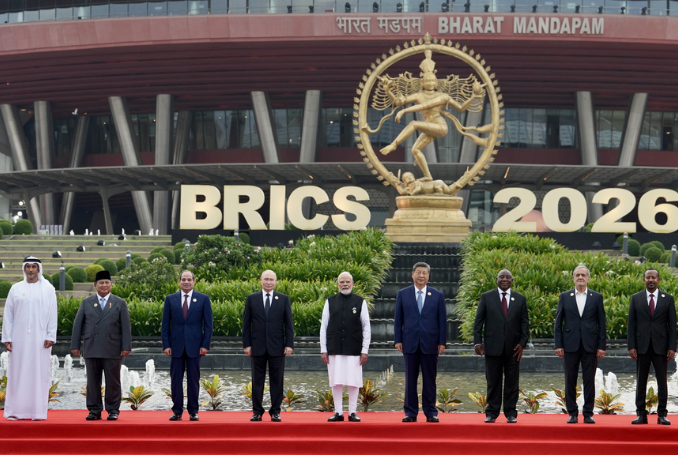 BRICS leaders on the sidelines of the 18th BRICS Summit at Bharat Mandapam, in New Delhi on September 12, 2026. (Photo: Indian Prime Minister's Office// Wikimedia Commons)
While there have been developments in the treatment of the Palestinian cause, rhetorically, the practical achievements could still be construed as in the works.
The recent New Delhi Declaration, unanimously adopted at the 18th BRICS Leaders Summit, has again revived hopes that, through multipolarity, the world is moving closer to aiding the path toward a Palestinian State. In reality, there is a long way to go, to say the least.
Back in 2022, the issue of an emerging multipolar world order thrust the BRICS economic group into the global spotlight; since then, the alliance has expanded its membership while also revealing its many flaws. Much of the initial enthusiasm for BRICS was driven largely by China and Russia, alongside the broader decline in the power of the United States. Therefore, the assumption was that the push toward true multipolarity would encourage the championing of causes like Palestine and even the formation of an alternate power bloc through institutions at the United Nations.
While there have been developments in the treatment of the Palestinian cause, rhetorically, the practical achievements could still be construed as in the works. So far, BRICS has quite frankly fallen short on a number of occasions when it comes to the issue of Palestine.
When multipolarity became a popular theme, especially on the Left of the political spectrum, it stirred up reminiscences of the Soviet Union, Chairman Mao’s People’s Republic, and the old Non-Aligned Movement. Although BRICS and the emerging multipolar order certainly do challenge the post-Cold War era of total US dominance, it cannot be interpreted as the revival of any previous period.
China and Russia have, for example, leaned into hosting talks between Palestine’s national factions, advocating the position of international law and championing Palestinian Statehood, in a way that we did not previously see. Yet, when major tests have been presented, the reality is that both Moscow and Beijing have backed down from standing up for their positions.
Take, for example, the vote on United Nations Security Council (UNSC) resolution 2803, which was passed on November 17, 2025. This resolution came about through the blatant bullying tactics of the US Trump administration, forcing all member states, with the exception of Russia and China, to bow down and vote it through.
UNSC Res. 2803 was the birth certificate for the infamous Board of Peace (BoP), which sought to take control of the Gaza Strip and implement a pro-Israeli project in the besieged territory, as the displaced population was left to rot in anguish after facing mass starvation, ethnic cleansing, and genocide. What the BoP also represents is an attempt to isolate the United Nations from having any true role over the affairs of Gaza, beyond that its own charter never mentioned the words “Palestine” or “Gaza” once, indicating that it was intended as more than simply a corrupt institution designed to do the US’s bidding in the besieged coastal territory.
Moscow and Beijing registered their opposition verbally, but ultimately backed down and opted to abstain, allowing for the resolution to pass. Since then, 27 States have joined the BoP, pulling them deeper into the US circle of power when it comes to the Palestinian issue.
Quite frankly, both the Russian and Chinese governments were left in a very difficult position; they opposed the resolution and what it meant for the future of the UN, in addition to international law, but when push came to shove, they didn’t decide they were willing to initiate the multipolar moment they could have at that very point in time. Another example of how the BRICS-aligned nations have failed to push back against US hegemony is in their lack of initiative when it came to Venezuela and currently in the case of Cuba. These have been clear-cut opportunities to push back.
While BRICS member States like Iran and South Africa have chosen to center the Palestinian cause, taking measurable steps towards punishing the Israelis and standing up for Gaza, the others have not taken that route. For example, Russia and China both maintain ties with the Israelis, refusing to take concrete steps to punish them for attacking 8 different nations, in addition to committing genocide in Gaza.
Then there is the elephant in the room: India is the largest single purchaser of Israeli military technology in the world, and its Prime Minister Narendra Modi is joined at the hip with Israeli PM Benjamin Netanyahu.
When it comes to the BRICS New Delhi Declaration, it falls way short of the mark for this historical moment on the Palestinian issue. In fact, point 30 says the following:
“We take note of the adoption of UNSC Resolution 2803. We call for the implementation of the relevant UNGA and UNSC Resolutions and urge all parties to ensure the maintenance of ceasefire and full and unhindered humanitarian access in the Gaza Strip. In this context, we express deep concern about the continued violence in Gaza despite the ceasefire agreement of October 2025. We call for halting any policies aimed at forced displacement of Palestinians from the Gaza Strip and express concern regarding arrangements that may prejudice the inalienable rights of the Palestinian people and legitimize or prolong occupation.”
Far from being an indicator of a multipolar system, it literally references the very UNSC resolution that asserted US domination and led to the disastrous situation we currently see in the besieged Gaza Strip. It is extremely weak, and the position of opposing ethnic cleansing is just a basic principle of international law.
Although there could be something there in the future with the decline of the US empire, the multipolar moment when there is real, tangible pushback against Washington has simply not come. Sooner or later we will see BRICS nations forced to actually pick sides. The UN system has deteriorated, the Israeli-US war on Iran is having global economic implications, and the rampant thuggery we are seeing will have to be confronted. So far, the only alliance standing up for itself is the Iranian-led Axis of Resistance, which has not been afraid to use every means at its disposal to follow through on its alternative system to the United States.

– Robert Inlakesh is a journalist, writer, and documentary filmmaker. He focuses on the Middle East, specializing in Palestine. He contributed this article to The Palestine Chronicle.

No comments:
Post a Comment