Showing posts with label turkey. Show all posts

Thursday, December 12, 2019

First Global Conference on Israeli Apartheid

Israel’s continued occupation of Palestinian territory, as well as the efforts that Israel goes to to impose second-class citizen status on Palestinian citizens and inhabitants of the occupied West Bank prompted the “First Global Conference on Israeli Apartheid” to take place in Istanbul, Turkey, last weekend.
Inaugurating the conference, President of the Union of Non-Governmental Organisations in the Islamic World (UNIW), Ali Kurk reiterated the Western governments’ overwhelming support for Israel’s apartheid system and the country as a whole, and stated: “International law has become meaningless now the law of the strong rules.”
Retired general of the Turkish armed forces who was appointed Chief Political Adviser to Turkish President Recep Tayyip Erdogan in 2016, Adnan Tanriverdi, said Jerusalem was particularly under threat of becoming a purely Jewish city as a result of Israel’s policy of evacuating Palestinian homes in occupied East Jerusalem and then either allowing Jewish settlers to occupy them or destroying them.

Jewish exclusivity

Former Executive Secretary of the United Nations Economic and Social Commission for Western Asia (ESCWA), Rima Khalaf, said Israel is “the only country in the world to confer full citizenship based on inherited religion.” She also linked the Israeli apartheid system to the racial Darwinism that was prevalent throughout the 19th and 20th centuries in Europe, which fostered an ideology of racial and ethnic supremacy that is the root cause of apartheid.
Archbishop of the Greek Orthodox Church in Jerusalem, Atallah Hanna, added: “Israeli occupiers want Muslims and Christians to be racist to each other,” but that will not work as “we share a common Palestinian identity.”
Activists, politicians and supporters of the Palestinian cause gather in Istanbul for the' First Global Conference on Israeli Apartheid' on 29 November 2019 [Middle East Monitor]
Greek Orthodox Church in Jerusalem, at the ‘ First Global Conference on Israeli Apartheid’ in Istanbul, Turkey on 29 November 2019 [Middle East Monitor]
He warned that Israel is carrying out a gradual ethnic cleansing campaign in Jerusalem in an effort to turn it into a purely Jewish city. The Christian population of the holy city has been decreasing over the years, he added, making up only one per cent of the population now. The solution, he said, is for both Christians and Muslims to join forces as they are both being insulted and oppressed by the Israeli occupation.
They want to evacuate Jerusalem and spread their colonial rule…We say to them: we will not leave, we will stay and protect our land.
Former United Nations human rights investigator Richard Falk said Israel is continuing the legacy of European-style colonialism by shifting entire demographics on the ground. This Zionist project “was unfolding at a time when colonisation was collapsing,” and that colonial legacy did not simply end in 1967 but is continuing to this day with its allies such as the US providing “unconditional” support.
This policy of demographic change makes the two-state solution defunct and no longer a viable solution, Falk added. It is “a ghost-solution or a zombie-solution” which refuses to die, which Israel holds onto due to the fact that if it renounces that concept then it will effectively renounce the very legitimacy of a separate and autonomous Jewish state. This reality of Israel’s established population plan, international political manipulation, and US support makes for a “dystopian outcome which rests on violence and apartheid”.
The unreliability of the two-state solution has long been espoused by many among both the pro-Palestine and pro-Israel communities, with some calling for a one-state solution instead, in which Palestinians have an equal status as Israelis and apartheid is abolished, while others call for a more Jewish identity and supremacy in the state of Israel.
Activists, politicians and supporters of the Palestinian cause gather in Istanbul for the' First Global Conference on Israeli Apartheid' on 29 November 2019 [Middle East Monitor]
Activists, politicians and supporters of the Palestinian cause gather in Istanbul for the’ First Global Conference on Israeli Apartheid’ on 29 November 2019 [Middle East Monitor]
Palestinians need to have a clear vision of how to navigate through their predicament, former Arab member of the Israeli Knesset (parliament) Haneen Zoabi said. She stressed that Palestinians – whether in the West Bank or in Israel – will not be liberated and apartheid will not be destroyed by going to the courts and asking for help.
Israel’s monopoly in the court system and its apartheid policies will not enable such endeavours to succeed, she explained. But the failures of such attempts have woken Palestinians up and encouraged them to be more active.
The conference was hugely effective in shedding light on the extent of the Israeli apartheid system and its suppression of the Palestinian people, with a variety of well-experienced and knowledgeable speakers, intellectuals, academics and figures at the forefront of it. A plethora of statistics and research were efficient in propagating the continued plight of Palestinians living under occupation and the numerous unspeakable violations of human rights and international law that the state of Israel has committed.
What the conference failed to do, however, was provide clear and direct solutions to the issue of the Israeli apartheid as a whole. This is not entirely blameworthy on the conference itself – the crisis of the Israeli-Palestinian “conflict” is not an easy one to find solutions for – but apart from Tanriverdi’s call for a united military force in the Muslim world, recommendations on how to pressure Israel using international law, frequent references to toppling of apartheid in South Africa and the Boycott, Divestment and Sanctions (BDS) movement, a clear and united solution was sorely lacking.
The final communique on the conference, UNIW included the five primary guidelines which are to be observed in its aim to form the Global Coalition against Israeli Apartheid:
  1. The Coalition shall be open to all individuals and organizations committed to the principles of justice, equality, and dignity for all;
  2. The goal of the Coalition is to contribute to and expedite the dismantlement of the Israeli apartheid regime imposed on the Palestinian people, in the framework of achieving equality, dignity, and justice for all;
  3. The Coalition shall use all legal means possible towards that end;
  4. The Coalition shall act as a forum and support network allowing its members to maximize the impact of their work in their respective fields, 4 including research, awareness raising, legal action, and activities of boycott, divestment and sanctions (BDS),with a view to combatting Israeli apartheid;
  5. In all its initiatives and activities, the Coalition shall adhere to the principles set forth in international law.


Tuesday, December 10, 2019

Big change not expected in Doha policy towards Riyadh: Zaccara

Big change not expected in Doha policy towards Riyadh: Zaccara

TEHRAN, (MNA) – Research assistant professor at Qatar University says despite recent talks between Saudi Arabia and Qatar It is still difficult to predict if this will mean a change in the overall foreign policy of Qatar.
Qatar's foreign minister has said he hopes for "progress" in the efforts to resolve the Gulf diplomatic crisis following talks with Saudi Arabia, adding that the parties have "moved from a stalemate" in the two-year dispute.
Sheikh Mohammed bin Abdulrahman Al Thani made the comments on Friday while speaking at a foreign policy conference in Rome amid signs of thawing tensions between Qatar and its neighbors.
To shed more light on the issue we reached out to Dr. Luciano Zaccara, a research assistant professor at Qatar University.
During "MED - Mediterranean Dialogues" in Rome, Qatari Foreign Minister said that his country hadn’t supported the Muslim Brotherhood (Ikhwanul Muslimin) and political Islam. Can his remarks be considered as a shift in the country’s foreign policy?
Bearing in mind the recent signs that are showing some rapprochement between Saudi Arabia and Qatar, including the unannounced visit of the Qatari Foreign Minister to Riyadh in November and the developments around the [Persian] Gulf Football Cup which is currently played at Doha with the presence of the ‘blockading’ teams and fans that came directly by airplane despite the blockade, the words of the FM can certainly be attributed to a negotiation that is taking place among both states to ease the tension. It is still difficult to predict if this will mean a change in the overall foreign policy of Qatar, but I don’t expect a big change.
Reuters also announced that about one month ago the Qatari FM had visited Riyadh and has announced that his country won’t support Ikhwanul Muslimin anymore. Can such a thing affect Ankara and Doha relations?
Turkey-Qatar relations are strategic and very important for both countries, and Turkey was very helpful in overcoming the negative effects of the blockade. Therefore, relations will remain unchanged, despite the fact that Turkey may be affected by its foreign policy interest due to the changes in the Qatari foreign policy. Turkey understands that the PGCC is the natural regional environment for both Saudi Arabia and Qatar despite their differences, and Turkey would not pressure Qatar to act otherwise.
Will Qatar’s recent moves overshadow the military and political cooperation of the country with Turkey?
I don’t expect so.
Qatar and Kuwait have recently joined the US proposed Persian Gulf marine coalition. On the other hand, Iran has invited them to join Tehran’s HOPE initiative. How do you see the future of Iran’s HOPE propose?
Even though the HOPE initiative was received with attention on the southern shore of the Persian Gulf, no more advancement was witnessed in that regard. And certainly, the engagement of PGCC state members in new military coalitions that may have Iran as the main ‘target’ is incompatible with any security arrangement that includes Iran. If no improvement is witnessed in the HOPE initiative in the short term, despite the Chinese or Russian support, the proposal will be definitively abandoned or rejected.
How can a possible breakthrough in Saudi Arabia and Qatar relation affect the Tehran-Doha relation?
If Iran is the bargaining chip for the Qatari-Saudi reconciliation, the Tehran-Doha relations will be directly affected. Some of the commercial and trade agreements signed would be canceled or not implemented, and the benefits Iran obtained due to the geographical proximity and goods provision will certainly get reduced. However, it would be difficult to justify that Qatar is sacrificing its relations with Iran (nor Turkey) since its strategic value became more important than expected before the blockade. In the event of a new chapter in the PGCC crisis, then Qatar wouldn’t be able to count on Iran anymore!
Interview by Payman Yazdani

Friday, December 06, 2019

NATO’s irrelevance self-evident


Crescent International
The recent public spat between head of the fanatic-secular French regime, President Emmanuel Macron and the moron-in-chief heading the regime in Washington DC, Donald Trump, about NATO’s current and future prospects is a positive development for global peace.
The military-political alliance of war-mongering Western neo-colonial regimes, the North Atlantic Treaty Organization (NATO), has outlived its usefulness.
It should have been disbanded with the demise of the Soviet Union in 1991.
Recent public disagreements between key NATO members that surfaced due to Trump’s crude antics would hopefully generate lively debate about the military alliance’s irrelevance.
At 70, it is time to perform its last rites and consign it to the dustbin of history where it belongs.
The post-WWII military alliance was created in 1949 to confront the Soviet Union and prevent its expansion into Western Europe.
NATO has now expanded much beyond the shores of the North Atlantic and has spread its tentacles even into landlocked Afghanistan and Niger.
From strictly a military point of view, in the age of hybrid and guerrilla warfare, NATO’s conventional military approach rooted in nation on nation warfare is outdated.
This is probably the reason why Kremlin’s spokesman Dmitry Peskov responding to NATO’s communique of December 4, highlighted that Moscow would not get involved in an arms race with NATO.
The Soviet Union committed this mistake in the 1980s thereby weakening itself economically.
Russia clearly understands the radically altered military landscape of 2019, where a lightly armed but highly motivated Taliban movement has forced Washington to negotiate its retreat.
Nevertheless, it is not the military aspect that renders NATO irrelevant for the contemporary situation, but its political failure.
Created supposedly to hold Europe together against an external threat, NATO’s arrogance is probably one of the primary reasons for EU’s current crisis.
Despite EU’s many shortcomings, the Western part of Europe is the most successful socio-political project. It has prevented war among these states since the Second World War.
True, wars have been exported elsewhere: Africa, Latin America, and the Muslim East but Europe has remained conflict-free since 1945.
Nonetheless, NATO’s use of EU as a political cover to expand eastward toward the Russian borders, under its “partnership for peace program” triggered harsh Russian responses in Georgia in 2008 and in Ukraine in 2014.
One of the key reasons for EU’s current political crisis is that the bloc stopped being an economic union and was pushed by the US to turn into a political and security project closely linked to NATO.
The EU’s acceptance of East European states as members, while most of them are still not ready to be part of the bloc economically and politically, created an array of economic and political problems.
Influx of cheap labor from Europe into Britain was one of the key contributors to the Brexit disaster.
Apart from clear divisions among NATO member Western regimes, Turkey is also beginning to gradually distance itself from the Western designed security system.
While it is too early to predict Ankara’s date of departure from NATO, Turkey’s disdain for the alliance is a small step towards regional Muslim security architecture.
As Turkish society is becoming more Islamicaly conscious and its government more oriented toward advancing its own interests, at some point Turkey will leave NATO.
It will then seek an alternative and that would most likely be a regional alliance that will include Iran and Pakistan.
Among Muslim countries, these three are the only ones that pack military punch. In the past, they had formed an economic bloc under the Regional Cooperation for Development (RCD).
It petered out due to internal changes in the three countries. Recent developments point toward the possibility of a revival of cooperation between them.
This should be welcomed and encouraged.

Wednesday, December 04, 2019

Nuclear Lies and Broken Promises

Conn M. HALLINAN
When Turkish President Recep Tayyip Erdogan told an economic meeting in the city of Sivas on Sept. 4 that Turkey was considering building nuclear weapons, he was responding to a broken promise.
When Israeli Prime Minister Benjamin Netanyahu accused the government of Iran of lying about its nuclear program, he was concealing one of the greatest subterfuges in the history of nuclear weapons.
And the vast majority of Americans haven’t a clue about either.
Early in the morning of Sept. 22, 1979, a US satellite recorded a double flash near the Prince Edward islands in the South Atlantic. The satellite, a Vela 5B, carries a device called a “bhangmeter” whose purpose is to detect nuclear explosions. Sent into orbit following the signing of the Partial Test Ban Treaty in 1963, its job was to monitor any violations of the agreement. The Treaty banned nuclear explosions in the atmosphere, underwater and in space.
Nuclear explosions have a unique footprint. When the weapon detonates, it sends out an initial pulse of light, but as the fireball expands, it cools down for a few milliseconds, then spikes again.
“Nothing in nature produces such a double-humped light flash,” says Victor Gilinsky. “The spacing of the hump gives an indication of the amount of energy, or yield, released by the explosion.” Gilinsky was a member of the US Nuclear Regulatory Commission and a former Rand Corporation physicist.
There was little question who had conducted the test. The Prince Edward islands were owned by South Africa and US intelligence knew the apartheid government was conducting research into nuclear weapons, but had yet to produce one. But Israel had nukes and both countries had close military ties. In short, it was almost certainly an Israeli weapon, though Israel denied it.
In the weeks that followed, clear evidence for a nuclear test emerged from hydrophones near Ascension Island and a jump in radioactive iodine-131 in Australian sheep. Only nuclear explosions produce iodine-131.
But the test came at a bad time for US President Jimmy Carter, who was gearing up his re-election campaign, a cornerstone of which was a peace agreement between Israel and Egypt.
If the Israelis were seen to have violated the Partial Test Ban, as well as the 1977 Glenn Amendment to the Arms Export Control Act, the US would have been required to cut off all arms sales to Israel and apply heavy sanctions. Carter was nervous about what such a finding would have on the election, since a major part of Carter’s platform was arms control and non-proliferation.
So Carter threw together a panel of experts whose job was not to examine the incident but to cover it up. The Ruina Panel cooked up a tortured explanation involving mini-meteors that the media accepted and, as a result, so did the American public.
But nuclear physicists knew the panel was blowing smoke and that the evidence was unarguable. The device was set off on a barge between Prince Edward Island and Marion Island (the former should not be confused with Canada’s Prince Edward Island) with a yield of from 3 to 4 kilotons. A secret CIA panel concurred but put the yield at 1.5 to 2 kilotons. For comparison, the Hiroshima bomb was 15 kilotons.
It was also clear why the Israelis took the risk. Israel had a number of Hiroshima-style fission bombs but was working on producing a thermonuclear weapon—a hydrogen bomb. Fission bombs are easy to use, but fusion weapons are tricky and require a test. That the Vela picked it up was pure chance, since the satellite had been retired. But its bhangmeters were still working.
From Carter on, every US president has covered up the Israeli violation of the 1963 Partial Test Ban Treaty, as well as the 1968 Nuclear Non-Proliferation Treaty (NPT). So when Netanyahu says Iran is lying about its nuclear program, much of the rest of the world, including the US nuclear establishment, rolls their eyes.
As for Turkish President Erdogan, he is perfectly correct that the nuclear powers have broken the promise they made back in 1968 when the signed the NPT. Article VI of that agreement calls for an end to the nuclear arms race and the abolition of nuclear weapons. Indeed, in many ways Article VI is the heart of the NPT. Non-nuclear armed countries signed the agreement, only to find themselves locked into a system of “nuclear apartheid,” where they agreed not to acquire such weapons of mass destruction, while China, Russia, Great Britain, France and the US get to keep theirs.
The “Big Five” not only kept their weapons, they are all in the process of upgrading and expanding them. The US is also shedding other agreements, like the Anti-Ballistic Missile Treaty and the Intermediate-Range Nuclear Force Agreement. Washington is also getting ready to abandon the START treaty that limits the US and Russia to a set number of warheads and long-range strategic launchers.
What is amazing is that only four other countries have abandoned the NPT: Israel, North Korea, Pakistan and India (only the latter three have been sanctioned by the US). But that situation cannot hold forever, especially since part of Article VI calls for general disarmament, a pledge that has been honored in the breach. The US currently has the largest defense budget in its history and spends about 47 percent of what the entire rest of the world spends on their militaries.
While the US doesn’t seem able to win wars with that huge military—Afghanistan and Iraq were disasters—it can inflict a stunning amount of damage that few countries are willing to absorb. Even when Washington doesn’t resort to its military, its sanctions can decimate a country’s economy and impoverish its citizens. North Korea and Iran are cases in point.
If the US were willing to cover up the 1979 Israeli test, while sanctioning other countries that acquire nuclear weapons, why would anyone think that this is nothing more than hypocrisy on the subject of proliferation? And if the NPT is simply a device to ensure that other countries cannot defend themselves from other nations’ conventional and/or nuclear forces, why would anyone sign on or stay in the Treaty?
Turkish President Erdogan may be bluffing. He loves bombast and effectively uses it to keep his foes off balance. The threat may be a strategy for getting the US to back off on its support for Israel and Greece in their joint efforts to develop energy sources in the eastern Mediterranean Sea.
But Turkey also has security concerns. In his speech, Erdogan pointed out “There is Israel just beside us. Do they have [nuclear weapons]? They do.” He went on to say that if Turkey did not response to Israeli “bullying,” in the region, “We will face the prospect of losing our strategic superiority in the region.”
Iran may be lying—although though there is no evidence that Teheran is making a serious run at producing a nuclear weapon—but if they are, they in good company with the Americans and the Israelis.
Sooner or later someone is going to set off one of those nukes. The likeliest candidates are India and Pakistan, although use by the US and China in the South China Sea is not out of the question. Neither is a dustup between NATO and Russia in the Baltic.
It is easy to blame the current resident of the White House for world tensions, except that the major nuclear powers have been ignoring their commitments on nuclear weapons and disarmament for over 50 years.
The path back to sanity is thorny but not impossible:
One: re-join the Anti-ballistic Missile Treaty, thus making Russia’s medium range missiles unnecessary, and reduce tensions between the US and China by withdrawing ABM systems from Japan and South Korea.
Two: re-instate the Intermediate-Range Nuclear Force Agreement and find a way to bring China, India and Pakistan into it. That will require a general reduction of US military forces in Asia coupled with an agreement with China to back off on its claims over most of the South China Sea. Tensions between India and Pakistan would be greatly reduced by simply fulfilling the UN pledge to hold a referendum in Kashmir. The latter would almost certainly vote for independence.
Three: continue adherence to the START Treaty but halt the modernization of the Big Five’s nuclear weapons arsenals and begin to implement Article VI of the NPT in regards to both nuclear and conventional forces.
Pie in the sky? Well, it beats a mushroom cloud..

Sunday, November 17, 2019

White House-Ak Saray relations: From close friendship to conflict of interests

By Hossein Amiri

Relations between the U.S. Turkey have strained since the failed July 2016 coup in Turkey. Now, the most important reasons for the tension is Washington's strong opposition to Turkey's plan to buy S-400 missile system from Russia and Turkish military invasion into northern Syria.
Although Turkish President Recep Tayyip Erdogan's visit to the U.S. on November 13 was intended to resolve the two countries' disputes and open a new horizon in economic and trade relations, differences still remain. 
Though after the meeting at the White House, Trump made some pledges, including increasing trade ties to $100 billion, it takes a long time to fulfill these promises.
Contrary to such pledges, the Pentagon announced that it had replaced all F-35 fighter parts made by Turkey.
While the Turkish and U.S. leaders were meeting, F-35 production program executive Lt. Gen. Eric Fick said at a congressional hearing that Turkey would be completely phased out until March.
At the moment the U.S. has narrowed the number of parts down from 1,000 to 12.
Undersecretary of Defense for Acquisition and Sustainment Ellen Lord affirmed to Rep. Donald Norcross, D-N.J., that as of Wednesday, Turkey’s exit from the program was not expected to cause any F-35 production delays.
The U.S. government believes Ankara's move to buy S-400 missile system from Russia is not in line with NATO policies. Washington also sees Turkey’s decision as a threat to U.S. F-35 fighters. However, Ankara has announced that it will go ahead with its decision to buy the missile system.
Erdogan said it is not a right policy to ask Ankara to deprive itself of the Russian S-400 missile defense system.
Erdogan's remarks came in response to some reports that Trump had requested Turkey to cancel the purchase of S-400 system, a defense system that has been deployed in some parts of Turkey since July 2019.
But after Trump and Erdogan's meeting, the Turkish president claimed that the U.S. president had a positive view on buying the missile system.
Though Trump may seek to strike a deal with Erdogan on the S-400 missile system and F-35 fighter aircraft, based on his own businessmen approach, Ankara's military intervention in northern Syria and its insistence on buying the S-400 system are at odds with Washington. For this reason, the House of Representatives has passed two resolutions against Turkey.
On October 30, the House approved a resolution against Turkey recognizing the Ottoman massacre of Armenians in 1915. 305 representatives voted in favor of the resolution, with only three opposing it. It also passed another resolution calling on Trump to impose sanctions on Turkey over military operations in northern Syria. The resolution was also adopted by 403 votes in favor and 16 against, a move that rose Turkey's anger.
After Erdogan's meeting with Trump, attended by some Congress representatives, senior Republican Senator Lindsey Graham and chairman of the Senate Judiciary Committee vetoed the resolution recognizing the massacre of Armenians by the Ottoman Empire. 
Earlier, Senate Majority Leader Robert Menendez had called for the resolution to be approved. Lindsey Graham noted that he had listened to Erdogan's speech at the White House and criticized a House resolution that recognized the Armenian genocide. 
Menendez argued that "U.S. policy must be unanimous and honest in the face of human rights violations, crimes against humanity, ethnic cleansing, and genocide" and sent it to the Senate for approval.
There is a difference between the White House and Congress in how to deal with Turkey. Also, there is a difference between Republicans and Democrats despite Trump's promises to Erdogan.

Sunday, November 10, 2019

President Assad: European States Hate Erdogan but Want Him!


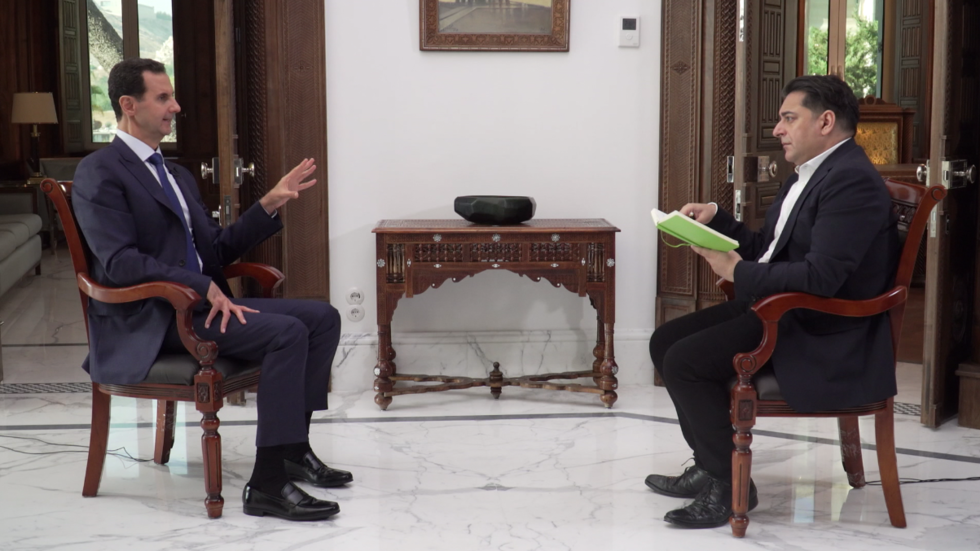
Assad RT interview

Syrian President Bashar Al-Assad in an interview with RT

 Syrian Presdient Bashar Al-Assad slammed as Hypocrisy the way European nations deal with Turkish President Recep Tayyip Erdogan.


In an interview with RT, Assad said it’s hypocrisy for European nations to fear that Ankara will send refugees to Europe, but continue to sponsor terrorism in Syria.
The Syrian leader argued that the primary concern for Europe should not be the Syrian refugees which Erdogan now threatens to release to Europe, but the “hundreds of thousands” of extremists Europe allied itself with.
“How can you fear those few millions, the majority of them are moderates and they have few terrorists, while you support those terrorists directly in tens of thousands at least and maybe hundreds of thousands in Syria and you don’t fear that they’re going to go back to your country?” Assad told Afshin Rattansi in an interview that will be fully broadcast this Monday.
While there might be some extremists among those who fled the war-torn country, the majority of the refugees do not pose any acute threat, as opposed to hardened jihadists who may turn on their patrons, the Syrian leader said.
“Let’s say that sending those Syrians and other refugees is dangerous, the most dangerous [for] Europe is to support the terrorists in Syria, this is the most dangerous part.”
The relationship between Europe and Turkey is love-hate, Assad said. He noted that although the EU “hates” the Turkish leader, European nations cannot but listen to what he has to say.
“Actually, the relation between Erdogan and the EU is two ways: they hate him but they want him.”
Source: RT

Wednesday, November 06, 2019

The Kurds may well have ‘no friends but the mountains’, but they do have Israel

Omar Ahmed
There is an old saying that “the Kurds have no friends but the mountains”. Poetic, poignant and tragic; but not quite true. Despite the mainstream Western media lamenting the latest “betrayal” of Kurdish allies by the US government, there has been one ally who has had a consistent relationship with the Kurds: Israel.
A day after Turkey launched Operation Peace Spring on 9 October, following reports of US President Donald Trump announcing a withdrawal of US troops from north-eastern Syria, Israeli Prime Minister Benjamin Netanyahu “strongly condemned” the Turkish invasion against the “gallant Kurdish people” and warned of ethnic cleansing. Netanyahu also said that Israel was prepared to extend humanitarian aid to the Kurds. However, as Haaretz has noted, there has been a deafening silence from Netanyahu about Trump effectively abandoning the Kurds to their fate at the hands of the second largest army in NATO.

Israeli-Kurdish relations

The relationship between the Kurds and Israel is no mystery. Ties between the two go back to the 1960s, with Israel providing military and humanitarian aid until 1975. The arrangement ended abruptly after the accord signed between Iraq and pre-Islamic Republic Iran, following the latter’s support for Iraqi-Kurdish separatists under the pro-West Shah Mohammad Reza Pahlavi, who also enjoyed close ties with Israel. Relations resumed discretely thereafter, becoming more prominent following the US invasion and occupation of Iraq in 2003, in the form of an Israeli base used to facilitate the training of Kurds; Israel had a strategic interest in supporting Kurdish forces, as a counterweight to Sunni and Shia groups in Iraq. Involvement in the region also gave Israel better access to intelligence from Syria and Iran. Iraqi Kurdish leader Mustafa Barzani once said of Israel, “There is no other country to which we Kurds owe so much.” He also told an Israeli emissary that “only the Jews cared about the Kurds.”
In his prison journal, the Kurdish leader Abdullah Ocalan says that it was Israel's Mossad that "built the clandestine network for surveillance of the PKK."


View image on Twitter

It is no surprise, then, that Israel has been so vocal in its support for an independent Kurdistan state, primarily to act as a buffer against Arab adversaries and arch-rival Iran, which has its own Kurdish population. It is, however, easy to forget that there was a time when the most important ally for Israel in the region was Turkey, which was the first Muslim majority country to recognise the nascent Zionist state in 1949. This relationship, as with pre-revolutionary Iran’s, was established in more secular times, when Ataturk’s ideology was entrenched in Turkish politics and society. Turkey has increasingly become less secular (although some polls suggest otherwise) and eastward facing under President Recep Tayyip ErdoÄŸan’s AK Party. The relationship took a downward turn with the assault on the Mavi Marmara Flotilla massacre in 2010, when Israeli commandos killed nine humanitarian activists (a tenth died later of his wounds) taking aid to the besieged Gaza Strip, and injured many more. Yet to maintain ties with Turkey, Israel has taken the same view as the US and the EU, and designated the Kurdistan Workers’ Party (PKK) as a terrorist organisation.
It thus becomes problematic when the US State Department declares that the so-called Syrian Democratic Forces, which include the Syrian Kurdish militia group the YPG, are the “Syrian offshoot of the PKK”. Washington did, after all, rebrand the Syrian Kurdish militia and encourage it to change its name in order to disassociate itself from the PKK.


The current alliance between the YPG and the Syrian government is pragmatic, given that the Kurds have no one to protect them against the Turkish offensive intended to establish a safe zone for refugees in the border area, yet they have proven time and again to be very politically fickle throughout the Syrian civil war. In the summer of 2016, and not for the first time in the conflict (the earliest known clashes occurred in 2012), the YPG clashed in Aleppo with the so-called Free Syria Army (the FSA), which is supported by Turkey. The rebels accused the YPG of collaborating with the Syrian government against them, whereas in 2014, the YPG and FSA had launched a joint operation command in Kobane in a bid to combat the then emerging threat of Daesh.
We now have a situation where the FSA — which includes jihadists in its ranks, since its rebranding as the “Syrian National Army” — are leading the ground offensive against the YPG. At the time of writing, a shaky five-day ceasefire is in place to allow the YPG to withdraw, although reports claim that this has been violated.
Trump gets a lot of criticism in the mainstream media but at times he has revealed rare gems of raw truth. Like the time that he said that the Saudi royal family won’t last two weeks without US protection, for example. Now he has pointed out that the Kurds “are not angels”, which goes against the message in the mainstream media as establishment figures fall over themselves to express dismay at the betrayal of the Kurds. Almost nonchalantly, Trump said that the PKK is worse than Daesh. He may be right, given that the Syrian chapter of the movement is willing to release its Daesh prisoners, knowing full well the possible impact of such a move. The Kurds have also committed crimes in Arab villages in areas under their control and persecuted local Christians.
Following the Iraqi Kurdish retreat from Kirkuk in 2017, it became clear that the international community was not interested in an independent state of Kurdistan. Not only are the Kurds scattered in Iran, Turkey, Iraq and Syria — two of the region’s natural hegemons are in that list – but they also have affiliations with Israel and just about anyone else with whom any close links are convenient at the time. This renders a possible Kurdistan politically untrustworthy.
A complete withdrawal of the US from Syria would be disastrous for the documented Zionist plan for the Balkanisation of Syria and the wider Middle East, which is why Israel has demanded that the US base near the Jordan border remains open, so as to serve as an obstacle between the Iran-Syria-Lebanon corridor. Crucially, in another of Trump’s slip-ups, the US is still holding on to the Syrian oil fields in the east. Despite the US President’s acknowledgement that they still are in control, the likelihood of a US pull-out is inevitable as the Syrian army retakes its territory with Russian support, leaving Washington’s position unsustainable.
Furthermore, maps reveal that the Kurdish population in Syrian territory has claimed vastly more land east of the River Euphrates than the land which is their historic region. We have seen this sort of thing before in the region, and continue to do so to this day.
As the Kurds navigate through a myriad of short-term alliances – often with false promises of statehood or autonomy ringing in their ears, or even protection from an existential threat — they are likely to be betrayed. Unfortunately for them, they are once again being used by the West as pawns against the perceived bogey of the day in an imperial project gone wrong.

Nevertheless, the one constant which they can count on is support from Israel. Hence, a state of Kurdistan is only ever going to be an Israeli proxy, as the fragmentation of Arab states serves the Yinon Plan for Greater Israel with the hope that, “sectarian-based states become Israel’s satellites and, ironically, its source of moral legitimation”.