Showing posts with label Vladimir Putin. Show all posts

Saturday, September 21, 2019

Absolution from crimes by deflection and deceit is never successful

By Martin Love

NORTH CAROLINA - Vladimir Putin appears far and away smarter than any major Western “leader”, especially Donald Trump and Mike Pompeo. Ansarullah appears to have attacked the Abqaiq oil processing plant in the Eastern Province of Saudi Arabia with drones or something, or claims it did. Maybe they fired off missiles of some sort that had adopted Iranian technology. It’s a mystery, but whatever and whoever hit the plant, and it wasn’t the homemade firecracker rockets that fly out of the Gaza Strip to land in some farm field around Sederot inside “Israel”, whatever this “country” without defined borders really is geographically (it’s never been reliably determined).
What hit the Saudi oil installations was well aimed or it aimed itself well and proved powerful enough to shut down half of Saudi oil production for a couple weeks more at least. And Putin masterfully and even tongue-in-cheek trolled the Saudis, offering to sell them the S-300 or S-400 missile defense systems. Priceless!
The Saudi regime is hopeless and helpless. After spending many billions of dollars on military equipment over years, and with virtually no “defense” against whatever it was exactly that bombed Abqaiq and Khurais, and with alleged military cover by the U.S., the Saudis nonetheless may still as well be driving mangy camels and not Ferraris, Lamborghini’s or F-16s in the Eastern Province. Same goes for the UAE.
So far, Trump’s response has been vague and has allowed others at least to blame Iran for the attacks, claiming the drones or whatever originated from somewhere in Iran, or maybe it was Iraq. Hell, maybe they flew from an Iranian missile base on the moon?
The truth is Trump and Pompeo and all the rest don’t have a clue, and it is even quite possible – as claimed Robert J. Moriarty, arguably the best U.S. Navy/Marine fighter pilot during the Vietnam War and since the war an aviation record maker and holder – that the Israelis attacked Abqaiq and Khurais in an effort to spur the U.S. to gallop to the side of the Saudis and as the Zionists equally desire, attack Iran. Neither the Saudis nor the Zionists can fight anybody without gobs of U.S. assistance, and never really have.
False flags are nothing to the Zionists and they are good at creating them: the most notable being the attack in June 1967 on the U.S. Navy frigate “Liberty” in the Mediterranean cruising west of Gaza and north of Sinai during the Six Day War To this day the Navy veterans who are still alive and who served on the Liberty are treated like lepers by the U.S. Veterans Administration – such is the unholy grip the Jews have about the public ever being properly informed that the bombing and strafing of the Liberty was a premeditated Israeli attack in which dozens of sailors died. Those fine veterans know too much, it seems, just like Julian Assange of Wikileaks fame who is now officially a Western political prisoner, not a criminal, at Belmarsh dungeon in London, and he may actually be dying.
Let’s face it: the Saudis are inept and the Israelis, stripped of their high-tech war tech (and nukes as threats), are only good for, for example, shooting and killing elderly Palestinian women (or children in Gaza) as they did this week at Kalandia checkpoint north of Jerusalem: the hapless woman, 50, apparently   entered the wrong “lane” in the incredible, cruel maze of the checkpoint and was summarily murdered. The Zionist soldiers and police said she was wielding a knife, which as usual was a fabrication. She was 10 meters from anyone when she was gunned down and certainly no threat to anyone.
And it’s not as if any country is entirely free at least of some oppression of citizens, Iran included, just as no individual person is ever entirely cleansed of occasional bad actions. But the reiteration of assaults on Iran does not justify in any proportional way even a tiny fraction of the much more severe and horrific postures and deeds of the U.S. and Israel and the Saudis. We see, for example, a raft of what has been called “Whataboutism” by Western apologists in the media, as if this absolves perps of obvious crimes.
Among the worst of Zionist apologists happens to be columnists Bret Stephens and Bari Weiss, both Zionists, at the New York Times. Whenever anyone questions them about Israeli apartheid crimes, they are inclined to say: “But ‘what about’ (for example) the way the Chinese treat the minority Muslim Uighers, or the way Modi in India is currently treating Muslims in Indian controlled parts of Kashmir?” Now we have the spectacle that a desperate Netanyahu may well be “out” as Israeli Prime Minister, this cat’s nine lives perhaps used up. No doubt he fears he’s finally going to be indicted for corruption, and may go to prison.
Absolution by way of deflection and deceit is absurd and can never be finally won. And the most remarkable aspect of such hypocrisy, hubris and exceptionalism is that almost the entire world is seeing through this very tiresome game and neither Washington nor Tel Aviv nor Riyadh (and some others) realize it enough yet to change course. But the day is somewhere ahead eventually when they will have to realize it. At any rate, this is part the reason why Trump has been unsuccessful in virtually all his foreign policy initiatives to date.
Foreign Minister Javad Zarif seems of the same caliber, generally, as Putin, and has so far navigated the stresses that Iran has been subject to with class and even, like Putin, with some humor. Good thing he did not resign earlier this year, as he suggested he might.

Tuesday, September 17, 2019

Iranian, Turkish and Russian presidents hold talks on security situation in Syria

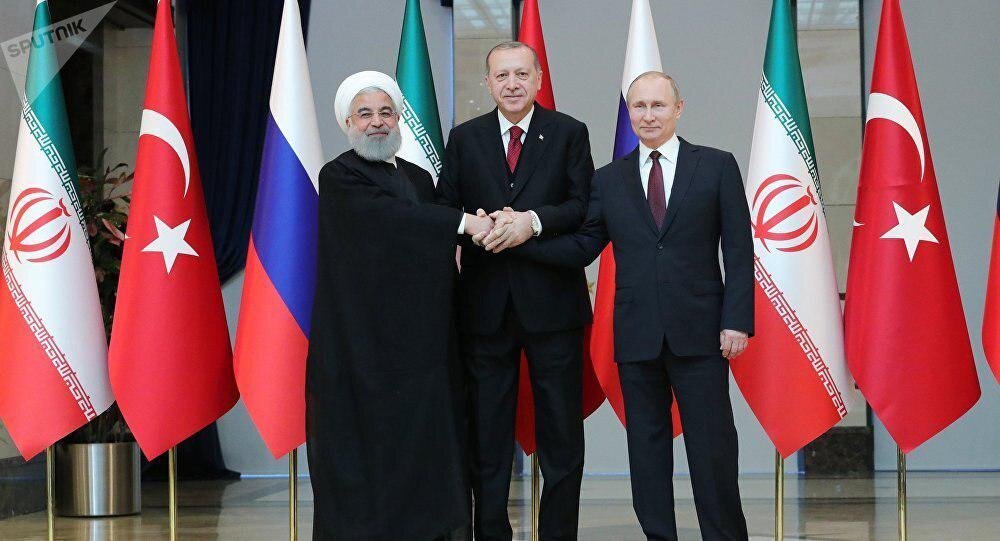
TEHRAN/ANKARA – President Recep Tayyip Erdogan, the host of this round of trilateral summit between Turkey, Iran and Russia, hosted President Hassan Rouhani and President Vladimir Putin in Ankara on Monday. It was the fifth summit since 2017.
They were set to speak to reporters at a closing news conference and release a joint declaration.
The three presidents held one-on-one talks before the summit.
In the Syrian war, Tehran and Moscow have been backing the central government. However, Turkey has been a supporter of the rebel groups. Now, the three countries, despite differences, agree on power-sharing in Syria.
Iran and Russia were instrumental in cracking down on terrorists, especially ISIS, in Syria. ISIS misused the chaos resulting from the armed conflict between the government and the opposition groups to create killing fields in the country.
According to Al-Jazeera, the Turkish presidency had said the summit was to focus on ensuring required conditions for voluntary return of refugees.
Erdogan said the summit will bring new dimensions to the Astana process for Syria. He said the Astana platform on Syria was a "unique attempt" to find effective solutions for Syria.
"We have to take more responsibility to ensure peace in Syria," he added.
Talking before the meeting of the three presidents, Rouhani also said cooperation among Iran, Russia, and Turkey, as the three guarantor states of the ceasefire regime in Syria, has promoted security in the war-ravaged country.
-------- Efforts to ‘normalize’ situation in Idlib
Russia and Turkey agree on measures to “normalize” the situation in the terrorist-infested northwestern Syrian province of Idlib.
“Together with Turkey’s president, we have outlined additional joint steps to neutralize the terrorists’ nests in Idlib and normalize the situation there and in the whole of Syria as a result,” Putin told a joint briefing with Erdogan, Press TV reported.
----------Rouhani: Tehran-Ankara ties amicable, strong, developing
In his separate meeting with Erdogan, Rouhani called relations between Iran and Turkey amicable, strong and developing in many fields, vowing to work to deepen ties.
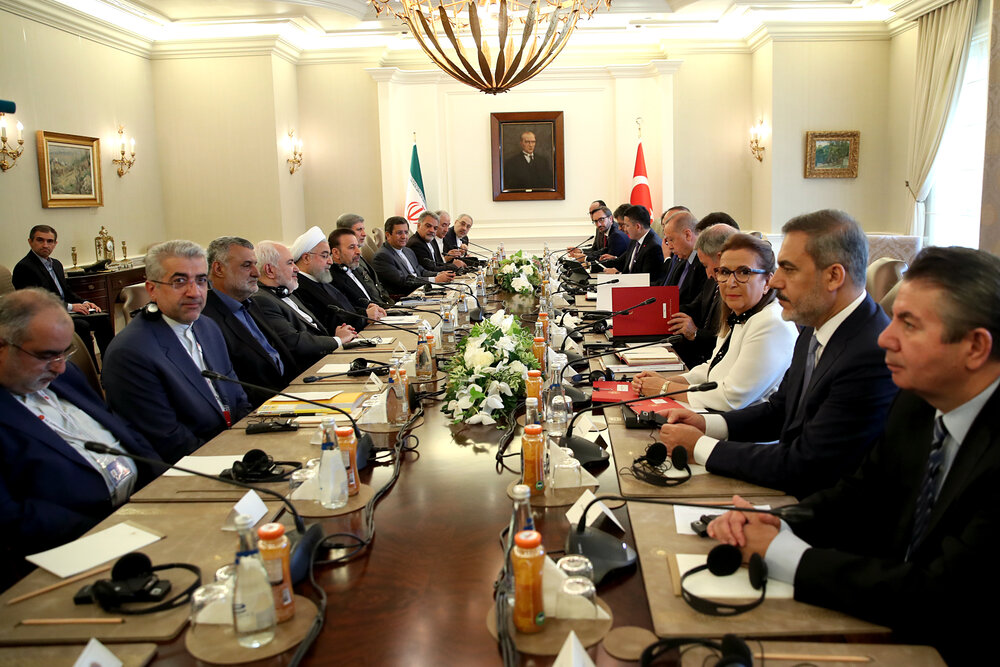
After the meeting, the two presidents attended the meeting of the high-ranking delegations of Iran and Turkey during which Rouhani said, “Fortunately, relations between Iran and Turkey have always been close and brotherly, and the two governments and nations have stood by each other in different conditions”.
Appreciating the warm hospitality of the Turkish government and people, the Iranian president expressed hope that the visit would yield good results for both nations and the region, especially the people of Syria.
He went on to acknowledge the Turkish government’s clear stances against the United States’ unjust sanctions against Iran, saying, “Despite hardships, Iran and Turkey will continue their inclusive economic relations”.
He added, “Iran welcomes Turkish investors and private sector’s presence and participation in implementing common projects.”
The president said, “The holding of the 27th Joint Commission of Iran and Turkey Cooperation in the coming days is a very important opportunity to further develop these relations and cooperation”.
Rouhani also said Iran and Turkey share close views view in combatting terrorism. “Fortunately, good developments have been made in defense-related cooperation between the two countries. Therefore, Iran-Turkey cooperation in ensuring security in common borders and the region will improve further”.
“The pattern of Iran-Turkey trilateral cooperation with Russia in ensuring the security of the region could contribute to the development and stability of the region and the two nations through trilateral and multilateral economic cooperation with neighbors”.
“Guaranteeing the security of the Persian Gulf waterways, the Sea of Oman and the Strait of Hormuz has always been important for Iran as the largest littoral state,” Rouhani said, adding that Iran considers itself responsible to ensure security of regional waterways.
In an indirect reference to the presence of U.S. forces in the Persian Gulf, the president said, “The security of regional waterways has to be protected only by its littoral states, and that the presence American forces and inviting other countries to be present in the region will only increase the existing problems and tensions.”
Rouhani also said attacks on Yemen is the result of miscalculation and misinformation by the U.S., saying, “We must all work to bring stability back to Yemen with the participation of the United Nations.”
Rouhani also pointed to cooperation between Iran and Turkey, as guarantors of the Astana process, which has made Syria more secure, saying, “We must help the Syrian government in fighting the remaining terrorists, especially in Idlib and east of Euphrates until the terrorists are eradicated from the region”.
At the same meeting, the Turkish president referred to the friendly and brotherly relations between Iran and Turkey, saying, “We are determined to continue the great steps taken in relations between the two countries”.
Erdogan added, “Trade cooperation between the two countries by using national currencies has grown significantly and this trend will continue”.
He also said, “America’s sanctions against Iran are unconstructive, and in view of the Turkish government, preserving the Joint Comprehensive Plan of Action is an important symbol of the success of dialogue and diplomacy.”
“We hope that as a result of today’s summit and finalization of the previous summit’s agreements in Sochi stability and security will prevail in the region, especially in Idlib,” he concluded.
  • Rouhani: Tehran-Ankara ties amicable, strong, developing

    TEHRAN – The presidents of the Islamic Republic of Iran and Turkey have stressed that relations between the two countries are amicable, strong and developing in many fields, vowing to work to deepen and develop ties.
    President Hassan Rouhani had a meeting with President Recep Tayyip Erdogan on Monday on the sidelines of the fifth round of tripartite summit of Iran, Russia and Turkey in Ankara, according to the Iranian president’s official website.
    After the meeting, the two presidents attended the meeting of the high-ranking delegations of Iran and Turkey, in which Rouhani said, “Fortunately, relations between Iran and Turkey have always been close and brotherly, and the two governments and nations have stood by each other in different conditions”.
    Appreciating the warm hospitality of the Turkish government and people, the Iranian president expressed hope that the visit would yield good results for both nations and the region, especially the people of Syria.
    He went on to acknowledge the Turkish government’s clear stances against the United States’ unjust sanctions against Iran, saying, “Despite hardships, Iran and Turkey will continue their inclusive economic relations”.
    He added, “Iran welcomes Turkish investors and private sector’s presence and participation in implementing common projects.” 
    The president said, “The holding of the 27th Joint Commission of Iran and Turkey Cooperation in the coming days is a very important opportunity to further develop these relations and cooperation”.
    Rouhani also said Iran and Turkey share close views view in combatting terrorism. “Fortunately, good developments have been made in defense-related cooperation between the two countries. Therefore, Iran-Turkey cooperation in ensuring security in common borders and the region will improve further”.
    “The pattern of Iran-Turkey trilateral cooperation with Russia in ensuring the security of the region could contribute to the development and stability of the region and the two nations through trilateral and multilateral economic cooperation with neighbors”.
    “Guaranteeing the security of the Persian Gulf waterways, the Sea of Oman and the Strait of Hormuz has always been important for Iran as the largest littoral state,” Rouhani said, adding that Iran considers itself responsible to ensure security of regional waterways.
    In an indirect reference to the presence of U.S. forces in the Persian Gulf, the president said, “The security of regional waterways has to be protected only by its littoral states, and that the presence American forces and inviting other countries to be present in the region will only increase the existing problems and tensions.” 
    Rouhani also said attacks on Yemen is the result of miscalculation and misinformation by the U.S., saying, “We must all work to bring stability back to Yemen with the participation of the United Nations.”
    Rouhani also pointed to cooperation between Iran and Turkey, as guarantors of the Astana process, which has made Syria more secure, saying, “We must help the Syrian government in fighting the remaining terrorists, especially in Idlib and east of Euphrates until the terrorists are eradicated from the region”.
    At the same meeting, the Turkish president referred to the friendly and brotherly relations between Iran and Turkey, saying, “We are determined to continue the great steps taken in relations between the two countries”.
    Erdogan added, “Trade cooperation between the two countries by using national currencies has grown significantly and this trend will continue”.
    He also said, “America’s sanctions against Iran are unconstructive, and in view of the Turkish government, preserving the Joint Comprehensive Plan of Action is an important symbol of the success of dialogue and diplomacy.”
    “We hope that as a result of today’s summit and finalization of the previous summit’s agreements in Sochi stability and security will prevail in the region, especially in Idlib,” he concluded.

    Wednesday, July 24, 2019

    Was foul play behind IAEA Chief Yukiya Amano’s death?

    Was foul play behind IAEA Chief Yukiya Amano’s death?


    TEHRAN, Jul. 24 (MNA) – American analyst and columnist Stephen Lendman has raised questions about Yukiya Amano's suspicious death.
    Following is the full text of his article: 
    On Monday, an IAEA statement said the following: “The secretariat of the International Atomic Energy Agency regrets to inform with deepest sadness of the passing away of Director General Yukiya Amano.”
    On July 18, he died at age-72 after heading the organization since 2009, no cause of death explained. Was it natural or otherwise? More on this below.
    It’s believed Amano intended to step down before his third term expired in November 2021.
    Reportedly he had health issues from an unspecified illness. Last September, the IAEA said he’d undergone an unexplained medical procedure, no further elaboration given about his health status.
    His death came at a time of heightened tensions between Iran and the West because of Trump regime-led hostility toward the country.
    During his tenure, he oversaw the landmark JCPOA nuclear deal’s adoption by its signatories and Security Council members, making it binding international law.
    Iran’s Deputy Foreign Minister, Abbas Araghchi paid tribute to Amano following his death, saying:
    “My deep condolences…We worked very closely” during JCPOA negotiations. “I commend his skillful and professional performance (that) resulted in complete closure. May the Almighty bless his soul.”
    Vladimir Putin said he “always admired his wisdom and foresight - his ability to make informed decisions in the most difficult circumstances.”
    It’s unclear who’ll succeed him. Deputy Director General Mary Alice Hayward is serving as acting IAEA chief in the interim.
    Since Security Council Resolution 2231 adopted the JCPOA, the IAEA affirmed Iran’s full compliance with its provisions 15 consecutive times.
    No nation is more intensively monitored none more scrupulously in compliance with Nuclear Non-Proliferation Treaty (NPT) provisions and its other nuclear obligations.
    Last October, in response to Israel’s Netanyahu falsely claiming Iran seeks nuclear weapons, citing a (nonexistent) “secret atomic warehouse” in his UN General Assembly address, Amano refuted the accusation, saying:
    “The agency sends inspectors to sites and locations only when needed. The agency uses all safeguards relevant to information available to it but it does not take (so-called intelligence) at face value.”
    Without mentioning Israel or Netanyahu by name, Amano added that “(a)ll information obtained, including from third parties, is subject to rigorous review and assessed together with other available information to arrive at an independent assessment based on the agency’s own expertise.”
    “In order to maintain credibility, the agency’s independence in relation to the implementation of verification activities is of paramount importance.”
    Following Trump’s unlawful JCPOA pullout in May 2018, a week’s later IAEA June 8-dated quarterly report said the following:
    “Since 16 January 2016 (JCPOA Implementation Day), the Agency has verified and monitored Iran’s implementation of its nuclear-related commitments in accordance with the modalities set out in the JCPOA, consistent with the Agency’s standard safeguards practices, and in an impartial and objective manner.”
    “The Agency reports the following for the period since the issuance of the Director General’s previous quarterly report.”
    “Iran has continued to permit the Agency to use on-line enrichment monitors and electronic seals which communicate their status within nuclear sites to Agency inspectors, and to facilitate the automated collection of Agency measurement recordings registered by installed measurement devices.”
    The report, others preceding and following it, found Iran in full compliance with its JCPOA obligations, stating:
    “Iran is implementing its nuclear-related commitments under the Joint Comprehensive Plan of Action.”
    That status has not changed to this day. The Arms Control Association affirmed Iran’s compliance with Nuclear Non-Proliferation Treaty (NPT) and JCPOA provisions.
    Based on Iran’s fulfillment of its NPT and JCPOA obligations, no justification exists for imposing nuclear related sanctions on the country — by the Security Council, the only body authorized to impose them, not individual nations on their own.
    Unilaterally imposed US sanctions on Iran and other nations constitute economic terrorism. They breach UN Charter Article 41, stating:
    The Security Council is empowered to decide what actions may be used to enforce international law — including “complete or partial interruption of economic relations and severance of diplomatic relations,” other than use of military force.
    When Article 41 steps don’t work, Article 42 authorizes Security Council members to “take such action by air, sea, or land forces as may be necessary to maintain or restore international peace and security” — by use of “demonstrations, blockade,” or military intervention.
    The Security Council alone may authorize going this far — not presidents, prime ministers, lawmakers, or judicial bodies of member states.

    Saturday, April 27, 2019

    Dictator: Media code for ‘Government we don’t like’

    By Alan Macleod 

    FAIR - Let’s start with a quiz: Quick! Name some dictators! I’m willing to bet most of you responded with just a few of the same names: Assad, Putin, Castro, Kim Jong-un, Gaddafi, Maduro. This is not because they are the only dictators in the world (far from it), or that all of them even necessarily qualify for the title, but precisely because these are the figures most constantly labeled as such by our media.
    “Dictator” is a very powerful moniker to give someone. There is a hard-to-define but very important distinction between a government with authoritarian tendencies or a poor human rights record, on the one hand, and a full-blown dictatorship. The very name implies that dictatorial governments should, nay, must be resisted and overthrown, while the same action is not appropriate or justifiable for the former.
    Democracy is a supposedly sacred ideal for Americans. Politicians and media tell us that the United States “stands for” democracy and opposes dictatorships everywhere, one reason why the US must continue to involve itself diplomatically and militarily around the world.
    However, Freedom House’s “Freedom in the World” studies find that 49 countries—over a quarter of the world’s governments—are “not free”, a designation they use interchangeably with “dictatorships” on their website and their reports. Why then, do most politically savvy people not know the names of all these dictators? Why are they not household names, like Assad and co.? Is it because the United States provides military assistance (training, sales and aid) to three-quarters of them, as Rich Whitney’s study (Truthout, 9/23/17) suggests?
    How Free is Freedom House?
    Defining and quantifying what does and does not constitute a dictatorship is a notoriously tricky business, and Freedom House’s strong conservative political bias makes its list and judgments all the more questionable. For one, the “non-governmental” organization is actually overwhelmingly funded by Washington, who employed Freedom House in 2006 to perform “clandestine activities”—i.e., regime change operations—in Iran.
    The man in charge of compiling the freedom list, used by Whitney and many others, admitted his methodology consisted of “hunches and intuition.” And as many scholars have indicated, Freedom House also has a long history of supporting US client state dictatorships and attacking enemy states such as Nicaragua; the ratings have a strong conservative and pro-US ideological bias. Nevertheless, its index is useful, as it is the most commonly cited source on the matter, and one can assume that it is not going out of its way to falsely label US allies as dictators.
    When you look at the governments that Freedom House describes as dictatorships, those that are also Official Enemies are frequently described as such in corporate media—for example, Russia (Washington Post, 5/8/18), Cuba (USA Today, 2/26/19), Syria (New York Times, 3/2/19), Belarus (ABC, 3/5/19),  North Korea (USA Today, 3/22/19) and Venezuela (New York Times, 4/10/19). Yet “our dictators”—that is, the “not free” governments that Washington supports—are rarely if ever labeled as dictatorships by the establishment press. In fact, there is very little coverage at all of those countries that are “behaving themselves” as far as the US State Department is concerned.
    Let’s look at the press coverage of four of Freedom House’s “dictators” who receive US military aid, all of whom have been in the news recently: Paul Biya of Cameroon, Abdel el-Sisi of Egypt, Abdelaziz Bouteflika of Algeria and Kazakhstan’ s Nursultan Nazarbayev.
    Cameroon
    The 86-year-old Paul Biya, the longest serving non-royal head of state in the world, has held office in Cameroon since Gerald Ford was president. He recently won a seventh term in office that Foreign Policy (10/22/18) described as a “farce.” Cameroon has been in the news of late, due to the government’s human rights abuses pushing the country to the brink of a civil war. Freedom House considers it to be one of the least free countries in the world.
    However, when discussed at all, Biya was presented matter-of-factly by the media, without the need to add call him a “dictator.” The New York Times (10/6/18) presented him euphemistically as “one of the world’s longest-serving presidents.” From the coverage, readers would not know he is a dictator, even by Freedom House’s standards. In fact, going through fully 20 years of coverage in the Times, Biya was never once described as a “dictator,” “despot,” “tyrant” or any other similar designation.
    When Biya was rebuked at all, the tone of the coverage was less condemnatory and more muted criticism. Voice of America (2/14/19) noted that Biya’s decision to remove presidential term limits (meaning he could rule for life) led some “critics” to call the move “authoritarian.”
    Egypt
    Gen. Abdel el-Sisi came to power in 2013 in  a military coup that overthrew the democratically elected government of President Mohamed Morsi. Sisi recently announced his plan to rule until 2034—effectively in perpetuity.
    The New York Times’ article (2/14/19) on the subject noted that this would “further entrench his authoritarian rule,” and even noted he had jailed “tens of thousands” of opponents, muzzled the internet and taken over the courts. Nevertheless, it stopped well short of calling him a dictator. Indeed, it noted that he enjoyed strong support from around the world, and was seen as a “bulwark against Islamist militancy” in the region, endorsed by the US and France. Other media outlets followed this tendency. CNN (2/13/19) simply described him as “current President Abdel Fattah el-Sisi,” while NPR (2/14/19) likewise just referred to “Egyptian President Abdel-Fattah el-Sissi.”
    While accurately noting Sisi’s “unprecedented crackdown on dissent,” which imprisoned “tens of thousands of people,” the BBC’s report (2/15/19) labeled him neutrally as “president,” and only characterized his steps to rule virtually indefinitely as something “opponents of the proposal describe” as “a further step towards authoritarianism.” Thus, its strongest criticism of Egypt is that it’s accused of moving toward “authoritarianism”—a long way from being a full-fledged “dictator.”
     Algeria
    After he announced he intended to stand once again for president, massive protests broke out all around Algeria against 82-year-old Abdelaziz Bouteflika. The uprising has been serious enough that he has promised to stand down. Despite coming to power fraudulently and ruling with an iron fist for 20 years, media outlets (e.g., CNN, 3/11/19; Reuters, 4/2/19) have refrained from describing him as a dictator, with the BBC (3/6/19) simply referring to him as a “reclusive president.”
    Indeed, reading the Guardian’s coverage  (4/1/19), one would have no idea he was not the epitome of a democrat. The New York Times(3/12/19) also praised Bouteflika for “bringing back stability” to the North African country, and “restoring the honor of the nation’s army.” As with Cameroon’s Biya, Bouteflika has never once been described as a “dictator” in the last 20 years of Times coverage.
     Kazakhstan
    Another ruler propped up with US military aid is Nursultan Nazarbayev. The 85-year-old, in power since 1989, recentlyannounced he would step down. It was also revealed that Kazakhstan’s capital, Astana, would berenamed Nursultan in his honor (not a common occurrence in democracies—with Washington, named for the winner of an election that involved approximately 1 percent of the population, arguably not an exception).
    Nazarbayev has a long history of cracking down on freedom of speech, the press and  religion, and uses torture against his political opponents. Despite this, he was presented positively in the media, with the New York Times (3/19/19) simply referring to him as the “longtime president of Kazakhstan.” The Associated Press (3/19/19) called him “the only leader that independent Kazakhstan has ever known,” praising him for “maintaining stability.” Reuters (3/19/19) claimed he was a “widely popular” leader, with none of the above using the “dictator” moniker.
    The Washington Post editorial board (3/29/19) published a glowing appraisal of his tenure. It presented him as a visionary leader, an ex-steelworker “who led the former Soviet republic out of the empire’s chaotic implosion,” claiming he brought Kazakhstan into a peaceful, prosperous new era, while “building national identity” and stopping any ethnic conflict. While noting that he “ruled as a strongman” and “would have been wiser to view dissent and democracy with more tolerance,” the editorial implied his repression was justified, concluding “he won’t be soon forgotten” by his people.
     Double Standards
    The double standard is highlighted by the constant media references to enemy states as dictatorships, whether the label is warranted or not. The Washington Post (1/4/19) describes leftist Bolivian President Evo Morales as “wishing to become a Venezuela-style dictator,” while the Guardian(12/3/18) carries warning of Bolivia becoming an “imminent ‘Venezuelan-Cuban-style’ dictatorship.”
    The leftist Sandinista government of Nicaragua is constantly called a “dictatorship” as well. The New York Times (8/2/18) published an opinion piece from a Nicaraguan headlined “A Dictatorship Is Rising in My Country Again.” Many other outlets describe him as a “dictator” (Economist, 7/12/18; Time, 3/18/19) carrying out a “terrifying crackdown” (National Review, 3/15/19)—language that is never used for US-backed dictatorships.
    And it takes only a cursory glance at the headlines to see how Nicolas Maduro, “the child butcher of Venezuela” (Washington Examiner, 2/21/19), is portrayed:
    1    “The Dictator of Venezuela Earns His Title” (New York Times, 2/27/19)
    2    “Venezuela’s Dictator Maduro Survived a Tough Week, but His Problems Are About to Get Worse” (Miami Herald, 2/25/19)
    3   “Why Are Progressives More Focused on Disagreeing With Trump Than Countering a Dictator [Maduro]?” ( Washington Post, 3/2/19)
    4  “Newt Gingrich: Venezuela’s Dictator Maduro Must Go—Even if the Military Has to Intervene” (Fox News, 3/14/19)
    5    “Maduro Really Didn’t Like Being Asked if He’s a ‘Dictator’” (New York Post, 2/26/19)
    6    “Gen. Jack Keane, Hans Humes on Venezuela’s Socialist Dictator Maduro’s Potential Exit” (Fox Business, 3/7/19)
    Is it truly a coincidence that these three countries with elected leftist heads of state are constantly labeled “dictatorships”? Bolivia is not even on Freedom House’s “not free” list—unlike Cameroon, Egypt, Algeria and Kazakhstan. Venezuela and Nicaragua were recently added to it, despite the fact that both countries’ latest elections were endorsed internationally.
    While there are some clear shortcomings to Venezuela and Nicaragua’s political systems, the US-dominated Organization of American States observed the 2017 Nicaraguan municipal elections and declared that “the popular will [was] expressed through the vote in the vast majority of Nicaragua’s municipalities.” (With 53 percent turnout, the governing Sandinista party won in 135 out of 152 communities, with the Independent Liberal Party taking 12 of the remainder.)
    Meanwhile, Venezuela’s 2018 elections were endorsed by 150 international observers, including foreign ex-heads of state like Spain’s Jose Zapatero and Ecuador’s Rafael Correa, with three international election observation teams endorsing the result, despite the fact that US media wrote them off as a sham (FAIR.org, 5/23/18).
    The same cannot be said for Kazakhstan, even by Freedom House, that notes that “none of the elections held in Kazakhstan since independence have been considered ‘free and fair’ by credible international observers.” Nursultan was declared to have won 98 percent of the vote in 2015.
    Enemy states are covered far more and far more harshly in US corporate media than friendly ones. A search for Paul Biya in the NYTimes.com database elicits 97 results, compared to 1,135 for Maduro, 713 for Morales and 3,517 for Ortega, despite the fact that Biya has been in power as long as the other three combined. (Cameroon’s population is 24 million, three-fourths the size of Venezuela, more than twice as big as Bolivia and four times as populous as Nicaragua.)
    In a recent article (FAIR.org, 3/23/19), I suggested that the term “moderate” or “centrist” has a tactical definition when used in the media. It does not refer to any political positions, but is used as a way of conveying legitimacy. Thus anyone the media approve of is, by definition, a moderate. FAIR (8/20/18) has also noted that a “regime,” in US media usage, is simply a government that is at odds with the US empire.
    The “dictator” label is also a powerful cue, used by media to prime the reader to see a particular country or leader a certain way. Readers are invited to feel outraged at the misdeeds of Assad, Putin or other anti-US head of states, while authoritarian rulers that toe the US line are ignored or even praised. The choice of whether to use a word like “dictator” frames a country in a way conducive to elite US interests, conveying legitimacy or the lack thereof in a single label.

    Thursday, April 11, 2019

    ‘Russia Compromising Iran, Syria Interests by Tilting towards Israel’

    A senior political analyst says Russian President Vladimir Putin’s recent campaign gift to Israeli Prime Minister Benjamin Netanyahu was a humiliation for Syria.
    Political commentator Seyyed Hadi Borhani has, in an article, weighed in on Russia-Israel relations. He believes the cordial ties between Moscow and Tel Aviv come at the expense of Iranian and Syrian interests in the region.
    He has particularly referred to Putin’s recent move to gift Netanyahu the body of a missing Israeli soldier killed in fighting with Syrian forces in 1982, and described it as a humiliation for Syria.
    The full text of the opinion piece published on Khabar Online news website follows.
    Only a few days before Israeli elections when campaigning was in full swing, Israeli Prime Minister Benjamin Netanyahu received a warm welcome at the Kremlin before sending back to Israel the body of missing Israeli soldier Zachary Baumel killed in fighting with Syrian forces in Lebanon back in 1982.
    The images of Netanyahu standing next to the soldier’s coffin wrapped in the Israeli flag could possibly be the best subject for Bibi’s campaign posters in the last days of the election campaign in Israel. The pictures can portray Netanyahu as an Israeli hero and advocate of people’s interests.
    Incontrovertibly, Netanyahu owes this victory to Russian President Vladimir Putin. Russian forces led by Putin transferred the soldier’s body from Syria to Moscow without the permission of Damascus officials, and handed it over to Syria’s arch-foe. In this development, Russia not only overlooked Syria’s sovereignty over its own territory, but also humiliated Syria and its government. This comes at a time when the Israeli occupation of Golan Heights in Syria is the subject of hot debate in international circles and Netanyahu takes pride in having carried out hundreds of illegal military attacks on Syrian soil. The latest such attacks occurred exactly a few days before the transfer of the soldier’s body.
    This story clearly states Russia’s different position vis-a-vis Israel and its enemies, and is reminiscent of Moscow’s stance toward both sides of the conflict over the past decades. Moscow – which was long seen as an ally of Arabs and the resistance front by many anti-Israeli forces in the region – has, under the current sensitive juncture, given Israel the worst concessions the last of which was Putin’s gift to Netanyahu, a gift which could facilitate and reinforce Netanyahu’s victory in Israel’s elections. Netanyahu is exactly the same person that has led Israeli troops’ years-long offensives against Syrian soil and left no stone unturned to scuttle the Iran nuclear deal and exert pressure on Iran.
    Netanyahu has probably broken the record with regards to the number of meetings with Putin. Netanyahu’s numerous trips to Moscow, the warm welcomes extended to him at the Kremlin and the many concessions given to him by Russia show the two sides have stepped into a special domain of friendship, so much so that the interests of Russia’s closest allies such and Iran and Syria are easily compromised in this friendship and dealings associated with it.
    From the standpoint of realistic politics [which rule international relations], the stance adopted by Putin might seem justifiable. Putin is responsible for protecting Russia and its interests, and, to that end, would adopt whatever measure he deems fit, and Iran or Syria cannot expect Russia to design and plan its foreign policy in accordance with their interests. Having said that, one should bear in mind that Russia is not a reliable partner in fighting Israel’s expansionism and violations of law in the region despite some anti-Israeli positions it has adopted. Russia would like to have in its basket the eggs of regional nations’ struggles against Israel, so that it would be able to use that card in its major dealings with the West and Israel. Under such circumstances, one should not be surprised if these eggs are seen in Israel’s basket one day – eggs which have been gained through the resistance, sacrifice and struggles of the regional nations. Those at the Kremlin are an old hand at this!

    Sunday, April 07, 2019

    Russia Vows to Provide Timely ‘Reply’ to Dangers Posed by Washington’s INF Exit


    TEHRAN (Tasnim) - Moscow will give a timely military and technical response, if risks arise for its security due to the US pullout from the Intermediate-Range Nuclear Forces (INF) Treaty, Russian Deputy Foreign Minister Alexander Grushko said on Thursday.

    The United States has withdrawn from the INF Treaty proceeding from the interests of achieving geopolitical superiority in all the theaters of military operations and "has actually forced its allies to join its unfounded version why such a decision was made," the high-ranking Russian diplomat.
    "Our position on the INF remains perfectly clear: we believe that the treaty’s regime was a cornerstone of European security," Grushko said, responding to a question from TASS.
    "If a threat arises for Russia, we will give a military and technical response to it. Already now, we will take all necessary efforts to make this response timely with regard to developing such capabilities," the senior Russian diplomat stressed.
    "Simultaneously, proceeding from the interests of maintaining peace in Europe, and the document had its European dimension apart from its strategic significance, we will not be deploying intermediate-range missiles in Europe and other regions as long as US missiles are not deployed there," the Russian deputy foreign minister said.
    On February 1, US President Donald Trump and US Secretary of State Michael Pompeo announced the suspension of Washington’s obligations under the INF Treaty starting February 2. Washington is determined to withdraw from the Treaty in six months unless Russia returns to "real and verifiable" compliance.
    On February 2, Russian President Vladimir Putin announced that Moscow was also suspending the Treaty. He handed down instructions to refrain from initiating talks with Washington on the issue and stressed that the US needed to show readiness for an equal and substantive dialogue.
    On February 5, Trump mentioned the possibility of negotiating "a different agreement - adding China and others."
    The INF Treaty, signed by the Soviet Union and the United States on December 8, 1987, took effect on June 1, 1988. It applies to deployed and non-deployed ground-based missiles of intermediate range (1,000-5,000 kilometers) and shorter range (500-1,000 kilometers). Washington on many occasions accused Russia of violating the Treaty but Moscow strongly dismissed all accusations and expressed grievances concerning Washington’s non-compliance.

    Tuesday, February 26, 2019

    Assad, Putin's green light for battle of Idlib

    By Ramin Hossein Abadian

    TEHRAN - All eyes are on Idlib and the terrorist group’s fate there. Media are reporting on massive preparations by the Syrian army and its dispatch to the northern fronts of the country.
    More equipment has been sent to Idlib suburbs, and troops under the command of the famous general, Suheil al-Hassan, are based in the outskirts. The equipment includes tanks and other weapons, as the Syrian army prepares to recapture Idlib. Many Syrian force have been stationed at Jourin base in the northwest of the countryside beyond Hama and in al-Ahmar in Jab al-Ahmar village in Latakia and surrounds.
    General Suheil al-Hassan is Syria's most notorious commander who is said to be undefeated in war. He has achieved significant success in battles against armed terrorist groups in Syria. Known as the Tiger, he successfully used psychological warfare techniques using large speakers that spread frightening messages.
     The terrorist groups that are in Idlib
    There are various terrorist groups in Idlib, the most important of which is the Hayat Tahrir al-Sham, formerly called Jabhat al-Nusra. In particular, since July 2017, the group has had the most influence in Idlib.
    Smaller groups are Jaysh al-Badia and Jaysh al-Malahim fighting in the south of Idlib. On January 11, 2018, Jaysh al-Malahim issued a statement saying it was fighting in southern Idlib alongside Jaysh al-Badiya.
    The Turkistan Islamic Party, which has close ties to al-Qaeda found in Xinjiang Province, western China, is considered broadly as a terrorist group but is present in Syria. The group has media tools such as the Telegram, which publishes their statements and activities.
    In July 2017, Hayat Tahrir al-Sham defeated its only serious rival, Ahrar al-Sham, for factional dominance in Syria’s insurgent-held northwest, centered on Idlib province.
    Other groups include other movements such as Nour Al-Din Al-Zinki , Jaysh Al-Ahrar, Faylaq al-Sham, Jaish al-Ezzah, (a Free Syrian Army flagged faction), and some smaller groups in Idlib.
    It is time to see that the Syrian government, with the support of its allies, has decided to take important and decisive steps to strengthen the Syrian Armed Forces and equipment in the northern suburbs of Hama and south of Idlib, despite the U.S. and international obstinacy. 
    The question is whether Syria and its allies have taken the final decision to confront the terrorists in Idlib, especially the legitimate and sovereign right of Syria, and Turkey has, like always, refused to fulfill its obligations? Can Lavrov speech at Munich Security Conference be considered a message to Turkey and the U.S.? What is the Syrian army's strategy to prevent civilian casualties? Can the battle of Idlib end easily and quickly? What will be the reaction of regional and international countries, and what will Turkey do?
    What America misses with the domination of Damascus
    The United States is worried that the Syrian army will remove all the military and field milestones that the United States and regional allies can use to exert pressure on Damascus. Especially since the battle of Idlib will be the last stage in the process of liberating the entire geography of Syria from terrorists.
    With the liberation of Idlib, the Syrian government returns to the pre-crisis situation, and those who launched the multi-year war against Syria will return empty handed and Damascus will be victorious, while the U.S.  and allies will be the losers.
    Russia is aware of the situation, and analysts say they will directly support the Syrian army in the face of a possible U.S. reaction. Washington is afraid that Damascus will move swiftly to try to recapture all areas under occupation in Syria, including areas controlled by U.S. military units.
    What will happen to the terrorists in Umm al-Ma'arik Battle?
    Terrorists who do not surrender will be dealt with. According to media reports, all eyes are on the main roads such as Hamah-Idlib, Aleppo- Latakia. All measures are being taken for a tough battle in a region where thousands of Arab, Turkmen, Chinese and Uzbek terrorists are present.
    No one can predict how difficult the battle to recapture Idlib might be. Some observers predict a tough fight, while others claim the Syrian army is more than ready to prevail after victories in the south of Syria. 
    Idlib is the home for rebels and terrorists gathered from all regions. The battle of the city is associated with a lot of complexities compared to the previous fronts and is difficult to predict the course of its field developments. The coming days will reveal the fate of Syria and the determination of the Damascus government to dominate the entire country. 

    Saturday, February 16, 2019

    Iran, Russia and Turkey reaffirms commitment to Syria’s sovereignty

    TEHRAN – Iran, Russia and Turkey issued a joint statement on Thursday at the end of Sochi conference on Syrian crisis and reaffirmed commitment to Syria’s sovereignty and independence.
    The statement was issued by Hassan Rouhani, Vladimir Putin and Recep Tayyip Erdogan.
    Following is full text of the statement published by website of Iran’s Foreign Ministry:
    The Presidents:
    1. Discussed the current situation on the ground in Syria, took stock of the developments following their last meeting in Tehran on 7 September 2018 and underscored their determination to strengthen the trilateral coordination in light of their agreements.
    2. Emphasised their strong and continued commitment to the sovereignty, independence, unity and territorial integrity of the Syrian Arab Republic as well as to the purposes and principles of the UN Charter.
    3. Highlighted that these principles should be universally respected and that no actions, no matter by whom they were undertaken, should undermine them.
    4. Rejected all attempts to create new realities on the ground under the pretext of combating terrorism and expressed their determination to stand against separatist agendas aimed at undermining the sovereignty and territorial integrity of Syria as well as the national security of neighboring countries.
    5. Took note in this regard that the US decision on the withdrawal of its forces from Syria, if implemented, would be a step that would help strengthen stability and security in the country in compliance with the above-mentioned principles.
    6. Examined in details the situation in the Idlib de-escalation area, denounced and expressed serious concern with the attempts of the terrorist organization “Hayat Tahrir al-Sham” to increase its control over the area, and agreed to effectively counter these attempts as well as to take concrete steps to reduce violations in the Idlib de-escalation area through full implementation of the agreements on Idlib, including the Memorandum on Stabilization of the Situation in the Idlib De-escalation Area of 17 September 2018. They also reaffirmed the determination to continue cooperation in order to ultimately eliminate DAESH/ISIL, Al-Nusra Front and all other individuals, groups, undertakings and entities associated with Al-Qaeda or DAESH/ISIL, and other terrorist groups, as designated by the UN Security Council.
    7. Discussed the situation in the north-east of Syria and agreed to coordinate their activities to ensure security, safety and stability in this area including through existing agreements, while respecting sovereignty and territorial integrity of the country.
    8. Reaffirmed their conviction that there could be no military solution to the Syrian conflict and that it could only be resolved through the Syrian-led and Syrian-owned, UN-facilitated political process in line with the UN Security Council Resolution 2254.
    9. Reaffirmed their determination to facilitate the launch of the Constitutional Committee as soon as possible, including by agreeing on its composition and elaborating recommendations for its rules of procedure based on the work undertaken by the three guarantors. They emphasised in this regard the importance of continuing interaction and coordination with the Syrian parties and the United Nations Secretary-General’s Special Envoy for Syria Geir O. Pedersen.
    10. Welcomed the successful development of the second mutual release of detainees within the framework of efforts of the respective Working Group. The releases that took place on 24 November 2018 and 12 February 2019 constituted important contribution of the Astana format to building confidence between the Syrian parties and creating necessary conditions for advancing the political process.
    11. Emphasised the need to continue all efforts to help all Syrians restore normal and peaceful life as well as alleviate their sufferings. In this regard, they called upon the international community, particularly the United Nations and its humanitarian agencies, to increase their assistance to Syria by providing additional humanitarian aid, restoring humanitarian infrastructure assets, including water and power supply facilities, schools and hospitals.
    12. Highlighted the importance of creating conditions for the safe and voluntary return of refugees and internally displaced persons (IDPs) to their original places of residence in Syria. They assessed positively the interaction with all interested parties, including the Office of the United Nations High Commissioner for Refugees (UNHCR), and reaffirmed their readiness to continue this coordination.
    13. Agreed to assign their representatives with the task of holding the next International Meeting on Syria in Astana in April 2019.
    14. In addition to the Syrian issue, discussed recent developments in the world as well as their collaboration in different fields and decided to boost joint economic and commercial cooperation.
    15. Condemned the recent terrorist attack in Iran (Sistan-Balouchestan Province). President of the Russian Federation H.E. Vladimir Putin and President of the Republic of Turkey H.E. Recep Tayyip Erdogan expressed their condolences to the families of the victims of this attack and sympathy with the people and the government of the Islamic Republic of Iran.
    16. Decided to hold the next Tripartite Summit in the Republic of Turkey upon the invitation of President of the Republic of Turkey H.E. Recep Tayyip Erdogan.
    17. The Presidents of the Islamic Republic of Iran and the Republic of Turkey expressed their sincere gratitude to President of the Russian Federation H.E. Vladimir Putin for hosting the Tripartite Summit in Sochi.

    Tuesday, December 25, 2018

    A closer look at American “democracy”

    What is this much vaunted “American democracy?” Barry Grey, a British writer on social issues, has shed light on this top in an article titled A closer look at American “democracy”.
    A central theme of the hysteria over alleged “Russian meddling” in US politics is the sinister effort supposedly being mounted by Vladimir Putin “to undermine and manipulate our democracy” - in the words of Democratic Senator Mark Warner. According to the narrative fabricated by the intelligence agencies and promoted by the Democratic Party and the corporate media over the past year and a half, Putin and his minions hacked the Democrats and stirred up social divisions and popular grievances to secure the election for Donald Trump, and they have been working ever since to destroy “our institutions.”
    Their chosen field of battle is the internet, with Russian trolls and bots infecting the body politic by taking advantage of lax policing of social media by the giant tech companies such as Google, Facebook and Twitter.
    To defend democracy, the argument goes, these companies, working with the state, must silence oppositional viewpoints—above all left-wing, anti-war and socialist viewpoints—which are labeled “fake news,” and banish them from the internet. Nothing is said of the fact that this supposed defense of democracy is a violation of the basic canons of genuine democracy, guaranteed in the First Amendment to the US Constitution: freedom of speech and freedom of the press. But what is this much vaunted “American democracy?” Let's take a closer look.
    In a vast and complex country with a population of 328 million people, consisting of many different nationalities, native tongues, religions and other demographics, spanning six time zones and thousands of miles, two political parties totally dominate the political system.
    The ruling corporate-financial oligarchy controls both parties and maintains its rule by alternating control of the political institutions—the White House, Congress, state houses, etc.—between them. The general population, consisting overwhelmingly of working people, is given the opportunity every two or four years to go to the polls and vote for one or the other of these capitalist parties. This is what is called “democracy.”
    The monopoly of the two big business parties is further entrenched by the absence of proportional representation, which it makes it impossible for third parties or independent candidates to obtain significant representation in Congress.
    The entire political process—the selection of candidates, elections, the formulation of domestic and foreign policies—is dominated by corporate money. No one can seriously bid for high office unless he or she has the backing of sponsors from the ranks of the richest 1 percent—or 0.01 percent—of the population. The buying of elections and politicians is brazen and shameless.
    Last month's midterm elections set a record for campaign spending in a non-presidential year—$5.2 billion—a 35 percent increase over 2014 and triple the amount spent 20 years ago, in 1998. The bulk of this flood of cash came from corporations and multi-millionaire donors.
    In the vast majority of contests, the winner was determined by the size of his or her campaign war chest. Eighty-nine percent of House races and 84 percent of Senate races were won by the biggest spender.
    Democratic candidates had a huge spending advantage over their Republican opponents, exposing the fraud of their attempt to posture as a party of the people. The securities and investment industry—Wall Street—favored Democrats over Republicans by a margin of 52 percent to 46 percent. Elections are anything but a forum to openly and honestly discuss and debate the great issues facing the voters.
    The real issues—the preparation for new wars, deeper austerity and further attacks on democratic rights—are concealed behind a miasma of attack ads and mudslinging. The research firm PQ Media estimates that total political ad spending will reach $6.75 billion this year. In last month's elections, the number of congressional and gubernatorial ads rose 59 percent over the previous, 2014, midterm.
    The setting of policy and passage of legislation is helped along by corporate bribes, euphemistically termed lobbying. In 2017 alone, corporations spent $3 billion to lobby the government.
    A welter of arcane, arbitrary and anti-democratic requirements for gaining ballot status, which vary from state to state, block third parties from challenging the domination of the Democrats and Republicans. These include filing fees and nominating petition signature requirements in the tens of thousands in many states. Democratic officials routinely challenge the petitions of socialist and left-wing candidates who are likely to find support among young people and workers.
    The corporate media systematically blacks out the campaigns of third party and independent candidates, especially left-wing and socialist candidates. The exception is candidates who are either themselves rich or who have the backing of wealthy patrons. Third party candidates are generally excluded from nationally televised candidates’ debates.
    Since the stolen election of 2000, when the Supreme Court shut down the counting of votes in Florida in order to hand the White House to the loser of the popular vote, George W. Bush, with virtually no opposition from the Democrats or the media, attacks on the right of workers and poor people to vote have mounted.
    Thirty-three states have implemented voter identification laws, which, studies show, bar up to 6 percent of the population from voting. States have cut back early voting and absentee voting and shut down voting precincts in working class neighborhoods. A number of states impose a lifetime ban on voting by felons, even after they have done their time. In 2013, the Supreme Court gutted the enforcement mechanism of the 1965 Voting Rights Act, with no real opposition from the Democrats. The United States is one of the few countries that hold elections on a work day, making it more difficult for workers to cast a ballot.
    The two corporate parties have overseen a social counterrevolution, resulting in a staggering growth of social inequality. In tandem with this process, the oligarchic structure of society has increasingly found open expression in the political forms of rule. Alongside the erection of the infrastructure of a police state—mass surveillance, indefinite detention, the militarization of the police, Gestapo raids on workplaces and attacks on immigrants, the ascendancy of the military in political affairs, internet censorship—the personnel of government have increasingly been recruited from the rich and the super-rich.
    More than half of the members of Congress are millionaires, as compared to just 1 percent of the American population. All the presidents for the past three decades—George H. W, Bush, Bill Clinton, George W. Bush, Barack Obama—have either been multi-millionaires going in or have cashed in on their presidencies to become multi-millionaires afterward. In the person of the multi-billionaire real estate speculator and con man Donald Trump, the financial oligarchy has directly taken occupancy of the White House.
    The people will never achieve genuine democracy, nor succeed in defending the democratic gains it extracted in the course of more than a century of struggle against the capitalist class, so long as it remains an oppressed class, exploited by the corporate owners and their state apparatus. Democracy for the workers and oppressed, as opposed to the phony democracy of the rich, can be achieved only through the creation of organs of struggle and control and the building of a revolutionary leadership to overthrow the existing state, place power in the hands of the public in a real democratic system and to establish a society based on equality.