Showing posts with label Kim Jong un. Show all posts

Tuesday, July 02, 2019

The messages hidden in a meeting

By Mohammad Ghaderi

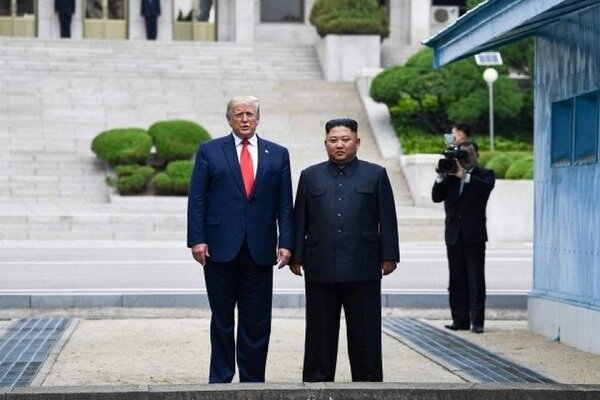
The leaders of the United States and North Korea met at the demilitarized zone (DMZ) in the borders that divide North and South Korea. The meeting was about 50 minutes long. The two sides were inside North Korea’s borders only for the initial greetings and handshakes and after taking some pictures they had their talks inside the territory of South Korea.
The two sides had last met in late February; after that, the negotiations did not go any further and were practically on hold.
Evidently, Donald Trump is the first U.S. president to step into North Korea; he believes that going across the borders that divide North and South Korea is a cause for pride.
After the meeting, Trump announced that he had invited North Korean leader Kim Jong Un to Washington and they had agreed to restart negotiations, but the sanctions on North Korea were still in place! 
Kim Jong Un also said that Trump’s coming to the North Korea was a historical and important moment. If Kim Jong Un travels to U.S. as well, he will be the first North Korean president to visit U.S.
This meeting and Trump’s strategy in dealing with one of the most important issues of U.S. foreign policy, tells us many important things which we will briefly discuss here:
First, as many international analysts believe, Trump’s behavior, as a politician, has a number of features that makes him different from most of other politicians.
Experts believe Trump is a politician who majorly behaves based on advertising techniques; with using these techniques, he plays both his enemies and political rivals.
As he himself has repeatedly said in his electoral campaigns, he is an actor who tries to take the lead in all his interactions and don’t let others to design the rules of games he is playing. This strategy is completely evident in the way he interacted with rich Arab sheikhs and now with boasting about his seemingly bold entrance into North Korea.
Therefore, we can conclude that Trump’s actions are not based on any specific set of rules; he has no clear stand in politics; rather, he mainly designs he actions based on an advertising and commercial model. This is completely evident in the way he has been dealing with North Korea.
Trump wants to pretend that he has a specific doctrine in his international policy; he has even tried to come up with “Trumpism” as a new doctrine like “Jacksonism” or “Jefersonism”, but it is already clear to everybody, including the republicans, that Trump’s international policy is not based on any specific strategy or theory; rather it is merely a show that is rooted in his specific character.
The second point to discuss here is the important role of “foreign policy” in U.S. next presidential elections in 2020.
Based on the latest polls taken by Quinnipiac University, foreign policy is among the most crucial parameters that have severely decreased Trump’s popularity, especially in grey, key states such as Pennsylvania, Wisconsin and Michigan, Ohio and Florida.
it is expected of democrats to mainly focus on Trump’s foreign policy as one of his weaknesses during the next presidential elections; therefore, Trump is now thinking about “changing the current trend” of his foreign policy; in other words, he mainly wants to create the feeling in American citizens that he is making changes in his foreign policy.
In conclusion, we cannot simply figure out Trump’s strategies and judge the limits and parameters of his behavior; because his behaviors are not consistent, they are based on “fleeting tactics” and “momentary emotions”, and we have all witnessed numerous examples of this behaviors since he took the office in 2017.
The last point to discuss is the general idea behind the meeting between U.S. and North Korea’s leaders. Obviously, in dealing with Pyongyang, Trump is simultaneously using both “threats” and “negotiations”, this is the same strategy that he is trying to adopt toward Iran as well.
This paradox is not based on some careful foreign policy plans that U.S. administration has devised; rather, it is the result of Trump’s uncertainty about the right way to use U.S. diplomatic and strategic powers. This is a very serious problem and cannot be resolved anytime soon, even with removing people like John Bolton and Mike Pompeo from the cabinet.
Even when Rex W. Tillerson was the Secretary of State and H. R. McMaster was the National Security Advisor, Trump suffered from this chronic uncertainty; therefore Trump will continue to have this paradoxical, dubious and dual behavior until the last day he is in office, whether it would be 2020 or 20224.

Saturday, April 27, 2019

Dictator: Media code for ‘Government we don’t like’

By Alan Macleod 

FAIR - Let’s start with a quiz: Quick! Name some dictators! I’m willing to bet most of you responded with just a few of the same names: Assad, Putin, Castro, Kim Jong-un, Gaddafi, Maduro. This is not because they are the only dictators in the world (far from it), or that all of them even necessarily qualify for the title, but precisely because these are the figures most constantly labeled as such by our media.
“Dictator” is a very powerful moniker to give someone. There is a hard-to-define but very important distinction between a government with authoritarian tendencies or a poor human rights record, on the one hand, and a full-blown dictatorship. The very name implies that dictatorial governments should, nay, must be resisted and overthrown, while the same action is not appropriate or justifiable for the former.
Democracy is a supposedly sacred ideal for Americans. Politicians and media tell us that the United States “stands for” democracy and opposes dictatorships everywhere, one reason why the US must continue to involve itself diplomatically and militarily around the world.
However, Freedom House’s “Freedom in the World” studies find that 49 countries—over a quarter of the world’s governments—are “not free”, a designation they use interchangeably with “dictatorships” on their website and their reports. Why then, do most politically savvy people not know the names of all these dictators? Why are they not household names, like Assad and co.? Is it because the United States provides military assistance (training, sales and aid) to three-quarters of them, as Rich Whitney’s study (Truthout, 9/23/17) suggests?
How Free is Freedom House?
Defining and quantifying what does and does not constitute a dictatorship is a notoriously tricky business, and Freedom House’s strong conservative political bias makes its list and judgments all the more questionable. For one, the “non-governmental” organization is actually overwhelmingly funded by Washington, who employed Freedom House in 2006 to perform “clandestine activities”—i.e., regime change operations—in Iran.
The man in charge of compiling the freedom list, used by Whitney and many others, admitted his methodology consisted of “hunches and intuition.” And as many scholars have indicated, Freedom House also has a long history of supporting US client state dictatorships and attacking enemy states such as Nicaragua; the ratings have a strong conservative and pro-US ideological bias. Nevertheless, its index is useful, as it is the most commonly cited source on the matter, and one can assume that it is not going out of its way to falsely label US allies as dictators.
When you look at the governments that Freedom House describes as dictatorships, those that are also Official Enemies are frequently described as such in corporate media—for example, Russia (Washington Post, 5/8/18), Cuba (USA Today, 2/26/19), Syria (New York Times, 3/2/19), Belarus (ABC, 3/5/19),  North Korea (USA Today, 3/22/19) and Venezuela (New York Times, 4/10/19). Yet “our dictators”—that is, the “not free” governments that Washington supports—are rarely if ever labeled as dictatorships by the establishment press. In fact, there is very little coverage at all of those countries that are “behaving themselves” as far as the US State Department is concerned.
Let’s look at the press coverage of four of Freedom House’s “dictators” who receive US military aid, all of whom have been in the news recently: Paul Biya of Cameroon, Abdel el-Sisi of Egypt, Abdelaziz Bouteflika of Algeria and Kazakhstan’ s Nursultan Nazarbayev.
Cameroon
The 86-year-old Paul Biya, the longest serving non-royal head of state in the world, has held office in Cameroon since Gerald Ford was president. He recently won a seventh term in office that Foreign Policy (10/22/18) described as a “farce.” Cameroon has been in the news of late, due to the government’s human rights abuses pushing the country to the brink of a civil war. Freedom House considers it to be one of the least free countries in the world.
However, when discussed at all, Biya was presented matter-of-factly by the media, without the need to add call him a “dictator.” The New York Times (10/6/18) presented him euphemistically as “one of the world’s longest-serving presidents.” From the coverage, readers would not know he is a dictator, even by Freedom House’s standards. In fact, going through fully 20 years of coverage in the Times, Biya was never once described as a “dictator,” “despot,” “tyrant” or any other similar designation.
When Biya was rebuked at all, the tone of the coverage was less condemnatory and more muted criticism. Voice of America (2/14/19) noted that Biya’s decision to remove presidential term limits (meaning he could rule for life) led some “critics” to call the move “authoritarian.”
Egypt
Gen. Abdel el-Sisi came to power in 2013 in  a military coup that overthrew the democratically elected government of President Mohamed Morsi. Sisi recently announced his plan to rule until 2034—effectively in perpetuity.
The New York Times’ article (2/14/19) on the subject noted that this would “further entrench his authoritarian rule,” and even noted he had jailed “tens of thousands” of opponents, muzzled the internet and taken over the courts. Nevertheless, it stopped well short of calling him a dictator. Indeed, it noted that he enjoyed strong support from around the world, and was seen as a “bulwark against Islamist militancy” in the region, endorsed by the US and France. Other media outlets followed this tendency. CNN (2/13/19) simply described him as “current President Abdel Fattah el-Sisi,” while NPR (2/14/19) likewise just referred to “Egyptian President Abdel-Fattah el-Sissi.”
While accurately noting Sisi’s “unprecedented crackdown on dissent,” which imprisoned “tens of thousands of people,” the BBC’s report (2/15/19) labeled him neutrally as “president,” and only characterized his steps to rule virtually indefinitely as something “opponents of the proposal describe” as “a further step towards authoritarianism.” Thus, its strongest criticism of Egypt is that it’s accused of moving toward “authoritarianism”—a long way from being a full-fledged “dictator.”
 Algeria
After he announced he intended to stand once again for president, massive protests broke out all around Algeria against 82-year-old Abdelaziz Bouteflika. The uprising has been serious enough that he has promised to stand down. Despite coming to power fraudulently and ruling with an iron fist for 20 years, media outlets (e.g., CNN, 3/11/19; Reuters, 4/2/19) have refrained from describing him as a dictator, with the BBC (3/6/19) simply referring to him as a “reclusive president.”
Indeed, reading the Guardian’s coverage  (4/1/19), one would have no idea he was not the epitome of a democrat. The New York Times(3/12/19) also praised Bouteflika for “bringing back stability” to the North African country, and “restoring the honor of the nation’s army.” As with Cameroon’s Biya, Bouteflika has never once been described as a “dictator” in the last 20 years of Times coverage.
 Kazakhstan
Another ruler propped up with US military aid is Nursultan Nazarbayev. The 85-year-old, in power since 1989, recentlyannounced he would step down. It was also revealed that Kazakhstan’s capital, Astana, would berenamed Nursultan in his honor (not a common occurrence in democracies—with Washington, named for the winner of an election that involved approximately 1 percent of the population, arguably not an exception).
Nazarbayev has a long history of cracking down on freedom of speech, the press and  religion, and uses torture against his political opponents. Despite this, he was presented positively in the media, with the New York Times (3/19/19) simply referring to him as the “longtime president of Kazakhstan.” The Associated Press (3/19/19) called him “the only leader that independent Kazakhstan has ever known,” praising him for “maintaining stability.” Reuters (3/19/19) claimed he was a “widely popular” leader, with none of the above using the “dictator” moniker.
The Washington Post editorial board (3/29/19) published a glowing appraisal of his tenure. It presented him as a visionary leader, an ex-steelworker “who led the former Soviet republic out of the empire’s chaotic implosion,” claiming he brought Kazakhstan into a peaceful, prosperous new era, while “building national identity” and stopping any ethnic conflict. While noting that he “ruled as a strongman” and “would have been wiser to view dissent and democracy with more tolerance,” the editorial implied his repression was justified, concluding “he won’t be soon forgotten” by his people.
 Double Standards
The double standard is highlighted by the constant media references to enemy states as dictatorships, whether the label is warranted or not. The Washington Post (1/4/19) describes leftist Bolivian President Evo Morales as “wishing to become a Venezuela-style dictator,” while the Guardian(12/3/18) carries warning of Bolivia becoming an “imminent ‘Venezuelan-Cuban-style’ dictatorship.”
The leftist Sandinista government of Nicaragua is constantly called a “dictatorship” as well. The New York Times (8/2/18) published an opinion piece from a Nicaraguan headlined “A Dictatorship Is Rising in My Country Again.” Many other outlets describe him as a “dictator” (Economist, 7/12/18; Time, 3/18/19) carrying out a “terrifying crackdown” (National Review, 3/15/19)—language that is never used for US-backed dictatorships.
And it takes only a cursory glance at the headlines to see how Nicolas Maduro, “the child butcher of Venezuela” (Washington Examiner, 2/21/19), is portrayed:
1    “The Dictator of Venezuela Earns His Title” (New York Times, 2/27/19)
2    “Venezuela’s Dictator Maduro Survived a Tough Week, but His Problems Are About to Get Worse” (Miami Herald, 2/25/19)
3   “Why Are Progressives More Focused on Disagreeing With Trump Than Countering a Dictator [Maduro]?” ( Washington Post, 3/2/19)
4  “Newt Gingrich: Venezuela’s Dictator Maduro Must Go—Even if the Military Has to Intervene” (Fox News, 3/14/19)
5    “Maduro Really Didn’t Like Being Asked if He’s a ‘Dictator’” (New York Post, 2/26/19)
6    “Gen. Jack Keane, Hans Humes on Venezuela’s Socialist Dictator Maduro’s Potential Exit” (Fox Business, 3/7/19)
Is it truly a coincidence that these three countries with elected leftist heads of state are constantly labeled “dictatorships”? Bolivia is not even on Freedom House’s “not free” list—unlike Cameroon, Egypt, Algeria and Kazakhstan. Venezuela and Nicaragua were recently added to it, despite the fact that both countries’ latest elections were endorsed internationally.
While there are some clear shortcomings to Venezuela and Nicaragua’s political systems, the US-dominated Organization of American States observed the 2017 Nicaraguan municipal elections and declared that “the popular will [was] expressed through the vote in the vast majority of Nicaragua’s municipalities.” (With 53 percent turnout, the governing Sandinista party won in 135 out of 152 communities, with the Independent Liberal Party taking 12 of the remainder.)
Meanwhile, Venezuela’s 2018 elections were endorsed by 150 international observers, including foreign ex-heads of state like Spain’s Jose Zapatero and Ecuador’s Rafael Correa, with three international election observation teams endorsing the result, despite the fact that US media wrote them off as a sham (FAIR.org, 5/23/18).
The same cannot be said for Kazakhstan, even by Freedom House, that notes that “none of the elections held in Kazakhstan since independence have been considered ‘free and fair’ by credible international observers.” Nursultan was declared to have won 98 percent of the vote in 2015.
Enemy states are covered far more and far more harshly in US corporate media than friendly ones. A search for Paul Biya in the NYTimes.com database elicits 97 results, compared to 1,135 for Maduro, 713 for Morales and 3,517 for Ortega, despite the fact that Biya has been in power as long as the other three combined. (Cameroon’s population is 24 million, three-fourths the size of Venezuela, more than twice as big as Bolivia and four times as populous as Nicaragua.)
In a recent article (FAIR.org, 3/23/19), I suggested that the term “moderate” or “centrist” has a tactical definition when used in the media. It does not refer to any political positions, but is used as a way of conveying legitimacy. Thus anyone the media approve of is, by definition, a moderate. FAIR (8/20/18) has also noted that a “regime,” in US media usage, is simply a government that is at odds with the US empire.
The “dictator” label is also a powerful cue, used by media to prime the reader to see a particular country or leader a certain way. Readers are invited to feel outraged at the misdeeds of Assad, Putin or other anti-US head of states, while authoritarian rulers that toe the US line are ignored or even praised. The choice of whether to use a word like “dictator” frames a country in a way conducive to elite US interests, conveying legitimacy or the lack thereof in a single label.

Wednesday, March 06, 2019

Why the Hanoi summit failed

The Hanoi Summit between North Korea leader Kim Jong Un and US President Donald Trump did not advance the national security of any of the countries in East Asia, the United States, or the world. The puzzle is why two leaders would travel so far and leave emptyhanded. Michael Haas, Emeritus Professor of Political Science, University of Hawai`i, has written an analysis on the reason behind failure of the recent Hanoi summit.
One theory is that there was insufficient time to get ready for the summit. But the US State Department’s special representative, Stephen Biegun, undertook elaborate preparations to develop a step-by-step approach. An agreement was prepared for signature that apparently would have allowed American inspectors to oversee and verify the dismantling of the Yongbyon plutonium facility that originally launched North Korea’s nuclear program. A joint declaration to end the Korean War would repair the failure of both countries to sign the 1953 Armistice. Kim Jong UN was evidently prepared to put in writing his commitment to permanently end missile and nuclear testing. A reporter’s question revealed that both sides were open to the idea of exchanging liaison offices in their respective capitals.
A second theory is that extreme caution prevailed in the American delegation because many East Coast experts issued warnings that an unpredictable Trump might agree to something without contemplating the consequences. Some even feared that he would agree to withdraw American military forces from South Korea. The Director of National Intelligence predicted that Kim Jong UN would never abandon nuclear weapons so that he could retain control in North Korea.
Trump had suggested that he would relax some pressure on North Korea before full denuclearization, contrary to views within various quarters in Washington. But there was no presentation of a “road map” concerning which denuclearization steps would be timed to coincide with which sanctions were to be removed.
Trump articulated a third explanation – that North Korea asked for a complete cancellation of all economic sanctions, which have accumulated in several rounds since 1992. However, the chief Pyongyang negotiator quickly denied making any such demand, instead pointing out that limited sanctions relief was sought only to satisfy the basic needs of the people – in particular, only sanctions imposed since March 2016 involving coal exports, metals, raw materials, refined petroleum imports, raw petroleum imports, and seafood. In return, Pyongyang was prepared to demolish the Yongbyon facility and other sites with supervision by American inspectors.
During the Hanoi Summit, extraordinary testimony by Trump’s former personal attorney took place in Congress, upstaging his meeting with Kim Jong UN Trump may have been so despondent that he lost enthusiasm for making a monumental deal.
The most probable reason for lack of progress was that the United States made new demands at Hanoi. Although North Korea’s proposal for limited if robust sanctions relief had been discussed weeks prior to the meeting, American negotiators in Hanoi suddenly asked for destruction of a second nuclear enrichment facility that Pyongyang had not previously acknowledged. Even though North Korea apparently agreed to that demand, another unanticipated request was not only for full disclosure of all nuclear and missile sites but also for a full accounting of all biological and chemical weapons. In other words, the American negotiators moved the goalposts regarding the focus of the potential agreement, startling their North Korean counterparts, who then countered that such a step might require removal of all sanctions. Upping the ante on one side was mirrored by the other side, giving Trump an excuse to walk away.
According to North Korea’s vice foreign minister, the unanticipated American demands hit a nerve in Kim. They report that he lost interest in deal-making, evidently believing that negotiators acted in bad faith by deliberately torpedoing progress at the summit. If Kim expected that Trump would prevail over obstacles erected by lower-level personnel on his team, he was mistaken.
Many will blame one side or the other for wrecking the momentum toward the goal of eventual denuclearization, which has been estimated to take ten years for completion. Bargaining between military rivals almost never goes smoothly. The remaining impasse is that North Korea’s position on leaving Hanoi was that their initial offer would remain as before, while Trump refused to accept a “bad deal,” hoping that Pyongyang will reduce its demands or increase its concessions in due course.
Although Trump has been congratulated for making no deal rather than a bad deal, the fact is that the situation is now dangerously uncertain. A small deal, vaguely but not definitively addressing denuclearization steps and sanctions relief, would have been preferable to assure future progress. At a minimum, they could have agreed to an end-of-war declaration, which was the only widely anticipated outcome in the first place.
Observers are left with the impression that Pyongyang and Washington negotiators might have fine-tuned the lifting of sanctions to reach an agreement. North Korea wanted 5 of 11 rounds relaxed, so they might have agreed on 3 or 4 instead. But negotiators lacked the time and will to do so, so a standoff occurred.
A probable explanation for the hardened American position is the fact that John Bolton, who distrusts paper agreements, was unexpectedly part of the American delegation in Hanoi and sat alongside Secretary of State Mike Pompeo at the negotiating table. Bolton presented the additional demands, possibly because of all the warnings from East Coast experts about Trump’s unpredictability. Meanwhile, Stephen Biegun sat in a row behind Bolton and Pompeo, indicating that his meticulous preparations for an agreement awaiting signatures were being sidelined.
The failure of the Hanoi Summit is not the first time that the United States has had problems in negotiating with North Korea. Denuclearization was proceeding systematically in accordance with the Agreed Framework of 1994, as negotiated during Bill Clinton’s presidency. Then came the Axis of Evil Speech of 2002 and disavowal of that 1994 agreement by the administration of George W. Bush. As a result, North Korea felt betrayed and proceeded apace to develop considerable missile and nuclear capability. John Bolton has been identified as the author of one or both negative moves.
Although both Kim and Trump lost face, the major loser at Hanoi was Seoul. President Moon Jae In wanted to see a relaxation of sanctions so that he could encourage South Korean businesses to operate in the North, promoting prosperity within both halves of the Korean peninsula, something of considerable significance for the people of North Korea, where there is an expected shortfall of 1.4 million tons of food during 2019.
Both Koreas had already issued peace declarations and undertaken demilitarization measures around their joint border. They were awaiting the United States to join the de-escalation, the first step toward development of a comprehensive peace treaty that would finally end the last vestige of the Cold War. Now President Moon will have the mediatory task of pursuing the compromise that could have made the Hanoi Summit a success.
Russia is a possible beneficiary of the uncertainty: Moscow has offered to assist in the dismantling of the nuclear and plutonium sites in North Korea while bringing fuel to make up for the resulting loss in energy capabilities at nuclear power plants. China will now have reason to relax sanctions, as North Korea appears to have negotiated in good faith. Japanese Prime Minister Shinzo Abe, who has indicated that he will meet Kim Jong UN to resolve issues between the two countries, will hear about what really happened in Hanoi.
Nevertheless, President Trump does not want total failure, and he praised Kim in remarks before he left town. The US president will try to keep hope alive so that peacemaking will be his most important legacy. How he can do so and retain a war hawk as National Security Adviser remains to be seen.

Sunday, December 30, 2018

In 2018, Trump’s erratic belligerence spiraled

Syed Zafar Mehdi
TEHRAN - As we get ready to bid adieu to 2018, an eventful year marked by trials, tribulations and triumphs, it is time to look back at some of the major developments that shaped the year.
As yet another year goes by, it is time to reflect and see whether the world is getting better or worse. Optimists would tell you that the world is certainly becoming a better place. But, there is a section of people who believe that the world has taken a turn for the worse.
Their misgivings aren’t completely unfounded. Looking at the world today and how certain countries are acting as ‘globocops’, bullying and intimidating other countries through interventionism, intrusiveness, and imperialism, it can be argued that our world still isn’t a better place to live in.
It was another year for the American industrial-military complex to advance their hegemony around the world and for the megalomaniac U.S. president to prove why he is such a loathed world figure today.
The year 2018 started with Donald Trump launching a tirade against former U.S. ally Pakistan with a hyperbolic tweet, which raised eyebrows in Islamabad and led to fractures in the U.S.-Pakistan ties.
“The United States has foolishly given Pakistan more than 33 billion dollars in aid over the last 15 years, and they have given us nothing but lies & deceit, thinking of our leaders as fools. They give safe haven to the terrorists we hunt in Afghanistan, with little help,” Trump tweeted.
It was followed by suspension of security aid to Pakistan, from $255 million to whopping $900 million before culminating in $3 billion. The sequence of events that led to the decline and fall of this relationship began on the first day of this year. Despite the latest overtures, the divorce is final.
Another interesting development that happened in the beginning of this year was the sensational Twitter battle between North Korea’s Kim Jong Un and Trump.
Kim warned that the U.S. was “within the range of our nuclear strike and a nuclear button is always on the desk of my office.” That didn’t go down well with mandarins in Washington and the president himself. He responded in his characteristic way, boasting he had a bigger nuclear button than Kim.
A few months later, he held a summit with his Korean counterpart and famously told a crowd of his supporters that he had “fallen in love” with the North Korean leader. A perfect match it was.
Ironically, a year later, North Korea’s nuclear program is still thriving and Trump’s handshake and love letters have failed to dissuade North Koreans from building a robust nuclear arsenal.
Known for his loud-mouthed, thoughtless utterances, Trump made many controversial and provocative remarks throughout the year. He called some African nations “shithole countries”, which backfired in a way he wouldn’t have imagined.
Trump used the vulgarity to describe Haiti during a meeting on immigration. However, veteran journalist Bob Woodward in his recent book ‘Fear: Trump in the White House’ writes that Trump has used the term many times, including during his 2016 campaign in Little Haiti.
This year, the U.S. president also blasted G7 leaders in Canada, insulted leaders of European Union and announced an unprecedented trade war with China. He threatened to impose heavy tariffs on Chinese imports to force Beijing into renegotiating its trade balance with the U.S.
However, the old man forgot that the U.S. will be a loser as big companies like Walmart import billions of dollars of cheap goods from China. The war is still going on and there is no sign of truce.
The year’s most important strategic event, though, was Trump’s unilateral withdrawal from the nuclear deal with Iran – a decision that shocked the world and exposed the hypocrisy of the U.S. As Financial Times noted, Trump “isolated America from the rest of the West by quitting the Iran deal”.
The brutal murder of Saudi journalist Jamal Khashoggi was one of the biggest stories of this year. And the way Trump deemed “credible” Saudi explanation that the journalist died in a fistfight was preposterous. He even denied a U.S. intelligence conclusion that Saudi crown prince Mohammed bin Salman was directly involved in the killing.
This year, Trump not only engaged in blatant war-mongering and saber-rattling, but he also crushed the values of universal human rights, violated press freedom, and supported dictators accused of horrendous war crimes.
Yet he had the audacity to stand up in the United Nations and claim that his administration had “accomplished more than almost any administration in the history of our country.” The titters from the world leaders sitting in the hall was a perfect response to his grandiloquence and pomposity.
As Guardian editorial on Thursday noted, Trump’s increasingly “erratic belligerency” is not simply a display of his unsuitability for the presidency. “It is the behavior of a president who sees the threats facing him and whose instability is such that he may try to pull the temple down with him.”
Bloomberg, reviewing his performance this year, said the damage Trump has wreaked on the U.S. role in the world is “only beginning to manifest itself”, adding that the year saw a “staggering number of countries misruled by the worst crop of world leaders in recent memory”, with Trump topping the list.
New York Times said 2018 has been a year of “perpetual motion” for Trump, who has “presided over near constant turmoil as he has increasingly relied on his own instincts”.
The year ends where it began, with resignation of Defense Secretary James Mattis, withdrawal of U.S. forces from Syria and Afghanistan and the much-publicized government shutdown.
The latest poll by Reuters/Ipsos showed that 47 percent of adult Americans held Trump responsible for the government shutdown, which officially began at midnight on December 22.
The year ahead doesn’t promise much change with people like Trump presiding over a devilish empire, announcing open war against the world, barring Israel and Saudi Arabia. Because petrodollars matter and the powerful Jewish lobby in the U.S. matters too.

Wednesday, September 19, 2018

Will Madman Trump Rain “Fire and Fury” on the world?


Odds of nuclear winter better than 50/50
Kevin Barrett


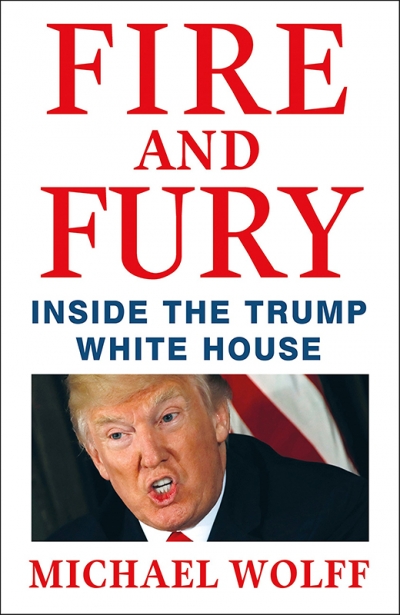
Fire and Fury: Inside the Trump White House by Michael Wolff; Pub: Henry Holt and Company, New York, New York, 2018, 324 pages. Price: $18.00 Hbk; $13.09 Pbk; $14.00 Amazon Kindle.
The Doomsday Machine: Confessions of a Nuclear War Planner by Daniel Ellsberg; Pub: Bloomsbury Publishing, London, UK, 2017, 432 pages. Price: $18.89 Hbk; $9.20 Amazon Kindle.
Michael Wolff’s new book Fire and Fury takes its title from one of Donald Trump’s most infamous Twitter outbursts. On August 8th, 2017 — between the anniversaries of the US nuclear holocausts of Hiroshima (August 6th) and Nagasaki (August 9th) —Trump tweeted, “North Korea best not make any more threats to the United States. They will be met with fire and fury like the world has never seen.” Trump’s promise to counter mere verbal threats by murdering millions of people with nuclear bombs suggested to many observers that the President is, at best, monumentally careless with his tweets.
At worst, he may be stark, raving mad — as 27 mental health professionals wrote in The Dangerous Case of Donald Trump: 27 Psychiatrists and Mental Health Experts Assess a President. One of the authors, Bandy Lee, an assistant clinical professor of psychiatry at the Yale School of Medicine, briefed Democratic lawmakers last month on the president’s mental state. Though professional psychological and psychiatric associations have discouraged such diagnoses-at-a-distance, 70,000 self-described mental health professionals have signed a Change.org petition entitled “Trump is mentally ill and must be removed.” Indeed, one does not need to be a psychiatric professional to see signs of sociopathy, narcissism, and emotional and intellectual instability in Trump’s demeanor, words, and actions.
From a Muslim perspective, the psychiatric diagnoses ring true. Trump is an extreme embodiment of bad adab. His self-centered arrogance seems to rival that of Pharaoh, the Qur’anic villain who follows the egomaniacal path of Satan.
On January 2nd, Trump inaugurated 2018 by once again taunting Kim Jong un, “I too have a Nuclear Button, but it is much [a] bigger & more powerful one than his, and my Button works!” Some tried to laugh it off, pointing out that Trump’s unintentional Freudian joke sounded like a line from the nuclear black comedy Dr. Strangelove. Others countered that having a deranged buffoon like Trump in command of the world’s biggest military machine may be a joke on the world, but not a terribly funny one, since the eventual punchline could be tragic beyond measure.
How did we reach this point? Wolff’s Fire and Fury offers one answer: Trump’s run for president was a publicity stunt designed to bolster his brand and enhance his riches and fame. Nobody, least of all Trump himself or his family or advisors, ever expected him to win, or thought he would be capable of governing if he did (Trump, being a quintessential narcissist, quickly changed his mind on election night when he saw that he had won; but nobody else did).
Wolff’s account mainly follows Steve Bannon’s viewpoint, according to which it was Bannon, backed by huge cash infusions from the billionaire Mercer family, who put Trump in office. Bannon’s project was, and still is, to turn America in the direction of right-wing nationalism, in the manner of a Pat Buchanan on steroids. Bannon initially saw Trump as a useful idiot. But as Trump’s presidency underwent slow-motion implosion during its first year, with Bannon’s America-first project taking a back seat to the internationalist Zionist bankster machinations of former Goldman Sachs honcho Steven Mnuchin and Kissinger-Netanyahu protégé Jared Kushner, Bannon jumped ship, told all to Wolff, and broke decisively with Trump.
All this gossip about America’s unlikely, absurd, and quite possibly deranged President is as gripping and entertaining (at least until the novelty wears off) as it is horrifying. But in the end, it is not Wolff’s book that we need to read to understand our predicament. Daniel Ellsberg’s The Doomsday Machine is far more edifying, and in the long run, more important.
Ellsberg is a former nuclear war planner for the RAND Corporation who risked life in prison by leaking the Pentagon Papers in hopes of stopping America’s genocidal assault on Vietnam. The Doomsday Machine makes a strong case that the problem is not that we have a madman president. The real dilemma, according to Ellsberg, is much worse than that: we have a nuclear war system in place which is, for all practical purposes, in the hands of omnicidal lunatics — and has been for more than 70 years.
It isn’t that the individuals who run America’s nuclear war system are all as crazy and ignorant as Trump. As individuals, most of them are quite sane, not to mention highly intelligent, like the young Dan Ellsberg when he worked for RAND. Ellsberg opens The Doomsday Machine with a quote from Nietzsche, “Madness in individuals is something rare; but in groups, parties, nations, and epochs, it is the rule.” The nuclear command and control systems of our epoch illustrate the point to perfection.
As Ellsberg makes clear, it is only through the grace of Allah (swt) that all human life and all large animal life on earth, or virtually all of it, has not yet been extinguished by these nuclear madmen. For the nuclear war fighting plans and scenarios of the US, and presumably Russia as well, seemingly guarantee that such a thing will happen, probably sooner rather than later.
Two key points emerge from Ellsberg’s book. First, the chances of a major nuclear war between the superpowers are shockingly high. Repeatedly, such a war has been narrowly and improbably averted. If a professional oddsmaker were fully informed about the issue, he would probably conclude that the chances of a full-scale nuclear war breaking out are about 5%/year or 50/50 per decade (or per two decades if the oddsmaker dons rose-colored glasses). That means that during the 70-year nuclear superpower standoff, we have flipped the coin three to five times, and gotten lucky every time. In other words, we just played Russian roulette, holding a gun to the head of the world, with five bullets in the chamber (actually the odds are worse than that, but you get the drift). Absent continual miraculous divine intervention, we are eventually going to get the malhamah that Shaykh Imran Hosein and others claim is foretold in scripture. Or, paraphrasing Ibsen, “If a gun is on the mantle in the first act, it must go off in the third.”
The second key point is that the looming malhamah, as Imran Hosein says, is likely to kill all or nearly all of the world’s population. Ellsberg points out that even today, many decades after the discovery of the planet-killing “nuclear winter” that would follow even a relatively small nuclear war between superpowers, nuclear war planners continue to work toward “limited” nuclear wars under the delusional assumption that “only” tens or hundreds of millions of people would die, rather than the full seven billion (plus or minus a few miserable cannibalistic survivors). For the truth, according to climate scientists, is that even an improbably minuscule nuclear exchange of 100 small nuclear bombs (and no big ones) would put enough smoke into the atmosphere to block incoming sunlight planet-wide for more than a decade, plunging the earth into “nuclear winter” and completely ending agriculture. The result would be that all of earth’s population, except perhaps for a few warrior cannibals, would die of starvation.
The Qur’an tells us “…if anyone kills a human being — unless it be [in punishment] for murder or for spreading corruption on earth — it shall be as though he had killed all mankind; whereas, if anyone saves a life, it shall be as though he had saved the lives of all mankind” (5:32). Allah (swt) thus emphasizes the importance of protecting human life, showing the immense consequences of even one unjust killing. And yet the nuclear war planners calmly plot the murder of the whole of mankind, all the while deluding themselves into thinking they are behaving acceptably by imagining that they are “only” plotting the murder of tens or hundreds of millions.
The upshot is that, yes, Trump may be an ignorant, unstable, narcissistic nutjob. But the menace of Trump pales in comparison to that of the criminally-insane nuclear command and control system, which is built and maintained by thousands of individually sane people, and tolerated by 300 million seemingly normal Americans.
Dr. Kevin Barrett is a US-based journalist, commentator, and radio broadcaster. He hosts the TruthJihad radio program as well as manages the VeteransToday website.