Showing posts with label Nicolas Maduro. Show all posts

Tuesday, November 19, 2019

Bolivia and Venezuela: Two Countries, But Same Hybrid War

by NINO PAGLICCIA
Photograph Source: Canal 7 de Jujuy – CC BY 2.5
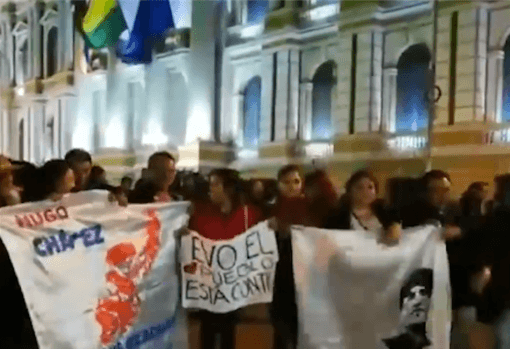
A coup took place in Bolivia on November 10. The fact that the president of the country, Evo Morales, resigned does not contradict the fact that a coup has taken place. Morales was forced by the military to resign. The perpetrators of the Hybrid War were envisioning this same scenario for Venezuela but failed while they succeed in Bolivia. What made the difference?
Bolivia and Venezuela are similar in their independent approach to following a socialist path to break away from the hegemonic interference and economic exploitation from the US and its allies. Both countries have been successful in reducing poverty and achieving economic growth by the social use of their resources. And both countries have been subjected to a US promoted Hybrid War for regime change from a socialist government to a more neoliberal pro-US government.
The Hybrid War script involves at its minimum the following basic elements: accusing the government of some false wrongdoing, “mobilising destructive mobs” if other less violent means have not succeeded, creating “moderate groups” that penetrate as a wedge into the established institutions of the society in order to create divisions, and finally the coup de grâce: convincing the armed forces to betray their allegiance to the country’s constitution and turning them against the government and the people. All these basic elements may be often operating simultaneously. At any time complementary actions can be introduced to force the success of the Hybrid War script. For instance, sanctions can be imposed to create shortages and economic restrictions that will further create hardship among the population; or parallel entities can be created in order to undermine the legitimate ones.
In the case of Bolivia the sequence of events followed to the letter the approach to regime change by the US-backed Hybrid War script. The basic elements of the Hybrid War were accomplished in Bolivia in the short span of time after Evo Morales was elected for his fourth term as the country’s president last October 20 until his resignation on November 10.
When it became clear that Morales was winning the election, the losing opposition candidate, Carlos Mesa, claimed that electoral fraud had been committed and that he would not recognise the elections results. The misguided intervention of the OAS publishing “preliminary observations” before a final ballot count was done, and suggesting a second round of elections was an endorsing factor to the opposition’s claim. Neither was helpful the uncalled for interference from the government of Canada calling the presidency of Morales “illegitimate”. Taking into account the pro-US position of both the OAS and Ottawa, their involvement may have been part (or not) of the Hybrid War approach. The end result accomplished the delegitimisation of the Morales government.
Riots and street violence immediately broke out with protests that the government had not been elected by legitimate means and therefore another election was called for. Morales made several attempts to defuse the crisis by calling to dialogue and inviting the OAS to audit the election ballots. The latter may have been a political mistake considering the organisation previous blunder. In fact, the OAS concluded the audit suggesting to have another election. Morales backtracking and accepting the OAS suggestion was not enough to restore the social order.
At this point it is important to note that the Hybrid War must achieve the total annihilation of the people and progressive parties involved one way or another to the very end, and that is until regime change is achieved
In the meantime another opposition figure came to the forefront with his mission to create enough political division, but the division may also be along the race line in the Bolivian society. After all Evo Morales has been the first indigenous president in Bolivia. This is a very significant factor in a region where the indigenous population has been decimated and oppressed for the last 500 years. Luis Fernando Camacho is a white wealthy lawyer from Santa Cruz who has accused Morales of being a “tyrant” and a “dictator”, not unlike Juan Guaidó in Venezuela, with whom he has associated himself publicly. He has been involved with an organisation that has been criticised for being “paramilitary” and “racist”.
The final stroke happened on November 10 when Morales announced his resignation after 14 years as president of Bolivia apparently in response to a communiqué of the commander in chief of the Armed Forces, William Kaiman who declared: “We suggest to the president that he resign his mandate allowing the pacification and maintenance of the stability of Bolivia”.
This was the final act of this short play of a military coup in Bolivia masterminded by a US designed Hybrid War. At least for the time being.
In the case of Venezuela a coup attempted to remove democratically elected president Hugo Chavez in 2002 after he became president in 1999. That was the first strike that the US-backed Hybrid War gave to “undo” the Bolivarian Revolution but failed. Chavez remained a reelected president until his death in 2013. He was followed by president Nicolas Maduro.
Similar events to Bolivia’s had occurred after Maduro was re-elected in May 2018. Soon a vocal and violent Venezuelan opposition, supported by a group of Western countries and some rightwing Latin American governments declared Maduro’s presidency illegitimate.
What we have described in the case of Bolivia did not quite work as smoothly in Venezuela. The Hybrid War script has been basically the same including the creation of violent groups with a “moderate” façade, but the circumstances in Venezuela have been different and harder to succeed in regime change. Despite the numerous sanctions and US financial blockade, and despite the foreign recognition of a self-appointed “interim president” attempting to create a parallel entity, Nicolas Maduro remains the legitimate president democratically elected and recognised by the United Nations and about 120 nations.
Venezuela has developed a strong civic-military union supported my thousands of voluntary militias that has been the bastion against which the Hybrid War has failed despite the numerous attempts to break that union.
The National Bolivarian Armed Forces of Venezuela (Fuerza Armada Nacional Bolivariana – FANB) have a strict abidance to the Venezuelan constitution and have not betrayed the Bolivarian Revolution in the 20 years of its existence making it impossible for the last act of the Hybrid War to take place.

Friday, September 20, 2019

Maduro: Trump Has Obsessive Hatred Against Latin Americans

Venezuela’s President Nicolas Maduro (L) and Ecuador’s former President Rafael Correa (R) in Caracas, Venezuela, Sep. 19, 2019.

Venezuela’s President Nicolas Maduro (L) and Ecuador’s former President Rafael Correa (R) in Caracas, Venezuela, Sep. 19, 2019. 

"Despite all imperial aggressions, we are standing still and ready to resume the path of growth", President Nicolas Maduro to Rafeal Correa in a recent interview on RT.

In the new season of his RT TV show, Ecuador’s former President Rafael Correaon Thursday interviewed Venezuela’s President Nicolas Maduro at the Miraflores Palace in Caracas, where both critically addressed the complex realities the Bolivarian Revolution is currently facing.

In order to highlight the effects of the U.S.-led economic aggression, President Maduro recalled that from the beginning of President Hugo Chavez's administration in 1999 up to 2015, “we had annual revenues of US$50 billion from oil sales. Now we only receive US$4 billion.”During their one-hour conversation, those leaders of the contemporary Latin American politics talked about the economic and social situation of Venezuela, which, as Correa said, is "victim of a disinformation campaign" whereby political opposition tries to get benefit from problems that have been "clearly caused by the so-called 'sanctions' which are actually illegal aggressions against sovereign countries."
Maduro also mentioned that the death of Commander Hugo Chavez in March 2013 meant a "very big blow" for his country because "internal enemies, but especially the U.S. imperial power, began to design tactics to replace Chavismo."
During the presidency of Donald Trump, over the last two years, "the war with Washington has had a devastating effect on our social stability and people's lives," the United Socialist Party of Venezuela (PSUV) leader said.
"Venezuela cannot either open or close international bank accounts. It cannot pay for any type of product. In addition, we are now being threatened with a complete naval blockade."
In his talk with Correa, the Bolivarian president once again denounced that the U.S. government actions imply many financial costs to the Venezuelans. "They have confiscated and robbed us of almost US$30 billion," Maduro said and explained that Venezuela is living "an economy of resistance."
In order to tackle this situation, his administration has established priority policies, one of which is food and medicine production. This goal is "at the center" of those priorities so as to be able to supply the population.
"Venezuela has no sanctions, it has aggressions," Maduro said and added "Trump has kind of AN obsessive hatred against Latin American peoples, refugees, immigrants; he has a special hatred against the Venezuelan people and our history."
"I compare [what happens now] with the Hitler era, with that same vision that Hitler imposed against the Jews before the war," he stressed.
Based on the challenges it faces at the current ​​​​​​​historical moment, the Venezuelan government is laying the long-term foundations to overcome the country's traditional dependence on oil revenues.
"I have defined 16 'development drivers' on the basis of our country's economic, industrial and technological realities," Maduro said and recalled that transforming a natural resources-based growth model, which has been in place for the last 100 years, is a difficult task.
Nevertheless,, "despite all imperial aggressions, we are standing still and ready to resume the path towards growth", President Maduro said.​​​​​​​

"Imagine a country which cannot sell oil, its main product; even if it could sell it and obtain some foreign currency, it cannot buy anything because it cannot use the international financial system," the Ecuadorean politician said.For his part, in order to illustrate what is happening in Venezuelans' everyday live, former President Correa asked the audience to imagine what it means to live under siege.
“That is what they have done to Venezuela. And, in their eagerness to sanction a government without having the right to do so, they are sanctioning the whole population," Correa stressed.​​​​​​​
Before finishing the interview, Correa invited President Maduro to describe in his own words the Venezuelan political system.
"In Venezuela, they tell us, there is no democracy and you are a 'usurper'," Correa said provocatively.
"Over 20 years of revolution, we have had 25 elections for president, governors and mayors," Maduro replied and, with a hint of irony, he said that it would be "a strange dictatorship."
Then the Venezuelan president recalled that the Chavista movement has beaten the opposition in 23 out of those 25 elections.
Rafael Correa concluded his program by reiterating his support for Nicolas Maduro and the Venezuelan people.
"Intellectual honesty does not mean being neutral, which is impossible. Intellectual honesty means trying to keep objectivity, despite the partiality we all have and our ideological inclinations."

Monday, July 01, 2019

Venezuelans Continue to Defeat US Plots for Regime Change

By:Kayhan Int’l

Venezuela continues to be in the crosshairs of the US whose series of plots of the past few months and years to bring down the elected government of President Nikolas Maduro have ended in failure, including the recent coup that was nipped in the bud before it could take place in the last days of June by American-backed generals living abroad.

Thanks to the vigilance of the intelligence authorities who time and again have shown their loyalty to the legal government against the few treasonous elements on the payroll of Washington, Venezuela stands firm with the overwhelming majority of people solidly behind President Maduro.

If Trump and his thuggish administration had any commonsense they would have realized by now that it is impossible to bring about ‘regime change’ in a country resolved to safeguard its sovereignty and refusing to yield to the US.

It was revealed last Wednesday in Caracas by Communications Minister Jorge Rodriguez that the authorities busted an intricate plot planned for June 23 or 24, which included assassination of President Maduro, National Constituent Assembly Chief Diosdado Cabello, and other high-ranking officials.

According to Rodriguez, Venezuelan intelligence succeeded in intercepting 56 hours of communications that helped the authorities seize the chief culprits who in turn confessed to their role in the planned coup which was being directed from the Dominican Republic by retired Brigadier-General Eduardo Jose Baez Torrealba, who had a hand in previous coup attempts as well.

President Maduro who has requested the Dominican Republic for extradition of Baez, condemned the latest plot, and charged the conspirators with looking to seize power through a "bloodbath.”

Why is Washington against the present government?
The answer is obvious. The US covets the untapped wealth of a country which holds the world’s largest oil reserves, estimated to be around 297 billion barrels.
Venezuela is also strategically located in South America wielding influence over the oppressed masses of other neighbouring countries, such as Colombia, which is firmly controlled by the US, and is actually a military base of the regime in Washington.

The socialist system of government of Venezuela that naturally gives preference to the country’s downtrodden and deprived masses, has become an eyesore for the displaced capitalist elite which, before the Late President, Hugo Chavez, was elected to lead the country, used to plunder the wealth of the country and deposit in American banks.

That is the reason Washington has invested in such treasonous elements as Juan Gerardo Guaidó Márquez, who serves as a federal deputy to the National Assembly representing the state of Vargas, and earlier this year stirred discontent by claiming to be acting president of Venezuela in direct challenge to Maduro’s presidency, on being appointed by the Popular Will party to become the president of the National Assembly of Venezuela.

Since then Juan Guaido, who was never popular among the Venezuelans, because his party was financed by the United States Agency for International Development (USAID), has now been exposed in an embezzlement scandal in Colombia, to the extent that the Americans who actively backed him in the aborted military coup earlier this year, have begun to distance themselves from him.

What happened in Colombia appears to be so damning that not only is the Colombian intelligence service leaking documents exposing wrongdoing by Popular Will representatives appointed by Guaido, but the Organization of American States (OAS) — which is typically just as pro-opposition as the Colombian government — has called for an investigation.

It means, Washington is losing all its aces in Venezuela, to the detriment of Secretary of State, Mike Pompeo, and National Security Advisor, John Bolton – the diabolical duo dragging the US into every self-defeatist crisis.

Thus, what we learn from the failure of repeated American attempts to overthrow the legal elected government of President Maduro, is the resistance of the Venezuelan people and readiness to stand firmly in the face of every evil move, undeterred by the natural harm to the national economy as a result of Trump’s policy of economic terrorism. 

Sunday, June 09, 2019

Venezuela’s Bolivarian Revolution in the Crosshairs of US Imperialism

by 

Photograph Source: Cancillería del Ecuador – CC BY-SA 2.0
With the likes of John Bolton and Elliot Abrams directing US foreign policy, the US government has abandoned all pretense of “plausible denial” for its illegal regime-change initiatives. The “humanitarian” bombs may not be falling but, make no mistake, the US is waging a full-bore war against the Bolivarian Revolution in Venezuela.
Back in 1998, Venezuela had had nearly a half a century of two-party rule. A duopoly, not unlike the Republican and Democratic parties in the US, alternated in power imposing a neoliberal order. Poor and working people experienced deteriorating conditions of austerity regardless of which party was in power.
Then third-party candidate Hugo Chávez was elected president. HeH He initiated what has become known as the Bolivarian Revolution, which has inspired the peoples of the world while engendering the enmity of both the US imperialists and the Venezuelan elites.
This article explores the contributions, shortcomings, and lessons of the Bolivarian Revolution’s two decades, in the context of the US regime-change efforts from its inception to current attempts by the US to install the unelected Juan Guaidó as Venezuela’s president.
Forging a new national identity based on a people’s history.
History, it is said, is written by the victors. The historical narrative typically reflects the class that enslaved the Africans, dispossessed the Indigenous, and exploited the workers. There are exceptions. In the US, we have the legacy of Howard Zinn’s People’s History of the United States.
In Venezuela, Chávez revised his country’s history and thereby wrought a sea change of national consciousness. Prior to Chávez, Venezuela was arguably the most sycophantically pro-US country in South America. Miami was looked to for cultural affirmation; baseball was the national pastime.
Chávez took special inspiration from the leader of the South American struggle against Spanish colonialism and named his project after Simón Bolívar, known as the “Liberator.” Bolívar was not merely a national leader, but a true internationalist. The Bolivarian project is about the integration of nations based on mutual respect and sovereignty. Bolívar presciently declared in 1829: “The United States appears to be destined by Providence to plague Latin America with misery in the name of liberty.”
This new Venezuelan national identity and consciousness, based on their history told from the bottom up, may prove to be the most lasting legacy of the Bolivarian Revolution.
Inclusive society.
Fundamental to the Bolivarian project has been the inclusion of the formerly dispossessed: especially women, people of color, and youth.
As professor of Latin American history at NYU Greg Grandin observed, this inclusiveness has awakened “a deep fear of the primal hatred, racism, and fury of the opposition, which for now is directed at the agents of Maduro’s state but really springs from Chávez’s expansion of the public sphere to include Venezuela’s poor.”
For example, when an opposition demonstration came upon an Afro-descendent street peddler, he was presumed to be a chavista because he was dark-skinned and poor. The opposition demonstrators poured gasoline over him and set him on fire. Then the horrific image was posted on social media.
A less gruesome example occurred at the Venezuelan Embassy in Washington, DC. North American activists in solidarity with the Bolivarian government protected the embassy in accordance with international law from being usurped by representatives of US-backed Juan Guaidó for 36 days. Before the protectors were evicted by the US Secret Service on May 16, counter-protesting opposition expatriate Venezuelans would wave bananas at African American solidarity activists, chanting “go back to the zoo.” Such is the racist loathing that fuels the Venezuelan opposition.
Special option for poor and working people.
Why should a state of all the people have a special option for those who are poor and working? Because these are the people who most need the social welfare services of the state. Billionaires don’t need government schools, hospitals, and housing, but the masses of Venezuelan people do.
The Bolivarian project had halved poverty and cut extreme poverty by two-thirds, while providing free health care and education. On May 27, the United Nations cited Venezuela as one of the top countries for guaranteeing the right to housing, recognizing the over 2.5 million public housing units built.
Democracy promotion.
The role of a state aspiring to be socialist is not simply to provide social welfare, but to empower the people.
The Bolivarian project has experimented in what is called “protagonistic democracy”: cooperatives, citizens councils, and communes. Some succeeded; others did not. One of the first priorities was to eradicate illiteracy. The Bolivarian state has promoted community radio stations, low-cost computers, internet cafés for senior citizens, and other venues for popular expression. Venezuela now has one of the highest rates of higher education attendance in the world. These are not the hallmarks of a dictatorship.
21st century socialism.
More than even Bernie Sanders, the Bolivarian Revolution put socialism on the agenda for the 21st century. For this we owe the Venezuelans a debt of gratitude, not for providing us with a playbook to be copied, but for demonstrating that the creation of a better world is principally a process.
This was not the primary transgression placing Venezuela in the crosshairs of US imperialism. Promoting socialism may be regarded as blasphemy, but the original sin is the following.
Multi-polar world and regional integration.
The greatest challenge to the Empire, to the world’s sole superpower, is a multi-polar world based on regional integration. In 1999, Chávez helped strengthen OPEC (Organization of Petroleum Exporting Countries). In 2004, he helped initiate ALBA (Alliance for Our Peoples of America), followed by PetroCaribe in 2005, UNASUR (Union of South American Nations) in 2008, and CELAC (Community of Latin American and Caribbean States) in 2011. Venezuela has consistently demonstrated solidarity with the Palestinian struggle and other oppressed peoples.
When the small fish organize, the big fish gets nasty. Above all, this is why the world’s hegemon has targeted Venezuela.
The traumatic transition from Chávez to Maduro
Chávez, suffering from cancer, died on March 5, 2013. The reaction in Venezuela was polarized. The elites danced in the street. The majority, composed mainly of poor and working people, were traumatized.
The bully to the north, smelling blood, saw an opportunity. The US had conspired to overthrow the Bolivarian Revolution from the beginning, backing a short-lived coup in 2002 followed by a boss’s strike. With the passing of Chávez, the imperialist offensive doubled down.
A snap election was called according to the Venezuelan Constitution for April 14 to replace the deceased president. Chávez, anticipating his demise, had designated Nicolás Maduro as his successor. Although polls had shown Maduro with a 10% lead going into the election campaign, he won with a narrow 1.5% margin.
I was in Caracas as an election observer when Maduro won. My observation of the election was like that of former US President Jimmy Carter, who had declared a year before that of the 92 elections the Carter Center had observed, “The election process in Venezuela is the best in the world.”
Within minutes of the announcement of Maduro’s victory, the main opposition candidate, Henrique Capriles, came on TV to denounce the election as fraudulent and call on the people to “show their rage.” Thus began the opposition’s violent offensive, the guarimbas, to achieve by violence what they could not achieve in democratic elections.
The opposition charges of fraud were investigated by Venezuela’s National Electoral Council (CNE) and found groundless, based on a 100% audit of the electronic vote backed up with paper receipts. Capriles still maintained the charge of fraud, and the US became the sole nation to refuse to recognize the Maduro presidency. The opposition violence continued, taking over 40 lives.
Upon assuming the presidency, Maduro inherited existing problems of crime, inefficiency, corruption, inflation, and a dysfunctional currency exchange system. These were problems that existed during the Chávez period and even prior to that. These problems persist in varying degrees to the present, despite concerted programs to address them.
President Maduro has had his feet held to the fire by the imperialists from the get-go. Far from having a respite, shortly into his presidency, Venezuela was hit with petroleum prices plummeting from a high of nearly $125/barrel to a low of close to $25/barrel. Despite efforts to diversify the economy, Venezuela remains dependent on oil exports for most of its foreign exchange, which is used to fund the social programs.
US regime-change war intensifies
The US regime-change war continues to intensify with increasingly harsh sanctions. These unilateral measures are illegal under the charters of the United Nations and the Organization of American States, because they constitute collective punishment. Trump’s security advisor, John Bolton, elucidates: “It’s like in Star Wars, when Darth Vader grips someone. That’s what we’re doing economically with the (Venezuelan) regime.”
In 2013, the US waited until after the presidential election in Venezuela to declare it fraudulent. Taking no chances, the US declared the 2018 election fraudulent four months before it was held. Joining Trump in this rush to pre-judgement were eleven Democratic senators including Bernie Sanders.
The charges of fraud were based on three issues: setting the date of the election, disqualifying opposition parties, and barring opposition candidates. Maduro had continually called for dialogue with the opposition to set the election date. But each time a date was mutually agreed upon, the opposition backed out after their US handlers intervened. As for the disqualified parties, they had lost their ballot status because they had boycotted past elections. They then refused to reapply for ballot status, because their intention was not to participate in the electoral process.
Opposition candidates, namely Leopoldo López and Henrique Capriles, were barred from running, because they had committed criminal acts that warranted their exclusion. López clearly incited violence that resulted in deaths and would have received far harsher treatment had he committed such acts in the US. Capriles was convicted of economic fraud, “administrative irregularities,” during his tenure as a state governor. While the courts found Capriles guilty, this action against a political opponent damaged the Maduro government’s international image.
Overall, the charges of fraud by the radical right opposition were mainly pretenses to delegitimize the upcoming election. However, several moderate opposition candidates did run, defying the US demand that the election be boycotted.
Henri Falcón was the leading opposition candidate to run in 2018, championing a neoliberal platform of privatization, austerity for workers, and subservience to the International Monetary Fund (IMF). The US, which would ordinarily gleefully embrace such a platform, instead threatened Falcón with sanctions for breaking the election boycott.
The explanation for this seemingly anomalous behavior by the US government is that the stakes in Venezuela are much higher than just the presidency. The regime-change project is to exterminate the Bolivarian Revolution, reverse its social gains, and return Venezuela to a subservient client state where the world’s largest oil reserves would be freely exploited by US corporations.
Orwellian world of US foreign policy
As CEO of the capitalist world order (that is what is meant by exercising “American world leadership”), then US President Obama declared in 2015 that Venezuela constituted an imminent and extraordinary threat to US national security. He didn’t mean a military or even an economic threat. That would have been preposterous. What Obama was implicitly confirming is that Venezuela poses a “threat of a good example.” Venezuela is at the top of US imperialism’s hit list because of the good things, not for its faults.
President Trump has intensified Obama’s regime-change policies aimed at Venezuela. Condemning the Bolivarian Revolution, Trump opined: “Socialism is not about justice, it’s not about equality, it’s not about lifting up the poor.” Might he have been really thinking of capitalism? His national security advisor John Bolton tweeted that removing the democratically elected President Maduro by violent coup and installing the US-anointed and unelected Guaidó is protecting the Venezuelan constitution.
On the other side of the aisle, Senator Sanders accused Chávez of being a “dead communist dictator.” Alexandria Ocasio-Cortez described the US regime-change war as a contest of “authoritarian regime versus democracy,” with the questionable presumption that the US is the democracy.
In the Orwellian terminology of US politicians and corporate media, a fraudulent election is one where the people vote their choice. A dictatoris the democratically elected choice of the people. And the so-called dictator is an authoritarian if he resists rather than surrenders to the bullying power.
Surrender does not appear to be on the agenda for the Bolivarian Revolution, with US asset Guaidó forced to negotiate in Norway after his failed coup attempts. Despite the suffocating sanctions and threats of military action, the poor and working people in Venezuela who are most adversely affected by the US war against them remain the strongest supporters of their elected government.
Make Orwell fiction again!
Roger Harris is on the board of the Task Force on the Americas, a 32-year-old anti-imperialist human rights organization.

Tuesday, May 07, 2019

Media lies in service of war for regime change in Venezuela

Bill Van Auken

The recent abortive coup attempt initiated by the US puppet and self-proclaimed “interim president” Juan Guaidó in Venezuela has served once again to expose the criminal role of the US corporate media.
Bill Van Auken, a politician and activist who was a presidential candidate in the U.S. presidential election of 2004, has more on the issue in an article titled “Media lies in service of war for regime change in Venezuela.”
Guaidó’s video of himself and Leopoldo Lopez, the leader of Guaidó’s extreme right-wing CIA-funded party, Voluntad Popular, appearing with a few dozen armed men in uniform and calling for a military uprising, was greeted with undisguised glee by the major media outlets.
This stunt was staged as the 100-day “reign” of Guaidó, existing only in the greedy imagination of US imperialism and Big Oil, appeared no closer to establishing control over Venezuela. Even as it became evident that it had turned into an unmitigated fiasco, the media continued to broadcast reports suggesting that the military was divided, and the people were in revolt.
As the failure of the coup attempt became increasingly undeniable, CNN and the major networks all repeated the farfetched claims made by the regime-change operation’s principal protagonists within the Trump administration as if they were incontrovertible fact.
US Secretary of State Mike Pompeo told the media that Venezuelan President Nicolas Maduro was set to board a jet waiting on the tarmac in Caracas to whisk him away to Havana but had only been persuaded at the last minute by the “Russians” to stay.
Did any of the talking heads who repeated this claim over and over have any evidence beyond the words of the former CIA director to substantiate its veracity? If so, they didn’t bother to share it with their audience.
John Bolton, Trump’s warmongering national security adviser, issued a statement on the White House lawn in which he asserted that Venezuela’s Defense Minister Vladimir Padrino, the head of the country’s supreme court and the chief of the palace guard had all “agreed that Maduro had to go” and now had to act on their “commitments” or “go down with the ship.”
This likewise was treated as fact, despite the public denunciations of Guaidó’s actions by both Padrino and the Supreme Court. Bolton’s peculiar repetition three times of the three men’s names in the course of his remarks was an unmistakable sign that the national security adviser was engaged in a bit of information warfare aimed at disrupting the Venezuelan government.
The Washington Post, owned by Amazon billionaire Jeff Bezos, weighed in with an editorial on the very night of the US-backed coup under the headline, “Don’t call it a coup. Venezuelans have a right to replace an oppressive, toxic regime.” It might have benefited from an underline, “Who are you going to believe, me or your lying eyes?”
The Washington Post editors declared, “Venezuelans responded to Guaidó’s call for street protests and were met by troops loyal to Maduro. By late afternoon, clashes were taking place, regime officials were promising a decisive ‘counterattack,’ and there was no way to know whether ‘Operation Liberty,’ as Guaidó dubbed this high-risk move, would succeed or be crushed — or devolve into civil war. The Post declared, “What is not, or should not be, ambiguous is the political and moral essence of this volatile situation”.
The “moral essence” of the situation, all the invocations of “liberty” notwithstanding, smells decidedly of oil and excrement.
There was no “decisive counterattack” by the government because none was needed. Neither troops nor any sizeable number of civilians rallied to Guaidó’s tweeted video calling for the storming of the La Carlota Air Base and the armed overthrow of the Maduro government. By the end of the day, Lopez, the apparent architect of the coup attempt, had sought refuge in first the Chilean and then the Spanish embassy. The handful of soldiers who stayed with the right-wing US puppets, some 25 in all, asked for protection in the embassy of Bolsonaro’s Brazil.
Guaidó’s political party has its roots in Venezuela’s reactionary traditional ruling oligarchy, responsible for the oppression of the masses and poor and for such crimes as the massacre of thousands who rose up against IMF austerity in the caracazo uprising of 1989, which far eclipses any repression carried out under Maduro or his predecessor, Hugo Chavez.
The attempt to oust a sitting and elected president by mobilizing small groups of armed men to storm a military base with the backing of a foreign power is, whether the Post likes it or not, a coup. The New York Times, in the wake of the coup fiasco, made its own contribution to Washington’s regime-change operation, publishing an article based upon a supposed “secret dossier” ostensibly provided by a turncoat Venezuelan intelligence officer and confirmed by a cohort claiming that former Venezuelan vice president and current industry minister Tareck El Aissami had “pushed to bring Lebanon’s Hezbollah into Venezuela!”
The fabricated “dossier” has all the earmarks of the kind of reporting that the Times did about “weapons of mass destruction” in the advance of the 2003 US war of aggression against Iraq.
The Times’ own readers responded to the story with suspicion and contempt. Among the top-rated readers’ comments was the observation that “the report has all the smell of a conjured-up pretext, the same as the basis to race into Iraq and wreak havoc and destabilize West Asia. In fact, the smell is even more pungent.”
Another reader wrote: “So why are ‘secret dossiers’ on the Venezuelan government suddenly appearing? Why not secret dossiers on Saudi Arabia? Why not secret dossiers on Egypt? Why not secret dossiers on Israel? Why? Because the US is 100 percent focused on regime change in Venezuela, and already has the regimes it wants in Saudi Arabia, Egypt, the usurper regime of Israel, and other certain countries.”
There has been not a single critical voice raised within the so-called mainstream media against the US regime-change operation in Venezuela. The newspapers and television news programs are filled with lies and propaganda preparing for the realization of the continuously invoked threat that “all options are on the table.”
The media watchdog group Fairness and Accuracy in Reporting (FAIR) recently published the results of a survey of the main trend-setting media outlets, both print and broadcast, covering the three-month period between January and April of this year. It concluded: “zero opinion pieces in the New York Times and Washington Post took an anti-regime change or pro-Maduro/Chavista position. Not a single commentator on the big three Sunday morning talk shows or PBS NewsHour came out against President Nicolas Maduro stepping down from the Venezuelan government.”
Underlying the corporate media’s lockstep, shameless and undisguised support for another imperialist regime-change operation and coup in Latin America are the overriding interests of crisis-ridden US capitalism in asserting its unfettered control over Venezuela’s oil reserves, the largest on the planet. It is also in rolling back the growing economic and political influence of both China and Russia in a hemisphere that Washington has historically regarded as is own “backyard.”
The US media has undergone a protracted degeneration, corresponding with the abandonment by the US capitalist ruling elite of any semblance of support for democratic rights and processes. While there was never a golden age of the capitalist press in the United States, the days when the New York Times and the Washington Post could publish the Pentagon Papers, defying the US government to bring the criminal policy of US imperialism in Southeast Asia to the attention of the American public in the midst of a bitter war, are long gone.
Those attempting to carry out a similar function in today’s environment confront the full weight of capitalist repression, with the media talking heads and columnists egging the state on.
That is the fate of WikiLeaks founder Julian Assange, sentenced to almost a year in prison by a UK judge and facing the threat of rendition to the US and a potential death sentence for the crime of exposing Washington’s war crimes. Like him, Chelsea Manning, the army whistleblower who provided WikiLeaks with files exposing US crimes in Iraq and Afghanistan and conspiracies around the world, has been jailed for nearly two months, much of it in solitary confinement and without needed medical care, for refusing to provide state’s evidence against Assange.
The struggle against the threat of war on Venezuela and the defense of Assange and Manning lies with the people, whose interests are diametrically opposed to those of the warmongers in the American ruling class and their lackeys in the media.

Thursday, May 02, 2019

Message From Caracas

by 

FacebookTwitterRedditEmaiLast Saturday we went to a March to celebrate the finalization, after a two year wait, of Venezuela’s departure from the OAS. We saw hundreds of militia members. There seem to be as many women as men–my subjective impression–and a large proportion of people of very advanced age. We met a group the next day in their khaki uniforms, strolling through the Plaza Bolivar. One lady told us she is 70 years old. Many others we have seen could be that age, along with more of middle age. The militia is voluntary of course. They train regularly with Kalashnikovs. There are at least a million and a half and they are aiming to recruit more than two million
My computer is not working so I am laboriously writing on my phone. Thus I will be brief.
The streets of Caracas were very normal today except for a big concentration of Chavistas around Miraflores presidential palace. One of our delegation went to the Altamira area and saw about 200 demonstrators, far from the thousands reported by some media. The guardian ran a video from weeks ago fraudulently implying it was today. We were in that area today and the scene was completely peaceful.
Guaido’s assault on La Carlota military airport was farcical. I don’t have all the details but one thing has emerged: most of the soldiers involved had been told that they were going there to receive an award and were surprised when they were arrested. They were tricked into being there. No doubt details will come out eventually.
There is food in stores and restaurants and everything seems quite normal on the streets. They did close the subways early today and tomorrow, just to be on the safe side. The biggest problem we have had is from the fact that a lot of electronic equipment in our hotel is malfunctioning due to the interruptions in electric service–we are told that is common. Also, there are fewer cars on the road due to lack of spare parts.
It appears that the opposition is losing its momentum, given the incompetence of Guaido and his handlers, while thousands of Chavistas were ready to show up to defend Miraflores. We will see what they can do tomorrow.
Someone came by our hotel who went along with some of Guaido’s supporters to a classy restaurant after watching his coup attempt fail. Many were angry that he had falsely implied that he had taken control of the airport when he called for them to join him there. They felt he was manipulating them with a lie. Their evolving attitudes are turning up in their social media posts.
Also, it was a lie when he tweeted that the army was with him. It has been coming out that many in the army resent the fact that he has been calling on the US to send in its army, since they would be the ones who would die.