Showing posts with label iaea. Show all posts

Wednesday, December 11, 2019

Israel, should be considered when discussing Iran's missile program: Jenkins

By Javad Heirannia

TEHRAN – Peter Jenkins, former UK Ambassador to the IAEA and UN, says that Israel has a significant missile program while Saudi Arabia has acquired a significant quantity of missiles from foreign suppliers and is reported to have embarked on an indigenous program.
A former associate fellow of the Geneva Centre for Security Policy also adds that “Both possess missiles of ranges in excess of 2000 km, unlike Iran.”
He adds that “These facts should be seen as of crucial relevance to any discussion of Iran’s missile program.”
Following is the full text of the interview:
Q: The British, German and French ambassadors, in a letter circulated on Wednesday, called on U.N. Secretary-General Antonio Guterres to inform the Security Council in his next report that Iran’s missile program was “inconsistent” with a U.N. resolution that had endorsed the nuclear deal reached between Iran and six world powers)UN Security Council Resolution 2231(. The claim is that some of Iran's missiles do not comply with the resolution, while the resolution “calls on” Iran not to work on missiles "designed to carry nuclear warheads". What is your assessment of this letter? And is it possible to vote against Iran at the Security Council meeting?
A: The European claim that aspects of Iran’s missile program are inconsistent with UNSC Res 2231 is not new. We have heard it on more than one past occasion. It rests on paragraph 3 of Annex B of that resolution. In this paragraph, Iran is called upon not to undertake any activity related to ballistic missiles designed to be capable of delivering nuclear weapons. I say “aspects of” because I assume – I do not know – that the Europeans recognize that only some of the missiles in Iran’s inventory or under development would be capable of delivering nuclear weapons. 
Is such a claim watertight? No, it’s a controversial claim because of the word “designed”. That word enables Iranian representatives to assert that none of the missiles in Iran’s inventory or under development has been designed to be a nuclear delivery vehicle, and it places a burden of proof on the Europeans that they are likely to be unable to sustain.
Why have the Europeans chosen to resurface the claim at this point, by writing to the UN Secretary-General? I assume there is a connection between this move and Iran’s policy of progressive non-performance of the 2015 nuclear agreement known as the JCPOA. I assume that the Europeans are seeking to put diplomatic pressure on Iran as a counter to the diplomatic pressure that Iran has been putting on Europe by threatening the survival of the JCPOA. 
If that is their tactic, will it be effective? Alas, it seems more likely that Iran will dismiss the European claim as unfounded and will continue to move progressively towards killing off the JCPOA. I say “alas” because, as I have told you in the past, I believe the policy of progressive non-performance to be both unwise and unfair: it amounts to punishing Europe to no constructive effect for injustices which the United States has committed and which Iran has prevented Europe from mitigating. 
   
Q: These two actions of Europe while Europe failed to fulfill its obligations to Iran and the reduction of its obligations by Iran was also a reaction to the passivity of European countries. What is your assessment?
 
A: I do not think there are objective grounds for ascribing passivity to European policy over the 22 months that have passed since President Trump first declared war on the JCPOA. The Europeans have tried repeatedly to persuade Trump that the JCPOA is a precious component of the global nuclear non-proliferation regime. They have consistently opposed Trump’s policy of subjecting Iran to “maximum pressure”, which they see to be both unjust and incapable of contributing to global peace and security. They have set up the trading facilitation mechanism known as INSTEX. President Macron of France has sought to create a basis for the resumption of European purchases of Iranian oil, but has been denied cooperation by President Rouhani.   
 
Q: Resolution 2231 uses the term “calls on” which does not have a legal requirement. Accordingly, while on the basis of arguments put forward by Europe, Iran has models of missiles capable of carrying nuclear warheads, but there are no legal entities for the legal review of countries' missile programs. This means that there is no international organization for recognizing the country's missile capabilities and its aims include defensive, offensive or capable of carrying a nuclear warhead. What is your assessment?
 
A: You are right that UNSC Res 2231 does not impose on Iran a legally-binding obligation to refrain from developing a certain type of missile.  You are also right that there is no international agreement that Iran is violating by developing and holding a range of missile types. This explains why Europe is reduced to claiming that Iran’s missile program is “inconsistent” with 2231 and to making debatable assertions about the intention behind the characteristics of some of Iran’s missiles.
 
Q: Iran does not have a Continental missile and its missile range is eventually 2,000 kilometers. However, Israel has both a nuclear bomb and missiles that have far more missiles than Iranian missiles, and Saudi Arabia has a new, more advanced, missile program. Regarding this why Iran has no right to have a missile balance? If Iran is asked to limit its missile program, so should countries around Iran. What is your assessment?
 
A: Again, you are right: Israel has a significant missile program while Saudi Arabia has acquired a significant quantity of missiles from foreign suppliers and is reported to have embarked on an indigenous program. Both possess missiles of ranges in excess of 2000 km, unlike Iran (although Iran has developed a “space launch vehicle” that could be modified to deliver payloads over a longer distance than 2000 km). These facts should be seen as of crucial relevance to any discussion of Iran’s missile program. To my mind they lead to at least two conclusions: it is reasonable for Iran to seek to deter the use of missiles against Iran by acquiring a capability to retaliate, and only a regional approach to controlling missile proliferation has any chance of obtaining Iranian assent.
You mention that Israel possesses nuclear weapons. This too is a fact. It would not justify the Iranian acquisition of nuclear weapons since “two wrongs do not make a right”. But it does justify Iran’s possession of an effective anti-Israeli deterrent in the form of missiles.

Saturday, August 03, 2019

Iran has lawful right to nuclear energy program


In accordance with the international treaty JCPOA (Joint Comprehensive Plan of Action), and as testified by inspectors of the Vienna-based International Atomic Energy Agency (IAEA), Iran’s uranium enrichment project is for peaceful purposes.
Stay with us for an article on the ‘Globetrotter’ site, titled “Iran has lawful right to nuclear energy program”, by Vijay Prashad, an Indian historian and journalist, who is the chief editor of LeftWord Books and the director of Tricontinental Institute for Social Research. He has written more than 20 books, including “The Darker Nations: A People’s History of the Third World”.
During the recent Non-Aligned Movement (NAM) ministerial meeting in Caracas, the capital of Venezuela, Iranian Foreign Minister Javad Zarif charged the United States with “economic terrorism.”
He was referring to the unilateral US sanctions that have clobbered Iran, which, like most countries, is reliant on the financial system that remains dominated by the US.
The United States has had a sanctions regime in place against Iran for decades, almost since the victory of Islamic Revolution in 1979. The US, France and Germany later reneged on their nuclear-energy contracts with Iran and kept billions of dollars of Iranian money. Matters sharpened in 1996, when the US administration of Bill Clinton signed the Iran-Libya Sanctions Act. Since then, the US pressure on Iran has increased, then decreased, and increased again – but it has never been withdrawn.
The United States, since 1979 but more firmly since 1996, has alleged – without any shred of evidence – Iran is trying to produce a nuclear weapon.
Iran has rejected this accusation – especially in view of the fatwa or religious edict of the Leader of the Islamic Revolution, Ayatollah Seyyed Ali Khamenei, that Islam prohibits manufacture of all weapons of mass destruction.
Iran points out that it is merely acting within what is permitted by the nuclear Non-Proliferation Treaty, which Iran signed in 1968. The NPT allows its members to develop a nuclear energy program, which includes the enrichment of uranium into fuel for nuclear reactors. Iran began its nuclear power program in 1957. The United States of America – alongside France and Germany – provided nuclear plants and fuel for the development of nuclear energy in Iran.
Article IV of the NPT clearly states that all signatories have the right to “participate in … the fullest possible exchange of equipment, materials and scientific and technological information for the peaceful uses of nuclear energy.” This includes the enrichment of uranium, at a threshold much below nuclear-weapons grade.
After victory of the Islamic Revolution, the West ended support for Iran’s nuclear energy program. Iran only restarted the program in the 1980s, but this time with limited access to technology and fuel.
It was from this period – when Iran restarted its nuclear energy program – that the United States has made the claim that Iran is not obliged to enrich uranium.
The US says that Iran’s requirement to enrich uranium – at any level – is the pathway to nuclear weaponization – an allegation that Tehran firmly rejects.
Iran says the NPT allows it to enrich uranium. Here is the real gap between the two countries. This alternative perception of what Iran is legally allowed to do is at the root of the problem.
When Iran signed the 2015 Joint Comprehensive Plan of Action (JCPOA), it agreed to freeze uranium enrichment at a low level. This was a major concession, which permitted the deal to be signed.
When President Donald Trump withdrew the US from the JCPOA, Iran argued that it was no longer obliged to freeze its uranium enrichment at 3.67%. Behrouz Kamalvandi, the spokesman for Iran’s Atomic Energy Organization, announced this July that Iran had exceeded this cap, reaching 4.5%.
In response, the US government rushed to push for new, harsh sanctions on Iran’s nuclear supply network, which includes sanctions on companies in Belgium, China and Iran. US Secretary of State Mike Pompeo accused the Iranians of being “weapons of mass destruction proliferators” – despite the regular reports of the IAEA that there is no diversion.
Though Iran has exceeded the cap placed by the JCPOA – after a two months ultimatum, a year following the US breach – it has only reached 4.5%, which is far below the 90% enrichment level needed to produce a nuclear weapon.
In 2010, Iran had offered to freeze its enrichment level at 5%, just above where it has now reached. That offer was rejected. In 2011, the Russians proposed a “step-by-step” plan, which once more proposed the 5% enrichment level as well as a comprehensive plan for transparency (including the full array of International Atomic Energy Agency surveillance) and a limitation on centrifuge research and production. This was also rejected by the United States and its European partners.
The head of Iran’s Supreme National Security Council, Ali Shamkhani, argues that the US and Iran have different views on the NPT. That treaty allows countries to enrich uranium as long as it is at a level merely for nuclear energy and not for nuclear weapons. Iran insisted that the JCPOA affirmed Iran’s right to enrich uranium.
That was “Tehran’s condition for entering the negotiations,” Shamkhani said earlier this month.
The JCPOA has the imprimatur of international law with UN Security Council resolution 2231 of 2015. That resolution says that the initial restrictions on Iran “will be followed by a gradual evolution, at a reasonable pace, of Iran’s peaceful nuclear program, including its enrichment activities, to a commercial program for exclusively peaceful purposes, consistent with international non-proliferation norms.” The full array of restrictions were to end in 2023.
Iran is a signatory of all the major treaties against weapons of mass destruction: the NPT (1968), the Biological Weapons Convention (1996), and the Chemical Weapons Convention (1997). Based on these conventions and treaties, Iran claims the right to a peaceful nuclear program. The United States denies Iran the right to develop a peaceful nuclear energy program. That is the basic problem.
The US has weaponized the NPT and the International Atomic Energy Agency to fulfill its political goals.
India, unlike Iran, is not a signatory of the NPT. India not only has a nuclear energy program, but it has a declared nuclear weapons program (having tested such weapons in 1974 and 1998). The United States has circumvented the NPT to arrange for the delivery of enriched uranium to India.
Israel has a nuclear weapons program. The United States fully backs Israel and has never called for IAEA inspections inside Israel. This shows that the US objection to Iran is not based on international law, but merely on its political objectives.
At the Caracas meeting, the mood in the Non-Aligned Movement was against the US view. The NAM has regularly affirmed Iran’s right to a peaceful nuclear energy program. Zarif pointed to the “new wave of extreme one-sided adventurism” of the United States, which, he said, is “threatening peace and stability all around the world.” Iran’s “peaceful nuclear program,” Zarif said, is being disallowed by the United States, which has breached the JCPOA and violated the UN Security Council resolution.
There is no exit here. The United States, however isolated, refuses to accept that Iran has the right – under international law – to a nuclear energy program (which includes enrichment).
As long as the US holds this view, and as long as the other countries sit back and allow the US to throw its weight around, there will be no solution to the standoff around Iran.

Wednesday, July 31, 2019

WIll Shake Up at IAEA Impact Iran?

AMANo
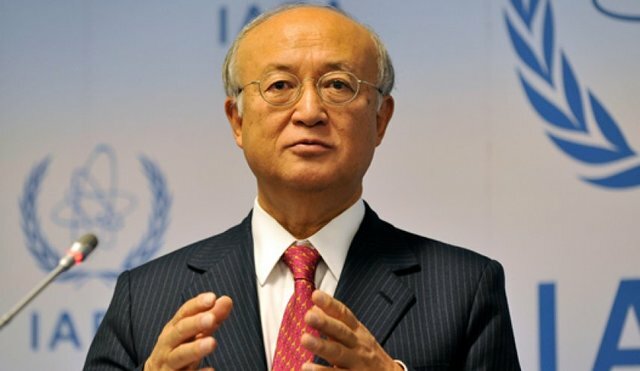
International Atomic Energy Agency (IAEA) chief Yukiya Amano’s passing has stirred up suspicion and further tensions amid US-Iranian tensions.
Amano was 72 years old and as of mid July 2019 had already begun preparing to step down due to poor health.
The head of the U.N.’s nuclear watchdog, Yukiya Amano, will step down in March for health reasons, diplomatic sources said Wednesday, as the agency navigates verification of the increasingly fragile Iran nuclear deal.
However, in the wake of his death and because of his perceived opposition to US efforts to undermine the Joint Comprehensive Plan of Action (JCPOA) or “Iran Deal” – suspicions began circulating that the US or Israel – or both – may have played a role in his death.
Iran-based Tasnim News Agency in an article titled, “Sources Raise Possibility of Israeli Assassination of Amano,” would claim:
Informed sources have speculated that late chief of the International Atomic Energy Agency (IAEA) Yukiya Amano was assassinated by Israel in collaboration with the US for refusing to give in to pressures to raise new fabricated allegations against Iran’s nuclear program.
Considering the foreign policy track records of either the US or Israel – an assassination targeting members of international institutions impeding Western interests certainly sounds plausible. However no evidence has been provided to suggest Amano was assassinated.
Furthermore – his death whatever the cause will likely have little impact on the IAEA’s policies or the general state of US-Iranian tensions – for several reasons.

International Institutions are the Sum of their Member States

International institutions reflect the vector sum of sponsoring nations’ interests. As the global balance of power shifts, so too does the proportion of influence of each member state represented by these institutions. In turn the agenda of these institutions changes accordingly.
The IAEA’s criticism of Washington’s undermining of the Iran Deal reflects not the IAEA’s independent assessment – but the collective interests of member nations the IAEA supposedly represents in all matters of nuclear technology. It is no coincidence that in the halls of foreign ministries around the globe similar criticism has been leveled against Washington regarding the Iran Deal.
Nations in Europe attempting to salvage the deal have taken measures to sidestep US sanctions imposed after the US unilaterally and without justification, withdrew. Whatever influence these same nations have within the UN and IAEA has certainly filtered through and was reflected by Amano’s position over the Iran Deal prior to his death.
With this in mind, one can expect the IAEA’s position to remain relatively unchanged regardless of who becomes the institution’s next chief.

Washington’s Abuse of International Institutions: A Tired Trick 

The United States and its partners have so regularly abused or even entirely sidestepped international institutions that the legitimacy and impact of these institutions have been greatly diminished.
While the IAEA may reflect a position supporting the Iran Deal’s continuation – nations of the world pragmatically sidestepping US sanctions and pursuing multilateral diplomacy is by far more important than anything the IAEA can contribute.
Should the US or Israel succeed in maneuvering to the head of the IAEA a new chief reflecting their interests it will only accelerate the IAEA’s irrelevancy further regarding the Iran Deal.
Were Amano’s death an assassination – it would have been an incredibly costly move with very little payoff in return. The fate of the Iran Deal rests not in the IAEA’s hands but rather in the hands of the deal’s remaining signatories and nations which trade with Iran.
The IAEA is not in a position to significantly influence how these nations move forward except by providing or denying the most superficial legitimacy to whatever decisions are made.
US Aggression Toward Iran Already Tramples International Law 

Finally – US foreign policy toward Iran already operates beyond international law. From the terrorists it sponsors within and along Iran’s borders, to unilateral sanctions, to provocations, as well as signed and dated policy papers admitting to all of it – no amount of legitimacy lent by the IAEA under even the most ideal circumstances could conceal the criminal nature of US aggression toward Iran. Nor can the IAEA paper over the wider hegemonic ambitions US aggression toward Iran fits into.
The shake up at the IAEA will likely have a minimum impact on the future of the Iran Deal. The deal’s fate rests in the hands of Iran’s trade partners and the remaining signatories to the deal.
Only if these nations seek the deal’s success and work vigorously to circumvent US efforts to sabotage it, can it be saved. If anything, this process will shape the IAEA and its stance, rather than the other way around.
For Iran, its leadership will need to continue exercising maximum diplomatic and strategic patience under Washington’s “maximum pressure” campaign. Tehran must continue working on proving through tangible incentives why trading with a stable and unified Iran is more beneficial to interests from Europe to East Asia than Washington’s vision of a divided and destroyed Iran.

Tony Cartalucci, Bangkok-based geopolitical researcher and writer, especially for the online magazine “New Eastern Outlook”. 

Monday, July 29, 2019

US attempts to find Amano’s replacement to serve its interests: Cartalucci

US attempts to find Amano’s replacement to serve its interests: Cartalucci

TEHRAN, Jul. 28 (MNA) – Referring to Yukiya Amano’s death and the US attempts to find a replacement to serve Washington's interests Cartalucci says Tehran must expect the worst and prepare for it while attempting to maintain diplomatic and strategic patience for as long as possible
Yukiya Amano, who led the International Atomic Energy Agency for a decade and was extensively involved in negotiations over Iran’s nuclear program, died at the age of 72. He was heavily involved in the years-long negotiations that led to the landmark Iran nuclear deal.
Under the agreement, reached between Iran and the P5+1 group of countries in 2015, Tehran undertook to put limits on its nuclear program in exchange for the removal of nuclear-related sanctions.
United States President Donald Trump, however, withdrew Washington from the landmark agreement last May and decided to re-impose what it described as the “toughest” sanctions ever against Tehran.
The news of Amano’s death comes at a time of increasing concerns and escalating tensions between US and Iran, with Washington and Tel Aviv having failed to create a crisis in Iran’s cooperation with the UN atomic agency which has repeatedly confirmed the peaceful nature of the country's nuclear program.
There are some speculations about Mr. Amano's (head of IAEA) death. Some reports say his death and replacement of him by an American close to Trump administration and Israel is very suspicious and can be interpreted in line of Israel and the US efforts to affect IAEA reports on Iran's nuclear activity.
In this regards, Bangkok- based geopolitical researcher Anthony Cartalucci said in an interview with Mehr News Agency that International Atomic Energy Agency chief Yukiya Amano was advanced in age, so his death was not in and of itself suspicious.
Meanwhile Cartalucci said, "The US and its partners including Israel will undoubtedly attempt to find a replacement that serve their own interests rather than the IAEA's actual mandate."
"However, it should be noted that Washington, London, and Brussels' serial abuse of international institutions like the United Nations and the IAEA have undermined the credibility of both and their efficacy not only to perform their stated missions, but to serve the interests of those trying to abuse them", he added.
He went on to say, " finally, it should be warned that Washington has reached a point of desperation in regards to Iran and other nations it sees as a threat to its global primacy".
Cartalucci added, "Tehran must expect the worst and prepare for it while attempting to maintain diplomatic and strategic patience for as long as possible. Empires do not disappear overnight nor do they usually disappear quietly. The United States and its global network of power and influence is no exception."
Interview by Payman Yazdani

Wednesday, July 24, 2019

Was foul play behind IAEA Chief Yukiya Amano’s death?

Was foul play behind IAEA Chief Yukiya Amano’s death?


TEHRAN, Jul. 24 (MNA) – American analyst and columnist Stephen Lendman has raised questions about Yukiya Amano's suspicious death.
Following is the full text of his article: 
On Monday, an IAEA statement said the following: “The secretariat of the International Atomic Energy Agency regrets to inform with deepest sadness of the passing away of Director General Yukiya Amano.”
On July 18, he died at age-72 after heading the organization since 2009, no cause of death explained. Was it natural or otherwise? More on this below.
It’s believed Amano intended to step down before his third term expired in November 2021.
Reportedly he had health issues from an unspecified illness. Last September, the IAEA said he’d undergone an unexplained medical procedure, no further elaboration given about his health status.
His death came at a time of heightened tensions between Iran and the West because of Trump regime-led hostility toward the country.
During his tenure, he oversaw the landmark JCPOA nuclear deal’s adoption by its signatories and Security Council members, making it binding international law.
Iran’s Deputy Foreign Minister, Abbas Araghchi paid tribute to Amano following his death, saying:
“My deep condolences…We worked very closely” during JCPOA negotiations. “I commend his skillful and professional performance (that) resulted in complete closure. May the Almighty bless his soul.”
Vladimir Putin said he “always admired his wisdom and foresight - his ability to make informed decisions in the most difficult circumstances.”
It’s unclear who’ll succeed him. Deputy Director General Mary Alice Hayward is serving as acting IAEA chief in the interim.
Since Security Council Resolution 2231 adopted the JCPOA, the IAEA affirmed Iran’s full compliance with its provisions 15 consecutive times.
No nation is more intensively monitored none more scrupulously in compliance with Nuclear Non-Proliferation Treaty (NPT) provisions and its other nuclear obligations.
Last October, in response to Israel’s Netanyahu falsely claiming Iran seeks nuclear weapons, citing a (nonexistent) “secret atomic warehouse” in his UN General Assembly address, Amano refuted the accusation, saying:
“The agency sends inspectors to sites and locations only when needed. The agency uses all safeguards relevant to information available to it but it does not take (so-called intelligence) at face value.”
Without mentioning Israel or Netanyahu by name, Amano added that “(a)ll information obtained, including from third parties, is subject to rigorous review and assessed together with other available information to arrive at an independent assessment based on the agency’s own expertise.”
“In order to maintain credibility, the agency’s independence in relation to the implementation of verification activities is of paramount importance.”
Following Trump’s unlawful JCPOA pullout in May 2018, a week’s later IAEA June 8-dated quarterly report said the following:
“Since 16 January 2016 (JCPOA Implementation Day), the Agency has verified and monitored Iran’s implementation of its nuclear-related commitments in accordance with the modalities set out in the JCPOA, consistent with the Agency’s standard safeguards practices, and in an impartial and objective manner.”
“The Agency reports the following for the period since the issuance of the Director General’s previous quarterly report.”
“Iran has continued to permit the Agency to use on-line enrichment monitors and electronic seals which communicate their status within nuclear sites to Agency inspectors, and to facilitate the automated collection of Agency measurement recordings registered by installed measurement devices.”
The report, others preceding and following it, found Iran in full compliance with its JCPOA obligations, stating:
“Iran is implementing its nuclear-related commitments under the Joint Comprehensive Plan of Action.”
That status has not changed to this day. The Arms Control Association affirmed Iran’s compliance with Nuclear Non-Proliferation Treaty (NPT) and JCPOA provisions.
Based on Iran’s fulfillment of its NPT and JCPOA obligations, no justification exists for imposing nuclear related sanctions on the country — by the Security Council, the only body authorized to impose them, not individual nations on their own.
Unilaterally imposed US sanctions on Iran and other nations constitute economic terrorism. They breach UN Charter Article 41, stating:
The Security Council is empowered to decide what actions may be used to enforce international law — including “complete or partial interruption of economic relations and severance of diplomatic relations,” other than use of military force.
When Article 41 steps don’t work, Article 42 authorizes Security Council members to “take such action by air, sea, or land forces as may be necessary to maintain or restore international peace and security” — by use of “demonstrations, blockade,” or military intervention.
The Security Council alone may authorize going this far — not presidents, prime ministers, lawmakers, or judicial bodies of member states.

The words that Amano did not say!

By Hanif Ghaffari 

Yokyo Amano, director general of the International Atomic Energy Agency, died at the age of 73. There are no doubt about Amano and his performance at the IAEA, which should be taken into consideration:
1. Today, less analyst in the field of international relations, recalls Amano as an independent person at the International Atomic Energy Agency. Many of Amano's decisions were taken under the influence of powerful lobbying at the IAEA.
Amano knew well that issues such as the diversion of the peaceful nuclear program of the Islamic Republic of Iran were merely unlawful allegations in the direction of limiting our country, but, nevertheless, he was never prepared to take any action in confrontation with the United States.
on 2017 Washington's pressure on the IAEA to inspect Iran's military sites was  a real violation of the JCPOA and UN Security Council resolution 2231. Beyond that, it means Washington's public blackmail from Amano and other Agency officials.
During the nuclear negotiations between Iran and 5 + 1, the issue of inspection of Iranian military sites became one of the key issues in the talks. Even the controversy over the issue between the parties led to a prolonged process of reaching a nuclear deal. However, Ayatollah Khamenei at the time emphasized that the inspection of military places in our country is considered Iran’s red line.After victory of Donald Trump in the 2016 presidential election and his move to the White House, he set up a committee to examine how to quit and disrupt the nuclear deal.
Trump had the intention of breaking the nuclear deal under the pretext of organizing an inspection of Iran's military sites by the IAEA. Yukiya Amano’s silence about Nikki Haley’s trip had a clear message for many people who have watched his approach in recent years! The reality is that Amano's approach to the IAEA had been a function of pressures and political games, rather than being dependent on the legal principles.
Eventually, Amano never agreed to disclose the role of the United States to the IAEA and Washington's political pressures. Even in some cases, Amano himself became part of this incredible American game.

Saturday, July 13, 2019

Fact check: Trump wrong on all 3 claims in tweet on Iran deal

By Daniel Dale, Nicole Gaouette and Zachary Cohen

WASHINGTON (CNN) - President Donald Trump's Wednesday tweet on the Iran nuclear deal contained three inaccurate claims.
"Iran has long been secretly 'enriching,' in total violation of the terrible 150 Billion Dollar deal made by John Kerry and the Obama Administration," Trump tweeted. "Remember, that deal was to expire in a short number of years."
Facts First: All three parts of this tweet are wrong. International nuclear monitors and Trump's own intelligence officials say Iran complied until recently with the agreement's limits on its enrichment activities. Trump exaggerated the amount of money Iran gained access to because of the agreement. And he mischaracterized the deal by saying the whole thing would soon "expire."
Let's go through the claims one by one.
No evidence Iran was secretly enriching
There is no public evidence to support Trump's claim that Iran "has long been secretly 'enriching.'" The claim has been contradicted by the International Atomic Energy Agency, whose monitors were tasked with ensuring that Iran was complying with the terms of the 2015 deal, as well as by independent experts and by Trump's own top intelligence officials.
Iran announced this week that it was breaching a limit on uranium enrichment set by the agreement. But there was no evidence Iran had broken its enrichment promises under the agreement until now, much less that it had "long" done so.
"There is absolutely no truth to that statement. Iran has not, repeat not, been enriching in secret," said Gary Sick, an Iran expert who served on the National Security Council under Gerald Ford, Jimmy Carter and Ronald Reagan.
Trump withdrew the U.S. from the multi-country agreement, formally the Joint Comprehensive Plan of Action, in May 2018. According to public comments from Trump's intelligence officials and the IAEA, Iran continued to comply with the enrichment provisions of the agreement, and the rest of the agreement's provisions, for the next year.
The agreement limited Iran, for 15 years, to enriching uranium to a maximum of a 3.67% concentration of a fissile isotope called U-235. That is a U-235 level suitable for use in a nuclear reactor but far from the approximately 90% suitable for use in a nuclear weapon.
As of this spring, the IAEA certified that Iran was still complying with the 3.67% limit. In a May 31report, the IAEA again said: "Iran has not enriched uranium above 3.67% U-235."
In January, U.S. Director of National Intelligence Dan Coats and Central Intelligence Agency director Gina Haspel, both of whom Trump appointed, told the Senate Intelligence Committee that Iran kept abiding by the terms of the agreement even after the U.S. withdrew.
Brett McGurk, who served as anti-ISIS special envoy under Trump and Barack Obama and before that as a Deputy Assistant Secretary of State for Iraq and Iran, cast doubt on Trump's claim in his own tweets on Wednesday. Noting that Trump's assertion was "totally contrary to the unanimous assessment of our own intelligence community" earlier in the year, he said it was "likely to further undermine American credibility in these partner capitals."
Trump, of course, has access to secret intelligence we do not. But he has presented no proof whatsoever that his top intelligence appointees and international experts have been incorrect.
Trump's $150 billion figure is too high
Trump has repeatedly claimed that the agreement involved a $150 billion payment the U.S. made to Iran. He was a little vaguer than usual this time, but his claim that this was a "150 Billion Dollar deal" was still inaccurate.
The U.S. did not pay Iran even tens of billions of American dollars in the agreement. Rather, the U.S. agreed to unfreeze a significant sum of Iran's assets that had been frozen in international financial institutions, predominantly outside the U.S., because of sanctions against Iran.
Trump did not invent the $150 billion figure out of thin air: Obama himself mused in a 2015 interview about Iran having "$150 billion parked outside the country." But experts on Iran policy, and Obama's own administration, said that the quantity of assets the agreement actually made available to Iran was much lower.
In 2015, Treasury Secretary Jack Lew put the number at $56 billion. PolitiFact reported that Garbis Iradian, chief economist at the Institute of International Finance, put it at about $60 billion,and that Nader Habibi, professor of economics of the Middle East at Brandeis University, thought it was between $25 billion and $50 billion after discussing the issue with officials at Iran's Central Bank.
Adam Szubin, a senior Treasury Department official, testified to Congress in 2015 that the "usable liquid assets" would total "a little more than $50 billion." The rest of Iran's foreign assets, he said, were either tied up in "illiquid" projects "that cannot be monetized quickly, if at all, or are composed of outstanding loans to Iranian entities that cannot repay them."
The agreement wouldn't have expired soon
Trump could have accurately said that some central provisions of the agreement would have expired in the next 10 to 15 years. But the deal as a whole -- including a blanket prohibition on Iran developing nuclear weapons -- was written to continue in perpetuity.
"It's not accurate to say the deal expires," said Naysan Rafati, Iran analyst at the International Crisis Group. "Certain clauses of the deal expire and a lot of the key clauses don't expire."
The deal includes important sunset clauses. Its limits on the number of first-generation centrifuges Iran can possess, and on the research and development of more advanced centrifuges, are scheduled to end in 2025. The 3.67% uranium purity limit is to end in 2030.
So is the 300-kilogram limit on Iran's stockpile of low-enriched uranium, which Iran said last week it has now broken. And so is the ban on building a new heavy-water reactor and on reprocessing spent fuel, which effectively bars Iran from developing a plutonium weapon.
However, some of the limits in the deal extend past 2030 -- and some do not expire at all. Centrifuge production sites are to be under continuous surveillance until 2035. Iran's uranium mines and mills are to be monitored until 2040.
Other provisions were written to be in place in perpetuity. For example, Iran is permanently required to provide advance notice of plans to build a nuclear facility. Iran promised that it will not "ever" seek a nuclear weapon. And IAEA monitoring of Iran's nuclear activities is to continue indefinitely.

Wednesday, January 09, 2019

Creating The Conditions For War

by Tyler Cullis

Hawks inside and outside the Trump administration have not been afraid to threaten the nuclear option when it comes to the re-imposition of sanctions on Iran. From threats to sanction European central banks and SWIFT’s board of directors to threats against foreign government officials facilitating trade with Iran, U.S. hawks have adopted the madman theory to undermine international adherence to the Iran nuclear accord (the Joint Comprehensive Plan of Action or JCPOA) and to deflate the confidence of those resisting the U.S.’s withdrawal from the agreement and its re-imposition of sanctions.
But now U.S. hawks are signaling their intent to attack more directly the very foundations of the nuclear accord, including in ways that undermine core U.S. nuclear non-proliferation objectives. Their willingness to do so is ultimately illustrative of their intent, which—contrary to their feigned concern over Iran’s nuclear program—is to create the conditions for war with Iran.
Few items have better crystallized U.S. hawks’ ultimate objectives vis-à-vis Iran than a Foreign Policy article published this week by Foundation for the Defense of Democracies (FDD) Senior Advisor Richard Goldberg and FDD Visiting Fellow Jacob Nagel. Goldberg and Nagel argue that the Trump administration should use its sanctions authorities to target foreign governments, as well as their agencies and officials, engaged in activities authorized under the JCPOA. This includes, in particular, those very activities that seek to reduce the proliferation capabilities of Iran’s nuclear program. For instance, Goldberg and Nagel state that foreign governments involved in the re-design and re-build of Iran’s Arak nuclear reactor—which, nuclear experts agree, would ultimately reduce the plutonium-producing capabilities of that reactor ten-fold—should be targeted for U.S. sanctions.
Moreover, Goldberg and Nagel argue that those parties establishing research or business ties with U.S.-designated entities—which, come November, will include the Atomic Energy Organization of Iran—should be subject to U.S. secondary sanctions. Since the JCPOA required Iran to convert its Fordo uranium enrichment facility into a nuclear, physics, and technology center at which “international collaboration, including in the form of scientific joint partnerships, [would] be established in agreed areas of research,” foreign parties—including foreign governments, agencies, and officials—engaged in such international collaboration consistent with the express terms of the JCPOA would nonetheless be subject to U.S. secondary sanctions for engaging in transactions with a U.S.-designated entity—i.e., the AEOI.
Current U.S. sanctions authorities would indeed permit the Trump administration to target foreign governments for their scientific collaboration with Iran to reduce latent proliferation risks. In the upside-down world of U.S. hawks, the Trump administration could determine that foreign parties, including foreign governments, engaged in activities to reduce nuclear proliferation risks in Iran consistent with the JCPOA—such as the reconfiguration of the Arak nuclear reactor—are instead engaged in activities that materially contribute to or pose a risk of contributing to the proliferation of weapons of mass destruction and are thus engaged in sanctionable activities pursuant to Executive Order 13382. Similarly, upon the re-listing of the Atomic Energy Organization of Iran on OFAC’s SDN List, foreign parties that provide any financial, material, technological, or other support to the AEOI would meet the criteria for designation under E.O. 13382, even if such support takes the form of efforts to reduce the proliferation capabilities of Iran’s nuclear reactor. Parties designated under E.O. 13382 would have all property that is or comes within U.S. jurisdiction frozen and would likely be subject to U.S. secondary sanctions.
Not satisfied with targeting foreign governments engaged in non-proliferation work with Iran, Goldberg and Nagel further argue that the Trump administration should threaten to cut funding to the International Atomic Energy Agency (IAEA) if the agency continues to provide technical assistance to Iran and to host seminars and conferences in Iran. Further, Goldberg and Nagel claim that U.S. funding to the IAEA should be predicated on its removal of all Iranian employees.
The JCPOA provides that the IAEA will engage in all kinds of technical cooperation projects with and technical assistance to Iran. For instance, the nuclear accord requires the Joint Commission to “support assistance to Iran, including through IAEA technical cooperation projects” and notes that the Arak modernization project, described above, would involve significant IAEA support. Annex III of the JCPOA describes a long list of civil nuclear cooperation between Iran and the other JCPOA participants—all of which is ultimately reliant on the IAEA’s technical assistance.
Goldberg and Nagel’s proposal seeks to entirely sever the IAEA from engaging in this work. But perhaps the most obvious and distressing consequence of Goldberg and Nagel’s scheme is that if the IAEA were to terminate all technical assistance projects with Iran and to discriminate against Iranian national employees at the agency, Iran would have little choice but to kick the IAEA out of the country and withdraw entirely from the agency’s oversight. The world would thus lose the unprecedented oversight of Iran’s nuclear program that the JCPOA had provided.
That may be a feature, rather than a bug, of Goldberg and Nagel’s proposal. If the ultimate objective of U.S. hawks is not to restrain Iran’s nuclear program and reduce its latent proliferation risks but instead is to create the conditions for war with Iran, then undermining the nuclear accord and ensuring the re-constitution and re-invigoration of Iran’s nuclear program—absent international oversight—may prove the means to doing so.
U.S. hawks have choreographed a well-developed scheme for undermining the JCPOA—first, successfully targeting the JCPOA’s promised economic dividend to Iran and now the JCPOA’s civil nuclear cooperation with Iran. Sanctioning foreign governments and international agencies engaged in the tough but fruitful work of reducing the proliferation risks inherent in Iran’s nuclear program appears a price that U.S. hawks are willing to pay to achieve their malign objectives.

Saturday, December 01, 2018

Sanctions War

Editor


The US is the only country in the world that uses sanctions as a weapon of war. Islamic Iran has been subjected to a new round of sanctions — completely illegal — to force it to comply with Washington’s ludicrous demands. They went into force on November 5 (meant to coincide with the “hostage crisis” that started on Nov. 4, 1979) with the avowed aim of shutting off Iran’s oil exports. The punitive measures also targeted 700 individuals, banks, aircraft, ships, and companies tied to Iran’s energy and financial industries.
If it is any consolation to the Islamic Republic, it is not alone in being subjected to sanctions. Russia, China, Turkey, Syria, Cuba, Venezuela, and North Korea also face America’s wrath. In the past, Iraq and Pakistan were also sanctioned because the Washington warlords did not like their policies. Between 1991 and 1996, more than 586,000 Iraqi children were killed as a result of US sanctions, a horror described by then US Secretary of State Madeleine Albright as a price “worth it” to remove Saddam Husayn from power (he was removed from power not through sanctions but by US bombs).
Returning to the latest round of illegal sanctions against Iran, the US no longer has the clout or the power to enforce them as it used to. Even America’s European allies are appalled at the cavalier attitude of Donald Trump. Iran is in strict compliance of the 2015 JCPOA agreement — a fact repeatedly certified by the International Atomic Energy Agency (IAEA). Even Trump does not dispute that; what he is demanding is that Iran must abandon its defensive missile program and end all policies that advance its strategic interests. In other words, Trump demands Iran’s surrender, something the moron-in-chief is not going to achieve in his lifetime.
While Trump continued with his characteristic bombast through tweets, the climb down was left for Secretary of State Mike Pompeo to announce. Ten countries in all were exempted from sanctions, including Turkey, Iraq, India, China, South Korea, Japan, Taiwan, Russia, Italy, and Greece. Three countries — India, China, Japan — account for some 80% of Iran’s oil, so the latest round of sanctions are practically meaningless as far as Iran is concerned.
Some countries had already announced that they would not abide by the illegal US sanctions. These included Turkey, Iraq, China, and Russia. Members of the European Union (EU) said they would establish a separate payment mechanism to bypass trading in US dollars. Russia has created a new payment system that bypasses SWIFT (Society for Worldwide Interbank Financial Telecommunication), the Belgium-based mechanism that simply transmits information about transactions.
Russia’s alternative to SWIFT — SPFS — is drawing considerable interest, especially from the Europeans, who are fed up of Trump’s disruptive behavior, as well as China and Turkey. And then there are barter arrangements being worked out whereby countries trade in their own currencies. Turkey, Iran, Russia, and China have all entered into such arrangements. India, too, despite playing both sides of the fence, is looking into it.
Thus, realistically, while Iran may face some difficulties in the near term, it is the US under Trump that has been left largely isolated. He only has himself to blame. Washington’s demands were always illegal but Trump’s latest moves have shown how obnoxious he can be. His behavior has turned off even his closest allies. He is too toxic to touch. Similarly, the two pariah regimes, Zionist Israel and Wahhabi Arabia that have pushed this policy, also stand exposed.

Tuesday, September 18, 2018

'Gradualism' not proper approach to save nuclear deal, Salehi tells EU


TEHRAN - Ali Akbar Salehi, director of the Atomic Energy Organization of Iran (AEOI), said on Monday that “approach of gradualism” adopted by the European Union’s is not a proper way to preserve the 2015 nuclear deal, officially called the Joint Comprehensive Plan of Action.
“We believe that the so far adopted approach of gradualism is not the proper mechanism whatsoever in response to the situation arising from the American reckless policy in undermining the UN Security Council resolution 2231,” Salehi said during a speech at the 62nd conference of the International Atomic Energy Agency in Vienna.
Following is the full text of his speech posted on the Tasnim news agency:
It is my pleasure and delight to join you here at the 62nd General Conference. Seizing the opportunity to congratulate you, Madam President, on your deserved election, I am confident that under your able and wise presidency, the Conference will achieve the best of its collective results. Please be assured of the full cooperation of my delegation.
The General Conference, as the Agency’s highest policy-making body, provides all of us with an opportunity to present our national perspective on a wide range of issues and challenges.
Let me just start with one of the most important global concerns, that is: the fate of the Joint Comprehensive Plan of Action (JCPOA). I really doubt that the IAEA General Conference needs to be convinced of the historic significance and importance of the hard-won multilateral agreement on the Iranian nuclear issue. It took the concerned parties many years and a long process of tough negotiations to reach an agreement. The two sides, decided to limit their expectations and aspirations and instead, settle for a mutually agreed set of solutions. Ever since that the agreement went into effect in January 2016, Iran, as stipulated in 12 consecutive IAEA reports, has fully complied with the provisions of the deal and implemented all its ensuing nuclear-related commitments. This is a simple, undeniable and generally recognized fact.
“The American unilateral decision, a blatant breach of the UN Security Council Resolution 2231 and an open travesty of the fundamental and cherished principles of international law and multilateralism, has placed in serious jeopardy the fate of this valuable and unique science-diplomacy achievement [nuclear agreement].”
On the other side, everybody is well aware of the U.S. approach and its particular misconduct. Following a period of less-than-faithful compliance with the provisions of the agreement, under the previous administration and subsequently more so under the current administration, the US Government eventually withdrew from the JCPOA in May 2018. The American unilateral decision, a blatant breach of the UN Security Council Resolution 2231 and an open travesty of the fundamental and cherished principles of international law and multilateralism, has placed in serious jeopardy the fate of this valuable and unique science-diplomacy achievement. Let me be very clear about the negative impact and consequences of this reckless act. As discerned almost unanimously by the international community, this ominous move is doomed to have serious repercussions for the international and regional peace and security. 
The reaction at the international level to the unlawful U.S. withdrawal from the JCPOA, clearly raises serious doubts concerning the validity and wisdom of the American policy. The international community’s opposition to the US withdrawal, as widely analyzed and discussed and as all of us understand, does not merely reflect their deep anger at the American unilateralism but also their concerns about the extremely difficult situation in our immediate region with all its pervasive chaos, and the existing menace of terrorism.
As to the Nuclear Weapons-Free-Zone in the Middle East, Iran has since 1974 been a strong proponent of its establishment. That said, however, one cannot but lament the deliberate disregard by some, of the actual threat posed by the Zionist regime’s adamant refusal to join NPT, and worse, its possession of a considerable nuclear arsenal as well as its denial of IAEA inspections. While, in the case of Iran, as stated by the Director-General, the most robust verification system is in existence anywhere in the world in my country.
Here is one of today’s controversial issues, full-fledged execution of NPT related safeguards in the case of a party to the treaty and turning a totally blind eye to a non-NPT party. Such a blatant and discriminatory conduct is a travesty of justice.
“We believe that the so far adopted approach of gradualism is not the proper mechanism whatsoever in response to the situation arising from the American reckless policy in undermining the UN Security Council resolution 2231.”
What has transpired thus far on the JCPOA, by the EU and others, while encouraging, certainly needs to be further complemented through more solid and practical steps. Now is the time for EU to uphold its commitments. Here, we believe that the so far adopted approach of gradualism is not the proper mechanism whatsoever in response to the situation arising from the American reckless policy in undermining the UN Security Council resolution 2231.
Observing the merits of the nuclear deal and its moral imperative, we hope the Agency will continue executing its mandate with necessary professionalism and impartiality. Technical reports should be prepared solely on the basis of objective assessments and need to be kept free from politically-motivated elements. Within this context, we look forward to the Agency’s expedition of the process of drawing “broader conclusion” on our nuclear program.
The Islamic Republic of Iran aspires to use nuclear science and technology for managing water supplies as well as responding to climate change, while continuing generating electricity, and improving health, food and agriculture. Here, we believe that one of the main missions of IAEA is to help Member States to achieve their Sustainable Development Goals through transfer of experience, share of knowledge and provision of the required equipment.
Given that nuclear power makes a significant contribution to reducing greenhouse gas emissions and improving energy security, Iran has envisioned a long and aspiring plan in order to increase the share of nuclear power in the country’s energy mix, and in line with this vision, is implementing phases 2 and 3 of Bushehr Nuclear Power Plant (BNPP). Accordingly, the first concrete pouring for BNPP-2 has been planned for the third quarter of 2019. These reactors will also run two desalination plants. The safe and secure operation of BNPP has resulted in generation of 30 TWh (terawatt hours) so far and the World Association of Nuclear Operators (WANO) through its peer review mechanism has evaluated its performance and has upgraded its safety performance indicators from D to B. Moreover, OSART mission to Bushehr has been planned later this year. Currently, Iran`s need to electricity at its peak stands for 65,000 megawatts.
Iran also is seriously pursuing fusion technology. So far few pertinent steps have been taken and by the same token, fruitful consultations and eminent cooperation with a number of countries are underway. Moreover, we have made progress in redesigning Khondab (Arak) Heavy Water Research Reactor in close cooperation with China, and advancing the production of stable isotopes with the assistance of the Russian Federation.
Nuclear safety has always been a high priority for Iran and, as a result, we attach great importance to strengthening the relevant safety standards. Iran through cooperation with the EU among others is determined to establish an advanced nuclear safety center equipped with modern technologies and equipment and has so far achieved tangible progress in this regard.
On the issue of nuclear security, however, we believe that the undertaken measures should neither hamper the international cooperation in the field of peaceful nuclear activities nor should it undermine the established priorities of the Agency’s technical cooperation program. The Islamic Republic of Iran emphasizes that the responsibility of nuclear security rests entirely with Member States and the Agency`s role should be merely aimed at enhancing national infrastructures, upon voluntary request. We deem issues of terrorism and cyber-attacks as well as illicit trafficking as the most significant nuclear security threats.
Regarding the State Level Approach (SLA) we believe that despite the recent report by the Director General (GOV/2018/20), there are still ambiguities and concerns which shall be resolved before taking further action.
On the issue of technical cooperation, IAEA is expected to assist Member States based on their needs and priorities. Iran, on its part as a pioneering nuclear state remains ready to share its achievements with other member states, specifically those in our neighboring region. By the same token, the I.R. Iran looks forward to the IAEA Ministerial Conference on Nuclear Science and Technology, in November 2018, in result of which we highly expect the IAEA to facilitate the transfer of nuclear science and technology to developing countries.
  As always, we will look forward to a day when the motto of peaceful use of nuclear energy for all and nuclear weapons for none, is universally recognized and materialized. I conclude on this very point, and thank you Madam President, and the whole house for their gracious patience and indulgence.