Showing posts with label Algeria. Show all posts

Monday, September 16, 2019

Algeria’s political impasse: What is next?

By Hanaa Saada

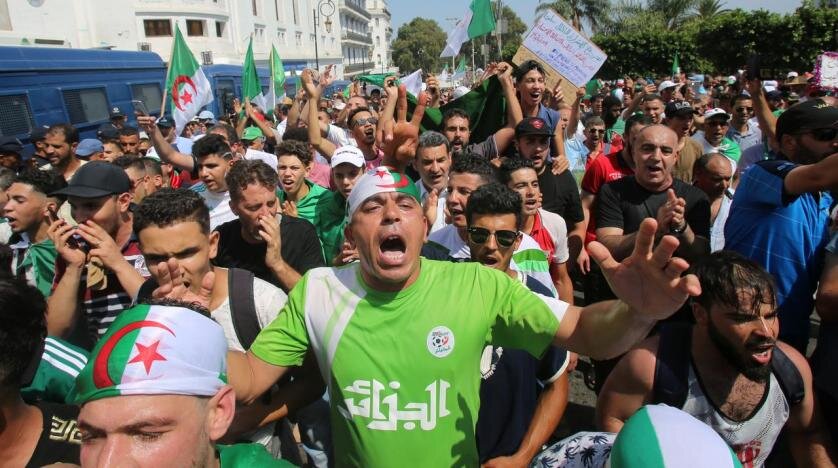
ALGERIA - Seven months after a wave of protests began in Algeria; people are still pilling onto the streets of the Algerian capital “Algiers” and other cities nationwide every Friday, reiterating their main demands: the departure of the regime and its symbols and the application of Articles 7 and 8 of the Constitution stating that the constituent power belongs to the people.
The demonstrations have gained a familiar rhythm and worldwide admiration since tens of thousands of Algerians first took, peacefully, to the streets on 22 February. Thousands of students turn out on Tuesdays and there are larger protests each Friday revolting against former opaque group of power-brokers that have run the country for decades.
After weeks of mass demonstrations, President of the Republic Abdelaziz Bouteflika stepped down, ceding power after 20 years of rule and abandoning his re-election bid. The protesters pressured the authorities, again, to cancel presidential elections originally scheduled for April.
Despite the postponement of the election, the public anger continued to mount. Thus, Army chief Gaid Salah emerged as the key powerbroker positioning himself in favor of El Hirak “Popular movement”. He publicly disavowed the former leader and called for his impeachment, winning legitimacy in the streets.
Purging Corruption
Gaid Salah responded favorably to protesters’ demands, launching a sweeping anti-graft campaign targeting high-ranked officials that have served the Bouteflika government as well as influential tycoons and businessman.
Two Prime Ministers, namely; Ahmed Ouyahia and Abdelmalek Sellal, the deposed President's brother Said Bouteflika, tens of ministers, leading industrialists, tycoons, key businessmen, Governors,  and two former Intelligence chiefs, have been remanded in custody for accusations ranging from money laundering, embezzlement, misuse of public money to using officials posts to influence industrial and commercial contracts and granting undue privileges, affiliation to suspicious parties that plot to destabilize the country, plotting against the army, and instigating the opposition to call for a transitional phase before holding any election.
Bouteflika's resignation puts Abdelkader Bensalah, Speaker of the upper house of parliament, in charge as caretaker Head of State for 90 days until elections are held. However, elections (scheduled for July 4th) have been postponed for a second time and protesters are demanding his departure.
For his part, Bensalah, and in a bid to calm them, set a Panel of Dialogue and Mediation, composed of political actors, the civil society, the representatives of the trade union organizations and many citizens, with the aim to mediate between public authorities and people  and hold a "serious and responsible" dialogue to reach a national consensus which would help resolve the political crisis in Algeria, through the organization of a fair and transparent presidential election, as soon as possible."
However, the Panel itself is facing rejection by protesters who are taking into the streets denouncing its formation, saying it does not represent them along other claims, such as the departure of Bensalah, a former head of the upper house of parliament, and Prime Minister Noureddine Bedoui, who are regarded by them as part of the old guard.
Despite all these arrangements, Algeria is still at an impasse, with two camps facing each other in seemingly irreconcilable positions.
To resolve this stalemate, Lieutenant General Ahmed Gaïd Salah, Deputy Minister of  National Defence, Chief of Staff of the People’s National Army (ANP), launched, last week, a call, saying that it would be "appropriate" to convene the electorate on the 15th of September, and that the elections could be held within the deadlines set by law.
In my previous speech, "I have spoken about the priority to seriously launch the preparation of the presidential elections within the coming weeks, and today, based on our missions, prerogatives and our compliance with the Constitution and the laws of the Republic as well, I confirm that we regard as appropriate to summon the Electorate on September 15th and the elections can be held within the deadlines provided for by the law. Reasonable and acceptable deadlines which respond to the insistent demand of the people," said Lieutenant General.
Theoretically, if the head of state, Abdelkader Bensalah, summons the electorate on September 15, 2019, as desired by the head of the army, the presidential election should take place before the end of the current year (mid-December).  The Organic Law No. 12-01 2012 (Electoral Code) provides in article 25 that "Subject to the other provisions of this organic law, the electorate shall be convened by presidential decree within three (3) months preceding the date of the elections ".
As a response, Algerian street has expressed its rejection of elections in the current political conditions. According to demonstrators, no election should take place as long as Bouteflika-era officials remain in positions of power.
For their parts, the opposition parties and civil society groups have also demanded the resignation of the government which constitutes “a popular demand”, voicing rejection of the holding of the elections.
The people are determined to pursue the hirak until the establishment of a state of institutions, widening gap between them and the power constrained, for lack of serious candidates, to cancel the vote twice.
According to observers, these presidential elections are unachievable for the moment because the approach advocated by Ahmed Gaid Salah " requires the revision of some texts of the electoral law to adapt to the requirements of the current situation, and not a total and profound revision that would affect all texts, as claimed by the demonstrators. The partial amendment means the holding of elections basing on the same mode of organization. This is likely to trigger the street again as the popular movement with its magnitude unparalleled in the contemporary history of the country will, likely, sabotage the preparations for this election. The political climate also does not allow the organization of such an election with the absence of total trust between voters and the political class.
However, it is imperative to go quickly to a presidential election provided that it is transparent, where the mediation initiatives of the Panel or other organizations, can lead to a consensual platform far from the occult practices of the past which saw the majority of the population sulking the ballot boxes, reflecting the state-citizen divorce, noting that an independent election monitoring commission and the departure of the Bedoui government are two prerequisites for a transparent presidential election.
This necessarily implies the cleaning up of the electoral file, the creation of an independent election supervision body where neither the executive (the government - especially the Ministry of the Interior and the Walis) nor the deputies/senators and representatives of the current APCs denounced by Al Hirak, will be stakeholders. 
Only a democratically elected legitimate president, elected on the basis of a transparent agenda, pledging to include the legitimate demands of Al Hirak including a new balance of power and the moralization of management (fight against corruption and embezzlement), can amend the constitution and carry out the profound political and economic reforms to bring Algeria to the new world and make it an emerging country: a pivotal country regionally and internationally.
Economically, it is imperative to quickly resolve the political crisis before the end of 2019 or at most the first quarter of 2020, to avoid towards a cessation of payments at the end of 2021 and beginning of 2022, and prevent Algeria the depletion of its foreign exchange reserves which would culminated in the economic, social, political insecurity.

Friday, June 21, 2019

Who is setting the Middle East on fire?

The Middle East is in so much disorder that chaos barely disappears in one place before it reappears in another. It is as if a hidden fiendish hand is controlling the destruction. Furthermore, it so happens that the flames only burn Arabs in the region and exhaust Arab resources.
Yemen, which was once a relatively happy country, is now suffering from the worst humanitarian disaster of this century so far, thanks to a futile war now in its fifth year. It is only Arabs involved, from the Arabian Peninsula and the Gulf, and it has affected western and central Saudi Arabia, as well as the UAE, places which have not witnessed war for decades.
Beloved Syria has become the scene of civil war for over eight years, during which time millions of people have been displaced, with hundreds of thousands killed and wounded while regional and international forces take advantage of their land. The blood being shed on Syrian soil is almost all Arab blood.
The people of Libya looked forward to freedom after ousting dictator Muammar Gaddafi in 2011, but as soon they looked like doing so, chaos erupted at the hands of one of Gaddafi’s former officers. Khalifa Haftar had been imprisoned in Chad before he announced his split from Gaddafi and became a refugee in the US, sponsored by the CIA and taking American citizenship. He is now behind the divisive and bloody fighting that is shedding Libyan blood; more Arab blood.
Now further chaos is erupting in Sudan as the people try to rise up against the regime of Omar Al-Bashir. After 30 years of oppression, tyranny and bloody repression, a group of generals raised the slogan of support for the popular revolutionary movement, arrested Bashir, formed a military council to take over the government, and then revealed their true face by ending a peaceful protest with violence at the hands of a compliant militia. More Arab blood shed by Arabs.
We should not lose sight of the tension in Algeria for the past four months. Weekly protests continue peacefully, albeit under the tight control of the army chief of staff. Let us hope things stay that way to allow the people to fulfil their aspirations.
Meanwhile, the chaos in Iraq continues. It’s nothing new, and the shedding of Arab blood is ongoing. In Palestine, the unrest and bloodletting has been going on for more than seventy years. The resistance against Israeli aggression has led to much Arab blood being spilt. Palestinian civilians are the main victims.
Does the Arab world have room for any more chaos? Who is behind it all, and why? Answers can be found in events in the heart of the region. The recent attacks on oil tankers in the Gulf of Oman sent a clear message that the oil supply routes from the Arabian Gulf can be cut very easily. While the fingers of blame pointed to Iran and its proxies, the government in Tehran denied any involvement. Analysts concluded that the attacks sought to escalate the conflict between the US and Iran, in favour of regional states, and Iran sought to ease the pressure of US economic sanctions. Interestingly, both the US and Iran helped to rescue tanker crews caught up in the dispute.
Elsewhere in the region, America may be accusing Iran of threatening international peace and security, but its own ally, Israel, has laid the foundations of an illegal Jewish settlement in the occupied Syrian Golan Heights named after a certain Donald Trump. The ceremony was attended by the US Ambassador in Israel, a confirmation that Washington accepts Israeli sovereignty over the occupied territory.
Israeli Prime Minister Benjamin Netanyahu seen at the dedication of an Israeli settlement to US President Donald Trump, in the Golan Heights on 16 June 2019 [USAmbIsrael / Twitter]
Next week sees the economic workshop being held in Bahrain to discuss the Palestinian issue through “investment for peace”, not land for peace. Washington has announced that the Arab parties which will participate are primarily Egypt, Jordan and Morocco. The programme is apparently a prelude to the political aspects of the “deal of the century”, the announcement of which has been delayed yet again, until November, following Israel’s second General Election this year, to be held in September.
In the midst of all of this, with contradictions galore between beating the drums of war and Arab states normalising relations with the Israeli enemy, Trump has spoken of his readiness for dialogue with Iran.
So who is causing all of this chaos in the Middle East, and what is the purpose? America will not strike Iran to please any regional party, nor will it stop blackmailing Arab oil states on the pretext of protecting them from the “Iranian threat”. More importantly, its “deal of the century” to liquidate the Palestinian cause is on its way. In the meantime, it is happy to let the Middle East remain in flames, as long as only the Arabs get burnt.

Saturday, April 27, 2019

Dictator: Media code for ‘Government we don’t like’

By Alan Macleod 

FAIR - Let’s start with a quiz: Quick! Name some dictators! I’m willing to bet most of you responded with just a few of the same names: Assad, Putin, Castro, Kim Jong-un, Gaddafi, Maduro. This is not because they are the only dictators in the world (far from it), or that all of them even necessarily qualify for the title, but precisely because these are the figures most constantly labeled as such by our media.
“Dictator” is a very powerful moniker to give someone. There is a hard-to-define but very important distinction between a government with authoritarian tendencies or a poor human rights record, on the one hand, and a full-blown dictatorship. The very name implies that dictatorial governments should, nay, must be resisted and overthrown, while the same action is not appropriate or justifiable for the former.
Democracy is a supposedly sacred ideal for Americans. Politicians and media tell us that the United States “stands for” democracy and opposes dictatorships everywhere, one reason why the US must continue to involve itself diplomatically and militarily around the world.
However, Freedom House’s “Freedom in the World” studies find that 49 countries—over a quarter of the world’s governments—are “not free”, a designation they use interchangeably with “dictatorships” on their website and their reports. Why then, do most politically savvy people not know the names of all these dictators? Why are they not household names, like Assad and co.? Is it because the United States provides military assistance (training, sales and aid) to three-quarters of them, as Rich Whitney’s study (Truthout, 9/23/17) suggests?
How Free is Freedom House?
Defining and quantifying what does and does not constitute a dictatorship is a notoriously tricky business, and Freedom House’s strong conservative political bias makes its list and judgments all the more questionable. For one, the “non-governmental” organization is actually overwhelmingly funded by Washington, who employed Freedom House in 2006 to perform “clandestine activities”—i.e., regime change operations—in Iran.
The man in charge of compiling the freedom list, used by Whitney and many others, admitted his methodology consisted of “hunches and intuition.” And as many scholars have indicated, Freedom House also has a long history of supporting US client state dictatorships and attacking enemy states such as Nicaragua; the ratings have a strong conservative and pro-US ideological bias. Nevertheless, its index is useful, as it is the most commonly cited source on the matter, and one can assume that it is not going out of its way to falsely label US allies as dictators.
When you look at the governments that Freedom House describes as dictatorships, those that are also Official Enemies are frequently described as such in corporate media—for example, Russia (Washington Post, 5/8/18), Cuba (USA Today, 2/26/19), Syria (New York Times, 3/2/19), Belarus (ABC, 3/5/19),  North Korea (USA Today, 3/22/19) and Venezuela (New York Times, 4/10/19). Yet “our dictators”—that is, the “not free” governments that Washington supports—are rarely if ever labeled as dictatorships by the establishment press. In fact, there is very little coverage at all of those countries that are “behaving themselves” as far as the US State Department is concerned.
Let’s look at the press coverage of four of Freedom House’s “dictators” who receive US military aid, all of whom have been in the news recently: Paul Biya of Cameroon, Abdel el-Sisi of Egypt, Abdelaziz Bouteflika of Algeria and Kazakhstan’ s Nursultan Nazarbayev.
Cameroon
The 86-year-old Paul Biya, the longest serving non-royal head of state in the world, has held office in Cameroon since Gerald Ford was president. He recently won a seventh term in office that Foreign Policy (10/22/18) described as a “farce.” Cameroon has been in the news of late, due to the government’s human rights abuses pushing the country to the brink of a civil war. Freedom House considers it to be one of the least free countries in the world.
However, when discussed at all, Biya was presented matter-of-factly by the media, without the need to add call him a “dictator.” The New York Times (10/6/18) presented him euphemistically as “one of the world’s longest-serving presidents.” From the coverage, readers would not know he is a dictator, even by Freedom House’s standards. In fact, going through fully 20 years of coverage in the Times, Biya was never once described as a “dictator,” “despot,” “tyrant” or any other similar designation.
When Biya was rebuked at all, the tone of the coverage was less condemnatory and more muted criticism. Voice of America (2/14/19) noted that Biya’s decision to remove presidential term limits (meaning he could rule for life) led some “critics” to call the move “authoritarian.”
Egypt
Gen. Abdel el-Sisi came to power in 2013 in  a military coup that overthrew the democratically elected government of President Mohamed Morsi. Sisi recently announced his plan to rule until 2034—effectively in perpetuity.
The New York Times’ article (2/14/19) on the subject noted that this would “further entrench his authoritarian rule,” and even noted he had jailed “tens of thousands” of opponents, muzzled the internet and taken over the courts. Nevertheless, it stopped well short of calling him a dictator. Indeed, it noted that he enjoyed strong support from around the world, and was seen as a “bulwark against Islamist militancy” in the region, endorsed by the US and France. Other media outlets followed this tendency. CNN (2/13/19) simply described him as “current President Abdel Fattah el-Sisi,” while NPR (2/14/19) likewise just referred to “Egyptian President Abdel-Fattah el-Sissi.”
While accurately noting Sisi’s “unprecedented crackdown on dissent,” which imprisoned “tens of thousands of people,” the BBC’s report (2/15/19) labeled him neutrally as “president,” and only characterized his steps to rule virtually indefinitely as something “opponents of the proposal describe” as “a further step towards authoritarianism.” Thus, its strongest criticism of Egypt is that it’s accused of moving toward “authoritarianism”—a long way from being a full-fledged “dictator.”
 Algeria
After he announced he intended to stand once again for president, massive protests broke out all around Algeria against 82-year-old Abdelaziz Bouteflika. The uprising has been serious enough that he has promised to stand down. Despite coming to power fraudulently and ruling with an iron fist for 20 years, media outlets (e.g., CNN, 3/11/19; Reuters, 4/2/19) have refrained from describing him as a dictator, with the BBC (3/6/19) simply referring to him as a “reclusive president.”
Indeed, reading the Guardian’s coverage  (4/1/19), one would have no idea he was not the epitome of a democrat. The New York Times(3/12/19) also praised Bouteflika for “bringing back stability” to the North African country, and “restoring the honor of the nation’s army.” As with Cameroon’s Biya, Bouteflika has never once been described as a “dictator” in the last 20 years of Times coverage.
 Kazakhstan
Another ruler propped up with US military aid is Nursultan Nazarbayev. The 85-year-old, in power since 1989, recentlyannounced he would step down. It was also revealed that Kazakhstan’s capital, Astana, would berenamed Nursultan in his honor (not a common occurrence in democracies—with Washington, named for the winner of an election that involved approximately 1 percent of the population, arguably not an exception).
Nazarbayev has a long history of cracking down on freedom of speech, the press and  religion, and uses torture against his political opponents. Despite this, he was presented positively in the media, with the New York Times (3/19/19) simply referring to him as the “longtime president of Kazakhstan.” The Associated Press (3/19/19) called him “the only leader that independent Kazakhstan has ever known,” praising him for “maintaining stability.” Reuters (3/19/19) claimed he was a “widely popular” leader, with none of the above using the “dictator” moniker.
The Washington Post editorial board (3/29/19) published a glowing appraisal of his tenure. It presented him as a visionary leader, an ex-steelworker “who led the former Soviet republic out of the empire’s chaotic implosion,” claiming he brought Kazakhstan into a peaceful, prosperous new era, while “building national identity” and stopping any ethnic conflict. While noting that he “ruled as a strongman” and “would have been wiser to view dissent and democracy with more tolerance,” the editorial implied his repression was justified, concluding “he won’t be soon forgotten” by his people.
 Double Standards
The double standard is highlighted by the constant media references to enemy states as dictatorships, whether the label is warranted or not. The Washington Post (1/4/19) describes leftist Bolivian President Evo Morales as “wishing to become a Venezuela-style dictator,” while the Guardian(12/3/18) carries warning of Bolivia becoming an “imminent ‘Venezuelan-Cuban-style’ dictatorship.”
The leftist Sandinista government of Nicaragua is constantly called a “dictatorship” as well. The New York Times (8/2/18) published an opinion piece from a Nicaraguan headlined “A Dictatorship Is Rising in My Country Again.” Many other outlets describe him as a “dictator” (Economist, 7/12/18; Time, 3/18/19) carrying out a “terrifying crackdown” (National Review, 3/15/19)—language that is never used for US-backed dictatorships.
And it takes only a cursory glance at the headlines to see how Nicolas Maduro, “the child butcher of Venezuela” (Washington Examiner, 2/21/19), is portrayed:
1    “The Dictator of Venezuela Earns His Title” (New York Times, 2/27/19)
2    “Venezuela’s Dictator Maduro Survived a Tough Week, but His Problems Are About to Get Worse” (Miami Herald, 2/25/19)
3   “Why Are Progressives More Focused on Disagreeing With Trump Than Countering a Dictator [Maduro]?” ( Washington Post, 3/2/19)
4  “Newt Gingrich: Venezuela’s Dictator Maduro Must Go—Even if the Military Has to Intervene” (Fox News, 3/14/19)
5    “Maduro Really Didn’t Like Being Asked if He’s a ‘Dictator’” (New York Post, 2/26/19)
6    “Gen. Jack Keane, Hans Humes on Venezuela’s Socialist Dictator Maduro’s Potential Exit” (Fox Business, 3/7/19)
Is it truly a coincidence that these three countries with elected leftist heads of state are constantly labeled “dictatorships”? Bolivia is not even on Freedom House’s “not free” list—unlike Cameroon, Egypt, Algeria and Kazakhstan. Venezuela and Nicaragua were recently added to it, despite the fact that both countries’ latest elections were endorsed internationally.
While there are some clear shortcomings to Venezuela and Nicaragua’s political systems, the US-dominated Organization of American States observed the 2017 Nicaraguan municipal elections and declared that “the popular will [was] expressed through the vote in the vast majority of Nicaragua’s municipalities.” (With 53 percent turnout, the governing Sandinista party won in 135 out of 152 communities, with the Independent Liberal Party taking 12 of the remainder.)
Meanwhile, Venezuela’s 2018 elections were endorsed by 150 international observers, including foreign ex-heads of state like Spain’s Jose Zapatero and Ecuador’s Rafael Correa, with three international election observation teams endorsing the result, despite the fact that US media wrote them off as a sham (FAIR.org, 5/23/18).
The same cannot be said for Kazakhstan, even by Freedom House, that notes that “none of the elections held in Kazakhstan since independence have been considered ‘free and fair’ by credible international observers.” Nursultan was declared to have won 98 percent of the vote in 2015.
Enemy states are covered far more and far more harshly in US corporate media than friendly ones. A search for Paul Biya in the NYTimes.com database elicits 97 results, compared to 1,135 for Maduro, 713 for Morales and 3,517 for Ortega, despite the fact that Biya has been in power as long as the other three combined. (Cameroon’s population is 24 million, three-fourths the size of Venezuela, more than twice as big as Bolivia and four times as populous as Nicaragua.)
In a recent article (FAIR.org, 3/23/19), I suggested that the term “moderate” or “centrist” has a tactical definition when used in the media. It does not refer to any political positions, but is used as a way of conveying legitimacy. Thus anyone the media approve of is, by definition, a moderate. FAIR (8/20/18) has also noted that a “regime,” in US media usage, is simply a government that is at odds with the US empire.
The “dictator” label is also a powerful cue, used by media to prime the reader to see a particular country or leader a certain way. Readers are invited to feel outraged at the misdeeds of Assad, Putin or other anti-US head of states, while authoritarian rulers that toe the US line are ignored or even praised. The choice of whether to use a word like “dictator” frames a country in a way conducive to elite US interests, conveying legitimacy or the lack thereof in a single label.

Monday, April 15, 2019

Why the Gulf States Are So Edgy


Why the Gulf States Are So Edgy
ALASTAIR CROOKE

A little more than a decade ago, I was asked to address a London dinner-table of about twenty Gulf ‘figures’ – a mix of Ambassadors and those with ‘ties to power’. All represented the cosmopolitan, rich élite of the Gulf. Then, towards the evening’s end, talk turned to Hizbullah: the gathering simply erupted into flames. Well, almost literally – as these grandees choked on the smoke and tongues of fire pouring from their nostrils (to say they were unhappy is an understatement). In unison, they swore oaths that they would stop at absolutely nothing to destroy ‘the resistance’. They choked again at the very word ‘resistance’. They swore to destroy it, utterly, down to the last particle.
But how times do change. Of course, in the interval, there was a war backed by these gentlemen in 2006 that was supposed to finish off Hizbullah for good (but plainly didn’t). There was also a billions-of-dollar insurrection mounted against ‘rejectionist’ President Assad in Syria that was supposed to break the keystone to the arch (but hasn’t); and an equally massive info-war to turn Iran into a global leper. 
Yes, these well-polished gentlemen have had certain successes in squashing the so-called Arab Spring, and in fracturing and demonising Hamas and the Muslim Brotherhood. Yet, after these, and after gulling the Americans and Europeans with their anti-Iranian propaganda so completely, the Gulf is fretting again. Why?
Well, the clue lies in Libya, and with General Haftar’s military thrust on the capital, Tripoli. At one level, evidently this push is a part of an internal Libyan struggle; but at another, Haftar’s unexpected and sudden exit from the political process (the UN Secretary General and Envoy were left gaping on their last visit to Libya), is revealed more as an expression of Gulf agitation. (Haftar’s push came on the heels of a round of consultations in certain Gulf capitals).
It is not so much agitation about Libya, but rather fears – real fears – about Algeria. Algeria is experiencing huge and repeated popular protests which have forced the President to stand down. The popular (peaceful, so far) uprising, however, continues – but with the security apparatus still hovering menacingly in the background. In Khartoum too, protests have been afoot, and now that President has been overthrown (in a military coup). Ghosts – old ghosts – from 2011 are affronting Gulf leaders.
The UAE-Saudi message from (Islamist-hater) Haftar’s getting the ‘green light’ to take Islamist controlled Tripoli is simply addressed to the people of Algeria: ‘If you rise up against your ruling-structures, be aware: ‘It will be repressed unhesitatingly’’. And, it is an absolute ‘red line’ that ‘Islamists will not be tolerated’. (The UAE has a past history of intervention in Algeria’s affairs through the Algerian military. Bouteflika was a ‘guest’ of the UAE, until he became President).
If that was ‘it’, a cynic might conclude that the UAE will likely deal with Algeria; so what’s their fuss? But that is not ‘it’: Algeria comes against a context – a background. One that makes Gulf States so very edgy.
Here is the point. After all those pyrotechnics at dinner a decade or so ago, and after the sarcasm directed at the ‘resistance’ from US commentators subsequently, a resistance front is, in fact, taking shape. From Lebanon to Iran, a political front has arisen out from the defeat of the Gulf-supported, jihadist and Kurdish political projects in the region.
And for the sake of clarity, the regional ‘Belt and Road’ initiative linking Iran – via Iraq, Syria and Lebanon – to the Mediterranean ports of Tripoli (in Lebanon) and Latakia in Syria, is very much of interest to China (just as its’ energy dimension is of interest to Russia). Nicholas Lyall writes in The Diplomat:
“The Levant is set to become a critical node in the BRI’s China-Central Asia-West Asia economic corridor, as it offers an alternative route to the Mediterranean as opposed to the Suez passage. Syria is being eyed in the long term as the key Levantine region to achieve this aim. For instance, Tripoli in Lebanon is set to become a Special Economic Zone within the BRI, with the Tripoli port planned to be a main trans-shipment hub for the eastern Mediterranean. This will provide a more direct route for Chinese goods to Europe compared to relying on the Suez Canal.
“China is set to be the major player in the impending rebuilding process that will occur in postwar Syria …pledged deals include the construction of steel and power plants, car manufacturing, and hospital development. Some of China’s flagship involvements include Huawei committing in 2015 to rebuild Syria’s telecommunications system by 2020, and the China National Petroleum Corporation owning major stakes in two of Syria’s largest oil companies.”
And what has this to do with Libya or Algeria, or Gulf edginess? Quite a lot. And that is not just because Syria, Iran, Iraq and Lebanon – all of whom have been on the ‘wrong end’ of Gulf regional projects – are ‘on the rise’, but because Turkey and deep-pocketed Qatar are moving ever closer to Russia, and to the Iran, Iraq, Syria, axis.
The latter (Turkey and Qatar), are the main supporters of the Libyan Misrata militia, and the Islamists of Tripoli – which is to say, they are the facilitators and funders of those forces opposing General Haftar’s thrust to destroy the Islamist movements based in Tripoli (Libya). The present conflict in Libya therefore is also a Gulf proxy war waged against the Muslim Brotherhood, and its patrons (Turkey and Qatar). This constitutes a further, second, message to Algeria: Do not allow the Brotherhood a role in the popular unrest – or else!
And there is something else to keep the Gulf grandees awake at night: Turkey is gently slipping away from NATO towards Moscow (as best Erdogan can do, without as a result, completely losing the secular, Europe-leaning coastal constituencies). And, even if Turkey should remain in NATO in body – though not in spirit – this would represent a huge strategic shift, impacting on (substantively Turkic) Central Asia, and the Middle East.
In brief, a major US pillar is being uprooted from the region at a time when Gulf leaders are questioning US constancy, and are alarmed at the resurgence of popular protest. No wonder they are making overtures towards Israel. Where else can they turn for protection in a world becoming ever more hostile to their interests.
But even that is not without risk. Reports suggest that Trump is on the cusp of publishing his ‘Deal of the Century’. It is widely expected to be another Naqba (catastrophe) for the Palestinians. Gulf leaders (who guardedly support Kushner’s ‘deal’), will worry that its publication will provide fertile ground for Turkey and Qatar to instigate the Muslim Brotherhood against them on their own patch – on the Palestinian issue.
All in all, the Gulf grandees have a right to be edgy. They can see that Trump’s ‘war hawks’ are intent on cornering, pressurising and provoking Iran. After 3 May (when oil waivers expire), we may witness a major escalation by Bolton and Pompeo against Iran. How far might this be bluster and bluff in the lead up to crucial Presidential elections in the US? Or is Trump being quietly being manoeuvred into some ‘forever war’ with Iran, that John Bolton has long sought? Will Netanyahu play along? What then will become of the Gulf?
All of this complicates matters for President Putin. The ‘Belt and Road’ political and economic alignment that is shaping up across the northern Middle East to the Mediterranean, is not just some extraneous ‘happening’ that doesn’t really impinge on Russia. No. Rather it impacts very directly on Russian strategic interests. The new alignment serves as the ‘frontline’ to Russia and China’s vulnerable underbellies: the various ‘stan’ states, and China’s Xingjian Province. China needs a secure corridor into Europe for its goods, and Russia needs a land ‘energy’ corridor to Europe – to counter Trump’s attempt at US energy dominance, by hobbling rival producers. (Both China and Russia are at risk from maritime chokepoints on their sea links being closed by the US, through naval blockade).
And, it is just because of this emerging constellation of the northern tier of the region – plus NATO Turkey shifting towards the Russian security ‘umbrella’ – and therefore towards effective ‘area denial’ in respect to the US and Israel, that Russia must worry that the US will try to disrupt it. Not least, because of the Tel Aviv hold over US foreign policy. In other words, Russia must (and is), preparing against the possibility of conflict occurring in the region (most likely between US/Israel and Iran). Recall the old Mackinder doctrine: he who controls the (Asian) heartland ...
On March 14, Russia’s National Security Council, headed by President Putin, officially raised its perception of American intentions toward Russia from “military dangers” (opasnosti) to direct “military threats” (ugrozy). In short, the Kremlin is preparing for war, however defensive its intention.
Does Moscow think Trump wants a war? It is doubtful; but Trump’s position – his very continuance in office, like that of previous US Presidents – inevitably is held ransom by the collegiate deep state which will not allow any existential threat to its inner circle, or to its hold on the levers of global power to develop. Trump undoubtedly is aware of his predecessors’ fates, and trades with them: i.e. pursuit of his own political necessities – against yielding to Sheldon Adelson’s two protégés (Bolton and Pompeo), the licence to do Israel’s will. Faustian perhaps, but maybe the only way to survive.
It appears then, that Putin’s response is to prioritise Moscow remaining as the ‘go-to’ global mediator that is not pulled into any gathering Middle East storm, but holds itself above the fray. The point here is that Middle East conflicts have a history of escalating. And the risk of a direct stand-off between Russia and the US is beyond contemplation. For this end, Putin needs a direct channel to Trump (where none exists at the diplomatic level; they have been dismantled); and, to be able mediate between Israel and Iran, he needs to clutch Netanyahu tight to his bosom, and to show empathy for the latter’s political needs (a strategy that Putin has evolved well, with the mercurial Erdogan too).
It will not be easy: Netanyahu is asking to continue to attack claimed Iranian structures in Syria and Iraq, and wants assurances that Russian air defences will not intervene; and he wants – together with Washington – a joint say in the political future of Syria.
That is no small ‘ask’. It would place at risk Russia’s relations with Iran and Syria and with her ‘Belt and Road’ allies. The precedent could become the rule. Can Mr Putin walk this tightrope? Is the channel to Trump through Netanyahu worth it? Can Netanyahu ever be trusted?