Showing posts with label Idlib. Show all posts

Thursday, October 03, 2019

Inching Toward the Liberation of Idlib

A political solution will require a determined Wahhabi resocialization

Kevin Barrett
The War of Syrian destabilization is almost over. Across most of the length and breadth of Syria, people are getting back to work and rebuilding their lives. Displaced citizens are returning to their former homes. Gradually people are coming back together as the foreign-backed mercenary war that tore the country apart fades into the yellowing pages of history.
But in the northwest corner of Syria, a major mop-up operation remains on hold. Idlib city, capital of the Idlib Governate, is the last holdout of the motley array of rebels, mercenaries, terrorists, and opportunists who declared war on the Syrian government in 2011. That chaotic constellation of feuding forces has now been decisively defeated by Syrian loyalists — with the help of the Axis of Resistance and its Russian ally. But the victorious Syrian government faces a tough choice: should it fight all-out for Idlib, which would require targeting mercenary forces that are squatting in civilian neighborhoods and using those civilians as human shields? An all-out effort to liberate Idlib would inevitably cause a great many civilian casualties. And even after what could only be an extremely bloody victory, what would the Syrians do with the surrendering remnants of the 60,000 militants currently ensconced in Idlib?
In August 2019 the Syrian army made significant advances into northern Hama and southern Idlib Governate, after anti-government mercenaries, led by al-Qaeda affiliate Hay’ah Tahrir al-Sham (HTS), continually violated the shaky ceasefire negotiated under the Astana framework and its Idlib memorandum of September 2018. In late-August, Syrian troops recovered the strategic city of Khan Sheikhoun. The eventual liberation of all of Idlib, through political agreements as well as military success, looms on the horizon.
But despite the tactical gains, Syrian forces face a possible strategic stalemate. HTS has established de facto dominance over the chaotic constellation of rebel groups, and still enjoys backing from Turkey (since the Turks failed to impose their puppet group, the so-called National Front for Liberation, as the leader of the anti-government front, they have had to content themselves with supporting HTS).
The key strategic question is when and how the Syrian government will succeed in re-establishing full sovereignty over all of its territory. HTS hopes it can continue to consolidate military, political, and economic control over Idlib Governate, ultimately forcing Damascus to accept a Turkish-backed or even Turkey-annexed quasi-independent statelet on formerly Syrian territory. This option is of course unacceptable to Syria, hence the stalemate.
Ironically, the two “enemies,” Syria and Turkey, share a common strategic interest: re-establishing peace, security, and prosperity in the region. And they have a common enemy: the partisans of the Zionist-instigated Oded Yinon plan to break up the Muslim East into dozens of tiny, powerless statelets incapable of challenging Zionist hegemony.
The Oded Yinon destabilization plot against Syria was intended to fragment that country along sectarian lines, rendering it too weak to help liberate Palestine, or even recover the colonized Golan Heights, otherwise known as the “Stolen Golan.” The War of Syrian destabilization, long planned in the corridors of power in Tel Aviv and Washington, was officially launched at a February 2011 meeting in Paris, where two Zionists and a bedouin — namely, US Ambassador to Israel, Dan Shapiro, US former ambassador to Lebanon Jeffrey Feldman, and Saudi Arabia’s then intelligence chief, Bandar bin Sultan — decided to pour weapons and later mercenaries into Syria in an effort to overthrow the Damascus-based government. Along with Balkanizing the Muslim East on behalf of Zionism, the Great Destabilization War also aimed at rolling back the Iran-backed Axis of Resistance and redrawing the oil-and-gas-pipeline map in favor of Israel, Turkey, and Qatar, while damaging alternative pipeline plans favoring Iran and Syria.
The Oded Yinon plot against Turkey, by contrast, uses Kurdish separatism as its primary weapon. The Zionists have been the primary sponsor and instigator of Kurdish separatism since at least the early-1960s, with the post-9/11 Zionist-occupied US jumping on board in recent years. Today, Turks are fighting in Syria not to destabilize the Damascus government, but to protect their own territorial integrity by preventing Kurdish separatists from establishing a US-supported beachhead on their borders.
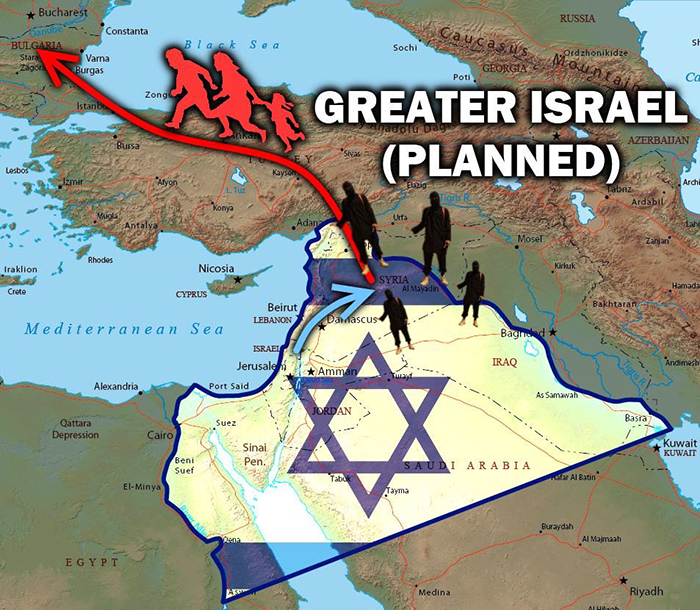
The Oded Yinon plan for Greater Israel, achievable only by Balkanizing the Muslim East into statelets and sustainable only by keeping them perpetually at war.
So all of the major, legitimate parties to the conflict — namely the Astana participants Syria, Turkey, Iran, and Russia — have the same ultimate interest: healing the region and defeating all forms of Oded Yinon style destabilization. By contrast, the three increasingly marginalized, illegitimate parties to the conflict (who were in fact the original aggressors), namely the US, the Wahhabi Gulf Arabians, and the Zionist entity, continue trying to spread chaos and instability. All three bad actors are still supporting mercenaries who aim to Balkanize the region. The Saudis and their friends continue to pour weapons and money, albeit at reduced levels, into the coffers of HTS and other al-Qaeda-allied pseudo-Islamic forces; while the Zio-Americans continue to lavish weapons and money on their Kurdish separatist militias, the People’s Protection Units (YPG) and Syrian Democratic Forces (SDF).
The looming strategic endgame could be a politically negotiated solution in which Turkey and Syria, backed by Iran and Russia, work together to eliminate all Oded Yinon forces, whether Wahhabi or Kurdish, and establish full sovereignty for all countries in the region. That naturally includes Iraq, where Kurdish separatists, supported by the Zionists, have also been pursuing Oded Yinon related activities.
The ideological framework for such a solution would have to be inclusivist and pan-Islamic. Islamic Iran and increasingly-Islamic Turkey can lead the way toward overcoming sectarianism, especially the ultra-toxic Wahhabi-obscurantist variety, as well as nationalism, which Islam has always rejected (Kurds, like Iraqis, Syrians, Turks, Iranians, and so many others, are fully, equal members of the Muslim Ummah, and should follow the lead of the great Kurdish thinker Bediuzzaman Said Nursi in rejecting nationalism in favor of pan-Islamic solidarity).
While all legitimate parties to the conflict can easily agree to oppose Zionist-supported Kurdish separatism, they may find it harder to agree on what to do with the 60,000 anti-Syrian-government fighters and sympathizers who remain in Idlib. This is where pan-Islamism could provide a solution. According to an Al-Monitor article by Semih Idiz, “Turkish analysts… believe that Moscow and Damascus are set on pushing the Sunni opposition from the province altogether, without differentiating between moderates and jihadis.” This misleadingly-described problem of sorting out “moderates” from “jihadis” involves finding a way to separate the troublemakers from their Saudi paychecks and/or their Wahhabi beliefs. Perhaps the Turks, Syrians, and Iranians could work together to find a common framework for helping educate “recovering Wahhabis” on the importance of Islamic unity.
In any case, the gradual elimination of the last remaining pockets of pro-destabilization mercenary forces in Idlib will proceed in fits and starts. The Turkish “observation posts” in Idlib Governate are growing increasingly precarious as the Syrian army slowly advances, putting pressure on Turkish President Erdogan to finalize his U-turn and fully normalize relations with Damascus — a move that could unite Syria and Turkey in joint opposition to Zio-American-sponsored Kurdish separatism, and in common resolve to overcome sectarianism. Such a development could hasten the arrival of the Zionists’ worst nightmare: a peaceful and increasingly united Muslim East.

Tuesday, September 17, 2019

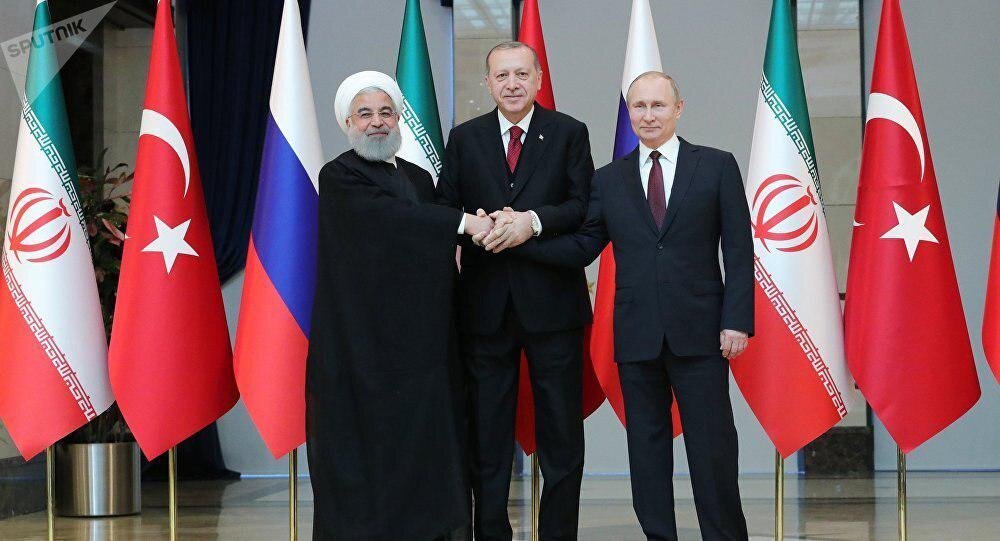
Iranian, Turkish and Russian presidents hold talks on security situation in Syria

TEHRAN/ANKARA – President Recep Tayyip Erdogan, the host of this round of trilateral summit between Turkey, Iran and Russia, hosted President Hassan Rouhani and President Vladimir Putin in Ankara on Monday. It was the fifth summit since 2017.
They were set to speak to reporters at a closing news conference and release a joint declaration.
The three presidents held one-on-one talks before the summit.
In the Syrian war, Tehran and Moscow have been backing the central government. However, Turkey has been a supporter of the rebel groups. Now, the three countries, despite differences, agree on power-sharing in Syria.
Iran and Russia were instrumental in cracking down on terrorists, especially ISIS, in Syria. ISIS misused the chaos resulting from the armed conflict between the government and the opposition groups to create killing fields in the country.
According to Al-Jazeera, the Turkish presidency had said the summit was to focus on ensuring required conditions for voluntary return of refugees.
Erdogan said the summit will bring new dimensions to the Astana process for Syria. He said the Astana platform on Syria was a "unique attempt" to find effective solutions for Syria.
"We have to take more responsibility to ensure peace in Syria," he added.
Talking before the meeting of the three presidents, Rouhani also said cooperation among Iran, Russia, and Turkey, as the three guarantor states of the ceasefire regime in Syria, has promoted security in the war-ravaged country.
-------- Efforts to ‘normalize’ situation in Idlib
Russia and Turkey agree on measures to “normalize” the situation in the terrorist-infested northwestern Syrian province of Idlib.
“Together with Turkey’s president, we have outlined additional joint steps to neutralize the terrorists’ nests in Idlib and normalize the situation there and in the whole of Syria as a result,” Putin told a joint briefing with Erdogan, Press TV reported.
----------Rouhani: Tehran-Ankara ties amicable, strong, developing
In his separate meeting with Erdogan, Rouhani called relations between Iran and Turkey amicable, strong and developing in many fields, vowing to work to deepen ties.
After the meeting, the two presidents attended the meeting of the high-ranking delegations of Iran and Turkey during which Rouhani said, “Fortunately, relations between Iran and Turkey have always been close and brotherly, and the two governments and nations have stood by each other in different conditions”.
Appreciating the warm hospitality of the Turkish government and people, the Iranian president expressed hope that the visit would yield good results for both nations and the region, especially the people of Syria.
He went on to acknowledge the Turkish government’s clear stances against the United States’ unjust sanctions against Iran, saying, “Despite hardships, Iran and Turkey will continue their inclusive economic relations”.
He added, “Iran welcomes Turkish investors and private sector’s presence and participation in implementing common projects.”
The president said, “The holding of the 27th Joint Commission of Iran and Turkey Cooperation in the coming days is a very important opportunity to further develop these relations and cooperation”.
Rouhani also said Iran and Turkey share close views view in combatting terrorism. “Fortunately, good developments have been made in defense-related cooperation between the two countries. Therefore, Iran-Turkey cooperation in ensuring security in common borders and the region will improve further”.
“The pattern of Iran-Turkey trilateral cooperation with Russia in ensuring the security of the region could contribute to the development and stability of the region and the two nations through trilateral and multilateral economic cooperation with neighbors”.
“Guaranteeing the security of the Persian Gulf waterways, the Sea of Oman and the Strait of Hormuz has always been important for Iran as the largest littoral state,” Rouhani said, adding that Iran considers itself responsible to ensure security of regional waterways.
In an indirect reference to the presence of U.S. forces in the Persian Gulf, the president said, “The security of regional waterways has to be protected only by its littoral states, and that the presence American forces and inviting other countries to be present in the region will only increase the existing problems and tensions.”
Rouhani also said attacks on Yemen is the result of miscalculation and misinformation by the U.S., saying, “We must all work to bring stability back to Yemen with the participation of the United Nations.”
Rouhani also pointed to cooperation between Iran and Turkey, as guarantors of the Astana process, which has made Syria more secure, saying, “We must help the Syrian government in fighting the remaining terrorists, especially in Idlib and east of Euphrates until the terrorists are eradicated from the region”.
At the same meeting, the Turkish president referred to the friendly and brotherly relations between Iran and Turkey, saying, “We are determined to continue the great steps taken in relations between the two countries”.
Erdogan added, “Trade cooperation between the two countries by using national currencies has grown significantly and this trend will continue”.
He also said, “America’s sanctions against Iran are unconstructive, and in view of the Turkish government, preserving the Joint Comprehensive Plan of Action is an important symbol of the success of dialogue and diplomacy.”
“We hope that as a result of today’s summit and finalization of the previous summit’s agreements in Sochi stability and security will prevail in the region, especially in Idlib,” he concluded.
  • Wednesday, September 04, 2019

    How Syria Defeated the 2012-2019 Invasion by US & Al-Qaeda

    Eric ZUESSE

    On August 31st, the brilliant anonymous German intelligence analyst who blogs as “Moon of Alabama” headlined “Syria – Coordinated Foreign Airstrike Kills Leaders Of Two Al-Qaeda Aligned Groups”, and he reported that,“Some three hours ago an air- or missile strike in Syria’s Idleb governorate hit a meeting of leaders of the al-Qaeda aligned Haras-al-Din and Hay’at Tahrir al-Sham (HTS) aka Jabhat al-Nusra. Both were killed. It is likely that leaders of other Jihadist groups were also present. The hit completely destroyed a Haras al-Din guesthouse or headquarter. The Syrian Observatory says that more than 40 people were killed in the strike. The hit will make it much easier for the Syrian army campaign to liberate Idleb governorate.”
    At long last, Syria’s army and Russia’s air force are no longer being threatened with World War III by the US and its allies if they proceed to destroy the tens of thousands of Al-Qaida-led jihadists whom the US had helped to train and arm(and had been protecting in Syria ever since December 2012) in order to overthrow Syria’s non-sectarian Government and replace it by a fundamentalist-Sunni Government which the royal Sauds who own Saudi Arabia would appoint. All throughout that war, those Al-Qaeda-led ‘moderate rebels’ had been organized from the governate or province of Idlib (or Idleb). But now, most (if not all) of their leadership are dead.
    Turkey’s leader Tayyip Erdogan had hoped that he would be allowed both by Russia’s Vladimir Putin and by the United States’ Donald Trump to grab for Turkey at least part of Idlib province from Syria. But now, he is instead either participating in, or else allowing, Syria’s army and Russia’s air force, to slaughter Idlib’s jihadists and restore that province to Syria. On 9 September 2018, Russia and Iran had granted Turkey a temporary control over Idlib, and Erdogan then tried to seize it permanently, but finally he has given it up and is allowing Idlib to become restored to Syria. This turn-around signals Syria’s victory against its enemies; it’s the war’s watershed event.
    Here is the history of how all that happened and how Syria is finally a huge and crucial step closer to winning its war against the invaders (which had originally been mainly Al Qaeda, US, Turkey, Qatar, and the Sauds,, but more recently has been only Al Qaeda and US):
    —
    Right now, the Trump Administration has committed itself to prohibiting Syria (and its allies) from retaking control of Idlib, which is the only province that was more than 90% in favor of Al Qaeda and of ISIS and against the Government, at the start of the ‘civil war’ in Syria. Idlib is even more pro-jihadist now, because almost all of the surviving jihadists in Syria have sought refuge there — and the Government freely has bussed them there, in order to minimize the amount of “human shield” hostage-taking by them in the other provinces. Countless innocent lives were saved this way.
    Both Democratic and Republican US federal officials and former officials are overwhelmingly supportive of US President Trump’s newly announced determination to prohibit Syria from retaking control of that heavily jihadist province, and they state such things about Idlib as:
    It has become a dumping ground for some of the hardcore jihadists who were not prepared to settle for some of the forced agreements that took place, the forced surrenders that took place elsewhere. … Where do people go when they’ve reached the last place that they can go? What’s the refuge after the last refuge? That’s the tragedy that they face.
    That happened to be an Obama Administration official expressing support for the jihadists, and when he was asked by his interviewer “Did the world fail Syria?” he answered “Sure. I mean, there’s no doubt about it. I mean, the first person who failed Syria was President Assad himself.”
    —
    Idlib city, incidentally, had also been the most active in starting Syria’s ‘civil war’, back on 10 March 2012 (that’s a news-report by Qatar, which had actually helped to finance the jihadists, whom it lionized as freedom-fighters, and Qatar had also helped the CIA to establish Al Qaeda in Syria). Idlib city is where the peaceful phase of the “Arab Spring” uprisings transformed (largely through that CIA, Qatari, Saudi, and Turkish, assistance) into an armed rebellion to overthrow the nation’s non-sectarian Government, because that’s where the Syrian branch of Al Qaeda was centered. On 29 July 2012, the New York Times headlined “As Syrian War Drags On, Jihadists Take Bigger Role”and reported that “Idlib Province, the northern Syrian region where resistance fighters control the most territory, is the prime example.” (Note the euphemism there, “resistance fighters,” not “jihadists,” nor “terrorists.” That’s how propaganda is written. But this time, the editors had slipped up, and used the honest “Jihadists” in their headline. However, their news-report said that these were only “homegrown Muslim jihadists,” though thousands of jihadists at that time were actually already streaming into Idlib from around the world. Furthermore, Obama lied and said that the people he was helping (the al-Saud family who own Saudi Arabia, and the al-Thani family who own Qatar) to arm, were not jihadists, and he was never called-out on that very blatant ongoing lie.) But the US-allied, Saud-and-Thani-financed, massive arms-shipments, to the Al-Qaeda-led forces in Syria, didn’t start arriving there until March 2013, around a year after that start. And, then, in April 2013, the EU agreed with the US team to buy all the (of course black-market) oil it could that “the rebels” in Syria’s oil region around Deir Ezzor were stealing from Syria, so as to help “the rebels” to expand their control in Syria and thus to further weaken Syria’s Government. (The “rebels,” in that region of Syria, happened to be ISIS, not Al Qaeda, but the US team’s primary target to help destroy was actually Syria, and never ISIS. In fact, the US didn’t even start bombing ISIS there until after Russia had already started doing that on 30 September 2015.)
    A week following my 10 September 2018 news-report, I reported, September 17th, about how Erdogan, Putin, and Iran’s Rouhani, had dealt with the US alliance’s threat of going to war against Russia in Syrian territory if Russia and Syria were to attack the jihadists in Idlib:
    —
    As I recommended in a post on September 10th, Russia’s President Vladimir Putin and Turkey’s President Tayyip Erdogan jointly announced on September 17th, “We’ve agreed to create a demilitarized zone between the government troops and militants before October 15. The zone will be 15-20km wide,” which compares to the Korean DMZ’s 4-km width. I had had in mind the Korean experience, but obviously Putin and Erdogan are much better-informed about the situation than I am, and they have chosen a DMZ that’s four to five times wider. In any case, the consequences of such a decision will be momentous, unless US President Donald Trump is so determined for there to be World War III as to stop at nothing in order to force it to happen no matter what Russia does or doesn’t do.
    What the Putin-Erdogan DMZ decision means is that the 50,000 Turkish troops who now are occupying Idlib province of Syria will take control over that land, and will thus have the responsibility over the largest concentration of jihadists anywhere on the planet: Idlib. It contains the surviving Syrian Al Qaeda and ISIS fighters, including all of the ones throughout Syria who surrendered to the Syrian Army rather than be shot dead on the spot by Government forces.
    —
    However, after Erdogan got control over Idlib, he double-crossed Putin and Rouhani, by trying to solidify his control not only over Idlib but over adjoining portions of Syria, I headlined on 14 July 2019 “Turkey Will Get a Chunk of Syria: An Advantage of Being in NATO”, and reported:
    Turkey is already starting to build infrastructure even immediately to the north and east of Idlib in order to stake its claim to a yet larger portion of Syria than just Idlib. This might not have been part of the deal that was worked out by Russia’s Putin, Iran’s Rouhani, and Turkey’s Erdogan, in Tehran, on 9 September 2018, which agreement allowed Turkey only to take over — and only on a temporary basis — Idlib province, which is by far the most pro-jihadist (and the most anti-Assad) of Syria’s 14 provinces. Turkey was instead supposed to hold it only temporarily, but the exact terms of the Turkey-Russia-Iran agreement have never been publicly disclosed.
    Turkey was building in those adjoining Syrian areas not only facilities from two Turkish universities but also a highway to extend into the large region of Syria to the east that was controlled by Kurdish separatist forces which were under US protection. In July 2019, Erdogan seems to have been hoping that Trump would allow Turkey to attack those Kurdish proxy-forces of the US.
    For whatever reason, that outcome, which was hoped for by Erdogan, turned out not to be realized. Perhaps Trump decided that if the separatist Kurds in Syria were going to be allowed to be destroyed, then Assad should be the person who would allow it, not he; and, therefore, if Erdogan would get such a go-ahead, the blame for it would belong to Assad, and not to America’s President.
    Given the way Assad has behaved in the past — since he has always sought Syrian unity — the likely outcome, in the Kurdish Syrian areas, will be not a Syrian war against Kurds, but instead some degree of federal autonomy there, so long as that would be acceptable also to Erdogan. If Erdogan decides to prohibit any degree of Kurdish autonomy across the border in Syria as posing a danger to Turkish unity, then Assad will probably try (as much as he otherwise can) to accommodate the Kurds without any such autonomy, just like in the non-Kurdish parts of the unitary nation of Syria. Otherwise, Kurdish separatist sentiment will only continue in Syria, just as it does in Turkey and Iraq. The US has backed Kurdish separatism all along, and might continue that in the future (such as after the November 2020 US Presidential election).
    Finally, there seems to be the light of peace at the end of the nightmarish eight-year invasion of Syria by the US and its national (such as Turkey-Jordan-Qatar-Saud-Israel) and proxy (such as jihadist and Kurdish) allies. Matters finally are turning for the better in Syria. The US finally appears to accept it. America’s threat, of starting WW III if Russia and Syria try to destroy the jihadists who have become collected in Syria’s Idlib province, seems no longer to pertain. Maybe this is because Trump wants to be re-elected in 2020. If that’s the reason, then perhaps after November of 2020, the US regime’s war against Syria will resume. This is one reason why every US Presidential candidate ought to be incessantly asked what his/her position is regarding the US regime’s long refrain, “Assad must go”, and regarding continued sanctions against Syria, and regarding restitution to Syria to restore that nation from the US-led war against it. Those questions would reveal whether all of the candidates are really just more of the same actual imperialistic (or “neocon”) policies, or whether, perhaps, one of them is better than that. Putin has made his commitments. What are theirs? Will they accept peace with Russia, and with Iran? If America were a democracy, its public would be informed about such matters — especially before the November 2020 ‘elections’, and not merely after they are already over.

    Saturday, August 24, 2019

    Syrian army gain strategic win in Idlib

    By Ramin Hoseinabadian

    On Tuesday, local news reported that terrorists withdrew from a key city, Khan Sheikhoun, in the Syrian province of Idlib and the Syrian army captured the city.
    According to the latest news, after capturing the key hilltop of Tal Nimr, the Syrian army were able to enter the city of Khan Sheikhoun.
    After the Syrian army entered Khan Sheikhoun, all the terrorists fled out of the city.
    But why this city is so important and why capturing it was an important victory for the Syrian army?
    Khan Sheikhoun has a high strategic importance; it overlooks the key roads in Syria and is the intersection of Idlib’s western, eastern and northern parts. Capturing Khan Sheikhoun is the first step toward reopening the road that connects Syria’s economy capital Aleppo to Damascus which is the political capital of the country.
    Capturing Khan Sheikhoun is also critical from a military point of view because it will make it easier for the army to go further north toward cities of Kafar Sijnah and Maarat al-Numan.
    Capturing Khan Sheikhoun paves the way for more victories for the Syrian Army because it means that now the Syrian Army gains control over a big area in northern Hama, an area which is called the triangle of death.
    Another important part of the victory is that it will pave the way for the Syrian army to wipe out all Takfiri terrorists in the province of Idlib.
    If the Syrian army free Idlib in a quick, surprising strike, how it would influence the Americans and their military forces in Syria?
    The answer is that the United States is worried that the Syrian army seize the control of all critical military areas out of the hands of Americans and their allies as they use these areas to put pressure on Damascus. In fact, operation in Idlib will be the last stage of the war for completely freeing Syria from the curse of terrorism.
    With freeing Idlib, the militia forces and their supporters will lose their winning edge and pressure leverage against the Syrian army.
    After Idlib is freed, the Syrian government goes back to its normal situation before the crisis. This means that all the people and countries who started this war in Syria will have to go back to their countries empty-handed and Damascus will be the true winner of this war. This is surely contrary to what American wants, so they would make every effort to prevent this scenario.
    Anyway, the war in Syria that first started from Aleppo and Qalamun Mountains is nearing its end in Idlib which is among the last areas under the control of the terrorists. 
    The further the Syrian army goes toward victory, the further the terrorists and their supporters try to influence the media and abuse the non-military people to create fake news for the media. 
    Surely, capturing the city of Khan Sheikhoun in the south of Idlib province is among the most importing victories of the Syrian army over the last five years; that is why the victory has caused great worries for the Americans and officials of Ankara.
    Undoubtedly, after this we will see many bigger achievements from Syrian army.
    Now that the terrorists are surrounded in the northern part of Hama, they have no choice other than death or fleeting the region with the help of Turkey. It means that the whole northern part of Hama will be freed and cities of Moharade and Al-Suqaylabiyah will reach some peace after suffering daily missile attacks for a long time.

    Tuesday, February 26, 2019

    Assad, Putin's green light for battle of Idlib

    By Ramin Hossein Abadian

    TEHRAN - All eyes are on Idlib and the terrorist group’s fate there. Media are reporting on massive preparations by the Syrian army and its dispatch to the northern fronts of the country.
    More equipment has been sent to Idlib suburbs, and troops under the command of the famous general, Suheil al-Hassan, are based in the outskirts. The equipment includes tanks and other weapons, as the Syrian army prepares to recapture Idlib. Many Syrian force have been stationed at Jourin base in the northwest of the countryside beyond Hama and in al-Ahmar in Jab al-Ahmar village in Latakia and surrounds.
    General Suheil al-Hassan is Syria's most notorious commander who is said to be undefeated in war. He has achieved significant success in battles against armed terrorist groups in Syria. Known as the Tiger, he successfully used psychological warfare techniques using large speakers that spread frightening messages.
     The terrorist groups that are in Idlib
    There are various terrorist groups in Idlib, the most important of which is the Hayat Tahrir al-Sham, formerly called Jabhat al-Nusra. In particular, since July 2017, the group has had the most influence in Idlib.
    Smaller groups are Jaysh al-Badia and Jaysh al-Malahim fighting in the south of Idlib. On January 11, 2018, Jaysh al-Malahim issued a statement saying it was fighting in southern Idlib alongside Jaysh al-Badiya.
    The Turkistan Islamic Party, which has close ties to al-Qaeda found in Xinjiang Province, western China, is considered broadly as a terrorist group but is present in Syria. The group has media tools such as the Telegram, which publishes their statements and activities.
    In July 2017, Hayat Tahrir al-Sham defeated its only serious rival, Ahrar al-Sham, for factional dominance in Syria’s insurgent-held northwest, centered on Idlib province.
    Other groups include other movements such as Nour Al-Din Al-Zinki , Jaysh Al-Ahrar, Faylaq al-Sham, Jaish al-Ezzah, (a Free Syrian Army flagged faction), and some smaller groups in Idlib.
    It is time to see that the Syrian government, with the support of its allies, has decided to take important and decisive steps to strengthen the Syrian Armed Forces and equipment in the northern suburbs of Hama and south of Idlib, despite the U.S. and international obstinacy. 
    The question is whether Syria and its allies have taken the final decision to confront the terrorists in Idlib, especially the legitimate and sovereign right of Syria, and Turkey has, like always, refused to fulfill its obligations? Can Lavrov speech at Munich Security Conference be considered a message to Turkey and the U.S.? What is the Syrian army's strategy to prevent civilian casualties? Can the battle of Idlib end easily and quickly? What will be the reaction of regional and international countries, and what will Turkey do?
    What America misses with the domination of Damascus
    The United States is worried that the Syrian army will remove all the military and field milestones that the United States and regional allies can use to exert pressure on Damascus. Especially since the battle of Idlib will be the last stage in the process of liberating the entire geography of Syria from terrorists.
    With the liberation of Idlib, the Syrian government returns to the pre-crisis situation, and those who launched the multi-year war against Syria will return empty handed and Damascus will be victorious, while the U.S.  and allies will be the losers.
    Russia is aware of the situation, and analysts say they will directly support the Syrian army in the face of a possible U.S. reaction. Washington is afraid that Damascus will move swiftly to try to recapture all areas under occupation in Syria, including areas controlled by U.S. military units.
    What will happen to the terrorists in Umm al-Ma'arik Battle?
    Terrorists who do not surrender will be dealt with. According to media reports, all eyes are on the main roads such as Hamah-Idlib, Aleppo- Latakia. All measures are being taken for a tough battle in a region where thousands of Arab, Turkmen, Chinese and Uzbek terrorists are present.
    No one can predict how difficult the battle to recapture Idlib might be. Some observers predict a tough fight, while others claim the Syrian army is more than ready to prevail after victories in the south of Syria. 
    Idlib is the home for rebels and terrorists gathered from all regions. The battle of the city is associated with a lot of complexities compared to the previous fronts and is difficult to predict the course of its field developments. The coming days will reveal the fate of Syria and the determination of the Damascus government to dominate the entire country. 

    Tuesday, January 22, 2019

    Tiger’s claws in terrorists’ nest; the battle of north Syria is coming soon

    By Farzad Farhadi 
    TEHRAN - The Syrian army succeeded in striking a blow at the Takfiri group in their occupied territories and did away with the ISIS. Now, it is time to get rid of other terrorists, including Al-Nusra Front or Jabhat al-Nusra in the province of Idlib in northern Syria as the Syrian Armed Forces are seeking to wrap up the terrorist's chapter in Syria.
    Recently, terrorist groups have violated the agreement on a weapon-free zone in Idlib and its surroundings and have taken provocative action against the Syrian Army who supports civilians in villages and settlements. 
    It seems that northern Syria, Idlib and its suburb, is about to witness new developments as the Syrian Army is through with terrorists in other fronts. 
    Tahrir al-Sham terrorist group, headed by Al-Nusra Front, some takfiri terrorist groups, and foreign mercenaries are in Idlib and northern suburb of Hama while they receive their training abroad.
    When Tahrir al-Sham won a battle against a group called Nooruddin Zangi, they imagined they could take over Idlib region. The Nour al-Din al-Zenki group was defeated in five days and escape to Afrin in the north leaving all their arms and ammunition depots behind. 
    The terrorists that Turkey couldn’t tame
    The weapon-free zone promised by Turkey seems to have had little success as Al-Nusra Front leader Abu Mohammad al-Golani greatly disappointed Turkey and violated the area. The Turks did not succeed in pushing the Takfiris back from borders. As Tahrir al-Sham group and its ally did not bow down to Ankara’s demand, they brought their own downfall. 
    Some analysts believe it would be unlikely for Ankara to bring Turkish-backed arm groups against 30,000 Tahrir al-Sham terrorists whose half of them is from the Al-Nusra Front. 
    Other experts believe Turkey’s agreement and perhaps its collaboration with Russia is to carry out direct attacks on the Tahrir al-Sham especially that the action is in line with the international community law to combat terrorism.
    However, the most likely option is that the Syrian army, with the support of the Russians to determine Idlib's fate, particularly the Turks has failed to be committed to the deal. Damascus has decided to add more Syrian forces to the frontline. This is also in line with the Astana agreement because the terrorists of Al-Nusra Front are not subject to the armed groups listed in the ceasefire agreement.
    An invincible general to rout the terrorists
    According to a Syrian military source, Brigadier General Suheil Salman al-Hassan, known as The Tiger, has visited the battlefields in the western suburbs of Hamah province. 
    In the past days, the Syrian Army is on standby on the fronts of the Hama and Idlib suburbs, as more forces and equipment are being dispatched on the northern front of Hama. In addition, General al-Hassan has summoned the Syrian Special Mission Forces.
    The secret of the commander’s presence in difficult missions on the front of Idlib and Hama suburbs
    General al-Hassan is one of the most popular Syrian commanders who won’t be defeated in any war. He was honored by the Russian commanders at al-Hamim Russian military air base in Syria. He is the one who broke the siege of the Aleppo and other sensitive sites around the city.
    The influence of this general, his sense of patriotism, and loyalty to the Syrian army and Bashar al-Assad is exemplary. Since he is the closest commander to Bashar al-Assad, the most important and sensitive missions are assigned to him.
    Known as a military commander who loves the battlefield, General al-Hassan has sworn not to see his only son, age 5, until he reaches the ultimate victory. That shows the degree of his sincerity to his cause. General Al-Hassan is among the first to graduate from the Air Force College in 1991 and has some of the outstanding attributes of Syrian Former President Hafiz al-Assad.
    He always appears in the photos and videos of the media on the battlefield supporting the wounded soldiers, lifting their spirit, and encouraging them to fight for Syria.
    The Syrian general is a decisive and steadfast general committed to his military approach, and fights corruption and disorder, especially among forces under his command. He executes militants, who are accused of looting and plundering civilian homes during raids in the conflict zones. 
    Commander Tiger's popularity is to an extent that Syrian troops wish to fight under his command. His military unit is composed of 80,000 soldiers who, according to experts, all have gone through necessary trainings.
    What do the Zionists say about General al-Hassan?
    On General al-Hassan, the Israeli News Agency Walla admits that he has very tough tactics. He liberated a military airport in northern Syria and has achieved significant success in the battlefield with the Syrian Armed Forces. 
    In fact, Commander Tiger has brought all victories to the Syrian Army.  He successfully takes advantage of psychological warfare techniques by using large speakers to echo messages of fear and threat to the enemy.
    It appears that the new developments in Syria have been accelerating, because, on the one hand, the United States and Turkey are discussing the creation of a secure area, and on the other hand, the fate of the east of the Euphrates region is still unclear as the terrorists’ attacks in Hama and Idlib are intensifying. 
    Since the Syrian general has visited the northern suburbs of Hama and Idlib, evidently surprising developments are on the way. Of course, the battle will be tough since the most ruthless U.S.- and Western-backed terrorists are in the province of Idlib and they carry a chemical attack after each successful Syrian military operation. 
    We just have to wait and see what the fate of the most important front in Syria will be.

    Wednesday, November 28, 2018

    The West Stays Mum About Aleppo Chemical Attack

    The West Stays Mum About Aleppo Chemical Attack

    More than 100 people were injured as a result of a chemical attack in Aleppo on Nov. 24. The Syrian government asked the Organization for the Prohibition of Chemical Weapons (OPCW) to send a fact-finding mission to the city. Evidently the rebels were responsible. The West’s reaction has been surprising. Unlike in previous instances, the West has stayed mum instead of creating an uproar after the attacks and blaming Syria without any sort of thorough investigation to prove its guilt.
    When rebel-controlled areas came under chemical attacks, Western leaders raised a hue and cry, but they more or less shrugged it off when civilians living in Aleppo’s government-controlled areas became the targets — shot by 120-mm mortars firing chlorine-filled rounds. The shelling came from Idlib — the province where the remaining rebels are based. There is no way the Syrian government troops could have been the perpetrators. Nobody would believe a story claiming that they attacked their own forces so deep behind their own lines. Russia and Syria are proud of the fact they have established peace in Aleppo, and they have no interest in disturbing it.
    Neither the US nor its comrades-in-arms — the UK and France — is launching missile and air attacks to strike rebel-held positions in Idlib. And no one is rushing toward international podiums to do any finger-pointing. No statements have been issued from either Washington or Brussels as of Nov. 27. The silence is deafening.
    Only French President Macron has announced that his country is condemning the use of chemical weapons in general and in the Syrian city of Aleppo in particular. Some time ago, Paris was vigorously advocating for the West’s intervention in Syria. It joined the US military actions against Syrian government forces. French special forces operate side-by-side with their American counterparts there. The French president has always expressed his indignation and condemnation of the Syrian government for the things it has not done. This time he failed to castigate the radicals in Idlib for the crime they really did commit.
    It was Russian forces who attacked the terrorist positions from where mortars were firing chemical rounds, according to intelligence sources. The Russian air force prevented another chemical attack in order to protect civilians. Russian and Syrian medical personnel saved human lives by rapidly coming to their aid. Syria and Russia joined efforts in an investigation to produce proof that it was Hay’at Tahrir al-Sham militants (the former Jabhat al-Nusra) who perpetrated this war crime.
    Russia had warned that the White Helmets were preparing to stage such an attack while freely operating in the terrorist-controlled areas. They had been painted in the West as human-rights defenders until their group was exposed as terrorist collaborators. Interestingly, the group had always operated in areas controlled by the extremists, never in zones held by the so-called “moderate opposition.”
    But the question is — why were the Russian warnings  ignored? Another question — what will the OPCW do after it has acquired new powers to hand down verdicts about who is to blame? Russian experts are already there investigating and producing tangible results, while that global watchdog is not sure if it is safe enough for a team to be sent to Aleppo! Even if it goes in, it’ll have lost too much time to be able to conduct an effective investigation. The way to do it is to arrive on the scene quickly and gather evidence. It has not done this. Will it cooperate with the Russian military as it should? After all, Russia has hard evidence it can produce, otherwise it would not have attacked Idlib and breached the ceasefire accord. It protected the civilians in Aleppo knowing perfectly it would have to justify its actions.
    In any event, the chemical attack in Aleppo is an acid test that will demonstrate the OPCW’s ability to beef up its credibility as an international body empowered with the authority to assign blame. The inspectors did not travel to Syria’s Shayrat air base to conduct an inspection after the Khan Sheikhoun chemical attack last year, nor did they go to see with their own eyes what really happened in Douma, where a chemical attack took place in April. It’ll have to behave more responsibly this time, even if its own safety is not guaranteed.
    The idea behind the attack was to provoke a clash between Turkey, which is responsible for the situation in Idlib, and the Russian-backed Syrian government that is defending Aleppo. But those plans fell apart when they were exposed by Russian intelligence. The attack was not unexpected. And there was one other thing that was exposed as a result — the duplicity of the West.