Showing posts with label Iraq. Show all posts

Wednesday, December 18, 2019

Costs by inexperienced crown prince for Saudi Arabia

By Ramin Hossein Abadian
As the influence of Crown Prince Mohamad bin Salman on Saudi Arabia’s decision-making bodies has been increasing, the country has taken an aggressive foreign policy approach.
The most important reason for changes in Saudi Arabia’s foreign policy is the crown prince’s ambitions and inexperience in governing as well as ignoring the realities of the country’s political environment.  
The illegal invasion of Yemen, widespread intervention in the domestic affairs of Iraq, Syria, Egypt, and Libya as well as cutting ties with Qatar are among obvious effects of the aggressive approach adopted by Saudi Arabia. 
The unprecedented strain in Riyadh’s ties with Iran and extensive effort to apply direct or indirect pressure on the Islamic Republic are the measures that can be considered as the crown prince’s foreign policy achievement. 
After nearly six years of following such an approach, not only no new achievement has emerged, but also the country has faced the burdensome economic, security and political costs.
Being caught in the Yemeni quagmire coupled with failure in implementing its policies in Syria and Iraq, which were being pursued through financial and intelligence support for the Takfiri terrorist groups are the effects of the aggressive approach. The inept foreign policy has resulted in more debacles, such as the scandal of arresting Lebanese Prime Minister Saad Hariri while in Saudi Arabia and Qatar’s successful resistance in face of widespread pressure by Riyadh.
In recent months, Saudi Arabia have made many efforts to reduce the problems caused its aggressive foreign policy approach.
In this regard, Riyadh has taken some actions. For example, it has taken steps to resolve disputes with Qatar and attempting to get closer to the Yemeni Houthis in order to reach a peace agreement. 
Although Saudi Arabia has been trying to review its previous aggressive approaches, there are numerous evidence that the country is seeking to interfere in the regional states’ domestic affairs and dictate its political will through soft and less costly methods. 
Recent events in Lebanon and Iraq that led to political and security problems along with efforts by the Saudi-affiliated media such as Iran International TV and the Saudi-owned Al Arabiya TV to exploit the recent popular protests in Iran are just a few examples of the Saudi interventionist approach. 
Riyadh must learn lessons from the consequences of the aggressive policy toward the countries in the region and of enormous economic and security losses. Saudi Arabia should be aware that pursuing previous policies with tactical changes will also result in unpredictable costs for the country.

Tuesday, December 17, 2019

I Never Saw a World So Fragmented!

Andre Vltchek

It is amazing how easily, without resistance, the Western empire is managing to destroy “rebellious” countries that are standing in its way.
I work in all corners of the planet, wherever Kafkaesque “conflicts” get ignited by Washington, London or Paris.
What I see and describe are not only those horrors which are taking place all around me; horrors that are ruining human lives, destroying villages, cities and entire countries. What I try to grasp is that on the television screens and on the pages of newspapers and the internet, the monstrous crimes against humanity somehow get covered (described), but the information becomes twisted and manipulated to such an extent, that readers and viewers in all parts of the world end up knowing close to nothing about their own suffering, and/or of the suffering of the other.
For instance, in 2015 and in 2019, I tried to sit down and reason with the Hong Kong rioters. It was a truly revealing experience! They knew nothing, absolutely zero about the crimes the West has been committing in places such as Afghanistan, Syria or Libya. When I tried to explain to them, how many Latin American democracies Washington had overthrown, they thought I was a lunatic. How could the good, tender, ‘democratic’ West murder millions, and bathe entire continents in blood? That is not what they were taught at their universities. That is not what the BBC, CNN or even the China Morning Post said and wrote.
Look, I am serious. I showed them photos from Afghanistan and Syria; photos stored in my phone. They must have understood that this was original, first hand stuff. Still, they looked, but their brains were not capable of processing what they were being shown. Images and words; these people were conditioned not to comprehend certain types of information.
But this is not only happening in Hong Kong, a former British colony.
You will maybe find it hard to believe, but even in a Communist country like Vietnam; a proud country, a country which suffered enormously from both French colonialism and the U.S. mad and brutal imperialism, people that I associated with (and I lived in Hanoi for 2 years) knew close to nothing about the horrendous crimes committed against the poor and defenseless neighboring Laos, by the U.S. and its allies during the so-called “Secret War”; crimes that included the bombing of peasants and water buffalos, day and night, by strategic B-52 bombers. And in Laos, where I covered de-mining efforts, people knew nothing about the same monstrosities that the West had committed in Cambodia; murdering hundreds of thousands of people by carpet bombing, displacing millions of peasants from their homes, triggering famine and opening the doors to the Khmer Rouge takeover.
When I am talking about this shocking lack of knowledge in Vietnam, regarding the region and what it was forced to go through, I am not speaking just about the shop-keepers or garment workers. It applies to Vietnamese intellectuals, artists, teachers. It is total amnesia, and it came with the so-called ‘opening up’ to the world, meaning with the consumption of Western mass media and later by the infiltration of social media.
At least Vietnam shares borders as well as a turbulent history with both Laos and Cambodia.
But imagine two huge countries with only maritime borders, like the Philippines and Indonesia. Some Manila dwellers I met thought that Indonesia was in Europe.
Now guess, how many Indonesians know about the massacres that the United States committed in the Philippines a century ago, or how the people in the Philippines were indoctrinated by Western propaganda about the entire South East Asia? Or, how many Filipinos know about the U.S.-triggered 1965 military coup, which deposed the internationalist President Sukarno, killing between 2-3 million intellectuals, teachers, Communists and unionists in “neighboring” Indonesia?
Look at the foreign sections of the Indonesian or Filipino newspapers, and what will you see; the same news from Reuters, AP, AFP. In fact, you will also see the same reports in the news outlets of Kenya, India, Uganda, Bangladesh, United Arab Emirates, Brazil, Guatemala, and the list goes on and on. It is designed to produce one and only one result: absolute fragmentation!
***
The fragmentation of the world is amazing, and it is increasing with time. Those who hoped that the internet would improve the situation, grossly miscalculated.
With a lack of knowledge, solidarity has disappeared, too.
Right now, all over the world, there are riots and revolutions. I am covering the most significant ones; in the Middle East, in Latin America, and in Hong Kong.
Let me be frank: there is absolutely no understanding in Lebanon about what is going on in Hong Kong, or in Bolivia, Chile and Colombia.
Western propaganda throws everything into one sack.
In Hong Kong, rioters indoctrinated by the West are portrayed as “pro-democracy protesters”. They kill, burn, beat up people, but they are still the West’s favorites. Because they are antagonizing the People’s Republic of China, now the greatest enemy of Washington. And because they were created and sustained by the West.
In Bolivia, the anti-imperialist President was overthrown in a Washington orchestrated coup, but the mostly indigenous people who are demanding his return are portrayed as rioters.
In Lebanon, as well as Iraq, protesters are treated kindly by both Europe and the United States, mainly because the West hopes that pro-Iranian Hezbollah and other Shi’a groups and parties could be weakened by the protests.
The clearly anti-capitalist and anti-neo-liberal revolution in Chile, as well as the legitimate protests in Colombia, are reported as some sort of combination of explosion of genuine grievances, and hooliganism and looting. Mike Pompeo recently warned that the United States will support right-wing South American governments, in their attempt to maintain order.
All this coverage is nonsense. In fact, it has one and only one goal: to confuse viewers and readers. To make sure that they know nothing or very little. And that, at the end of the day, they collapse on their couches with deep sighs: “Oh, the world is in turmoil!”
***
It also leads to the tremendous fragmentation of countries on each continent, and of the entire global south.
Asian countries know very little about each other. The same goes for Africa and the Middle East. In Latin America, it is Russia, China and Iran who are literally saving the life of Venezuela. Fellow Latin American nations, with the one shiny exception of Cuba, do zero to help. All Latin American revolutions are fragmented. All U.S. produced coups basically go unopposed.
The same situation is occurring all over the Middle East and Asia. There are no internationalist brigades defending countries destroyed by the West. The big predator comes and attacks its prey. It is a horrible sight, as a country dies in front of the world, in terrible agony. No one interferes. Everybody just watches.
One after another, countries are falling.
This is not how states in the 21st Century should behave. This is the law of attraction the jungle. When I used to live in Africa, making documentary films in Kenya, Rwanda, Congo, driving through the wilderness; this is how animals were behaving, not people. Big cats finding their victim. A zebra, or a gazelle. And the hunt would begin: a terrible occurrence. Then the slow killing; eating the victim alive.
Quite similar to the so-called Monroe doctrine.
The Empire has to kill. Periodically. With predictable regularity.
And no one does anything. The world is watching. Pretending that nothing extraordinary is taking place.
One wonders: can legitimate revolution succeed under such conditions? Can any democratically elected socialist government survive? Or does everything decent, hopeful, and optimistic always ends up as the prey to a degenerate, brutal and vulgar empire?
If that is the case, what’s the point of playing by the rules? Obviously, the rules are rotten. They exist only in order to uphold the status quo. They protect the colonizers, and castigate the rebellions victims.
But that’s not what I wanted to discuss here, today.
My point is: the victims are divided. They know very little about each other. The struggles for true freedom, are fragmented. Those who fight, and bleed, but fight nevertheless, are often antagonized by their less daring fellow victims.
I have never seen the world so divided. Is the Empire succeeding, after all?
Yes and no.
Russia, China, Iran, Venezuela – they have already woken up. They stood up. They are learning about each other, from each other.
Without solidarity, there can be no victory. Without knowledge, there can be no solidarity.
Intellectual courage is now clearly coming from Asia, from the “East”. In order to change the world, Western mass media has to be marginalized, confronted. All Western concepts, including “democracy”, “peace”, and “human rights” have to be questioned, and redefined.
And definitely, knowledge.
We need a new world, not an improved one.
The world does not need London, New York and Paris to teach it about itself.
Fragmentation has to end. Nations have to learn about each other, directly. If they do, true revolutions would soon succeed, while subversions and fake color revolutions like those in Hong Kong, Bolivia and all over the Middle East, will be regionally confronted, and prevented from ruining millions of human lives.

Andre Vltchek is philosopher, novelist, filmmaker and investigative journalist. He’s a creator of Vltchek’s World in Word and Images, and a writer that penned a number of books, including China and Ecological Civilization. He writes especially for the online magazine “New Eastern Outlook.”

Thursday, December 12, 2019

The effects and consequences of US Congress’ endless permissions for war

More than 7,000 US service members have been killed and more than 50,000 wounded in the wars since 9/11. Of the 2.5 million troops deployed to Iraq and Afghanistan it is estimated as many as 20% are afflicted with PTSD, while 20% more may have traumatic brain injury.
Based on US Veterans Administration (VA) data, Afghan and Iraq veterans have rates of suicide 4-10 times higher than their civilian peers, adjusted for age and sex.
The following is an article in this regard published in the website of Antiwar under the heading: “The Effects and Consequences of Congress’ Endless Permissions for War.”
For the first time in decades, passage of the National Defense Authorization Act (NDAA) has been delayed due to disagreements between Democrats and Republicans. The disagreements at the center of the delay in Congress are, as usual, partisan in nature: funding for the President’s border wall with Mexico, a Space Force the Pentagon doesn’t want, the impeachment hearings, and other domestic political issues.
This delay in passage of a reconciled NDAA between the two houses of Congress, however offers an opportunity, because buried within the NDAA are possibilities to repeal the pieces of legislation that have brought mass human, financial and moral consequences to the US, have wrecked entire nations and societies abroad, and have made the United States less safe.
In both 2001 and 2002, via large majorities, the Congress passed authorizations for war. While not declarations of war, these mandates, each titled an Authorization for Use of Military Force (AUMF) provided the legal framework in 2001 for attacks against al-Qaeda and in 2002 for the invasion of Iraq.
Since 2001, the first AUMF has far exceeded its original purpose and has been used to justify military strikes and operations in close to twenty countries in the West Asia, Africa and Asia, often against nations, organizations, and individuals who had nothing to do with 9/11.
It was even cited by President Obama, and then President Trump, as the authority to extra-constitutionally execute an American citizen and his teenage children, without trial, by drones and commandos.
President Trump, as the 2001 is still operative, can seemingly do what he pleases with the military overseas.
With regards to the 2002 AUMF, I think most Americans would find it a shock to know it is still in effect, that the congressional blessing given to the Bush Administration to launch the Iraq War, based on the lies of Iraq’s nonexistent weapons of mass destruction and ties to al-Qaeda, has never been revoked.
Within the NDAA, presented as amendments, are calls for the 2001 and 2002 AUMFs to be repealed. The oft stated arguments offered against repeal by politicians and pundits in the service of the war machine refer to the worldwide presence of terror groups like al-Qaeda and Daesh in Syria and Iraq; appeal to the sunk cost of US lives and treasure in the post-9/11 wars; or point to the requirement for the Pentagon’s leadership abroad, somehow claiming that US military, and CIA, presence and activity over the last two decades has brought about stability and peace.
It doesn’t take very much to belie such excuses and reasons, simply having paid attention to the news of endless war for the last couple of decades or by speaking to a war veteran will guide most people to an understanding that these wars have not just been failures, but never-ending catastrophes of counter-production and suffering, proving with clear certainty both the old adages of war as hell and as a breeding ground for unintended consequences.
The list of reasons to not repeal these AUMFs are heard in varying degrees from congressional leaders and members on both sides.
These reasons are at best specious and are most commonly political myths and tropes that fluctuate around American exceptionalism and the benevolence of war making.
The antidote to such falsehoods of war is hard experience and undeniable fact.
The listing of all such experience and fact is too great to provide, however, I believe simply outlining the costs and consequences of the actual results of the wars enabled by the AUMFs is enough to cause democrats, republican and independent voters, – men and women who are not on the dole of the weapons industry, unlike nearly all members of Congress – to want to see a repeal of both AUMFs.
Based on FBI and journalist investigations, al Qaeda’s strength was between 200 and 400 members worldwide in September of 2001.
Al Qaeda now has affiliates in every corner of the world, their forces measure in the tens of thousands of fighters, and they control territory in Yemen, Syria and Africa.
Per Brett McGurk, the former US envoy for combating al Qaeda and Daesh, Idlib Province in Syria is the largest single location of al Qaeda fighters ever assembled in the world.
In Afghanistan, the Taliban are stronger than at any point since 2001, and, with regards to international terrorism, where there was one international terror group in Afghanistan in 2001, now the Pentagon reports twenty groups, the largest gathering of such groups in the world.
It is important to remember Daesh is the former al Qaeda in Iraq, an organization that came into being due to the invasion and occupation of Iraq by the United States.
While apologists for the United States’ wars and militarized foreign policy will argue this was an unforeseeable and regrettable accident, it seems beyond dispute, as understood through leaked US intelligence documents, comments by American and foreign officials, and multiple journalist and academic reports, that Daesh’s success in Syria and Iraq in the first half of this decade was due to the direct and indirect military, logistic and financial support to ISIS by the US and its allies.
This same support occurred for al Qaeda and their associated forces in Syria.
At times the US found itself providing air cover for al Qaeda forces in Syria and even air strikes in support of Daesh. Such use of US warplanes resulted in accusations that the US was serving as al Qaeda and ISIS’ Air Force in Syria.
In response US active duty soldiers protested via social media, angered at being on the same side as the people they saw as responsible for 9/11.
While much of the counterproductive results of the AUMFs are correctly described as blowback, the outcome of incompetent and nefariousness US meddling overseas, whether it be through Reagan-era support for Islamic militants in Afghanistan or Obama’s use of “smart power” in Libya, I certainly do not want to take away from the agency of those people who have spent decades fighting against the US Empire and its allies.
The 9/11 hijackers, the murderers who give reason for these AUMFs, offered the following three motives for their attack: 1. the US sanctions and bombings of Iraq through the 1990s, 2. the US support for Israeli regime against the Palestinians, 3. the stationing of the US military in Saudi Arabia.
Rather than executing a response to that act of terror which would directly pursue the perpetrators while ameliorating the conditions that gave rise to the attacks, the US chose a path that inflamed anti-US sentiments and assisted terrorist recruiting by opening wars against Muslims across the world, including in the US.
The result should not be surprising: US military, intelligence agencies, journalists and other international organizations continually report the reasons people join such groups is not out of ideology or religious devotion, but out of resistance to invasion and occupation, and in response to the death of family, friends and neighbors by foreign and corrupt government forces. Anywhere from 70-90% of the people who are fighting our soldiers in Africa, Asia and across the Greater Middle East are doing so simply because our soldiers are occupying them or are backing predatory and kleptocratic local government forces.
Often, when I ask those in the US who possess the loudest desire for overseas intervention, occupation and war what they would do if their own home towns and cities were occupied by a foreign army I usually receive a quiet non-reply or an answer so intellectually and morally dissonant that I have to catch my breath.
Yet, it is such silence and dissonance that allows for these wars to continue and disallows any consideration that without the 2001 and 2002 AUMFs we may not today have a worldwide network of al Qaeda fighters and, most certainly, we would not have Daesh. The AUMFs, and the wars they have enabled, have worsened terrorism, not defeated it.
More than 7,000 US service members have been killed and more than 50,000 wounded in the wars since 9/11.
Of the 2.5 million troops deployed to Iraq and Afghanistan it is estimated as many as 20% are afflicted with PTSD, while 20% more may have traumatic brain injury.
Based on US Veterans Administration (VA) data, Afghan and Iraq veterans have rates of suicide 4-10 times higher than their civilian peers, adjusted for age and sex.
This translates to almost two Afghan and Iraq veterans dying by suicide each day. Do the math and it is clear more Afghan and Iraq veterans are being lost to suicide than to combat.
The cost to the people overseas to whom we have brought these wars is hard to realize.
Between one and four million people have been killed, directly and indirectly, while tens of millions have been wounded or psychologically traumatized, and tens of millions more made homeless – the cause of our planet’s worst refugee crisis since World War Two.
Financially, the cost of these wars is immense: more than $6 trillion dollars. The cost of these wars is just one element of the $1.2 trillion the US government spends annually on wars and war making.
Half of each dollar paid in federal income tax goes towards some form or consequence of war. While the results of such spending are not hard to foresee or understand: a cyclical and dependent relationship between the Pentagon, weapons industry and Congress, the creation of a whole new class of worker and wealth distribution is not so understood or noticed, but exists and is especially malignant.
Where the manufacturing, oil, financial and tech centers of the US were once the most affluent regions of the country, for more than a decade now Washington, DC’s counties have composed the wealthiest section of the United States. In 2016, 4 of the wealthiest 6 counties in the US were Washington, DC suburbs.
As discretionary federal spending, aside from that going to defense, intelligence and homeland security agencies, has remained flat or fallen in the last two decades, in relation to inflation and GDP, that household wealth amassed in and around Washington, DC has come primarily from year after year of trillion dollar aggregate spending in support of war making (with the exception of President Obama’s 2009 bank bailout). The sustainment of this war wealth class in and around Washington, DC, seems set for permanence as predicted by future congressional spending priorities, while non-war making classes of Americans, such as scientists, educators and environmentalists, will continue to see reduced support from the federal government.
This is a ghastly redistribution of wealth, perhaps unlike any known in modern human history, certainly not in American history. As taxpayers send trillions to Washington. DC, that money flows to the men and women that remotely oversee, manage and staff the wars that kill and destroy millions of lives overseas and at home.
Hundreds of thousands of federal employees and civilian contractors servicing the wars take home six figure annual salaries allowing them second homes, luxury cars and plastic surgery, while veterans put guns in their mouths, refugees die in capsized boats and as many as four million nameless souls scream silently in death.
The only additional statistic I have the space to provide, of a vast many which compose that incomprehensible cost of more than $6 trillion spent solely for these wars, is that nearly $1 trillion of the $6 trillion dollars is simply just interest and debt payments.
For politicians, whether or not they claim some form of fiscal conservatism as a political principal, these interest and debt payments alone should cause them to reconsider these wars.
It should also make all Americans flinch when they are told, by leaders of both parties and the media, that reform or expansion of domestic public policy programs is too expensive.
In 2004 Osama bin Laden said: All that we have to do is to send two mujahidin to the furthest point east to raise a piece of cloth on which is written al-Qaida, in order to make the generals race there to cause America to suffer human, economic, and political losses without their achieving for it anything of note other than some benefits for their private companies.
It is not hard to imagine bin Laden smiling at his accomplishments from his oceanic grave.
These AUMFs and the wars have provided tens of thousands of recruits to international terror groups; mass profits to the weapons industry and those that service it; promotions to generals and admirals, with corporate board seats upon retirement; and a perpetual and endless supply of bloody shirts for politicians to wave via an unquestioning and obsequious corporate media to stoke compliant anger and malleable fear. What is hard to imagine, impossible even, is anyone else who has benefited from these wars.
The wars since 9/11 have been brutal, stupid and futile. The majority of Americans, including Afghan and Iraq war veterans, believe the wars to have not been worth fighting. Cravenly, with some notable exceptions by progressives and libertarians, there has not been a concerted effort within Congress to put an end to these wars, gain some control over the American war machine and cripple its ability to deliver mass suffering and death.
With the NDAA stalled in conference committee an opportunity now exists for members of Congress to hear from their constituents that the wars must come to an end.
While revoking the AUMFs would by no means wave a magic wand that would end the bloodshed, it would be a crucial first step in forcing the Trump administration, and subsequent administrations, to return to Congress for approval to start another war or to even continue with those wars that are now well into their second decade.

The Israel Lobby’s Hidden Hand in the Theft of Iraqi and Syrian Oil

Agha HUSSAIN, Whitney WEBB
“We want to bring our soldiers home. But we did leave soldiers because we’re keeping the oil,” President Trump stated on November 3, before adding, “I like oil. We’re keeping the oil.”
Though he had promised a withdrawal of U.S. troops from their illegal occupation of Syria, Trump shocked many with his blunt admission that troops were being left behind to prevent Syrian oil resources from being developed by the Syrian government and, instead, kept in the hands of whomever the U.S. deemed fit to control them, in this case, the U.S.-backed Kurdish-majority militia known as the Syrian Democratic Forces (SDF).
Though Trump himself received all of the credit — and the scorn — for this controversial new policy, what has been left out of the media coverage is the fact that key players in the U.S.’ pro-Israel lobby played a major role in its creation with the purpose of selling Syrian oil to the state of Israel. While recent developments in the Syrian conflict may have hindered such a plan from becoming reality, it nonetheless offers a telling example of the covert role often played by the U.S.’ pro-Israel lobby in shaping key elements of U.S. foreign policy and closed-door deals with major regional implications.
Indeed, the Israel lobby-led effort to have the U.S. facilitate the sale of Syrian oil to Israel is not an isolated incident given that, just a few years ago, other individuals connected to the same pro-Israel lobby groups and Zionist neoconservatives manipulated both U.S. policy and Iraq’s Kurdish Regional Government (KRG) in order to allow Iraqi oil to be sold to Israel without the approval of the Iraqi government. These designs, not unlike those that continue to unfold in Syria, were in service to longstanding neoconservative and Zionist efforts to balkanize Iraq by strengthening the KRG and weakening Baghdad.
After the occupation of Iraq’s Nineveh Governorate by ISIS (June 2014-October 2015), the Kurdistan Regional Government (KRG) took advantage of the Iraqi military’s retreat and, amidst the chaos, illegally seized Kirkuk on June 12. Their claim to the city was supported by both the U.S. and Israel and, later, the U.S.-led coalition targeting ISIS. This gave the KRG control, not only of Iraq’s export pipeline to Turkey’s Ceyhan port, but also to Iraq’s largest oil fields.
Israel imported massive amounts of oil from the Kurds during this period, all without the consent of Baghdad. Israel was also the largest customer of oil sold by ISIS, who used Kurdish-controlled Kirkuk to sell oil in areas of Iraq and Syria under its control. To do this in ISIS-controlled territories of Iraq, the oil was sent first to the Kurdish city of Zakho near the Turkey border and then into Turkey, deceptively labeled as oil that originated from Iraqi Kurdistan. ISIS did nothing to impede the KRG’s own oil exports even though they easily could have given that the Kirkuk-Ceyhan export pipeline passed through areas that ISIS had occupied for years.
In retrospect, and following revelations from Wikileaks and new information regarding the background of relevant actors, it has been revealed that much of the covert maneuvering behind the scenes that enabled this scenario intimately involved the United States’ powerful pro-Israel lobby. Now, with a similar scenario unfolding in Syria, efforts by the U.S.’ Israel lobby to manipulate U.S. foreign policy in order to shift the flow of hydrocarbons for Israel’s benefit can instead be seen as a pattern of behavior, not an isolated incident.
“Keep the oil” for Israel
After recent shifts in the Trump administration in its Syria policy, U.S. troops have controversially been kept in Syria to “keep the oil,” with U.S. military officials subsequently claiming that doing so was “a subset of the counter-ISIS mission.” However, Secretary of Defense Mark Esper later claimed that another factor behind U.S. insistence on guarding Syrian oil fields was to prevent the extraction and subsequent sale of Syrian oil by either the Syrian government or Russia.
One key, yet often overlooked, player behind the push to prevent a full U.S. troop withdrawal in Syria in order to “keep the oil” was current U.S. ambassador to Turkey, David Satterfield. Satterfield was previously the assistant secretary of state for Near Eastern Affairs, where he yielded great influence over U.S. policy in both Iraq and Syria and worked closely with Brett McGurk, the former Deputy Assistant Secretary of State for Iraq and Iran and later special presidential envoy for the U.S.-led “anti-ISIS” coalition.
Over the course of his long diplomatic career, Satterfield has been known to the U.S. government as an Israeli intelligence asset embedded in the U.S. State Department. Indeed, Satterfield was named as a major player in what is now known as the AIPAC espionage scandal, also known as the Lawrence Franklin espionage scandal, although he was oddly never charged for his role after the intervention of his superiors at the State Department in the George W. Bush administration.
In 2005, federal prosecutors cited a U.S. government official as having illegally passed classified information to Steve Rosen, then working for AIPAC, who then passed that information to the Israeli government. That classified information included intelligence on Iran and the nature of U.S.-Israeli intelligence sharing. Subsequent media reports from the New York Times and other outlets revealed that this government official was none other than David Satterfield, who was then serving as Principal Deputy Assistant Secretary for Near East Affairs.
Charges against Rosen, as well as his co-conspirator and fellow AIPAC employee Keith Weissman, were dropped in 2009 and no charges were levied against Satterfield after State Department officials shockingly claimed that Satterfield had “acted within his authority” in leaking classified information to an individual working to advance the interests of a foreign government. Richard Armitage, a neoconservative ally with a long history of ties to CIA covert operations in the Middle East and elsewhere, has since claimed that he was one of Satterfield’s main defenders in conversations with the FBI during this time when he was serving as Deputy Secretary of State.
The other government official named in the indictment, former Pentagon official Lawrence Franklin, was not so lucky and was charged under the Espionage Act in 2006. Satterfield, instead of being censured for his role in leaking sensitive information to a foreign government, was subsequently promoted in 2006 to serve as the Coordinator for Iraq and Senior Adviser to then-Secretary of State Condoleezza Rice.
In addition to his history of leaking classified information to AIPAC, Satterfield also has a longstanding relationship with the Washington Institute for Near East Policy, a controversial spin-off of AIPAC also known by its acronym WINEP. WINEP’s website has long listed Satterfield as one of its experts and Satterfield has spoken at several WINEP events and policy forums, including several after his involvement with the AIPAC espionage scandal became public knowledge. However, despite his longstanding and controversial ties to the U.S. pro-Israel lobby, Satterfield’s current relationship with some elements of that lobby, such as the Zionist Organization of America (ZOA), is complicated at best.
While Satterfield’s role in yet another reversal of a promised withdrawal of U.S. troops from Syria has largely escaped media scrutiny, another individual with deep ties to the Israel lobby and Syrian “rebel” groups has also been ignored by the media, despite his outsized role in taking advantage of this new U.S. policy for Israel’s benefit.
US Israel Lobby secures deal with Kurds
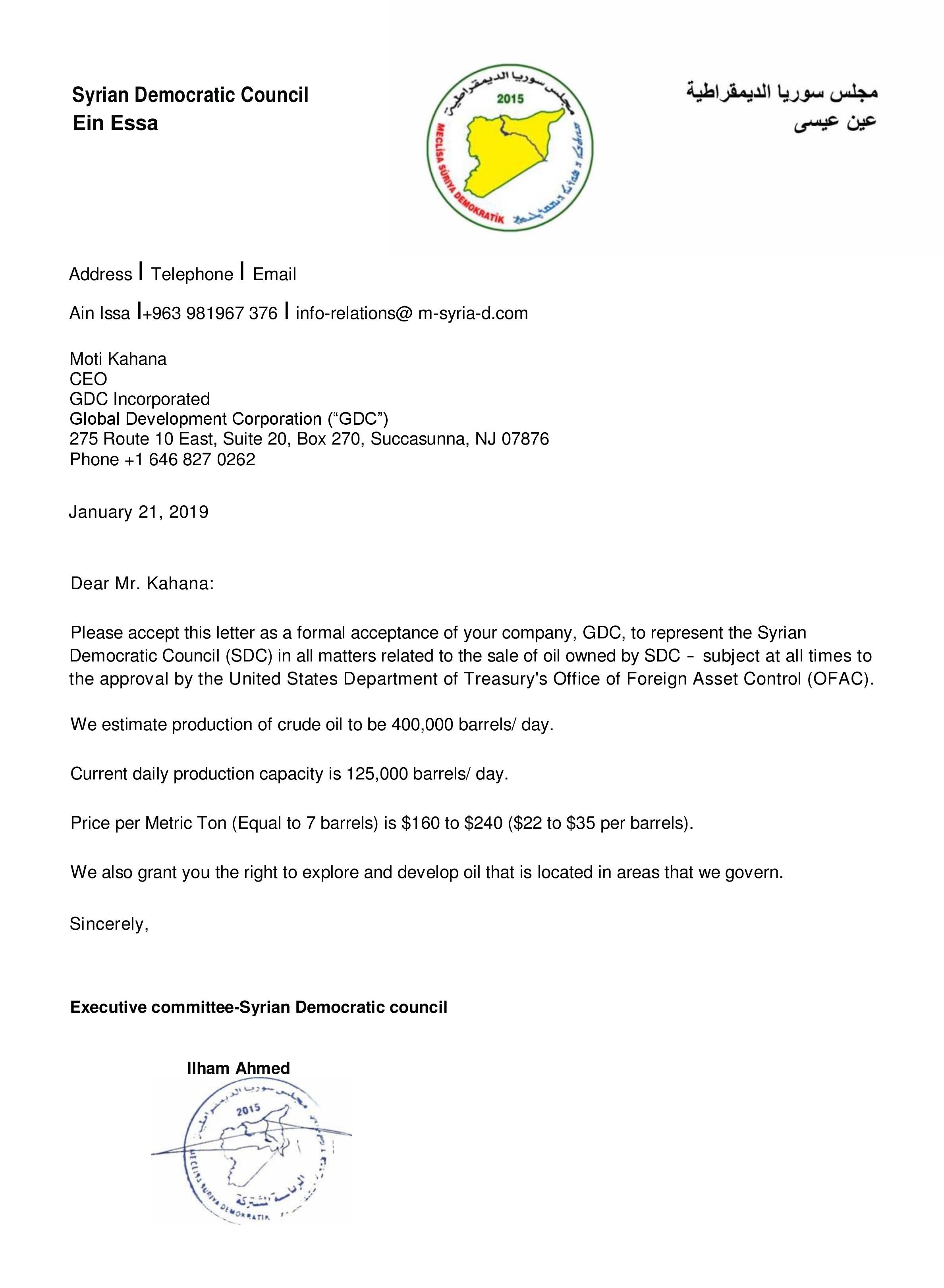
Earlier this year, well before Trump’s new Syria policy of “keeping the oil” had officially taken shape, another individual with deep ties to the U.S. Israel lobby secured a lucrative agreement with U.S.-backed Kurdish groups in Syria. An official document issued earlier this year by the Syrian Democratic Council (SDC), the political arm of the Kurdish majority and U.S.-backed Syrian Democratic Forces (SDF), a New Jersey-based company, founded and run by U.S.-Israeli dual citizen Mordechai “Motti” Kahana, was given control of the oil in territory held by the SDC.
Per the document, the SDC formally accepted the offer from Kahana’s company — Global Development Corporation (GDC) — to represent SDC in all matters pertaining to the sale of oil extracted in territory it controls and also grants GDC “the right to explore and develop oil that is located in areas we govern.”
Global Development Corporation Kurdish Oil
The SDC’s formal acceptance of Global Development Corporation’s offer to develop Syrian oil fields. Source | Al-Akhbar
The document also states that the amount of oil then being produced in SDC-controlled areas was 125,000 barrels per day and that they anticipated that this would increase to 400,000 barrels per day and that this oil is considered a foreign asset under the control of the United States by the U.S. Department of the Treasury.
After the document was made public by the Lebanese outlet Al-Akhbar, the SDC claimed that it was a forgery, even though Kahana had separately confirmed its contents and shared the letter itself to the Los Angeles Times as recently as a few weeks ago. Kahana previously attempted to distance himself from the effort and told the Israeli newspaper Israel Hayom in July that he had made the offer to the SDC as means to prevent the “Assad regime” of Syria from obtaining revenue from the sale of Syrian oil.
The Kurds currently hold 11 oil wells in an area controlled by the [Syrian] Democratic Forces. The overwhelming majority of Syrian oil is in that area. I don’t want this oil reaching Iran, or the Assad regime.”
At the time, Kahana also stated that “the moment the Trump administration gives its approval, we can begin to export this oil at fair prices.”
Given that Kahana has openly confirmed that he is representing the SDC’s oil business shortly after Trump’s adoption of the controversial “keep the oil policy,” it seems plausible that Kahana has now received the approval needed for his company to export the oil on behalf of the SDC. Several media reports have speculated that, if Kahana’s efforts go forward unimpeded, the Syrian oil will be sold to Israel.
However, considering Turkey’s aversion to engaging in any activities that may benefit the PKK-SDF – there are considerable obstacles to Kahana’s plans. While the SDF — along with assistance from U.S. troops — still controls several oil fields in Syria, experts assert that they can only realistically sell the oil to the Syrian government. Not even the Iraqi Kurds are a candidate, considering Baghdad’s firm control over the Iraq-Syria border and the KRG’s weakened state after its failed independence bid in late 2017.
Regardless, Kahana’s involvement in this affair is significant for a few reasons. First, Kahana has been a key player in the promotion and funding of radical groups in Syria and has even been caught hiring so-called “rebels” to kidnap Syrian Jews and take them to Israel against their will. It was Kahana, for instance, who financed and orchestrated the now infamous trip of the late Senator John McCain to Syria, where he met with Syrian “rebels” including Khalid al-Hamad – a “moderate” rebel who gained notoriety after a video of him eating the heart of a Syrian Army soldier went viral online. McCain had also admitted meeting with ISIS members, though it is unclear if he did so on this trip or another trip to Syria.
In addition, Kahana was also the mastermind behind the “Caesar” controversy, whereby a Syrian using the pseudonym “Caesar” was brought to the U.S. by Kahana and went on to make claims regarding torture and other crimes allegedly committed by the Assad-led government Syria, claims which were later discredited by independent analysts. He was also very involvedin Israel’s failed efforts to establish a “safe zone” in Southern Syria as a means of covertly expanding Israel’s territory from the occupied Golan Heights and into Quneitra.
Notably, Kahana has deep ties — not just to efforts to overthrow the Syrian government — but also to U.S. Israel lobby, including the Washington Institute for Near East Policy (WINEP) where Satterfield is as an expert. For instance, Kahana was a key player in a 2013 symposiumorganized by WINEP along with Syrian opposition groups intimately involved in the arming of so-called “rebels.” One of the other participants in the symposium alongside Kahana was Mouaz Moustafa, director of the “Syrian Emergency Task Force” who assisted Kahana in bringing McCain to Syria in 2013. Moustafa was listed as a WINEP expert on the organization’s website but was later mysteriously deleted.
Kahana is also intimately involved with the Israeli American Council (IAC), a pro-Israel lobby organization, as a team member of its national conference. IAC was co-founded and is chaired by Adam Milstein, a multimillionaire and convicted felon who is also on the boards of AIPAC, StandWithUs, Birthright and other prominent pro-Israel lobby organizations. One of IAC’s top donors is Sheldon Adelson, who is also the top donor to President Trump as well as the entire Republican Party.
Though the machinations of both Kahana and Satterfield to guide U.S. policy in order to manipulate the flow of Syria’s hydrocarbons for Israel’s benefit may seem shocking to some, this same tactic of pro-Israel lobbyists using the Kurds to illegally sell a country’s oil to Israel was developed a few years prior, not in Syria, but Iraq. Notably, the individuals responsible for that policy in Iraq shared connections to several of the same pro-Israel lobby organizations as both Satterfield and Kahana, suggesting that their recent efforts in Syria are not an isolated event, but a pattern.
War against ISIS is a war for oil
In an email dated June 15, 2014, James Franklin Jeffrey (former Ambassador to Iraq and Turkey and current U.S. Special Representative for Syria) revealed to Stephen Hadley, a former George Bush administration advisor then working at the government-funded United States Institute of Peace, his intent to advise the KRG in order to sustain Kirkuk’s oil production. The plan, as Jeffery described it, was to supply both the Kurdistan province with oil and allow the export of oil via Kirkuk-Ceyhan to Israel, robbing Iraq of its oil and strengthening the country’s Kurdish region along with its regional government’s bid for autonomy.
Jeffrey, whose hawkish views on Iran and Syria are well-known, mentioned that Brett McGurk, the U.S.’ main negotiator between Baghdad and the KRG, was acting as his liaison with the KRG. McGurk, who had served in various capacities in Iraq under both Bush and Obama, was then also serving Deputy Assistant Secretary of State for Iraq and Iran. A year later, he would be made the special presidential envoy for the U.S.-led “anti-ISIS” coalition and, as previously mentioned, worked closely with David Satterfield.
Jeffrey was then a private citizen not currently employed by the government and was used as a non-governmental channel in the pursuit of the plans described in the leaked emails published by WikiLeaks. Jeffrey’s behind-the-scenes activities with regards to the KRG’s oil exports were done clandestinely, largely because he was then employed by a prominent arm of the U.S.’ pro-Israel lobby.
At the time of the email, Jeffrey was serving as a distinguished fellow (2013-2018) at WINEP. As previously mentioned, WINEP is a pro-Israel foreign policy think-tank that espouses neoconservative views and was created in 1985 by researchers that had hastily left AIPAC to escape investigations against the organization that were related to some of its members conducting espionage on behalf of Israel. AIPAC, the American Israeli Public Affairs Committee, is the largest registered Israel lobbyist organization in the US (albeit registration under the Foreign Agents Registration Act would be more suitable), and, in addition to the 1985 incident that led to WINEP’s creation, has had members indicted for espionage against the U.S. on Israel’s behalf.
WINEP’s launch was funded by former President of the Jewish Federation of Los Angeles,  Barbara Weinberg, who is its founding president and constant Chairman Emerita. Nicknamed ‘Barbi’, she is the wife of the late Lawrence Weinberg who was President of AIPAC from 1976-81 and who JJ Goldberg, author of the 1997 book Jewish Power, referred to as one of a select few individuals who essentially dominated AIPAC regardless of its elected leadership. Co-founder alongside Weinberg was Martin Indyk. Indyk, U.S. Ambassador to Israel (1995-97) and Assistant Secretary of State for Near Eastern Affairs (1997-99), led the AIPAC research time that formed WINEP to escape the aforementioned investigations.
WINEP has historically received funding from donors who donate to causes of special interest for Zionism and Israel. Among its trustees are extremely prominent names in political Zionism and funders of other Israel Lobby organizations, such as Charles and Edgar Bronfman and the ChernicksIts membership remains dominated by individuals who have spent their careers promoting Israeli interests in the U.S.
WINEP has become more well-known, and arguably more controversial, in recent years after its research director famously called for false-flag attacks to trigger a U.S. war with Iran in 2012, statements well-aligned with longstanding attempts by the Israel Lobby to bring about such a war.
A worthy partner in crime
Stephen Hadley, another private citizen who Jeffrey evidently considered as a partner in his covert dealings discussed in the emails, also has his own past of involvement with Israel-specific intrigues and meddling.
During the G.W. Bush administration, Hadley tagged along with neoconservatives in their numerous creations of fake intelligence and efforts to incriminate Iraq for possessing chemical and nuclear weapons. Hadley was one of the promoters from within the U.S. government of the false claim that 9/11 hijacker Mohammed Atta met with Iraqi officials in Prague.
Hadley also worked with then-Chief of Staff to the Vice President, Lewis Libby — a neoconservative and former lawyer for the Mossad-agent and billionaire Marc Rich — to discredit a CIA investigation into claims of Iraq purchasing yellowcake uranium from Niger. That claim famously appeared in Bush’s State of the Union address in 2002.
What this particular claim had in common with the ‘Iraq meets Atta in Prague’ disinformation, and other famous lies against Iraq fabricated and circulated by the dense neocon network, was its source: Israel and pro-Israel partisans.
The distribution network of these now long-debunked claims was none other than the neoconservatives who act a veritable Israeli fifth column that has long sought to promote Israeli foreign policy objectives as being in the interest of the United States. In this, Hadley played his part by helping to ensure that the United States was railroaded into a war that had long been promoted by both Israeli and American neoconservatives, particularly Richard Perle — an advisor to WINEP — who had been promoting regime change in Iraq for Israel’s explicit benefit for decades.
In short, for covert intrigues to serve Israel that would likely be met with protest if pitched to the government for implementation as policy, Hadley’s resume was impressive.
Israeli interests pursued through covert channels
Given his employment at WINEP during this time, Jeffrey’s intent to advise the KRG to sustain Kirkuk’s oil production despite the seizure of the Baiji oil refinery by ISIS is somewhat suspect, especially since it required that 100,000 barrels per day pass through ISIS-controlled territory unimpeded.
Jeffrey’s email from June 14, therefore, demonstrated that he had foreknowledge that ISIS would not disturb the KRG as long as the Kurds redirected oil that was intended originally for Baiji to the Kirkuk-Ceyhan export pipeline, facilitating its export and later sale to Israel.
Notably, up until its liberation in mid-2015 by the Iraqi government and aligned Shia paramilitaries, ISIS kept the refinery running and, only upon their retreat, destroyed the facility.
In July 2014, the KRG began confidently supplying Kurdish areas with Kirkuk’s oil per the plan laid out by Jeffrey in the aforementioned email. Baghdad soon became aware of the arrangement and lashed out at Israel and Turkey, whose banks were used by the KRG to receive the oil revenue from Israel.
One would normally expect ISIS to be opposed to such collusion given that the KRG, while a beneficiary of the ISIS-Baghdad conflict, was not an ally of ISIS. Thus, a foreign power with strategic ties to ISIS used its close ties to the KRG and assurances that it was on-board for the oil trade, to deliver a credible guarantee that ISIS would ‘cooperate’ and that a boom in production and exports was in the cards.
This foreign power — acting as a guarantor for the ISIS-KRG understanding vis-a-vis the illegal oil economy, represented by Jeffrey and clearly not on good terms with Iraq’s government — was quite clearly Israel.
Israel established considerable financial support as well as the provision of armaments to other extremist terrorist groups active near the border between the Israeli-occupied Golan Heights and Southern Syria when war first broke out in Syria in 2011. At least four of these extremist groups were led by individuals with direct ties to Israeli intelligence. These same groups, sometimes promoted as ‘moderates’ by some media, were actively fighting Syria’s government – an enemy of Israel and ally of Iran – before ISIS existed and eagerly partnered with ISIS when it expanded its campaign into Syria.
Furthermore, Israeli officials have publicly admitted maintaining regular communication with ISIS cells in Southern Syria and have publicly expressed their desire that ISIS not be defeated in the country. In Libya, Israeli Mossad operatives have been found embedded within ISIS, suggesting that Israel has covert but definite ties with the group outside of Syria as well.
Israel has also long promoted the independence of Iraqi Kurdistan, with Israel having provided Iraq’s Kurds with weapons, training and teams of Mossad advisers as far back as the 1960s. More recently, Israel was the only state to support the KRG independence referendum in September 2017 despite its futility, hinting at the regard Israel holds for the KRG. Iraq’s government subsequently militarily defeated the KRG’s push for statehood and reclaimed Kirkuk’s oil fields with assistance from the Shia paramilitaries which were responsible for defeating ISIS in the area.
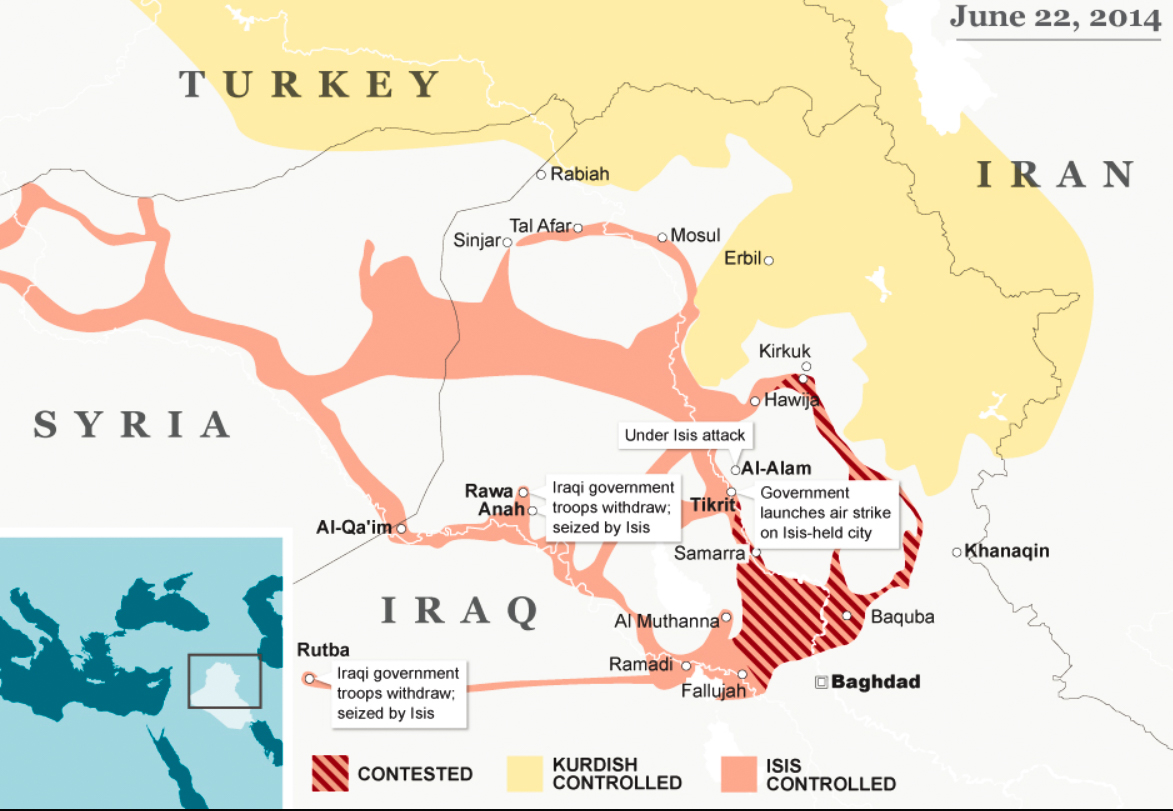
Iraq ISIS control map
A 2014 map shows the areas under ISIS and Kurdish control at the time. Source | Telegraph
This arrangement orchestrated by Jeffrey, served the long-time neoconservative-Israeli agenda of empowering the Kurds, selling Iraqi oil to Israel and weakening Iraq’s Baghdad-based government.
WINEP’s close association with AIPAC, which has spied on the U.S. on behalf of Israel several times in the past with no consequence, combined with Jeffrey’s long-time acquaintance with key U.S. figures in Iraq, such as McGurk, provided an ideal opening for Israel in Iraq. Following the implementation of Jeffrey’s plan, Israeli imports of KRG oil constituted 77 percent of Israel’s total oil imports during the KRG’s occupation of Kirkuk.
The WINEP connection to the KRG-Israel oil deal demonstrates the key role played by the U.S. pro-Israel Lobby, not only in terms of sustaining U.S. financial aid to Israel and ratcheting up tensions with Israel’s adversaries but also in facilitating the more covert aspects of U.S.-Israeli cooperation and the implementation of policies that favor Israel.
Yet the role played by the U.S. Israel lobby in this capacity, particularly in terms of orchestrating oil sale agreements for Israel’s benefit, is hardly exclusive to Iraq and can accurately be described as a repeated pattern of behavior.