Showing posts with label Abdus Sattar Ghazali. Show all posts

Thursday, September 05, 2019

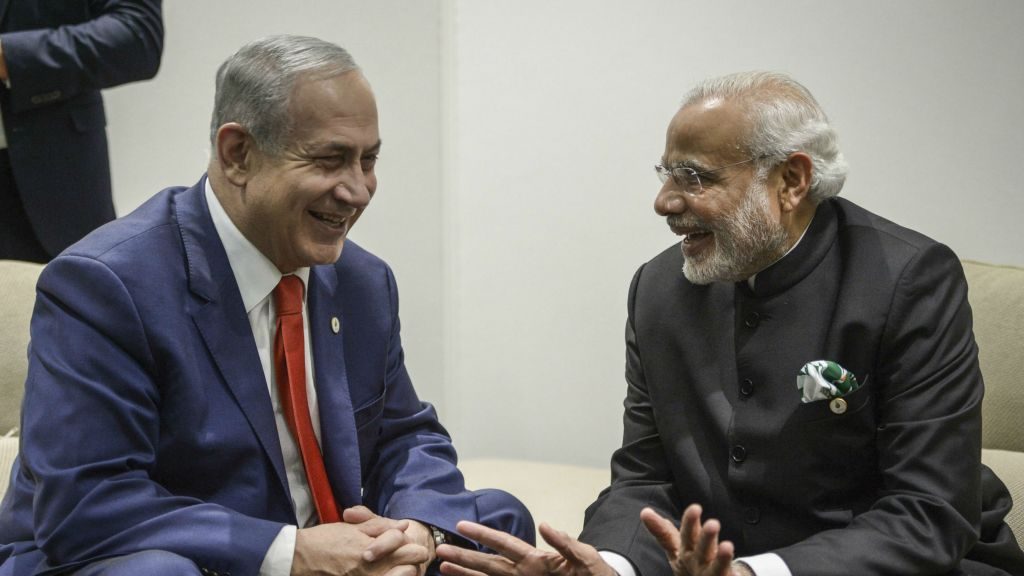
Israel Prime Minister Netanyahu cancels visit to India

Israeli Prime Minister Benjamin Netanyahu on Tuesday (Sept 3) cancelled a planned visit to India on September 9 to meet his counterpart Narendra Modi who last month annexed the disputed territory of Kashmir.
This is the second time this year that Netanyahu on has cancelled a planned visit to India, doing so earlier before the April elections.
Netanyahu’s planned visit was widely seen in Israel as an effort by him to project his acceptance worldwide and prop up his campaign just days before the September 17 repeat polls, according to the Press Trust of India.
Netanyahu, who created history on July 20 by becoming the longest serving Israeli Prime Minister, surpassing Israel’s first premier David Ben-Gurion, is facing a tough political challenge as opinion polls show flagging fortunes for his ruling Likud party.
Israeli lawmakers in May voted 74-45 in favor of dissolving the 21st Knesset (Parliament) and hold an unprecedented re-elections on September 17 after Netanyahu failed to form a coalition government after the April 9 polls.
Netanyahu visited India in January 2018, while Modi travelled to Tel Aviv in 2017, becoming the first Indian prime minister to tour the Jewish state.
Over the past two years, Netanyahu and Modi have hailed “a new era of friendship between the nations,” with mutual high-profile visits and several bilateral agreements signed in the fields of oil, gas, renewable energy and cyber cooperation. In his January 2018 visit to India, Netanyahu called Modi a “revolutionary leader,” who had transformed the relationship between the two nations.
According to media reports, Israel wishes to sell India several advanced weapons manufactured by the country’s defense industries, such as spy planes, unmanned aircraft, anti-tank missiles, cannons and radar systems.
In January, National Security Adviser Meir Ben Shabbat travelled with several members of the council to India, where he met with his Indian counterpart and with Modi. In those meetings, Ben Shabbat discussed different weapon deals between the two countries.
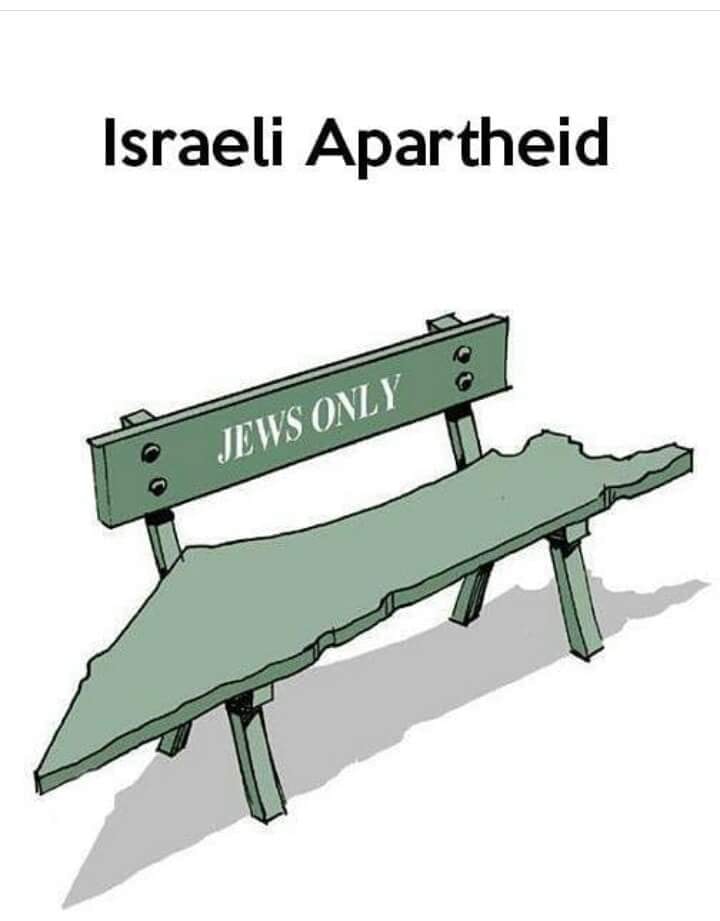
“By revoking autonomy from Kashmir, Indian Prime Minister Narendra Modi is taking a page straight out of the Israeli playbook.” This is the tile of Abdulla Moaswes’s article published by +972 Magazine where he provides a graphic scenario of the Indo-Israeli collaboration to implement Hindutva, or extreme Hindu Nationalism policies adopted by Rashtriya Swayamsevak Sangh (RSS) backed the Bharatiya Janata Party (BJP). Abdulla Moaswes writes:
“Relations between India and Israel grew even closer with the rise of the Bharatiya Janata Party in the 1990s. The BJP, which today is led by Modi, adheres to the political ideology known as Hindutva, or Hindu Nationalism. The history of Hindu nationalists’ affinity with Zionism is well documented by professor Sumantra Bose of the London School of Economics, who traces it back to the 1920s when Vinayak Damodar Savarkar, the father of Hindutva, supported the creation of a Jewish state in Palestine. The BJP and other Hindu Nationalists have since become obsessed with replicating the Zionist project in turning a constitutionally secular India into a Hindu ethnocratic state.
“Many of the BJP’s aspirations and policy proposals for Kashmir are imitations of extant Israeli practices in Palestine. Key among these is the desire to build Israeli-style Hindu-only settlements in Kashmir as a way of instigating demographic change. For example, the Rashtriya Swayamsevak Sangh (RSS), a non-state volunteer Hindu paramilitary volunteer group to which the BJP are affiliated, have long desired the repeal of the state subject laws that have maintained the demographic make-up of Kashmir.
“These changes are clearly inspired by the Israeli settlement model, as expressed by BJP lawmaker Ravinder Raina, who, in 2015, stated that the government of India will use its army to protect Hindu-only settlements in Jammu and Kashmir. This type of securitization and protection would entail an expansion of the security apparatus that already restricts the flow of life for most Kashmiris, using them as a pretext to justify a new level of domination and intrusiveness.
“Aside from the parallels in policy objectives, the discourse used by supporters of the current regime in India resemble old Israeli refrains. Both Israel and India claim to be exceptional democracies, despite their treatment of large swaths of populations under their control. Additionally, both Zionists and Hindu Nationalists argue that the existence of many Muslim countries in the world necessitates a Jewish and Hindu state, respectively. This perpetuates the lie that Palestinians and Indian Muslims can supposedly live elsewhere, yet choose to live in Palestine and India only to antagonize Jews and Hindus.
“Meanwhile, the variety of tactics used by India to control the civilian population of Kashmir strongly resembles t hose used by Israel in Palestine. These include, “arbitrary arrests, extra-judicial killings, enforced disappearances, curfews, collective punishment, administrative detention, torture, rape and sexual abuse, the suppression of freedom of speech and assembly, house demolitions, and so forth.”
“The revocation of Articles 35A and 370 paves the way for Indian presence in Kashmir to further mirror Zionist presence in historic Palestine, since this allows the Indian state to rule Kashmir directly without the need for Kashmir’s state legislature, which was also recently abolished. Furthermore, it facilitates the execution of plans to alter the demographic make-up of Kashmir by allowing Indians from across the country to purchase property and settle there under the protection of the Indian military presence, just as the demographic make-up of the West Bank continues to be altered with the construction of Jewish-only settlements.
“With the unprecedented change of Jammu and Kashmir’s legal status from a special status state to a union territory without a legislative assembly, India’s colonial domination over the contested region will only become more overtly coercive in representing Indian interests. This is a crucial development to be observed closely by Palestinians who live in areas where the Israeli occupation is currently facilitated by the Palestinian Authority.
“As things move forward, it is increasingly clear that the colonial processes in Kashmir and Palestine will become further interdependent on one another. What Israel does in Palestine is likely to happen in Kashmir, and what India does in Kashmir is likely to happen in Palestine. In aiming to dismantle Israeli apartheid and settler colonialism, it is essential to observe its global consequences, for it is highly likely that these interdependent processes will require a multilateral confrontation.”
“Although the Indian presence in Kashmir never amounted to settler colonialism like in the Palestinian case, where a large proportion of the existing population of the region was expelled and replaced by a settler population, India has maintained a heavy military presence in the area and has acted as a police state vis-à-vis Kashmiri civilians and politicians,” argued Abdulla Moaswes, a graduate of the School of Oriental and African Studies (SOAS) and the University of Exeter.
Abdus Sattar Ghazali is the Chief Editor of the Journal of America (www.journalofamerica.net) 

Wednesday, August 28, 2019

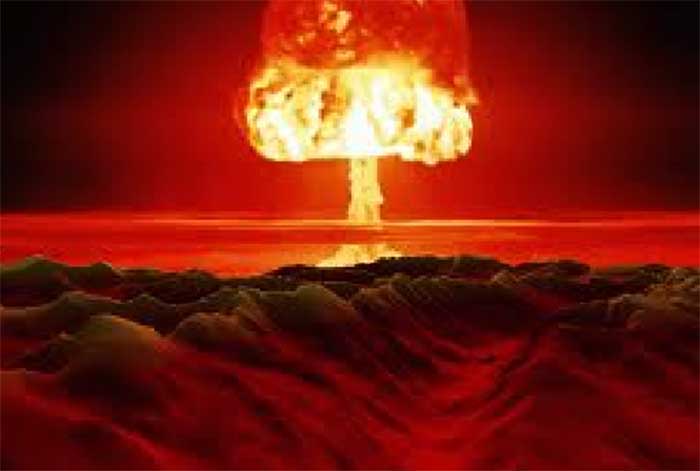
Stratfor: Kashmir may provide spark for Pakistan-India nuclear war

The specter of nuclear war haunts tensions between India and Pakistan, and the disputed territory of Kashmir could provide the spark that lights South Asia’s nuclear fuse, warns Strafor, a geopolitical intelligence think tank that provides strategic analysis and forecasting to individuals and organizations around the world.
With passions again running high in Kashmir, the stakes for the region and the world could not be higher, it said adding: “Decades ago, the people of Kashmir were promised a plebiscite that never took place. Will they ever be asked what they want?”
The Strafor report is written by Charles Glass from its Board of Contributors. The report recalled that in 1998, the CIA subjected India to strict surveillance to ensure it was complying with its commitment not to test nuclear weapons. Washington went into shock on May 11, 1998, when Indian Prime Minister Atal Bihari Vajpayee announced that his country had just detonated not one, but five nuclear warheads at Pokhran.
Pakistan responded by testing five of its nuclear bombs on May 28. Pandora’s box was wide open, threatening mass destruction to the Asian subcontinent if the Pakistani and Indian armies squared off along the Line of Control that separated their forces in the disputed region of Jammu and Kashmir.
If the CIA is watching India and Pakistan now, it will have to do better than it did in 1998, the Strafor report said adding: “In 2019, with passions high over India’s abrogation of Kashmir’s legal, if fictitious, autonomy, the outcome would not be waking up to discover one side or the other had tested weapons. It would be the sight of nuclear war taking millions of lives. Although the stakes in Kashmir could not be higher, the United States and much of the international community call the dispute India’s “internal affair” or a “bilateral” issue between India and Pakistan. It isn’t. A potential nuclear conflagration cannot be anything other than a matter of international peace and security.”
The Indian and Pakistani armed forces possess both strategic and tactical nuclear weapons, which local commanders could use on the battlefield in populated areas. This would be the first use in war of atomic weapons since the U.S. destruction of Hiroshima and Nagasaki in 1945, according to Strafor which is sometimes referred to as ‘The Shadow CIA.’
The possibility of the conflict going nuclear may have increased on Aug. 16 when Indian Defense Minister Rajnath Singh seemed to abandon India’s “no first use” doctrine when he tweeted that “India has strictly adhered to this doctrine. What happens in the future depends on the circumstances,” the Strafor report pointed out.
If the decades long armed rebellion in Kashmir grows more intense in response to India’s revocation of the region’s autonomy and its imposition of a total security lockdown, India will blame Pakistan, which in years past supported Kashmiri insurgents, Strafor said adding:
India and Pakistan came to blows last February, following an insurgent attack on Indian troops in Kashmir. The Pakistanis downed an Indian fighter jet and captured its pilot, Abhinandan Varthaman. When (Prime Minister Imran) Khan returned the Indian pilot on March 1, Modi did not acknowledge his conciliatory gesture. Nor has his government been willing to discuss Kashmir, whose people were promised a plebiscite on their future by India’s first prime minister, Jawaharlal Nehru, in 1947. The vote never took place, but several wars have.
“The question is, what do the people of Kashmir — those in the Indian-held two-thirds of the region, the Pakistani-held western third and the Hindu Kashmiris who were expelled from their homes in 1947 and are still officially displaced — want? No one is asking them, but that may be the only way to save them, and the world, from nuclear war,” Strafor report concluded.
Abdus Sattar Ghazali is the Chief Editor of the Journal of America (www.journalofamerica.net)
Thursday, August 08, 2019

Woodrow Wilson Center expert says: India’s sudden Kashmir move could backfire badly

Michael Kugelman of the Washington-based Woodrow Wilson International Center, has warned that Indian Prime Minister Narenra Modi’s sudden move in Kashmir could backfire badly.
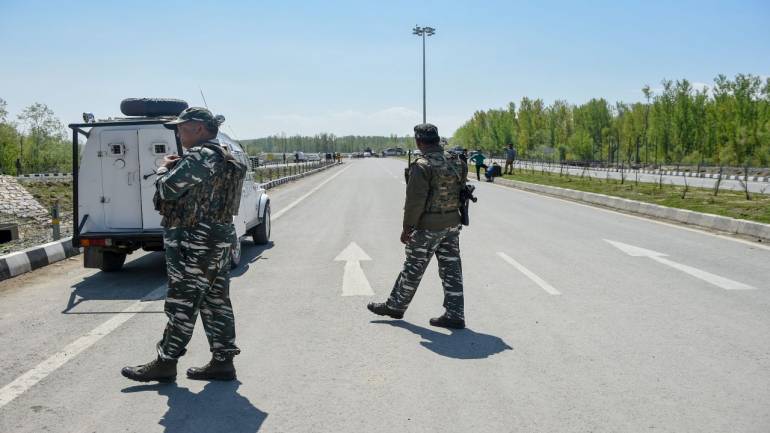
“Sure enough, on Aug. 5, India announced that it plans to revoke Article 370, a constitutional clause dating back to 1949 that gives Jammu and Kashmir its special autonomous status. The scale of this move cannot be overstated. Abrogating Article 370 represents a major tipping point for an already fraught dispute—and it could easily backfire on India,” according to Kugelam.
Writing in the Foreign Affairs, Kugelam argued that the Kashmir problem has not been solved by removing the Article 370 but “on the contrary, it’s just gotten a lot more complicated—and potentially a lot more destabilizing”.
“The repeal of Article 370 is fraught with risk. “India is unilaterally altering the territorial status of a highly disputed territory that is, per square mile, the most militarized place in the world. Something has to give, and New Delhi understands this—which is why it implemented a draconian lockdown before the announcement,” Kugelam said adding:
“For many Kashmiris, Article 370 had more symbolic than practical meaning, given that the longstanding and repressive presence of Indian security forces had undercut the notion of autonomy. Many Kashmiris face daily restrictions on their freedom of expression and movement, along with the constant risk of rough treatment from security personnel. Still, for many Kashmiri Muslims, the dominant group in Jammu and Kashmir and the victims of what they regard as an Indian occupation, the revocation of Article 370 is a nightmare scenario, because it brings them closer to an Indian state that they despise. Most of them want to be free of Indian rule.”
In Kugelam’s view it’s easy to understand New Delhi’s decision to remove Kashmir’s autonomous status.
“Two recent developments probably pushed the government to act now. The first was U.S. President Donald Trump’s offer to mediate the Kashmir dispute. The second is a rapidly progressing Afghanistan peace process, facilitated to an extent by Islamabad, which could lead to an eventual political settlement that gives the Taliban a prominent role in government. Each of these developments strengthens Pakistan’s hand. Making a dramatic move on Kashmir enables New Delhi to push back against Islamabad. It also sends a strong message to Washington about New Delhi’s utter lack of interest in external mediation.
Kugelman also cited domestic reasons for Modi’s move: “Domestic politics are also at play. A big-bang, early term move from the newly reelected BJP is sure to attract strong support from its rank and file, and such backing can blunt potential disillusionment and unhappiness down the road if the government struggles to ease India’s growing jobs crisis. Indeed, it may not be a coincidence that the party, during its previous term, stepped up its Hindu nationalist policies—another surefire way to attract support from its base—after it struggled to carry out an oft-promised economic reform agenda.”
For now, a major question is how key players will respond, Kugelman says by adding: So long as New Delhi maintains its security lockdown in Kashmir, unrest is unlikely. But if that grip is loosened, violence could ensue—suggesting that the lockdown could remain in place for an extended period. Then there is Pakistan. Islamabad’s immediate priority will be to step up its longstanding campaign to get the Kashmir issue on the global agenda and to get the world to condemn India’s policies.
There is also the risk of further social turmoil once those outside Kashmir, following the repeal of Article 370, are allowed to acquire land, Kugelam believes. “For many Kashmiri Muslims, the fear is that this influx of Indians will eventually change the demographics of the Muslim-majority region and exacerbate communal tensions between Hindus and Muslims.”
Abdus Sattar Ghazali is the Chief Editor of the Journal of America 

Sunday, July 21, 2019

The Politics of oil tankers capture

In an apparent retaliation of the capture of an Iranian oil tanker by Gibraltar, a British colony, Iran Friday (July 19) captured a British oil tanker.
Iran’s Islamic Revolution Guards Corps (IRGC) said in a statement on Friday that the vessel named “Stena Impero” had been impounded “at the request of Hormozgan Ports and Maritime Organization when passing through the Strait of Hormuz, for failing to respect international maritime rules.”
The oil tanker was transferred to the coast to undergo the required legal proceedings, the statement added.
The Northern Marine Management, which owns the Stena Impero, has said the vessel carried 23 crew members.”Northern Marine Management has not been able to establish contact directly with the vessel since it was notified of the incident at approximately 1600 Today, 19th July 2019,” it said in a statement.
An un-named Iranian official told the Iranian News Agency (IRNA) the ship had breached international maritime regulations by passing through a prohibited maritime passage in the Strait, turning off its tracking signals and ignoring warnings issued by Iranian authorities.
Iran’s Fars news agency said the Stena Impero was involved in an accident with an Iranian fishing boat and ignored its distress call.
“It got involved in an accident with an Iranian fishing boat… When the boat sent a distress call, the British-flagged ship ignored it,” the head of Ports and Maritime Organization in southern Hormozgan province, Allahmorad Afifipour, told Fars.
“The tanker is now at Iran’s Bandar Abbas port and all its 23 crew members will remain on the ship until the probe is over.”
According to Telegraph, tracking data showed the Stena Impero was in the same area that a United Arab Emirates-based vessel was detained on Sunday and where a British vessel, the British Heritage, was blocked by Iranian forces earlier this month.
Iran briefly captured another British oil tanker on Friday. Informed Iranian military sources were quoted by Press TV that the second British-owned Liberian-flagged tanker, the Mesdar, was allowed to continue its pre-scheduled course after “being briefed on the concept of innocent passage and observing environmental regulations”.
Gibraltar
The capture of British ship came two weeks after Gibraltar seized an Iranian vessel. Gibraltar
said the Iranian vessel, seized by marines in a daring landing in darkness off the coast of the British territory on July 4, was suspected of smuggling oil to Syria in breach of European Union sanctions.
Iran has repeatedly called for the ship’s release, denies the allegation that the tanker was taking oil to Syria in violation of sanctions and says Gibraltar and Britain seized the vessel on the orders of Washington.
Gibraltar denies that it was ordered to detain the vessel, which was carrying up to 2.1 million barrels of oil, but several diplomatic sources said the United States asked the United Kingdom to seize the vessel.
Reuters said the vessel is now seen as a pawn in the standoff between the Islamic Republic and the West, with its fate tangled in the diplomatic differences between the EU’s big powers and the United States.
“This tanker is important because it is part of the wider tensions between Iran and the United States,” Reuters quoted Sanam Vakil,  senior research fellow at Chatham House in London as saying.
Jeremy Hunt
Jeremy Hunt, the Foreign Secretary, said he was “extremely concerned by the seizure of two vessels by Iranian authorities in the Strait of Hormuz”.
Hunt said he was attending a Cobra meeting to determine the UK’s response and what could be done to secure their release, adding that the seizures were “unacceptable”. He said it was understood there were no British citizens among the two crews.
“We remain deeply concerned about Iran’s unacceptable actions which represent a clear challenge to international freedom of navigation,” a Government spokesman said after the meeting.
UK vessels have been advised to “stay out of the area” of the Strait of Hormuz for an “interim period”, the spokesman said, adding: “As the Foreign Secretary has said, our response will be considered and robust and there will be serious consequences if the situation is not resolved.”
Abdus Sattar Ghazali is the Chief Editor of the Journal of America (www.journalofamerica.net)
Friday, July 12, 2019

Former Israeli defense minister says: ‘Our conflict is with the Entire Muslim World’

Former Israeli defense minister Avigdor Lieberman said Monday (July 9) ‘Our conflict is with the entire Muslim world, with the entire Arab world.’
Speaking at a campaign trail meeting in Kiryat Ono, the Yisrael Beiteinu party head described the “conflict” as “three-dimensional” – “with the Arab countries, with the Palestinians and Israeli Arabs.”
“We do not have a separate conflict with the Palestinians, and anyone who claims so, does not understand what he is talking about or is being deliberately misleading,” he said.
“Our conflict is with the entire Muslim world, with the entire Arab world,” Lieberman declared.
The comments were originally carried by Zman Yisrael, the Times of Israel’s Hebrew-language sister site, “and approved for publication by Liberman though the event was billed as closed to press,” according to the Middle East Monitor.
Lieberman told the attendees that “the arrangement must be three-dimensional and simultaneous with the Arab League, with Israeli Arabs and with the Palestinians”, adding: “Any attempt to reach a separate agreement with the Palestinians or the Arabs of Israel will fail.”
As noted by the report, Lieberman has long called for a permanent settlement to include redrawing Israel’s pre-1967 boundaries so as to remove major population centres of Palestinian citizens.
The former minister also routinely attacks the “loyalty” of Palestinian citizens of Israel. On Monday, Lieberman “lashed out” at Palestinian parliamentarians, saying it was “total madness” that Israel “tolerated elected representatives in the Knesset who sided with its enemies”.
Religion cannot be separated from state in Israel
Earlier this month, Avigdor Lieberman said that it was impossible to separate religion from the state in Israel.
On July 2, speaking at the Herzliya Conference, Lieberman said: “When we talk about relations between religion and state, I say that religion must be separated from politics in the State of Israel. However, it is impossible to separate religion from the state.”
In May, Lieberman opposed joining a government headed by Israel’s Prime Minister Benjamin Netanyahu with the ultra-Orthodox parties, which he called a “[Jewish law] government”, Israel’s Haaretz newspaper reported.
Lieberman and the ultra-Orthodox parties have been in a dispute over the military conscription bill which would force ultra-Orthodox men studying the Torah, who are currently exempt from service, to join the military.
Lieberman has criticized the pre-military preparatory programs of the religious community, saying “they are developing into private religious militias”.
Lieberman called to separate the pre-military academies from the Ministry of Education and put them under the full supervision of the defense ministry.
Who is Lieberman?
Lieberman is a Soviet-born Israeli politician who served as the Defense Minister of Israel; on  November 14, 2018 Lieberman announced he was handing in his resignation due to a ceasefire versus Gaza which Lieberman said was “surrendering to terror.”
He served as Israel’s Minister of Foreign Affairs from 2009 to 2012, and again from 2013 to 2015. He has also served as member of the Knesset and as Deputy Prime Minister of Israel.
He is the founder and leader of the secular-nationalist Yisrael Beiteinu party, whose electoral base are overwhelmingly Russian-speaking immigrants from the former Soviet Union. As a result of the arrival in Israel during the 1990s of more than one million Russian-speaking immigrants, Yisrael Beiteinu has regularly played the “king-maker” role in Israel’s coalition governments. [Wikipedia]
Abdus Sattar Ghazali is the Chief Editor of the Journal of America (www.journalofamerica.net) 

Saturday, July 06, 2019

3,185 extrajudicial killings in Egypt since 2013 by the US-Client El-Sisi’s regime

The Arab Organization for Human Rights (AOHR) said Tuesday (July 3) as many as 3,185 civilians have been extra-judicially killed by Egyptian security forces since July 3, 2013 when the US-client General Abdel Fattah El-Sisi overthrew the government of President Mohammad Morsi who was the first democratically elected President of Egypt.
Abdel Fattah El-Sisi has now assumed the title of Field Marshall and became permanent president of Egypt since Egypt’s rubber-stamp parliament has overwhelmingly voted to approve constitutional changes to extend his term of office by another 12 years.
The Human Rights organization has issued its report on the 6th anniversary on the July 3, 2013 coup against President Mohammad Mosri who collapsed and died last month in Egypt’s Kangaroo court.
The organization has documented a series of atrocities it says amount to crimes against humanity under the Rome Statute including systematic torture, enforced disappearance and genocide.
The AOHR has monitored extensive attempts at eliminating Egypt’s opposition, including members of the Muslim Brotherhood, activists, political opponents, journalists and intellectuals by forcibly disappearing them, incarcerating them in dire prison conditions and torturing them.
In a report the AOHR explained the extra-judicial killings. The victims included 2,194 people who were killed during the Egyptian security forces’ attacks on peaceful gatherings, most notably the dispersal of two sit-ins in the Rabaa and Al-Nahda squares on 14 August 2013. The victims included 766 people who had died in detention centers, including 122 people who died as a result of torture.
According to the AOHR report 516 people died as a result of medical negligence, 37 due to overcrowding and poor conditions in detention and 91 people due to corruption of the detention facilities’ administrations.
“In the six years since July 3, 2013, in Egypt, the human rights situation has been continually declining in an unprecedented manner. Security forces have practiced all forms of violations under the climate of complete impunity,” the London-based AOHR said in its report titled “Six Years of Impunity”.
Some 144 people have been executed since US-client Field Marshall President Abdul Fatah el-Sisi seized power overthrowing the elected President Mohammad Morsi in July 2013, the Times reported on May 6, 2019.
More than 2,440 people have been sentenced to death in Egypt since President Sisi began a crackdown on opposition after coming to power six years ago, according to new figures released by UK-based human rights group Reprieve.
According the AOHR, 83 people are currently on death row.
The AOHR report said that on June 17, 2019, the death of former President Mohamed Morsi was announced after he fell unconscious during a court session of his trial, but several questions were raised about Morsi’s sudden death in court.
Was his death due to medical negligence? Indeed, over the six years of his detention, the regime deliberately refused to provide him with necessary treatment for the several chronic diseases he suffered with. Or was he killed by some kind of poisoning?
Morsi had mentioned in one of his trial sessions that he was exposed to threats that may affect his life. Despite these questions, Egyptian authorities forced his family to bury him hastily without allowing the family to request a medical autopsy.
The AOHR emphasized that over the past six years, the Egyptian regime has used extensive arbitrary arrests to suppress opposition and to abolish any potential for freedoms of opinion and expression. According to quantitative monitoring of arbitrary arrests in Egypt, there is an estimated figure of 63,032 people who have been arbitrarily detained since July 3, including 691 women and 1,161 minors.
Most detainees were subjected to enforced disappearance for varying periods of time. According to complaints received by AOHR, the families of those forcibly disappeared sent many telegrams and communications to the Attorney General and the Minister of Interior demanding that the fate of their relatives be revealed, but the Public Prosecution, in its capacity as the entity responsible for initiating criminal proceedings, refrained from opening any investigation into any such communications.
The AOHR asserted that in order to blur the truth, the Egyptian regime targeted journalists and various media outlets continuously since July 3, 2013, closing down more than 20 media channels and newspapers, and prohibiting many journalists and writers from  writing and publishing.
A number of journalists were also deported. The Journalists Syndicate was broken into and two journalists who had taken refuge in it were kidnapped, and the Chairman of the Syndicate had fabricated charges imposed against him.
Over the course of the six years, 11 journalists were killed and more than 250 were arrested, of whom 29 journalists remain in detention. Furthermore, more than 45 journalists have been placed on the terrorism lists, and the Egyptian regime has blocked 535 news websites and newspapers.
The AOHR monitored the hearings of the trials of detainees held in cases related to opposing the authorities since July 3, 2013 until now. Sentences were handed down in 2,638 politically-affiliated cases related to opposition of the regime. Verdicts were handed down in civil and military courts, with 2,368 verdicts in civil cases and 270 verdicts in military cases.
The AOHR also reported that the number of civilians killed since July 3, 2013, in Sinai is 4,441, of whom 4,093 were those the army said were killed as a result of security confrontations, and the rest the Egyptian army admitted were killed indiscriminately.
In Sinai, the number of houses that were burned and destroyed during the period of this report was 262 houses, and the number of huts burned and destroyed was 2,914, in addition to the destruction of 355 farms and 279 acres of land.
The AOHR pointed out that the aforementioned houses and huts that were burned and destroyed were outside the Gaza border strip which the Egyptian government ordered its evacuation, displacing the residents from their homes and demolishing them, in preparation for establishing a buffer zone on the border with Gaza.
The AOHR stressed the need to take serious and decisive position against the Egyptian regime, which is not subject to any domestic or international monitoring. The state of impunity the regime has been enjoying has reinforced its will to move forward with further crimes and violations.
The AOHR called on the UN Secretary-General to activate the necessary international mechanisms to restrain the Egyptian regime, stand by the victims, and hold accountable all those responsible for the crimes committed. “Six years of repression, killing and detention have passed across all Egyptian lands, and the victims are still waiting for equity and justice.”
Abdus Sattar Ghazali is the Chief Editor of the Journal of America (www.journalofamerica.net)
Tuesday, May 28, 2019

From BRI to Clash of Civilization: Beijing conference refutes Huntington

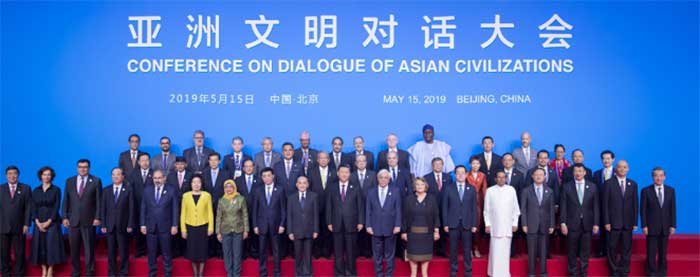
China hosted a two-day Conference on Dialogue of Asian Civilizations (CDAC), to boost exchanges and mutual learning among Asian civilizations. The CDAC theme was “Exchanges and Mutual Learning among Asian Civilizations and A Community with A Shared Future.”
It brought together more than 2,000 government officials and representatives of various circles from 47 Asian countries and other nations outside the region.
Among those attending were: King of Cambodia Norodom Sihamoni, Greek President Prokopis Pavlopoulos, Singapore President Halimah Yacob, Sri Lankan President Maithripala Sirisena and Armenian Prime Minister Nikol Pashinyan.
In his inaugural address, the President of China, Xi Jinping, underlined that this Conference  “creates a new platform for civilizations in Asia and beyond to engage in dialogue and exchanges on an equal footing to facilitate mutual learning”.
President Xi highlighted the importance of the interactions in Asia, as these interactions between civilizations “have enriched each other and written an epic development”. He elaborated also:
“Our forefathers in Asia have long engaged in inter-civilizational exchanges and mutual learning; the ancient trade routes notably the Silk Road, the tea road and the spice road brought silk, tea, porcelain, spices, paintings and sculpture to all corners of Asia, and they have witnessed inter-civilizational dialogue in the form of trade and cultural interflow.”
“No civilization is superior over others. The thought that one’s own race and civilization are superior and the inclination to remold or replace other civilizations are just stupid,” the Chinese leader said adding:
“All civilizations are rooted in their unique cultural environment. Each embodies the wisdom and vision of a country or nation, and each is valuable for being uniquely its own. Civilizations only vary from each other, just as human beings are different only in terms of skin color and the language used. No civilization is superior over others. The thought that one’s own race and civilization are superior and the inclination to remold or replace other civilizations are just stupid. To act them out will only bring catastrophic consequences…. What we need is to respect each other as equals and say no to hubris and prejudice.”
Pehaps Xi was alluding to Huntington’s theory of Clash of Civilizations. In 1992, American political scientist Samuel P. Huntington proposed the hypothesis of the Clash of Civilizations that people’s cultural and religious identities will be the primary source of conflict in the post-Cold War world. Huntington later expanded his thesis in a 1996 book The Clash of Civilizations and the Remaking of World Order.
Huntington argued: “It is my hypothesis that the fundamental source of conflict in this new world will not be primarily ideological or primarily economic. The great divisions among humankind and the dominating source of conflict will be cultural. Nation states will remain the most powerful actors in world affairs, but the principal conflicts of global politics will occur between nations and groups of different civilizations. The clash of civilizations will dominate global politics. The fault lines between civilizations will be the battle lines of the future.”
In short, Huntington suggests that in the future the central axis of world politics tends to be the conflict between Western and non-Western civilizations. Huntington divided the world into the “major civilizations” in his thesis as such:
Western civilization comprising the United States and Canada, Western and Central Europe, Australia and Oceania; Latin American, Includes Central America, South America; The Orthodox world of the former Soviet Union; The Eastern world is the mix of the Buddhist, Chinese, Hindu, and Japonic civilizations; The Muslim world of the Greater Middle East, (the Islamic civilization) and The civilization of Sub-Saharan Africa located in southern Africa, Middle Africa.
Huntington’s hypothesis was criticized by various academic writers. They challenged his claims empirically, historically, logically, or ideologically.
Edward Said
Edward Said, the late University Professor of English and Comparative Literature at Columbia University,  issued a response to Huntington’s thesis in his 2001 article, “The Clash of Ignorance”. Said argues that Huntington’s categorization of the world’s fixed “civilizations” omits the dynamic interdependency and interaction of culture. Edward Said (2004) also argues that the clash of civilizations thesis is an example of “the purest invidious racism, a sort of parody of Hitlerian science directed today against Arabs and Muslims” (p. 293).
According to Edward Said “Huntington is an ideologist, someone who wants to make “civilizations” and “identities” into what they are not: shut-down, sealed-off entities that have been purged of the myriad currents and countercurrents that animate human history, and that over centuries have made it possible for that history not only to contain wars of religion and imperial conquest but also to be one of exchange, cross-fertilization and sharing.
“This far less visible history is ignored in the rush to highlight the ludicrously compressed and constricted warfare that “the clash of civilizations” argues is the reality. When he published his book by the same title in 1996, Huntington tried to give his argument a little more subtlety and many, many more footnotes; all he did, however, was confuse himself and demonstrate what a clumsy writer and inelegant thinker he was.
“These are tense times, but it is better to think in terms of powerful and powerless communities, the secular politics of reason and ignorance, and universal principles of justice and injustice, than to wander off in search of vast abstractions that may give momentary satisfaction but little self-knowledge or informed analysis. “The Clash of Civilizations” thesis is a gimmick like “The War of the Worlds,” better for reinforcing defensive self-pride than for critical understanding of the bewildering interdependence of our time.”
Noam Chomsky
Noam Chomsky called it just being a new justification for the United States “for any atrocities that they wanted to carry out”, which was required after the Cold War as the Soviet Union was no longer a viable threat.
“We have to support oppressive states, like Saudi Arabia and others, to make sure that they guarantee that the profits from oil (it’s not so much the oil as the profits from oil) flow to the people who deserve it: rich western energy corporations or the US Treasury Department or Bechtel Construction, and so on. So that’s why we need a huge military budget. Other than that, the story is the same,” Chomsky said in a lecture delivered at the Delhi School of Economics on November 5, 2001.
He went on to say: “What does this have to do with Huntington? Well, he’s a respected intellectual. He can’t say this. He can’t say, look, the method by which the rich run the world is exactly the same as before, and the major confrontation remains what it has always been: small concentrated sectors of wealth and power versus everybody else. You can’t say that. And in fact if you look at those passages on the clash of civilizations, he says that in the future the conflict will not be on economic grounds. So let’s put that out of our minds. You can’t think about rich powers and corporations exploiting people, that can’t be the conflict. It’s got to be something else. So it will be the ‘clash of civilizations’ – the western civilization and Islam and Confucianism.”
Jochen Hipplier
Jochen Hipplier, author of The Next Threat: Western Perception of Islam, has said: By caricaturing different cultures, by arbitrarily and willfully misrepresenting Islamic societies we grant ourselves absolution. Others are fanatical, we are not. Other are irrational, we are not.  Furthermore, it is clearly very important for us in the West to feel superior and to see Western culture as the ‘best’ and ‘most progressive.
The term civilization is usually used in the singular to mean Western civilization which since the eighteenth century has been in the West as the civilization that has set about to destroy and obliterate systematically all other civilizations including the Islamic.
To borrow from Hippler: In a certain sense you could call Huntington’s argument ‘culturally racist’. The Muslims (or Chinese) are different from us and therefore dangerous. Unlike in classic racism, this difference is not generically but culturally-based. There is such a gulf between their values and ways of thinking and ours that understanding or cross-pollination is almost unthinkable. Only military solutions can promise result.
Hippler further elaborates this point very convincingly: Huntington’s image of Islam (or of other Asian cultures) is hardly original. It follows the current stereotypes and clichés of popular literature and some of the media. Yet he manages brilliantly to embellish these repeated fears pseudo-scientifically and elevate them ideologically. His success is in making the old clichés acceptable in foreign policy debate. For Huntington, Islam is ideologically hostile and anti-Western. It is also a military threat in itself due to Chinese (Confucian) arms supplies. Islam is bloody, with a long warring tradition against the West. (The fact that Muslims have often been the victims rather than the perpetrators of violence from Bosnia to India hardly troubles him.)
According to Stephen M. Walt, The Clash of Civilizations is also strangely silent about Israel, which has been a central concern for U.S. foreign policy since its founding in 1948. During the Cold War, U.S. support for Israel could be justified on both ideological and strategic grounds. From a cultural perspective, however, the basis for close ties between Israel and the “West” is unclear. Israel is not a member of the West (at least not by Huntington’s criteria) and is probably becoming less “Western” as religious fundamentalism becomes more salient and as the Sephardic population becomes more influential. His silence on this issue may reflect an awareness that making this conclusion explicit would not enhance the appeal of the book, or Israel may simply be an anomaly that lies outside of his framework. In either case, however, the issue reveals a further limitation of the civilizational paradigm. [Building Up New Bogeyman by Stephen M. Walt- Foreign Policy, Spring 1997]
Abdus Sattar Ghazali is the Chief Editor of the Journal of America (www.journalofamerica.net) 

Tuesday, April 09, 2019

Trump declares Iranian Revolutionary Guards a terrorist group at Netanyahu’s request

Israeli Prime Minister Benjamin Netanyahu, facing a hotly contested bid for a fourth term, tweeted Monday (April8) that the Trump administration designated Iran’s Islamic Revolutionary Guard Corps as a foreign terrorist organization at his request, Los Angeles Times reported from Jerusalem.
“Thank you, my dear friend, the president of the United States, Donald Trump, for having decided to designate Iran’s Revolutionary Guards as a terrorist organization,” he wrote in Hebrew on Twitter on Monday. “Thank you for responding to another of my important requests, which serves the interests of our countries and countries of the region.”
The Los Angeles Times said Netanyahu English-language thank you note posted later omitted taking credit, but said of Trump, “Once again you are keeping the world safe from Iran aggression and terrorism.”
President Donald Trump said in a statement that the “unprecedented” move “recognizes the reality that Iran is not only a State Sponsor of Terrorism, but that the IRGC actively participates in, finances, and promotes terrorism as a tool of statecraft.”
“The IRGC is the Iranian government’s primary means of directing and implementing its global terrorist campaign,” Trump said.
It is the first time the United States has designated part of a foreign government a terrorist organization, rather than guerrilla groups or other more informal entities, according to AFP.
The Trump administration argues that Iran’s government, which is locked in a deeply hostile standoff with top US ally Israel, cannot be trusted and should face “maximum pressure.”
Addressing reporters following Trump’s announcement, Secretary of State Mike Pompeo warned all banks and business of consequences to dealing with the Revolutionary Guards from now on.
“The leaders of Iran are racketeers, not revolutionaries,” Pompeo said. “Businesses and banks around the world now have a clear duty to ensure that companies with which they conduct financial transactions are not conducted with the IRGC in any material way.”
A senior Trump administration official was quoted by AFP as saying that the new measure would criminalize contact with the Guards and “enable our prosecutors to bring charges to those that bring material support to the IRGC.”
“The IRGC is interwoven into the Iranian economy.… The safest course is to stop doing business with the IRGC. If you do business with the IRGC you run the risk of bankrolling terrorism,” said the official.
Another official said the force has “been a principal driver of violence on a vast scale for many decades” in an attempt “to reshape the Middle East in Iran’s favor.”
Los Angeles Times said U.S. military and intelligence officials have raised concerns that the designation may bar them from meeting foreign officials in contact with Revolutionary Guard personnel. Those concerns are one reason previous administrations did not make the move, which was considered for more than a decade.
But administration officials said Monday that exceptions would be made for U.S. personnel as needed. U.S. diplomats talk with the Taliban in Afghanistan, another group listed as a foreign terrorist organization, noted Nathan Sales, the State Department’s coordinator for counter-terrorism.
Some military experts warned the decision could endanger U.S. troops, one reason for long-standing concerns at the Pentagon, the LAT said.
In response to Washington’s decision, the Iranian Supreme Security Council declared the US a “terrorist government” while calling the US CENTCOM a terrorist group as well.
Following what it called an “unlawful and unreasonable action” of the US, Tehran officially declared the US “a terrorist government and the US Central Command known as CENTCOM as well as all its affiliates a terrorist group,” a statement of the Islamic Republic’s Supreme National Security Council headed by President Hassan Rouhani said.
The statement blamed CENTCOM for harming Iran’s national security as well as ruining the lives of “innocent Iranian and non-Iranian individuals” to promote the US’ “aggressive policies” in Western Asia.
It also specifically mentioned that the US is “involved” in the killing of people in Yemen, where a Saudi-led coalition wages a brutal military campaign against the Shia Houthi rebels.
The US and its allies “have always been advocates of extremist groups and terrorists in the Western Asian region,” the council said, adding that Washington has to take responsibility for “the dangerous consequences of its adventures.”
In a tweet, Zarif, the Iranian foreign minister, called it a “misguided election-eve gift to Netanyahu. A(nother) dangerous U.S. misadventure in the region.”
Mohammad Ali Jafari, commander of the guard, warned that “the American army in West Asia will see the end of tranquility,” according to the Iranian Fars news agency.
Abdus Sattar Ghazali is the Chief Editor of the Journal of America (www.journalofamerica.net)