
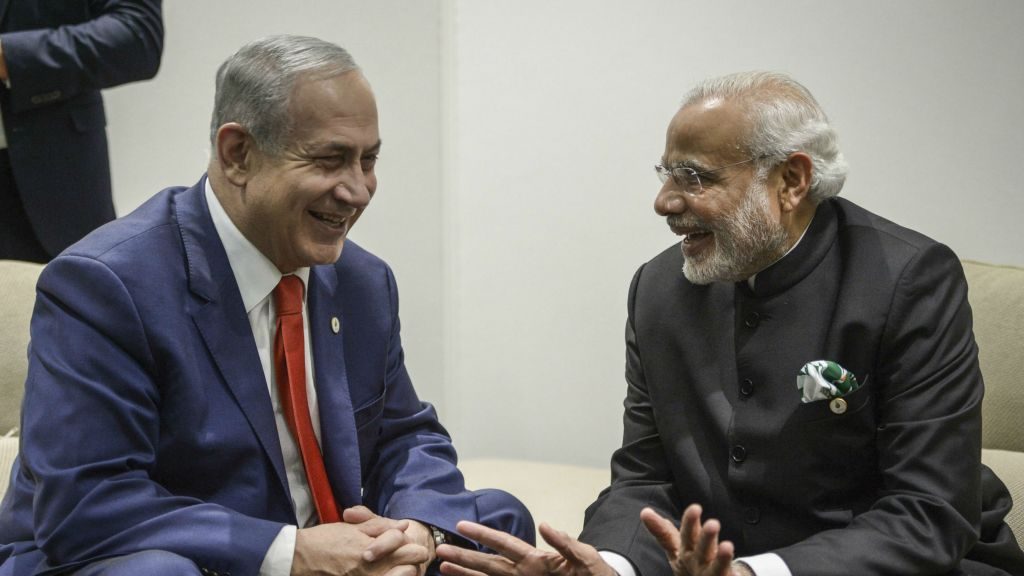
Israeli Prime Minister Benjamin Netanyahu on Tuesday (Sept 3) cancelled a planned visit to India on September 9 to meet his counterpart Narendra Modi who last month annexed the disputed territory of Kashmir.
This is the second time this year that Netanyahu on has cancelled a planned visit to India, doing so earlier before the April elections.
Netanyahu’s planned visit was widely seen in Israel as an effort by him to project his acceptance worldwide and prop up his campaign just days before the September 17 repeat polls, according to the Press Trust of India.
Netanyahu, who created history on July 20 by becoming the longest serving Israeli Prime Minister, surpassing Israel’s first premier David Ben-Gurion, is facing a tough political challenge as opinion polls show flagging fortunes for his ruling Likud party.
Israeli lawmakers in May voted 74-45 in favor of dissolving the 21st Knesset (Parliament) and hold an unprecedented re-elections on September 17 after Netanyahu failed to form a coalition government after the April 9 polls.
Netanyahu visited India in January 2018, while Modi travelled to Tel Aviv in 2017, becoming the first Indian prime minister to tour the Jewish state.
Over the past two years, Netanyahu and Modi have hailed “a new era of friendship between the nations,” with mutual high-profile visits and several bilateral agreements signed in the fields of oil, gas, renewable energy and cyber cooperation. In his January 2018 visit to India, Netanyahu called Modi a “revolutionary leader,” who had transformed the relationship between the two nations.
According to media reports, Israel wishes to sell India several advanced weapons manufactured by the country’s defense industries, such as spy planes, unmanned aircraft, anti-tank missiles, cannons and radar systems.
In January, National Security Adviser Meir Ben Shabbat travelled with several members of the council to India, where he met with his Indian counterpart and with Modi. In those meetings, Ben Shabbat discussed different weapon deals between the two countries.
“By revoking autonomy from Kashmir, Indian Prime Minister Narendra Modi is taking a page straight out of the Israeli playbook.” This is the tile of Abdulla Moaswes’s article published by +972 Magazine where he provides a graphic scenario of the Indo-Israeli collaboration to implement Hindutva, or extreme Hindu Nationalism policies adopted by Rashtriya Swayamsevak Sangh (RSS) backed the Bharatiya Janata Party (BJP). Abdulla Moaswes writes:
“Relations between India and Israel grew even closer with the rise of the Bharatiya Janata Party in the 1990s. The BJP, which today is led by Modi, adheres to the political ideology known as Hindutva, or Hindu Nationalism. The history of Hindu nationalists’ affinity with Zionism is well documented by professor Sumantra Bose of the London School of Economics, who traces it back to the 1920s when Vinayak Damodar Savarkar, the father of Hindutva, supported the creation of a Jewish state in Palestine. The BJP and other Hindu Nationalists have since become obsessed with replicating the Zionist project in turning a constitutionally secular India into a Hindu ethnocratic state.
“Many of the BJP’s aspirations and policy proposals for Kashmir are imitations of extant Israeli practices in Palestine. Key among these is the desire to build Israeli-style Hindu-only settlements in Kashmir as a way of instigating demographic change. For example, the Rashtriya Swayamsevak Sangh (RSS), a non-state volunteer Hindu paramilitary volunteer group to which the BJP are affiliated, have long desired the repeal of the state subject laws that have maintained the demographic make-up of Kashmir.
“These changes are clearly inspired by the Israeli settlement model, as expressed by BJP lawmaker Ravinder Raina, who, in 2015, stated that the government of India will use its army to protect Hindu-only settlements in Jammu and Kashmir. This type of securitization and protection would entail an expansion of the security apparatus that already restricts the flow of life for most Kashmiris, using them as a pretext to justify a new level of domination and intrusiveness.
“Aside from the parallels in policy objectives, the discourse used by supporters of the current regime in India resemble old Israeli refrains. Both Israel and India claim to be exceptional democracies, despite their treatment of large swaths of populations under their control. Additionally, both Zionists and Hindu Nationalists argue that the existence of many Muslim countries in the world necessitates a Jewish and Hindu state, respectively. This perpetuates the lie that Palestinians and Indian Muslims can supposedly live elsewhere, yet choose to live in Palestine and India only to antagonize Jews and Hindus.
“Meanwhile, the variety of tactics used by India to control the civilian population of Kashmir strongly resembles t hose used by Israel in Palestine. These include, “arbitrary arrests, extra-judicial killings, enforced disappearances, curfews, collective punishment, administrative detention, torture, rape and sexual abuse, the suppression of freedom of speech and assembly, house demolitions, and so forth.”
“The revocation of Articles 35A and 370 paves the way for Indian presence in Kashmir to further mirror Zionist presence in historic Palestine, since this allows the Indian state to rule Kashmir directly without the need for Kashmir’s state legislature, which was also recently abolished. Furthermore, it facilitates the execution of plans to alter the demographic make-up of Kashmir by allowing Indians from across the country to purchase property and settle there under the protection of the Indian military presence, just as the demographic make-up of the West Bank continues to be altered with the construction of Jewish-only settlements.
“With the unprecedented change of Jammu and Kashmir’s legal status from a special status state to a union territory without a legislative assembly, India’s colonial domination over the contested region will only become more overtly coercive in representing Indian interests. This is a crucial development to be observed closely by Palestinians who live in areas where the Israeli occupation is currently facilitated by the Palestinian Authority.
“As things move forward, it is increasingly clear that the colonial processes in Kashmir and Palestine will become further interdependent on one another. What Israel does in Palestine is likely to happen in Kashmir, and what India does in Kashmir is likely to happen in Palestine. In aiming to dismantle Israeli apartheid and settler colonialism, it is essential to observe its global consequences, for it is highly likely that these interdependent processes will require a multilateral confrontation.”
“Although the Indian presence in Kashmir never amounted to settler colonialism like in the Palestinian case, where a large proportion of the existing population of the region was expelled and replaced by a settler population, India has maintained a heavy military presence in the area and has acted as a police state vis-à-vis Kashmiri civilians and politicians,” argued Abdulla Moaswes, a graduate of the School of Oriental and African Studies (SOAS) and the University of Exeter.
Abdus Sattar Ghazali is the Chief Editor of the Journal of America (www.journalofamerica.net)


![Kashmiri villagers walk past the debris of a house which was damaged by Indian forces in Kashmir on 5 March 2019 [Faisal Khan/Anadolu Agency]](https://i2.wp.com/www.middleeastmonitor.com/wp-content/uploads/2019/03/2019_3-5-Indian-forces-in-Kashmir20190305_2_35266908_42285003.jpg?resize=933.5%2C622&quality=75&strip=all&ssl=1)