Showing posts with label Avigdor Lieberman. Show all posts

Friday, November 01, 2019

70 years of shooting refugees

Jake Batinga
Despite Israel’s brutality, Palestinians have insisted for seven decades that the right of refugees to return home be upheld. 
Ashraf AmraAPA images
Since March 2018, weekly protests – known as the Great March of Return – have been held in Gaza.
The demonstrators are insisting that people uprooted by Zionist forces during the Nakba – the 1948 ethnic cleansing of Palestine – be allowed to go home. This right of return has been recognized by United Nations General Assembly resolution 194, passed in December 1948.
Israel has responded brutally to demands that this basic right be upheld. More than 210 Palestinians have been killed during the Great March of Return and more than 9,000 have been injured by live fire.
As well as insisting that the right to return be respected, Palestinian refugees have occasionally attempted to exercise that right over the past seven decades. In doing so, they have been treated with extreme violence.
In the years following the adoption of UN resolution 194, large numbers of people living in Gaza tried to cross the boundary with Israel, a newly established state. In an Orwellian turn of phrase, the Israeli authorities designated these returning refugees as “infiltrators.”
In his book Israel’s Border Wars, the historian Benny Morris writes that the so-called infiltration was “a direct consequence of the dispossession of hundreds of thousands of Palestinians.”
Refugees sought to reunite with family, tend crops, recover lost possessions and, of course, see their old homes.

Firing “at anything that moved”

Israel’s Border Wars was published in 1997 – seven years before Morris argued that Zionist forces should have expelled all Palestinians in the 1940s. Despite his attempts to defend ethnic cleansing, Morris has never repudiated the important facts he had previously unearthed.
And we can continue to learn a considerable amount from his work about crimes committed in the name of Israel and its state ideology Zionism.
He recounts, for example, how Israel operated a “free fire” policy on refugees seeking to return home. According to Morris, Israeli forces “fired at anything that moved” and often executed injured refugees “on the spot.”
Between 2,700 and 5,000 refugees were killed under the free fire policy, the vast majority of whom were unarmed civilians, from 1949 to 1956. Furthermore, “no Israeli soldier, policeman, or civilian was ever tried for shooting and killing an unarmed Arab infiltrator,” Morris writes.
While Palestinian refugees were slaughtered for attempting to exercise their right of return, Israel’s parliament, the Knesset, passed the cynically titled “Law of Return” in 1950. It granted Jews from around the world the right to gain Israeli citizenship and live in Israel.
Immigrants to Israel, many of whom were Holocaust survivors, often settled in the vacant homes of Palestinian refugees.
Another policy implemented against Palestinian refugees seeking to go home was known as “retaliation.”
Israel “retaliated” by raiding villages in Jordan, Egypt, Gaza, and Syria. These raids were meant to punish communities that had allegedly helped returning refugees.
In his book The Iron Wall, the historian Avi Shlaim writes that the reprisals were effectively “a form of collective punishment against whole villages.”
One notable case of “retaliation” occurred during October 1953 in the Jordanian village of Qibya.
According to Shlaim’s book, Israeli commandos raided Qibya, forced the residents to stay in their homes, then blew up the houses with everyone still inside. At least 69 people were killed, most of them women and children.
The leader of this raid was a young commander named Ariel Sharon, who would later be dubbed the “butcher of Beirut” for his role in the 1982 mass slaughter at Sabra and Shatila, Palestinian refugee camps in Lebanon.

Shifting the blame

Israel has consistently sought to shift the blame for its own violence.
In the 1950s, the Israeli government blamed Arab governments and Palestinian refugees themselves. According to Shlaim, Israel claimed that the killing of civilians was a “legitimate form of self-defense.”
Identical – or almost identical – words are used by Israel’s political leaders today.
Benjamin Netanyahu, Israel’s prime minister, has invoked “self-defense” to try and justify the killing of unarmed protesters in Gaza. After one Israeli massacre in Gaza last year, Netanyahu claimed the state was acting “to protect its sovereignty and the security of its citizens.”
When a video was broadcast which showed Israeli troops gleefully cheering and laughing as a sniper shoots a protester, Israeli politicians rushed to defend the troops.
Avigdor Lieberman, then Israel’s defense minister, stated that the sniper in the video “deserves a commendation.” Naftali Bennett, also a government minister at the time, said that “judging soldiers because they are not expressing themselves elegantly while they are defending our borders is not serious.”
Today, the Israeli government smears Gaza protesters as “terrorists.” Benny Morris has noted how “infiltrator” – the term applied to Palestinian refugees seeking to go home – quickly became synonymous with “terrorist.”
And just as the Israeli authorities tried to evade responsibility for its attacks on Arab neighbors in the 1950s, today’s politicians try to blame Hamas for the deaths of protesters in Gaza.
Lieberman has alleged that “no innocent civilians” have taken part in Gaza’s protests, which he has nicknamed the “march of terror.” All the protesters, according to Lieberman, have been Hamas members.
Another pattern can be discerned. Palestinians fought for their rights in the years immediately following the Nakba, as they are doing in the 21st century.
Israeli brutality continues – and so does the struggle against it.
Jake Batinga is a California-based writer and activist. He lived in the occupied West Bank city of Hebron, while working with the International Solidarity Movement, documenting human rights abuses by the Israeli army and settlers.

Saturday, September 28, 2019

Netanyahu or Gantz: The tragic dilemma facing Israel's Palestinian citizens

Orly Noy

The Joint List's recommendation of Gantz as prime minister dramatically alters the traditional political stance of Arabs in Israel


Members of the Joint List party sit next to Israeli President Reuven Rivlin as he began cross-party talks on 22 September over who should form a new government (Reuters)
Many people were hoping that the mid-September election in Israel would resolve the political mess that followed the previous election in April when neither of the two leading candidates for prime minister - Benny Gantz of the Blue and White alliance and Benjamin Netanyahu of Likud - garnered enough votes to form a government.
But that hope was quickly dashed within a few days when the votes were counted. The political blocs headed by both candidates fell short of securing the 61 seats required for a parliamentary majority.

Chaotic landscape 

On the right, the bloc headed by Netanyahu won 55 seats. It included Likud, Shas and the ultra-Orthodox Torah Judaism party as well as the far-right Yamina party headed by Ayelet Shaked. The centre-left bloc, headed by Benny Gantz, which includes Blue and White, the Joint List, Labor and the Democratic Union, secured 57 seats.
The degree of chaos in the Israeli political landscape today is indicated by the status of Yisrael Beiteinu, headed by Avigdor Lieberman, who has proposed among other things the “transfer” of Arab citizens out of Israel entirely. Lieberman is one of the most extreme far-right politicians the country has ever seen.
The degree of chaos in the Israeli political landscape today is indicated by the status of Yisrael Beiteinu, headed by Avigdor Lieberman
Yisrael Beiteinu won eight seats but has joined neither the rightist bloc nor the centre-left bloc. Thus far Lieberman has refused to express support for either Gantz or Netanyahu, and is calling for a national unity government with the two major parties, Likud and Blue and White.
In the absence of a clear majority for either of them, both Gantz and Netanyahu have begun their quest to round up the required minimum of 61 Knesset seats to form a government. The first stop is the office of the Israeli president, where the heads of all political parties represented in the next Knesset must come to recommend their preferred candidate for the prime minister position.
Following those discussions, the president in turn recommends which of the candidates he believes has the best prospects to succeed in forming a government and formally tasks him with the job. If, within the legally mandated time period, that candidate fails to muster 61 seats, his rival is given an opportunity to assemble his own coalition. 

The highest priority

The decision as to which of the two candidates - Gantz or Netanyahu - to recommend to the president, or whether even to make a recommendation at all, has posed the first major challenge to the (mostly Arab) Joint List since it reassembled itself on the eve of the election.
The Arab parties have historically refrained from recommending Jewish candidates for prime minister, from either the right or the left
On the one hand, the Arab parties have historically refrained from recommending Jewish candidates for prime minister, from either the right or the left, because all of them lead Zionist parties that seek to preserve Jewish supremacy in Israel.
On the other hand, this latest electoral victory was - to a great extent - a referendum on the question of Netanyahu’s continued leadership, the end of which is sought more eagerly by Arab citizens in Israel than by any other constituency. And given Netanyahu’s increasingly unbridled incitement against Arab citizens over the course of his tenure in office, the yearning to put an end to his rule became the highest political priority. 

Dethroning Netanyahu

This dilemma sparked some trenchant discussion among the four parties comprising the Joint List, each with its own distinct political ideology. Ultimately (five days after the election, on 22 September), the Joint List recommended to the president that Gantz be named to form a government.
But the move was made with a heavy heart, based on the overriding need to do whatever was necessary to dethrone Netanyahu.
The Joint List's recommendation of Gantz as prime minister was made with a heavy heart, based on the overriding need to do whatever was necessary to dethrone Netanyahu
Balad, the Palestinian National Democratic party, remained opposed because of Gantz's bloody military record of Gantz when he served as Israeli army Chief of Staff between 2011 and 2015, and because of the likelihood that ultimately he will opt for a unity government that includes Likud and the far-right Lieberman. 
The decision by the Joint List was termed “historic” and duly applauded by many on the Jewish left in Israel. Bear in mind, however, that no such truly “democratic” celebration is possible in Israel, nor is there cause for such rejoicing.
The decision proves only one thing: The depth of the tragedy of Palestinian citizens of Israel, whose default choice was the man whose election campaign included boasting of having "returned Gaza to the Stone Age" during the Cast Lead war on Gaza (2008-09), who bragged about the massive numbers of Palestinians killed in that war and whose pronouncements show that he will not hesitate to do likewise again.
Israeli Prime Minister Benjamin Netanyahu sits next to Benny Gantz, leader of the Blue and White party on 22 September (Reuters)
Israeli Prime Minister Benjamin Netanyahu sits next to Benny Gantz, leader of the Blue and White party, on 22 September (Reuters)
The Joint List representatives also presented the president with a list of their demands, including among other things the annulment of the Nation State Law, an end to the demolition of the homes of Arab citizens and official status for villages without it, an end to the occupation, etc. – but in practice, the gesture is merely a formality.
The list of demands needs to be presented not to the president but to Gantz, who not only did not promise anything to the Arab members of Knesset in exchange for their recommendation, but continues to dodge any suggestion of negotiating or partnering with them. Gantz has trouble even pronouncing the word “Arabs”, preferring during the campaign to talk about "Jews and non-Jews".

No government participation

Meanwhile, we should note that a recommendation in favour of this or that candidate to be tasked to form a government does not reflect willingness to join that government. Certainly no one is contemplating such a possibility vis-à-vis Arab members of Knesset.
The Arab parties are voicing a historic refusal to join an Israeli government as a matter of principle
But to assist in bringing down Netanyahu's regime in favour of a government headed by Gantz, the Joint List is not required to join Gantz’s coalition. Besides their recommendation of Gantz to the president, the Joint List can theoretically be part of the Knesset's voting bloc on which Gantz’s government relies, without themselves being part of the government.
There is a precedent from 1993 when Shas left the Rabin government after Israel signed the Oslo Accords and the five Arab Knesset members, without actually joining the government themselves, were part of a voting bloc that enabled the government to remain in power. 
If this question comes up, there will naturally also be a question as to the price Gantz is willing to pay for such support by the Arab parties from outside his coalition. But this is not entirely about a quid pro quo; the Arab parties are voicing a historic refusal to join an the Israeli government as a matter of principle, and not merely because in any case a government with Arab ministers would be considered illegitimate by a substantial majority of the Jewish public in Israel.

Between fire and brimstone

The Arab Knesset members know that their presence in the Knesset lends legitimacy to a government that engages in institutionalised discrimination against them, but the implied liability in actually joining the government is another thing entirely.
In the Knesset, they can fight for the rights of the Arab minority and can oppose government policies whereas once they join the government, they are no longer the opposition, and the responsibility for Israeli policies falls on all members of the governing coalition.
Again, the question of Arab Knesset members’ inclusion in the government is not on the agenda, but nonetheless the Joint List has taken a dramatic step that alters the traditional political stance of Arab citizens of Israel. Arabs and Jews seeking greater political involvement on the part of Arab citizens lauded the decision and called it "historic".
And so it may be; but the hand of every Arab  legislator who voted for that decision must have trembled at the thought of its significance and of the responsibility thereby laid upon them when the day comes that Gantz, this time as prime minister, orchestrates another hellish massacre against the residents of Gaza.
In such an eventuality, those who applauded the decision today will presumably find it hard to live with their role - a not inconsiderable one - in having brought Gantz to power. The same dilemma naturally exists with regards to a Netanyahu regime, of course.
That’s how it is when you have to choose between fire and brimstone.
Orly Noy
Orly Noy is a political activist who has worked through frameworks including the Coalition of Women for Peace and the Mizrahi Democratic Rainbow Coalition.

Sunday, September 22, 2019

All Points Alert: Killer State at Large

Israeli forces shot dead Alaa Wahdan (28), near the Qalandiya checkpoint. (Photo: Video Grab)
By Jeremy Salt
The most important news coming out of occupied Palestine last week was not the blow delivered to Benyamin Netanyahu.  Netanyahu or Gantz, it will be business as usual, now that the elections are over: more attacks on Gaza, possibly a large-scale war on Gaza, possibly a war on Lebanon, or Iran, who would know, as Israel always has a profusion of targets.
No, the most important news was not the elections but the killing of a Palestinian woman in the West Bank, only a few days after a 10-year-old boy, Abd al Rahman Yasir Shtewi, had been shot in the head by a soldier near the northern West Bank village of Kafr Qaddum during a demonstration over the closure of an access road. He was taken to hospital in critical condition.   
The woman, Alaa Wahdan, was shot with an assault rifle as she walked towards a checkpoint near the Qalandiya refugee camp, built for refugees after the massacres and ethnic cleansing of Palestinians from Lydda and Ramle in 1948.
She was walking on the road, having missed the pedestrian lane allotted to the Palestinians. That was the crime for which she had to die. She was told to stop. According to the five heavily armed men who blocked her way, she pulled out a knife, a small yellow-handled thing photographed lying on the road. Alaa was five to seven meters away and the knife could have been knocked away with the butt of a gun but one of the armed men shot her instead, the bullet apparently severing an artery in her leg.   
Alaa fell to the road and was left there unattended for half an hour, bleeding to death. The Palestinian Red Crescent said it was prevented from attending to her. The soldiers watched her drag herself along the roadside on her front, the blood pouring out of her body, leaving a long, wide red stain behind her.  Not one of them made any attempt to comfort her or staunch the wound. They watched her bleed to death. They let her die, in line with unstated state policy.
Who Alaa was precisely, a mother, a sister, a daughter or an aunt, was of no interest to the occupiers. She was a down-page story in the media, not even worthy of being given a name, no more than the African ‘terrorists’ of the 1940s or 50s were worthy of being given a name by the British or French occupiers of their land who tortured and murdered them. In the words of Mickey Rosenfeld, the police gauleiter of occupied Jerusalem, she was no more than a “female terrorist” who was “injured moderately.” If this is so, Mr Rosenfeld, why did she die?   
In the background, while Alaa crawled along the road, her lifeblood draining away, the spivs, the thieves and the war criminals quarreled over who should be next to take over the occupation of Palestine. The choice was between Netanyahu and Gantz, the outcome of the elections so close that the ‘kingmaker’ will be Avigdor Lieberman, the Moldovan immigrant who arrived in Palestine when he was 20 and lives with his wife and children on Palestinian land in the settlement of Nokdim.
Like Menahim Begin in the 1970s, Lieberman was once regarded as a thug and fanatic who would never make it into the mainstream of Zionist politics but as the mainstream has shifted further right year by year it finally reached him.  He once advocated the bombing of the Aswan dam as a means of shutting up the Egyptians. He thinks the ‘Arab’ members of the Zionist ‘parliament’ are the allies of terrorists.  
He wants Muslim and Christian Palestinians to be required to swear an oath of loyalty to a state which has declared itself to be a Jewish, which has practically stripped them bare of all they possess and which plans to keep going until nothing is left.
His philosophy can be summed up in his own words: “Whoever is against us there’s nothing to do …. We have to lift up an axe and remove his head … otherwise we won’t be here.” The option of handing back part of what has been stolen as a means of making peace is not even within his realm of thinking.
As for Netanyahu, his campaigning was nakedly racist. He warned against an ‘Arab’ party ending up in government and his Likud party stationed cameras outside polling booths to intimidate Palestinians and prevent them from voting.  It didn’t work. They turned out in higher numbers than ever.  It is the measure of this individual’s vile nature that he wanted to attack Gaza either to win or postpone the elections, riding to eventual victory over the bodies of more dead Palestinian men, women and children.
Gantz got in his way, but only for the same electoral reason, because he also is a killer of Palestinians, and currently the subject of prosecution in the Netherlands for the bombing of an apartment building in Gaza in 2014 which killed six members of the same family.
As the Palestinians well know, it makes no difference which of the parties is in power because their policies – more war, more killing, more settlements, with annexation now only a few steps away – are all the same.
The pathology of the Zionists puts them beyond reason. They do not connect up with any laws or values except their own and trying to reason with them on the basis of international law and universal values is a waste of time, pebbles thrown against the side of a tank.
In 2013 Mehdi Hassan interviewed Dani Dayon as the centerpiece of an Oxford Union debate. Until recently Dayon was the head of the Yesha settler council.  Sitting in the front row, Ghada Karmi, born in Al Quds to a family that owns land on the West Bank taken over by foreign settlers like Dayon, had to endure the lies and delusions that flowed from this man’s mouth. Cutting through the arrogance and his smiling, self-assured attempts to deceive the audience, she told him what he actually was in her eyes and the eyes of the world –  a common thief.
There is no mystery about what has ‘happened’ in Palestine.  There is no ‘conflict of rights,’ ‘contested narratives’ or ‘disputed’ ownership. These are all propaganda phrases designed to conceal the indisputable reality.  From the Mediterranean to the Jordan River, Palestine has been stolen by people whose moral right to stay there can only be conferred on them by the people whose land they have stolen.  Had they ever accepted this principle, had they ever apologized for their crimes, had they agreed to share instead of wanting to take the lot, using all the brutal means at their disposal, this moral right could have been secured but they forfeited this possibility long ago, preferring endless war to the possibility of peace. There is no ‘two state’ solution in sight.  Add it to the list of myths still being purveyed. There is no solution in sight at all, at least not one based on rational discussion and the application of international.   
There is no statute of limitations here. The land was stolen and will remain stolen no matter how long the Zionists hold it.  There is no ‘land of Israel’.  There is no ‘Temple Mount’ and no ‘tomb of the patriarchs’ in Hebron.  These are all deceptions sitting atop a mountain of lies intended to bury the truth.  There is Palestine, there is the Haram al Sharif, the Ibrahimi mosque in Hebron, where the settler state pogrom against the Palestinians continues without pause, and countless other sites on the map, all of them occupied and renamed.  Not a drop of water in the sea or a speck of sand on the beach belongs to the Zionists.  It has all been stolen.
As soon as the elections were over, ‘kingmaker’ Lieberman, leading the party of Russian ‘immigrants’ to an illegally occupied land, started stitching together a ‘national unity’ government. As excited or as preoccupied with the process as the Zionist population of Palestine might be, there is no prospect of change for the Palestinians except change for the worse.
Gantz is as much a warmonger as Netanyahu or Lieberman and as the Palestinians will continue to resist occupation of their land where and when they can, as is their natural right and their right under international law, more large-scale violence is only a matter of time. In their arrogance the Zionists are ignoring all the warning signs, the cries of ‘death to Israel’ from the Houthis, the tens of thousands of missiles in Hizbullah’s armory and the determination of Iran to defend itself and its allies. The Zionists can kick the Palestinians around, but not these powerful enemies, who have behind them the support for Palestine of Muslims everywhere, not to speak of the numerous defenders of Palestine and Palestinian rights in Europe, the US, Canada, Australia and many other countries.
The Zionists came to the Middle East as a ‘rampart’ of ‘western civilisation’ and that is where they have remained, on the ramparts, behind the palisades, the fences and the wall, fencing others out and fencing themselves in. They wanted to be in the Middle East but not of the Middle East. It was beneath them. They hijacked those aspects of its culture that suited them but looked down with contempt on the rest and they still do.   
In any case, western domination was the accurate phrase, not western civilization.  The ‘west’ has never been civilized, not in the Middle East or in any other lands against which it went to war and occupied. Rather, it has been utterly barbaric, as the word is generally understood, and Zionism has been part of that barbarism.   
Not wanting to be part of the Middle East except on its own unacceptable terms, Zionism has to rely on powerful outside backers, a role currently filled by one of them, the United States.  However, will it always be there to give the Zionist state the support it demands, will it always be capable of giving it the support it demands, will it ultimately be willing to put its own life on the line for a small state far away that is held in contempt by much of the world, not for bad reasons but for perfectly understandable ones, and one that is held in contempt as well by an increasing number of Americans?
Only arrogance could be the reason for the willingness of the Zionists to stake their future on such uncertainties, when for a small price, except in their own greedy eyes, they could have secured their place in the Middle East long ago. There is one other reason for their confidence, though, and that is their possession of nuclear weapons.  At the worst, backs finally against the wall, they can take everyone down with them.
Take a serial killer out of the psychiatric ward, hand him a machine-gun and wait to see what happens.  That is the prospect ahead of the Middle East as long as the Zionist state remains a killer at large.
– Jeremy Salt taught at the University of Melbourne, at Bosporus University in Istanbul and Bilkent University in Ankara for many years, specializing in the modern history of the Middle East. Among his recent publications is his 2008 book, The Unmaking of the Middle East. A History of Western Disorder in Arab Lands (University of California Press). He contributed this article to The Palestine Chronicle.

Friday, July 12, 2019

Former Israeli defense minister says: ‘Our conflict is with the Entire Muslim World’

Former Israeli defense minister Avigdor Lieberman said Monday (July 9) ‘Our conflict is with the entire Muslim world, with the entire Arab world.’
Speaking at a campaign trail meeting in Kiryat Ono, the Yisrael Beiteinu party head described the “conflict” as “three-dimensional” – “with the Arab countries, with the Palestinians and Israeli Arabs.”
“We do not have a separate conflict with the Palestinians, and anyone who claims so, does not understand what he is talking about or is being deliberately misleading,” he said.
“Our conflict is with the entire Muslim world, with the entire Arab world,” Lieberman declared.
The comments were originally carried by Zman Yisrael, the Times of Israel’s Hebrew-language sister site, “and approved for publication by Liberman though the event was billed as closed to press,” according to the Middle East Monitor.
Lieberman told the attendees that “the arrangement must be three-dimensional and simultaneous with the Arab League, with Israeli Arabs and with the Palestinians”, adding: “Any attempt to reach a separate agreement with the Palestinians or the Arabs of Israel will fail.”
As noted by the report, Lieberman has long called for a permanent settlement to include redrawing Israel’s pre-1967 boundaries so as to remove major population centres of Palestinian citizens.
The former minister also routinely attacks the “loyalty” of Palestinian citizens of Israel. On Monday, Lieberman “lashed out” at Palestinian parliamentarians, saying it was “total madness” that Israel “tolerated elected representatives in the Knesset who sided with its enemies”.
Religion cannot be separated from state in Israel
Earlier this month, Avigdor Lieberman said that it was impossible to separate religion from the state in Israel.
On July 2, speaking at the Herzliya Conference, Lieberman said: “When we talk about relations between religion and state, I say that religion must be separated from politics in the State of Israel. However, it is impossible to separate religion from the state.”
In May, Lieberman opposed joining a government headed by Israel’s Prime Minister Benjamin Netanyahu with the ultra-Orthodox parties, which he called a “[Jewish law] government”, Israel’s Haaretz newspaper reported.
Lieberman and the ultra-Orthodox parties have been in a dispute over the military conscription bill which would force ultra-Orthodox men studying the Torah, who are currently exempt from service, to join the military.
Lieberman has criticized the pre-military preparatory programs of the religious community, saying “they are developing into private religious militias”.
Lieberman called to separate the pre-military academies from the Ministry of Education and put them under the full supervision of the defense ministry.
Who is Lieberman?
Lieberman is a Soviet-born Israeli politician who served as the Defense Minister of Israel; on  November 14, 2018 Lieberman announced he was handing in his resignation due to a ceasefire versus Gaza which Lieberman said was “surrendering to terror.”
He served as Israel’s Minister of Foreign Affairs from 2009 to 2012, and again from 2013 to 2015. He has also served as member of the Knesset and as Deputy Prime Minister of Israel.
He is the founder and leader of the secular-nationalist Yisrael Beiteinu party, whose electoral base are overwhelmingly Russian-speaking immigrants from the former Soviet Union. As a result of the arrival in Israel during the 1990s of more than one million Russian-speaking immigrants, Yisrael Beiteinu has regularly played the “king-maker” role in Israel’s coalition governments. [Wikipedia]
Abdus Sattar Ghazali is the Chief Editor of the Journal of America (www.journalofamerica.net) 

Monday, December 03, 2018

Netanyahu’s Predicament: The Era of Easy Wars is over

When Israeli Prime Minister, Benjamin Netanyahu, ordered his army to carry out a limited operationin the besieged Gaza Strip on November 12, he certainly did not anticipate that his military adventure would destabilize his government and threaten the very survival of his right-wing coalition.
But it did, far more than the multiple police investigations into variouscorruption cases involving Netanyahu’s family and closest aides.
Thanks to the botched operation in Gaza which led to the killing of seven Palestinians and an Israeli army commander, Netanyahu’s coalition has begun to disintegrate, merely needing a final push for it to collapse completely.
It all began with the resignation of the country’s extremist Defense Minister, Avigdor Lieberman, who quit his post, two days after the Gaza attack, in protest of the country’s ‘surrender’ to Palestinian Resistance.
The even more extreme, far-right leader, Naftali Bennett, was expected to pounce on the opportunity and follow suit. He did not, in a calculated move aimed at capitalizing on the fact that he had suddenly become the government’s ultimate kingmaker.
Now, Netanyahu’s once stable coalition is hanging by a thread, with the support of only 61 members in the Knesset.
This means that the coalition’s once comfortable majority is now dependent on a single MK. One wrong move, and Netanyahu could find himself forced into snap elections, a choice that, at least for now, he dreads.
Netanyahu’s options are growing limited. It seems that the age of striking Gaza with impunity in order to score political points with Israeli voters, is, perhaps, over.
While much political commentary is being dedicated to Netanyahu’s future and the dirty politicking of his right-wing coalition, Israel’s burgeoning problem is bigger than any single individual.
Israel’s ability to win wars and translate its victories to political concessions from Palestinians and Arabs have been greatly hampered, and this fact has little to do with Netanyahu’s supposed ‘weakness’, as his Israeli detractors often claim.
Some Israeli politicians, however, still refuse to accept that the violence paradigm is changing.
Almost every time that Israel has attacked Gaza in the past, Israel’s own politics factored greatly in that decision.
Gaza has been used as a stage where Israel flexed its muscles and displayed the latest of its war technology.
The 2014 war – dubbed ‘Operation Protective Edge’ – was, however, a wakeup call for the over-confident Israeli leaders.
More than 2,300 Palestinians were killed in that war and over 17,000 were wounded, the vast majority of them being civilians.
While that is quite consistent with the Israeli war trajectory, the number of Israeli casualties indicated a changing trend. 66 Israeli soldiers were killed in that war, and only a few civilians, indicating that the Palestinian Resistance has abandoned the randomness of its past tactics and grown bolder and more sophisticated.
Four years since that war, coupled with a particularly harsh stage of the siege – which has been imposed on Gaza since 2007 – did not change the equation. In fact, the fighting that was instigated by the latest Israeli attack further accentuated the fact.
As Israel pounded Gaza with a massive bombing campaign, Gaza fighters filmed a rare attack using anti-tank missiles that targeted an Israeli military bus on the Israeli side of the fence.
Hours later, a truce, facilitated by Egypt, was announced, to the relief of Netanyahu and the jubilation of Palestinians, who marched in their thousands celebrating the end of fighting.
Considering the disproportionate military power and desperate humanitarian situation in Gaza, it makes perfect sense why Palestinians perceived the outcome as a ‘victory’.
Israeli leaders, not only on the Right but the Left as well, attacked Netanyahu, who understood that continued fighting would lead to another major war, with most unpredictable outcomes.
Unlike Lieberman, Bennett and others, Netanyahu’s political strategy is not only driven by attempting to pacify Israel’s angry public – many of whom protested the Gaza truce in various parts of the country.
The Israeli Prime Minister has a twofold political outlook: laboring to politically divide Gaza from the West Bank, and maintaining a degree of ‘stability’ that would give time and space for American political maneuvering in preparation for Donald Trump’s so-called ‘Deal of the Century.’
Moreover, Israel’s growing challenge in Syria and Lebanon makes a prolonged military operation in Gaza quite dangerous and unsustainable.
But the pressure on the home-front is relentless.
74 percent of the Israeli public is ‘dissatisfied’ with Netanyahu’s performance in the latest round of fighting in Gaza, according to an Israel Television News Company poll released soon after the truce was announced.
Yet Netanyahu has no other option but to commit to the truce in Gaza, which, as per Israeli political logic, means that he must stir trouble elsewhere to send a message of strength and prowess to the disquieted public.
This is precisely why Netanyahu renewed his threats of ethnically cleansing the population of Khan al-Ahmar in the Occupied West Bank.
“It will be demolished very soon,”he declared, in an attempt to move the conversation from Gaza to elsewhere, and to regain the confidence of his right-wing constituency.
While Gazans are getting a badly needed respite, however fleeting, Khan al-Ahmar residents will now become the main target for Israel’s political violence and chauvinism.
The question is how long will Israel be able to sustain this violent paradigm and what will it take for the international community to hold Tel Aviv accountable?
As for Palestinians, Gaza has demonstrated that only Resistance, popular or otherwise, works. It is the only language that registers with Israel, who must understand that the age of easy wars is long gone.
– Ramzy Baroud is a journalist, author and editor of Palestine Chronicle. His latest book is The Last Earth: A Palestinian Story (Pluto Press, London, 2018). He earned a Ph.D. in Palestine Studies from the University of Exeter and is a Non-Resident Scholar at Orfalea Center for Global and International Studies, UCSB.

Thursday, September 14, 2017

The Genocide Of The Rohingya: Big Oil, Failed Democracy And False Prophets


Rohingya-baby
To a certain extent, Aung San Suu Kyi is a false prophet. Glorified by the west for many years, she was made a ‘democracy icon’ because she opposed the same forces in her country, Burma, at the time that the US-led western coalition isolated Rangoon for its alliance with China.
Aung San Suu Kyi played her role as expected, winning the approval of the Right and the admiration of the Left. And for that, she won a Nobel Peace Prize in 1991; she joined the elevated group of ‘The Elders’ and was promoted by many in the media and various governments as a heroic figure, to be emulated.
Hillary Clinton once described her as “this extraordinary woman.” The ‘Lady’ of Burma’s journey from being a political pariah in her own country, where she was placed under house arrest for 15 years, finally ended in triumph when she became the leader of Burma following a multi-party election in 2015. Since then, she has toured many countries, dined with queens and presidents, given memorable speeches, received awards, while knowingly rebranding the very brutal military that she had opposed throughout the years. (Even today, the Burmese military has a near-veto power over all aspects of government.)
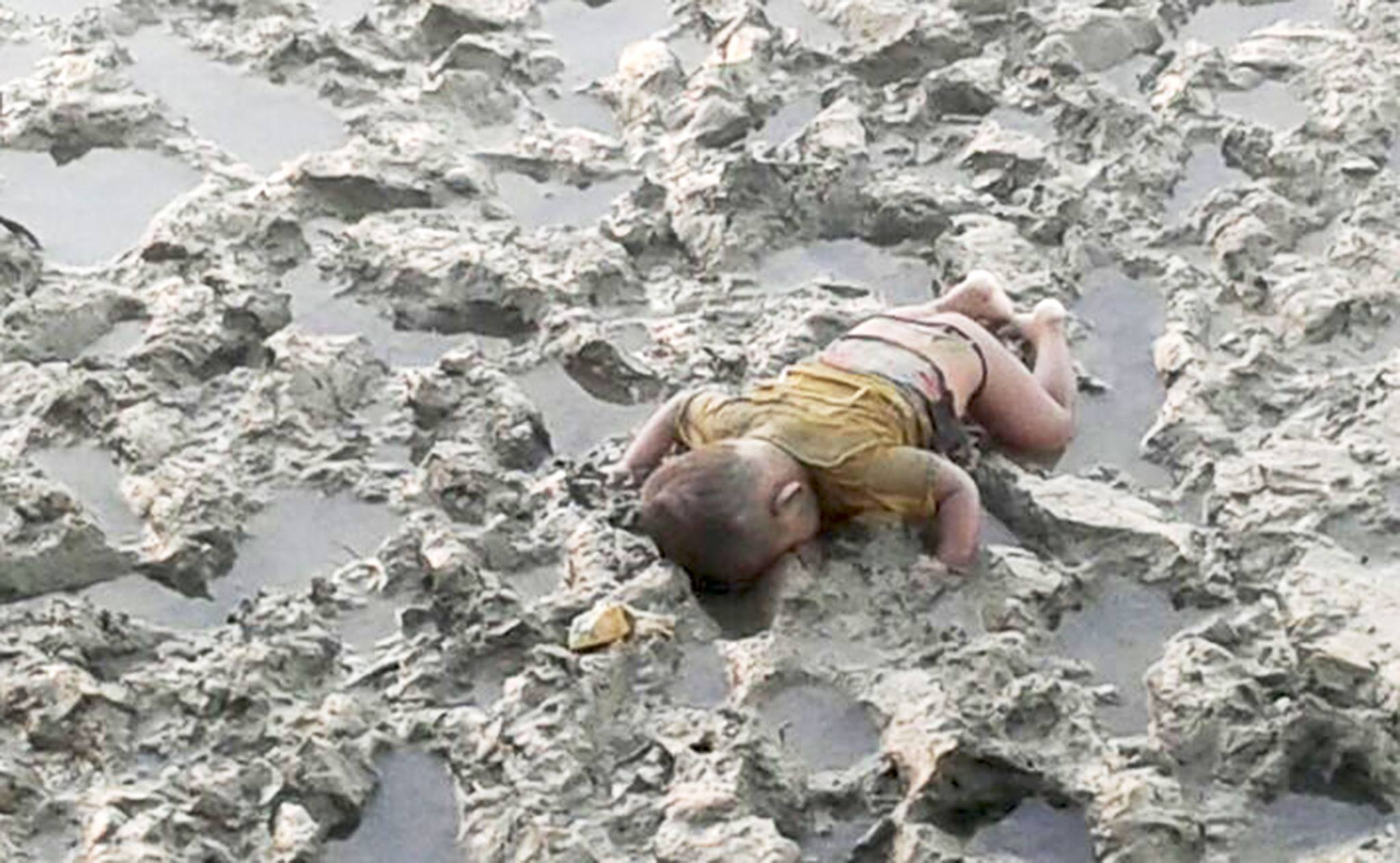
But the great ‘humanitarian’ seems to have run out of integrity as her government, military and police began conducting a widespread ethnic cleansing operation that targeted the ‘most oppressed people on earth’, the Rohingya. These defenseless people have been subjected to a brutal and systematic genocide, conducted through a joint effort by the Burmese military, police and majority Buddhist nationalists.
The so-called “Cleansing Operations” have killed hundreds of Rohingya in recent months, driving over 250,000 crying, frightened and hungry people to escape for their lives in any way possible. Hundreds more have perished at sea, or hunted down and killed in jungles.
Stories of murder and mayhem remind one of the ethnic cleansing of the Palestinian people during the Nakba of 1948. It should come as no surprise that Israel is one of the biggest suppliers of weapons to the Burmese military. Despite an extended arms embargo on Burma by many countries, Israel’s Defense Minister, Avigdor Lieberman, insists that his country has no intentions of halting its weapons shipments to the despicable regime in Rangoon, which is actively using these weapons against its own minorities, not only Muslims in the western Rakhine state but also Christians in the north.
One of the Israeli shipments was announced in August 2016 by the Israeli company TAR Ideal Concepts. The company proudly featured that its Corner Shot rifles are already in ‘operational use’ by the Burmese military.
Israel’s history is rife with examples of backing brutal juntas and authoritarian regimes, but why are those who have positioned themselves as the guardians of democracy still silent about the bloodbath in Burma?
Nearly a quarter of the Rohingya population has already been driven out of their homes since October last year. The rest could follow in the near future, thus making the collective crime almost irreversible.
Aung San Suu Kyi did not even have the moral courage to say a few words of sympathy to the victims. Instead, she could only express an uncommitted statement: “we have to take care of everybody who is in our country”. Meanwhile, her spokesperson and other mouthpieces launched a campaign of vilification against Rohingya, accusing them of burning their own villages, fabricating their own rape stories, while referring to Rohingya who dare to resist as ‘Jihadists‘, hoping to link the ongoing genocide with the western-infested campaign aimed at vilifying Muslims everywhere.
But well-documented reports give us more than a glimpse of the harrowing reality experienced by the Rohingya. A recent UN report details the account of one woman, whose husband had been killed by soldiers in what the UN described as “widespread as well as systematic” attacks that “very likely commission of crimes against humanity.”
“Five of them took off my clothes and raped me,” said the bereaved woman. “My eight-month-old son was crying of hunger when they were in my house because he wanted to breastfeed, so to silence him they killed him with a knife.”
Fleeing refugees that made it to Bangladesh following a nightmarish journey spoke of the murder of children, the rape of women and the burning of villages. Some of these accounts have been verified through satellite images provided by Human Rights Watch, showing wiped out villages throughout the state.
Certainly, the horrible fate of the Rohingya is not entirely new. But what makes it particularity pressing is that the west is now fully on the side of the very government that is carrying out these atrocious acts.
And there is a reason for that: Oil.
Reporting from Ramree Island, Hereward Holland wrote on the ‘hunting for Myanmar’s (Burma) hidden treasure.’
Massive deposits of oil that have remained untapped due to decades of western boycott of the junta government are now available to the highest bidder. It is a big oil bonanza, and all are invited. Shell, ENI, Total, Chevron and many others are investing large sums to exploit the country’s natural resources, while the Chinese – who dominated Burma’s economy for many years – are being slowly pushed out.
Indeed, the rivalry over Burma’s unexploited wealth is at its peak in decades. It is this wealth – and the need to undermine China’s superpower status in Asia – that has brought the west back, installed Aung San Suu Kyi as a leader in a country that has never fundamentally changed, but only rebranded itself to pave the road for the return of ‘Big Oil’.
However, the Rohingya are paying the price.
Do not let Burmese official propaganda mislead you. The Rohingya are not foreigners, intruders or immigrants in Burma.
Their kingdom of Arakan dates back to the 8th Century. In the centuries that followed, the inhabitants of that kingdom learned about Islam from Arab traders and, with time, it became a Muslim-majority region. Arakan is Burma’s modern-day Rakhine state, where most of the country’s estimated 1.2 million Rohingya still live.
The false notion that the Rohingya are outsiders started in 1784 when the Burmese King conquered Arakan and forced hundreds of thousands to flee. Many of those who were forced out of their homes to Bengal, eventually returned.
Attacks on Rohingya, and constant attempts at driving them out of Rakhine, have been renewed over several periods of history, for example: following the Japanese defeat of British forces stationed in Burma in 1942; in 1948; following the takeover of Burma by the Army in 1962; as a result of so-called ‘Operation Dragon King’ in 1977, where the military junta forcefully drove over 200,000 Rohingya out of their homes to Bangladesh, and so on.
In 1982, the military government passed the Citizenship Law that stripped most Rohingya of their citizenship, declaring them illegal in their own country.
The war on the Rohingya began again in 2012. Every single episode, since then, has followed a typical narrative: ‘communal clashes’ between Buddhist nationals and Rohingya, often leading to tens of thousands of the latter group being chased out to the Bay of Bengal, to the jungles and, those who survive, to refugee camps.
Amid international silence, only few respected figures like Pope Francis spoke out in support of the Rohingya in a deeply moving prayer last February.
The Rohingya are ‘good people’, the Pope said. “They are peaceful people, and they are our brothers and sisters.” His call for justice was never heeded.
Arab and Muslim countries remained largely silent, despite public outcry to do something to end the genocide.
Reporting from Sittwe, the capital of Rakhine, veteran British journalist, Peter Oborne, described what he has seen in an article published by the Daily Mail on September 4:
“Just five years ago, an estimated 50,000 of the city’s population of around 180,000 were members of the local Rohingya Muslim ethnic group. Today, there are fewer than 3,000 left. And they are not free to walk the streets. They are crammed into a tiny ghetto surrounded by barbed wire. Armed guards prevent visitors from entering — and will not allow the Rohingya Muslims to leave.”
With access to that reality through their many emissaries on the ground, western government knew too well of the indisputable facts, but ignored them, anyway.
When US, European and Japanese corporations lined up to exploit the treasures of Burma, all they needed was the nod of approval from the US government. The Barack Obama Administration hailed Burma’s ‘opening’ even before the 2015 elections brought Aung San Suu Kyi and her National League for Democracy to power. After that date, Burma has become another American ‘success story’, oblivious, of course, to the facts that a genocide has been under way in that country for years.
The violence in Burma is likely to escalate and reach other ASEAN countries, simply because the two main ethnic and religious groups in these countries are dominated and almost evenly split between Buddhists and Muslims.
The triumphant return of the US-west to exploit Burma’s wealth and the US-Chinese rivalries is likely to complicate the situation even further, if ASEAN does not end its appalling silence and move with a determined strategy to pressure Burma to end its genocide of the Rohingya.
People around the world must take a stand. Religious communities should speak out. Human rights groups should do more to document the crimes of the Burmese government and hold to account those who supply them with weapons.
Respected South African Bishop Desmond Tutu had strongly admonished Aung San Suu Kyi for turning a blind eye to the ongoing genocide.
It is the least we expect from the man who stood up to Apartheid in his own country, and penned the famous words: “If you are neutral in situations of injustice, you have chosen the side of the oppressor.”

– Ramzy Baroud is a journalist, author and editor of Palestine Chronicle. His forthcoming book is ‘The Last Earth: A Palestinian Story’ (Pluto Press). Baroud has a Ph.D. in Palestine Studies from the University of Exeter and is a Non-Resident Scholar at Orfalea Center for Global and International Studies, University of California.