Showing posts with label Bhartiya Janta Party (BJP). Show all posts

Thursday, September 05, 2019

Israel Prime Minister Netanyahu cancels visit to India

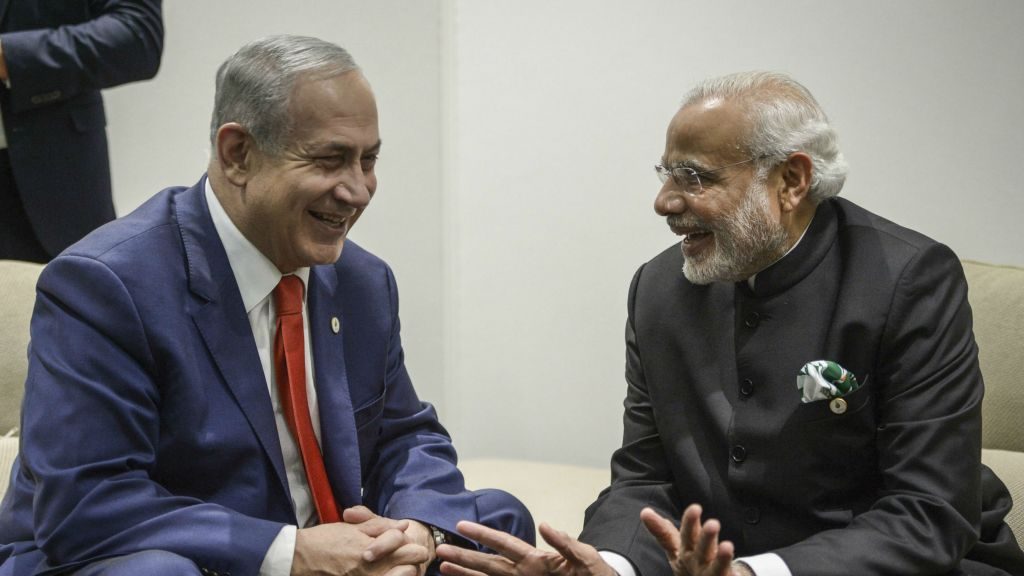
Israeli Prime Minister Benjamin Netanyahu on Tuesday (Sept 3) cancelled a planned visit to India on September 9 to meet his counterpart Narendra Modi who last month annexed the disputed territory of Kashmir.
This is the second time this year that Netanyahu on has cancelled a planned visit to India, doing so earlier before the April elections.
Netanyahu’s planned visit was widely seen in Israel as an effort by him to project his acceptance worldwide and prop up his campaign just days before the September 17 repeat polls, according to the Press Trust of India.
Netanyahu, who created history on July 20 by becoming the longest serving Israeli Prime Minister, surpassing Israel’s first premier David Ben-Gurion, is facing a tough political challenge as opinion polls show flagging fortunes for his ruling Likud party.
Israeli lawmakers in May voted 74-45 in favor of dissolving the 21st Knesset (Parliament) and hold an unprecedented re-elections on September 17 after Netanyahu failed to form a coalition government after the April 9 polls.
Netanyahu visited India in January 2018, while Modi travelled to Tel Aviv in 2017, becoming the first Indian prime minister to tour the Jewish state.
Over the past two years, Netanyahu and Modi have hailed “a new era of friendship between the nations,” with mutual high-profile visits and several bilateral agreements signed in the fields of oil, gas, renewable energy and cyber cooperation. In his January 2018 visit to India, Netanyahu called Modi a “revolutionary leader,” who had transformed the relationship between the two nations.
According to media reports, Israel wishes to sell India several advanced weapons manufactured by the country’s defense industries, such as spy planes, unmanned aircraft, anti-tank missiles, cannons and radar systems.
In January, National Security Adviser Meir Ben Shabbat travelled with several members of the council to India, where he met with his Indian counterpart and with Modi. In those meetings, Ben Shabbat discussed different weapon deals between the two countries.
“By revoking autonomy from Kashmir, Indian Prime Minister Narendra Modi is taking a page straight out of the Israeli playbook.” This is the tile of Abdulla Moaswes’s article published by +972 Magazine where he provides a graphic scenario of the Indo-Israeli collaboration to implement Hindutva, or extreme Hindu Nationalism policies adopted by Rashtriya Swayamsevak Sangh (RSS) backed the Bharatiya Janata Party (BJP). Abdulla Moaswes writes:
“Relations between India and Israel grew even closer with the rise of the Bharatiya Janata Party in the 1990s. The BJP, which today is led by Modi, adheres to the political ideology known as Hindutva, or Hindu Nationalism. The history of Hindu nationalists’ affinity with Zionism is well documented by professor Sumantra Bose of the London School of Economics, who traces it back to the 1920s when Vinayak Damodar Savarkar, the father of Hindutva, supported the creation of a Jewish state in Palestine. The BJP and other Hindu Nationalists have since become obsessed with replicating the Zionist project in turning a constitutionally secular India into a Hindu ethnocratic state.
“Many of the BJP’s aspirations and policy proposals for Kashmir are imitations of extant Israeli practices in Palestine. Key among these is the desire to build Israeli-style Hindu-only settlements in Kashmir as a way of instigating demographic change. For example, the Rashtriya Swayamsevak Sangh (RSS), a non-state volunteer Hindu paramilitary volunteer group to which the BJP are affiliated, have long desired the repeal of the state subject laws that have maintained the demographic make-up of Kashmir.
“These changes are clearly inspired by the Israeli settlement model, as expressed by BJP lawmaker Ravinder Raina, who, in 2015, stated that the government of India will use its army to protect Hindu-only settlements in Jammu and Kashmir. This type of securitization and protection would entail an expansion of the security apparatus that already restricts the flow of life for most Kashmiris, using them as a pretext to justify a new level of domination and intrusiveness.
“Aside from the parallels in policy objectives, the discourse used by supporters of the current regime in India resemble old Israeli refrains. Both Israel and India claim to be exceptional democracies, despite their treatment of large swaths of populations under their control. Additionally, both Zionists and Hindu Nationalists argue that the existence of many Muslim countries in the world necessitates a Jewish and Hindu state, respectively. This perpetuates the lie that Palestinians and Indian Muslims can supposedly live elsewhere, yet choose to live in Palestine and India only to antagonize Jews and Hindus.
“Meanwhile, the variety of tactics used by India to control the civilian population of Kashmir strongly resembles t hose used by Israel in Palestine. These include, “arbitrary arrests, extra-judicial killings, enforced disappearances, curfews, collective punishment, administrative detention, torture, rape and sexual abuse, the suppression of freedom of speech and assembly, house demolitions, and so forth.”
“The revocation of Articles 35A and 370 paves the way for Indian presence in Kashmir to further mirror Zionist presence in historic Palestine, since this allows the Indian state to rule Kashmir directly without the need for Kashmir’s state legislature, which was also recently abolished. Furthermore, it facilitates the execution of plans to alter the demographic make-up of Kashmir by allowing Indians from across the country to purchase property and settle there under the protection of the Indian military presence, just as the demographic make-up of the West Bank continues to be altered with the construction of Jewish-only settlements.
“With the unprecedented change of Jammu and Kashmir’s legal status from a special status state to a union territory without a legislative assembly, India’s colonial domination over the contested region will only become more overtly coercive in representing Indian interests. This is a crucial development to be observed closely by Palestinians who live in areas where the Israeli occupation is currently facilitated by the Palestinian Authority.
“As things move forward, it is increasingly clear that the colonial processes in Kashmir and Palestine will become further interdependent on one another. What Israel does in Palestine is likely to happen in Kashmir, and what India does in Kashmir is likely to happen in Palestine. In aiming to dismantle Israeli apartheid and settler colonialism, it is essential to observe its global consequences, for it is highly likely that these interdependent processes will require a multilateral confrontation.”
“Although the Indian presence in Kashmir never amounted to settler colonialism like in the Palestinian case, where a large proportion of the existing population of the region was expelled and replaced by a settler population, India has maintained a heavy military presence in the area and has acted as a police state vis-à-vis Kashmiri civilians and politicians,” argued Abdulla Moaswes, a graduate of the School of Oriental and African Studies (SOAS) and the University of Exeter.
Abdus Sattar Ghazali is the Chief Editor of the Journal of America (www.journalofamerica.net

Tuesday, March 19, 2019

Kashmir matters, and Kashmiris too

By A. G. Noorani

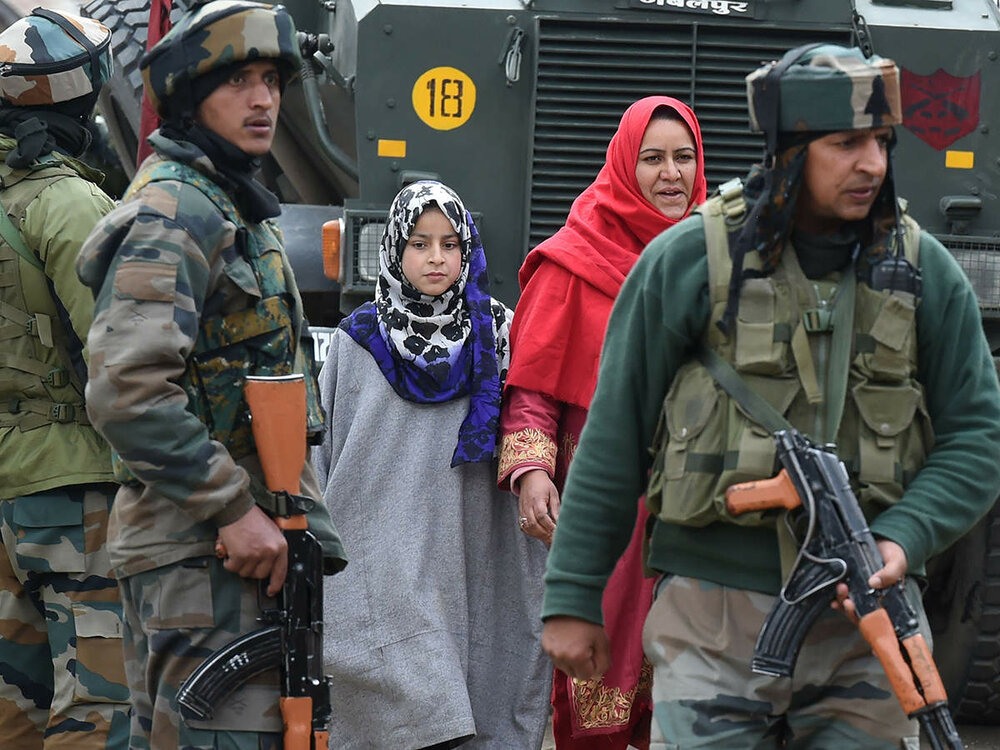
TEHRAN- Relations between India and Pakistan have nosedived since Narendra Modi became prime minister in 2014. If anyone thought that he would make up the loss by a conciliatory policy towards Kashmiris, they were mistaken. It was never part of his agenda. The Rashtriya Swayamsevak Sangh (RSS) would have none of it. The game is to accuse dissent within Kashmir as a movement that is Pakistani sponsored, and ruthlessly crush it.
At least a decade ago, Mirwaiz Umar Farooq had warned that alienation was on the rise and leaders of the All Parties Hurriyat Conference were fast losing influence over the insurgents. He has nothing to offer them except snubs.
Muslim-majority Kashmir was an eyesore. Modi aspired to plant an RSS-led government there backed by a massive Jammu vote and a few seats from the Valley won by hirelings. Coalition was the first step. The goal is to fulfil the aim of repealing Article 370 of India's constitution, which guarantees Kashmir's autonomy, and its corollary Article 35-A. It guarantees its "permanent residents" special rights and privileges on acquisition of immoveable property on employment by the government, barring non-Kashmiris.
Petitions are pending in the Indian supreme court to nullify Articles 370 and 35-A and thus bring Kashmir on a par with states by stripping it of its "special status".
On Feb 25, PDP leader and former chief minister Mehbooba Mufti said: "If anything like [tinkering with Article 35-A] happens, its consequences would be - I have said it earlier and my words were not taken well - that it would be difficult for those who raise the flag of [India] to even shoulder it. If [Article 35-A] is attacked, I don't know that which flag the people of Jammu and Kashmir would raise...." A joint strategy, across the political divide, to safeguard the special position of Jammu and Kashmir is necessary. Will the leaders rise to the occasion?
The National Investigation Agency has been targeting Kashmir's leaders on charges inter alia of money laundering and 'terror funding'. On Feb 26, it raided the homes of the Mirwaiz Umar Farooq, Mohammad Yasin Malik, Shabbir Ahmed Shah and a son of Syed Ali Shah Geelani who has been under house arrest for years. Geelani Shah has been in precariously poor health. With the decline of the Hurriyat, these three formed the Joint Resistance Leadership, which soon acquired a standing in popular esteem. On Feb 23, 150 separatists were detained by police in a midnight swoop.
Prime Minister Modi faced the same spectacle as his predecessors did whenever they went to Kashmir - a total boycott. That did not deter him from declaring in Srinagar, on Feb 3, that his government would "break the back" of militancy in Kashmir. History demonstrates that no fighting that has roots in the people's sentiments can be extinguished by brute force. That is what Modi seeks to do. He is certain to fail.
On Feb 3, a senior army official said that as many as 191 local youth joined various outfits in Jammu and Kashmir last year, 65 more than 2017 when 126 locals had joined these ranks. He said of the 191 recruits in 2018, 139 hailed from southern Kashmir areas - the highest, 59, were from Pulwama. In 2016, 88 Kashmiri youth had joined the fighters. Since 2016, there has been a constant rise in the number of youths becoming part of the insurgency. The year 2013 marked the lowest point in recruitment. Significantly, it rose since 2014 when Modi became prime minister.
A former union home minister who dealt with Kashmir, P. Chidambaram, has a similar story to tell, "The number of infiltrators and number of local recruits have been on the rise since 2015. I am implacably opposed to the muscular, militaristic and maximalist position of the BJP-led central government that has also victimised the people." Recruits rose from 16 in 2013 to 164 in 2018, he said. Why? Few care to answer.
Violence and terror are condemnable. But repression is not the answer. The solution lies in addressing the roots of the problem. That was done by Harinder Baweja, who followed developments in Kashmir since the outbreak of militancy. She wrote on Feb 21, "If the number of locals joining militancy began to steeply rise, it was because they appeared fed up with Delhi's unwillingness to accept the very political nature of the Kashmir problem."
It is a measure of the BJP's abject defeat that the men who were driven to join the BJP hid their faces from the cameras. They know what the people think of such acts and decided to hide their faces. A photograph published on the front page of a leading daily revealed nearly 100 of them leaning on one another's back to avoid exposure. In Kashmir, more than the reportage in words, it is a reportage in photographs that reveals the whole truth - as well as the women who crowd at windows mourning at the funerals of those killed pass by.
Writer is a veteran Indian lawyer, author and commentator. This column was first published in Dawn.

Tuesday, March 12, 2019

Battle lines drawn for India elections; Modi and Gandhi main challengers

By Syed Zafar Mehdi

TEHRAN _ Battle lines are drawn and countdown has virtually begun for the biggest electoral showdown on the earth – the elections for India’s parliament – scheduled in April.
All major political parties in India have kicked off their campaign trial ahead of elections, with Bharatiya Janata Party (BJP) seeking to retain power and Congress looking to stage a strong comeback.
On Sunday, India’s election commission announced dates for the election that will see almost 900 million voters exercise their franchise at more than a million polling booths, which happens to the world’s largest democratic exercise.
The commission announced that the election will be held in seven phases on April 11, 18, 23, 29 and May 6, 12 and 19. The counting of votes will be held on May 23, followed by announcement of results.
Assembly elections will also be held simultaneously to four states – Andhra Pradesh, Sikkim, Arunachal Pradesh and Odisha. Jammu and Kashmir, the restive northern state of India, where a coalition government collapsed in June 2018, will not have assembly election, but will go for parliament poll.
The commission has faced heat from opposition parties for using electronic voting machines (EVMs), which many believe is prone to poll fraud and irregularities.
Too allay the fears of voters and observers, the commission said the voter-verifiable paper audit trail (VVPAT) system will be used in all polling stations. It is a device attached to an EVM and prints a small paper slip carrying the symbol, name and serial number of the candidate the voter votes for.
This system, authorities say, will help in verification process later and prevent allegations of fraud.
A total of 543 parliament seats are up for grabs in this election to Lok Sabha, India's lower house of parliament, which ultimately decides which party is eligible to form the government in New Delhi.
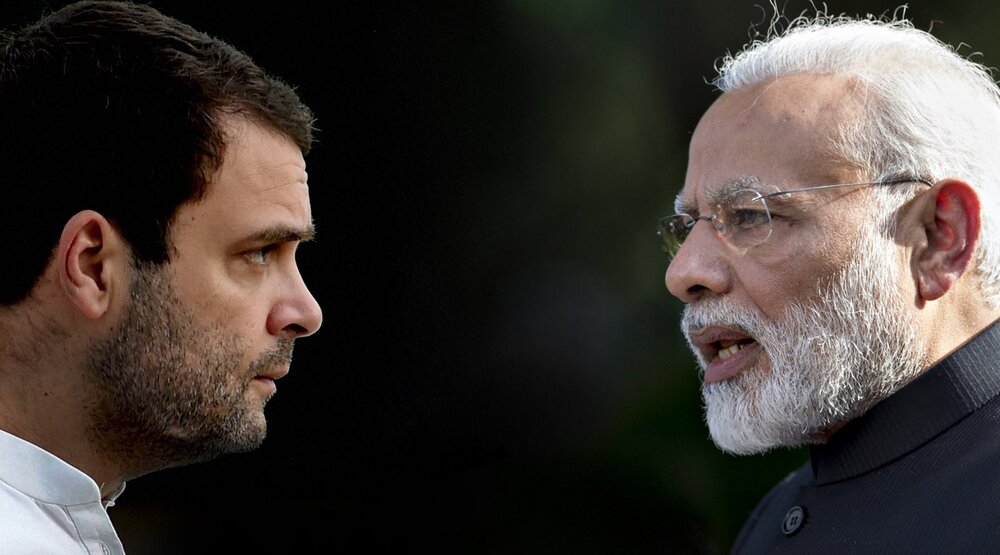
The incumbent Prime Minister Narendra Modi is running again for the top post, and he faces strong opposition in the form of Congress president Rahul Gandhi, the scion of India’s famed Gandhi family.
Although many political parties and powerful regional politicians are also in the fray, these two leaders are the main protagonists to represent more than 1.3 billion people.
While some analysts have given right-wing BJP a slight edge over Congress because of the hardcore Hindu narrative peddled by the party leaders to woo majority Hindu voters, some analysts see Gandhi putting up a tough challenge to BJP.  
The recent military escalation between India and its arch-rival Pakistan in the aftermath of a deadly attack in Indian-controlled Kashmir has become an important, emotive poll issue for the ruling party, as Modi seeks to project his ‘heroic image’ as the mastermind of ‘surgical strikes’.
However, the election commission has asked political parties not to use images of the country's armed forces in their campaign posters and other advertising material during the general election.
In a notice published on its website on Saturday, the commission said political parties must refrain from using photographs of defence personnel in advertisements or their election campaign propaganda as the armed forces are "apolitical and neutral stakeholders in a modern democracy".
Moreover, Modi has come under criticism for poor economic policies and lack of jobs in the country.
Some latest opinion polls have pointed to diminishing support for Modi-led BJP over job and economy, and hinted that the party may fall short of the absolute majority of 272 seats to form the next government without any external support.
Gandhi, who failed to impress political pundits in India for many years, has shown signs of political maturity and seriousness over the past one year, which was evident from party’s sweep in elections to three key states in December, a big setback for the BJP.
He has been scathing in his criticism of Modi's economic policies, his failure to help impoverished farmers and to create jobs for unemployed youth.
However, his party is not seen as strong enough to clinch the election on its own. So, it has entered into alliances with a number of regional parties across India, all of them having a common agenda to prevent BJP from coming back to power.
While acknowledging that national security issues could outdo economic issues in impacting voter behaviour in the elections, the latest HSBC Global Research report says a wave of new coalitions suggests “non-BJP parties are less fragmented today, making it a tough contest for the incumbent.”
The factors that will shape 2019 results, according to the report, are the geopolitical issues that will dominate the next few weeks.
“It is the BJP that faces anti-incumbency sentiment. Whether or not the youth will show up to vote with as much enthusiasm as before, and vote for the BJP as they did last time, cannot be ascertained,” the report notes. “Growth in some pockets of the economy is slowing, though not to worrisome levels, in our view. And the non-BJP votes may not be as fragmented as before,” it says.
It further says the recent surveys show the gap between Modi and Gandhi’s popularity ratings narrowing down and that voters’ preference for Gandhi as an alternative for PM’s post among opposition leaders is also on the rise.
So, will the Gandhi scion have the better of Modi? Or will Modi find the going easy. We shall know on May 23.