The eight million people of Jammu and Kashmir continue to suffer under a brutal Indian colonial occupation and almost continuous lockdown since August 4. Kashmiris residing outside the imprisoned state who have managed to speak to loved ones through infrequently available cell phone connections have learnt of horrifying tales. Relatives have died and they did not know. They could not even mourn their dead together.
There are other horrors inflicted on the Kashmiris. The nearly three-month long lockdown is taking its toll. How are people surviving without food, and more critically without medicines, especially those suffering from heart or kidney diseases? How are cancer patients coping? Hospitals are either shut or inaccessible because of barbed wires blocking streets and the huge military presence augmented by Hindu fascist thugs who have swarmed the state.
In mid-September, a group of five Indian women traveled to Srinagar to investigate. The group comprised three Hindu lawyers, one retired Sikh professor, and a Muslim social activist. Upon returning to Delhi, they held a press conference at which Poonam Kaushik, a lawyer at the Delhi High Court, spoke to the media and answered questions.
She recounted horrific tales of suffering. The Indian army raid people’s homes in the middle of the night. Kashmiris live in fear of the dreaded midnight knock. It only means trouble. The occupiers come looking for Kashmiri youth to drag them to unknown locations. If they cannot find the youth, they drag the father to prison. At least 13,000 Kashmiri youth have been taken away and locked up somewhere. Other sources say the total number is as high as 25,000.
Additionally, RSS thugs have swarmed the state, hunting for Kashmiri girls. These two-legged beasts have been given a license to do what they like to Kashmiri girls and women. Given that more than 11,100 Kashmiri women and girls have been raped since 1989, there are grave fears for the abducted Kashmiri girls.
Indian Prime Minister Narendra Modi and his equally fascist henchmen shamelessly claim there is “calm” in Kashmir. This is the calm of the graveyard. India’s 900,000 colonial troops have been given carte blanche under the Armed Forces Special Powers Act (AFSPA) to shoot on mere suspicion. While not new — this act has been in force in Kashmir since 1990 — the latest crisis has further emboldened the unruly occupation troops.
In another twist, the colonizers have issued orders to families not to reinforce their house front doors. The thugs in uniform would like to break down doors with a single kick. People who have installed strong doors or gates also face imprisonment.
On the rare occasion when families are able to venture out to seek information about their sons or daughters, army and police personnel demand bribes. That, however, is no guarantee that they would get accurate information. Fear and uncertainty are pervasive.
October 27 has been historically observed as “Black Day” in Kashmir. This year, it assumed added significance. It was on this day in 1947 that the Hindu ruler of Kashmir supposedly signed the provisional instrument of accession to India. He had already fled the state as the masses rose up against him. The instrument of accession was signed under duress. India demanded it before agreeing to send troops although there is evidence that Indian troops were already in Srinagar on October 1.
This year’s Black Day evoked even more anger among the Kashmiris and their friends and allies worldwide. In the wake of India’s August 5 revocation of Kashmir’s special status pending its resolution through a referendum, the legal situation has been radically altered. The instrument of accession was signed between two states: Kashmir and India. Only Kashmir was legally entitled to abrogate this unilaterally, not India.
It is quite revealing that in Britain where there is a large Kashmiri community, the British government warned protesters not to go near the Indian high commission to protest. The police as well as London’s “Muslim” mayor first demanded that no protests should be allowed and then put restrictions on the demonstrators. The “mother of all democracies” has strange habits. The Kashmiris’ rights and legitimate anger are being sacrificed at the altar of trade relations.
Claims to democracy are meaningless phrases that remain subservient to the interests of big business and concentrated power. So long as they define it, democracy can be whatever they want it to be (except for a representative system reflecting the popular will): an ethnocracy in Israel and India, a special interest paradise in America, etc. The Kashmiris will have to be excused if they can’t wait for their basic rights forever.
CI: The situation in Kashmir is very dangerous. It is one of the world’s worst and least-known human rights catastrophes, and has been for decades. When I interviewed Andre Vltchek on this show four years ago, he said that India’s abuse of the people of Kashmir was not only comparable, but in some ways worse than the Zionist abuse of the people of Palestine. And now we’re facing a much greater catastrophe. India is talking about annexing Kashmir, which might very well bring on war with Pakistan. So please introduce yourself and tell us how you came to be working on human rights in Kashmir, and how you see the situation there?
Sheik Ubaid (SU): I have been involved in the human rights struggle, whether in Bosnia, Burma, or Congo — which we don’t hear much about, it’s the second-longest-running genocide, the longest being in Burma-Myanmar. And I’m from India, which is why I have been keenly aware of what’s going on in Kashmir even when it’s not in the news. India does not encourage foreigners, even in “normal” times, to report from Kashmir. But now the crisis has exploded. And there is danger of nuclear war. As the prime minister of Pakistan has said, if war breaks out, and two nuclear powers — one being so disproportionately larger, India is seven times bigger than Pakistan — there is no way this will be a limited war.
[I have been working as] an antiwar activist, and speaking up for the suffering Kashmiris. There have been mass graves of Kashmiri civilians; there have been tens of thousands of rapes, since the mid-1980s, when the current situation developed, even though the problem dates back to the partition of British India. So that is why I got involved. And also we have been trying very hard to prevent the takeover of India by fascist forces — forces that have been slowly infiltrating Indian power centers in recent decades, and now have taken over the government. These are the people who killed Gandhi and who openly want to make India an exclusively Hindu state ruled by the upper caste. So we have been resisting that. Our coalition, the Coalition Against Genocide, was instrumental in stopping the visa of Modi, who is now the prime minister of India, so he couldn’t come to the US. He can now come to the US as prime minister. But he can’t come to the US as a private citizen because we got his visa revoked in 2005.
CI: Some think of Modi as being one of these right-wing populist leaders, like Trump, Boris Johnson, Marine Le Pen in France, Orban in Hungary, and so on. But as you mentioned, Modi is representing a movement that wants to put the upper caste in total control. What kind of populist movement is that?!
SU: That’s a very good question. It’s so ironic. India’s caste apartheid is the longest-running apartheid system in the world. It goes back at least 3,000 years, when the Aryan invaders came from the steppes of Central Asia to Iran and India’s Indus Valley civilization, which was one of the world’s oldest civilizations. So the Indus Valley people were pushed back into South India. And there they speak a language that is different from the Indo-Aryan language of North India, which is related to European and Iranian languages. Gradually the caste system developed and became a rigid system where the upper caste ruled the lower castes, and the huge population of the original inhabitants of India became outcasts, called Dalits. And then there is an even older population in India, one of the initial waves that came out of Africa 70,000 years ago. The upper castes were able to manage things by bringing in religion, which taught, “If you are born into a lower caste or an outcast it is because of the sins you committed in a past life. So if you serve the upper caste, then in the next life you will be born as an upper caste. If you resist, maybe in the next life you will be born as an animal.” So there was not much resistance until modern times. After exposure to Islam, and later exposure to Western liberal philosophies, they started to struggle. Gandhi, in spite of having some racist views about Africans, was quite good for lower castes. And that also took some of the pressure off them, and the Dalits started to organize. But they could not gain all they wanted because Gandhi also drew a line. And that is why the leader of the Dalits, [Bhimrao Ramji] Ambedkar [1891–1956], the father of India’s constitution, developed differences with Gandhi.
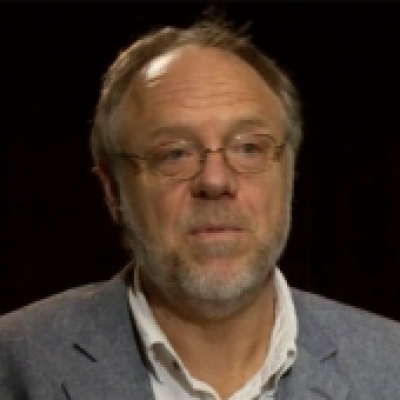
Dr. Shaikh Ubaid
CI: How did the Hindu fascist movement begin? As you said, these are the people who killed Gandhi, and who are working for authoritarian rule by the upper caste. Was Hindu fascism a backlash against the way the Dalits had been finding escape routes, whether through Islam or Western thinking?
SU: No. When [Hindu fascism] started the Dalits were not a threat. It was more an anti-Muslim feeling that started it. The Brahmanic founders of RSS (Rashtriya Swayamsevak Sangh) were mostly from an area of India called Maharashtra, where anti-Muslim feeling was quite strong. When they saw how Mussolini, and later Hitler, rose to power, they got their inspiration. So they mixed religion with ultra-nationalism. And they realized that maybe the British, who allowed the Congress Party and other parties to start functioning, might leave one day. And they did not want Muslims to have any say or power in running India. So actually it is fascinating that initially they wanted to have a division of India, because they wanted areas where Muslims lived in large numbers to be separated, so they [the Hindu fascists] could take over India completely, and then later take over those Muslim lands also, even though they blame Gandhi and Jinnah for the partition of India. But it was Vinayak Damodar Savarkar [founder of Hindutva or Hindu nationalism] who was the first to say there were two different nations, Hindus and Muslims. And his policies, and the policies of other Hindu extremists, led a secular Muslim leader of Congress, Jinnah, to realize that in India, Muslims would be at the total mercy of Hindu majoritarian tyranny if the [Hindu] fascist movement and its thinking spread. So he decided to support the creation of a separate homeland for Muslims.
For decades [the Hindu fascists] worked quietly. They infiltrated law enforcement and education, even when the Congress Party, the party of Gandhi, was ruling India.
CI: Is Pakistan facing a difficult existential situation with its much larger neighbor, India, bent on not only taking Kashmir and committing genocide against the population there, but also being unwilling to live with an independent Pakistan? This creates a very difficult situation for Pakistan as well as Kashmir, doesn’t it?
SU: Yes, it does. Not only taking over Kashmir, they want to take over Kashmir’s land, but they’re not interested in the Kashmiris living there. Kashmir has three main parts: the Valley of Kashmir, Jammu region, and the region of Ladakh. We should not forget that Jammu was also a Muslim-majority area in 1947. That area was ethnically cleansed in 1947 and became Hindu-majority. So they want to do the same thing in the Valley of Kashmir, to change the demographics there, to have an ethnic cleansing, a genocide. And it is just natural for people, as human beings, to resist. Even if you take away religion, take away the Pakistani factor, nobody wants to be treated as slaves or even be killed or ethnically cleansed. So that is the reason why in 1987, when the Kashmiris realized that India would not allow them to have fair elections even locally, the population rose up. And that led to massive reprisals, killing at a massive scale, and rape, which was later adopted by the Serbians who used it in Bosnia. Some of the Serbs responsible even mentioned that they got the idea from the way rape was being used in Kashmir in the late-1980s and early-1990s.
CI: During the Cuban missile crisis, both leaders, Kennedy and Khruschev, were relatively reasonable, sane, peace-loving people. But this time around [though Imran Khan may be in some ways comparable to Kennedy] Modi is a cartoon villain. If we’d had someone like that on one side during the Cuban Missile Crisis, it’s hard to imagine how nuclear war could have been prevented. How can the world restrain somebody like Modi?
SU: That is a very good question. The world could not restrain Hitler. But Hitler’s Germany was a world power. India is not yet a world power. The other thing is, we can learn from the mistakes that were made in Germany. Hitler was allowed to completely take over the military. The Indian military so far has not been completely taken over by the RSS. It is the last institution. Even the judiciary has been taken over now. That is why the Supreme Court is dragging its feet over so many petitions that have been filed about Kashmir — because the special status of Kashmir was a treaty between two states, Kashmir and India, and was abrogated illegally, in violation of the Indian constitution. But the Supreme Court won’t deal with it. And the Indian military, for the past several years, is being slowly saffronized — saffron being the color of the Hindu supremacist movement. So there is still some time, there is still some hope. But the world will have to start moving fast and put pressure on India.
CI: When Imran Khan spoke at the United Nations, he begged the UN to intervene. What kind of intervention could help? The UN has never forced India to honor its promise to hold a plebiscite in which the people of Kashmir could decide their own fate. What kind of intervention could stop the situation from moving toward nuclear war?
SU: Security Council resolutions, taking it to the International Court of Justice, can put a damper on this completely outlandish and outrageous move by Modi. If India tried to take over the whole of Kashmir, even if Pakistan were defeated, China would not allow that. So the UN should realize, and activists and Western governments should realize, that this war is not going to be a limited conventional war. It might be the end of human civilization. Maybe not every human being would be killed right away, but with the destruction of the ozone layer, and nuclear clouds blocking sunlight… between them, the two countries have nearly 150 nuclear bombs, and China has far more. That should take away our peaceful sleep. We should be very concerned about what’s going on in Kashmir. g
The plight of the people of Jammu and Kashmir is desperate. Facing a brutal Indian military lockdown since the night of August 4, they have no access to food or medicines and are completely cut off from the world. All services — hospitals, schools, colleges, and businesses — are closed. Virtually all communication links — the internet, cell phones, etc. — have been blocked.
Indian colonial troops have kidnapped thousands of Kashmiri youth during nightly raids on homes. Their whereabouts are unknown. Estimates of the number of youth kidnapped range from 6,000 to 25,000 with people expressing fears that the higher number may be closer to reality. Indian troops may be involved in genocide.
While India claims that there is “calm” in Kashmir, it is the calm of the graveyard. With tens of thousands of gun-totting soldiers shooting people on sight if they dare to come out of their homes, it is an imposed calm. Indian rulers also claim that people will get used to the new reality and will eventually accept it. Will they?
Beyond the oppressively grim reality that Indian troops and rulers in Delhi have created with their latest outrage in Kashmir, there is also the question of international reaction to this tragedy. It is not a new crisis; it has existed since 1947 but has remained in political and diplomatic limbo because of the self-serving interests of other players.
Let us first narrate the legal position of Jammu and Kashmir. Despite Delhi’s claim that it is an “integral part” of India, international law recognizes it as “disputed” territory. Its ultimate status is to be determined through a plebiscite (referendum) under UN supervision. There are at least 18 UN Security Council resolutions affirming this. Both India and Pakistan — the two principal claimants to the state — also accepted these resolutions when the Security Council first passed them. It was only later that India started to backtrack once it tightened its military grip on Kashmir. That, however, does not change the legal status Kashmir.
Following India’s illegal action in August abrogating Kashmir’s autonomy and turning it into “union territory,” its affairs will now be administered directly from Delhi. Naturally, Pakistan has taken a strong stand against this unilateral action. Regrettably, Islamabad has not been able to garner much support even from the Muslim world. Pakistan’s traditional allies in the Muslim East have stabbed it in the back. This, however, should come as no surprise.
The Arabian rulers, whether in Riyadh or Abu Dhabi, have sided with India. Most of them have gone even further. Adding insult to injury, they have conferred their kingdom’s highest civilian award on India’s fascist Prime Minister Narendra Modi.
If they wanted to suck up to India, could they have not waited for a while rather than now when the Kashmiris are being brutalized and their women being raped? The Arabian rulers, however, have no self-respect, dignity, or shame. And they certainly do not care for suffering Muslims anywhere. It is unrealistic to expect any decency from them.
Only three countries — Turkey, Iran, and China — have supported Pakistan’s principled position on Kashmir. It is also important for Pakistani decision makers to move beyond pious hopes and understand the global reality that is primed to abort any Muslim self-determination anywhere at all cost.
Why is the rest of the world turning a blind eye to the suffering of the Kashmiri people while being aware of India’s criminal acts? Unfortunately, the world does not function based on the rule of law or morality. The dictum “might is right” holds. Countries look for their own interests rather than worry about some esoteric principles of morality, human dignity, or justice. Damn the people!
Kashmir is situated at the crossroads of China, Pakistan, and India. The geostrategic interests of two great powers, the US and China, collide in Kashmir. One is a declining power; the other a rising power. China and Pakistan are longtime friends and Beijing is investing some $60 billion in Pakistan’s infrastructure projects as part of the China Pakistan Economic Corridor (CPEC). The US wants to disrupt this and is using India against China. It is unrealistic to expect that the US or any other Western country would help Pakistan over Kashmir.
India will not hand over Kashmir on a platter. Nor would any Western country or the UN help in this. Pakistan has to make the stark choice: is it earnest about the liberation of Kashmir? If so, it will require much greater effort than has hitherto been shown. And it will require enormous sacrifices. Nothing is achieved without sacrificing blood and treasure.
Many Muslims follow the traditional 40-day grieving period, but Kashmir has been grieving for decades. Now, 46 days later, even the grief is helpless, and soon the voices of outside support will fade. Today, too, Indian sympathy for the state is a quid pro quo. “They are one of us,” say the hashtag supporters, completely ghosting the plot. There is barely any acknowledgement of their right to be independent of the country. “I stand with Kashmir” is the slogan, not “I stand with Kashmir to be free”.
Are there headlines referring to the state as Indian Occupied Kashmir?
When the ruling Hindu nationalist Bharatiya Janata Party, in a most cowardly manner, got tourists and pilgrims out of the state before announcing that Article 370 granting Jammu and Kashmir special status was being revoked, when they put political leaders, activists, businessmen, civilians behind bars or under detention, when they shut down all internet and mobile services and put the state under curfew, when they took away the rights of 8 million people not only to have a flag and a say but to even conduct their daily lives with dignity, imprisoning them in their homes – no work, no schools, having to subsist on the food and medicines they could manage to procure, even then the liberals called it a mere “lockdown” and not the colonisation it was. When the National Security Advisor (NSA) Ajit Doval was shown sharing a meal with a group of Kashmiris, downed shutters in the background, the Indian media lapped it up as “confidence building”.
The saddest part of this shameless display of opportunism is that you don’t get to hear the voices of Kashmiris living in Kashmir. Those who try, suffer. The supposedly sympathetic section of the Indian media that projects itself as honorary Kashmiris retains a proprietorial tone replete with ridiculous equivalences. “If international headlines report the death of a 17-year-old, they should also tell us the story of the 5-year-old battling for her life after a militant attack.” A senior journalist cannot tell the difference between how terrorists and the state ought to behave.
***
Kashmiris will lose their identity, an identity they have held on to assiduously ever since the Partition of India left them with a piece of paper that would ensure a plebiscite to decide their own fate.
The nationalism narrative is not only politically fascist but also dehumanising. UK-based Kashmiri writer Mirza Waheed in this wrenching piece talks about wanting to hear his mother’s voice, to know if his ailing father is well, “You want to ask if they’ve got enough medicines, if they’ve been allowed to go for their weekly or fortnightly consult with the good doctor—if they’re alright, damn it. But you can’t pick up the phone and ask. You simply can’t call anyone. The world is made soundless when you can’t hear your beloveds.”
The NSA’s response after accepting the hardships caused was: “People were not born with Internet. For us, it is more important to protect the right of life of the people and keep them safe.”
Safe from whom? If protecting people against terrorist infiltration from Pakistan was the issue, why could the army not control it? Kashmir is the most militarised region, and yet the government felt it necessary to deploy 35,000 more forces for the safety of a people under curfew. An administration spokesperson reportedly said, “We decided to protect lives, some liberties may have to be compromised.”
The first casualty of this protection occurred on Day One of the incursion when a 17-year-old fell into a river trying to escape the police that cornered him. There have been many instances of pellets being fired to blind civilians and of torture after this ‘safety’ initiative. A young villager was one such victim: “Once they realised I was innocent, they wanted me to name a stone-pelter. I told them, I don’t know anyone. So, they continued beating and electrocuting me. They wanted all of us to give the names of stone-pelters…They began pulling my beard and even tried to put it on fire. Then, someone hit me on the head and I fainted. It is then they, perhaps, realised that I might die. So, they asked my friend to take me home. I regained consciousness after two days and it’s been 20 days and I still can’t walk properly.”
***
What sort of assimilation is the government speaking about when it excludes the people?
“What integration? We Kashmiris have been working and living in other cities as have people from other states in Kashmir.” I met Bilal six years ago. He was hesitant to admit he was Kashmiri at first. “I am from the other side, far from the trouble,” he had said. He was happy in Mumbai and earned enough to be able to send his kids to English-medium schools back home. He visited every year.
He remained steadfastly against separatists, but whenever the news flashed incidents of brutalities and deaths, he’d say, with remorse rather than rage, “When young boys see their fathers and brothers suffer and die before their eyes, will they not want revenge?” Yet, within minutes he would wonder if there was any alternative, and go back to the room he shared with four others, a room with mattresses on the floor and a stove on a stool to cook their meals. A room where family was a WhatsApp video call away.
That stopped on August 5.
The inclusiveness that the government speaks about is a lie. This lie has been repeated over the years by successive governments. They dangle the development carrot without any attempt to assuage the disaffection of the people. Rahul Gandhi had some years ago taken big corporate magnates to recce the state; Modi will not need to – it is a given now. On October 31, the Centre will divide Jammu and Kashmir and officially claim the Valley as its prized catch.
***
In the latest bit of news, 81-year-old former chief minister and leader of the National Conference Farooq Abdullah has been detained under the Public Safety Act (PSA), ironically the handiwork of his father Sheikh Abdullah. All the rooms in his house have been sealed, his staff fired, and he is confined to one room with an attached bath and toilet for 12 days. Tragic as it is, under the PSA that allows for arrest without trial and detention for upto two years, Kashmiris, including children, have been languishing in prison for years.
Local leaders and former chief ministers like Omar Abdullah and Mehbooba Mufti have aligned with the BJP, despite the party carrying its Hindu Rashtra dream and ambition to infiltrate Kashmir on its sleeve, only so that they could save their seats. Worse, they did not emphatically raise their voices over the disappearances and random killings of civilians in the state for all these years.
What happened on August 5 has to an extent been facilitated by such vacillation. Mehbooba Mufti’s first tweet on that day was, “Today marks the darkest day in Indian democracy. Decision of J&K leadership to reject 2 nation theory in 1947 & align with India has backfired.”
It raises the moot point: Are Kashmiris Indian? Do these leaders represent their struggle?
Kashmiris are taunted that they are not grateful to the army that helped them during the floods. They are taunted about living and earning “from us”.
They live in India because their home has been converted into a disputed territory that they have to reclaim. They have lives to live, families to feed. They take up jobs available to them and to all those in the much-touted ‘globalised’ India. Even if Kashmir were free, they could still work in India but as citizens of an independent state and not as residents of an occupied state they are ideologically fighting.
Kashmir has always been in a state of insurgency, but unlike in the Middle East the protests did not lead to overthrowing any regime, simply because there wasn’t any leader to overthrow. The anger on the streets, the “Go back, Indian dogs” graffiti on walls, the stone pelting were reactions to the daily harassment – being stopped in the streets and made to identify themselves, the disappearance of many, unmarked graves of “unidentified militants”, and war crimes like mass rape and third-degree torture.
These were crimes by the authorities, not terrorists. The authorities target the young because that is one way to wipe out a people and not just their protests. Each day is a struggle to hope, to live. But, as Mirza Waheed put it, the children “must grow, and try not to die”.
Fascism has consumed the collective psyche of Hindus in India. One would be hard pressed to find many Hindus who do not subscribe to this demonic ideology. If there are divergences, these are only in approach: those who are determined to fully implement this racist ideology with all the horrifying consequences immediately and those that would adopt a more gradual approach.
Narendra Modi, Amit Shah, (Home Minister in Modi’s regime), and others of their ilk are the torchbearers of this demonic ideology. They are in power and now have the capacity to implement this dangerously racist ideology. Their immediate targets are India’s 175 million Muslims but other minorities — Sikhs, Dalits, and Christians — are also not immune from their genocidal hatred.
Muslims are targeted for two main reasons: they are considered “outsiders” or being originally Hindus before their conversion to Islam during the 1,000-year Muslim rule and that Muslims are beef-eaters. Since Hindus worship the cow considering it as their “mother,” Muslims must, therefore, be slaughtered for eating beef. That such ideas are propounded, much less accepted, in the 21st century speaks volumes for what is wrong with the world today.
Both arguments can be easily refuted. Muslims are not outsiders in India. How many thousands of years must a people live in a land before they are accepted as indigenous? If one were to accept the Hindu fascists’ logic, all Europeans would have to leave North America, Australia, and New Zealand. Such absurd notions must be resisted with the full force of logic. Muslims have given much to India including the Taj Mahal, one of the wonders of the world. Hindu fascists however have had the Taj Mahal removed from the list of tourist attraction places. It does not alter history.
As for the beef-eating charge, yes Muslims eat beef, so do Christians but the $4 billion/year Indian beef export business is controlled by Hindus, not Muslims. If the Hindu fascists really care for the cow, they should go after Hindu businessmen, not lynch poor defenceless Muslims. Some have been set on fire; others have been hacked to death while Muslim women have been raped, at the instigation of BJP leaders.
It is, however, important to reveal the origins of India’s fascist movement and how it poses a threat to the safety and security of people everywhere, not just Muslims. The organization that spearheads the fascist movement in India is called Rashtriya Swayamsevak Sangh (RSS). It was established in 1925 and today has branches in many parts of the world, including Canada. Its core ideology is to declare India a Hindu nation in which there is no room for religious minorities. It goes further; they call themselves the “Aryan race” — a superior breed — that came from the northwest thousands of years ago and pushed the dark-skinned native Dravidian population south.
Skin complexion is a major obsession in India; lighter complexion is considered superior. Not surprisingly, billions of dollars are spent on facial creams that are supposed to turn one’s skin white. On skin color test, Modi, Amit Shah, and other obnoxious creatures in the ruling Bharatiya Janata Party (BJP) would not pass muster.
But it is the politico-religious ideology of RSS that is of grave concern. It believes in Hindutva (the Hindu nation) and insists non-Hindus must either convert to Hinduism or leave India. As part of this campaign, four million Muslims in Assam who had lived there for centuries have just been disenfranchised as citizens. This is the tip of the iceberg.
The RSS has six million members throughout India. They receive military training on a daily basis starting early in the morning. Nathuram Godse, the person who shot and killed Karamchand Gandhi (aka Mahatma Gandhi) in 1948 had close links to the RSS. The group has affiliate bodies such as the BJP, labor groups, student bodies, the police and paramilitary forces, Bollywood actors/actresses, etc. that bring its support base to hundreds of millions of people.
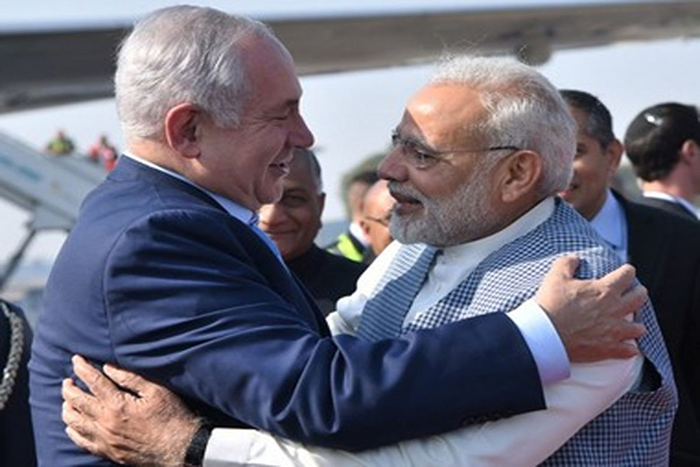
Israeli and Indian PMs, Netanyahu (left) and Modi, embrace on the former’s state visit to New Delhi in early-2018. The Zionist war criminal routinely accuses Islamic Iran of inciting another holocaust, yet anxiously runs a bromance with a partner in crime who does little to conceal the fact that he came up through the ranks patterning his rise on Hitler and the Nazis.
The Hindu fascists commonly display Nazi swastikas. They can be seen on shop fronts, pool parlors, markets, homes, temples, vehicles, notebooks, and even property documents. Their obsession and adulation of Nazi insignia has made it even to the internet. It is common to find such slogans as “Hari Om Heil Hitler,” on Facebook next to images of Hitler. Such images are juxtaposed with slogans of “Aum, Hail Aryan, Hail Aryavart,” (“Hail Aryans, Hail Land of the Aryans”). Hitler is openly proclaimed a great leader: “Jai Shree Ram, Heil Hitler” (“Hail Shree Ram, Heil Hitler”), “Nazi the great.” YouTube videos titled “Adolf Hitler, The Greatest Story Never Told,” have garnered over 100,000 hits.
A popular Indian web portal, rediff.com, declares “Hitler was great.” One comment on a YouTube channel run by NewsX, a 24-hour English-language news television channel in India said, “I too love Hitler and am one of his biggest fans! Hail Hitler!” There are also Indian Whatsapp groups discussing Hitler’s “positive contributions.”
Hindu fascists have internalized Hitler’s brand of racism and given it a distinctly Indian flavor, authenticated with a combination of ethnic hatred and Hindu nationalism. The result is the RSS and BJP.
Modi joined the RSS in 1970. Employed by the Gujarat Transport in its teashop, his duties included sweeping the floor (pictures of Modi sweeping the floor are available). His lowly origins — India is a deeply caste-ridden society in which there is rigid hierarchy of castes; Brahmins sit at the top of the caste pyramid while Shudras at the bottom and Dalits even below that — found an outlet in the RSS with its emphasis on Hindu supremacy and hatred of the “other” (in India’s case, Muslims).
Adulation of Hitler has been included even in school textbooks. Hitler’s “achievements” are extolled. In 2004, the Gujarat State Board published school textbooks portraying Hitler as a “hero.” They also glorified fascism. Modi was then the state chief minister. In tenth-grade social studies textbook there are chapters on “Hitler, the Supremo,” and “Internal Achievements of Nazism.”
In order to make absolutely clear where these Hindu fascists draw their inspiration from, in the section on the “Ideology of Nazism” the textbook says, “Hitler lent dignity and prestige to the German government. He adopted the policy of opposition towards the Jewish people and advocated the supremacy of the German race.” Social studies textbooks in the southern state of Tamil Nadu are even more explicit. The 2011 textbooks have chapters glorifying Hitler, praising his “inspiring leadership,” “achievements,” and how the Nazis “glorified the German state” so, “to maintain a German race with Nordic elements, [Hitler] ordered the Jews to be persecuted.”
Hitler’s glorification is not confined to textbooks, disturbing as it is. Bal Thackeray, leader of the Hindu extremist outfit Shiv Sena that is closely linked to the RSS, said in 1967 “It is a Hitler that is needed in India today.” He urged Hindus to form suicide squads to kill Muslims. And he is absolutely explicit about it. “There is nothing wrong if Muslims are treated as Jews were in Nazi Germany,” he said in an interview with Time magazine in 1993. He went on, “If you take Mein Kampf and if you remove the word Jew and put in the word Muslim, that is what I believe in,” he said. Modi is implementing this hate-filled ideology since his election as prime minister.
English translation of Hitler’s Mein Kampf is extremely popular in India. Most mainstream publishers have printed tens of thousands of copies that are readily available even at airport bookshops. This is the template for Hindu fascists’ persecution of Muslims in India today.
The above information is in the public domain. It could not have escaped the hawkish eyes of pro-Israeli Zionists. Yet the Zionists are deafeningly silent about India’s anti-Semitic writings and policies. The Zionist State of Israel considers Modi a close friend and ally. He became the first Indian leader to visit Israel where Benjamin Netanyahu welcomed him warmly and embraced him.
India officially and permanently rescinds Kashmir’s special status
Zafar Bangash
Indian Prime Minister Narendra Modi’s illegal and highly provocative move to abrogate articles 370 and 35A of the Indian constitution has brought India and Pakistan to the brink of war. Modi unilaterally abolished Jammu and Kashmir’s autonomous status whose ultimate fate is to be determined through a referendum as called for in a number of Security Council resolutions. When asked by the New York Times (NYT) whether he would hold a dialogue with Modi, Pakistani Prime Minister Imran Khan rejected this saying his repeated peace overtures have been misinterpreted as a sign of weakness. He called Modi a “fascist” and a threat to world peace (August 21).
Aware that the move would evoke strong reaction from the Kashmiris, the Modi regime arrested or put under house arrest all political leaders including those who had for decades collaborated with India. All eight million Kashmiris were also imprisoned in their homes. At the time of compiling this article, the lockdown has continued.
There are wider implications of Modi’s dangerously provocative act but first let us consider what the Kashmiris are going through. The entire state of Kashmir has become a vast concentration camp. Hundreds of thousands of heavily armed Indian occupation troops are enforcing a 24/7 curfew. Barbed wires and metal gates barricade deserted streets manned by heavily armed soldiers. This is the new reality in Kashmir, especially Srinagar, the capital city. Troops have orders to shoot on sight. The trigger-happy Hindu troops filled with anti-Muslim hate, eagerly kill unarmed Kashmiri civilians. There are several laws that provide them legal cover from prosecution.
Internet and other forms of communications with Kashmir have been shut. Newspapers, television and radio channels are all blocked. The Kashmir Valley has been cut off from the rest of the world prompting Genocide Watch to issue on August 22 a “Genocide Alert” for Indian occupied Kashmir.
Stating that “Genocide Watch’s Ten Stages of the genocidal process are also far advanced,” the group called “upon the United Nations and its members to warn India not to commit genocide in Kashmir.”
Genocide Watch’s warning came on the heels of fears expressed by President Sardar Masood Khan of Azad Jammu and Kashmir on August 20 that genocide may be under way in Indian occupied Kashmir. On August 22, nine Indian opposition leaders also expressed similar fears. Further, they criticized the Indian media for parroting Modi regime’s propaganda without accurately reflecting the reality in Kashmir.
President Masood Khan of Azad Kashmir also pointed out that more than 6,000 Kashmiris had been picked up from their homes since August 5. And in clear violation of International Law and the Geneva Conventions most of the kidnapped detainees have been transferred to prisons in India.
Syed Ali Shah Geelani, the 89-year-old veteran Kashmiri leader had sent out an “SoS” message on his twitter account urging people worldwide to prevent the planned genocide of Kashmiris immediately after India imposed a clampdown. He called upon Muslims everywhere to come to the aid of their Kashmiri brethren.
Since 1989, Indian occupation troops have murdered more than 95,000 Kashmiris. Rape of women is also used as an instrument of war. Thousands of Kashmiri youth have simply disappeared. Use of pellet guns has resulted in thousands of children being blinded.
Organizations such as Human Rights Watch, Amnesty International as well as the UN High Commission for Human Rights (UNHCHR) have documented Indian state crimes against innocent Kashmiris. The UNHCHR’s latest report was released on July 8, 2019.
On August 22, five UN rights experts released a joint statement in Geneva. “The shutdown of the internet and telecommunication networks, without justification from the Government, are inconsistent with the fundamental norms of necessity and proportionality,” they said. Describing the blackout as “a form of collective punishment of the people of Jammu and Kashmir, without even a pretext of a precipitating offence” the UN experts said. “We remind the Indian authorities that the restrictions imposed by the Indian Government are intrinsically disproportionate, because they preclude considerations of the specific circumstances of each proposed assembly.”
The UN experts said they were deeply concerned by reports that security forces were conducting night raids on private homes leading to the arrests of young people. “Such detentions could constitute serious human rights violations,” they said. “The allegations must be thoroughly investigated by the authorities, and, if confirmed, those responsible must be held accountable.
“We are gravely concerned about allegations that the whereabouts of some of those detained is not known as well as the general heightened risk of enforced disappearances, which may proliferate against the backdrop of mass arrests and restricted access to the internet and other communications networks,” added the experts.
The fears by UN experts as well as political figures were expressed against the backdrop of the deployment of tens of thousands of additional Indian troops to what was already the most militarized region in the world. Despite such deployment, the people of Kashmir have not been cowed down. They resisted the illegal occupiers at the first opportunity. When the occupation forces relaxed curfew in a few areas to allow people to offer Friday prayers, almost instantaneously, tens of thousands of people poured into the streets denouncing the occupiers. This is not likely to end and may result in a bloodbath of the Kashmiris.
Modi’s colonization of Kashmir has raised tensions with Pakistan that has demanded not only the reversal of the illegal move but that Jammu and Kashmir’s fate must be determined through a referendum. At least 18 Security Council resolutions affirm this. It was India that took the matter to the UN Security Council in 1948 as Indian forces were on the verge of being driven out of the Muslim majority state of Jammu and Kashmir.
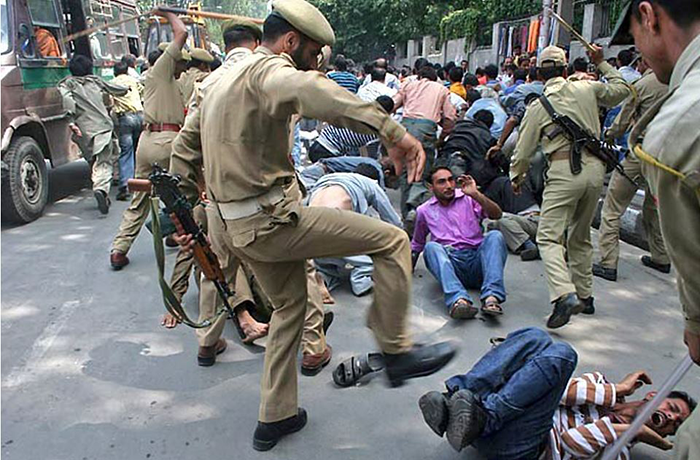
Indian shock troops, masquerading as policemen, assault Kashmiri protestors rallying against the serial violation of their human and natural rights just because they happen to be the only Muslim majority region in what is falsely claimed to be an integral part of India. Despite Kashmir’s special status (insofar as India’s constitution is concerned), which was supposed to protect the property rights of the indigenous Muslims of the region, the demographic gerrymandering of the embattled area has now been proceeding apace for the better part of five decades; as with the “only democracy in the Middle East,” a page out of Israel’s playbook, the desire was to create a Hindu majority through terrorism, authoritarian repression, forced expulsion, and ethnic cleansing — and then hold the much called-for referendum when accession into India would be a fait-accompli with mostly Hindus casting ballots.
India’s UN move stalled the Kashmiris’ advances backed by Pashtun tribesmen in aid of their Kashmiri brethren and the Pakistan army. India pledged that a referendum will be held and it would respect the wishes of the people. Initially, Indian rulers publicly made such pledges but as India tightened its grip on Kashmir, it started to backtrack culminating ultimately in Modi’s illegal act of August 5.
Shelling and exchange of gunfire on the Line of Control in Kashmir has intensified resulting in several civilians being killed on the Pakistani side. Pakistan is constrained in its response because people on both sides of the ceasefire line are Kashmiri Muslims. It cannot fire indiscriminately, unlike Indian troops who feel no compunction in killing civilians. India has also used banned cluster bombs.
Both India and Pakistan are nuclear-armed. While the two countries have pledged to not resort to “first-use policy,” the August 8 statement by India’s Defence Minister Rajnath Singh that India may not abide by this policy is a dangerous escalation of an already tense situation. Singh, like his boss Modi, is a Hindu fascist. They have unleashed millions of their fascist followers on innocent Muslims throughout India, killing and torturing men and raping women (see article about Hindu fascism in India in this issue).
Should a war break out between the two countries, it would be catastrophic not only for the region but the entire world. There is serious risk of the use of nuclear weapons, even if tactical, that could quickly escalate into something much bigger. The very thought of using nuclear weapons is horrifying.
Stone throwing Kashmiri women join the struggle to send a clear message to Indian colonial forces that all efforts to subdue the people will be met with stiff resistance.
Despite little concern shown by Western regimes, there has been much media coverage about recent developments in Kashmir. On August 23, the New York Times rubbished Indian claims that there was calm in Kashmir. “Our cameras tell a different story,” wrote the Times. This is quite interesting. Developments adversely affecting Muslims are seldom highlighted in the media unless it serves the West’s political interests (plight of Uighurs in China, for instance) or there is little cost involved (Ro-hingya refugees). This is not to suggest that such media coverage in not welcome. It has helped bring the Kashmir issue back to limelight after remaining dormant for decades. For the first time in 50 years the Security Council also held a session about Kashmir on August 16. While nothing earth shattering emerged from the closed-door meeting, there was at least discussion of Kashmir and reiteration of the fact that the dispute is still alive and has to be resolved through relevant Security Council resolutions.
Unfortunately, much of the Muslim world has also ignored the plight of the Kashmiris with some Arabian rulers — Saudi Arabia and the United Arab Emirates (UAE) — openly siding with India. As India brutalized the Kashmiris, Saudi Arabia announced a $75 billion investment in India. Tiny UAE welcomed Modi to Abu Dhabi on August 23 to confer on him the Emirates’ highest civilian award. One wonders what these Bedouins think: have they no shame? Certainly, they have no self-respect or dignity.
But Kashmir’s future was never dependent on these shameless puppets of imperialism and Zionism. The Arabian despots have abandoned the Palestinians, so it would be unrealistic to expect them to support the Kashmiris. It is the committed Muslims who will support the struggle to liberate Kashmir.
Modi and his fascist henchmen will likely regret usurping Kashmir. Like a fish-bone it will get stuck in his throat that he can neither swallow nor throw out.

 Editor