A US soldier stands in an armoured personnel carrier as the US forces pull out of their base in the Northern Syrian town of Tal Tamr, on October 20, 2019. - US forces withdrew from a key base in northern Syria today, a monitor said, two days before the end of a US-brokered truce to stem a Turkish attack on Kurdish forces in the region. (Photo: Delil Souleiman/AFP via Getty Images)
Although Trump keeps talking about bringing the troops home from the Middle East, that isn’t what he is doing.
There are some 60,000 US troops in and around the Middle East. There is no prospect of any significant number of them “coming home” any time soon.
In fact, Trump just sent nearly 2,000 troops to Saudi Arabia after the attack, attributed by many to Iran, on the Abqaiq oil processing facility.
I guess the difference between Syrian Kurds, whom he abandoned, and Saudi Arabia, to which he’s sending more troops, is about 9 million barrels a day of oil.
Moreover, Trump implies that there are cost savings to bringing the troops home, but he put up spending on the Department of Defense $130 billion a year. The 2015 Defense budget was $586 billion and that in 2019 was $716 billion. Trump wants to go on up to $750 billion. So there is no peace dividend, no extra investment in American infrastructure or bringing factory jobs back. There is just squandering of money on the military. Money invested in the Defense Department produces relatively few jobs compared to what would happen if you invested it in something useful.
So Trump hasn’t saved any money on the military and he hasn’t brought troops home.
Secretary of Defense Mark Esper, or Esperanto as Trump calls him, has announced that all the 1,000 US special operations personnel who had been embedded with the Kurdish-led Syrian Democratic Forces will go to Iraq.
Initially the plan had apparently been to send them to the Incirlik Air Force Base in Turkey, but since Turkey was targeting them with artillery, I suppose someone in Washington figured out that getting them through Turkish lines in the north and then basing them at Incirlik would be extremely awkward. Moreover, since Turkish president Tayyip Erdogan has shown almost no interest in fighting ISIL, Turkey would not be a very welcoming home for US troops so tasked.
In contrast, the Shiite government of Baghdad is extremely worried about a recrudescence of cultic ultra-right Muslim terrorism now that the US is mostly getting out of Syria.
So special operations forces will be able to strike from Iraq into eastern Syria to hit any resurgent ISIL cells. In fact, the Iraqi government has considered doing this itself, and actually launched some such strikes last November.
Just to sum up: 60,000 US troops in the Middle East, with no prospect of the number being reduced or units “brought home” except on ordinary rotations. The 1,000 troops in Syria will mostly relocate to Iraq, not to the United States. More troops have been sent to Saudi Arabia. A $750 billion Defense budget in the offing.
Not coming home. Not saving money. Not creating jobs.
If you want to identify the most reckless powers in our world today, look no further than Israel, Saudi Arabia, the United Arab Emirates, and the United States of America.
by
Vijay Prashad
Saudi Arabia and the UAE have been at war against Yemen since 2015. It is a ghastly war, a reckless war, one for which there is no end in sight. Trump wants advice on how to deal with Iran from the architect of that war—Mohammed bin Salman. (Photo: Reuters/Kevin Lamarque)
There’s no point in dredging up that old slogan, No Blood for Oil. It had no impact the last time. Don’t bomb Iraq, we said in 2002 and 2003, to no avail. George W. Bush and his friends had it in mind to destroy that country, which they did.
Donald Trump fired John Bolton. It seemed as if it would be acceptable to breathe a sigh of relief. But that was premature. Bolton was not the only one itching for a war against Iran. So was Mike Pompeo of the State Department, and so are a legion of arms dealers, lobbyists, establishment hawks, and people who believe that the United States should bomb Iran on behalf of Israel and Saudi Arabia.
Yemen’s Houthis took credit for the attack on Saudi Arabia’s eastern oilfields. But that was not enough. It was not enough that the Iraqis said that Iran did not use Iraqi territory to launch the drones. The U.S. asserted that the attack was done by Iran. No more needed to be said. There was no need to drag someone like Colin Powell before the UN Security Council. In fact, there is no one like Colin Powell in the Trump administration. None of his Cabinet members has the kind of gravitas that can be squandered with a lie.
This is madness of the highest kind—asking a man who is in the midst of an intractable war whether one should go to war.
The reaction from Iran has been calm. The government in Tehran has decided not to cower beneath the storm clouds from Washington. It threatens Canada with its own sanctions if the Canadians do not release seized Iranian assets. An oil tanker that was carrying diesel to the United Arab Emirates has been seized by the Iranians on the grounds of smuggling. Iran’s President Hassan Rouhani told the Syria Summit in Ankara, Turkey, that there can be no stability in Syria as long as U.S. troops remain there. Iran refuses to blink. It has taken the position that it must stand strong and call the U.S. bluff.
This is a dangerous bluff.
But it is also a calculated one.
Trade, Not Bombs
The Iranians know that there is no appetite in Europe for a U.S. war or even a U.S. military strike. This week, Michael Bock, the chair of the Instrument for Supporting Trade Exchanges (INSTEX), is in Tehran. INSTEX is the mechanism created by the European Union to sidestep the U.S. unilateral sanctions. Bock has met with the governor of the Central Bank of Iran and the head of SATMA—the Iranian institution created to facilitate INSTEX. The Europeans are eager to restart trade with Iran. They are not interested in Trump’s froth.
Nor are the Turks, whose senior banking officials have met with the Iranians to discuss how to reestablish trade outside the U.S. orbit. Turkey is interested in its own version of INSTEX and is calibrating what it would mean for Turkey and Iran to trade using their own currencies (in the rial or the lira). Both countries have said that they would like to increase trade to $30 billion—three times the highest trade volume.
Even the British, embroiled in their Brexit mess, are not eager for war. UK Foreign Secretary Dominic Raab said that “the picture is not entirely clear” as to who bombed the Saudi oil fields. He sounded like the Russians (no “hasty conclusions,” said Dmitry Peskov) and the Chinese (not easy to “apportion blame,” said Hua Chunying).
Russia and China
From the perspective of Russia and China, a U.S. bombardment of Iran would undermine their economic projects in Eurasia. There is fear in Moscow and Beijing that such an American adventure would rip apart whatever small measure of stability has been achieved from the Mediterranean Sea to the Hindu Kush mountains. The failed U.S. peace talks in Afghanistan leave that country now open to the initiatives from regional powers, including China and Russia.
One little-known aspect of the U.S.-Taliban talks over Afghanistan has been the role of China. In June and July, both Abdul Ghani Baradar—the Taliban’s chief negotiator—and Zalmay Khalilzad—the U.S. negotiator—came to Beijing at different times. China played a key role in urging Pakistan to pressure the Taliban in these talks. Even as the U.S. has stepped away, China will continue to build relations with various factions in Afghanistan. This is essential for the China-Pakistan Economic Corridor and the Trans-Himalayan Economic Corridor, which draw the Belt and Road Initiative southward into Pakistan and Nepal.
A U.S. war against Iran would upend the already terrible security situation in Afghanistan, and it would tear apart Syria and Iraq, as well as Lebanon. This is something that neither China nor Russia would like. That is why the U.S. will never get a favorable UN Security Council resolution to hit Iran. It would have to do it unilaterally. There are no allies for Trump apart from Israel, Saudi Arabia, and the United Arab Emirates: This is a Coalition of the Foolish.
Recklessness
Recklessness is not the mood in Tehran—nor in Moscow or Beijing. That should by now be clear.
If you want to identify the most reckless powers in our world today, look no further than Israel, Saudi Arabia, the United Arab Emirates, and the United States of America.
Israel’s Benjamin Netanyahu has said that he wants to annex the illegal settlements in the West Bank into Israel and leave a small, encircled rump territory occupied; this rump would include Ramallah. East Jerusalem would also likely be snatched fully in this move. This is recklessness. The reaction in Palestine would be another intifada, and—very likely—it would occasion rocket strikes not only from Gaza but also from Lebanon. Such an annexation would be an invitation to war.
Saudi Arabia and the UAE have been at war against Yemen since 2015. It is a ghastly war, a reckless war, one for which there is no end in sight. Trump wants advice on how to deal with Iran from the architect of that war—Mohammed bin Salman. This is madness of the highest kind—asking a man who is in the midst of an intractable war whether one should go to war.
Which brings us to the U.S. Trump has threatened war against Venezuela and Iran. He has used the entire apparatus of the U.S. war and money machine to conduct a hybrid war against these states. He has thus far not sanctioned a bombing run on them. But you never know. As I type these lines, Trump might be signing a document to authorize war.
No one on the planet wants Trump’s wars. We can march on the streets as we did in 2003, and the U.S. would not pay attention to us. Certainly, Bush did not, and certainly Trump will not. The U.S. is a reckless power. It needs to be checked.
This article was produced by Globetrotter, a project of the Independent Media Institute.
After years of reporting on the Global War on Terror, many questions behind the US attacks remain unresolved
ByPEPE ESCOBAR
A week back as the U.S. marked the 18th anniversary of the highly suspicious incident of the collapse of New York’s landmark 110-storey high twin-tower World Trade Center, it was once again the repetition of preposterous lies by American politicians and the mainstream western media, which think they can fool the world by continuing to hide the truth.
The following is an interesting article in this regard for the ‘Asia Times’ by investigative Brazilian journalist, Pepe Escobar, titled: “We are all hostages of 9/11”.
Afghanistan was bombed and invaded because of 9/11. I was there from the start, even before 9/11. On August 20, 2001, I interviewed commander Ahmad Shah Massoud, the “Lion of the Panjshir,” who told me about an “unholy alliance” of the Taliban, al-Qaeda and the ISI (Pakistani intel).
Back in Peshawar, I learned that something really big was coming: my article was published by Asia Times on August 30. Commander Massoud was killed on September 9: I received a terse email from a Panjshir source, only stating, “the commander has been shot.” Two days later, 9/11 happened.
And yet, the day before, none other than Osama bin Laden, in person, was in a Pakistani hospital in Rawalpindi, receiving treatment, as CBS reported. Bin Laden was proclaimed the perpetrator already at 11am on 9/11 – with no investigation whatsoever. It should have been not exactly hard to locate him in Pakistan and “bring him to justice.”
In December 2001 I was in Tora Bora tracking bin Laden – under B-52 bombers and side by side with Pashtun mujahideen. Later, in 2011, I would revisit the day bin Laden vanished forever.
One year after 9/11, I was back in Afghanistan for an in-depth investigation of the killing of Massoud. By then it was possible to establish a Saudi connection: the letter of introduction for Massoud’s killers, who posed as journalists, was facilitated by commander Sayyaf, a Saudi asset.
Saudi-born alleged terror mastermind Osama bin Laden is seen in a video taken at a secret site in Afghanistan. This was aired by Al-Jazeera on Oct. 7, 2001, the day the US launched bombing of terrorist camps, airbases and air defense installations in its campaign against the Taliban for sheltering bin Laden. Photo: AFP
For three years my life revolved around the Global War on Terror; most of the time I lived literally on the road, in Afghanistan, Pakistan, Iran, Iraq, the Persian Gulf and Brussels. At the start of ‘Shock and Awe’ on Iraq, in March 2003, Asia Times published my in-depth investigation of which neo-cons concocted the war on Iraq.
In 2004, roving across the US, I re-traced the Taliban’s trip to Texas, and how a top priority, since the Clinton years all the way to the neo-cons, was about what I had baptized as “Pipelineistan” – in this case how to build the Turkmenistan-Afghanistan-Pakistan-India (TAPI) gas pipeline, bypassing Iran and Russia, and extending US control of Central and South Asia.
Later on, I delved into the hard questions the 9/11 Commission never asked, and how Bush’s 2004 reelection campaign was totally conditioned by and dependent on 9/11.
Michael Ruppert, a CIA whistleblower, who may – or may not – have committed suicide in 2014, was a top 9/11 analyst. We exchanged a lot of information, and always emphasized the same points: Afghanistan was all about (existent) heroin and (non-existent) pipelines.
Now, President Trump may have identified a possible Afghan deal – which the Taliban, who control two-thirds of the country, are bound to refuse, as it allows withdrawal of only 5,000 out of 13,000 US troops. Moreover, the US ‘Deep State’ is absolutely against any deal, as well as India and the rickety government in Kabul.
But Pakistan and China are in favor, especially because Beijing plans to incorporate Kabul into the China-Pakistan Economic Corridor and have Afghanistan admitted as a member of the Shanghai Cooperation Organization, thus attaching the Hindu Kush and the Khyber Pass to the ongoing Eurasia integration process.
Praying for a Pearl
Eighteen years after the game-changing fact, we all remain hostages of 9/11. US neocons, gathered at the Project for the New American Century, had been praying for a “Pearl Harbor” to reorient US foreign policy since 1997. Their prayers were answered beyond their wildest dreams.
Already in The Grand Chessboard, also published in 1997, former National Security Adviser and Trilateral Commission co-founder Zbigniew Brzezinski, nominally not a neocon, had pointed out that the American public “supported America’s engagement in World War II largely because of the shock effect of the Japanese attack on Pearl Harbor.”
So, Brzezinski added, America “may find it more difficult to fashion a consensus on foreign policy issues, except in the circumstance of a truly massive and widely perceived direct external threat.”
As an attack on the homeland, 9/11 generated the Global War on Terror, launched at 11pm on the same day, initially christened “The Long War” by the Pentagon, later sanitized as Overseas Contingency Operations by the Obama administration. This cost trillions of dollars, killedover half a million people and branched out into illegal wars against seven Muslim nations – all justified on “humanitarian grounds” and allegedly supported by the “international community.”
Year after year, 9/11 is essentially a You Have The Right to Accept Only The Official Version ritual ceremony, even as widespread evidence suggests the US government knew 9/11 would happen and did not stop it.
Three days after 9/11, the Frankfurter Allgemeine Zeitung reported that in June 2001, German intelligence warned the CIA that Middle East terrorists were “planning to hijack commercial aircraft to use as weapons to attack important symbols of American and Israeli culture.”
In August 2001, President Putin ordered Russian intel to tell the US government “in the strongest possible terms” of imminent attacks on airports and government buildings, MSNBC revealed in an interview with Putin that was broadcast on September 15 that year.
No US government agency has released any information on who used foreknowledge of 9/11 in the financial markets. The US Congress did not even raise the issue. In Germany, investigative financial journalist Lars Schall has been working for years on a massive study detailing to a great extent insider trading before 9/11.
Mr Mueller, I presume
Robert Mueller was the Director of the FBI from 2001 to 2003. He was appointed by President Bush only one week before 9/11. Three days after 9/11, Mueller said, “there were no warning signs that I’m aware of” pointing to the possibility of airplanes crashing into buildings.
In fact FBI agents repeatedly accused HQ of blocking myriad investigations before 9/11 that could have prevented it.
In a devastating book, The FBI Accomplice of 9/11 (Documents), written in French and recently translated into English, Patrick Pasin painstakingly tracks all warnings on record: not only to the FBI, directly, but also including the by now notorious “August 6 memo,” which referred to planned attacks involving multiple airplane hijackings. Then National Security Adviser Condoleeza Rice famously dismissed the memo as “very vague,” “very non-specific” and “nothing really new here.”
Pasin meticulously aims to prove that the FBI knew all there was to know about indications toward the possibility of a 9/11. But then the bureau silenced them; buried them; made them disappear; fell into a prolonged comma; and, in quite serious instances, may have even forged false evidence, as in arguably fabricating a list of Muslim hijackers, complete with the finding of indestructible passports, and forging impossible phone calls placed at 30,000 feet.
Trump knows buildings
Discrediting the official, immutable 9/11 narrative remains the ultimate taboo. Hundreds of architects and engineers engaged in meticulous technical debunking of all aspects of 9/11’s official story are summarily dismissed as “conspiracy theorists.”
In the afternoon of 9/11, Donald Trump the real estate developer (not yet President of the United States) was interviewed by phone by Channel 9 in New York.
Fasten your seat belts, because this is incandescent. The serial money quotes start rolling at 5:20:
Channel 9: “There is a great deal of questions about whether or not the damage and the ultimate destruction of the buildings was caused by the airplanes, by architectural defect or possibly by bombs, or after-shocks. Do you have any thoughts on that?”
Donald Trump: “It wasn’t architectural defect. The World Trade Center was always known as a very, very strong building. Don’t forget that it took a big bomb in the basement [in 1993]. Now the basement is the most vulnerable place, because that is your foundation and it withstood that. And I got to see that area about 3 or 4 days after it took place, because one of my structural engineers actually took me for a tour because he did the building. And I said ‘I can’t believe it’. The building was standing solid and half of the columns were blown out. This was an unbelievably powerful building if you know anything about structure. It was one of the first buildings that was built from the outside. The steel, the reason the WTC had such narrow windows is that in between all the windows you had steel on the outside of the building. That’s why when I first looked at it you had big, heavy I-beams. When I first looked at it I couldn’t believe it because there was a hole in the steel. And this was steel that was … you remember the width of the windows of the World Trade Center, folks, I think that you know, if you were ever up there, they were quite narrow and in between was this heavy steel. I said: How could a plane, even a 767 or 747 or whatever it might have been, how could it possibly go through the steel? I happen to think that they had not only a plane, but they had bombs that exploded almost simultaneously. [italics mine]. Because I just can’t imagine anything being able to go through that wall. Most buildings are built with the steel on the inside around the elevator shafts. This one was built from the outside, which is the strongest structure you can have. And it was almost just like a can of soup.”
Channel 9: “You know…we were looking at pictures all morning long of that plane coming into Building #2. And when you see that approach the far side, then all of a sudden within another millisecond the explosion pops out the other side.”
Donald Trump: “Right. I just think that there was a plane with more than jet fuel.” [italics mine]
Donald Trump may be extremely controversial – and all things for all people. But one thing the former real estate developer and current President of the United States does know about is building construction.
Serious questions
In contrast, skepticism rooted in Greek and Latin tradition came up with arguably the best documentary on 9/11: Zero, an Italian production. Just as arguably the most stimulating book on 9/11 is also Italian: The Myth of September 11, by Roberto Quaglia, which offers a delicately nuanced narrative of 9/11 as a myth structured as a movie. The book became a huge hit in Eastern Europe.
Serious questions suggest quite plausible suspects to be investigated regarding 9/11, far more than 19 Arabs with box cutters. Ten years ago, in Asia Times, I asked 50 questions, some of them extremely detailed, about 9/11. After reader demand and suggestions, I added 20 more. None of these questions were convincingly addressed – not to mention answered – by the official narrative.
World public opinion is directed to believe that on the morning of 9/11 four airliners, presumably hijacked by 19 Arabs with box cutters, traveled undisturbed – for two hours – across the most controlled airspace on the planet, which is supervised by the most devastating military apparatus ever.
American Airlines Flight 11 deviated from its path at 8.13am and crashed into the first World Trade Center tower at 8.57am. Only at 8.46am did NORAD – the North American Aerospace Defense Command – order that two intercepting F-15s take off from Otis military base.
By a curious coincidence a Pentagon war game was in effect on the morning of 9/11 – so air-controllers’ radars may have registered only ‘ghost signals’ of nonexistent aircraft simulating an air attack. Well, it was much more complicated than that, as demonstrated by professional pilots.
‘Angel was next’
World public opinion is also directed to believe that a Boeing 757 – with a wingspan of 38 meters – managed to penetrate the Pentagon through a six-meter-wide hole and at the height of the first floor. A Boeing 757 with landing gear is 13 meters high. Airliners electronically refuse to crash – so it’s quite a feat to convince one to fly five to 10 meters above the ground, landing gear on, at a lightning speed of 800 kilometers an hour.
According to the official narrative, the Boeing 757 literally pulverized itself. Yet even after pulverization, it managed to perforate six walls of three rings of the Pentagon, leaving a two-meter wide hole in the last wall but only slightly damaging the second and third rings. The official narrative is that the hole was caused by the plane’s nose – still quite hard even after pulverization. Yet the rest of the plane – a mass of 100 tons traveling at 800 kilometers an hour – miraculously stopped at the first ring.
All that happened under the stewardship of one Hani Hanjour, who three weeks before had been judged by his flight instructors to be incapable of piloting a Cessna. Hanjour, nonetheless, managed to accomplish an ultra-fast spiral descent at 270 degrees, aligning at a maximum 10 meters above ground, minutely calibrating the trajectory, and keeping a cruise speed of roughly 800 kilometers an hour.
Chairman of the US Joint Chiefs of Staff Richard Myers, left, and US Defense Secretary Donald Rumsfeld brief reporters at the Pentagon on Oct. 8, 2001 following the US bombing raids on Afghanistan in response to 9/11 attacks. Photo: AFP / Luke Frazza
At 9.37am, Hanjour hit precisely the Pentagon’s budget analysts’ office, where everyone was busy working on the mysterious disappearance of no less than $2.3 trillion that Defense Secretary Donald “Known Unknowns” Rumsfeld, in a press conference the day before, said could not be tracked. So, it’s not only Boeings that get pulverized inside the Pentagon.
World public opinion is also directed to believe that Newtonian physics was suspended as a special bonus for WTC 1 and 2 on 9/11 (not to mention WTC 7, which was not even hit by any plane). The slower WTC tower took 10 seconds to fall 411 meters, starting from immobility. So it fell at 148 kilometers an hour. Considering the initial acceleration time, it was a free fall, not the least impeded by 47 massive, vertical steel beams that composed the tower’s structural heart.
World public opinion is also directed to believe that United Airlines Flight 93 – 150 tons of aircraft with 45 people, 200 seats, luggage, a wingspan of 38 meters – crashed in a field in Pennsylvania and also literally pulverized itself, totally disappearing inside a hole six meters by three meters wide and only two meters deep.
Suddenly, Air Force One was “the only plane in the sky.” Colonel Mark Tillman, who was on board, recalled: “We get this report that there’s a call saying ‘Angel’ was next. No one really knows now where the comment came from – it got mistranslated or garbled amid the White House, the Situation Room, the radio operators. ‘Angel’ was our code name. The fact that they knew about ‘Angel,’ well, you had to be in the inner circle.”
This means that 19 Arabs with box cutters, and most of all their handlers, surely must have been “in the inner circle.” Inevitably, this was never fully investigated.
Already in 1997, Brzezinski had warned, “it is imperative that no Eurasian challenger emerges capable of dominating Eurasia and thus of also challenging America.”
In the end, much to the despair of US neocons, all the combined sound and fury of 9/11 and the Global War on Terror/Overseas Contingency Operations, in less than two decades, ended up metastasized into not only a challenger but a Russia-China strategic partnership. This is the real “enemy” – not al-Qaeda, a flimsy figment of the CIA’s imagination, rehabilitated and sanitized as “moderate rebels” in Syria.
An insider’s account of how Pakistan got sucked into the “War of Terror”
Zafar Bangash
Despite devoting thousands of hours of airtime and acres of newsprint to the official version of 9/11, the list of skeptics is still growing 18 years later. Included in this list are nearly 2,000 architects, structural engineers, demolition experts, airline pilots, and strategic analysts.
The official version is that 19 Arabs who could not fly even a single engine plane straight commandeered four jetliners. Flying them at high speed and performing complicated manuevres that even highly trained air force pilots would find difficult to carry out, they crashed two of them into the twin towers of the World Trade Centre in New York, one into the Pentagon building in Washington, DC and a fourth crashed in the fields outside Pennsylvania. Three buildings collapsed including Building No. 7 at the World Trade Centre that had not been hit by any object. Further, the two towers collapsed on their own footprint because, we were told the steel used in the buildings “melted” under intense heat generated by the burning jet fuel.
Three other details are relevant. First, Dan Rather of CBS News reported the same day that a “Flying manual in Arabic” was found in the car of one of the “hijackers” at Logan Airport in Boston from where the planes had taken off in the early morning of September 11, 2001. Second, that while heat from the burning fuel was so intense that it “melted” steel, somehow the passport of the alleged ringleader, Muhammad ‘Ata, survived this inferno intact. Why was he carrying a passport if he was supposedly on a suicide mission? Third, the BBC correspondent in New York reported on air that Building No. 7 had collapsed a half hour before the actual collapse!
There are other anomalies in the official version but we will not detain ourselves with such details here. There was one person who was virtually in the thick of events when the 9/11 attacks occurred: General Mahmood Ahmed, at the time serving as Director of Pakistan’s premier intelligence agency, the Inter-Services Intelligence (ISI). He was in Washington, DC on the morning of 9/11 meeting congressional leaders on Capitol Hill.
In December 2018, this writer met General Mahmood at his residence in Lahore (for the record, General Mahmood and this writer studied at the same institution in Pakistan: Lawrence College, Ghora Gali, Murree. He was four years senior to me). Since his retirement from the army, he has joined the Tablighi Jama‘ah, grown a long beard, and prays regularly. When in service, he had the reputation as a tough, “no nonsense” general. My friend and celebrated author and journalist Eric Margolis described him as absolutely “ferocious”!
When asked about his recollection of what happened during his congressional meeting on the morning of 9/11, this is what General Mahmood related (his words have been paraphrased). He had arrived in the US on September 1 and was due to leave on September 10. While he met a number of generals at the Pentagon and CIA officials who had invited him, a few senior figures from the US government or Congress afforded him time. The purpose of his visit was to see if he could get some of the sanctions the US had imposed on Pakistan eased. He had little luck.
On September 10, as he was preparing to leave his hotel for the return flight home, he received a call that Republican Senator Porter Goss and Democratic Senator Bob Graham would like to meet him the following morning for breakfast at Capitol Hill. He immediately accepted the offer, postponing his return flight, hoping to communicate Pakistan’s point of view to the two influential American figures.
At the breakfast meeting, there were six persons from each side. In addition to the two senators, there were four staffers. On the Pakistani side, Ambassador Maleeha Lodhi and the Political Officer at the Pakistan embassy in DC accompanied General Mahmood plus three aides. As they held discussions over breakfast, an aide entered the room and handed the senators a piece of paper and then quickly left. Half hour or so later, another aide came in and handed Goss another piece of paper. He showed it to Graham and then the two senators got up and said, “General, we will have to end this meeting. Something urgent has come up.” They appeared greatly agitated and nervous, according to General Mahmood.
He also said, until then he had no idea what was going on. There was no TV in the room. They learned about the twin tower attacks on their way out when they saw the television screens that people were glued to. They saw the twin towers burning with thick smoke billowing out. All flights in and out of the US were immediately grounded resulting in General Mahmood being stuck in DC for several days.
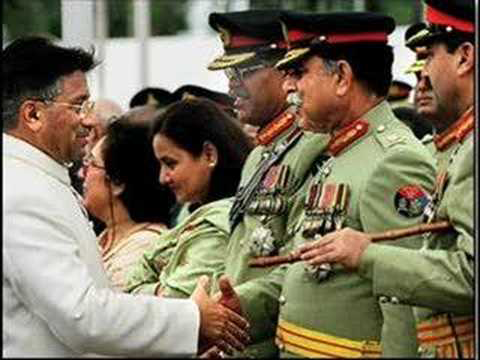
General Mahmood Ahmed shakes hands with then President Pervez Musharraf, left, in 2001, whom he “engineered” into office but later fell out with due to the latter’s desire to secure American political favors under the rubric of “saving” Pakistan from America’s war against the Taliban.
During his 10-day visit from September 1–10, few American officials had time for him. Following the 9/11 attacks, everybody wanted to see him from the White House staff to the State Department and the Pentagon. On September 12, General Mahmood and Ambassador Maleeha Lodhi had a meeting with members of the National Security Council. There were other meetings with CIA, Pentagon, and State Department officials.
When I asked him about his meeting with the burly Richard Armitage, the former Navy Seal who was then serving as Assistant Secretary of State at the State Department, General Mahmood said he desperately needed Pakistan’s help. I specifically asked him about media reports about Armitage’s threats against Pakistan (in his interview with CBS’ “60 Minutes” program on September 17, 2006, General Pervez Musharraf had said Armitage had threatened to bomb Pakistan “back into the Stone Age”).
General Mahmood rejected such assertions. “Despite his massive bulk and his head cocked up because of his oversized neck, Richard Armitage spoke softly and politely. Reports of his threats against Pakistan are completely untrue.”
Scott Conroy’s report on the CBS website (September 23, 2006) corroborates General Mahmood’s position. “On Friday [September 22, 2006], US President George W. Bush said that he was taken aback when he heard the claim [about Armitage’s threats to Pakistan], while Mr. Armitage denied he had ever threatened the use of military action against Pakistan if it refused to join the US-led war on terror after the Sept. 11 terrorist attacks,” Conroy wrote.
According to General Mahmood’s recollection, American officials were both nervous and confused. They needed help and they turned to Pakistan. The September 12, 2001 phone call from US Secretary of State Colin Powell to Musharraf is well known. As absolute dictator, Musharraf accepted each and every one of the US demands without consulting anyone or asking anything in return. The rest, as they say, is history.
By surrendering to US demands, Musharraf, hitherto shunned by the West, immediately became the most sought after Third-World ruler. Not only American but European leaders also made a beeline to Pakistan seeking its help in what was going to be a devastating war on the Taliban in Afghanistan. Musharraf thought he had hit a jackpot!
Soon after the Americans launched their war on Afghanistan (October 7, 2001), General Mahmood was relieved of his responsibilities as Director ISI. He resigned from the army and went into retirement. The two generals — Musharraf and Mahmood — were quite close and had worked together for decades. Now they had a falling out over the manner in which Musharraf threw in his lot with the Americans against the Taliban.
It needs recalling that General Mahmood was one of the main organizers of the coup that overthrew Nawaz Sharif and brought Musharraf to power in October 1999. The other was General Muhammad Aziz Khan, then Chief of General Staff but it was General Mahmood who played the key role. As Commander 10 Corps to which the 111 Brigade belongs, it was General Mahmood who ordered the 111 Brigade to arrest Nawaz Sharif and take over Pakistan Television Station (the 111 Brigade is tasked with carrying out coups!).
In his long and distinguished military career, General Mahmood, an artillery officer, had also served as Director Military Intelligence. He was unhappy with the manner in which Musharraf had abandoned the Taliban. The Americans clearly wanted him out of the way. Musharraf could not resist US pressure and caved in. It also served Musharraf’s purpose in other ways. He did not want powerful generals around him that could challenge his authority (in its inner workings the Pakistani military is quite democratic; generals and even junior officers speak their mind freely). Removal of General Mahmood earned Musharraf brownie points with the Americans.
The US conduct toward Pakistan once the Taliban were ousted from power vindicated General Mahmood’s position. The Americans are again asking Pakistan to help “extricate” their forces from Afghanistan, as Donald Trump stated during his White House meeting with Pakistani Prime Minister Imran Khan on July 22. There are few people in Pakistan who harbor any illusions about US duplicity. Once the US is able to safely withdraw its forces from Afghanistan, Pakistan would again be ditched. It cannot be ruled out that the US may even reimpose sanctions on Pakistan.