Showing posts with label JUAN COLE. Show all posts

Friday, December 06, 2019

Trump Fails Again to Bring Our Troops Home From Mideast: Mulling Escalation of 14,000 US Troops to the Middle East to Counter Iran

It's not clear how another 14,000 US troops would effectively do anything to block Iran.


A new contingent of 14,000 troops would double the extra total sent in 2019 alone and bring the over-all number to 74,000. (Photo: Delil Souleiman/AFP via Getty Images)
A new contingent of 14,000 troops would double the extra total sent in 2019 alone and bring the over-all number to 74,000. (Photo: Delil Souleiman/AFP via Getty Images)
Although the Pentagon pushed back against the initial report, that had only said they were considering the troop escalation, and the Pentagon did not deny considering it.
Trump has sent 14,000 troops to the Mideast since last May. Apparently the bulk of them are on an aircraft carrier. Some 3,000 are being sent to Saudi Arabia to help man new Patriot anti-missile batteries provided to the Kingdom after the September Iran-backed drone and rocket strikes on the Abqaiq oil facility, which temporarily took 5% of the world’s oil off the market.
Trump made a big splash in October by claiming to bring home the 1,000 special operations personnel embedded with the Kurds in northern Syria. In fact, in the end he sent 500 of them to guard the Syrian oil fields in Deir al-Zor and repositioned the rest in Iraq.
So he didn’t actually bring any troops home, but has sent in 14,000 in the past half-year. There are some 60,000 US troops in the Greater Middle East, but their exact distribution is now hidden by the Pentagon.
A new contingent of 14,000 troops would double the extra total sent in 2019 alone and bring the over-all number to 74,000.
Aside from Iraq, Syria and Afghanistan, most US troops in the region are not war fighters. There are nearly 5,000 sailors at the HQ of the 5th Fleet at Manama, Bahrain. There are another 11,000 at al-Udeid Air Force Base in Qatar, from which many air missions against ISIL in Iraq and Afghanistan and against the Taliban in the latter country are flown.
In June of 2017 Trump put the al-Udeid base in jeopardy by publicly backing the Saudi Arabian blockade of Qatar, but he was counter-acted by the Secretary of Defense James Mattis and then Secretary of State Rex Tillerson.
It is not clear to me how another 14,000 US troops would effectively do anything to block Iran. The 3,000 planned for Saudi Arabia to man the Patriot batteries make sense on the surface, at least, but that was part of the last 14,000-troop escalation. It is being reported that one Pentagon concern is Iranian missiles in Iraq. But Iraq currently doesn’t actually have a government and it is difficult to understand how Baghdad practically speaking could authorize an increase in 5,000 or so US troops stationed there (they largely advise the Iraqi Army on clean-up missions against the remnants of the ISIL terrorist group).
Iran does not have a significant number of Iranian troops outside the country. There may be a small contingent of Iranian Revolutionary Guards Corps advisers in Iraq at the invitation of Baghdad, though their welcome among the protesting masses they and their proteges among the Shiite Iraqi militias is growing thin. There are about 2500 Iranian Revolutionary Guards Corps advisers in Syria. At the height of the civil war back in 2016 there were estimated to be another 7500 or so conscripted Afghan and other foot soldiers, but it isn’t clear how many of those are still in country. I doubt there are more than a handful of IRGC personnel in Lebanon, though Iran funds the Shiite party-militia, the Hizbullah.

Iran has mainly benefited from soft power in the region, which can’t be countered easily by 14,000 US troops.
Juan Cole
Juan Cole teaches Middle Eastern and South Asian history at the University of Michigan. His new book, The New Arabs: How the Millennial Generation Is Changing the Middle East (Simon and Schuster), will officially be published July 1st. He is also the author of Engaging the Muslim World and Napoleon's Egypt: Invading the Middle East (both Palgrave Macmillan). He has appeared widely on television, radio and on op-ed pages as a commentator on Middle East affairs, and has a regular column at Salon.com. He has written, edited, or translated 14 books and has authored 60 journal articles.

Wednesday, October 23, 2019

No, Trump Isn't Bringing US Troops Home

Not those in Syria and not any of the 60,000 soldiers spread across the Mideast

A US soldier stands in an armoured personnel carrier as the US forces pull out of their base in the Northern Syrian town of Tal Tamr, on October 20, 2019. - US forces withdrew from a key base in northern Syria today, a monitor said, two days before the end of a US-brokered truce to stem a Turkish attack on Kurdish forces in the region. (Photo: Delil Souleiman/AFP via Getty Images)
Although Trump keeps talking about bringing the troops home from the Middle East, that isn’t what he is doing.
There are some 60,000 US troops in and around the Middle East. There is no prospect of any significant number of them “coming home” any time soon.
In fact, Trump just sent nearly 2,000 troops to Saudi Arabia after the attack, attributed by many to Iran, on the Abqaiq oil processing facility.
I guess the difference between Syrian Kurds, whom he abandoned, and Saudi Arabia, to which he’s sending more troops, is about 9 million barrels a day of oil.
Moreover, Trump implies that there are cost savings to bringing the troops home, but he put up spending on the Department of Defense $130 billion a year. The 2015 Defense budget was $586 billion and that in 2019 was $716 billion. Trump wants to go on up to $750 billion. So there is no peace dividend, no extra investment in American infrastructure or bringing factory jobs back. There is just squandering of money on the military. Money invested in the Defense Department produces relatively few jobs compared to what would happen if you invested it in something useful.
So Trump hasn’t saved any money on the military and he hasn’t brought troops home.
Secretary of Defense Mark Esper, or Esperanto as Trump calls him, has announced that all the 1,000 US special operations personnel who had been embedded with the Kurdish-led Syrian Democratic Forces will go to Iraq.
Initially the plan had apparently been to send them to the Incirlik Air Force Base in Turkey, but since Turkey was targeting them with artillery, I suppose someone in Washington figured out that getting them through Turkish lines in the north and then basing them at Incirlik would be extremely awkward. Moreover, since Turkish president Tayyip Erdogan has shown almost no interest in fighting ISIL, Turkey would not be a very welcoming home for US troops so tasked.
In contrast, the Shiite government of Baghdad is extremely worried about a recrudescence of cultic ultra-right Muslim terrorism now that the US is mostly getting out of Syria.
So special operations forces will be able to strike from Iraq into eastern Syria to hit any resurgent ISIL cells. In fact, the Iraqi government has considered doing this itself, and actually launched some such strikes last November.
Just to sum up: 60,000 US troops in the Middle East, with no prospect of the number being reduced or units “brought home” except on ordinary rotations. The 1,000 troops in Syria will mostly relocate to Iraq, not to the United States. More troops have been sent to Saudi Arabia. A $750 billion Defense budget in the offing.
Not coming home. Not saving money. Not creating jobs.
Juan Cole
Juan Cole teaches Middle Eastern and South Asian history at the University of Michigan. His new book, The New Arabs: How the Millennial Generation Is Changing the Middle East (Simon and Schuster), will officially be published July 1st. He is also the author of Engaging the Muslim World and Napoleon's Egypt: Invading the Middle East (both Palgrave Macmillan).

Thursday, June 27, 2019

Dear Trump (and the US media): Iran doesn’t have a nuclear weapons program

Juan Cole
Islam forbids the killing of the innocents, and in accordance with Divine teachings the Leader of the Islamic Revolution, Seyyed Ali Khamenei, has issued a religious edict (fatwa) prohibiting manufacture of weapons of mass destruction including atomic bombs.
A fact confirmed by the International Atomic Energy Agency (IAEA) and even by Japanese Prime Minister Abe Shinoza during his visit to Tehran earlier this month, yet the Godless American administration which has stockpiled a doomsday arsenal falsely says Iran has nuclear weapons ambitions.
Here we present you an article from the ‘Informed Comment’ site, titled: “Dear Trump (and the US Media): Iran Doesn’t Have a Nuclear Weapons Program”.
The writer is Juan Cole who teaches Middle Eastern and South Asian history at the University of Michigan, and is the author of 14 books and at least 60 research articles.
Julian Borger at The Guardian reports that Trump said recently to reporters: “They’re not going to have a nuclear weapon. We’re not going to have Iran have a nuclear weapon. When they agree to that, they’re going to have a wealthy country. They’re going to be so happy, and I’m going to be their best friend. I hope that happens.”
Trump can’t get the conservative script right to save his life. The argument warmongers made for breaching the 2015 international nuclear deal (Joint Comprehensive Plan of Action or JCPOA) was that it did not address a range of other issues beyond nuclear matters – such as Iran’s principled backing of the popular Lebanese Muslim force, the Hezbollah, Iran’s help upon request to Syria against terrorism, and Iran’s right to develop the non-nuclear ballistic missile defence system for protection of its national sovereignty and territorial integrity.
Although UN inspectors continue to monitor Iran’s inalienable right to develop nuclear energy for peaceful purpose, Trump is now citing Iran’s non-existent bomb-making as the reason for his breach of the treaty and not mentioning any of the things the hawks mind.
Iran isn’t making a bomb and gave up 80% of its civilian nuclear enrichment program in the JCPOA.
In fact, there have been no US intelligence assessments that Iran has decided to try to make a bomb as it is a signatory to the Non-Proliferation Treaty (NPT).
Uranium comes in nature in two isotopes, U-238 (very common and relatively inert) and U-235 (rarer and much more volatile). In order to use uranium to fuel a nuclear reactor, it has to be enriched to roughly 3.5% of U-235. If it is enriched to 95% U-235, it can be made to blow up in a thermonuclear explosion, as the US did at Hiroshima and Nagasaki in 1945 – when it bombed the two Japanese cities, mass massacring the whole populations.
Iran knows how to enrich uranium, but has never enriched to levels above what is considered “Low Enriched Uranium.” The cut-off is above 20% U-235. It has a medical reactor that uses 19.5% enriched uranium.
Although the CIA has not assessed that Iran has during the past decade and a half had a nuclear weapons program, its civilian enrichment capacities – without the least evidence – have constantly been blamed by the US as potentially of dual use, with a chance to militarize.
I can’t get anybody to believe me on this, but Iran is a Shi’ite Muslim country with a religious system of government led by an Ayatollah, and Seyyed Ali Khamenei has given several fatwas (fatwas or considered legal rulings) in which he has forbidden the making, stockpiling or use of nuclear weapons. He rules according to Islamic law, which disallows the deliberate infliction of mass casualties on civilian noncombatants in war. Nuclear weapons obviously target the populations of whole cities and so the Shi’ite maraje’ (sources of emulation) consider them tools of Satan.
On the other hand, having the world know that you could whip up a nuclear bomb in short order is a form of deterrence against invasion. Japan has that capability.
The 2015 agreement attempted to forestall any move by Iran to develop a nuclear weapons enrichment program (again, it has never done so and says it never would).
Still, for the suspicious, the JCPOA took away the option of quick militarization with four steps:
1. Regular UN inspections of sites for signatures of high-enriched uranium or for plutonium
2. Reduction of number of centrifuges to 6,000, which would take a year to make bomb-grade uranium even if they were turned to that purpose
3. The bricking in and abandonment of a proposed heavy water nuclear reactor at Arak. Heavy water reactors can accumulate fissile material for a bomb faster and easier than light water reactors, so Obama and the UN team insisted on this step for Iran.
4. The stockpiles of low-enriched-Uranium (LEU) built up for the medical reactor (and which had come to much exceed the actual needs of that reactor) were cast in a form that prevented further enrichment, and much of it was exported.
Under these circumstances, there is no way Iran can make a bomb without everybody knowing it is trying. It would have to kick out the UN inspectors, build thousands more centrifuges under the gaze of US satellites, etc., etc.
So if what Trump wanted was no Iranian nuclear weapon, he had that when he was sworn into office in 2017. By breaching the treaty and refusing to reward Iran’s good behavior by ceasing sanctions, Trump put the US on a war footing with Iran.
He has stopped Iran from selling its oil, a form of blockade that probably amounts to an act of war. He is also stopping European concerns from investing in Iran.
It is frustrating that Trump is dancing on the brink of a war for a purpose that had already been attained. This is why it is bad to elect people to high office who have mental health problems.

Friday, May 17, 2019

Top Ten Differences Between the Iraq War and Trump’s Proposed Iran War

There is no way to compare the devastating consequences of the U.S. invasion of Iraq in 2003, but a war of choice with Iran would represent something on an even larger scale

White House National Security Advisor John Bolton (L) and Vice President Mike Pence listen to President Donald Trump announce his decision to withdraw the United States from the 2015 Iran nuclear deal in the Diplomatic Room at the White House May 8, 2018 in Washington, DC. After two and a half years of negotiations, Iran agreed in 2015 to end its nuclear program in exchange for Western countries, including the United States, lifting decades of economic sanctions. Since then international inspectors have not found any violations of the terms by Iran. (Photo: Chip Somodevilla/Getty Images)
1. Iraq is 168,754 mi² and Iran is 636,400 mi²; that is, Iran is geographically 3.77 times bigger than Iraq, almost 4 times as big.
2. Iraq’s population when invaded was 26 million. Iran’s population today is 81 million.
3. General Eric Shinseki testified before Congress prior to Bush’s invasion that based on the US military’s experience in the Balkans, 800,000 troops would be needed to provide security to Iraq. Secretary of Defense Donald Rumsfeld insisted on 100,000 troops, wrongly believing he could pull them out in 6 months. Bush’s viceroy in Iraq, Paul Bremer, later admitted that “we never had enough troops” in Iraq.
4. Since Iran is 3 times as populous as Iraq, by Shinseki’s correct calculation, the US would need 2.4 million troops to occupy Iran.
5. The US total military personnel count is about 2,141,900, of whom 1, 281,900 are active duty and the rest reservists.
6. Iraq’s army was a conventional military force with four powerful tank divisions, which the US Air Force turned to black carbon dust. The US only ran into trouble when Iraqis opposed to the invasion turned to guerrilla tactics, which the US never was able to deal with effectively.
7. Iran can already mobilize at least 1.5 million paramilitary “Basij” forces for guerrilla warfare. This is in addition to over 500,000 active duty military personnel.
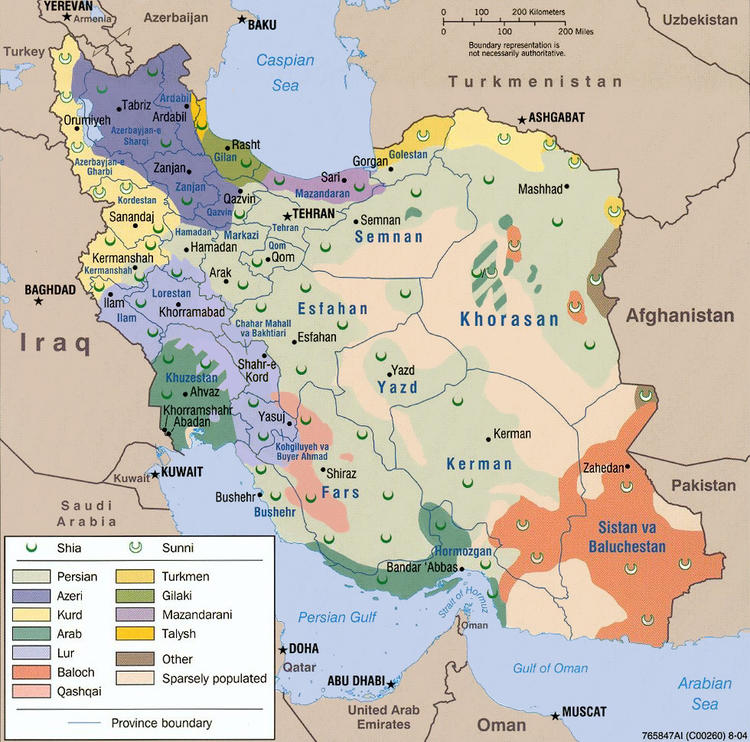
8. Iraq was largely ruled by a small Sunni minority of perhaps 17% of the population. Iran is ruled by the Shiite majority that makes up 90% of the population. That Iraq had a minority government allowed the Bush administration to make friends in the majority Shiite community by putting them in power. This step alienated and angered the Sunnis, but they were a minority and so could not do much about it. In Iran, the Shiite majority would mount a massive struggle against the US invaders.
9. Bush found international allies for his war on Iraq, including Britain and Spain. No one in Western Europe would join Trump in a war with Iran, making the US isolated and causing it to look like a unilateralist bully.
10. Whereas Iraq’s neighbors—Turkey, Iran and Saudi Arabia in particular—had been mauled by Saddam and so did not strongly oppose Bush’s invasion, Shiite Iraqis, many Syrians, the Hazaras of Afghanistan, and the some 40 million Shiites of Pakistan would support Iran.

Tuesday, December 25, 2018

Christmas and Sufism: Rumi on the Nativity and the Christ Within


Both the Christian and the Muslim traditions honor Mary the mother of Jesus and it was natural that Rumi should think about the spiritual significance of the Nativity.
As I discussed last year, the Qur’an tells the story of the virgin birth in Chapter 19, entitled “Mary.”
The Chapter of Mary, 19:16-23, says (my interpretation):
And mention in the Book Mary, when she withdrew from her family to an eastern place.

And once remote from them, she hid behind a screen. Then we sent to her our spirit, who took the shape of a well-formed man.
She said, “I take refuge in the All-Merciful from you, if you are pious.”
He said, “I am but an angel of your lord, come to bestow on you a son without blemish.”
She said, “Will I have a son, when no mortal has touched me, and I was not rebellious?”
He said, “So it is.” He said, “Your Lord says, it is easy for me. We will make him a sign for the people and a mercy from us. The matter has already been decreed.”
So she bore him, and withdrew with him to a remote place.

And the pangs of childbirth drove her to the trunk of a palm tree. She said, “I wish I had died before now, and had been forgotten in oblivion.”
Rumi in chapter 5 of his Arabic treatise “In it What is In It,” translated by AJ Arberry as “Discourses of Rumi,” makes this mention of the pangs of childbirth his starting point for considering the spiritual message of this event. I will interpret from the original Arabic text.

Rumi says that pain is what drives human beings to undertake any task. As long as the pain associated with that endeavor, and passion for it, doesn’t fill their insides, people won’t strive to accomplish that object–whether it pertains to worldly success or salvation in the next world.
It was only, Rumi observes, when the painful contractions of childbirth began that Mary hugged the palm tree. (This imagery of the Qur’an about Mary and the pain of childbirth and the palm tree draws on Greek literary traditions that were still cultivated in the Near East, which can be seen in the myth of Leto giving birth on Delos to Apollo, as Suleiman A. Mouradhas shown).
Now Rumi urges us to think about the story as an allegory of the soul. Mary, he says, is like the corporeal body, and each of us has a Jesus within us. When we experience pain, our Jesus is born. Without that excruciating torment, Jesus returns again to his essence by his secret path, and we remain deprived and lack any share in him.
Elsewhere in the Qur’an, in 3:47, when Mary asks the angel how she can give birth despite being a virgin, he replies that when God wills a thing to happen he simply says “Be!” and it is.
Rumi goes on to say that he has used words to draw out this allegory of each of our souls giving birth to our most realized selves (i.e. our Jesus) by working through a profound existential pain that we suffer.
He maintains, however, that a spiritually more advanced seeker will not need words and allegories to see this truth, but will read it in nature–in the heavens and the earth, since they themselves are the result of God’s command, “Be!” and it is.
Rumi’s notion that each human being has a Jesus within waiting to be born is not foreign to Christian mysticism.
Paul says (Gal.2: 20) “and it is no longer I who live, but it is Christ who lives in me.” In Cor. 2:16, Paul asks, ““For who has known the mind of the Lord so as to instruct him? But we have the mind of Christ (hēmeis de noun Christou echomen).”
Rumi and his son both wrote some mystical verse in Greek, showing that they knew the language well. Although it is obvious that much of Rumi’s thought is Neoplatonic, I’ve never seen anyone discuss the possible influences on him of Byzantine Neoplatonism. In any case, Rumi probably knew these verses of Paul.
So that is what Christmas means to some Sufi Muslims– it is a time to commemorate the pains that Mother Mary suffered and the birth of something wondrous, which emerges from working through the agony of the soul–the realized, perfected self, the Jesus within each of us.

About the Author

Juan Cole is the founder and chief editor of Informed Comment and Richard P. Mitchell Professor of History at the University of Michigan. He is author of, among many other books, Muhammad: Prophet of Peace amid the Clash of Empires.