Showing posts with label afghanistan. Show all posts

Tuesday, December 17, 2019

Disconnect Over Afghanistan War Shows Dysfunction of US Politics

A Washington Post report this week (reposted here) has exposed the US war in Afghanistan as a vile charade. Declassified government papers reveal notes and interviews by hundreds of senior US officials which attest to systematic lies and deception in the conduct of that war.  The GW Bush and Obama administrations are directly implicated in hoodwinking the American people about why the US went to war in Afghanistan in October 2001. Nearly two decades later, that war is continuing under the Trump administration with no sign of stopping.
Close to 150,000 people have been killed in this war, including 38,000 civilians. Afghanistan is mired in violence and corruption under a puppet regime propped up by Washington. The financial cost of the conflict is reckoned to exceed $1 trillion, which generations of American citizens will pay for through the ensuing national debt.
Senior American politicians and military leaders, from Presidents George W Bush to Barack Obama, from former Defense Secretaries Donald Rumsfeld and Leon Panetta, to generals David Petraeus and Douglas Lute, are implicated in waging an illegal war behind the backs of the American people. The Trump administration is also implicated because it continues to pursue this war. Indeed, there has been a surge in civilian deaths from US air strikes on Afghanistan since Donald Trump took over the presidency in 2017. Yet, as the Washington Post report makes clear, the entire war is a fraud. It was never about “fighting terrorism”, as the declassified interviews of US policymakers reveal. America is in a quagmire from which it doesn’t know how to extricate itself. It is not just an endless war; it is an endless criminal war.
The revelations about the Afghan war should be an earth-shattering moment for all politicians in Washington and the entire US news media. So far, only a handful of lawmakers such as Democrat Representative Ro Khanna are reportedly making an outcry. They are calling for Congressional hearings and for former government officials to be grilled in testimony. The chances are, however, that nothing will be done to hold politicians and military commanders to account. Like other major scandals, such as proven CIA torture programs, the Afghan war debacle will be allowed to fade away by Washington and corporate media indifference.
By contrast is the extravagance of taxpayer money, political energy and media attention that has been showered on relatively minor scandals.
Take “Russiagate” and the relentless, unfounded claims about Russian interference in US elections. A two-year report by special counsel Robert Mueller produced thin gruel to satisfy voracious appetites for Russian malfeasance. The hysterical conspiracy theories and media hyperbole against Russia continue to dominate, as can be discerned from the impeded bilateral relations, whereby Moscow is treated like an enemy. When Russian Foreign Minister Sergei Lavrov visited the White House this week – nearly two-and-half years after his last visit – it was evident that progress on important negotiations, such as arms control, is still frustrated by the toxic legacy of “Russiagate”.
Another illustration of cognitive dissonance in Washington and the mainstream US media is the impeachment inquiry against Trump. The Democrat-controlled House of Representatives has formally charged the president with impeachable offenses concerning a phone call with Ukrainian counterpart, Volodymyr Zelensky. Trump is accused of abusing his office for personal political gain. Many within his Republican party are not convinced by the impeachment case against Trump. It will no doubt be terminated when it goes to a vote in the Republican-controlled Senate.
The amount of political and media capital expended on “Russiagate” and what has been dubbed “Ukrainegate” is wildly disproportionate to the scant or slight evidence. The outcome so far is damaging to relations between the US and Russia, and may hamper the chances of a peaceful resolution to the Ukrainian conflict. President Vladimir Putin met with Zelensky in Paris this week for much-needed peace talks. But American politicians obsessed by Ukrainegate are undermining a potential resolution by falsely portraying Russia as an aggressor.
When something as flagrantly and hugely criminal as the war in Afghanistan – the longest-ever American war – is virtually ignored, while Washington fixates on issues like Russiagate and impeachment based on dubious claims, then we should know that the US political institutions are dysfunctional to their core.

Sunday, December 15, 2019

The Afghanistan Papers Confirm America's Longest War Is a Lie


The Washington Post’s Afghanistan Papers, detailing a true history of the nation’s longest official war, reveals nothing new about the war’s futility or about the fact that it was doomed to failure from almost the beginning. The Post fought a legal battle for three years to obtain the documents from the Special Inspector General for Afghanistan Reconstruction (SIGAR), a federal government watchdog agency that interviewed hundreds of officials about their honest assessments of the war.
What the Afghanistan Papers do offer is a confirmation of what critics had already been asserting for nearly two decades: that there is no clearly defined goal or endpoint to the war to help determine when to stop fighting, and that our efforts have been futile at best and deeply destructive at worst.
More than 10 years ago I wrote, together with James Ingalls, a critical assessment of the Afghanistan war. The title of our book was Bleeding Afghanistan: Washington, Warlords, and the Propaganda of Silence (Seven Stories, 2006). Those last three words, “the Propaganda of Silence,” are a direct reference to poor media coverage and the irresponsible manner in which the press took an uncritical view of the war. The evidence was there for all to see that the U.S. war was doomed to failure once you scratched beneath the surface of officials’ rosy rhetoric.
The most important function of the Afghanistan Papers is to confirm that government officials have been utterly dishonest with the public about U.S. achievements and progress in Afghanistan. John Sopko, the Special Inspector General at SIGAR, admitted to the Post that the documents prove that “the American people have constantly been lied to.”
The picture that emerges of how insiders have viewed the war is startlingly similar to how critics have portrayed it over the years. Earlier this year I wrote a “Brief History” of the Afghanistan war for Truthdig in which I assessed the early years of the conflict:
The Bush plan to build a stable Afghan government as a bulwark against the Taliban and al-Qaida failed for reasons that had as much to do with imperial hubris as it did with the practical shortcuts taken by an outsider to patch together a precarious government—as if that were a sufficient substitute for real democracy.
In comparison, one economist told SIGAR, as revealed in the Afghanistan Papers, that he:
… blamed an array of mistakes committed again and again over 18 years — haphazard planning, misguided policies, bureaucratic feuding. Many said the overall nation-building strategy was further undermined by hubris, impatience, ignorance and a belief that money can fix anything.
In my history of the war, I also wrote: “Obama’s strategy included a temporary increase in troops, as if throwing more American soldiers at the problem would help any one of his goals stick.” But, I continued, “The Taliban appears to have had a ‘wait it out’ strategy with respect to Americans, stringing along the U.S. and the Afghan government over several years of talks until it had the upper hand to return to power.”
By comparison, the Afghanistan Papers revealed that “Obama’s strategy was also destined to fail,” as it relied on “a massive counterinsurgency campaign, backed by 150,000 U.S. and NATO troops.” In the end, I concluded: “Obama tried to set artificial dates for ending the war before it was over. All the Taliban had to do was wait him out.”
In 2015 I wrote in another piece for Truthdig titled “We Have Failed Afghanistan Again and Again,” that:
Despite spending billions of dollars—the U.S. offered its largest share of foreign aid to Afghans last year—there is little to show for it. Nearly $10 billion was spent on arming and training Afghan forces. But as the dismal state of the Afghan National Army shows, that money may as well have been poured down the drain.
By comparison, the Afghanistan Papers reveal that officials privately knew they were fueling corruption, and that “Much of the money … ended up in the pockets of overpriced contractors or corrupt Afghan officials, while U.S.-financed schools, clinics and roads fell into disrepair, if they were built at all.”
The U.S. has also been lining the pockets of Afghanistan’s most notorious warlords, who have a long and bloody history going back to the era of Soviet occupation, when the CIA doled out cash to fight its Cold War enemy. In my 2006 book, my co-author and I warned against this practice, devoting a whole chapter to it, titled “Replacing One Brutal Regime With Another.” We suggested that instead of rewarding them with cash and government positions, the U.S. ought to disarm the warlords and help Afghans bring them to justice. The U.S. did the opposite, and the result was entirely predictable.
The Afghanistan Papers confirm that:
According to the interviews, the CIA, the U.S. military, the State Department and other agencies used cash and lucrative contracts to win the allegiance of Afghan warlords in the fight against al-Qaeda and the Taliban. Intended as a short-term tactic, the practice ended up binding the United States to some of the country’s most notorious figures for years.
One senior government official told SIGAR, “We were giving out contracts to pretty nasty people, empowering people we shouldn’t have empowered, in order to achieve our own goals.” American tax dollars have lined the pockets of mass killers to an unimaginable extent. In my 2015 article, I referred specifically to Abdul Rashid Dostum, who was elevated to the position of vice president even though he had been “implicated in numerous atrocities and mass killings.” Among the few new revelations from The Washington Post’s investigative report is the assertion that “the United States and other sources had been giving Dostum $100,000 a month ‘to not cause trouble.’ ”
Now the Trump administration is hoping to resume peace negotiations with the Taliban with a plan to reinstall the very regime the U.S. claimed was harboring terrorists and harming Afghans. If the point of the war was to go from point A to point B and then back to point A, with an unimaginably high death toll in between, then by that measure alone the U.S. war in Afghanistan has been a success.
What American officials and the mainstream media has consistently failed to do in Afghanistan is actually pay attention to what ordinary Afghans say and want. The biggest toll of the failed American war has been the death and destruction of lives in a country that was already torn apart by years of war in 2001. We may never get a full accounting of how many Afghans have died or been maimed for life as a direct result of a war that insiders knew was a mistake.
But what we do know is all armed forces in Afghanistan are implicated in war crimes. In 2018, in a little-covered story, Afghans submitted a whopping 1.17 million complaints to the International Criminal Court that “include accounts of alleged atrocities, not only by groups like the Taliban and the ISIS, but also Afghan Security Forces and government-affiliated warlords, the U.S.-led coalition, and foreign and domestic spy agencies.”
The Post’s investigative series is a welcome addition to mountains of evidence that the Afghanistan war is a failure. But it was clear to those of us who had been paying attention that U.S. officials were lying about the war for nearly two decades. The important question today is: Will the Afghanistan Papers bring about the end of the longest war?

Sonali Kolhatkar
Columnist
Sonali Kolhatkar is a columnist for Truthdig. She also is the founder, host and executive producer of "Rising Up With Sonali," a television and radio show that airs on Free Speech TV (Dish Network, DirecTV,…

Thursday, December 12, 2019

The effects and consequences of US Congress’ endless permissions for war

More than 7,000 US service members have been killed and more than 50,000 wounded in the wars since 9/11. Of the 2.5 million troops deployed to Iraq and Afghanistan it is estimated as many as 20% are afflicted with PTSD, while 20% more may have traumatic brain injury.
Based on US Veterans Administration (VA) data, Afghan and Iraq veterans have rates of suicide 4-10 times higher than their civilian peers, adjusted for age and sex.
The following is an article in this regard published in the website of Antiwar under the heading: “The Effects and Consequences of Congress’ Endless Permissions for War.”
For the first time in decades, passage of the National Defense Authorization Act (NDAA) has been delayed due to disagreements between Democrats and Republicans. The disagreements at the center of the delay in Congress are, as usual, partisan in nature: funding for the President’s border wall with Mexico, a Space Force the Pentagon doesn’t want, the impeachment hearings, and other domestic political issues.
This delay in passage of a reconciled NDAA between the two houses of Congress, however offers an opportunity, because buried within the NDAA are possibilities to repeal the pieces of legislation that have brought mass human, financial and moral consequences to the US, have wrecked entire nations and societies abroad, and have made the United States less safe.
In both 2001 and 2002, via large majorities, the Congress passed authorizations for war. While not declarations of war, these mandates, each titled an Authorization for Use of Military Force (AUMF) provided the legal framework in 2001 for attacks against al-Qaeda and in 2002 for the invasion of Iraq.
Since 2001, the first AUMF has far exceeded its original purpose and has been used to justify military strikes and operations in close to twenty countries in the West Asia, Africa and Asia, often against nations, organizations, and individuals who had nothing to do with 9/11.
It was even cited by President Obama, and then President Trump, as the authority to extra-constitutionally execute an American citizen and his teenage children, without trial, by drones and commandos.
President Trump, as the 2001 is still operative, can seemingly do what he pleases with the military overseas.
With regards to the 2002 AUMF, I think most Americans would find it a shock to know it is still in effect, that the congressional blessing given to the Bush Administration to launch the Iraq War, based on the lies of Iraq’s nonexistent weapons of mass destruction and ties to al-Qaeda, has never been revoked.
Within the NDAA, presented as amendments, are calls for the 2001 and 2002 AUMFs to be repealed. The oft stated arguments offered against repeal by politicians and pundits in the service of the war machine refer to the worldwide presence of terror groups like al-Qaeda and Daesh in Syria and Iraq; appeal to the sunk cost of US lives and treasure in the post-9/11 wars; or point to the requirement for the Pentagon’s leadership abroad, somehow claiming that US military, and CIA, presence and activity over the last two decades has brought about stability and peace.
It doesn’t take very much to belie such excuses and reasons, simply having paid attention to the news of endless war for the last couple of decades or by speaking to a war veteran will guide most people to an understanding that these wars have not just been failures, but never-ending catastrophes of counter-production and suffering, proving with clear certainty both the old adages of war as hell and as a breeding ground for unintended consequences.
The list of reasons to not repeal these AUMFs are heard in varying degrees from congressional leaders and members on both sides.
These reasons are at best specious and are most commonly political myths and tropes that fluctuate around American exceptionalism and the benevolence of war making.
The antidote to such falsehoods of war is hard experience and undeniable fact.
The listing of all such experience and fact is too great to provide, however, I believe simply outlining the costs and consequences of the actual results of the wars enabled by the AUMFs is enough to cause democrats, republican and independent voters, – men and women who are not on the dole of the weapons industry, unlike nearly all members of Congress – to want to see a repeal of both AUMFs.
Based on FBI and journalist investigations, al Qaeda’s strength was between 200 and 400 members worldwide in September of 2001.
Al Qaeda now has affiliates in every corner of the world, their forces measure in the tens of thousands of fighters, and they control territory in Yemen, Syria and Africa.
Per Brett McGurk, the former US envoy for combating al Qaeda and Daesh, Idlib Province in Syria is the largest single location of al Qaeda fighters ever assembled in the world.
In Afghanistan, the Taliban are stronger than at any point since 2001, and, with regards to international terrorism, where there was one international terror group in Afghanistan in 2001, now the Pentagon reports twenty groups, the largest gathering of such groups in the world.
It is important to remember Daesh is the former al Qaeda in Iraq, an organization that came into being due to the invasion and occupation of Iraq by the United States.
While apologists for the United States’ wars and militarized foreign policy will argue this was an unforeseeable and regrettable accident, it seems beyond dispute, as understood through leaked US intelligence documents, comments by American and foreign officials, and multiple journalist and academic reports, that Daesh’s success in Syria and Iraq in the first half of this decade was due to the direct and indirect military, logistic and financial support to ISIS by the US and its allies.
This same support occurred for al Qaeda and their associated forces in Syria.
At times the US found itself providing air cover for al Qaeda forces in Syria and even air strikes in support of Daesh. Such use of US warplanes resulted in accusations that the US was serving as al Qaeda and ISIS’ Air Force in Syria.
In response US active duty soldiers protested via social media, angered at being on the same side as the people they saw as responsible for 9/11.
While much of the counterproductive results of the AUMFs are correctly described as blowback, the outcome of incompetent and nefariousness US meddling overseas, whether it be through Reagan-era support for Islamic militants in Afghanistan or Obama’s use of “smart power” in Libya, I certainly do not want to take away from the agency of those people who have spent decades fighting against the US Empire and its allies.
The 9/11 hijackers, the murderers who give reason for these AUMFs, offered the following three motives for their attack: 1. the US sanctions and bombings of Iraq through the 1990s, 2. the US support for Israeli regime against the Palestinians, 3. the stationing of the US military in Saudi Arabia.
Rather than executing a response to that act of terror which would directly pursue the perpetrators while ameliorating the conditions that gave rise to the attacks, the US chose a path that inflamed anti-US sentiments and assisted terrorist recruiting by opening wars against Muslims across the world, including in the US.
The result should not be surprising: US military, intelligence agencies, journalists and other international organizations continually report the reasons people join such groups is not out of ideology or religious devotion, but out of resistance to invasion and occupation, and in response to the death of family, friends and neighbors by foreign and corrupt government forces. Anywhere from 70-90% of the people who are fighting our soldiers in Africa, Asia and across the Greater Middle East are doing so simply because our soldiers are occupying them or are backing predatory and kleptocratic local government forces.
Often, when I ask those in the US who possess the loudest desire for overseas intervention, occupation and war what they would do if their own home towns and cities were occupied by a foreign army I usually receive a quiet non-reply or an answer so intellectually and morally dissonant that I have to catch my breath.
Yet, it is such silence and dissonance that allows for these wars to continue and disallows any consideration that without the 2001 and 2002 AUMFs we may not today have a worldwide network of al Qaeda fighters and, most certainly, we would not have Daesh. The AUMFs, and the wars they have enabled, have worsened terrorism, not defeated it.
More than 7,000 US service members have been killed and more than 50,000 wounded in the wars since 9/11.
Of the 2.5 million troops deployed to Iraq and Afghanistan it is estimated as many as 20% are afflicted with PTSD, while 20% more may have traumatic brain injury.
Based on US Veterans Administration (VA) data, Afghan and Iraq veterans have rates of suicide 4-10 times higher than their civilian peers, adjusted for age and sex.
This translates to almost two Afghan and Iraq veterans dying by suicide each day. Do the math and it is clear more Afghan and Iraq veterans are being lost to suicide than to combat.
The cost to the people overseas to whom we have brought these wars is hard to realize.
Between one and four million people have been killed, directly and indirectly, while tens of millions have been wounded or psychologically traumatized, and tens of millions more made homeless – the cause of our planet’s worst refugee crisis since World War Two.
Financially, the cost of these wars is immense: more than $6 trillion dollars. The cost of these wars is just one element of the $1.2 trillion the US government spends annually on wars and war making.
Half of each dollar paid in federal income tax goes towards some form or consequence of war. While the results of such spending are not hard to foresee or understand: a cyclical and dependent relationship between the Pentagon, weapons industry and Congress, the creation of a whole new class of worker and wealth distribution is not so understood or noticed, but exists and is especially malignant.
Where the manufacturing, oil, financial and tech centers of the US were once the most affluent regions of the country, for more than a decade now Washington, DC’s counties have composed the wealthiest section of the United States. In 2016, 4 of the wealthiest 6 counties in the US were Washington, DC suburbs.
As discretionary federal spending, aside from that going to defense, intelligence and homeland security agencies, has remained flat or fallen in the last two decades, in relation to inflation and GDP, that household wealth amassed in and around Washington, DC has come primarily from year after year of trillion dollar aggregate spending in support of war making (with the exception of President Obama’s 2009 bank bailout). The sustainment of this war wealth class in and around Washington, DC, seems set for permanence as predicted by future congressional spending priorities, while non-war making classes of Americans, such as scientists, educators and environmentalists, will continue to see reduced support from the federal government.
This is a ghastly redistribution of wealth, perhaps unlike any known in modern human history, certainly not in American history. As taxpayers send trillions to Washington. DC, that money flows to the men and women that remotely oversee, manage and staff the wars that kill and destroy millions of lives overseas and at home.
Hundreds of thousands of federal employees and civilian contractors servicing the wars take home six figure annual salaries allowing them second homes, luxury cars and plastic surgery, while veterans put guns in their mouths, refugees die in capsized boats and as many as four million nameless souls scream silently in death.
The only additional statistic I have the space to provide, of a vast many which compose that incomprehensible cost of more than $6 trillion spent solely for these wars, is that nearly $1 trillion of the $6 trillion dollars is simply just interest and debt payments.
For politicians, whether or not they claim some form of fiscal conservatism as a political principal, these interest and debt payments alone should cause them to reconsider these wars.
It should also make all Americans flinch when they are told, by leaders of both parties and the media, that reform or expansion of domestic public policy programs is too expensive.
In 2004 Osama bin Laden said: All that we have to do is to send two mujahidin to the furthest point east to raise a piece of cloth on which is written al-Qaida, in order to make the generals race there to cause America to suffer human, economic, and political losses without their achieving for it anything of note other than some benefits for their private companies.
It is not hard to imagine bin Laden smiling at his accomplishments from his oceanic grave.
These AUMFs and the wars have provided tens of thousands of recruits to international terror groups; mass profits to the weapons industry and those that service it; promotions to generals and admirals, with corporate board seats upon retirement; and a perpetual and endless supply of bloody shirts for politicians to wave via an unquestioning and obsequious corporate media to stoke compliant anger and malleable fear. What is hard to imagine, impossible even, is anyone else who has benefited from these wars.
The wars since 9/11 have been brutal, stupid and futile. The majority of Americans, including Afghan and Iraq war veterans, believe the wars to have not been worth fighting. Cravenly, with some notable exceptions by progressives and libertarians, there has not been a concerted effort within Congress to put an end to these wars, gain some control over the American war machine and cripple its ability to deliver mass suffering and death.
With the NDAA stalled in conference committee an opportunity now exists for members of Congress to hear from their constituents that the wars must come to an end.
While revoking the AUMFs would by no means wave a magic wand that would end the bloodshed, it would be a crucial first step in forcing the Trump administration, and subsequent administrations, to return to Congress for approval to start another war or to even continue with those wars that are now well into their second decade.

Tuesday, December 10, 2019

Iran's FM: Foreign presence paves way for extremism in region

Iran's foreign minister has slammed presence of foreign troops in Afghanistan, saying history shows that foreign presence in the region has only “provided a recruiting ground for extremists.”
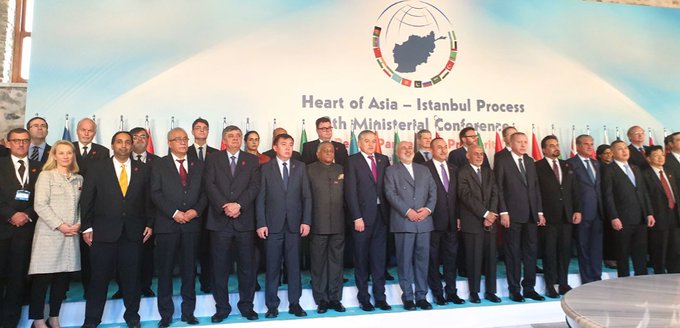
Mohammad Javad Zarif made the remarks in a Monday speech delivered at the Ministerial Conference of Heart of Asia Countries, which was held in the Turkish port city of Istanbul.
The Heart of Asia - Istanbul Process was established to provide a platform to discuss regional issues, particularly encouraging security, political, and economic cooperation among Afghanistan and its neighbors. This region-led dialogue was launched in November 2011 to expand practical coordination between Afghanistan and its neighbors and regional partners in facing common threats.
Addressing the conference, Zarif said, “There is no military solution in Afghanistan. The presence of foreign forces has never brought stability in our region and has historically provided a recruiting ground for extremists.”
He mentioned withdrawal of foreign forces from Afghanistan as prerequisite for restoration of peace to the war-torn country, saying, “Announcement of a timetable for a responsible exit of foreign troops from Afghanistan would prepare the necessary ground for the Afghan government to promote peace and reconciliation process at the national level.”
Zarif noted that Iran believed any peace initiative for Afghanistan should be launched by domestic groups and parties, adding, “In that regard, we support an Afghan-owned and Afghan-led peace process with the participation of all political groups and factions including the Taliban with the Afghan government in the center.”
Stressing the role of neighboring countries and the UN in the establishment of peace in Afghanistan, Iran's top diplomat said, “Taking the views of neighboring countries and considering their legitimate concerns during the process would guarantee that the peace agreement has stronger supports regionally. We believe the United Nations could become active to bring all domestic groups as well as international partners of Afghan government under one umbrella to facilitate this process.”
Zarif also warned about “the increasing threat of Daesh in Afghanistan, which has led to more bloodshed and introduced dangerous sectarian tendencies,” noting that using such terror groups to achieve one’s own political goals would not be beneficial to parties involved in Afghanistan’s developments.

“As no one gained from introducing and supporting Daesh and other extremists in Syria and Iraq, no one will gain from introducing them to Afghanistan and Central Asia,” he said.

Sunday, December 01, 2019

How to Commit War Crimes and Get Away With It


Vijay PRASHAD
U.S. President Donald Trump sacked his Navy secretary on Twitter. The main reason is that the Navy secretary did not follow Trump’s advice regarding Navy Special Warfare Operator Edward Gallagher. Trump wanted Gallagher to retain his position as a Navy Seal. Gallagher was accused of stabbing to death a wounded fighter of the Islamic State of Iraq and the Levant (ISIS) in 2017; he was also accused of other incidents of murder (of a schoolgirl and an elderly man), and then of obstruction of justice. In July 2019, a military court acquitted Gallagher of most of the charges but found him guilty of posing with the body of the fighter who had been stabbed to death.
Gallagher’s situation emerged onto the front pages only because of the intervention of Trump. Otherwise, these accusations of war crimes or “misconduct” emerge, they are sometimes investigated, and then they just dissipate. Report upon report has accumulated over the past 16 years of war crimes committed in Afghanistan and Iraq. The U.S.-NATO war on Afghanistan began in 2001, while the U.S. war on Iraq began in 2003. Hardly a day goes by in these countries where their combatants aren’t committing war crimes.
As early as December 21, 2001, the United Nations inquired about reports of “summary execution of prisoners after capture”; the immediate news was that about 2,000 Taliban prisoners at Qala-i-Jangi, near Mazar-i-Sharif, Afghanistan, had been “suffocated to death or shot in container trucks,” according to a report by the Physicians for Human Rights. In 2009, it became clear that the administration of George W. Bush had obstructed any investigation into this particular atrocity. Not one person has seen the inside of a court for this war crime.
What is a “war crime”? The Rome Statute of the International Criminal Court—which went into effect in 2002 but was drafted in 1998—defines war crimes as “serious violations of the laws and customs applicable in international armed conflict.” These include attacks against civilians, attacks against those who have surrendered, attacks with biological and chemical weapons, and attacks against medical and cultural institutions.
The Rome Statute builds on 100 years of legal precedent established in the Geneva Conventions and the Hague Conventions. There is no ambiguity in the Statute, which should be read by schoolchildren in countries that are prone to prosecute wars.
International Criminal Court
The United States is not a party to the International Criminal Court (ICC). It had helped establish the Court, but then reversed course and refused to allow itself to be under the ICC’s jurisdiction. In 2002, the U.S. Congress passed the American Service-Members’ Protection Act, which allows the U.S. government to “use all means” to protect its troops from the ICC prosecutors. Article 98 of the Rome Statute does not require states to turn over wanted personnel from a third party if these states had signed an immunity agreement with the third party; the U.S. government has therefore encouraged states to sign these “article 98 agreements” to give its troops immunity from prosecution.
The enormity of evidence of war crimes by U.S. troops and U.S.-affiliated troops in Afghanistan and Iraq weighed on the credibility of the ICC. In 2016, after a decade of investigation, the ICC released a report that offered hope to the Afghan people. The ICC said that there is “a reasonable basis” to pursue further investigation of war crimes by various forces inside Afghanistan—such as the Taliban, the Haqqani network, and the United States military forces alongside the Central Intelligence Agency. The next year, the ICC went forward with more detailed acknowledgment of the possibility of war crimes. Pressure on the ICC’s prosecutor mounted.
Pressure on the Court
This is where everything seemed to end. The Trump administration, via John Bolton and Mike Pompeo, made it clear to the ICC that if they pursued a case against the U.S., then the Trump administration would go after the ICC prosecutor and judges personally. An application for a U.S. visa by Fatou Bensouda, the ICC prosecutor, was denied; she had intended to come to the U.S. to appear before the United Nations. This was a shot across the bow of the Court. The U.S. was not going to play nice. Not long thereafter, in April 2019, the ICC said that it would not go ahead with a war crimes case against the United States, or indeed against any of the belligerents in Afghanistan. The Court said it would “not serve the interests of justice” to pursue this investigation.
Trump responded to this decision by calling the ICC “illegitimate” and—at the same time—that the ICC’s judgment was “a victory, not only for these patriots, but for the rule of law.”
Staff at the ICC were dismayed by the ICC’s decision. They were eager to challenge it, fearing that if they let the U.S. mafia tactics prevent their own procedures then the ICC would lose whatever shred of legitimacy remains. As it is, the ICC is seen as being deployed mainly against the enemies of the United States; there have been no serious investigations of any power that is closely aligned with the United States.
In June, Fatou Bensouda, the ICC prosecutor, filed a request inside the cumbersome system of the ICC to essentially appeal the decision not to pursue the investigation of the war crimes in Afghanistan. Bensouda’s appeal was joined by various groups from Afghanistan, including Afghan Victims’ Families Association and the Afghanistan Forensic Science Organization. In September, the Pre-Trial Chamber of the Court said it would allow the appeal to go forward. Bensouda’s office is now going to have to assemble an enormous case for her appeal; this could itself take the better part of six months. It is likely that the Trump administration has already begun to pressure the Court, which the Court’s staff worries will have an impact on the appeal as it did on the first filing.
Britain and the Court
The main U.S. ally in these wars in Afghanistan and Iraq has been the United Kingdom. A recent television program in the UK provided chilling evidence of British war crimes in Iraq. In 2017, the ICC said it had “credible” evidence that UK armed forces had committed horrific war crimes—including murder, torture, and rape—between 2003 and 2009. Reports piled up, but action was not taken. Now, given the new revelations on BBC’s “Panorama,” the ICC says that it will likely take up the case again.
There is no doubt that if the UK’s case is fairly adjudicated, it will raise many issues about the senior partner in these wars, namely the United States. Boris Johnson, the prime minister of the UK for now, says that he wants to pass legislation that—like in the U.S.—gives immunity for its troops. Jeremy Corbyn’s Labour Party has said, on the other hand, that it welcomes the scrutiny.
No soldier should be above the law. Nor should those who sent the soldiers into battle. None of these inquiries asks that more fundamental question.
Former United Nations Secretary-General Kofi Annan called the U.S. war on Iraq “illegal.” No one, not even Bensouda, has suggested that George W. Bush, his Cabinet, and Tony Blair be brought into the dock.
If justice is to be sought, it is not at the level of someone like Edward Gallagher alone; it should be his superiors on the political side who need to answer questions about not just this or that war crime, but about the entire war and the crime of it all.
Globetrotter via counterpunch.org

Will the ICC Prosecute Perpetrators of the ‘War on Terror’?

Ramona WADI

On May 13 2014, the International Criminal Court’s (ICC) Chief Prosecutor announced it would reopen the investigations into alleged war crimes committed by British soldiers in Iraq and Afghanistan, following additional submitted information pertaining to the investigation which had been concluded in 2006.
A recent BBC Panorama investigation, in collaboration with the Sunday Times, ascertained a cover-up by the UK government of British soldiers torturing and murdering Iraqi and Afghan civilians, including children since 2003, when the UK participated alongside the US in invading Iraq under the pretext of the so-called “war on terror”.
In 2010, the Iraq Historic Allegations Team (IHAT) was tasked with investigating allegations of abuse in Iraq, with the possibility of prosecuting the perpetrators. However, mismanagement and corruption within the body, including claims that solicitor Phil Shiner had paid people to find clients for IHAT, failed to open a single case from its investigations. For the UK’s Ministry of Defence, the allegations against IHAT were an opportune moment to discredit the claims of human rights violations committed by British troops. Rather than prioritise the allegations of human rights violations, IHAT was deemed harmful and “making soldiers on the battlefield anxious about later legal repercussions.”
In a 2018 report issued by the ICC, UK soldiers are alleged to have committed war crimes against 61 Iraqis in custody, including killings, torture, rape and sexual violence. Seven deaths occurred in custody and 54 victims died of “mistreatment”. The ICC report specifies: “At this stance, these incidents should not be considered as either complete or exhaustive, but rather illustrative of the alleged criminal conduct.”
In July 2019, the European Centre for Constitutional and Human Rights (ECCHR) submitted a follow-up to the ICC Prosecutor, informing the office about the UK’s failure to investigate or prosecute those responsible for war crimes, “despite significant and growing evidence indicating that liability extends up the chain of command to senior military and civilian officials.” The ECCHR also described the closing down of IHAT as a politically motivated decision to avoid ICC prosecution.
The UK’s intention was clearly to preserve its impunity. During the course of the BBC investigation, it was revealed that “The Ministry of Defence (MoD) had no intention of prosecuting any soldier of whatever rank he was unless it was absolutely necessary, and they couldn’t wriggle their way out of it.” Among the concealed crimes, a soldier from an SAS unit shot 4 Afghan civilians, three of them children, in the head, while they were in their own home, drinking tea. “When I entered the room, the bones, teeth, blood and brain were all over the place,” a witness to the aftermath stated. The UK government dismissed the war crime allegation by stating the four Afghans were Taliban suspects and commanders.
Other war crimes were concealed through fabricated evidence in order to evade such classification. Evidence of sexual abuse was also revealed to have occurred at Camp Stephen in Basra, Iraq, which was under the command of the Black Watch.
If the ICC does investigate the UK government for these violations of the Geneva Convention, it would have set a precedent, given that the Court has, so far, focused on investigating the leaders of African nations as opposed to the crimes of Western governments and foreign intervention. The “war on terror” is characterised by two main factors – perpetual aggression and extended impunity for the perpetrators. Justice for the Iraqi and Afghan people, by now, is worse than a macabre farce. Yet the ICC must fulfil its duty to lay bare the dynamics that have so far shielded the UK military and governmental collaboration from judicial scrutiny.