Showing posts with label Peter Koenig. Show all posts

Thursday, November 28, 2019

Iran’s Barter Deals with China Help Iran Decoupling from Western Economies

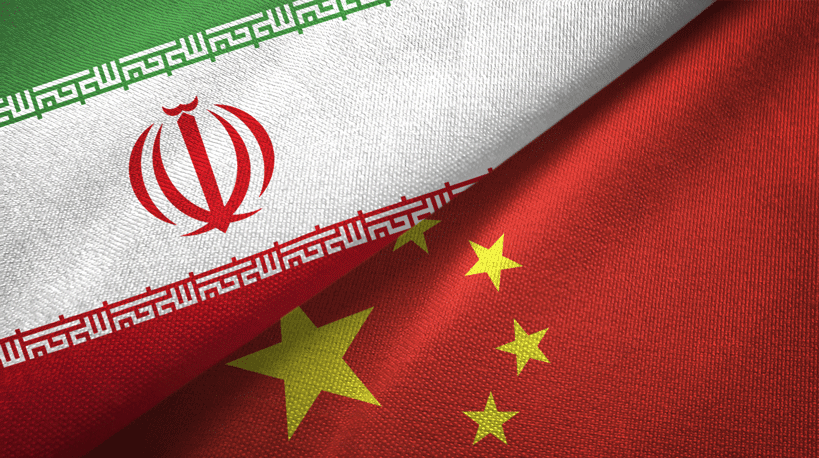
According to a PressTV Report of 24 November, 2019, Iran and China are working on a trade or barter deal that would circumvent US sanctions. It would bypass US-dollar denominated transactions, exchanging Iranian oil for Chinese goods and services and investments. The head of the Tehran Chamber of Commerce, Industries, Mines and Agriculture (TCCIMA), Masoud Khansari told Teheran’s Tasnim news agency, on 19 November 2019 that “The mechanism, aiming to increase economic exchanges between Iran and China, is in the process of being finalized and implemented.” He meant indeed, a barter deal between the two countries, avoiding a monetary exchange, is being worked out.
This is nothing new. Already in July 2011, the Financial Times reported that due to US sanctions against Iran, China, Iran’s largest hydrocarbon client was unable to pay Iran in cash, as monetary transactions were blocked. China had at that time accumulated at leas US$ 30 billion in unpaid bills, which deprived Iran from necessary hard currency to purchase goods, and mainly medication and medical equipment from countries that were either daring to go against the US sanctions, or clandestinely on the black market.
The case was similar with India which, together with China purchased then almost 50% of Iran’s oil – Iran’s lifeblood. While India exports almost nothing to Iran, China is a key exporter of a myriad of goods and services to Iran, including building infrastructure and investing in expansion of Iran’s oil sector. That’s when the two countries started making barter arrangements.
In the meantime, agreement was reached in July 2015 on Iran’s Nuclear Deal, the Joint Comprehensive Plan of Action (JCPOA) which for a short time lifted all sanctions, until on 8 May 2018 President Trump canceled Washington’s engagement in the deal – most likely on the behest of Israel – and new deadly US sanctions were imposed, stronger and more brutal as before – “the strongest ever sanctions imposed on any nation” – Trump boasted. And with these sanctions came the threat of punishment for every country that would do business with Iran, including the European Union members who were part of signing the Nuclear Deal, Germany, UK, France.
While at the outset the Europeans did not want to appear as Washington vassals – and more – their corporations had already signed new business deals with Iran and were not keen on canceling them, The EU had attempted to design an international payment system outside of the dollar-dominated SWIFT transfer system, the Instrument in Support of Trade Exchanges (INSTEX). Designed in January 2019, it is a special European transfer system, serving only European purposes to trade with Iran outside of US-dollar controlled sanctions. However, to this date not one single transaction has been carried out under INSTEX, mostly because of European’s are captive of an unexplainable puppetry dependence on Washington. The leader of the Islamic Revolution Ayatollah Seyyed Ali Khamenei called Instex “a bitter joke”.
In comes China – again, establishing a barter deal with Iran. A TCCIMA delegation recently visited Beijing and concluded a barter trade agreement that would be carried out both through mainland China and through Hong Kong. Among other potential deals for Iran petrol and gas deliveries, are investments in Iran’s power sector, by Chinese companies in, for example, energy and infrastructure projects. Rejecting US objections, Beijing says, dealing with Iran was legitimate under any international law. Iran is an integral link in the Belt and Road Initiative (BRI).

Earlier this year, Chinese President Xi Jinping said Beijing was seeking to develop a “comprehensive strategic partnership” with Tehran; and that “No matter how the international and regional situation changes, China’s resolve to develop a comprehensive strategic partnership with Iran will remain unchanged.” President Xi emphasized that the two sides should work together, “accelerate the building of a new type of international order and a community with a shared future for mankind,” – A Community with a shared future for mankind is indeed China’s long-term objective for decades to come. It converges with those of the BRI. An objective towards a multi-polar world and a peaceful coexistence among nations.

Barter deals do not provide Iran with the necessary cash to purchase needed imports. There are other avenues than barter, for a rapprochement outside the dollar-domain in trade between Beijing and Tehran, or Moscow and Tehran, for that matter. It should be relatively simple to open swap accounts between the Chinese and the Iranian central banks and to use the Chinese Interbank Payment System (CIPS) for monetary transfers.Such a solution should also leave Iran with sufficient revenues to pay for her imports. The reason such options may not be pursued with more vigor is perhaps that Iran is still very much divided between those Euro-US-centered Atlantists and those Iranians who follow the Ayatollah’s vision – towards a future in the East. A strong Fifth Column in Iran is also omni-present and rears its ugly neck when ever an opportunity arises, like the recent 50% hike in gasoline prices.
Its is a mystery for most observers why the gasoline price increase was not announced and explained by President Rouhani or Iranian Authorities prior to being implemented. It may have prevented much of the violence that is as of this day lingering on, causing bloodshed and mayhem. Most anywhere in the world, people would take to the streets if they would be hit with an unexplained price hike of a major commodity. It is as if the price for bread would double over night – an uproar foretold. That the opportunity would be taken advantage of by foreign-instigated violent elements was also foreseeable. And in this case, I dare say, preventable.

Demonstrations began peacefully and then suddenly on day two turned violent. It does not require rocket science to figure out that the violent was planted by outside forces trained and paid for by such notorious organizations like the NED (National Endowment for Democracy), the extended arm of CIA, funded with hundreds of millions from the US State Department. Those are the same people who are funding the unrests in Hong Kong. Their brand is chaos, crisis and destabilization – that’s what they do all over the world where ‘regime change’ is on Washington’s agenda. These forces are a clear impediment for Iran to go full-fledged their way to the East, associating wholeheartedly with the Shanghai Cooperation Organization (SCO) and de-coupling from the western economy.

In the face of a deeply divided Iran, barter deals with China, and why not with Russia, may be a first step towards a more serious move to de-dollarize, to decouple from the west. Iranian people deserve to live well, deserve to get out from under the misery-imposing boots of Washington. Even the Euro-centered and Washingtonites must recognize the US-western hypocrisy and realize that the US will never let go until she has a total grasp on Iran’s resources – that a resolute move to the east will give them relief from shortages of food, medicine – and western oppression and colonization.
Peter Koenig is an economist and geopolitical analyst. He is also a water resources and environmental specialist. He worked for over 30 years with the World Bank and the World Health Organization around the world in the fields of environment and water. He lectures at universities in the US, Europe and South America. He writes regularly for Global Research; ICH; RT; Sputnik; PressTV; The 21st Century; Greanville Post; Defend Democracy Press, TeleSUR; The Saker Blog, the New Eastern Outlook (NEO); and other internet sites. He is the author of Implosion – An Economic Thriller about War, Environmental Destruction and Corporate Greed – fiction based on facts and on 30 years of World Bank experience around the globe. He is also a co-author of The World Order and Revolution! – Essays from the Resistance.
Peter Koenig is a Research Associate of the Centre for Research on Globalization.

Wednesday, November 27, 2019

Peter Koenig: US Seeks Regime Change in Syria

Peter Koenig: US Seeks Regime Change in Syria
TEHRAN (FNA)- Peter Koenig, economist and geopolitical analyst, says the US plans to maintain its military presence in Syria to protect ISIL (also known as ISIS and DAESH) terrorists and use them against the Arab country and other states on the White House’s command.
Speaking in an exclusive interview with FNA, Peter Koenig said, “Eastern Syria, the border with Iraq, where most of Syria’s oil is located, covers about one third of the country. To be in control of one third of the Syrian territory under false pretenses which the world seems to swallow – is quite good. US troops never left; they never will – not as long as the US is militarily alive and kicking.”

Peter Koenig is an economist and geopolitical analyst. He worked for over 30 years with the World Bank and the World Health Organization around the world. Also, he lectures at universities in the US, Europe and South America. He is also a co-author of “The World Order and Revolution!”

Below is the full text of the interview:

Q: While the US is pulling some troops out of Syria, it is still sending in additional troops claiming the move ensures Syrian oil facilities will not fall into the hands of Daesh. How do you find the White House’s justification for more troops in Syria?

A: This is an outright lie, like so many others. The US never had the intention to pull out troops from Syria. They want to keep a hold in Syria, because the US mission is not finished until they achieve regime change in Syria. This was the motive of promoting the CIA-initiated civil war in 2011 (prepared since 2008) in the first place. If at one-point President Trump was serious in pulling out of Syria – like in honoring his pre-election promise, “no more engaging in foreign lands” – then his behind the scene handlers – including the Pentagon, weapon manufacturers, the CIA – the corporate oil oligarchy – certainly told him differently.
Why would the US want to protect Syrian Oil from ISIS or Daesh? - Washington created, funded, nurtured and armed Daesh/ISIS. Now they are enemies? Do you believe that? –  Of course, vis-à-vis the outside world, but in reality, the US still counts on them – to run and fight whenever they, Washington, commands them to do so.

Q: Moscow released photos it claims show the real reason the US wants to keep troops in Eastern Syria is to protect the illegal oil trade and reap large profits. How do you view this?

A: There is another narrative, namely that the US wants to keep troops in eastern Syria to protect illegal oil trade and reap large profits. I do not believe in this. The US has larger goals, not to leave Syria. They just do not admit it and keep confusing the public. And it seems to work. Let’s face it, eastern Syria, the border with Iraq, where most of the Syria’s oil is located, covers about one third of the country. To be in control of one third of the Syrian territory under false pretenses which the world seems to swallow – is quite good. US troops never left; they never will – not as long as the US is militarily alive and kicking.

Of course, petrol is part of the larger picture, but not for the protection of oil smugglers – and who would make huge profits? The military? – No, the larger picture is dominating Syria as one of the most strategic countries in the Middle east, transit for oil pipelines, and the pivot to five seas – the Persian Gulf, the Caspian Sea, Black Sea, Mediterranean, the Red Sea – that is President Assad’s strategy. The Caspian Sea is particularly important, as it is becoming a transit route for China’s Belt and Road Initiative. Being part of the BRI is key for future development. Mr. Assad knows it. And the US would of course like to prevent Assad closing links with China, especially because China is a close ally with her BRI partners and with their suppliers of hydrocarbons.

Tuesday, November 26, 2019

China – The Belt and Road Initiative – The Bridge that Spans the World

By Peter Koenig
"Information Clearing House" -   The Belt and Road Initiative (BRI), also called the New Silk Road, is based on a 2,100-year-old trade route between the Middle East and Eastern Asia, called the Silk Road. It wound its ways across the huge landmass Eurasia to the most eastern parts of China. It favored trading, based on the Taoist philosophy of harmony and peaceful coexistence – trading in the original sense of the term, an exchange with “win-win” outcomes, both partners benefitting equally.

Today, in the western world we have lost this concept. The terms of trade are imposed always by the ‘stronger’ partner, the west versus the poorer south – the south where most of the natural resources are lodged. Mother Earth’s assets have been and are coveted by the west – or north – for building and maintaining a lifestyle in luxury, abundance and waste. This trend has lasted for centuries of western colonialism: Exploitation, loot, esclavisation and rape of entire peoples of the Global South by the Global North, to use the current soothing World Bank lingo.

The New Silk Road, or BRI, is Chinese President Xi Jinping’s brainchild. It’s based on the same ancient principles, adjusted to the 21st Century, building bridges between peoples, exchanging goods, research, education, knowledge, cultural wisdom, peacefully, harmoniously and ‘win-win’ style. On 7 September 2013, Xi presented BRI at Kazakhstan’s Nazarbayev University. He spoke about “People-to-People Friendship and Creating a better Future”. He referred to the Ancient Silk Road of more than 2,100 years ago, that flourished during China’s Western Han Dynasty (206 BC to 24 AD).

“they had proven that countries with differences in race, belief and cultural background can absolutely share peace and development as long as they persist in unity and mutual trust, equality and mutual benefit, mutual tolerance and learning from each other, as well as cooperation and win-win outcomes.”
Referring to this epoch of more than two millenniums back, Xi Jinping pointed to the history of exchanges under the Ancient Silk Road, saying,

President Xi’s vision may be shaping the world of the 21st Century. The Belt and Road Initiative is designed and modeled loosely according to the Ancient Silk Road. President Xi launched this ground-breaking project soon after assuming the Presidency in 2013. The endeavor’s idea is to connect the world with transport routes, infrastructure, industrial joint ventures, teaching and research institutions, cultural exchange and much more. Since 2017, enshrined in China’s Constitution, BRI has become the flagship for China’s foreign policy.

BRI is literally building bridges and connecting people of different continents and nations. The purpose of the New Silk Road is “to construct a unified large market and make full use of both international and domestic markets, through cultural exchange and integration, to enhance mutual understanding and trust of member nations, ending up in an innovative pattern with capital inflows, talent pool, and technology database”. BRI is a perfect vehicle for building peacefully a World Community with a Shared Future for Mankind – which was the theme of an international Forum held in Shanghai, from 5-7 November, a tribute to China’s 70th Anniversary of her Revolution and achievements – with a vision into the future.

BRI is a global development strategy adopted by the Chinese Government. Already today BRI has investments involving more than 150 countries and international organizations – and growing – in Asia, Africa, Europe, the Middle East and the Americas. BRI is a multi-trillion investment scheme, for transport routes on land and sea, as well as construction of industrial and energy infrastructure and energy exploration – as well as trade among connected countries. Unlike WTO (World Trade Organization), BRI is encouraging nations to benefit from their comparative advantages, creating win-win situations. In essence, BRI is to develop mutual understanding and trust among member nations, allowing for free capital flows, a pool of experts and access to a BRI-based technology data base.

At present, BRI’s closing date is foreseen for 2049 which coincides with new China’s 100th Anniversary. The size and likely success of the program indicates, however, already today that it will most probably be extended way beyond that date. It is worth noting, 


though, that only in 2019, six years after its inception, BRI has become a news item in the West. 

Remarkably, for six years BRI was as much as denied, or ignored by the western media, in the hope it may go away. But away it didn’t go. To the contrary, many European Union members have already subscribed to BRI, including Greece, Italy, France, Portugal – and more will follow, as the temptation to participate in this projected socioeconomic boom is overwhelming.
Germany, the supposed economic leader of Europe, is mulling over the benefits and contras of participating in BRI. The German business community, like business throughout Europe, is strongly in favor of lifting US-imposed sanctions and reconnecting with the East, in particular with China and Russia. But official Berlin is still with one foot in the White House – and with the other trying to appease the German – and European – world of business. This balancing act is in the long run not sustainable and certainly not desirable. At present BRI is already actively involved in over 80 countries, including at least half of the EU members.

To counteract the pressure to join BRI, the European Union, basically run by NATO and intimately linked to Washington, has initiated their own ‘Silk Road’, attempting to connect Asia with Europe through Japan. In that sense, the EU and Japan have signed a “free trade agreement” which includes a compact to build infrastructure, in sectors such as energy, transport and digital devices. The purpose is to strengthen economic and cultural ties between the two regions, boosting business relations between Asia and Europa. It is an obvious effort to compete with or even sideline China’s BRI. But it is equally obvious that this response will fail. Usually initiatives taken in ill-fate are not successful. And China, non-belligerent China, is unlikely to challenge this EU-Japan competitive approach.

In another approach to counter BRI, The U.S. Overseas Private Investment Corporation (OPIC), Australia’s Department of Foreign Affairs and Trade (DFAT), and Japan Bank for International Cooperation (JBIC), launched on 4 November the Blue Dot Network (BDN), an initiative supposedly run entirely by private actors, funded by private banking, intended to bring together governments, the private sector, and civil society “to promote high-quality, trusted standards for global infrastructure development in an open and inclusive framework.”

It is not clear how the BDN will interact with or counteract BRI. Anything run entirely by the private sector, especially western private banking, is no good omen for the country their “development effort” touches. Such investments’ objectives are primarily shareholder profits, not socioeconomic development benefitting the countries where they plan to invest. No competition for China’s BRI. Again, non-aggressive China is unlikely to react.
China’s New Silk Road is creating a multipolar world, where all participants will benefit. The idea is to encourage economic growth, distributed in a balanced way, so as to prioritize development opportunities for those most in need. That means the under-developed areas of western China, eastern Russia, Central Asia, Central Europe – reaching out to Africa and the Middle East, Latin America, as well as to South East Asia and the Pacific. BRI is already actively building and planning some six to ten land and maritime routes, connecting Africa, the Middle East, Europe and South America.
The expected multi-trillion-dollar equivalent dynamic budget is expected to be funded by China, largely, but not exclusively, by the Asian Infrastructure and Investment Bank (AIIB), by Russia – and by all the countries that are part of BRI and involved in singular or multi-country projects. The long-term return on these massive investments in people’s wellbeing is an exponential multiple of the original investments and cannot be limited to numerical economics, as social benefits of wellbeing cannot be defined by linear accounting.

Implementing BRI, or the New Silk Road, is itself the realization of a vision of nations: Peaceful interconnectivity, joint infrastructure and industrial development, as well as joint management of natural resources. For example, BRI may help with infrastructure and management advice resolving or preventing conflicts on transboundary water resources. There are some 263 transboundary lake and river basins, covering almost half the earth’s surface and involving some 150 countries. In addition, there are about 300 transboundary aquifers serving about 2 billion people who depend on groundwater.

The Chinese government calls the Silk Road Initiative “a bid to enhance regional connectivity and embrace a brighter future”. Today, John Lennon’s “Give Peace a Chance” is more relevant than ever. And China is a vanguard in promoting peaceful development across the globe. BRI, China’s foreign policy flagship, is clearly an initiative towards world Peace.

Peter Koenig is an economist and geopolitical analyst. He is also a water resources and environmental specialist. He worked for over 30 years with the World Bank and the World Health Organization around the world in the fields of environment and water.He lectures at universities in the US, Europe and South America. He writes regularly for Global Research; ICH; RT; Sputnik; PressTV; The 21stCentury; Greanville Post; Defend Democracy PressTeleSUR; The Saker Blog, the New Eastern Outlook (NEO); and other internet sites. He is the author of Implosion An Economic Thriller about War, Environmental Destruction and Corporate Greed fiction based on facts and on 30 years of World Bank experience around the globe. He is also a co-author of The World Order and Revolution! -Essays from the ResistancePeter Koenig is a Research Associate of the Centre for Research on Globalization.

Wednesday, November 20, 2019

Bolivia – A Color Revolution – or a New Surge for Latin American Independence?

By Peter Koenig
"Information Clearing House" - Like Túpac Katari, indigenous Aymara leader more than 200 years ago, confronting the Spaniards, Evo Morales was betrayed and ‘dismembered’ by his own people, recruited and paid by the agents of the most destructive, nefarious and murderous dark elite that governs and has governed for over two hundred years our planet, the United States of America. With their worthless fiat-Ponzi-pyramid money, the made-out-of-thin-air US dollar, they create poverty throughout the globe, then buy off the weak and poor to plot against the very leaders that have worked for years to improve their social conditions.
It’s become a classic. It’s being called a Color Revolution, and it’s been taking place on all Continents. The list of victim-countries includes, but is not exhaustive – Colombia, Honduras, Argentina, Paraguay, Ecuador, Chile, Brazil, in some ways also Uruguay (the current left-leaning government is powerless and has to remain so, otherwise it will be “changed”… that’s the name of the game) – and now also Bolivia. – Then there are Georgia, Ukraine, Iraq, South Sudan, Libya, Afghanistan, Indonesia; and the lawless rulers of the universe are attempting to “regime change” North Korea, Syria, Iran, Venezuela, Cuba, Nicaragua – and on a larger scale China and Russia (I just returned from China – where the Government and people are fully aware what Washington’s intentions are behind every move they make).
In Africa, Africom, the US military Africa Command, buys off almost every corrupt African leader put in place by Africa’s former and new European colonialists, so they may continue sucking the riches out of Africa. These African leaders backed by Africom keep the African population in check, so they will not stand up. In case they won’t quite manage, “they” created the fear-squad called, Boko Haram, an off-spring of ISIS / IS – the Islamic State, created by the same creator, the CIA, Pentagon and NATO. The latter represents the European US-puppet allies; they keep raping Africa and reaping the benefits of her plentiful natural resources, and foremost, make sure that Africans stay subdued and quiet. Those who don’t may easily be “disappeared”. It’s Arica. But, have “they” noticed, Africa is moving, is gradually waking up?
And yes, not to forget, the “developed” and industrialized Europe, where sophisticated “regime change” over the years has subdued a largely well-off population, numbed and made apathetic by endless pro-capitalist propaganda and consumerism – Germany, UK, Netherlands, Denmark, Sweden, France, Italy, Spain – look what they have done to Greece! – Greece has become a red-flag warning for every EU nation that may dare to step out of US-dictated lockstep, of what might happen to them.
The list goes on with Eastern European EU countries, mostly former Soviet republics or Soviet satellites. They are EU members thanks to the UK, Washington’s mole in the EU, or as I like to call it – the European non-union – no Constitution, no solidarity, no common vision. They are all fiercely anti-Russia and most are also anti-Europe, but are made to – and love to eat and drink from the bowl of the EU-handouts, compliments of EU taxpayers. That’s about the state of the affairs we are in. There is, of course, much more coercion going on, but you get the picture. US interference is endless, merciless, reckless, without scruples and deadly.
Bolivia is just the latest victim. The process of Color Revolution is always more or less the same – a long preparation period. The coup d’état against Evo has been under preparation for years. It began already before Evo was first elected, when Washington realized that after the Bolivian people’s purging of two of Washington’s imposed “stooges” Presidents, in 2003 and 2005, Bolivia needed a respite. But the empire never gives up. That is a golden rule written in their unofficial Constitution, the PNAC (Plan for a New American Century), the writing of which has begun just after WWII, is regularly adjusted and updated, even name-changed (from Pax Americana to PNAC), but is still very much alive and ticking.
The coup against Evo Morales’ Government is not only because Washington does not tolerate any socialist government, and least in its “backyard”, but also – and maybe foremost – because of Bolivia’s riches in natural resources, gas, oil, a long list of minerals and metals – and lithium, the use of which is expected to triple over the next ten years, as it is used in electric cars and batteries. And as we know from the rapidly growing Green Movement, the future is out of hydrocarbon-driven into electric cars. No matter how the electricity is produced and how much environmental damage is done in producing the new flag, but still individual ‘mobility’. As neoliberal economists would say, “that’s just an externality”.

What he has achieved in his almost 14 years of Presidency is just remarkable – more than significant reductions of poverty, unemployment, analphabetism, increase in health indicators, in national reserves, in minimum wages, pension benefits, affordable housing – in general wellbeing, or as Evo calls it, “living well”.The first of the two US-imposed Presidents at the turn of the century, was Gonzalo Sánchez de Lozada, also called “Goni”, who privatized Bolivia’s rich hydrocarbon resources to foreign, mostly US, petro-corporations for a pittance. He was “elected” in 2002 against the indigenous, Aymara candidate, Evo Morales. When Goni was disposed of in a bloody people’s coup (about 60 dead) in 2003, he was replaced by his Vice-President, Carlos Mesa, the very key opponent of Evo’s, in the 20 October 2019 elections – who, following the same line of Goni’s privatization policies, was also overthrown by the Bolivian people in 2005. This led to a new election late in 2005 – and that’s when Evo finally won by a landslide and started his Presidency in January 2006.
That’s when Washington decided to step back for a while – and regroup, to hit again in an appropriate moment. This moment was the election three weeks ago. Preparation for the coup intensified a few months before, when Bolivia’s Vice-President, Álvaro Marcelo García Linera, told the media that every day there were reports that US Embassy agents were interfering in the country’s internal and local affairs.
The manipulated election in 2002 is recorded in an outstanding film, “Our Brand is Crisis”, a 2005 American documentary by Rachel Boynton on American political campaign marketing tactics in Bolivia by Greenberg Carville Shrum (GCS) – James Carville was previously President Clinton’s personal assistant – the documentary.
Then, like today, the coup was orchestrated by the CIA via the “legitimate” body of the Organization of American States (OAS). The US Ambassador to the OAS openly boasts paying 60% of OAS’ budget – “so, better don’t mess with us”.
Less than a week before the October 20 election, Carlos Mesa was trailing Evo Morales with 22 against 38 points. Under normal circumstances it’s is virtually impossible that in a few days a candidate picks up that much of a difference. The election result was Mesa 37% and Morales 47% which would give Morales a first-round win, as the winning candidate needs a margin of ten points. However, already before the final tally was in, the OAS, the US and the usual puppets, the European Union, complained about election ‘irregularities’ – when the only irregularities were manufactured in the first place, namely the drastic increase in Mesa’s percentage from 22 to 37 points.
Evo declared himself the winner on 20 October, followed immediately by violent anti-Evo riots throughout the country, but mostly in the oil-rich Santa Cruz area – home of Bolivia’s oligarchs and elite. The protests lasted for about three weeks during which at least three people died, when last Sunday, November 10, Evo was “suggested” by the military brass, supported by the OAS (US) to step down with his entire entourage, or else. He resigned, because he wanted the riots to stop and his countrymen to continue living in peace. But violence hasn’t stopped, to the contrary, the opposition has become fiercer in their racist attacks on indigenous people, targeting them with live ammunition. The dead toll as of today has reached at least 20.
President Morales asked for, and was granted political asylum in Mexico. The Vice-President, Alvaro Linera, and most of Morales’ cabinet members followed him to Mexico. The President of the Senate, Ms. Adriana Salvatierra, also of the MAS party, according to the Constitution, would have been the legitimate interim-President. But she was also forced to resign, and so were Victor Borda, the leader of the Chamber, and Rubén Medinaceli, First Vice President of the Senate. They all had to resign. In total some 20 high-ranking officials of Evo’s Government took refuge in the Mexican Embassy in La Paz, before they flew to Mexico.
Evo has since said he wants to return to Bolivia, to be there for the millions of his supporters. Yes, still a sizable majority of Bolivians support Evo and his Movement towards Socialism (MAS). There is a mass of peaceful unarmed Evo supporting demonstrators, growing every day. They are being brutally beaten by US trained and “bought” police and military forces. Indeed, the commander of Bolivia’s armed forces, Williams Kaliman, served in earlier days as a military attaché at the Bolivian Embassy in Washington. During that time he was secretly ‘recruited’ to be trained by what then was called the School of the Americas, and which is now the Western Hemisphere Institute for Security Cooperation, located at Fort Benning near Columbus, Georgia. Apparently Kaliman was not the only one of high-ranking Bolivian military and police officers having been subjected to this torturer and coup plotter training.
On Tuesday, 12 November, an extraordinary session of both chambers (Deputies and Senate) of the Plurinational Legislative Assembly (Parliament) was convened, to officially accept President Morales’ resignation, but the representatives of the Movement to Socialism (MAS), which are the majority in both chambers, did not attend because they were told by the opposition that their safety and that of their families could not be guaranteed. As a consequence, Parliament had suspended its session due to the lack of quorum.
Nevertheless, Jeanine Añez, an opposition senator, declared herself interim-President, and even though her nomination is illegal and unconstitutional, the Constitutional Court confirmed the legality of the transfer of power. But who could blame the judges of the Constitutional Court? They want to be on the right side of the fence, now that the Americans are soon expected to rule the country. Ms. Añez is from the right-wing Social Democrat Movement (not to confuse with MAS = movement towards socialism), and she is known to be fiercely anti-Morales. If her coronation looks and sounds like the one of Juan Guaidó in Venezuela, it is because her self-nomination is like Juan Guido’s, a US-supported farce. Washington has immediately recognized Ms. Jeanine Añez as (interim) President of Bolivia. She, as well as Carlos Mesa, have been groomed to become the next Bolivian leaders, when new elections are held – probably sometime in January 2020. Especially, Carlos Mesa is well known as a US-supporter from his earlier failed stint at the Bolivian Presidency (2003 – 2005).
Earlier, Jeanine Añez, tweeted, “I dream of a Bolivia free of satanic indigenous rites, the city is not for the Indians who should stay in the highlands or the Chaco”. That says it all, where Bolivia is headed, unless – unless another people’s revolution will stop this nefarious course. Ms. Añez apparently has since removed the tweet.
One of the internal drivers of the ‘golpe’ is Luis Fernando Camacho, a far-right multi-millionaire, from the Santa Cruz region, where the US have supported and encouraged separatism. Camacho, a religious bible fanatic, received support from Colombia, Brazil and the Venezuelan opposition – and, of course, he is the US henchman to lead the ‘coup’ internally.
As Max Blumenthal from “The Grayzone” reports,
“When Luis Fernando Camacho stormed into Bolivia’s abandoned presidential palace in the hours after President Evo Morales's sudden November 10 resignation, he revealed to the world a side of the country that stood at stark odds with the plurinational spirit its deposed socialist and Indigenous leader had put forward. – With a Bible in one hand and a national flag in the other, Camacho bowed his head in prayer above the presidential seal, fulfilling his vow to purge his country’s Native heritage from government and “return God to the burned palace.” Camacho added “Pachamama will never return to the palace,” referring to the Andean Mother Earth spirit. “Bolivia belongs to Christ.”
Still, there is hope. Bolivians are known to be sturdy and staunch defenders of their rights. They have proven that best in the overthrow of two foreign-imposed successive Presidents in 2003 and 2005, “Goni” and Carlos Mesa respectively. They brought their Aymaran Evo Morales to power in 2006, by an internationally observed, fully democratic election.
There are other signs in Latin America that things are no longer the way they used to be for decades. Latin Americans are sick and tired of their status of US backyard citizens. There is movement in Brazil, where Lula was just released from Prison, against the will of Brazil’s fascist also foreign, i.e. US-imposed, Jair Bolsonaro. Granted, Lula’s release from prison is temporary, but with the massive people’s support he musters, it will be difficult for Bolsonaro to put him back in prison – and preserve his Presidency.
Social upheavals in Chile for justice and equality, against a racist Pinochet era Constitution, violently oppressed by President Piñera’s police and military forces, have lasted for weeks and will not stop before a new Constitution is drafted, in which the protesters demands are largely integrated. That too is a sign for an awakening of the people. And the enduring resistance against North America’s aggression by Venezuela, Cuba and Nicaragua, are all positive vibes for Bolivia – not to be trampled over.


Peter Koenig is an economist and geopolitical analyst. He is also a water resources and environmental specialist. He worked for over 30 years with the World Bank and the World Health Organization around the world in the fields of environment and water. He lectures at universities in the US, Europe and South America. He writes regularly for Global Research; ICH; RT; Sputnik; PressTV; The 21st Century; Greanville Post; Defend Democracy Press, TeleSUR; The Saker Blog, the New Eastern Outlook (NEO); and other internet sites. He is the author of Implosion – An Economic Thriller about War, Environmental Destruction and Corporate Greed – fiction based on facts and on 30 years of World Bank experience around the globe. He is also a co-author of The World Order and Revolution! – Essays from the Resistance

Friday, September 20, 2019

Impact of Yemeni attack on Saudi ARAMCO Oil Facilities

Enhanced and partial transcript of a PressTV Interview
Background
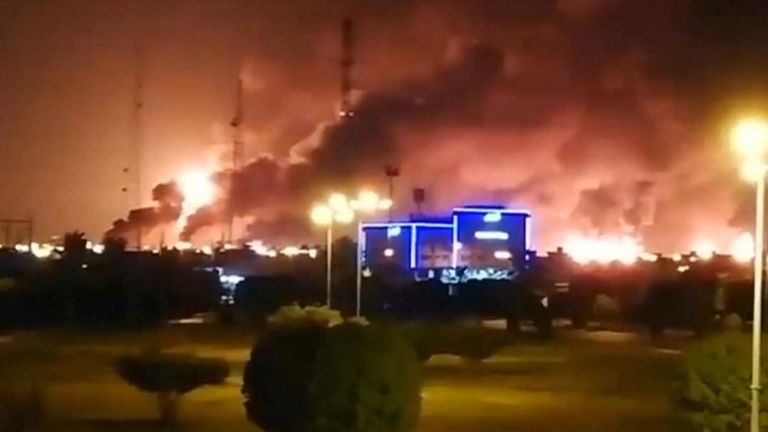
Saudi Arabia says the recent drone attacks on the state-run oil company Aramco, led to a temporary closure of its facilities and disrupted the kingdom’s oil production and exports.

[Saudi] Energy Minister, Abdulaziz bin Salman said the attacks led to the interruption in production of an estimated five-point-seven million barrels of crude per day. The amount is equivalent to five percent of the daily global supply of crude oil. Meanwhile, Crown Prince, Mohammad bin Salman, said his country is willing and able to deal with Saturday’s drone strikes. Also, the U-S secretary of state has accused Iran of being behind the recent attacks. Mike Pompeo claimed there is no evidence to prove that the attacks were launched from Yemen. He was actually adamant about blaming Iran for the attack, without any shred of proof. This is while Yemen’s Ansarullah movement [the Houthis] has claimed responsibility for the drone strikes.

Saudi stocks dropped dramatically following drone strikes on two Aramco facilities by Yemeni forces; an attack that halved the kingdom’s crude production.

Saudi shares have dropped three percent after Yemeni drone attacks on two major state-run Aramco oil facilities knocked out more than half the kingdom’s production.

Saudi Energy Minister, Abdulaziz bin Salman said the attacks led to the interruption in production of an estimated five-point-seven million barrels of crude per day. The amount is equivalent to five percent of the daily global supply of crude oil. Yemeni forces launched the massive drone attack in response to the Saudi-led coalition war that has lasted for more than 4 years on the impoverished nation on Saturday.

PressTVCould you please comment on the consequence of this reduction in the oil supply by Saudi Arabia?
PK
First, lets make one thing crystal clear – Mr. Pompeo is a flagrant liar, has been in the past with everything he says against his own fabricated enemies, and he will very unlikely change, as the type of his hawkish aggressive warrior character will not change. Therefore, everything Pompeo says and pretends which such assurance that most people realize it’s a fabricated lie as he did not – and never does – provide any evidence. Therefore, whatever he says and pretends to be the truth without evidence, has to be taken with more than a grain of salt.
In fact, immediately blaming Iran for the drone attack on ARAMCO, is without any foundation; it is an outright lie, just to put more dirt on Iran, to further denigrate Iran. It is very clear to me – who have worked for 7 years in Yemen – that the Houthis have the capacity to develop their own drones – they have a flying range potential of at least 1,000 km.
It is very simple and very logical, the Houthis are gradually getting their strength back and are revenging themselves for the horrendous aggression launched for more than 4 year by the Saudis against their country – of course, with staunch support from the US, UK and the French.

Lets just remind ourselves, that inhuman abhorrent aggression has cost tens of thousands of Yemeni lives – most of them children, women and the elderly and weak – from direct bomb attacks, from famine, and from cholera and other sanitation related diseases. Today still a million people are at risk of a cholera epidemic.

Having said this – the consequences or impact of a 5% oil output reduction due to the burning ARAMCO wells is insignificant. Of course, speculators – the Godman Sachs type, who are the chief manipulators behind oil prices – would like you to believe that this is ample ground for hefty fuel price increases – in reality not at all.
Of course, in our predatory capitalist world, the stock market wheelers and dealers, may try to cash-in on this event – which in reality has – or should have – zero impact on the world oil supply.
This shortfall could easily be made up by lifting sanctions o Iranian and Venezuelan oil sales… so it’s just a question of logics – and foremost – of justice, international law and Human Rights.
PressTVWhat about the fragility of the Saudis military power?
PKOf course, the Saudi military power is nothing without the full support and guidance, by weapons and technical and strategic advice directly from the Pentagon, CIA – and the European vassals, and – of course – from weapon manufacturers and weapon sales sharks, in the UK and in France.
The Saudis from day one – in October 2015 – were just launching a proxy war for the US against Yemen – Yemen has a key strategic location in the Gulf and Middle East, and also off-shore deep hydrocarbon deposits – and god forbid, may not be ruled by a people-friendly – a socialist leaning government. For the last 50-some years Yemen was ruled by a US puppet, or puppets – which was OK for the US, but once people get tired of injustice and corruption, they decided to dispose their nefarious regime and replace it with the popular Houthi movement.
When the Saudis agreed in the early 1970’s as head of OPEC and on behalf of OPEC, to sell crude only in US-dollars, the US Administration offered them in turn – “forever” military protection, in the form of multiple military bases in the Saudi territories. Without this protection, the Saudis would not have survived as long as they did with their horrendous discriminatory and corrupt government and, of course, without that protection, OPEC may not have stuck to the “dollar-only” rule to trade hydrocarbons. – We might be in another world today – but, we really don’t know how dynamics might have worked out.
Peter Koenig is an economist and geopolitical analyst. He is also a water resources and environmental specialist. He worked for over 30 years with the World Bank and the World Health Organizationaround the world in the fields of environment and water. He lectures at universities in the US, Europe and South America. He writes regularly for Global Research; ICH; RT; Sputnik; PressTV; The 21st Century; Greanville Post; TeleSUR; The Saker Blog, the New Eastern Outlook (NEO); and other internet sites. He is the author of Implosion – An Economic Thriller about War, Environmental Destruction and Corporate Greed – fiction based on facts and on 30 years of World Bank experience around the globe. He is also a co-author of The World Order and Revolution! – Essays from the Resistance.
Peter Koenig is a Research Associate of the Centre for Research on Globalization.

Saturday, September 14, 2019

Iran – a Club of Sanctioned Countries – In Solidarity Against US Economic Terrorism


PressTV Interview – 
transcript Excerpts:
An Iranian parliamentary faction has come up with the idea of establishing a club of sanctioned countries for concerted action against the US economic terrorism.
The chairman of the Parliament’s faction on countering sanctions, Poormokhtar, gave a report on the formation of the faction and its activities, as well as the ongoing efforts to establish the club of sanctioned countries. Iran’s FM, Zaraf, said this would be enhancing the already existing alliance of Russia, China, Syria, Iran, Cuba, Venezuela against US economic terrorism.
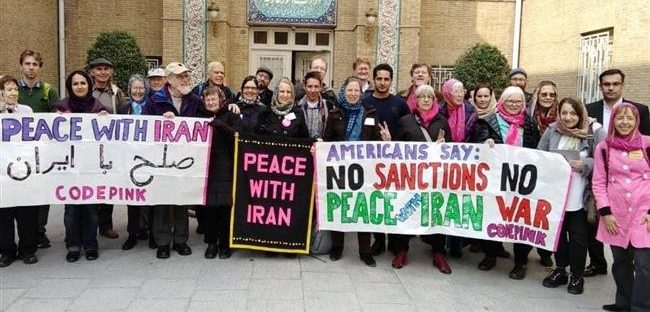
PressTV Questions:1. Russia, China, Iran, Syria, Cuba, and Venezuela are among the nations that have come out against the United States’ use of sanctions to enforce its foreign policy around the world. In what ways can they fight these US sanctions as a group?
PKBrilliant idea.
Solidarity makes stronger and eventually will attract other countries who are sick and tired of the US sanction regime, and since they have the backing of Russia and China – that’s a very strong alliance, especially an economic alliance. The sanction regime can only be broken through economics, meaning decoupling from the western monetary system. I said this before and say it again, at the risk of repeating myself.
After all, China is the world’s largest and strongest economy in Purchasing Power GDP measures – which is the only comparison that really counts. I believe this solidarity alliance against US sanctions is certainly worth a trial.
And personally, I think it will be a successful trial, as more countries will join, possibly even non-sanctioned ones, out of solidarity against a common tyrant.
The countries in solidarity against sanctions, in addition to ignoring them – and the more they ignore them, the more other countries will follow-suit, that’s logical as fear disappears and solidarity grows.
For example, Iran and Venezuela, oil exporting countries, could accompany their tankers by war ships. Yes, it’s an extra cost, but think of it as temporary and as a long-term gain. Would “Grace I” have been accompanied by an Iranian war ship – the Brits would not have dared confiscating it. That’s for sure.
PressTV:
2. Many of the US sanctions have led to death of civilians in those particular countries. At the same time, sanctions have also led to the improvement of these countries to the point where domestic production in various fields advanced. Don’t sanctions become country-productive to US aims?’
PKOf course, the sanctions arecounter-productive. They have helped Russia to become food-self-sufficient, for example. That was not Washington’s intention and less so the intention of the EU, who followed Washington’s dictate like puppets.
Sanctions arelike a last effort before the fall of the empire, to cause as much human damage aspossible, to pull other nations down with the dying beast.It has always been like that – starting with the Romans through the Ottoman’s. They realize their time has come – but can’t see a world living in peace. So, they must plant as much unrest and misery as possible before they disappear.
That’s precisely what’s happening with the US.
Intimidation, building more and more military bases, all with fake money, as we know the dollar is worth nothing – FIAT money – that the world still accepts – but less and less so, therefore military bases, deadly sanctions – and trade wars –
Trump knows that a trade war against China is a lost cause. Still, he can intimidate other countries by insisting on a trade war with China – or that’s what he thinks.
PressTV3. The more countries US sanctions, illegally, more people turn against the US: doesn’t that defeat the US so-called fight against terrorism and violence?
PKWell, US sanction and the entire scheme of US aggression has nothing to do with fighting terrorism,as you know. It’s nothing but expanding US hegemony over the world,and if needed, and more often than not,the US finances terrorism to fight proxy wars against their so-called enemies, meaning anybody not conforming to their wishes and not wanting to submit to their orders and notletting them exploit – or rather steal – their natural resources.
Syria is a case in point. ISILis funded and armed by the Pentagon,who buys Serbian produced weapon to channel them through the Mid-East allies to Syrian terrorists, the ISIL or similar kinds with different names -just to confuse.
Venezuela too – the opposition consist basically of US trained, financed and armed opposition “leaders” – who do not want to participate in totally democratic elections – order of the US – boycott them. But as we have seen as of this day, the various coup attempts by the US against their legitimate and democratically elected President, Nicolás Maduro, have failed bitterly – and this despite the most severe sanctions regime South American has known, except for Cuba, against whom the US crime has been perpetuated for 60 years.
So, nobody should have the illusion that Washington’s wars are against terrorism. Washington is THE terrorist regime that fights for world hegemony.
Peter Koenig is an economist and geopolitical analyst. He is also a water resources and environmental specialist. He worked for over 30 years with the World Bank and the World Health Organization around the world in the fields of environment and water. He lectures at universities in the US, Europe and South America. He writes regularly for Global Research; ICH; RT; Sputnik; PressTV; The 21st Century; TeleSUR; The Saker Blog, the New Eastern Outlook (NEO); and other internet sites. He is the author of Implosion – An Economic Thriller about War, Environmental Destruction and Corporate Greed – fiction based on facts and on 30 years of World Bank experience around the globe. He is also a co-author of The World Order and Revolution! – Essays from the Resistance.

Peter Koenig is a Research Associate of the Centre for Research on Globalization.

Saturday, August 31, 2019

Iran – Is a Rouhani – Trump Meeting Imminent?

Background

Tehran and Washington have been locked in a dispute since last year when the US unilaterally pulled out of the nuclear agreement and re-imposed crippling sanctions on Iran. On Monday, President Donald Trump said he is ready to meet his Iranian counterpart, Hassan Rouhani within weeks after a G-7 leaders’ summit. The idea was proposed by French President Emmanuel Macron who was hosting the summit. But Rouhani said Washington must first lift sanctions imposed since its withdrawal from the nuclear deal.

PressTV: Could you comment on Mr. Rouhani’s conditions for talks with President Trump?
PK
Mr. Rouhani is right asking for lifting of sanctions, as a principle, because Iran has never bypassed or violated the rules of the Nuclear Deal. The sanctions are a groundless punishment by Washington – because Iran wants – and should – remain a sovereign country, not bowing to Washington.
Its sheer economic terrorism.
However, let’s be realistic – the US, especially Trump who is dancing to the tunes of Netanyahu – will not just lift the sanctions. It would, in my opinion, be more constructive if Mr. Rouhani would ask for lifting of the most hurting sanctions – for example, the ban on importing crucial medication and medical equipment and other vital goods.
We know, the US will not change behavior, especially under Trump, as long as they still feel they are the exceptional Nation, the undisturbed Empire. Never mind that the empire is rapidly declining. As long as they have a stranglehold, literally, on the wester monetary system. That will not change.
That’s why I keep suggesting that Iran gradually but firmly and ever faster detach from the western economy and financial system, western banks, the use of dollars and euros – and shift to the East, becoming a member of the Shanghai Cooperation Organization (SCO) as quickly as possible, and trade in Chinese yuan.
Yes, Mr. Macron initiated the talks with Mr. Trump.
But, how shall I say this – Macron is not trustworthy. He does what he thinks can serve himself, not even the French people, but him, his image as King Macron.
He wants to be the go-between, be friends with Mr. Putin and Mr. Xi, but also be friends with Trump. Whatever serves his megalo-image.
When something doesn’t go his way, doesn’t bolster his image, he will step back.
So better Iran goes her own way – in direction East, where the future is.
And again – with as little as possible dealing with the west.
as long as the US is in the driver’s seat, and as long as the US controls the western money flow, anybody not liked by the Master is vulnerable for sanctions. We see it all over the world.
Therefore, asking for partial lifting of sanctions, namely for vital goods, those that cause most harm to the Iranian people, like medical imports, may be a good initial strategy. Who knows, perhaps Trump goes along. And if not, Mr. Rouhani has at least tried, and a rejection by Trump would further tarnish his presidency.
Peter Koenig is an economist and geopolitical analyst. He is also a water resources and environmental specialist. He worked for over 30 years with the World Bank and the World Health Organizationaround the world in the fields of environment and water. He lectures at universities in the US, Europe and South America. He writes regularly for Global Research; ICH; RT; Sputnik; PressTV; The 21st Century; TeleSUR; The Saker Blog, the New Eastern Outlook (NEO); and other internet sites. He is the author of Implosion – An Economic Thriller about War, Environmental Destruction and Corporate Greed – fiction based on facts and on 30 years of World Bank experience around the globe. He is also a co-author of The World Order and Revolution! – Essays from the Resistance

Peter Koenig is a Research Associate of the Centre for Research on Globalization.

Wednesday, August 28, 2019

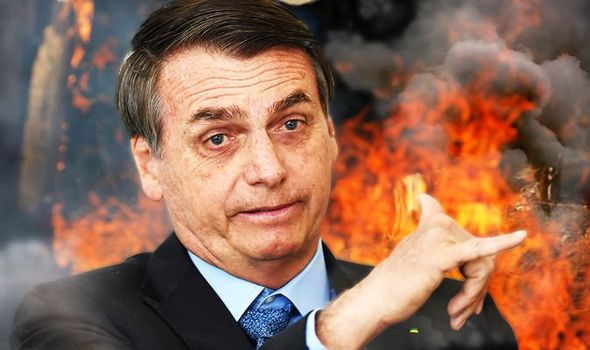
Amazonia in Flames – Brazil’s Bolsonaro is a World Criminal – Encouraging Jungle Burning for Private Exploitation of Freed Land

On 28 October 2018, Jair Bolsonaro was elected President of Brazil with 55.1% of the vote – and with a gigantic help from Cambridge Analytica.
At the World Economic Forum (WEF) in January 2019 in Davos Switzerland, Bolsonaro made a sumptuous presentation, “We Are Building a New Brazil”. He outlined a program that put literally Brazil up for sale, and especially the Brazilian part of Amazonia. He was talking particularly about Brazil’s water resources, the world’s largest, and the rain forest – offering a huge potential for agricultural development and mining.
None of the world leaders present at the WEF, precisely those that regularly meet pretending to save the planet, reacted to Bolsonaro’s statement on the Amazon region. They all new who Bolsonaro was and is – they knew that the man had no scruples and would destroy – literally – the world’s lungs. They did nothing. They stayed silent in words and deeds, applauding the neonazi for his openness to international business and globalization.
Today, on the occasion of another similar world event, the meeting of the G7 in Biarritz, France, French President Macron accused Bolsonaro of lying when he talked and pledged environmental consciousness after taking office, about protecting the Amazon area. Macron was joined by Germany in threatening Brazil with canceling the trade agreement with Mercosur, if he would not immediately undertake to stop the “wildfires”. They have most likely nothing to do with ‘wild’ – as they according to all circumstantial evidence were planted in a concerted effort to rid the rich Amazon territory of the life-sustaining jungle, so as to make the newly gained flame-deforested land accessible for private agri-business and mining.
Mind you, the G7 is another self-appointed totally illegal group of industrialized, rich countries (similar to the G20); illegal, because they have been approved by nobody, not by the UN or any international body. They became rich mostly on the back of poor developing nations that were and are still colonized for hundreds of years. The G7 count today about 10% of the world population and are controlling 40% of the globe’s GDP.
Despite the fact that nobody, other than themselves ratified their existence and their machinations, they believe they can call the shots of how the world should turn and function. They have no official backing by anybody, especially not the people across the globe, who, with a vast majority are fighting globalization. It’s a useless structure – RT refers to them as “The Unbearable Pointlessness of G7” – but their power lays in the rest of the world’s silence – their silent acceptance of the G7’s arrogant wielding of the scepter of power.
So, would Bolsonaro take them seriously, knowing that he is one of them and they are fully sharing his ideology of profit first, shoving environmental and social values down the muddy waters of the Amazon River? Hardly. He knows they are hypocrites. He knows that they make a bit of noise, because they have to. It makes for good public relation and propaganda – so people don’t go on the barricades. He knows that starting this coming Monday, 26 August, when the G7 summit will be history, that anything the Macrons of this world so impressively said, will fade away. The media will concentrate on other ‘news’ – and the forest fires will burn the life stream of Amazonia away – to make room for corporate profit making by the elite few.
Never mind the Constitutional protection of indigenous people and their land, Bolsonaro backed by evangelists and his military junta will rapidly dismantle any remaining protection for the ecosystem and native communities. His argument goes that the native people’s land is sitting on huge reserves of natural resources that belong to Brazil and may be concessioned to private corporations for mining, exploitation of agriculture and lumber.
The indigenous folks are people who have for thousands of years made a peaceful living in the Amazon. They are the gatekeepers of Amazonia; they are the people who may carry our genes from the present killer civilization to the next, hopefully less of a killer one, when mankind has finally managed to destroy itself. It will not destroy the planet. Never. The planet will just get rid of the nefarious elements of annihilation – mankind – and renew itself. As has happened many times in the past – a new civilization will eventually be born – and, yes, the world’s indigenous people, the likely only survivors, may carry on our DNA, possibly to the next attempt at humanity.

The fires have so far in about 20 days since they were discovered, consumed at least 74,000 ha of tropical rain forest. The smoke is already trespassing the border to Argentina and affecting the provinces of Formosa, Jujuy, Corrientes, Catamarca, La Rioja, Santa Fe and may have already reached Buenos Aires. NASA reports that about 3.2 million square kilometers of South America are covered by smoke.
The flames are massive and are devastating the jungle at a rapid pace. Amazonia comprises one of the world’s largest rainforests, also known as Mother Earth’s lungs – without which humanity – and fauna and flora might not survive.
According to the Brazilian National Institute for Space Research (INPE), the fires increased by 83% – almost double – from what they were last year, and, not coincidentally, at least 68% of protected areas have been affected. The Brazilian Space Research spotted 72,000 fires, of which 9,000 last week alone. The Amazon is home to 34 million people, including over 350 indigenous groups.
At the onset of the G7 conference, Mr. Macron twittered: “Our house is burning. Literally. The Amazon rain forest – the lungs which produces 20% of our planet’s oxygen – is on fire. It is an international crisis. Members of the G7 Summit, let’s discuss this emergency first order in two days!”

The destruction of the Amazon is indeed a crime of first degree. Accordingly, there are protests around the world against Bolsonaro’s “free for all” mining, lumbering, land and water grabbing policies. The eco-warriors Extinction Rebellion (XR) organize widespread protests, and in front of London’s Brazilian Embassy protesters chanted, “Hey hey, ho ho, Bolsonaro’s got to go!”.

While the Brazil fires catch world attention, there are jungle fires even larger than those in Amazonia burning down other parts of the world’s oxygen-generating lungs. Bloomberg cites NASA data, according to which last Thursday and Friday, 22 an 23 August – in two days alone – more than 6,900 fires were recorded in Angola and about 3,400 in the Democratic Republic of Congo (DRC), about 5 times as many as in the same two days in the Brazilian Amazon region. The destruction of the jungle in Africa progresses virtually unnoticed and is hardly reported in western media. Bloomberg is an exception. Whys is that?
Could it be that the same globalized corporations interested in Brazil’s natural resources underlaying the Amazon forests, are also interested in those enormous reserves of minerals and hydrocarbon resources of Central Africa? Have they – DRC, Angola and possibly others been encouraged tacitly or directly by Bolsonaro and his clan to let the jungle burn? There are plenty of Brazilian corporations which have a vivid interest in Angola, another former Portuguese colony.
Despite the G7 apparent concern to protect the world’s lungs in Amazonia, they seem to be oblivious about the Central African rain forest devastation. The massive African fires too advance rapidly and extinguish another part of the world’s lungs. But these fires are not on the G7 radar, or agenda for discussion, and nobody is threatened with sanctioning if the respective governments remain hapless onlookers.
In 2008, a so-called Amazon Fund, the first UN REDD+ initiative for the protection, preservation and monitoring of the Amazon region was created (UN REDD+ = reduce emissions from deforestation and forest degradation, and foster conservation, sustainable management of forests, and enhancement of forest carbon stocks).
Germany and Norway – and others – have accused Brazil for not having properly invested their contribution into the Fund. Norway has recently blocked a payment of US$ 30 million destined for the Fund. Germany had blocked already in early August the equivalent of US$ 39 million for different Amazon protection programs to be financed by the Fund. But Bolsonaro, in a nonchalant manner dismissed the blocked payments, suggesting that Germany should use the funds for reforestation of Germany.
In the case of Brazil, the threats by the Macron-Merkel duo – and others – seem to have had at least at the outset the effect that Bolsonaro is mobilizing the military to help extinguish the fires. Will he succeed? – Does he want to succeed? – In any case will the media continue reporting on progress once the G7 have gone home? – Will the world’s outcry be loud enough to force a concerted effort, possibly UN led – to fight and extinguish these fires that are menacing not only to destroy a key oxygen generator for life on mother earth, but also a UNESCO protected world heritage?
Peter Koenig is an economist and geopolitical analyst. He is also a water resources and environmental specialist. He worked for over 30 years with the World Bank and the World Health Organization around the world in the fields of environment and water. He lectures at universities in the US, Europe and South America. He writes regularly for Global Research; ICH; RT; Sputnik; PressTV; The 21st Century; TeleSUR; The Saker Blog, the New Eastern Outlook (NEO); and other internet sites. He is the author of Implosion – An Economic Thriller about War, Environmental Destruction and Corporate Greed – fiction based on facts and on 30 years of World Bank experience around the globe. He is also a co-author of The World Order and Revolution! – Essays from the Resistance.
Peter Koenig is a Research Associate of the Centre for Research on Globalization.