Showing posts with label and Venezuela. Show all posts

Saturday, September 14, 2019

Iran – a Club of Sanctioned Countries – In Solidarity Against US Economic Terrorism


PressTV Interview – 
transcript Excerpts:
An Iranian parliamentary faction has come up with the idea of establishing a club of sanctioned countries for concerted action against the US economic terrorism.
The chairman of the Parliament’s faction on countering sanctions, Poormokhtar, gave a report on the formation of the faction and its activities, as well as the ongoing efforts to establish the club of sanctioned countries. Iran’s FM, Zaraf, said this would be enhancing the already existing alliance of Russia, China, Syria, Iran, Cuba, Venezuela against US economic terrorism.
PressTV Questions:1. Russia, China, Iran, Syria, Cuba, and Venezuela are among the nations that have come out against the United States’ use of sanctions to enforce its foreign policy around the world. In what ways can they fight these US sanctions as a group?
PKBrilliant idea.
Solidarity makes stronger and eventually will attract other countries who are sick and tired of the US sanction regime, and since they have the backing of Russia and China – that’s a very strong alliance, especially an economic alliance. The sanction regime can only be broken through economics, meaning decoupling from the western monetary system. I said this before and say it again, at the risk of repeating myself.
After all, China is the world’s largest and strongest economy in Purchasing Power GDP measures – which is the only comparison that really counts. I believe this solidarity alliance against US sanctions is certainly worth a trial.
And personally, I think it will be a successful trial, as more countries will join, possibly even non-sanctioned ones, out of solidarity against a common tyrant.
The countries in solidarity against sanctions, in addition to ignoring them – and the more they ignore them, the more other countries will follow-suit, that’s logical as fear disappears and solidarity grows.
For example, Iran and Venezuela, oil exporting countries, could accompany their tankers by war ships. Yes, it’s an extra cost, but think of it as temporary and as a long-term gain. Would “Grace I” have been accompanied by an Iranian war ship – the Brits would not have dared confiscating it. That’s for sure.
PressTV:
2. Many of the US sanctions have led to death of civilians in those particular countries. At the same time, sanctions have also led to the improvement of these countries to the point where domestic production in various fields advanced. Don’t sanctions become country-productive to US aims?’
PKOf course, the sanctions arecounter-productive. They have helped Russia to become food-self-sufficient, for example. That was not Washington’s intention and less so the intention of the EU, who followed Washington’s dictate like puppets.
Sanctions arelike a last effort before the fall of the empire, to cause as much human damage aspossible, to pull other nations down with the dying beast.It has always been like that – starting with the Romans through the Ottoman’s. They realize their time has come – but can’t see a world living in peace. So, they must plant as much unrest and misery as possible before they disappear.
That’s precisely what’s happening with the US.
Intimidation, building more and more military bases, all with fake money, as we know the dollar is worth nothing – FIAT money – that the world still accepts – but less and less so, therefore military bases, deadly sanctions – and trade wars –
Trump knows that a trade war against China is a lost cause. Still, he can intimidate other countries by insisting on a trade war with China – or that’s what he thinks.
PressTV3. The more countries US sanctions, illegally, more people turn against the US: doesn’t that defeat the US so-called fight against terrorism and violence?
PKWell, US sanction and the entire scheme of US aggression has nothing to do with fighting terrorism,as you know. It’s nothing but expanding US hegemony over the world,and if needed, and more often than not,the US finances terrorism to fight proxy wars against their so-called enemies, meaning anybody not conforming to their wishes and not wanting to submit to their orders and notletting them exploit – or rather steal – their natural resources.
Syria is a case in point. ISILis funded and armed by the Pentagon,who buys Serbian produced weapon to channel them through the Mid-East allies to Syrian terrorists, the ISIL or similar kinds with different names -just to confuse.
Venezuela too – the opposition consist basically of US trained, financed and armed opposition “leaders” – who do not want to participate in totally democratic elections – order of the US – boycott them. But as we have seen as of this day, the various coup attempts by the US against their legitimate and democratically elected President, Nicolás Maduro, have failed bitterly – and this despite the most severe sanctions regime South American has known, except for Cuba, against whom the US crime has been perpetuated for 60 years.
So, nobody should have the illusion that Washington’s wars are against terrorism. Washington is THE terrorist regime that fights for world hegemony.
Peter Koenig is an economist and geopolitical analyst. He is also a water resources and environmental specialist. He worked for over 30 years with the World Bank and the World Health Organization around the world in the fields of environment and water. He lectures at universities in the US, Europe and South America. He writes regularly for Global Research; ICH; RT; Sputnik; PressTV; The 21st Century; TeleSUR; The Saker Blog, the New Eastern Outlook (NEO); and other internet sites. He is the author of Implosion – An Economic Thriller about War, Environmental Destruction and Corporate Greed – fiction based on facts and on 30 years of World Bank experience around the globe. He is also a co-author of The World Order and Revolution! – Essays from the Resistance.

Peter Koenig is a Research Associate of the Centre for Research on Globalization.

Sunday, January 27, 2019

How the Organization of American States Became an Agent of Regime Change

by 

Drawing by Nathaniel St. Clair
With a Venezuelan opposition leader declaring himself the country’s president and the Trump administration appearing to back a coup, Venezuela is lurching toward a new phase of crisis. And that crisis could be worsened by hardline leadership at the Organization of American States (OAS), the world’s oldest and most influential regional organization. Luis Almagro, the OAS Secretary General, recently announced his bid for another 5-year term at the helm of the organization. That would be a major setback for good governance in the region.
Throughout his tenure, Almagro has acted against many of the basic principles and mandates of the organization and consistently represented U.S. interests above those of its neighbors, generally supporting allies and punishing adversaries of the U.S. government. In particular, he’s actively sought regime change in Venezuela.
Almagro’s often unsubstantiated claims against Venezuela and Cuba echo the rhetoric of dangerous terrorists like Luis Posada Carriles. His open interventions in countries’ internal politics have completely reversed diplomatic advances in resolving controversies, divided the continent, and led his own Uruguayan political party to expel him and advocate for removing him from the leadership of the OAS.
Abetting Corruption and Dictatorship
Moreover, as Almagro has set himself up as arbiter in the internal affairs of leftist-governed nations (while turning a blind eye to blatant disregard for law in right-wing regimes), his own leadership faces serious corruption charges related to management of funds for the beleaguered anti-corruption mission in Honduras.
In an unusual move, Almagro appointed himself the head in absentiaof the Mission to Support the Fight against Corruption and Impunity in Honduras (MACCIH), maintaining control of the mission and finances in Washington. The MACCIH was founded in 2015 as a result of citizen pressure and placed under the auspices of the OAS.
The lead representative of the MACCIH, former Peruvian prime minister Juan Jimenez Mayor, resigned in frustration in February 2018, citing lack of support from Almagro, withdrawal of security measures for his team, and a “pact of impunity” between Almagro and JOH.
Jiménez also publicly accused Almagro of hiring persons close to him at hefty salaries despite the fact that the commission in Honduras doesn’t know what it is they do. With signs of corruption within the OAS anti-corruption mission, MACCIH lawyers requested an audit by the OEA Inspector General. Although member countries seconded the request, no audit was carried out.
Tensions between Almagro and the anti-corruption commission had been building for months. The MACCIH had recently taken on some major investigations in the midst of a political crisis in the country. Since the 2009 coup d’etat, Honduras has lurched from one crisis to the next. The nation has suffered a series of corruption scandals under the post-coup regimes, rule of law has deteriorated, and state and criminal violence have soared, often hand in hand.
In November 2017, Honduran President Juan Orlando Hernandez was re-elected in a vote viewed as illegitimate by the majority of the population and many experts. Although the OAS declared the elections essentially too dirty to call, the Honduran opposition criticized the OAS for tacitly supporting the U.S. embassy in propping up Hernandez (JOH), as massive protests called for him to step down and government forces killed at least 16 protestors.
In early 2018, with continuing post-electoral conflict, the MACCIH uncovered a corruption scheme involving members of the Honduran congress. The case alleges that legislators syphoned off hundreds of thousands of dollars in public money (in a country where 25 percent of the population lives on $5.50 a day or less). The MACCIH has filed several similar cases against government corruption since then, the latest on December 11. As the mission attacked corruption, it began to receive threats and encounter what one member, the Peruvian prosecutor Julio Arbizu, called “serious obstacles” to its work directly from Almagro.
June 2018 evaluation of the MACCIH by experts at American University concurs that much of the blame for the obstacles and failures of the MACCIH can be directly attributed to Almagro. The study concludes: “The political course of the MACCIH has revealed an OAS weakened and divided, directed by an impulsive and inconsistent Secretary General.” The report quotes a member of the anti-corruption commission saying that Almagro “spent more time spying on our colleagues to report to Washington what Jimenez Mayor was up to than working on what we were supposed to be doing.”
Almagro’s decisions to abandon the Honduran political crisis and back off on prosecuting corruption and state crimes, undermining his own mission, has contributed to the exodus of thousands of Hondurans seeking refuge in the United States. Since the audit of his office requested by MACCIH members and donor countries was blocked, allegations against Almagro of misuse of funds have not been cleared up.
Dividing the Hemisphere
Almagro’s support for the Honduran leader deemed a dictator by his own people contrasts sharply with his extremely aggressive campaign against Venezuela.
In a shocking break with his diplomatic mandate, last September Almagro threatened military intervention to overthrow the Maduro government. This position violates the OAS Charter and the reason for being of the organization, articulated in Article 21: “The territory of a State is inviolable; it may not be the object, even temporarily, of military occupation or of other measures of force taken by another State, directly or indirectly, on any grounds whatever.” Article 3 mandates “respect for the personality, sovereignty, and independence of States.” More broadly, Almagro’s hawkishness flies in the face of numerous organizational commitments to resolve conflicts through diplomacy and peaceful means.
Almagro’s statement, although not unexpected, provoked an avalanche of criticism from diplomats. His own party, the Broad Front of Uruguay, voted unanimously to expel him, and the Uruguayan government announced it will oppose his re-election. Subsequently, his instant recognition of National Assembly leader Juan Guaidó as “president-in-charge” of Venezuela, a coup also backed by Donald Trump, throws gas on a crisis that could easily erupt in violence just as diplomatic channels were being opened.
The promotion of intervention in alliance with the Trump administration has carefully driven a wedge between nations and forces in the hemisphere. Almagro’s attempts at regime change in Venezuela were consistently seconded by the Mexican and Colombian governments, but the new Mexican government of Andrés Manuel Lopez Obrador wisely decided against continuing to play the role of Almagro-Trump lackey in the OAS and abstained from a declaration by the majority of the Lima Group not to recognize Maduro’s re-election. Although Almagro has found a new ally in the neofascist Brazilian government of Jair Bolsonaro, that alliance will only make the politicized nature of his strategy more painfully obvious.
The OAS chief’s obsession with Venezuela has eroded his leadership and distracted the organization from confronting shared threats to the region. His cozy relationship to the Trump administration has meant downplaying the need to promote joint measures to slow climate change. Nor has the organization under Almagro’s rule taken a strong stance in defense of migrant rights despite thousands of deaths and human rights violations.
With the U.S. withdrawing from international accords on climate change, migration, and other shared interests — and Brazil following suit — there’s a growing governance gap on the most pressing issues facing the hemisphere. The OAS must step up to fill that gap, with creative solutions for working together before inequality and indifference send the planet into a tailspin.
Almagro has been far more interested in anti-democratic regime change than in facing these critical challenges. The region has an opportunity to restore regional cooperation on shared priorities. But that will require a change in leadership.
Laura Carlsen is the director of the Americas Program in Mexico City and advisor to Just Associates (JASS) .

Thursday, December 06, 2018

Hypocrisy of U.S. and its Mideast allies

By: Mudasir Sheikh
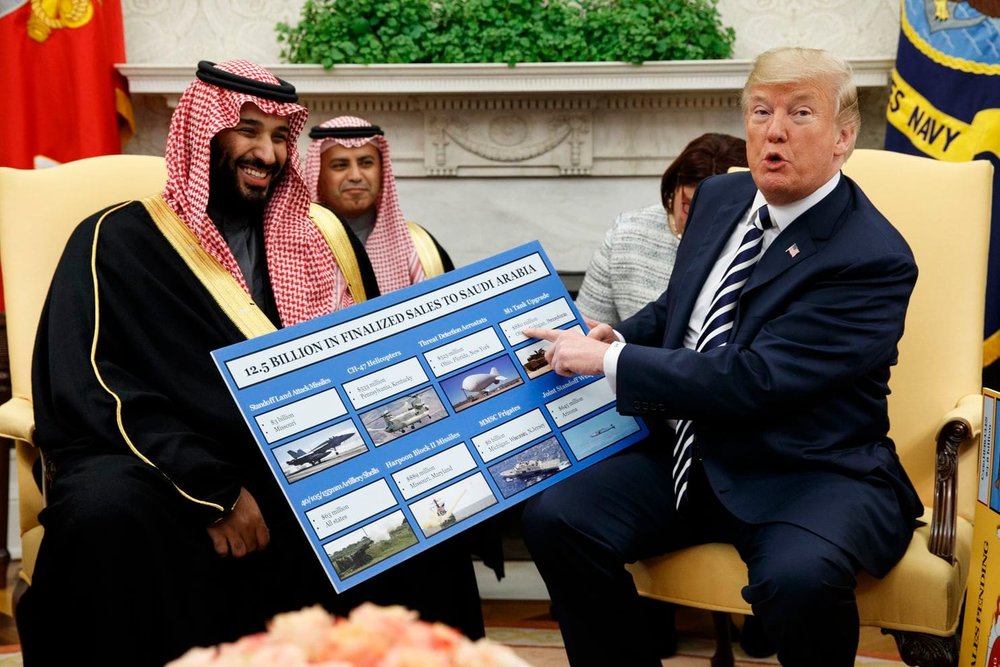
There is no denying the fact that the U.S. is using Saudi oil card to damage the oil-based economies of Russia, Iran, and Venezuela as they are unfailingly challenging Washington’s hegemony.
But, it's pertinent to note that the International Monetary Fund has warned that most Middle-Eastern nations, including Saudi Arabia, would run out of cash within five years if oil prices stand at $50 a barrel.
Amid the draconian U.S. sanctions against Iran, Trump ordered the de-facto leader of OPEC Saudi Arabia to increase its oil production, because of which production from Saudi regime touched 11.3 million barrels per day in November 2018 despite the devastating effects of lower oil prices on every oil economy.
In return, Trump eased the diplomatic pressure on the Saudi regime and the young crown prince got away with the brutal murder of Saudi journalist Jamal Khashoggi.
Corrupting free market operations by artificially lowering the oil prices and other prominent fronts like crushing dissent explain the hypocrisy of the U.S. and its allies Saudi Arabia and Israel.
Saudi monarchy has always been intolerant to any form of dissent. The recent example is the murder of journalist “Turki Bin Abdul Aziz Al-Jasser” just days after the killing of Khashoggi for operating the Twitter account “Kashkool” that highlighted the human rights violations by Saudi regime.
Since 2015, three Saudi princes Sultan bin Turki bin Abdul-Aziz, Saud bin Saif al-Nasr, and Turki bin Bandar have disappeared.
According to a BBC documentary, all three of them were abducted by the Saudi regime on foreign land to crush dissent.
Not only have the dissidents been eliminated but any form of protest from the country’s Shia minority has been crushed brutally.
The Arab spring sent shockwaves in the Saudi fiefdom as protestors demanded an end to decades of discrimination against country’s Shia minority. So Saudi regime resorted to violent crackdown on protesters and detained scores of them.
The world's so-called 'superpower' has turned blind eye to the brutalities of Saudi regime against religious minorities and backed the rulers in their wrongdoings.
In Yemen, instead of denouncing Saudis for committing horrendous war crimes, the U.S. has been supplying arms to them. In Syria, U.S. has played a key role in stoking the flames of war by blaming Assad government for killing his people, which is far from the truth.
The U.S. and its Middle Eastern allies like Saudi Arabia and the illegitimate regime of Israel funded and armed ISIS and Al-Nusra terrorists to overthrow the Assad government but as we know, they have miserably failed to achieve their goals.
The defeat of the U.S. and its proxies is so embarrassing for them that Israel tried to divert the Syrian war to another front that may have unleashed a nuclear catastrophe.
The downing of Russian IL-20 military aircraft in September 2018 could have become a new “Pearl Harbor” if Putin announced a military response against the coward act of Israel.
According to Russian Foreign Ministry spokeswoman Maria Zakharova, the tragedy was a result of “erroneous, unprofessional and cowardly" acts from Israel. It is clear that any military action from Russia against Israel could have definitely dragged the U.S. into the war and such a military confrontation could have had dangerous ramifications.
But still no one in the West seems to blame Israel for such dangerous provocation but they keep blaming Iran’s nuclear program.
Israel enjoys the nuclear immunity despite the fact that it is the only country in the Middle East that has nuclear weapons and has even threatened to use them.
Iranian Foreign Minister Javaid Zarif responded to the nuclear threat from Israel saying: 'Iran, a country without nuclear weapons, is threatened with atomic annihilation by a warmonger standing next to an actual nuclear weapons factory. Beyond shameless in the gall.” 
But the West led by the U.S. is paying no heed to Israel's warmongering. It is busy watching propaganda of Netanyahu at UN to defame the Islamic Republic of Iran.
Not only is Israel threatening Iran but the warmongers in Washington are also in favor of military offensive against the Islamic republic.
Recently “Brian Hook”, the US State Department's director of policy planning and head of Iran Action Group, stated that Trump administration is considering war against Iran if sanctions failed to curb Tehran’s influence and so-called threats against Washington.
The statement came just a day after Tehran asserted that it did not seek a war with any other nation. As American political analyst and author Stephen Lendman puts it, the U.S. would pay a huge price if it goes to war with Iran.
The humanitarian catastrophes in Yemen are the handiwork of the U.S. and its ally Saudi Arabia. Till now the conflict has cost more than 57,000 lives of Yemenis in addition to the destruction of schools, hospitals, and other infrastructure.
The famine in Yemen is worst in its history where 8.4 million Yemenis are in extreme hunger and another 22.2 million are facing food shortages.
Still, the Saudi-led coalition with the help of U.S. is intentionally ignoring the proposed four-point peace plan from Iran which includes an immediate ceasefire, humanitarian assistance, resumption of broad national dialogue and establishment of a stable and friendly government.
The regime in Riyadh that wanted to crush the Yemeni resistance is now on the brink of defeat but still, they are reluctant to agree on any peace plan.
The question remains: how long the world is going to tolerate the hypocrisy of the U.S. and its allies in the Middle East.
The author is a Kashmir based writer and researcher.