Showing posts with label drone attacks on Aramco. Show all posts

Friday, September 27, 2019

Iran: Neither Military Action Nor Economic Sanctions

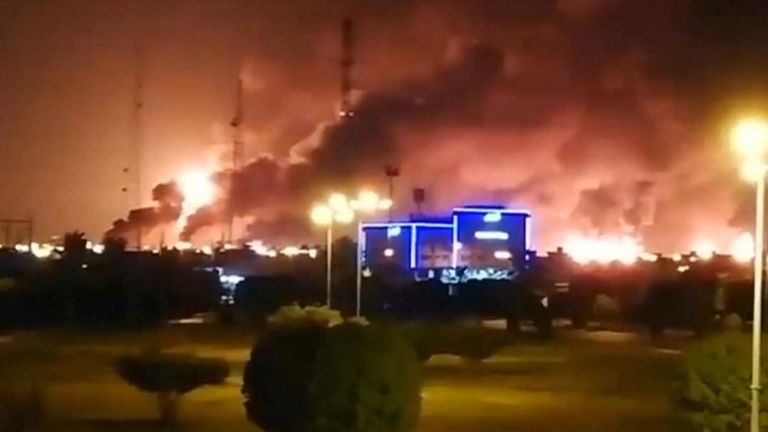
It would be utterly immoral of the United States to launch a military attack upon Iran if it is true that one of the missiles that destroyed an oil refinery in Saudi Arabia on the 14th of September 2019 had a casing bearing a number that suggested that the weapon was manufactured for NATO forces. The alphabets preceding the number denote the type of missile it is and one of its uses. The picture of the missile was inadvertently supplied to the media by the Saudi Defence Ministry.
A theory that has emerged in the wake of the picture of this missile is that the assault on the oil refineries in Saudi’s Eastern Province could have been a false flag operation initiated by John Bolton who was sacked by President Donald Trump as National Security Adviser around that time. It was his way of orchestrating a ‘parting shot’  which he could then blame on Iran — a State that he has always targeted in pursuit of his neo conservative agenda of emasculating Israel’s regional adversaries in order to ensure the latter’s supremacy and hegemony.
A false flag operation would exonerate Iran which has consistently maintained that it had nothing to do with the attack on the refineries. Besides, Iran does not stand to gain in any way from such action. Its current preoccupation is with getting crippling sanctions imposed on it by the US lifted immediately.  A false flag operation would however raise a question or two about the Houthi( Ansar Allah)  claim that it destroyed the Saudi refineries. Indeed, if anyone in the region has a reason to act against the Saudi regime, it would be the Houthis and the people of Yemen in general. Since 2015 at least 50,000 bombs and missiles have been dropped in Yemen by the Saudi military and its regional allies. More than 15,000 children, women and men have perished. Farms, hospitals and schools have been bombarded.  The constant daily attacks have spawned the worst humanitarian crisis in the 21st century. Preventable diseases such as cholera have spread and malnutrition and starvation haunt tens of thousands of families. It has been estimated that a child dies every 10 minutes in Yemen as a result of all this.
It is this terrible catastrophe that the world should address. False flag operations divert attention from the root causes of a catastrophe ignited by the Saudi and US elites years ago. Those causes in turn are related to geopolitics, power and hegemony. The ordinary Yemeni has paid a huge price.
If a military assault on Iran is not to going to help the ordinary Yemeni neither will the tightening of economic sanctions against the people of Iran. Already the sanctions re-imposed upon that country since the US withdrew from the six nation nuclear deal have led to a great deal of pain and suffering within the populace. The sick including children have been deprived of much needed medicines which are presently imported from abroad.
Military action and economic sanctions it is obvious only exacerbate dire situations.  Whenever it is initiated by a mighty power in collusion with its allies and agents, it fails to achieve its objectives. Take US helmed military campaigns aimed at furthering their own often diabolical agenda. The US attempt to crush what was in reality a nationalist movement in Vietnam in the sixties and early seventies resulted in its own ignominious defeat. Under the banner of NATO, it took control of Afghanistan in October 2001 and in the process ignited a war of resistance which after 18 years has undoubtedly enhanced the Taliban’s grip upon power. Together with Britain, it invaded and occupied Iraq convinced that it would not only be able to control the nation’s rich oil resource but also determine the region’s politics in favour of Israel. Neither goal has been achieved and Iraq continues to be in a quagmire. Libya is another country in West Asia and North Africa (WANA) where the US and its NATO partners initially succeeded in overthrowing Muammar Gaddafi and murdering him brutally but is now bogged down in a chaotic terrain where there is no effective functioning government. In Syria for at least seven years, starting in 2011, the US and its allies sought through covert and overt means to oust the government of Bashar Al-Assad mainly because it refused to kowtow to them. Though they even employed terrorist outfits to achieve their objective, Bashar is still in the seat of power, supported by the Hezbollah, Iran and Russia. Syria has proven yet again that it is not possible to accomplish regime change through military means orchestrated by external actors.
Economic sanctions however harsh have also not succeeded in bringing governments that value their independence and integrity to their knees. An outstanding example of a nation that has withstood US sanctions and enhanced its sovereignty is Cuba.  One of those rare occasions when sanctions have worked is the global movement against Apartheid South Africa in the eighties. There was a universal moral principle underlying those sanctions that transcended any self-serving agenda which was one of the reasons that explained its success. One can argue that such a principle is also present in the Boycott, Divest Sanctions (BDS) movement in relation to Israeli occupation of Palestinian and Arab lands.
The time has come for people everywhere to reject military action and self-serving economic sanctions   as means towards certain nefarious ends. Since the former is a threat and the latter is a reality in the case of Iran, the Iranian crisis should serve as a platform for the mass mobilization of global public opinion against the use of these two weapons. Let Iran be that moment in history that will persuade humankind to eschew what is vile and vicious, what is cruel and callous in our setting as we journey towards a civilization that is just, humane and compassionate.
Dr Chandra Muzaffar is President of the International Movement for a Just World (JUST).. Malaysia.

Friday, September 20, 2019

The Crisis Over The Attack On Saudi Oil Infrastructure Is Over - We Now Wait For the Next One

The crisis about the Yemeni drone and cruise missile attack on two Saudi oil installations is for now over.

The Saudis and the U.S. accuse Iran of being behind the "act of war" as Secretary of State Pompeo called it. The Saudis have bombed Yemen with U.S. made bombs since 2015. One wonders how Pompeo is calling that.

The Yemeni forces aligned with the Houthi Ansarallah do not deny that their drones and cruise missiles are copies of Iranian designs. But they insist that they are built in Yemen and fired from there.

President Trump will not launch a military attack against Iran. Neither will the Saudis or anyone else. Iran has deterred them by explaining that any attack on Iran will be responded to by waging all out war against the U.S. and its 'allies' around the Persian Gulf.
Trump sent Pompeo to Saudi Arabia to hold hands with the Saudi gangster family who call themselves royals. Pompeo of course tried to sell them more weapons. On his flight back he had an uncharacteristically dovish Q & A with reporters. Pompeo said:
I was here in an act of diplomacy. While the foreign minister of Iran is threatening all-out war and to fight to the last American, we’re here to build out a coalition aimed at achieving peace and a peaceful resolution to this. That’s my mission set, what President Trump certainly wants me to work to achieve, and I hope that the Islamic Republic of Iran sees it the same way. There’s no evidence of that from his statement, but I hope that that’s the case.
The crisis is over and we are back to waiting for the next round. A few days or weeks from now we will see another round of attacks on oil assets on the western side of the Persian Gulf. Iran, with the help of its friends, can play this game again and again and it will do so until the U.S. gives up and lifts the sanctions against that country.

The Houthi will continue to attack the Saudis until they end their war on Yemen and pay reparations.

As long as no U.S. forces get killed the U.S. will not hit back because Trump wants to be reelected. An all out war around the Persian Gulf would drive energy prices into the stratosphere and slump the global economy. His voters would not like that.

In our earlier pieces on the Abqaiq attack we said that the attacked crude oil stabilization plant in Abquaq had no air defense. Some diligent researchers have since found that there was a previously unknown Patriot air-defense unit in the area which was itself protected by several short range air-defense cannons:
Michael Duitsman @DuitsyWasHere - 7:02 UTC · Sep 18, 2019
On paper, the point air defenses at the Abqaiq oil processing facility are rather formidable... by 1995 standards, at least.
A battery of Shahine SAMs (French system from the early 1980's)
3 or 4 anti-aircraft gun sections, each with 2 twin 35mm cannons and a fire control unit

But one Patriot system covers only 120° of the horizon. The attacking drones came from a western directions while Saudi Arabia's enemies are to its east and south. The older Patriot 2 version the Saudis have is also not of much use against low flying drones and cruise missiles.
There is also the oddity that the Patriot unit's radar system was shut off.
Putin is a Virus @PutinIsAVirus - 4:53 UTC · Sep 19, 2019No patriot radars have been active in recent months (at least not consistently) in the vicinity of the plant, not in the short range required to detect low flying cruise missiles or drones. Closest installation is in Barhain.
(using Sentinel 1 CSAR sat for detection)

Satellites with synthetic-aperture radar can 'see' the radar of Patriot and other air-defense system. None was detected around Abqaiq.
The explanation for that is likely rather trivial. Colonel Pat Lang was stationed in Saudi Arabia as a military liaison officer. As he recently remarked:
Never underestimate the feckless laziness of the Saudis. In my experience they turn off all ATC and air defense systems that require manning or watch keeping when they find them inconvenient as on the weekend. IMO if Ansarallah did this they will do something similar soon to prove they are responsible.

Abqaiq was attacked on the night of Friday to Saturday. That is the weekend in Saudi Arabia.

Impact of Yemeni attack on Saudi ARAMCO Oil Facilities

Enhanced and partial transcript of a PressTV Interview
Background
Saudi Arabia says the recent drone attacks on the state-run oil company Aramco, led to a temporary closure of its facilities and disrupted the kingdom’s oil production and exports.

[Saudi] Energy Minister, Abdulaziz bin Salman said the attacks led to the interruption in production of an estimated five-point-seven million barrels of crude per day. The amount is equivalent to five percent of the daily global supply of crude oil. Meanwhile, Crown Prince, Mohammad bin Salman, said his country is willing and able to deal with Saturday’s drone strikes. Also, the U-S secretary of state has accused Iran of being behind the recent attacks. Mike Pompeo claimed there is no evidence to prove that the attacks were launched from Yemen. He was actually adamant about blaming Iran for the attack, without any shred of proof. This is while Yemen’s Ansarullah movement [the Houthis] has claimed responsibility for the drone strikes.

Saudi stocks dropped dramatically following drone strikes on two Aramco facilities by Yemeni forces; an attack that halved the kingdom’s crude production.

Saudi shares have dropped three percent after Yemeni drone attacks on two major state-run Aramco oil facilities knocked out more than half the kingdom’s production.

Saudi Energy Minister, Abdulaziz bin Salman said the attacks led to the interruption in production of an estimated five-point-seven million barrels of crude per day. The amount is equivalent to five percent of the daily global supply of crude oil. Yemeni forces launched the massive drone attack in response to the Saudi-led coalition war that has lasted for more than 4 years on the impoverished nation on Saturday.

PressTVCould you please comment on the consequence of this reduction in the oil supply by Saudi Arabia?
PK
First, lets make one thing crystal clear – Mr. Pompeo is a flagrant liar, has been in the past with everything he says against his own fabricated enemies, and he will very unlikely change, as the type of his hawkish aggressive warrior character will not change. Therefore, everything Pompeo says and pretends which such assurance that most people realize it’s a fabricated lie as he did not – and never does – provide any evidence. Therefore, whatever he says and pretends to be the truth without evidence, has to be taken with more than a grain of salt.
In fact, immediately blaming Iran for the drone attack on ARAMCO, is without any foundation; it is an outright lie, just to put more dirt on Iran, to further denigrate Iran. It is very clear to me – who have worked for 7 years in Yemen – that the Houthis have the capacity to develop their own drones – they have a flying range potential of at least 1,000 km.
It is very simple and very logical, the Houthis are gradually getting their strength back and are revenging themselves for the horrendous aggression launched for more than 4 year by the Saudis against their country – of course, with staunch support from the US, UK and the French.

Lets just remind ourselves, that inhuman abhorrent aggression has cost tens of thousands of Yemeni lives – most of them children, women and the elderly and weak – from direct bomb attacks, from famine, and from cholera and other sanitation related diseases. Today still a million people are at risk of a cholera epidemic.

Having said this – the consequences or impact of a 5% oil output reduction due to the burning ARAMCO wells is insignificant. Of course, speculators – the Godman Sachs type, who are the chief manipulators behind oil prices – would like you to believe that this is ample ground for hefty fuel price increases – in reality not at all.
Of course, in our predatory capitalist world, the stock market wheelers and dealers, may try to cash-in on this event – which in reality has – or should have – zero impact on the world oil supply.
This shortfall could easily be made up by lifting sanctions o Iranian and Venezuelan oil sales… so it’s just a question of logics – and foremost – of justice, international law and Human Rights.
PressTVWhat about the fragility of the Saudis military power?
PKOf course, the Saudi military power is nothing without the full support and guidance, by weapons and technical and strategic advice directly from the Pentagon, CIA – and the European vassals, and – of course – from weapon manufacturers and weapon sales sharks, in the UK and in France.
The Saudis from day one – in October 2015 – were just launching a proxy war for the US against Yemen – Yemen has a key strategic location in the Gulf and Middle East, and also off-shore deep hydrocarbon deposits – and god forbid, may not be ruled by a people-friendly – a socialist leaning government. For the last 50-some years Yemen was ruled by a US puppet, or puppets – which was OK for the US, but once people get tired of injustice and corruption, they decided to dispose their nefarious regime and replace it with the popular Houthi movement.
When the Saudis agreed in the early 1970’s as head of OPEC and on behalf of OPEC, to sell crude only in US-dollars, the US Administration offered them in turn – “forever” military protection, in the form of multiple military bases in the Saudi territories. Without this protection, the Saudis would not have survived as long as they did with their horrendous discriminatory and corrupt government and, of course, without that protection, OPEC may not have stuck to the “dollar-only” rule to trade hydrocarbons. – We might be in another world today – but, we really don’t know how dynamics might have worked out.
Peter Koenig is an economist and geopolitical analyst. He is also a water resources and environmental specialist. He worked for over 30 years with the World Bank and the World Health Organizationaround the world in the fields of environment and water. He lectures at universities in the US, Europe and South America. He writes regularly for Global Research; ICH; RT; Sputnik; PressTV; The 21st Century; Greanville Post; TeleSUR; The Saker Blog, the New Eastern Outlook (NEO); and other internet sites. He is the author of Implosion – An Economic Thriller about War, Environmental Destruction and Corporate Greed – fiction based on facts and on 30 years of World Bank experience around the globe. He is also a co-author of The World Order and Revolution! – Essays from the Resistance.
Peter Koenig is a Research Associate of the Centre for Research on Globalization.