Showing posts with label Islamic World. Show all posts

Saturday, August 31, 2019

A glance at essential elements of traditional architecture in Iran

TEHRAN - Persian architecture has a long and complex history. The Elamite, Achaemenian, Hellenistic, and other pre-Islamic dynasties left striking stone testaments to their greatness, such as Chogha Zanbil and Persepolis—both designated as UNESCO World Heritage sites in 1979. 
Three monastic ensembles central to the Armenian Christian faith were collectively recognized as a World Heritage site in 2008. Their architecture represents a confluence of Byzantine, Persian, and Armenian cultures. 
From the Islamic period the architectural achievements of the Seljuq, Il-Khanid, and Safavid dynasties are particularly noteworthy. During that time Iranian cities such as Neyshabur, Isfahan, and Shiraz came to be among the great cities of the Islamic world, and their many mosques, madrasahs, shrines, and palaces formed an architectural tradition that was distinctly Iranian within the larger Islamic milieu, according to Encyclopedia Britannica. 
There are some elements that are common among most of the monuments constructed upon Persian architecture.
The usage of iwans (porticos)
An iwan is a vaulted space that opens on one side to a courtyard. The idea of iwan developed in pre-Islamic Iran where it was used in monumental and imperial architecture. 
Extensive use of arches
The two famous monuments, the Taj Mahal for the Mughal architecture and the Great Mosque of Isfahan for the Persian architecture displays the example of this fact. It is built for aesthetic reasons, as well as to place windows and to lessen the extent of sunlight to pour into the building.
Gardens, fountains, and pools
Water plays a particularly central role in Iranian design: millennia before the invention of the first water pump, Persian agricultural experts created the qanat (subterranean aqueduct) based on their hydraulic laws.
Spacious gardens and pools with fountains have always been a main feature of Persian architecture over time. In a traditional mosque, madrasa, house, it is used for ablutions, aesthetics or both.
Domes 
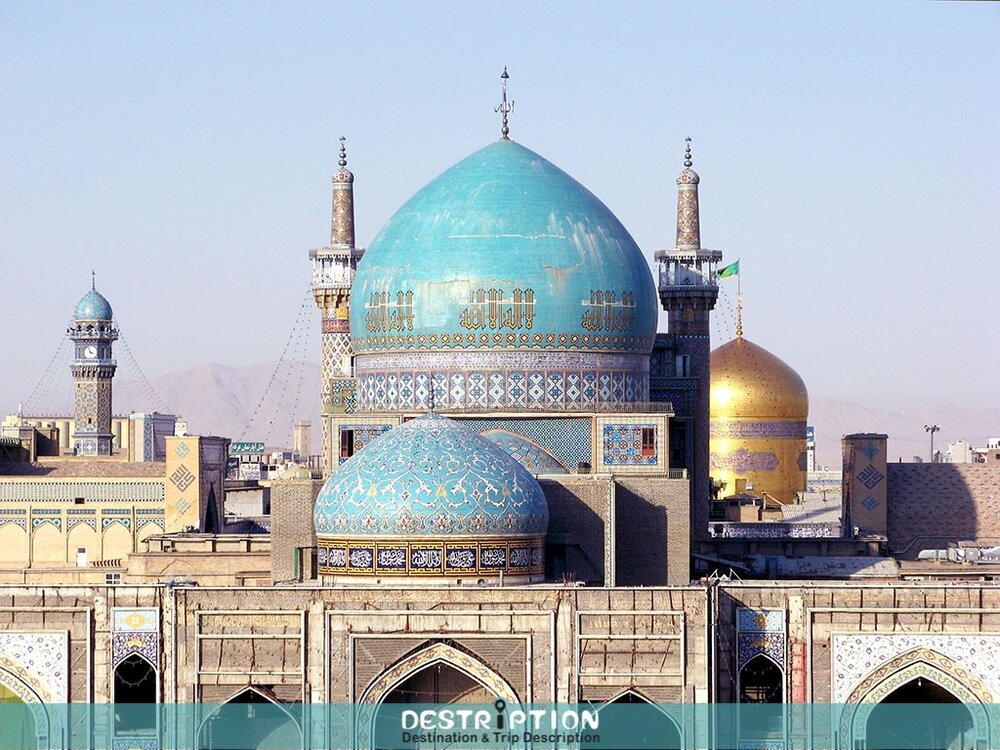
The Persian tradition of dome-building dates back to the earliest Mesopotamian architecture when domes became an integral part of buildings due to the scarcity of wood in many areas of the Iranian plateau.
In Ancient Persia, domes were associated with the divine side of life, as their circular shape represented perfection, eternity and the heavens, according to Press TV. 
Domes moved to the forefront of Persian architecture during the Sasanian period (224 to 651 CE) and they evolved through different eras until the Safavid dynasty (1501–1732) when the last generation of Persian domes were characterized by a distinctive bulbous profile and astonishing tileworks.
In the Persian urban designing, domes in places of worship and public places, including traditional bazaars, caravansaries, schools and baths, are designed in such a way that can be seen from different parts of urban or rural area.
The domes are normally double-shelled. While the interior shell is designed to carry the weight of the structure, the exterior shell serves as both a decorative element and as insulation against the elements. The aerodynamic shape of the domes also makes the structures more sustainable.
 
Symmetry 
Iranian architecture makes use of abundant symbolic geometry, using pure forms such as the circle and square, and plans are based on often symmetrical layouts featuring rectangular courtyards and halls.
Sassanid architecture is decorated with carved stone or stucco reliefs and makes use of colorful stone mosaics. Beautiful gold and silver dishes, bowls, and ewers, often decorated with hunting scenes or animals in high relief, and textiles with symmetrical heraldic designs also remain.
Usage of Muqarnas
Muqarnas is typically applied to the undersides of domes, pendentives, cornices, squinches, arches, and vaults and is often seen in the mihrab of a mosque. They can be entirely ornamental, or serve as load-bearing structures. The earliest forms of muqarnas domes, found in the Mesopotamian region, were primarily structural.
Calligraphy
 Iranians’ passion for using the script as an artistic impression goes back to pre-Islamic times but it is the work of Islamic era calligraphers and illuminators that elevated its use into the high art we appreciate today. Encouraged by the Islamic preference for the art of calligraphy over representational arts, it developed from epoch to epoch and from style to style.

Monday, September 03, 2018

No, it’s not the strongly cruel who survive in the longer run

By Martin Love


“The weak crumble, are slaughtered and are erased from history while the strong, for good or for ill, survive. The strong are respected, and alliances are made with the strong, and in the end peace is made with the strong.”
This is a direct quote of a Twitter submission by Benjamin Netanyahu this past week. It’s been copied (and condemned) by a variety of people on the Internet, and if anything has ever been written that shows the true face of the Zionist regime, this has to be it. It is fascist, and could have been written by a Nazi in Germany at the start of World War 2. “Might makes right” is apparently Netanyahu’s only thought. And, it seems, the only thought of the Trump Administration Neocons, too, who are directing US foreign policies and sanction activity worldwide.
One hardly knows how to respond, practically, to such an assertion, except to wonder what this dangerous man has been smoking, but it is entirely in line with Revisionist Zionism promulgated by Vladimir Jabotinsky as early as the 1920’s in Palestine. It was Natanyahu’s father who was for a time secretary to Jabotinsky, and thus Israel’s current Prime Minister was even as a child infused with an ideology that was anything but peaceful.
You can’t teach a bad man new tricks. It’s awfully clear what Iran has been up against in the Mideast since the 1979 revolution, and given the US refusal to balance its policies in the Mideast, matters have only gotten worse, especially under Trump.
One can read every day of new atrocities in Gaza and the West Bank such that it appears the Zionists want to literally wipe out any Palestinian identity. This is genocide. And Trump has withheld funds from UNWRA and also wants to reclassify the number of Palestinian refugees from about six million in the Mideast to 500,000, forcing millions to give up any notion of equity and justice. The hard-right Zionists are going for complete domination of the region along with the US, despite the fact that quite a few better thinking Jews in Israel are protesting the Likud government under Netanyahu.
The statement above is fraught with error. For one thing, few anywhere in the world, except other Zionists, respect Netanyahu. He and his country are almost universally despised. He has no real alliances to speak of except with the US government and some among the Saudis and perhaps others in the UAE. Any kind of real “peace” is not made with the “strong” since there is no real strength in militarism and cruelty.
It was the humble and meek and long persecuted Christians, for example, who in the three centuries after Jesus felled the mighty Roman Empire as it had been. It was humble but determined Prophet Mohammad who eventually overcame his naysayers, the recalcitrant and initially disbelieving tribes in Arabia in the early 7th century, which led to the ascent of Islam, a religion of brotherhood and peace in concept at least like no other.
The one thing that might be said about the U.S. government and the Pentagon and the all the various groups that comprise the so-called “Deep State”, even if is not much solace to emerging market countries like Iran and Turkey, or to Russia and China, and to those others in the Islamic world and Mideast who are suffering because of U.S. and Zionist actions and postures, is that they reek of complete desperation -- by doubling down on previous failures by doubling or tripling up on aggression and militancy. Perhaps these operators know they are not holding a winning hand? It’s like a person in a boxing match with an adversary, but the adversary looks like the eventual winner and in desperation the loser changes the game entirely – by drawing a gun on the unarmed opponent.
It may be that Trump is the culmination of America and Netanyahu is the culmination of the Zionist state. It hardly looks that way right now, but stranger things have happened. It really does depend on countries like Iran, Russia, China and Turkey, and even Germany, finding effective ways to carry on business despite U.S. sanctions and threats from both the U.S and the Zionists. Otherwise, there will be Hell to pay for a refusal to try to stand strong in spirit and at the same time, exactly what the U.S and Israel are not in desperation – cool headed.

Monday, July 09, 2018

Personality & Life of Imam Khomeini (R.A.)

By Hamid Algar


Prof. Hamid Algar
It is related that when teaching a class on ethical advancement at Qum in the 1930's, Imam Khomeini (R.A.) would always close his lectures with the following sentence from the Munajat-i Sha'ban, a litany unique in that all the Twelve [Ma’sumin] Imams recited it: O God, grant me total separation from other than You and attachment to You; brighten the vision of our hearts with the light of looking upon You, so that they may pierce the veils of light and attain the source of magnificence, and our spirits be suspended from the splendor of Your sanctity. The Imam always assigned great importance to the study and recitation of the supplicatory prayers of the Imams (A.S.) from the Ahlul-Bayt (A.S.), as a means of attaining Munajat-i Sha'ban spiritual insight as well as petitioning the Creator, but this appeal from the Munajat-i Sha'ban seems to have been particularly close to  his heart.


It appears in texts and pronouncements belonging to different phases of his life: in the commentary on a hadith of Imam Ja'far al-Sadiq (A.S.) concerning "the meeting with ALLAH" (liqa'ullah), contained in Sharh-i Chihil Hadith, a work completed in 1939; in one of his works concerning the inner dimensions of prayer, Mi'raj al-Salikin, also finished the same year; in Jihad-i Akbar ya Mubaraza ba Nafs, a lecture on ethical purification delivered in Najaf in about 1972; in the lectures on the exegesis of Surat al-Fatiha that were televised in December, 1979 and January, 1980; and in Rah-i 'Ishq, a letter written by the Imam to his daughter-in-law, [Khanum] Fatima Tabataba'i, in 1983. The aspiration "to pierce the veils of light and attain the source of magnificence" may therefore be regarded as a constant element in the devotional life of the Imam, and only by bearing it in mind can the totality of his struggles and achievements, including the political, be correctly understood. It was with a gaze fixed on "the source of magnificence", a mode of vision utterly different from that of the common political leader, that the Imam led a vast revolutionary movement to success.


 The integrality and comprehensiveness of the Imam's personality and vision of Islam are such that analytical distinctions among their various dimensions are in a sense artificial, reflecting an effort to understand the Imam rather than his actuality. It is nonetheless legitimate - or at least inevitable - to speak of the Gnostic ( ‘irfani) and political aspects of his life and activity and to accord a certain primacy to the former, in terms of not only chronology but also significance. The Imam is generally regarded, by both Westerners and Muslims, as nothing more than an unusually gifted revolutionary leader, yet all who knew him intimately, as well as many who met with him but briefly, can testify that he possessed a vision transcending the political at the very same time that it controlled and embraced it. It is precisely this inclusion of the political in the Gnostic that is perhaps the most distinctive feature of the Imam's persona. As for the chronological primacy of gnosis in the life of the Imam, this is amply demonstrated by the history of his early years in Qum.


His immediate purpose in going there in 1920 was no doubt to study with Shaykh 'Abd al-Karim Ha'iri, one of the principal authorities of the day in jurisprudence, and he distinguished himself in this essential area of Islamic learning long before his emergence as a marja'-i taqlid in the early 1960's. But in Qum he soon developed an interest in ‘irfan and associated disciplines that set him apart from many of his contemporaries and was, indeed, often viewed with suspicion and even hostility; many years later he had occasion to remark: "It is regrettable that some of the ‘ulama should entertain such suspicions and deprive themselves of the benefits to be gained from studying ‘irfan." His first guide in the pursuit of ‘irfan was Mirza'Ali Akbar Yazdi (d. 1926), a pupil of Husayn Sabzavari who had himself studied under Mulla Hadi Sabzavari (d. 1872), the author of Sharh-i Manzuma, one of the basic texts of ‘irfan; the Imam was thus affiliated to one of the principal lines of the teaching and transmission of Shi'ite gnosis. Another early guide was Mirza Aqa Javad Maliki Tabrizi (d. 1924), who had been teaching in Qum since 1911.


He held two classes on philosophy and ethics, a public one at the Madrasa-yi Fayziya and a private one in his own home that was attended by a number of gifted and favored students including the Imam. The Imam also studied with Sayyid Abu al-Hasan Rafi'i Qazvini (d. 1975), among whose few published writings is a commentary on the Du'a al-Sahar, the same profound supplication to which the Imam devoted his first work, Sharh Du'a al-Sahar; it is therefore possible that the Imam's attention was first drawn to this text by Qazvini. The Imam's chief teacher in gnosis was, however, Ayatullah Muhammad 'Ali Shahabadi (d.1950), to whom he respectfully referred in his own writings on ‘irfan as "our master in theosophy" (ustad-i ilahi-yi ma). He met Shahabadi soon after the latter's arrival in Qum (probably in the late 1920's), and the answer he gave the Imam to a question on ‘irfan convinced him that he was in the presence of a true master.


After initially refusing the Imam's request for permission to study with him, Shahabadi consented to teach him philosophy, but it was gnosis the Imam wished to pursue, and he persisted until Shahabadi agreed to instruct him in that discipline. Every Thursday and Friday, as well as on holidays, usually alone but sometimes in the company of one or two other students, the Imam listened to Shahabadi lecturing on the commentary by Da'ud Qaysari (d. 1350) on the Fusus al-Hikam of Ibn 'Arabi, the Miftah al-Ghayb of Sadr al-Din Qunavi (d. 1274), and the Manazil al-Sa'irin of Khwaja 'Abdullah Ansari (d. 1089). The Imam's interest in these texts, particularly the last, remained demonstrably with him throughout his life.


In so far as the Imam's fusion of Gnostic and political concerns can be traced to any source other than illumination and immersion in the Qur'an and the teachings of the Ma’sumin, it is to another aspect of Shahabadi's influence upon him that it may be attributed. Shahabadi was one of the relatively few ‘ulama in the time of Reza Shah to raise his voice against the misdeeds of the Pahlavi dynasty. He would regularly preach against the first Pahlavi during the commemoration of 'Ashura, and on one occasion manifested his extreme discontent by entering an eleven-month retreat at the shrine of Shah 'Abd al-'Azim. A similar commitment to the political sphere manifested itself in one of his books, Shadharat al-Ma'arif, a brief work which has been well described as "social as well as Gnostic in content."


Here Shahabadi analyzes the causes of decline and discontent in Muslim society, proposes the diffusion of authentic Islamic knowledge as a means of remedying the situation and creating unity, and concludes that although the establishment of perfect Islamic governance is a task reserved for the Sahib al-Zaman (AJ), the political dimension of Islam, implicit in all its juridical ordinances, cannot in any way be neglected, for "Islam is most certainly a political religion" (pp. 6-7). The Imam began his teaching career at the age of twenty-seven by providing instruction in hikmat, a discipline closely related to ‘irfan, and soon thereafter organized private sessions in ‘irfan itself. It was in these sessions that the Imam trained and inspired some of his closest associates, including above all Ayatollah Murtaza Mutahhari, whom the Imam described after his assassination in May 1979 as "the very quintessence of my being."


The texts taught to this elite were the section on the soul (nafs) in the Asfar al-Arba'a of Mulla Sadra and the Sharh-i Manzuma. Gnostic and devotional matters also formed the subject matter of the Imam's earliest writings. In 1928, he wrote a detailed commentary on the Du'a al-Sahar, the prayer recited before dawn during Ramadan by Imam Muhammad al-Baqir (A.S.). This work was followed in 1931 by Misbah al-Hidaya ila al-Khilafa wa al-Wilaya, a brief but dense exposition of the innermost reality of the Prophet (S.A.W) and the Imams (A.S) that draws not only on a meditation on the hadith of the Ma’sumin but also on the akbari concept of the Universal Man (al-insan al-kamil). In 1937, the Imam completed a series of glosses on Qaysari's commentary on the Fusus al-Hikam and on the Misbah al-Uns, Hamza b. Fanari's commentary on the Miftah al-Ghayb of Qunavi.


Two years later, the Imam completed his first work in Farsi, Sharh-i Chihil Hadith, a voluminous commentary on forty hadith of predominantly ethical and gnostic content. Also dating from 1939 is the Imam's Mir'aj al-Salikin wa Salat al-'Arifin (also known as Sirr al-Salat), a treatise in Farsi detailing the inner meaning of every part of the prayer, from the ablution that precedes it to the threefold takbir that concludes it. Somewhat more accessible than this dense and challenging work is another book on the same theme, Adab al-Salat, completed in 1942. Finally, mention may be made of Sharh-i Hadith-i Junud-i 'Aql o Jahl, a work completed in 1944 which, has been described as the fullest and most systematic exposition of the Imam's views on ethics and gnosis.


 Beyond this enumeration, it is neither possible nor desirable on the present occasion to attempt a fuller presentation of the Imam's contribution to the discipline of ‘irfan; it will be enough to refer the reader to Yahya Christian Bonaud's L'Imam Khomeyni, un gnostique méconnu du XXe siecle (Beirut, 1997), an excellent work of both synthesis and analysis. However, in connection with the trajectory of the Imam's life - the transition from early emphasis on ‘irfan to later engagement in the political realm - it is imperative to note that the Gnostic writings are not a digest or extension of received opinions and formulations, drawn up in youth only to be laid aside in maturity; rather they are the manifest fruit of a powerful, original, and lasting vision. As was remarked by Sayyid Ahmad Fihri, who attended some of the Imam's lectures in Qum during the 1930's, "it is apparent that he [the Imam] has experiential knowledge of all he wrote upon."


To put it somewhat differently, the Imam's works on ‘irfan were but the early, literary expression of a process of suluk, of continuous advancement towards the repeatedly invoked "source of magnificence." The Imam's leadership of the Islamic Revolution and his establishment of the Islamic Republic of Iran may be therefore be said to have constituted, from a certain point of view, a further stage in that process of spiritual wayfaring; the fruits of his inward strivings came ultimately to transcend his own person and to manifest themselves with profound effect in the political realm.


This characterization may be justified with reference to the first three of the four journeys that furnish both the subject and the title of Mulla Sadra's Asfar al-Arba'a, a work with which the Imam was intimately acquainted. The first is the journey from creation to the divine reality (min al-khalq ila al-haqq), a movement away from immersion in the multiplicity of creation to exclusive awareness of the sole reality that is coterminous with the divine essence. The second journey takes place within the divine reality by means of that reality itself (fi al-haqq bi al-haqq); it consists of the perception of the divine perfections (kamalat) and of a series of extinctions in the divine names followed by subsistence through them. The third journey is that which leads back from the divine reality to creation (min al-haqq ila al-haqq); however, it does not bring the wayfarer back to his point of departure, for it is a journey that is accomplished by means of the divine reality (bi al-haqq) and has as its result the perception of the mysteries of the divine acts (af'al) as they unfold in the phenomenal world.


 If the impertinence of speculating on the spiritual progress of the Imam be forgiven, it may be suggested that his period of primary emphasis on ‘irfan and associated matters corresponded to the first and second journeys described by Mulla Sadra, and that his involvement in the political sphere and his leadership of the Islamic Revolution were analogous to the third journey. What is certain that the unique insight the Imam displayed at critical junctures during the revolution and the early years of the Islamic Republic cannot be explained purely in terms of political sagacity; a clarity of vision was at work which enabled him to see beyond the immediate conjuncture, and it may be permissible to describe this capacity as a witnessing of the af'al as they became manifest in the political sphere. If this characterization is justifiable, it becomes plain that the Imam generally refrained from overt political activity until 1962 not only because of an unwillingness to dispute the quietist attitude of the senior ‘ulama of the day, but also because an essential process of inner preparation was underway. It was the Imam's own progress toward "the source of magnificence" that enabled him to lead a revolution that was like a collective suluk of the Iranian people.


 This having been said, it must be conceded that the scheme of the three successive journeys has an inevitably metaphorical character, in that the concreteness and definite accessibility of a terrestrial destination are lacking in the trackless realm of inward journeying. Moreover, the application of the scheme to a given life cannot be taken to imply an exact correspondence to chronologically distinct periods. It is no doubt for this reason that traces of political awareness and interest can be discerned in the life of the Imam even before his emergence on the national scene in 1962. He had some contact with scholars who contested various policies of Reza Shah, not only his master Shahabadi but also Hajj Aqa Nurullah Isfahani and Mulla Husayn Fisharaki who led a protest in Isfahan against compulsory military service in 1924; Ayatollah Angaji and Mirza Sadiq Aqa who led a similar movement in Tabriz in 1928; Aqazada Kafa'i who was brought to Tehran for trial after the Mashhad uprising of 1935; and Sayyid Hasan Mudarris, whom the Imam later described as "the leader of those who stood against oppression."


Moreover, the Imam often touched on political themes in the poetry he wrote at the time and which was privately circulated in Qum. Thus when in 1928 Reza Shah abolished the capitulations that had been granted to foreign powers and sought thereby to present himself as an authentic patriot, the Imam responded with a poem that included this line: "It's true he has now abolished every capitulation, but only to hide from you the abolition of the nation!" In any event, such was the climate of the day in Iran that even such an essential component of Shi'ite spirituality as rauzakhwani {the recitation of texts commemorating the martyrdom of Imam Hussain (A.S.)} automatically took on political connotations.


In an interview granted to the present writer in December 1979, the Imam recalled that the assemblies of rauzakhwani in which he participated in Qum during his youth rarely took place, and even then informers often infiltrated them, with the result that those participating were arrested. Still less to the liking of the Pahlavi regime than such traditional manifestations of piety were the public lectures on ethics given by the Imam in Qum in the early 1930's and, after a hiatus, from 1941 onward. Although based on the Manazil al-Sa'irin of Ansari, one of the texts the Imam had studied with Shahabadi, these lectures served as the vehicle for a comprehensive exposition of Islam as a whole, including its political dimensions. Sayyid Ahmad Fihri recalled: "I count the time I spent attending those lectures among the most precious hours of my life. In his lectures the Imam taught true Islamic ethics, which cannot be separated from revolution, in such a way that he left a deep impression on all who attended."


Another listener to those lectures, Ayatollah Murtaza Mutahhari, attributed to them "the formation of a good part of my intellectual and spiritual personality." Moreover, it was not only religious scholars who attended the lectures; people from other walks of life would come from places as far a field as Tehran and Isfahan, defying the wish of the Pahlavi regime to isolate the religious institution in Qum from the general population. The interconnectedness of the Gnostic and sapiential with the political and confrontational also came clearly to the fore in Kashf al-Asrar, which appearing in 1945 was the first published work of the Imam. The book is in the first place a crushing response to Asrar-i Hazarsala, a Wahhabi-inspired polemic against many of the key doctrines of Shi'ism.


This is accomplished largely through the marshalling of a wide range of scriptural and rational arguments, but the Imam also has recourse to the great authorities of hikmat and ‘irfan, men such as Ibn Sina, Suhrwardi, and Mulla Sadra. Further, the currency of works such as Asrar-i Hazarsala is denounced by the Imam as one consequence of the anti-religious policies of the Pahlavi regime, and it is in Kashf al-Asrar that the Imam expounds for the first time the doctrine of "the governance of the jurisprudent" (Vilayat-i Faqih) that was to become the constitutional foundation of the Islamic Republic.


In May 1944, at about the same time he must have been engaged in writing Kashf al-Asrar, the Imam issued what appears to have been his first political proclamation, calling for action to deliver the Muslims of Iran and the entire Islamic world from the tyranny of foreign powers and their domestic accomplices; the autograph copy of this proclamation is headed not only by the bismala but also by the injunction, "read it and put it into effect." The Imam begins, very significantly, by citing Qur'an, 34:46: "Say: I enjoin upon you one thing only -- that you rise up for God, in pairs and singly, and then reflect."


This is the same verse that opens the chapter on awakening (bab al-yaqza) at the very beginning of Ansari's Manazil al-Sa'irin, the handbook of spiritual wayfaring beloved of the Imam since his days of study with Shahabadi. "Rising up for God" counts, then, as the essential point of departure for suluk; it is defined by Ansari as "awakening from the slumber of neglect and rising from the pit of lassitude." The Imam similarly says of the verse in question that in it "God Almighty has set forth the progress of man from the dark realm of nature to the farthest point of true humanity," so that the injunction contained in it is "the sole path of reform in this world." But immediately after offering this Gnostic and ethical interpretation of the verse the Imam proceeds to analyze the lamentable state of the Muslim world, attributing it to the fact that all are engaged in "rising up for the sake of their appetitive souls" (qiyam barayi nafs); it is only through "rising up for God" that matters can be rectified. "Rising up for God" thus becomes both an act of personal redemption and a commitment to change and reform Muslim society, an insurrection equally against spiritual lassitude and neglect in oneself and against corruption, irreligion and tyranny in the world.


There is perhaps no clearer textual indication of the interconnectedness of the ethical and Gnostic with the political in the worldview of the Imam than in this understanding of "rising up for God." During the roughly eighteen years that elapsed between the issuing of this early proclamation and the beginning of the Imam's sustained public struggle against the Pahlavi regime in the autumn of 1962, he appears to have devoted himself primarily to teaching fiqh and usul and writing authoritative books on those disciplines. It has, however, already been pointed out that for the Imam ‘irfan was above all an existential matter, so that the diversion of his pedagogical and literary energies to fiqh and usul cannot be taken to mean that ‘irfan disappeared from the horizons of his inner life. There is evidence; moreover, that even his teaching of these exoteric sciences was colored by Gnostic concerns and that this was one factor in attracting an unusually large number of students to his classes. To quote Sayyid Ahmad Fihri once more, the Imam was able "to demonstrate the conformity of the shari'a to the logic of ‘irfan as well as the conformity of ‘irfan to the logic of the shari'a." In addition, the teaching methods of the hauza [theology school] have always involved the transmission to the student of more than formal learning; a complete ethos and worldview pass from one generation to the next.


That the Imam in particular was able to convey to his students essential spiritual virtues and qualities is apparent from the testimony of the late Muhammad Javad Bohonar that "the Imam would instill in us a sense of spiritual nobility, of responsibility and commitment, of spiritual and intellectual richness; his words would resound in our ears for many days after we left Qum to go preaching during Ramadan." The Imam addressed himself in detail to this task of the ethical and spiritual training of his students in the lectures on the "Major Jihad", the struggle against the self-indulgent tendencies of the self, which he delivered at Najaf in 1972. It is significant that these lectures were given after the better-known series on the governance of the jurisprudent, and appropriate that they were first published as a supplement to them. For the establishment of Islamic government was seen by the Imam as both dependent on and aiming at the spiritual purification of Muslim society and those called upon to lead it, the religious scholars; success in the "minor jihad," the struggle against external forces hostile to Islam, was indissolubly linked to exertion in the " Major Jihad." It is surely not accidental that the first tradition selected for commentary by the Imam in his Sharh-i Chihil Hadith was the hadith from which this pair of terms, major and minor jihad, is derived: "When a group of combatants whom the Prophet (S.A.W.) had sent forth returned, he addressed them saying, 'Welcome to a people who have completed the minor jihad; the major jihad remains for them to fulfill.' They asked: 'O Messenger of God, what is the major jihad?' He replied: “The jihad against the self.”


In his commentary on this hadith, the Imam expounds a concise but complete program of inner combat, its first stage being the reflection (tafakkur) that is ordained in Qur'an, 33:46, the verse cited by the Imam at the beginning of his first public proclamation. The numerous proclamations and directives, gathered together in the 22-volume collection entitled Sahifa-yi Nur, that the Imam issued first in the course of the struggle that led to the foundation of the Islamic Republic and then during the first ten years of its existence necessarily deal first and foremost with the problems and crises of the day. These documents also contain, however, numerous allusions to Gnostic and ethical concerns, demonstrating once again the inseparability of the spiritual and ethical in the worldview of the Imam; a thematic index of the Sahifa-yi Nur lists more than 700 passages of varying length dealing with the concerns of ‘irfan.


Here, only two examples will be discussed. On December 22, 1979, when addressing the people of Qum, the Imam described the success of the revolution as due to the fact that the people of Iran had oriented themselves to the divine presence and thereby taken on "a divine existence." Later, after the beginning of the Iraqi aggression in September 1980, the Imam repeatedly said of the martyrs that they had gone to "the contemplation of ALLAH" (liqa'ullah). This contemplation, a major theme of ‘irfan, had been the subject of a small treatise written by the Imam some time during the 1930's and published as a supplement to the lengthier work of his teacher, Aqa Javad Maliki Tabrizi, on the same subject. He treated the subject at greater length in his Sharh-i Chihil Hadith, where he clarifies that the meaning of liqa'ullah is not comprehensive rational knowledge of the divine essence but "a comprehensiveness of Gnostic witnessing attained by inner vision " (ihata dar ‘irfan-i shuhudi va qadam-i basirat).


He connects it, moreover, to the same supplication with which we opened this discussion, and it may therefore be concluded that for the Imam the martyr was one who by means of his death penetrated "the veils of light" to attain "the source of magnificence." Perhaps the clearest public evidence of the Imam's continuing attachment to ‘irfan and even his belief in the permissibility of conveying it to the broadest possible public came with his televised lectures on the exegesis of Surat al-Fatiha in December 1979 and January 1980. The lectures were suspended for a variety of reasons before the Imam had proceeded beyond the first two verses of the surah, but even in their incomplete form they are a remarkable exposition, clear, eloquent, and accessible, of key topics of ‘irfan, especially the modes of divine manifestation and the meanings of the divine names.


Worthy of note are also the tumultuous events through which Iran was passing at the time the lectures were delivered: the intensified confrontation with the United States that followed on the deposed Shah's entry to America and the occupation of the United States Embassy in Tehran by the Students Following the Line of the Imam; the struggle to institutionalize the new order; various counterrevolutionary plots; and upheaval in the armed forces. It was against this background of turmoil that the Imam chose, with the perfect tranquility that characterized his demeanor, to lecture to the Iranian nation on key topics of ‘irfan that might have been thought irrelevant to the urgent concerns of the day. To understand this choice, it may be appropriate to recall an episode in the life of Imam 'Ali ('alayhi 's-salam) to which the Imam himself refers in the lectures on Surat al-Fatiha. Once, when advancing to do battle with Mu'awiya, Imam 'Ali (A.S.) began discoursing on the inner meaning of Tawhid.


One of his companions asked him whether the time was suitable for the discussion of such matters. He responded, "this is the reason that we are fighting Mu'awiya, not for any worldly gain." The conclusion follows that it is precisely in the midst of the struggle for the establishment of an Islamic order that the deepest meanings of Tawhid may be fittingly evoked; the Gnostic and the political, ‘irfan and jihad, are seen once again to be indissolubly linked. The Imam's concern that Islamic gnosis should be properly known expressed itself even in the foreign policy of the Islamic Republic. In a letter to Mikhail Gorbachev, leader of the Soviet Union, dated January 4, 1988, the Imam not only foretold the collapse and utter discrediting of Communism, with a prescience that outstripped the expertise of conventional Kremlinologists, but also warned against the spiritual and ethical chaos into which post-Soviet Russia has now in fact fallen.


The essential problem confronting Russia, the Imam asserted, was not that of property, the administration of the economy, or personal freedom, but the absence of a valid faith in God. As a contribution to remedying the situation, the Imam proposed that Gorbachev dispatch Soviet scholars to Qum to study inter alia the works of Farabi, Ibn Sina, Suhrawardi, Mulla Sadra, and Ibn 'Arabi. Important and eloquent testimony to the Imam's essential nature as a Gnostic of high rank is also contained in more intimate documents, written towards the end of his life: the poems in which he anticipated the union with the Divine Beloved to which he had constantly aspired, and letters to his son, the late Hajj Sayyid Ahmad Khomeini, and his daughter-in-law, [Khanum] Fatima Tabataba'i. Both the poems and the letters are marked by a strongly emotive tone that distinguishes them from the writings on ‘irfan he had composed during the first phase of his life in Qum.


 As for the public testament that was released after the Imam's death on June 3, 1989, it consists primarily of counsels to various classes of the Iranian people and warnings of the problems they will face in preserving the Islamic Republic. It is therefore easy to dismiss as a mere preliminary the Imam's opening emphasis on the hadith-i thaqalayn, that foundational text for all of Shi'i thought, and to overlook the occurrence, in the exordium, of a reference to "the reserved name" (al-ism al-musta'thar) of God. The sense of this term, which ultimately goes back to a petitionary prayer of the Prophet (A.S.), may be summarized as the divine name (or compendium of names) that relate to the divine qualities that are not and never will be manifested, being "held in reserve" in God's hidden knowledge concerning himself.


As has been suggested by Ayatollah Muhammadi Gilani, the reference made by the Imam to "the reserved name" at the very beginning of his testament indicates a wish on his part to encourage the cultivation of ‘irfan after his passing as an indispensable part of his legacy. It is from the invocation of "the reserved name," together with all the names manifest or capable of manifestation, which the Imam descends, as it were, in the main body of his testament, to the plane of the divine acts that is simultaneously the plane of socio-political struggle. He thus underlined for the last time, subtly but unmistakably, the linkage between the Gnostic and the political that had been the hallmark of his life and one measure of his full and creative assimilation of the guidance of the Qur'an and the Ma’sumin.

Tuesday, June 11, 2013

An Imam is an Imam — and a non-imam is a non-imam

by Abu Dharr June, 2013 Imam Khomeini (ra) whose death anniversary falls this month (June 3) was an outstanding leader whose courage and convictions brought about meaningful change in Iran after the Islamic revolution. Other leaders, primarily in Egypt and Tunisia have failed to adopt bold policies. Sometimes we are forced to say the truth even when it hurts. And this month, on the occasion of the 24th anniversary of Imam Khomeini’s heavenly departure, we are forced to set the record straight as to his extraordinary leadership qualities. Today everyone is looking at the “Arab Spring” and the leaders that have stepped forward to take their countries in an Islamic direction. Currently there are three or four countries that occupy center stage in this regard: Tunisia, Egypt, Libya and Syria. We will spare ourselves the particular details about Libya and Syria as they are too numerous and too viscous to come to terms with. They are obviously not within the jurisdiction of any type of Islamic leadership worthy of its name. So we are left with Tunisia and Egypt. Here we have decision makers who belong to Islamic consciousness and Islamic ambition. So we will place these two countries side by side with Islamic Iran when it was in its formative years; that is, when Imam Khomeini was leading the people into an Islamic future. On the first count, consider how the country’s constitution was drawn up. That was done with all its requirements within the first year of the Imam’s return to Iran. And what do the detractors (Islamic ones, mind you) say about the constitution of the Islamic Republic of Iran? They say that one of its articles stipulates that the state religion shall be Shi‘i Islam of the Twelver persuasion (Ithna ‘Ashari). What’s wrong with that? This constitution was meant for the people in Iran who are predominantly Shi‘i Twelver Muslims. Knowing that these constitutions are meant for a particular population and not for the rest of the Muslim world, would anyone take issue with the Islamic movement in Tunisia working out its own constitution saying that the state religion shall be Islam with the Maliki fiqh as its choice? Or the Hanafi fiqh in Egypt? The problem is we don’t even have what may pass as an Islamic constitution (peculiar to Tunisia or Egypt) yet. All that was done in Egypt was to rewrite a secular constitution that has been embellished with Islamic symbolism: alphabetic characters and arbitrary (Islamic) visible clues. We need an Imam Khomeini in Egypt and in Tunisia who can summon the will of the people to endorse a constitution that invokes independence and sovereignty. Now we ask: why can’t the leadership in Egypt and Tunisia, with its top-heavy Islamic personalities, deal decisively with their opponents — some that are “Islamic” and others who are secular or averse to an Islamic state? Under the able leadership of Imam Khomeini, the mellow Muslims were weeded out. Case in point were personalities like Mahdi Bazargan, Ibrahim Yazdi, Sadeq Qutbzadeh, Abu al-Hasan Bani Sadr, etc. How come we have not heard of such a filtering process in Tunisia and Egypt? Or are the Bazargans, Yazdis, Qutbzadehs, and Bani Sadrs now the leaders themselves in Tunisia and Egypt? The Muslims in Tunisia and Egypt would be missing an Imam Khomeini if they really know what is being done to them. Then we had, within the first couple of years after Imam Khomeini instituted an Islamic state, the terrorist acts of blowing up the headquarters of the Islamic participatory party (Jumhuri Islami) with the martyrdom of over 70 leading figures, among them Dr. Sayyid Muhammad Beheshti Shaheed; this was accompanied by the targeted terrorist assassination of Ayatullah Mutahhari and Dr. Mufatteh. And there were other criminal acts that were meant to cripple the leadership of the Imam and the Islamic resolve of the people, but that did not happen. In Tunisia and in Egypt there hasn’t been any equivalent development. Would the explanation be that the leaderships in these two countries are US compatible? As we know now, most of the early assassinations and terrorist activities in Islamic Iran are traced to the US government and its proxies. On the other hand, we have violent groups and individuals in Syria, not so much in Libya, who are killing at a scale that dwarfs the killings in the early years of Imam Khomeini’s leadership. Those criminal and terrorist acts in Islamic Iran in the early days were mostly attributed to the violent and lawless organization, Muhajideen-e-Khalq (MEK). The Imam was fearless and decisive with this hooligan and condemnable bunch. They were forced to flee the emerging Islamic state and find refuge in every capital of the world that declared Islamic Iran and Imam Khomeini’s leadership enemy number one. Not to be lost on the handlers and coaches of such troublemakers, the US regime and its flunkies have metamorphosed the MEK into its al-Qa’ida clone with “Sunni-Shi‘i” divergences. We are beginning to see evidence of this in the Tunisian Ansar al-Shari‘ah battlering with the ruling al-Nahdah party. The Muslims miss the decisive character of Imam Khomeini in North Africa. One of Imam Khomeini’s first decisions was to close down the Israeli embassy in Tehran and expel the Zionist enemies from Iran. Compare that with the inability of the “Islamic” leadership in Egypt to break off diplomatic ties with the Israeli Zionist regime, which nowadays is maneuvering to physically occupy al-Masjid al-Aqsa and thwart access to the first qiblah and third haram to all Muslims. It gets worse: the Egyptian Islamic decision makers cannot open the borders between Egypt and Ghazzah. Egypt needs an Imam Khomeini. When Imam Khomeini began building an Islamic state in Iran he demanded justice be done to the fleeing Shah of Iran. The Shah had to beg for residency in different countries until he was finally appended to his American cooperator Muhammad Anwar al-Sadat in Egypt. The Islamic leadership in Iran with Imam Khomeini pursued the Shah until he finally went to his Maker where he will encounter ultimate justice. Correlate that with the official Egyptian inability to pass final judicial judgment on Hosni Mubarak the Pharaoh. Or correlate that with the disability of the Tunisian (Islamic) leadership to pursue and prosecute Zine al-Abidine bin ‘Ali who took refuge in the evil kingdom of Saudi Arabia. Why doesn’t the Tunisian government ask for the extradition of Bin ‘Ali to Tunisia to stand in a court of law where he will be answerable for his official presidential conduct and state policies, one of which forced Rachid al-Ghannoushi into exile at the behest of the security apparatus? It turns out that not all exiles are the same. Imam Khomeini was forced into exile by the Shah, but when he came back he sought the Shah and expended all that was necessary to bring him to a court of law. Rachid al-Ghannoushi was forced into exile, but when he came back to his home country he would not or could not pursue Bin ‘Ali, who had forced al-Ghannoushi into fugitive status. Then we have the eight-year war of aggression that was imposed upon the Imam and the Muslims in Islamic Iran. The leadership there did not buckle under those hard times. Imagine if such a war were imposed on any of the leaderships in the countries mentioned above; would they have the stamina to fight to the bitter end? Would they have the popular support to withstand all the trials and tribulations that come from a long and grinding war? The way things look, we seriously doubt it. The Egyptian (Islamic) leadership is not doing what is right and what is obligatory — cutting off diplomatic relations with Zionist Israel — precisely for the reason of avoiding such a war. Here we have it: the Islamic leadership of Imam Khomeini doing what is right and obligatory — come what may; and the “Islamic” leadership of the Ikhwan avoiding doing what is right and obligatory for fear of the consequences. The concept of tawakkul seems to be alien to our brothers in Cairo and Tunisia. Imam Khomeini called a spade a spade, as it were. He did not mince words when he wedged the descriptive marker Shaytani buzurg (the Colossal Satan) on the Washington regime. Compare Imam Khomeini with Mohammad Mursi in their interviews with the Euro-American press. Correspondents from the Euro-American media were scrambling to secure an interview with the Imam. But in Egypt and Tunisia interviews are by the dozen. Imam Khomeini had foreign correspondents stirred up and strained. But in interviews with al-akh Mohammad Mursi he talks to them about his years in the USA and his remarks about the film Planet of the Apes; and we have Shaykh Rachid al-Ghannoushi saying quite frankly that he is not a Khomeini. Thank you — you said it all. And, by the way, how many times have you come to Washington, DC since ascending the seat of power in Tunisia? We have lost count. What a difference between an imam whose base of popularity is the hearts and aspirations of the Muslims — Imam Khomeini — and those who are going along with an American Israeli plan executed through the agencies of Saudi Arabia, Qatar, et al. to try to smother the Islamic awakening that took place between an Imam and an Ummah. And We raised among them leaders who, so long as they bore themselves with perseverance and had faith in Our authority and power messages, guided [their people] in accordance with Our behest… (32:24). Pull quote: One of Imam Khomeini’s first decisions was to close down the Israeli embassy in Tehran and expel the Zionist enemies from Iran. Compare that with the inability of the “Islamic” leadership in Egypt to break off diplomatic ties with the Israeli Zionist regime…

Thursday, February 16, 2012

Thirty-third anniversary of Iran’s Islamic revolution


Iranian Muslim sisters demonstrate support for their country’s Islamic leadership as well as for oppressed people, by wearing the Palestinian head garb, now a universal symbol of liberation (one of the healthy impacts of the Islamic Revolution).


Editorials, Zafar Bangash


This month marks the 33rd anniversary of the victory of the Islamic Revolution in Iran. The US- and Zionist-backed puppet Mohammad Reza Pahlavi (Shah of Iran) was driven from power by a tidal wave of mass uprising led by the charismatic and muttaqi leader, Imam Khomeini (may Allah (swt) comfort him) in February 1979. While suffering massive casualties — 80,000 dead according to some estimates — the Islamic Revolution was completely non-violent. The leadership of the Islamic movement refused to respond in kind to the regime’s extreme brutality, which was fully supported by the US. Zbigniew Brzezinski, National Security Advisor to President Jimmy Carter has admitted in his book, Power and Principle (1983), that despite US urging, the Shah did not show enough resolve in “dealing firmly” with the protesters. Perhaps Brzezinski thought a million civilians killed would have crushed the uprising. So much for Carter’s much-touted human rights campaign!


One cannot help but compare the non-violent nature of the Islamic Revolution in Iran 33 years ago with the violent uprisings in Libya that brought down the regime of Colonel Muammar Qaddafi and the one currently underway in Syria against the regime of Bashar al-Asad. In both places, significant foreign intervention is pushing the situation toward civil war. Despite the overthrow and murder of Qaddafi, the situation in Libya is far from settled; tribal warfare continues and has the potential to escalate. In Syria, the turmoil is likely to drag on for months with neither side overwhelming the other, ultimately descending into a chaotic stalemate. In Egypt and Tunisia, where two long serving dictators were driven from power, the old system remains entrenched.


While reflecting on the Islamic Revolution it is fair to ask what it has achieved in 33 years. The former British Prime Minister Harold Wilson once remarked: “a week is a long time in politics.” To survive for 33 years in a hostile environment in which from the first day, its enemies have been trying to undermine Iran internally as well as externally, is a remarkable achievement. But Islamic Iran has done more: it has made great strides in scientific and technological fields despite facing stringent sanctions and the freezing of its assets by countries like the US and Britain. Since tens of billions of dollars of its assets have been frozen, this is tantamount to a declaration of war aimed at crippling the country’s economy.

If freezing its assets were the only hostile act, this in and of itself would have constituted enough pressure on the fledgling Islamic State. After all, it had just undergone a revolutionary upheaval that disrupted normal life. Almost immediately after the success of the revolution, leading figures were assassinated by US-Zionist agents. These included many leading ‘ulama’, a president, a prime minister, the chief justice, and many members of parliament. Altogether, some 1,200 leading figures were martyred. The elimination of leading figures on such a scale would have brought any other country to its knees; not the Islamic State of Iran. What this reflects is the depth of support the Islamic Revolution has among the masses and the courage and determination of its leaders.
Even while this campaign of sabotage and assassinations was underway internally, Islamic Iran was subjected to a full scale military invasion on September 22, 1980 by the Ba‘thist regime of Saddam Husain in Iraq. While Saddam’s regime had the backing of almost all the Western powers, which supplied him lethal weapons including chemical and biological poisons, and generous funding from his fellow Arabian rulers, the Islamic Republic singlehandedly withstood this onslaught for eight years. It is important to note that despite using chemical and biological weapons against Iran, not once did the UN Security Council muster the courage to name Saddam as the guilty party, or to label him a war criminal. This would have implicated the same Western powers that dominate the Security Council, in war crimes. Also interesting to note is the fact that Iran neither suspended its constitution nor postponed elections for the president or parliament. While defending itself all alone, Islamic Iran also did not incur any debt. Compare this to Britain during World War II or the more recent US experience in Afghanistan and Iraq. At the end of WWII, Britain had incurred a debt of $55 billion (perhaps several trillion in today’s terms). The US’ plight is even worse: it has an external debt of $14.5 trillion and rising. The US economy has nosedived and continues to suffer serious blows.

Statistics aside, what we must ask is: how has the Islamic State of Iran withstood all these pressures singlehandedly and survived? The principal reason is that an Islamic revolution changes the very nature of society and makes it impervious to economic or other kinds of pressures. Similarly, its leadership is sincere and does not work for a particular class of people. In a truly Islamic society, taqwa becomes the norm and spreads to all segments of the population. For the masses, it is not their personal interest but rather the interest and survival of the revolution that is paramount. This, however, is only possible if the leadership is muttaqi and willing to make sacrifices. This is what has happened in Iran. Imam Khomeini’s simple lifestyle, emulated by the Rahbar, Imam Sayyid Ali Khamenei is what keeps them close to the hearts of the people.

Islamic Iran is subjected to an intensified regime of sanctions and its nuclear scientists are being assassinated by US-Zionist agents to undermine its peaceful nuclear program, yet it has stood its ground. The question that must be asked is: why is Iran being attacked so viciously? The main reason is that it has dared to break out of the system crafted by the victors of WWII. This is seen as a threat to the vested interests of the predatory powers that thrive on sucking the blood of other people. Islamic Iran refuses to allow them to do so, hence the campaigns of sabotage, sanctions and killing of its civilians, soldiers, technocrats, and public representatives.


Far from having its will broken, the steely determination of the people and leaderhsip of Iran has inspired people elsewhere — in the Muslim East and beyond — to rise up for their rights. What is underway in the Muslim East, although not on the same scale, is the direct result of Iran’s great example set 33 years ago. The US and its Western allies are in retreat even while clutching to straws to save their tattered image. Their Arabian client regimes are similarly destined to oblivion, sooner rather than later.

Thursday, January 26, 2012

A Proposal to Unite Muslim World - A Union of Muslim Countries (UMC)

Bismillahi rahmani raheem,
A critic of Islam said, “Even if Islam were to sweep the entire area from South Africa to Philippines we [i.e the western powers] need not fear for they are utterly and hopelessly disunited. The Islamic world would probably turn in on itself over sectarian and national divisions before it would be a major threat to even India.” I wish it was not but I fear this is the truth. Today Muslims number 1.5 billion and counting. Oil drives the world and 3/4 of the proven oil reserves lie under Muslims feet. Islam the religion of Muslims is a potent force as it was when it first spread out of Arabia 14 centuries ago. From the Atlantic Ocean to the Pacific isles is a landmass spanning 15,000 km inhabited by Muslim majorities.
Yet how do Muslims figure in the world arena? Sad to say it’s nothing less that pathetic. The Gross Domestic Product (GDP) of ALL the Muslim countries combined is less than or equal to that of France. 15 years ago when 50,000 Muslim women are raped by Christian Serbs in Bosnia, Muslims watched as spectators. Now when country after country falls to the hands of American and other neo-colonialists Muslims look on helplessly. When Lebanon is bombed to Stone Age and Palestine is no more we heat our seats. Millions starving in Africa, many more oppressed by cruel dictators in Central Asia does not disturb the Muslim peace of mind. YaAllah! I dare say they’ll be heating their chairs even if Mecca is vaporized or millions butchered in Saudi Arabia and Iran. “The less we think about the Muslims the happier we’ll be,” seems the thought of the day.
Disunited as we are I don’t think Allah will help us if we don’t try to correct ourselves. Allah’s help comes only when we change ourselves for the better. The darkest hours are the nearest to dawn. There are ways out of this seemingly stalemate situation of the Muslim world.
Presented here is a vision to unite Muslims countries. If it can be realized there’ll be a Muslim federation or union stretching from the shores of Atlantic to the isles in the edge of the Pacific Ocean. First let’s look at the some facts.

Map of the union of Muslim countries we made for the article - "A Proposal to Unite Muslim World – A Union of Muslim Countries (UMC)" at 1MuslimNation.com

The map shows the current worldwide Muslim population distribution. The vision foreseen here is for a united union/federation of Muslim countries. Lets call it The Union of Muslim Countries or simply UMC for now, for easier reference. Here is the map of Union based on the above Muslim distribution. The countries with a Muslim majority population will belong to the Union of Muslim Countries (UMC). This is map of the intercontinental UMC.

The Union of Muslim Countries or UMC could be like the European Union, and inshaallah can be formed in phases and stages via discussions, consensus, coordination etc. The current national borders, nation governments etc. will be intact, but there will also be a federal government and parliament for the whole UMC. The people from one part of the federation, for instance a citizen of Nigeria would be able to go to Bangladesh or Malaysia without the need for a passport or other travel documents, just like within the EU. An investor from Kuwait will be able to start a business enterprise in Senegal or Pakistan as easily as he would in Kuwait. An Indonesian, Pakistani farmer will send his harvest to be sold to Moroccans and Yemenis without much hassle or import duties he presently has to pay. People within the UMC will be able to move and settle anywhere within the UMC union’s borders as if in the same country. The movement of people and goods within the union will have as much freedom as available in a country now. All people irrespective of gender, religion, nationality, caste, colour or language currently living within the UMC border will belong and be citizens of the UMC. They’ll have all the rights they enjoy now. There’s no need for Muslims living outside of the UMC federation to come and live in a UMC country, but of course if anyone wants they’ll be able to settle and obtain citizenship of any of the UMC countries be a citizen of UMC.
It’s worth remembering 60 years ago a European Union (EU) was a dream of a few enlightened people. But today it is a reality. And also Muslim countries have an advantage European nations didn’t have back then. That is, there always exists an urge in the Muslim psyche for something like a Caliphate or an intercontinental Islamic state covering the whole Muslim world. Similar proposals like these have been voiced before. That’s good. But to bear fruits, these proposal and ideas needs to reach as many people as possible. So as the first step to form a Union of Muslim Countries that can protect and act on behalf of Muslim peoples and countries interests is to spread the idea to many as possible.
Leaving things as it is or engaging in wishful thinking without action or allowing and appealing to non-Muslims Super Powers and countries to decide the fate of our Muslim people and our lands, in all likelihood leads to the devastation of both. We Muslims must decide our future and not leave it at the hands of other powerful nations. We are making a grave mistake in underestimating the abilities, resources and knowledge Allah has given us. Inshaallah if we try we can make it.
August 13th, 2006