What were the recent “protests” in Iran really about? Why was the price of gas tripled in Iran? Why did the mainstream media and American politicians magnify the entire thing? How did the noble Iranian people respond to the circumstances?_
_The Second Phase has begun. Iran is the hub and center of Pure Muhammadan Islam, the land of the emergence of the Islamic Revolution where the people are preparing for Imam Mahdi (A). But why is there so much pressure on Iran? A brief explanation of all these things and an examination of the current political climate and a revelation of the incredible direction the Islamic Republic of Iran and the entire world is now heading. The New Islamic Civilization is in the making…_

News And Views
Showing posts with label islamic revolution. Show all posts
Showing posts with label islamic revolution. Show all posts
Saturday, December 07, 2019

Tuesday, December 03, 2019
Establishment of new civilization in 2nd phase of the Islamic Revolution

For your information, one of the pivotal topics in the statement of the Leader of Islamic Revolution, Ayatollah Seyyed Ali Khamenei, on the second phase of the Islamic Revolution that started last February, is science and research.
The Iranian nation has surmounted numerous hurdles in its march towards the pinnacles of success over the past forty years, achieving astounding progress in numerous arenas, including various scientific fields. The Leader of the Islamic Revolution has put emphasis on continuation of this bright and promising path, while presenting a number of recommendations for the major Jihad in line with further development and progress of the Islamic Republic of Iran.
With its triumph in 1979 under the astute leadership of the Sage of the Age, Imam Khomeini (RA), the Islamic Revolution ended a long period of backwardness of the country during the eras of the Qajarid and Pahlavi dynasties. In other words, Iran experienced a significant growth and progress in the post-Revolution era.
Upon victory of the Islamic Revolution, Global Arrogance led by the US, imposed illegal sanctions on the Iranian nation, including the 8-year war that Saddam of Iraq’s repressive Ba’th minority regime started on the orders of Washington in September 1980 in a futile bid to overthrow the newly founded Islamic Republic system or at least stop Iran's progress and development in various fields.
It was the insight and foresight of the Father of the Islamic Revolution, Imam Khomeini that breathed faith, courage, and self-confidence into the Iranian people, especially the youths, enabling them to believe in their potentials and capacities. Thereafter, the Iranian youths started a Jihadi movement in scientific fields, turning threats and shortcomings into an opportunity for progress and development, thereby achieving significant successes in different branches of science and technology.
Currently, Iran ranks among the topmost countries in a wide variety of scientific fields such as the nuclear fuel cycle, stem cells, Nano-technology, and biotechnology. Iran's superiority in numerous scientific arenas, its glittering performance in the field of medicine, in addition to scores of other examples of progress, are the products of the collective efforts and indomitable spirit of the grand Iranian nation, thanks to the victory of the Islamic Revolution.
The Leader of Islamic Revolution, Ayatollah Seyed Ali Khamenei, in his prudent and insightful recommendations, has put emphasis on continuation of Iran's growth in science and research, as a necessity for maintenance of the national might and dignity.
Iran holds top global rankings in many branches of science. These astonishing accomplishments have been made in the face of the illegal scientific, financial, and economic sanctions imposed on the Iranian nation by the US.
Treatment of many diseases through use of modern sciences; indigenization and production of new and strategic medicines; production of equipment, and implementation of several studies, are part of the achievements of the scientific movement initiated in Islamic Iran following the triumph of the Islamic Revolution.
A glance at the innumerable accomplishments which have been made in the field of medicine, especially over the past six years, shows that Iran has taken a giant leap in this scientific field. In the meantime, publication of scores of articles by Iranian scientists in the prestigious international scientific magazines; the significant growth of Iranian scientific companies; development of Iran's scientific cooperation worldwide; education of highly skilled human resources of Iran with the intention of further advancement in scientific research in the coming years, are part of the Islamic Republic’s major achievements.
The Islamic Revolution after leaving four decades of success behind in the face of the most intensive plots of Global Arrogance, has now entered its second 40-year phase, with promises of further successes.
The Islamic Republic is determined to further advance its scientific growth. This speaks of the dynamism of the Islamic Revolution, and is one of the important recommendations of Ayatollah Khamenei for second 40-year phase of the Islamic Revolution and Iran.
Thursday, November 28, 2019
Iran riots coverage again exposes duplicity of the corporate media
 Crescent International

As the Islamic government of Iran, with the assistance of the Iranian nation decisively aborted the foreign instigated riots, the usual duplicity of the Western corporate media in covering these riots was exposed yet again.
As the people of Iran began voicing their concerns about the rise of fuel prices, these concerns were immediately hijacked by violent thugs operating under external patronage.
As rioters began looting and burning infrastructure, the lack of popular support for anti-Islamic riots became clear. The overwhelming majority of people rejected the rioters and their destructive methods in all major Iranian cities, including Tehran.
The Western media and its regional protégés tried their best to inflate the number of rioters, but even they could not come up with a number higher than 100,000, in a country of over 80 million people.
Instead, many Western media outlets turned to Iranian exiles to present the “peoples” perspective. In Canada, this was best demonstrated by CBC’s “dramatic” coverage of a grand total of 60 people gathering (yes, 60 people!) in Ottawa to support the riots in Iran.
Compare this with the CBC’s stubborn refusal to give any coverage to Quds rallies against the Zionist occupation of Palestine that are attended by thousands of Canadians in all parts of Canada including several thousand in Toronto.
When covering events in Islamic Iran, the Western media, its pundits and government officials become an echo-chamber of their own propaganda. They only broadcast statements of people peddling the Western narrative.
By broadcasting Iranian names and individuals on air, Western media outlets are fed illusions by some in the exile community, which is detached from the realities of contemporary Iran.
It was this modus-operandi that got the US into the Iraq war, which ended in a strategic diminishment of Washington’s power in the Muslim world. American pundits even invented a term for their misstep – “We got Chalabied.”
In Canada, there are no known Ahmed Chalabis yet, but there is the pro-Zionist outfit B’nai Brith, masquerading as a human rights organization and proudly tweeting its participation in the anti-Iran rally in Toronto.
An Islamophobic placard “1400 Years of Stupidity” was prominently displayed at the rally.
Imagine the reaction in Canada if Muslims had carried a similar placard about another religion?
We are constrained to pose a question to our own community: where are the Muslim lawyers?
The failure of the strategy to turn hooliganism and riots into a political leverage against Iran was best reflected by US Secretary of State Mike Pompeo’s state,emt reminding people how the US failed to do the same in December 2017.
Pompeo tweeted: “As I said to the people of Iran almost a year and a half ago: The United States is with you.”
It will not be an exaggeration to state that future US Secretaries of State will continue tweeting their “support” for the next several decades.
Participation of millions of Iranians in pro-Islamic rallies against the foreign instigated riots once again points to the reality that Washington’s hopes of toppling the Islamic system in Iran is doomed to fail as it has in the past 40 years.
Sunday, November 17, 2019
The Islamic Republic has been promoting unity for forty years: Marzieh Hashemi
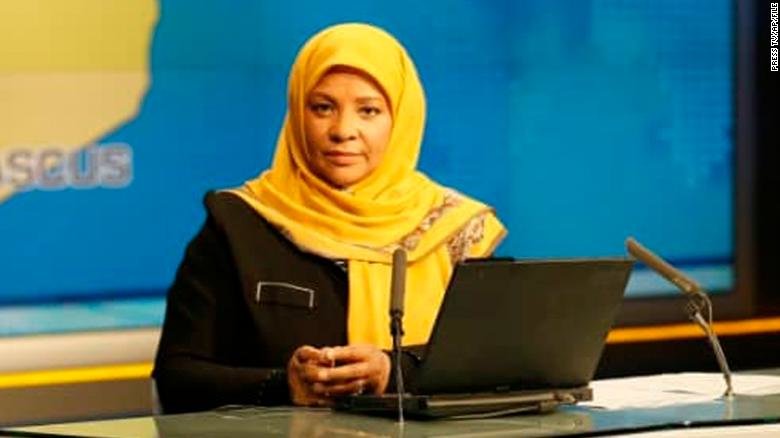
TEHRAN – Press TV anchor Marzieh Hashemi says the number of Islamic unity conferences held by the Islamic Republic of Iran demonstrates that Iran has been stressing the importance of unity from the very beginning.
“We have enemies who are trying to say that Iran is a divisive entity, but the facts speak way beyond that and what Iran is doing,” she told the Tehran Times on the sidelines of the International Islamic Unity Conference in Tehran on Thursday.
“We know that the Palestinians are not Shia, so it is not about Shia or Sunni, it is about what is right as well as fighting against oppression,” Marzieh Hashemi tells the Tehran Times.
Ms. Hashemi, who converted to Islam in the aftermath of the Islamic Revolution, also said the most important way to overcome Islamophobia in Western countries is through person-to-person contact between Muslims and non-Muslims.
The transcript of the interview is presented below:
Q: What’s the significance of the International Islamic Unity Conference and how can this event promote unity between Sunni and Shia Muslims?
A: I think the International Islamic Unity Conference is very important and of course we’ve been seeing it take place for years now. It is important that we continue to stress that sense of commonness between the Sunnis and the Shias and that Islam is what’s important. We have to make sure that we’re strong and that we’re united and that we stand together, especially during these times that the enemies are trying to divide us. If we stand together, with the population that we have in our Islamic Ummah, victory is promised to us and there’s no way that we can be defeated. The defeat will only come if we allow others to divide us. Whether it’s dealing with ethnicities or nationalities, we know that as Muslims we must be above that and that Islam is our priority. Inshallah we will be able to be even more united and Inshallah we will have the ultimate victory.
Q: Some countries say Iran is a divisive entity that divides Muslims by following sectarian policies. What’s your thought?
A: What we have seen in the forty-year history of the Islamic Republic, from the Islamic Revolution on, is the opposite of that. We have seen policies coming out of Iran that definitely encourage unity. If we go back to the time of Imam Khomeini at the beginning of the Revolution and what happened right after that, we see that actually the Israeli embassy under the time of the Shah was given to the Palestinians after the Revolution. We know that the Palestinians are not Shia, so it is not about Shia or Sunni, it is about what is right as well as fighting against oppression. And I think the Islamic Republic has proven itself time and time again that it is definitely not trying to divide the Ummah, but it is bringing it together. We have enemies who are trying to say that Iran is a divisive entity, but the facts speak way beyond that and what Iran is doing, for example this conference right now. If Iran was promoting division, then why would it continue to encourage unity? And I believe this is the 33rd conference, so it’s not new. This demonstrates that from the very beginning, Iran has been stressing the importance of unity. Again, it’s with unity that we will have the ultimate victory.
Q: Isalmophobia and anti-Muslim bigotry are currently very prevalent in Western societies. How can such conferences help resolve those issues and promote more nuanced views of Islam and Muslims?
A: I think by bringing Muslims together from all over the world, we realize we’re not alone and we are a very very large community. When we’re dealing with these countries – these Western countries – it is important to note how we carry ourselves as Muslims. We have to have that Akhlagh (ethics), that personality that we learned from Rasoul Allah Hazrat Muhammad (PBUH), and I think that attracts people. With people in the West, of course, the goal of the hegemonic powers is to try to portray Islam in a negative way. But interestingly, what’s happening in so many places is that people who have relationships with Muslims – whether as neighbors or colleagues – see that the reality is something else. They see that Muslims are not what they’re portrayed to be. So, I think it’s this person-to-person contact that is actually changing that perception, and we as Muslims are changing it. For example, in the United States and in other places, at the end of the day we’ve had more and more people convert to Islam, in spite of the peak of Islamophobia that followed 9/11.
Monday, October 07, 2019
Manipulation of realities by mainstream media
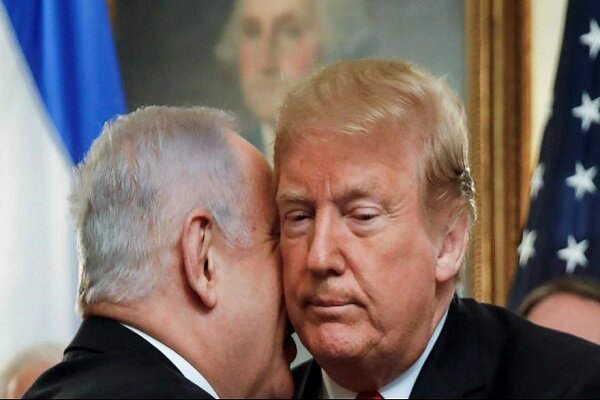 TEHRAN, (MNA) – Mainstream foreign propaganda and news outlets have launched a
Victory of the Islamic Revolution in Iran 40 years ago was beginning of a new page of regional and international developments. Since then Iran has made efforts to establish unity among the countries of the Islamic world and to bring about lasting peace and stability throughout the region. These factors have led the Islamic Revolution to be heard by other governments and nations around the world. Today, many political observers believe that the emancipation from dictatorial regimes is practically possible through the implementation of patterns' of Islamic Revolution of Iran.
Nevertheless, propaganda and news outlets affiliated to the Hebrew-Arab-Western axis are trying to deceive public opinion of the region and the world by dissemination of fake news about the achievements of Iran.
For instance, they claim that Iran has been behind divisions between the Shias and the Sunnis. Assisting Palestinian, Standing with the Syrian government and supporting the Syrian people who are mostly Sunnis, holding conferences on Islamic unity as well as forbidding insulting prominent Sunni figures affirm that the Islamic Republic of Iran has always called for the unity between Shias and Sunni.
All the above mentioned issues indicate that the claims of media and news agencies about Tehran's divisiveness is nothing more than a big lie.
Accusing Iran of supporting terrorism is another claim of these medias against Iran; the claim that has never been provided with any conclusive evidences. Defending any group, party and organization which are struggling for their independence and territorial integrity is portrayed as manifestation of backing of terrorism by these mainstream medias. However, the Islamic Republic's definition of terrorism is plundering, encroaching upon the national sovereignty of nations, seizing the wealth and natural resources of nations, and killing defenseless and innocent people.
In this regard, the Islamic Republic of Iran has always fought with various terrorist groups, including al-Qaeda and ISIL. For instance, it has always supported resistance groups in Lebanon, especially Hezbollah which are effective in military, as well as political, social, and cultural fields in the region.
The widespread support of the Islamic Republic of Iran in Iraq and Syria has also led to eradication of ISIL. The Islamic Republic of Iran's explicit stance in Yemen is also based on support to resistance and opposition to the continuation of aggression.
These policies and positions of the Islamic Republic of Iran have prompted Americans and Westerners to propagate a wave of Iran phobia across the region and the world. They have always tried to portray Iran as a threat to the countries of the region, especially the Arab countries.
This is the reason why they try to attribute the attack on Saudi oil facilities to Tehran through a lot of propaganda, while satellite images illustrate the fact that Tehran did not intervene in the attack.
In this regard, they declared that Iran’s HOPE (Hormuz Peace Endeavor) initiative is nothing more than a claim to proclaim itself a harbinger of peace, while they themselves are supporting the Zionist Regime, the biggest threat to the region and the world in the Persian Gulf.
Thursday, July 18, 2019
Iran travel sector: Ups and downs since U.S. reimposed sanctions
By Afshin Majlesi
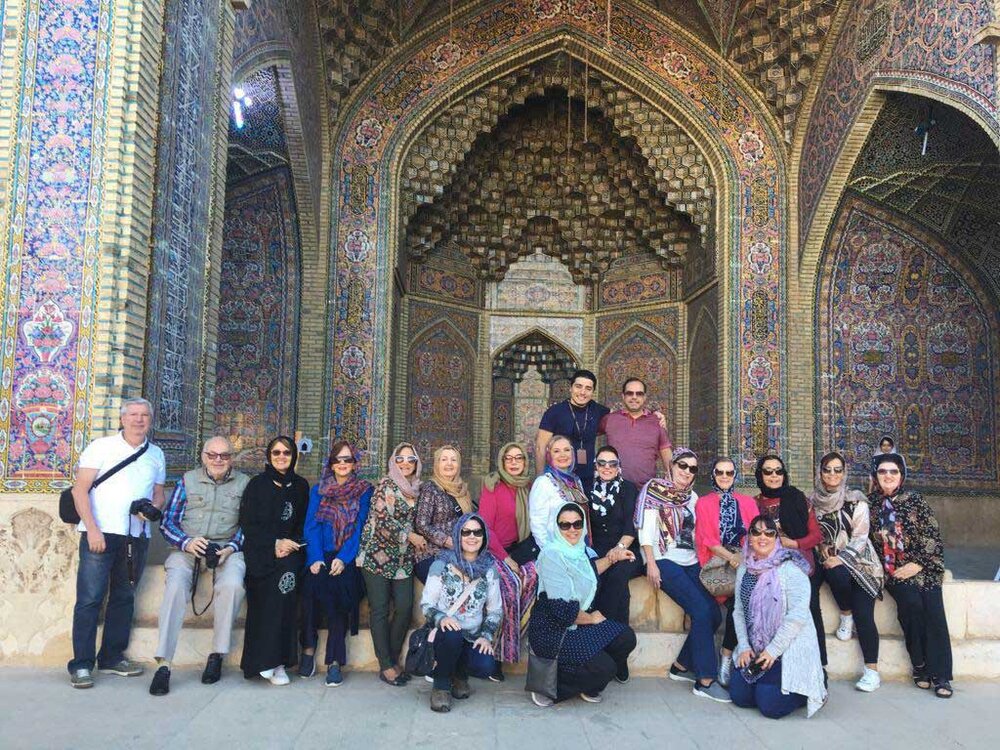
TEHRAN – Last November, the Trump administration reinstated sanctions on Iran, mainly the ones that had been lifted under the 2015 nuclear deal, in order to batter Iran’s economy, however, according to official data, they have so far failed to lessen foreign arrivals to the Islamic Republic.
Although the sanctions together with anti-Iran propaganda campaigns have decreased Western tourists but the country has managed to compensate and even improve by doing its best to attract more from neighboring states.
When it comes to outbound tourism, the effect of sanctions are seemingly more obvious as sharp rises in the value of foreign currencies against rial have pushed up the costs of traveling in the country.
A total of 1,759,749 Iranians traveled abroad in the first quarter of the current Iranian calendar year (March 21-June 21), indicating a 6.5% decrease compared with 1,882,414 outbound tourists in the same period last year, financialtribune.com reported in an article released on Monday.
“Nearly 7.8 million foreign nationals visited Iran over the past year that shows a 52.5 percent increase year on year. The country hosted 5.1 million travelers in 1396 (March 2017-18),” deputy tourism chief Vali Teymouri said in April.
“One of the shortcomings in Iran’s tourism industry is the government’s issuance of work permits to travel agencies without taking into consideration the number of inbound and outbound tourists. Less than 5% of travel agencies in Iran are active in organizing inbound tours, whereas 95% of them have focused on outbound tourism,” Hormatollah Rafiei, the head of Travel Agents Guild Association, said.
To tackle such harms, the association has decided to set up a committee tasked with curtailing the number of travel agencies’ closure by channeling them toward conducting more inbound tours.
The 2019 Travel Risk Map, which shows the risk level around the world, puts Iran among countries with “insignificant risk”, a category where the UK, Denmark, Switzerland, Norway, and Finland are placed in
“In two months, between 30 and 50 agencies are going to direct their activities toward attracting tourists from 10 countries, including Iraq, Afghanistan, Turkey, Pakistan, Turkmenistan, Georgia, Armenia and China,” Rafiei added.
Regarding to the downfall of potential Western visitors, Skift Inc., a New York City headquartered media company that provides news, research, and marketing services for the travel industry, said in July article that “Despite setbacks, [international] tour operators are optimistic about long-term growth in tourism to Iran, which in recent years has stepped up efforts to increase international visitation and has the stated goal of attracting 20 million annual visitors by 2025.
While the U.S. State Department has long issued strong advisories against traveling to Iran and despite tensions between the two countries, tour operators who spoke with Skift strongly disagree, maintaining that Iran has proven to be a safe and remarkably hospitable place for travelers, including Americans.
“It is a country that is often portrayed as unwelcoming, but the reality is quite the opposite,” said Jenny Gray, the global product and operations manager of the Australia-based Intrepid Travel.
“Iranians are warm, friendly and eager to show off their country to foreigners. The feedback from our travelers is a testament to this.”
“Once they [Iranian authorities] have been approved for entry [issuing visas], people are welcomed warmly—we’ve never encountered a problem or even a cold shoulder,” said Robin Pollak, the president of Journeys International, which is offering Iran tours since 2015.
To encourage and reassure sightseers, the Iranian government has decided not to stamp the passports of foreign tourists to help them skip the U.S. travel ban
“People in Iran are very curious about visitors from a culture that is off-limits to them. They understand that American visitors do not reflect the way America is portrayed to them by their government,” she added.
To compensate the fall, Iran has turned to ease traveling for its target markets which are people from Iraq, China, Republic of Azerbaijan, Afghanistan, Turkey, Pakistan, and several other countries who arrive in Iran for medical, pilgrimage and cultural heritage purposes.
Some two million Iraqi nationals visited Iran during the first seven months of the past Iranian calendar year (ended on March 20), constituting Iran’s largest source of inbound passengers.
Mousa Tabatabai, assistant to Iran’s ambassador to Baghdad, told Al-Monitor in early July, “The number of Iraqis arriving in Iran for religious tourism and treatment is growing bigger on a yearly basis. This is added to those who travel to Iran to see their relatives. The visas are issued depending on the demand.”
“There are 2-3 million Iraqis arriving in Iran every year. Such a figure will more likely increase as the visas have become free of charge between the two countries,” Tabatabai explained.
Iran also eyes to have a bigger share of Chinese tourism, as it, in a unilateral measure, recently approved to waive the visa requirement for the Chinese passport holders.
To encourage and reassure sightseers, the Iranian government has decided not to stamp the passports of foreign tourists to help them skip the U.S. travel ban.
“President Hassan Rouhani assigned the airport police not to stamp passports of foreign tourists. Taking into consideration the fact that America is practicing the economic terrorism plans, and people who travel to Iran may feel a bit afraid that they may be pressured by America,” Government spokesman Ali Rabiei said earlier this month. He added that this can invite more tourists to Iran.
The World Travel & Tourism Council’s latest report indicates that Iraq was the main source of tourism for Iran in 2018, as Iraqis constituted 24% of all inbound visitors. Other major sources were Azerbaijan (17%), Turkey (8%), Pakistan (4%) and Bahrain (2%). The remaining 46% came from the rest of the world.
WTTC’s review of tourism spending in Iran in 2018 shows 93% of visitors spent for leisure purposes while only 7% spent on business purposes. The council ranked Iran 20th from among 185 countries in its 2017 power ranking, which evaluates countries in terms of absolute size growth measured in U.S. dollars in the field of travel and tourism.
The 2019 Travel Risk Map, which shows the risk level around the world, puts Iran among countries with “insignificant risk”, a category where the UK, Denmark, Switzerland, Norway, and Finland are placed in.
The country boasts hundreds of historical sites such as bazaars, museums, mosques, bridges, bathhouses, madrasas, mausoleums, churches, towers, and mansions, of which 22 being inscribed on the UNESCO World Heritage list.
Currently, Iran’s constant efforts to recover the value of Iranian rial against the U.S. dollar have paid off. The national currency is strengthened about eight percent in the open market over the past month to 125,450 per dollar, traders in Tehran, according to prices compiled by Bloomberg from foreign-exchange websites.
Travel associates see better prospects for tourism sector of the country as policies for shielding the currency against the U.S. sanctions are taking effect.
Thursday, June 06, 2019
30 years of the wise leadership of Ayatollah Khamenei (2)

Welcome to the second and concluding part of our special feature on the 30th anniversary of the election by the Assembly of Experts of Ayatollah Seyyed Ali Khamenei as the Leader of the Islamic Revolution, following the departure from the mortal world of the Father of the Islamic Revolution, Imam Khomeini (God’s mercy upon him).
Two factors are important in the success of a person. First, personality traits and secondly environmental factors. Some of the experts consider the first factor namely the personality abilities and privileges more important and influential. The more important post a person has, the greater the role played either by his talents or weaknesses that become manifest in his performance. Accordingly, Ayatollah Khamenei has over the past three decades proven that he possess outstanding characteristics, which have been tested in crucial events, and are evident by his wise decisions and actions.
If we want to mention the most important attribute of the Leader, we must point to spirituality, worship and faith in God. In fact, virtue is one of the conditions of Velayet-e Faqih or Governance of the Supreme Jurisprudence, as per the constitution of the Islamic Republic. Thus, members of the Assembly of Experts, in view of the piety and ethical virtues of Ayatollah Khamenei, elected him as the worthy successor of Imam Khomeini.
Hojjat al-Islam Mohammadi Golpayegani, the head of the Leader's office, says: vigilance and being awake in the greater part of the night are some of the extraordinary characteristics of the Leader of the Islamic Revolution. Most of the night, Ayatollah Khamenei is engrossed in prayer, supplications and other acts of worship, before catching some sleep. He wakes up before the morning Azan to perform ‘Tahajjod’ or the late midnight prayer. As a devotee of the Ahl al-Bayt (or Blessed Household) of Prophet Mohammad (blessings of God upon him and his progeny), Ayatollah Khamenei, who is a Seyyed or descendant of the Prophet, is spiritually connected to the Immaculate Lady Hazrat Fatema Zahra (peace upon her) and the Lord of the Age, Imam Mahdi (may God hasten his reappearance for end of corruption and oppression on Earth and establishment of the global government of peace, prosperity and justice.
Undoubtedly, the piety of the Leader of the Islamic Revolution inspires the people of Iran, in addition to help him carry out his duties with the Grace of God. Spirituality means to lead a simple-life that is far removed from luxuries. Ayatollah Khamenei, despite the fact that he is the first person in the country, his living standards are lower than most of the people, and he emphasizes the avoidance of luxuries and even the use of certain items which many people use. In particular, he is especially careful not to involve in his personal life any items of Bayt-ol-Maal or the public treasury. This simple lifestyle can be seen in the simplicity of the meetings he has with foreign dignitaries and Iranian officials, as well as with people of various strata of the society. Many visiting leaders and presidents of other countries, after meeting with Ayatollah Khamenei, are surprised at his simple life. The virtuous and simple life of Ayatollah Khamenei has increased his popularity among the people.
The people's love for Leader of the Islamic Revolution is not one-sided, and is reciprocated by Ayatollah Khamenei, as is evident by his speeches and policies. He always defends the rights of the people and reminds the officials to look into the situation of poor and deprived people. No leader in the world has meetings with the common people as much as Ayatollah Khamenei. In these meetings, in addition to providing guidelines, he also listens to their pains and tries to alleviate their sufferings.
An example of Ayatollah Khamenei's defense of the rights of the people is to emphasize the right to hold various elections and protect the people's vote as trusteeship because he believes: The election is really respect for the people's vote; respect for the recognition of the people. Paying attention to the role of the people in the government is based on the theory of the popular system of religious rule.
Among the various strata of the people, Ayatollah Khamenei has a special role for young people as the future hopes of the country. He believes in the exuberance of youth in continuing the path of the Islamic Revolution. For this reason, he always encourages officials to use young and motivated forces as much as possible.
Another principle of the leadership of Ayatollah Khamenei, which is also considered the defense of the rights of the people, is the emphasis and commitment to law enforcement. The Leader believes that "nothing is higher and dear than law." And on that basis, the leader stipulates that everyone must submit to the law and act in order to ensure justice. Meanwhile, the Leader of the Islamic Revolution also expects the government and other government institutions to properly fulfill their legal obligations and, if they are violated, they should be dealt with through respective channels.
Ayatollah Khamenei is one of those who fought for victory of the Islamic Revolution, and after establishment of the Islamic Republic, he has been working on various positions to maintain and consolidate its foundations. For this reason, he deeply believes in the ideals of the Islamic Revolution and considers their full implementation necessary for the material and spiritual progress of the people and the country. In the last thirty years, the leader of the Islamic Revolution has set goals such as independence, freedom, justice, spirituality, development and investigating the situation of the deprived people and the like on the agenda, and provided the necessary guidance to the officials in each section.
One of the important ideals of the revolution, based on Islamic values, is the support of the poor and the deprived, which is stipulated in the constitution of the Islamic Republic of Iran. Ayatollah Khamenei has always been paying particular attention to defending the oppressed nations and, in this regard, supports the people of Palestine, Yemen, Bahrain and other areas. He also has detailed information about global affairs and events that is well known in his meetings with the heads of different countries as well as speeches. Recognition of the enemies and their tricks are another feature of the Leader of the Islamic Revolution, which shows his vigilance and intelligence, and over the past thirty years, has rid the country from significant dangers. Like Imam Khomeini, he considers the US as the archenemy enemy of the Iranian nation and calls the Zionist regime a threat to Iran and the Islamic world. He believes that Muslims should be free from the domination and influence of the West, especially the US, and therefore he pursues seriously the unity of the Ummah. Such traits of leadership are in accordance with the final ayah of Surah Fath which says:
"Muḥammad, the Prophet of Allah, and those who are with him are hard against the faithless and merciful amongst themselves."
One of the valuable characteristics of Ayatollah Khamenei's leadership is hope for the future, despite the difficult world conditions and internal problems. This view is, according to the holy Qur’an, that whoever helps the religion of God, God will help him, and the promise of God is true. Ayatollah Khamenei emphasizes: "We were not disappointed for a moment from Divine Help, and I hope that we will not be disappointed for a moment in the future also."
Tuesday, June 04, 2019
Imam Khomeini’s biography
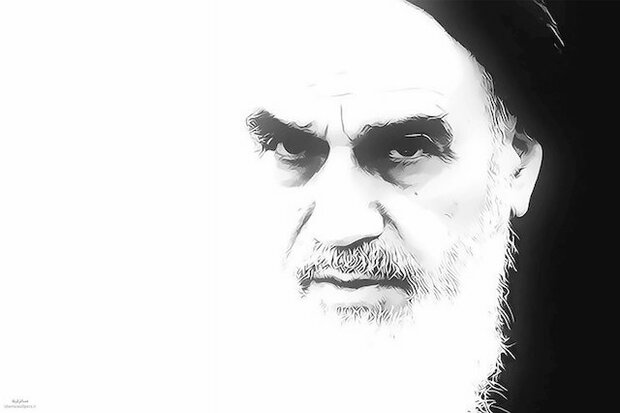
TEHRAN, Jun. 04 (MNA) – Here you can read the biography of Islamic Revolution founder Imam Khomeini. The text is being republished from the official website of Islamic Revolution Leader Ayatollah Khamenei 'Khamenei.ir'.
Introduction
Imam Ayatollah Seyed Ruhollah Musavi Khomeini (May 17, 1900 – June 3, 1989) was a Muslim cleric and Marja, and the political leader of the 1979 Islamic Revolution of Iran which overthrew Mohammad Reza Pahlavi, the last Shah of Iran. Following the Revolution, Imam Khomeini became Grand Leader of Iran — the paramount figure in the political system of the new Islamic Republic — until his demise.
Imam Khomeini was considered a Marja-e taqlid to many Muslims, and in Iran was officially addressed as Imam rather than Grand Ayatollah; his supporters adhere to this convention. Imam Khomeini was also a highly-influential and innovative Islamic political theorist, most noted for his development of the theory of velayat-e faqih, the "guardianship of the jurisconsult."
Early Years
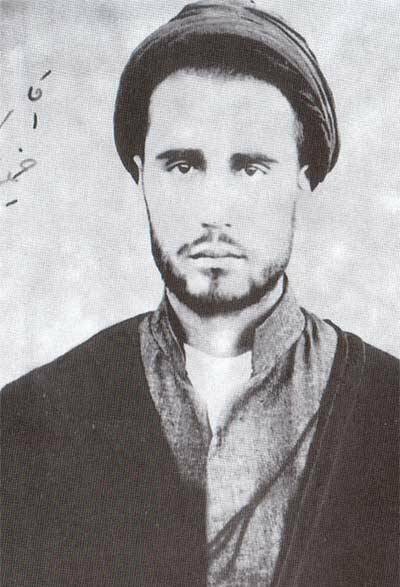
Family and early years
Ruhollah Mousavi was born to Ayatollah Seyyed Mostafa Musavi and Hajieh Agha Khanum, also called Hajar, in the town of Khomein, about 300 kilometers south of the capital Tehran, Iran, possibly on May 17, 1900 or September 24, 1902. He was a Seyyed from a religious family that are descendants of Prophet Mohammad, through the seventh Imam, (Imam Mousa Kazem). His paternal grandfather was Seyyed Ahmad Musavi, whose third wife, Sakineh, gave birth to Mostafa in 1856. Imam Khomeini's maternal grandfather was Mirza Ahmad Mojtahed-e Khonsari, a high-ranking cleric in central Iran whose Fatwa for banning usage of Tobacco in opposition to a monopoly granted by Shah to a British company, led to cancellation of the concession.
Imam Khomeini's father was murdered when he was five months old, and he was raised by his mother and one of his aunts. Later, when he was 15, his mother and aunt died in the same year. At the age of six he began to study the Quran, Islam's holy book. He received his early education at home and at the local school, under the supervision of Mullah Abdul-Qassem and Sheikh Jaffar, and was under the guardianship of his elder brother, Ayatollah Pasandideh, until he was 18 years old. Arrangements were made for him to study at the Islamic seminary in Esfahan, but he was attracted, instead, to the seminary in Arak, which was renowned for its scholastic brilliance under the leadership of Ayatollah Sheikh Abdol-Karim Haeri-Yazdi (himself a pupil of some of the greatest scholars of Najaf and Karbala in Iraq).
In 1921, Imam Khomeini commenced his studies in Arak. The following year, Ayatollah Haeri-Yazdi transferred the Islamic seminary to the holy city of Qom, and invited his students to follow. Imam Khomeini accepted the invitation, moved, and took up residence at the Dar al-Shafa school in Qom before being exiled to the holy city of Najaf in Iraq. After graduation, he taught Islamic jurisprudence (Sharia), Islamic philosophy and mysticism (Irfan) for many years and wrote numerous books on these subjects.
Although during this scholarly phase of his life Imam Khomeini was not politically active, the nature of his studies, teachings, and writings revealed that he firmly believed from the beginning in political activism by clerics. Three factors support this suggestion. First, his interest in Islamic studies surpassed the bounds of traditional subjects of Islamic law (Sharia), jurisprudence (Fiqh), and principles (Usul) and the like. He was keenly interested in philosophy and ethics. Second, his teaching focused often on the overriding relevance of religion to practical social and political issues of the day. Third, he was the first Iranian cleric to try to refute the outspoken advocacy of secularism in the 1940s. His now well-known book, Kashf-e Asrar (Discovery of Secrets) was a point by point refutation of Asrar-e Hezar Saleh (Secrets of a Thousand Years), a tract written by a disciple of Iran's leading anti-clerical historian, Ahmad Kasravi. Also he went from Qom to Tehran to listen to Ayatollah Hassan Modarres —the leader of the opposition majority in Iran's parliament during 1920s.
Imam Khomeini became a Marja in 1963, following the death of Grand Ayatollah Seyyed Hossein Borujerdi.
Early Political Activity
In this time he could represent his religious-political ideas openly. Because the deaths of the leading, although quiescent, Shia religious leader, Ayatollah Seyyed Mohammad Borujerdi (1961), and of the activist cleric Ayatollah Abol-Ghasem Kashani (1962) left the arena of leadership open to Imam Khomeini, who had attained a prominent religious standing by the age of 60. In addition, although ever since the rise of Reza Shah Pahlavi to power in the 1920s the clerical class had been on the defensive because of his secular and anticlerical policies and those of his son, Mohammad Reza Shah, these policies reached their peak in the early 1960s with "White Revolution."

Opposition to White Revolution
Imam Khomeini first became politically active in 1962. When the White Revolution proclaimed by the Shah's government in Iran called for land reform, nationalization of the forests, the sale of state-owned enterprises to private interests, electoral changes to enfranchise women, profit sharing in industry, and an anti-illiteracy campaign in the nation's schools. Most of these initiatives were regarded as dangerous, Westernizing trends by traditionalists, especially the powerful and privileged religious scholars (Ulama) who felt keenly threatened. The Ulama instigated anti-government riots throughout the country. They found the White Revolution a sustainable ideological framework to support a particular relation of domination, in this case the monarchy of Mohammad Reza Shah Pahlavi. This was above all a hegemonic project intended to portray the Shah as a revolutionary leader through the utilization of social and historical myths reinterpreted through the prism of contemporary, often conflicting ideological constructs, such as nationalism and modernism.
In January 1963, the Shah announced a six-point program of reform called the White Revolution, an American-inspired package of measures designed to give his regime a liberal and progressive facade. Imam Khomeini summoned a meeting of his colleagues (other Ayatollahs) in Qom to press upon them the necessity of opposing the Shah's plans. Imam Khomeini persuaded the other senior Marjas of Qom to decree a boycott of the referendum that the Shah had planned to obtain the appearance of popular approval for his White Revolution. Imam Khomeini issued on January 22, 1963 a strongly worded declaration denouncing the Shah and his plans. Two days later Shah took armored column to Qom, and he delivered a speech harshly attacking the ''ulama'' as a class. Imam Khomeini continued his denunciation of the Shah's programs, issuing a manifesto that also bore the signatures of eight other senior scholars. In it, he listed the various ways in which the Shah allegedly had violated the Constitution, condemned the spread of moral corruption in the country, and accused the Shah of comprehensive submission to America and Israel. He also decreed that the Nowruz celebrations for the Iranian year 1342 (March 21, 1963) be cancelled as a sign of protest against government policies. In the afternoon of Ashura (June 3, 1963), Imam Khomeini delivered a speech at the Feiziyeh Madreseh seminary in which he drew parallels between Yazid and the Shah and warned the Shah that if he did not change his ways, the day would come when the people would offer up thanks for his departure from the country.
Following Imam Khomeini's public denunciation of Shah Mohammad Reza Pahlavi as a "wretched miserable man" and his arrest, on June 5, 1963 (Khordad 15, on the Iranian calendar), three days of major riots erupted throughout Iran with nearly 400 killed. Imam Khomeini was kept under house arrest for 8 months and was released in 1964.
Also this was a turning point in political viewpoint of Islam. The clergies had supported Shia monarchy since establishment of Safavids and this was the main source of legitimacy of monarchs. Shia clergies had advised them to be just and obey Ja'fari jurisprudence. Also monarchs didn't enforce religious rules which restricted or threatened religious life and institutions and defended the Shia territory of Iran. But Reza Shah transformed the Iranian monarchy into a modern dictatorship. The modernizing programs of Pahlavi dynasty restricted and threatened religious life and made clergies be against monarchy and finally Imam Khomeini decide to fight with them and build another state comparable to religious rules.
Opposition to capitulation
During November of 1964, Imam Khomeini made a denunciation of both the Shah and the United States, this time in response to the "capitulations" or diplomatic immunity granted to American military personnel in Iran by the Shah. In Nov. 1964 Imam Khomeini was re-arrested and sent into exile.
Life in exile
Imam Khomeini spent over 14 years in exile, mostly in the holy city of Najaf in Iraq. Initially, he was sent to Turkey on 4 November 1964, where he stayed in the city of Bursa for less than a year. He was hosted by a Turkish Colonel named Ali Cetiner in his own residence, who couldn't find another accommodation alternative for his stay at the time. Later in October 1965 he was allowed to move to Najaf, Iraq, where he stayed until being forced to leave in 1978, after then-Vice President Saddam Hossein forced him out (the two countries would fight a bitter eight year war 1980-1988 only a year after the beginning of Imam Khomeini’s leadership in Iran and the start of Saddam Hussein’s term in Iraq) after which he went to Neauphle le Château in France.
Logically, in the 1970s, as contrasted with the 1940s, he no longer accepted the idea of a limited monarchy under the Iranian Constitution of 1906-1907, an idea that was clearly evidenced by his book Kashf-e Asrar. In his Islamic Government (Hokumat-e Islami) — which is a collection of his lectures in Najaf published in 1970 — he rejected both the Iranian Constitution as an alien import from Belgium and monarchy in general. He believed that the government was an un-Islamic and illegitimate institution usurping the legitimate authority of the supreme religious leader (Faqih), who should rule as both the spiritual and temporal guardian of the Muslim community (Umma).
In early 1970 Imam Khomeini gave a lecture series in Najaf on Islamic Government which later was published as a book titled variously Islamic Government or Guardianship of the Islamic Jurists (velayat-e faqih). This was his most famous and influential work and laid out his ideas on governance (at that time):
- That the laws of society should be made up only of the laws of God (Sharia), which cover "all human affairs" and "provide instruction and establish norms" for every "topic" in "human life."
- Since Sharia, or Islamic law, is the proper law, those holding government posts should have knowledge of Sharia (Islamic jurists are such people), and that the country's ruler should be a faqih who "surpasses all others in knowledge" of Islamic law and justice, as well as having intelligence and administrative ability. Rule by monarchs and/or assemblies of "those claiming to be representatives of the majority of the people" (i.e. elected parliaments and legislatures) have been proclaimed "wrong" by Islam unless approved by the faqih.
- This system of clerical rule is necessary to prevent injustice: corruption, oppression by the powerful over the poor and weak, innovation and deviation of Islam and Sharia law; and also to destroy anti-Islamic influence and conspiracies by non-Muslim foreign powers.
A modified form of this Velayat-e Faqih system was adopted after Imam Khomeini and his followers took power, and he became the Islamic Republic's first "Guardian" or Grand Leader.
In the meantime, however, Imam Khomeini was careful not to publicize his ideas for clerical rule outside of his Islamic network of opposition to the Shah which he worked to build and strengthen over the next decade. Cassette copies of his lectures fiercely denouncing the Shah as, for example, "the Jewish agent, the American snake whose head must be smashed with a stone," became common items on the markets of Iran, helped to demythologize the power and dignity of the Shah and his reign.
As protest grew, so did Imam Khomeini’s profile and importance. During the last few months of his exile, Imam Khomeini received a constant stream of reporters, supporters, and notables, eager to hear the spiritual leader of the revolution.
Return to Iran
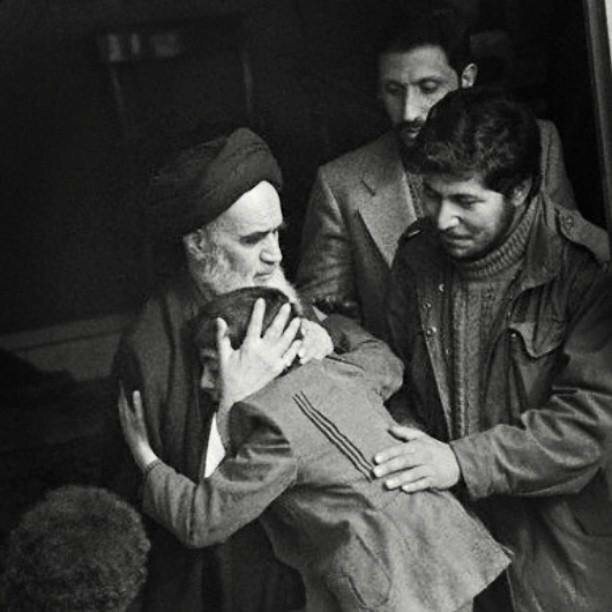
Only two weeks after the Shah fled Iran on January 16, 1979, Imam Khomeini returned to Iran triumphantly, on Thursday, February 1, 1979, invited by the anti-Shah revolution which was already in progress.
Conservative estimates put the welcoming crowd of Iranians at least three million. When Imam Khomeini was on plane on his way to Iran after many years in exile, a reporter, Peter Jennings asked him: "What do you feel?" and surprisingly Imam Khomeini answered "Nothing!"
In a speech given to a huge crowd on the first day of returning to Iran, Imam Khomeini attacked the government of Shapoor Bakhtiar promising "I shall punch their teeth in." He also made a variety of promises to Iranians for his coming Islamic regime: A popularly elected government that would represent the people of Iran.

Establishment of new government
On February 11, Imam Khomeini declared a provisional government. On March 30, 1979, and March 31, 1979, the provisional government asked all Iranians sixteen years of age and older, male and female, to vote in a referendum on the question of accepting an Islamic Republic as the new form of government and constitution. Through the ballot box, over 98% voted in favor of replacing the monarchy with an Islamic Republic. Subsequent elections were held to approve of the newly-drafted Constitution. Along with the position of the Grand Leader, the constitution also requires that a president be elected every four years, but only those candidates approved indirectly by the Council of Guardians may run for the office. Imam Khomeini himself became instituted as the Grand Leader for life, and officially decreed as the "Leader of the Revolution." After assuming power, Islam was made the basis of Iran's new constitution and obedience to Islamic laws made compulsory.
Relationship with other Islamic nations
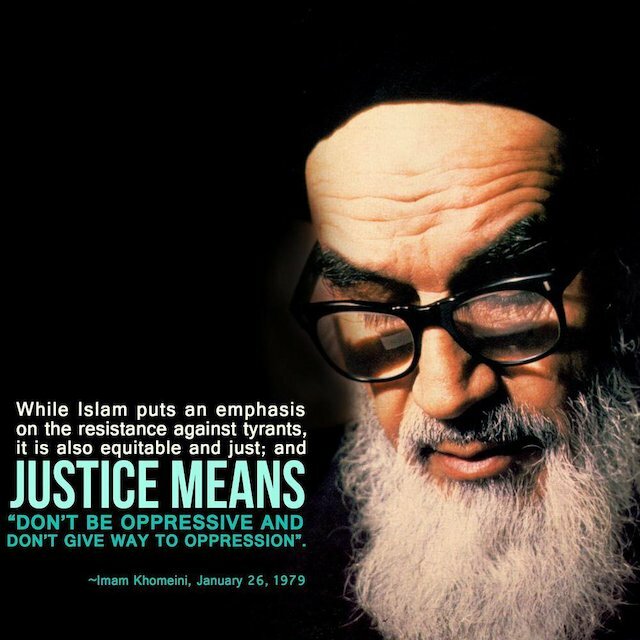
Imam Khomeini intended to reconstruct Muslim unity and solidarity, so he declared the birth week of Prophet of Islam (the week between 12th to 17th of Rabi'al-Awwal in Islamic Hegira calendar) as the Unity Week. Then he declared the last Friday of the fasting month of Ramadan as the International Day of Quds in 1979.
But because of Islamic ideology of Islamic Republic of Iran, most rulers of other Muslim nations turned against him and supported Iraq in the imposed war against Iran, even though most of Islamic parties and organizations supported his idea.
Iran-Iraq War
Saddam Hussein, Iraq's secular Arab nationalist Ba'athist leader, was eager to take advantage of Iran's weakened military and (what he assumed was) revolutionary chaos, and in particular to occupy Iran's adjacent oil-rich province of Khuzestan and undermine attempts by Iranian Islamic revolutionaries to incite the Shia majority of his country.
With what many believe was the encouragement of the United States, Saudi Arabia and other countries, Iraq soon launched a full scale invasion of Iran, starting what would become the eight-year-long Iran-Iraq War (September 1980 - August 1988). A combination of fierce patriot resistance by Iranians and military incompetence by Iraqi forces soon stalled the Iraqi advance and by early 1982 Iran regained almost all the territory lost to the invasion. The invasion rallied Iranians behind the new regime, enhancing Imam Khomeini's stature and allowed him to consolidate and stabilize his leadership.
Although outside powers supplied arms to both sides during the war, the West (America in particular) became alarmed by the possibility of the Islamic Revolution spreading throughout the oil-exporting Persian Gulf oil and began to supply Iraq with whatever help it needed. The war continued for another six years, with 450,000 to 950,000 casualties on the Iranian side and the use of chemical weaponry by the Iraqi military.
As the costs of the eight-year war mounted, Imam Khomeini, in his words, "drank the cup of poison" and accepted a truce mediated by the United Nations. As the war ended, the struggles among the clergy resumed and Imam Khomeini’s health began to decline.
Rushdie Fatwa
In early 1989, Imam Khomeini issued a fatwa calling for the killing of Salman Rushdie, an Indian-born British author. Imam Khomeini claimed that Rushdie's murder was a religious duty for Muslims because of his alleged blasphemy against Prophet Mohammad in his novel, The Satanic Verses. Rushdie's book contains passages that some Muslims — including Ayatollah Imam Khomeini — considered offensive to Islam and the Prophet. Though Rushdie publicly apologized, the fatwa was not revoked, Imam Khomeini explaining that "even if Salman Rushdie repents and becomes the most pious man of all time, it is incumbent on every Muslim to employ everything he has got, his life and wealth, to send him to Hell."

Letter to Mikhail S. Gorbachev
In December 1988 (before the fall of the Berlin Wall), Ayatollah Imam Khomeini sent a letter to USSR President Mikhail Gorbachev predicting the fall of Communism and inviting him to study and research Islam. In his historical letter he wrote: "It is clear to everyone that Communism should henceforth be sought in world museums of political history."
Life under Imam Khomeini
Under Imam Khomeini's rule, Sharia (Islamic law) was introduced, with the Islamic dress code enforced for both men and women. Women had to cover their hair, and men were not allowed to wear shorts.
Life for religious minorities has been mixed under Imam Khomeini and his successors. Shortly after his return from exile in 1979, Imam Khomeini issued a fatwa ordering that Jews and other minorities (except Bahai) be treated well. By law, several seats in the Parliament are reserved for minority religions. Imam Khomeini also called for unity between Sunni and Shia Muslims (Sunni Muslims are the largest religious minority in Iran).

Death and funeral
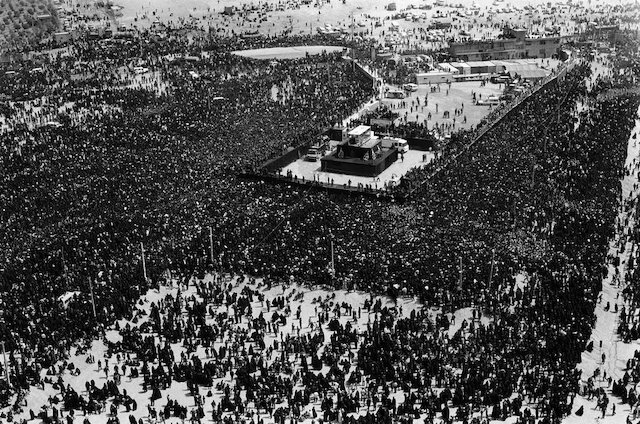
After eleven days in a hospital for an operation to stop internal bleeding, Imam Khomeini died of cancer on Saturday, June 3, 1989, at the age of 89. Many Iranians mourned Imam Khomeini's death and poured out into the cities and streets. More than 10 million people from across the country attended Imam Khomeini’s funeral to form one of the largest ever funerals in the world.
Following Imam Khomeini’s demise, Ayatollah Seyyed Ali Khamenei came to be selected on June 4, 1989 by the Assembly of Experts to be his successor, in accordance with the Constitution.
Political thought and legacy
Imam Khomeini adamantly opposed monarchy, arguing that only rule by a leading Islamic jurist would insure Sharia was properly followed (Velayat-e Faqih).
Imam Khomeini believed that Iran should strive towards self-reliance. He viewed certain elements of Western culture as being inherently decadent and a corrupting influence upon the youth. His ultimate vision was for Islamic nations to converge together into a single unified power, in order to avoid alignment with either side (the West or the East), and he believed that this would happen at some point in the near future.
Imam Khomeini expressed support for the Universal Declaration of Human Rights; in Sahifeh Nour (Vol. 2, page 242), he states: "We would like to act according to the Universal Declaration of Human Rights. We would like to be free. We would like independence."
Imam Khomeini led an ascetic lifestyle, being deeply interested in mysticism, and was against the accumulation of land and wealth by the clergy.
Many of Imam Khomeini's political and religious ideas were considered to be progressive and reformist by leftist intellectuals and activists prior to the Revolution.
Imam Khomeini's definition of democracy existed within an Islamic framework. His last will and testament largely focuses on this line of thought, encouraging both the general Iranian populace, the lower economic classes in particular, and the clergy to maintain their commitment to fulfilling Islamic revolutionary ideals.
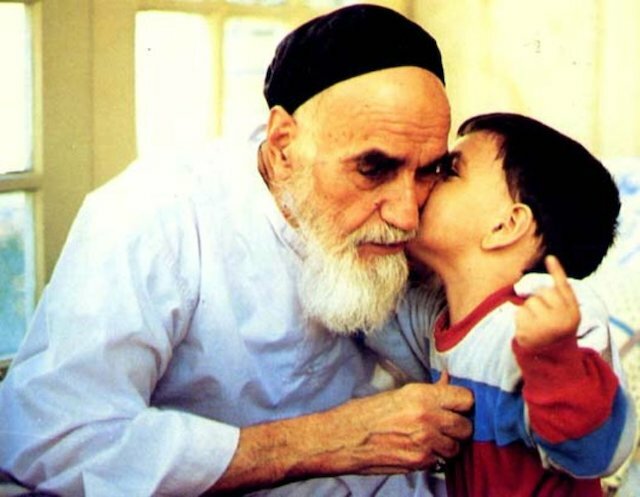
Family and descendants
In 1929, Imam Khomeini married Batol Saqafi Khomeini, the daughter of a cleric in Tehran. They had seven children, though only five survived infancy, 3 daughters and 2 sons. His sons entered into religious life. The elder son, Mostafa, was murdered in 1977 while in exile with his father in Najaf, Iraq and SAVAK (the Imperial-era secret police) was accused of his death by Imam Khomeini. Ahmad Khomeini, the younger son, died in 1995.
Imam Khomeini's grandson Seyyed Hassan Khomeini, son of the late Seyyed Ahmad Khomeini, is also a cleric and the trustee of Imam Khomeini's shrine.
Works:
Velayat-e Faqih
Forty Hadiths (Forty Traditions)
Adab-e Salat (The Disciplines of Prayers)
Jihad-e Akbar (The Greater Struggle)
Tahrir al-Wasilah
Interpretation of Surah Fatihah
Serr al-Salat (Secrets of Prayers)
Interpretation of Dawn Pray
Interpretation of Forces of Reason and Negligence Tradition
Hajj
Source: Khamenei.ir
Subscribe to:
Posts (Atom)