Showing posts with label hamas. Show all posts

Sunday, December 15, 2019

Hamas celebrates its 32nd anniversary in Gaza

Thousands of Palestinians took to the streets on Friday in the north of the Gaza Strip, to celebrate the 32nd anniversary of the Palestinian Islamic Resistance Movement Hamas.
Hamas gave the name ‘The Edge of the Sword’ to this year’s celebrations of its anniversary. This name was attributed to the Hamas military wing’s operation, when it foiled a plan by an Israeli special unit aimed at the Palestinian resistance last year.
For the first time, Hamas did not organise a central rally in the city of Gaza for its supporters, where leaders from other parties usually deliver speeches and artists perform folkloric shows, glorifying the Palestinian resistance.
In order to deal with the financial crisis, this year Hamas planned marches across the different cities along the Gaza Strip.
Participants and Hamas supporters raised Hamas flags and pictures of late Hamas founders and leaders, as they listened to the speeches of Hamas leaders.
During the march organised in the city of Jabalia, north of the Gaza Strip, member of Hamas Political Bureau, Fathi Hammad, announced: “Our people will not give up resistance until the Israeli occupation has ended.”
He added: “The time for imposing solutions has gone, and if the Israeli occupation rejects all proposed solutions and does not stop its violations against our people under the pressure of popular resistance, we will resume armed resistance.”
The senior Hamas leader hailed the Joint Operations Room of the military wings of the Palestinian factions in Gaza, stressing: “The Joint Operations Room will remain the highest body for popular and armed resistance.”
Commenting on the issue of Israeli prisoners captured by the Palestinians resistance, Hammad disclosed: “It seems that the Israeli occupation is not interested in the release of its captive soldiers. We will never release them without the release of our prisoners.”
Regarding national unity and the elections, he elucidated: “Hamas does not have any sanctions on the achievement of national unity. It is also ready for the elections and we call for President Mahmood Abbas to issue the election decree as soon as possible.”
Meanwhile, Hamas spokesman, Hammad Al-Reqib, informed a march in the city of Khan Younis, in the south of the Gaza Strip, that his movement “has no problem with political plurality and insisted on forming a government from the different Palestinian factions when it won the elections in 2006, which the Palestinian factions rejected.”

Wednesday, November 13, 2019

Hamas bias is fraught with consequences

By Damir Nazarov

Hamas once again condemned Saudi Arabia in connection with the detention and abuse of Palestinians affiliated with Hamas. However, only condemnation and nothing more. Hamas is trying to avoid conflict, party officials say, and is enshrined in the movement's Charter. There is a saying-everything is known in comparison.
As you know in the midst of the Syrian events, the Hamas leadership did not support the Assad government, ignored diplomatic efforts and advice from the Islamic Republic of Iran and joyfully rushed into the arms of Qatar and Turkey. This was followed by a series of statements with anti-Assad overtones, reproaches against Iran and Hezbollah, meetings with representatives of the self-proclaimed 'Syrian opposition' and so on. Then the situation changed 180 degrees. And now Hamas is hastily seeking to reconcile with all members of the Axis of Resistance Alliance.
Relations with the Gulf countries have never been ideal for Hamas, the reason is the Pro-Zionist inclination of the monarchies. Therefore, a priori it was naive to expect from the despots of the Arabian Peninsula, some decent attitude towards themselves. Hamas simply miscalculated. He miscalculated in two directions, the first-to create a balance (to try to play on two sides, between Tehran and Riyadh), and the second-Hamas naively believed that Saudi Arabia and the UAE would be interested in cooperation with the Palestinian resistance organization, at least in terms of diplomacy or humanitarian actions, the reality was different, the monarchies do not care about Palestine, and now they do not even hide their connection with Zionism. And by the way it is not necessary to put Qatar as an example, the Emirate only plays its role of "assistant to Hamas", we should never forget that Qatar by its nature is completely tied to local tribalism, and like all regimes of the Persian Gulf, is associated with Zionism.
The Saudis and the UAE are not just unwilling to cooperate with Hamas, they are pursuing an openly anti-Palestinian policy, and striking directly at Hamas. In 2010, the UAE assisted Mossad in the assassination of Mahmoud Al-Mabhouh, and in 2019, participating in the occupation of Yemen, the Emirates committed the murder of a Hamas representative in Yemen. For their part, the Saudis have organized a whole anti-Hamas and anti-Palestinian campaign of arrests. In Saudi prisons, Palestinians are bullied and interrogated by representatives of Zionism. These facts show how close Riyadh and the Zionist colony have become, now this tandem is no longer hiding anything and openly fighting the Islamic resistance of Palestine and its allies in the region. In fairness, we note that neither in Syria nor in Lebanon, on the part of local authorities, nothing like this was and could not be. Hamas must draw conclusions.
It is strange that Hamas in relation to the open Pro-Zionist policies of the Gulf regimes, is limited only to verbal condemnation. Very strange. For some reason, there are no sharp political steps, as it was in Syria. Although Damascus has not been seen in anti-Palestinian actions or rhetoric, Assad's government has been completely immersed in internal conflict. However, Hamas was not confused by this fact. Most of the leadership of the Palestinian organization explaining their departure from Syria, motivated their actions by something like "protection of the people of Syria", in other words, sided with the"opposition". In this case, the question is brewing. Why in Syria, in the internal strife of the Syrians, Hamas took one side, although no one involved the Palestinians in the conflict, and in Saudi Arabia, Hamas is limited to "verbal condemnation", although in this monarchy there is a targeted campaign against the Palestinians.  With regard to the Saudis and the UAE, there are not even enough "harsh" statements that Abu marzouk, for example, allowed he in relation to Iran and Assad, until recently. Only the standard set of remarks condemning the policy of persecution of Palestinians applies to the Gulf regimes.
If someone wants to say that these are different situations, then no it is not. In Saudi Arabia, there is a struggle for the throne and the clash of princes is evidence, but so far, that there are no analogues of Syrian events, but who said that the Saudis were able to avoid such a crisis in the future?
Conclusion. Hamas is well aware of the events in Saudi Arabia, but simply ignores all options for dealing with the Pro-Zionist power of the Saudis. Hamas does not express support for Saudi dissidents, opposition forces within the dictatorship, and is not interested in joining the Alliance of the main enemies of the Pro-Zionist power of the Saudis and the UAE. With this approach to the Palestinian cause, Hamas will remain a permanent 'supporter of the truce with the Zionists' in Gaza. While other Palestinian Islamic forces will be at the forefront of the resistance, I am sure such a day will come soon.

Friday, November 01, 2019

70 years of shooting refugees

Jake Batinga
Despite Israel’s brutality, Palestinians have insisted for seven decades that the right of refugees to return home be upheld. 
Ashraf AmraAPA images
Since March 2018, weekly protests – known as the Great March of Return – have been held in Gaza.
The demonstrators are insisting that people uprooted by Zionist forces during the Nakba – the 1948 ethnic cleansing of Palestine – be allowed to go home. This right of return has been recognized by United Nations General Assembly resolution 194, passed in December 1948.
Israel has responded brutally to demands that this basic right be upheld. More than 210 Palestinians have been killed during the Great March of Return and more than 9,000 have been injured by live fire.
As well as insisting that the right to return be respected, Palestinian refugees have occasionally attempted to exercise that right over the past seven decades. In doing so, they have been treated with extreme violence.
In the years following the adoption of UN resolution 194, large numbers of people living in Gaza tried to cross the boundary with Israel, a newly established state. In an Orwellian turn of phrase, the Israeli authorities designated these returning refugees as “infiltrators.”
In his book Israel’s Border Wars, the historian Benny Morris writes that the so-called infiltration was “a direct consequence of the dispossession of hundreds of thousands of Palestinians.”
Refugees sought to reunite with family, tend crops, recover lost possessions and, of course, see their old homes.

Firing “at anything that moved”

Israel’s Border Wars was published in 1997 – seven years before Morris argued that Zionist forces should have expelled all Palestinians in the 1940s. Despite his attempts to defend ethnic cleansing, Morris has never repudiated the important facts he had previously unearthed.
And we can continue to learn a considerable amount from his work about crimes committed in the name of Israel and its state ideology Zionism.
He recounts, for example, how Israel operated a “free fire” policy on refugees seeking to return home. According to Morris, Israeli forces “fired at anything that moved” and often executed injured refugees “on the spot.”
Between 2,700 and 5,000 refugees were killed under the free fire policy, the vast majority of whom were unarmed civilians, from 1949 to 1956. Furthermore, “no Israeli soldier, policeman, or civilian was ever tried for shooting and killing an unarmed Arab infiltrator,” Morris writes.
While Palestinian refugees were slaughtered for attempting to exercise their right of return, Israel’s parliament, the Knesset, passed the cynically titled “Law of Return” in 1950. It granted Jews from around the world the right to gain Israeli citizenship and live in Israel.
Immigrants to Israel, many of whom were Holocaust survivors, often settled in the vacant homes of Palestinian refugees.
Another policy implemented against Palestinian refugees seeking to go home was known as “retaliation.”
Israel “retaliated” by raiding villages in Jordan, Egypt, Gaza, and Syria. These raids were meant to punish communities that had allegedly helped returning refugees.
In his book The Iron Wall, the historian Avi Shlaim writes that the reprisals were effectively “a form of collective punishment against whole villages.”
One notable case of “retaliation” occurred during October 1953 in the Jordanian village of Qibya.
According to Shlaim’s book, Israeli commandos raided Qibya, forced the residents to stay in their homes, then blew up the houses with everyone still inside. At least 69 people were killed, most of them women and children.
The leader of this raid was a young commander named Ariel Sharon, who would later be dubbed the “butcher of Beirut” for his role in the 1982 mass slaughter at Sabra and Shatila, Palestinian refugee camps in Lebanon.

Shifting the blame

Israel has consistently sought to shift the blame for its own violence.
In the 1950s, the Israeli government blamed Arab governments and Palestinian refugees themselves. According to Shlaim, Israel claimed that the killing of civilians was a “legitimate form of self-defense.”
Identical – or almost identical – words are used by Israel’s political leaders today.
Benjamin Netanyahu, Israel’s prime minister, has invoked “self-defense” to try and justify the killing of unarmed protesters in Gaza. After one Israeli massacre in Gaza last year, Netanyahu claimed the state was acting “to protect its sovereignty and the security of its citizens.”
When a video was broadcast which showed Israeli troops gleefully cheering and laughing as a sniper shoots a protester, Israeli politicians rushed to defend the troops.
Avigdor Lieberman, then Israel’s defense minister, stated that the sniper in the video “deserves a commendation.” Naftali Bennett, also a government minister at the time, said that “judging soldiers because they are not expressing themselves elegantly while they are defending our borders is not serious.”
Today, the Israeli government smears Gaza protesters as “terrorists.” Benny Morris has noted how “infiltrator” – the term applied to Palestinian refugees seeking to go home – quickly became synonymous with “terrorist.”
And just as the Israeli authorities tried to evade responsibility for its attacks on Arab neighbors in the 1950s, today’s politicians try to blame Hamas for the deaths of protesters in Gaza.
Lieberman has alleged that “no innocent civilians” have taken part in Gaza’s protests, which he has nicknamed the “march of terror.” All the protesters, according to Lieberman, have been Hamas members.
Another pattern can be discerned. Palestinians fought for their rights in the years immediately following the Nakba, as they are doing in the 21st century.
Israeli brutality continues – and so does the struggle against it.
Jake Batinga is a California-based writer and activist. He lived in the occupied West Bank city of Hebron, while working with the International Solidarity Movement, documenting human rights abuses by the Israeli army and settlers.

Wednesday, September 11, 2019

Hezbollah-Hamas-Iran Alliance

Ramzy Baroud
To serve his limited political agenda, Israeli Prime Minister, Benjamin Netanyahu, may have unwittingly unified various resistance groups in the Middle East after years of separation and discord.
On August 24-25, Netanyahu ordered the Israeli army to strike several targets of parties he perceives to be allies of Iran in the region. The unprecedented military campaign included Syria, Lebanon, Iraq, and Gaza.
Within hours from the strikes, triumphant Netanyahu swooped in to collect the political rewards, bragging about the military operation, and warning Lebanon “to calm down”, because in his opinion, Hezbollah leader, Hassan Nasrallah, “knows very well that the state of Israel knows how to defend itself well, and to repay its enemies”.
Tel Aviv’s friends in Washington were ready with statements of support about “Israel’s right to defend itself,” as bizarrely reiterated by the US Secretary of State, Mike Pompeo.
Israel’s friends in the mainstream media also clamored to make connections between Iran’s Islamic Revolutionary Guard Corps, Hezbollah in Lebanon and Hamas in Gaza.
The truth, however, is that the Syria war had severed the once-strong alliance between the Palestinian resistance group, Hamas and Iran, and by extension, Hezbollah as well.
The Syrian bloodbath has done much damage beyond these alliances as well, dividing the Middle East region in a proxy war that roped in, not only politicians and fighters but intellectuals as well.
That aside, the Syria war is now winding down and Israel is terrified by the possibility of having a permanent Iranian military presence near its northern borders, and is especially concerned that Hezbollah has already neutralized Israel’s military advantage in Lebanon.
While there has always been a faction within Hamas (mostly centered in Gaza) that viewed an alliance with Iran as a strategic advantage – a view that was cemented by years of Iranian support for the Gaza resistance – others moved very carefully so as not to upset delicate regional balances.
However, following the isolation of Qatar by several Gulf and other Arab and Muslim countries, Hamas’ political margins began expanding again. Hamas has been particularly close to Qatar and Turkey but since these two countries were forced to rethink their foreign policy in the region, Hamas enjoyed more breathing space.
On June 6, 2017, Qatar left the so-called Arab coalition that has devastated Yemen in a lethal war that began more than four years ago. Meanwhile, the changing realities in Syria forced a Turkish rethink about its own alliances in Syria and within the Middle East.
Iran is also finding itself in a political transition. The US decision to abandon the Iran nuclear deal – The Joint Comprehensive Plan of Action – and the levying of yet more debilitating sanctions on Tehran, are placing tremendous pressure on the Iranian economy. However, Washington’s efforts to isolate Iran are encouraging Tehran to seek political alternatives, especially as Iran’s new feeble European allies are incapable of circumventing the hawkish US agenda.
Since the Qatar siege, Iran has sent many friendly signals to Doha while reaching out to Istanbul, mending fences and exploring new alliances.
This changing reality has emboldened the Hamas branch that was never convinced of breaking up with Iran in the first place. In February 2017, Yahya Sinwar was elected as the new leader of Hamas, shifting the center of the group’s decision making back to the besieged Strip. A resumption of strong ties between Hamas and Iran seemed inevitable.
The Israeli bombing of several targets at multiple fronts was meant to send a message of strength to Netanyahu’s constituency just before the September 17 elections. The strategic Hezbollah response on September 1, following days of dread and anticipation in Israel, hardly helped Netanyahu’s struggling image.
On September 2, Hezbollah revealed more details about its military response. The group released a video showing the targeting of an Israeli military vehicle by two separate missiles shot with total accuracy only seconds apart. The video also showed aerial images taken by a Hezbollah drone hovering above Israeli settlements and military bases.
Once more, Hezbollah has demonstrated its ability to balance out Israeli aggressions. But equally important, Hezbollah’s calculated response, laden with political and military messages, was the opportunity that Hamas needed to make its move.
On September 1, Iranian media reported on a letter attributed to former Hamas leader and Palestinian Prime Minister, Ismail Haniya, expressing “his appreciation to the Leader of the Islamic Revolution, Ayatollah Khamenei, for his support for the Palestinian Resistance”. Various Iranian news agencies reported on the letter, along with archival photos of the Hamas leader in a meeting with Khamenei.
Israeli and pro-Israeli media also reported on the letter to retrospectively justify the Israeli bombings of the multiple targets, by demonstrating that indeed, such an alliance exists.
However, the Hamas-Hezbollah-Iran alliance has been forged and strengthened by Netanyahu’s military miscalculations.
Soon after Hezbollah declared that it had responded to the Israeli attacks, Hamas issued a press release, congratulating the Lebanese group, saying that “the Lebanese resistance has the right to defend itself and its people in the face of (Israeli) aggression”.
This by no means suggests that Hamas will now lease its foreign policy to Tehran. The same is true for Hezbollah which, despite its strong alliance with Iran, has its own national agenda, political balances, and priorities as well.
What remains clear, however, is that Netanyahu has foolishly, though unwittingly, helped Hamas cross the final obstacle in its efforts to return to the Iran-Hezbollah camp in the region.
Now that the war in Syria is coming to an unceremonious end, this fact could prove very costly to Israel and its drive to dominate the region and its peoples.

Tuesday, September 03, 2019

Approaching End of Israel

By: Kayhan Int’l

The chronic question of Palestine cannot be resolved unless the Muslims of the world close ranks and mobilize all resources including military means to liberate the former qibla of Islam.
The recent meeting in Tehran between the Leader of the Islamic Revolution, Ayatollah Seyyed Ali Khamenei and a special representative of the Hamas Islamic movement from Zionist-besieged Gaza, highlighted this issue. 
May God damn the British occupiers of Palestine for planting the illegal Zionist regime in the heart of the Islamic World in 1948, after settling the non-Israelite and non-Semite Khazar European Jews in this Muslim land between the two world wars!
It is interesting to note that the Wise Leader is fully confident of the end of the cancerous tumour called Israel, at the most, within the next two decades, but maybe more sooner than one realizes.
Ever since the Father of the Islamic Revolution, Imam Khomeini (RA), had designated the usurped land of Palestine as the principal issue of the Muslim world, Iran has spared no efforts in marshalling its resources and awakening the Ummah worldwide for this great task of liberating Bayt al-Moqaddas and al-Aqsa Mosque. 
The struggle requires sacrifices, and the Muslims of the world are ready to offer their lifeblood for the holy struggle.
According to observers, the recent provocations of Israel against Lebanon’s legendary anti-terrorist movement, Hezbollah, and against the Hashd ash-Sha’bi (Popular Mobilization Units) of Iraq, is like to trigger an explosive situation in which the Zionists will suffer the most, if not totally wiped out from the map of West Asia.
This is something logical, and irrespective of the treason of regimes, such as those of Bahrain, Saudi Arabia, and Egypt, Palestinians and their supporters will definitely triumph over the Israelis. 
We know the US cannot do a damned thing, and we have full and firm faith in God Almighty that whatever weight they throw behind the Zionist entity, their efforts will end in futility.
The holy Qur’an has promised believers of final victory, and Insha Allah (God Willing we will soon be marching toward al-Aqsa in the heart of Palestine.

Monday, August 05, 2019

Will Hamas return to Damascus?

A few days after visiting Moscow last month, the Palestinian Islamic Resistance Movement, Hamas, headed to Tehran with a bigger and higher-level delegation. The visit lasted several days, hinting at its importance, the greatest indicator of its significance being the number of Hamas officials in the delegation and their meeting with the Supreme Guide Ali Khamenei and other senior officials.
The replacement of Hezbollah mediation by a personal delegation also suggests that Hamas is attempting to re-establish relations with the Syrian regime, an ally of Iran. Is Hamas planning to return to Damascus by normalising its relations with the regime?
It seems natural to ask this question, as there was apparently a close relationship between Hamas, Damascus and Tehran before the Syrian revolution. It is also a natural given the wave of normalisation of relations recently between a number of countries and the Assad regime in Syria.
It should be noted that a number of Hamas officials, both political and military, believe that leaving the Syrian capital was very costly for the movement on a political, economic and security level. Hamas is currently at a loss because neither Qatar nor Turkey are able to host its officials openly, as Damascus did before the start of the conflict there in 2011. Diplomatic statements by the movement have always claimed that leaving Syria did not affect the course of its work.
Hamas has been negotiating with the Syrian regime through Tehran since 2017 in order to return to Damascus, and based on the movement’s current political and security situation, it is said to be keen on going back to Syria. However, it seems that the regime of Bashar Al-Assad is being difficult about the matter, as it believes that Hamas has not supported it enough during the crisis, and thus did not “pay it back” properly. Hence, it seems that even if the regime is convinced about the return of Hamas — or is “persuaded” to be so by Iran — it is difficult to imagine things being as they were pre-2011.
In terms of timing, the geopolitical situation in Syrian is based on the rearrangement of all regional and international agendas in a manner conducive to it having influence equal to that of the opposition forces. This implicitly generates “geographical allocation” in which Hamas seeks to benefit from Tehran’s share. In what some observers describe as “political realism”, the movement is trying to return to Syria on the back of Tehran’s influence to ensure a suitable location for its ambitions to be realised.
Despite the Assad regime’s resentment towards Hamas and its position on the Syrian conflict, Tehran desperately needs a strong relationship with the Palestinian movement, not least so that it can still promote itself as being at the apex of the “axis of resistance”.
Moreover, Hamas’s pre-emptive step is being taken in the context of its concerns that Russia might give in to Israel’s demands for Hamas to be prevented from returning to Syria. This may happen if Iran’s influence in Syria is reduced, so Hamas is seeking to achieve what it needs before it is too late.
The visit to Tehran also addressed the current confrontation with the US in order to rescue whatever Palestinian rights might be possible in the face of the “deal of the century”. Hamas believes that cooperation with Russia and Iran will create an important axis to challenge US hegemony around the world. Another issue discussed was the mechanism for maintaining Iran’s support for the movement given the possibility of this declining due to US sanctions imposed on Tehran.
In conclusion, Hamas and the “axis of resistance” have mutual interests that prompt them to seek to maintain strong relations with each other. Hamas needs financial, political and geographic support in light of the harassment that the movement and the Palestinian cause are subjected to, while the “axis of resistance” cannot succeed in promoting itself as such without having a good relationship with the major Palestinian resistance group. On the basis of the mutual benefits available, therefore, the return to an open and strong relationship, as was the case in the past, is not all that difficult to imagine.

Monday, July 22, 2019

Ultimate victory will certainly be for Palestine: Ayat. Khamenei

Ultimate victory will certainly be for Palestine: Ayat. Khamenei

TEHRAN, Jul. 22 (MNA) – Leader of the Islamic Revolution Ayatollah Seyyed Ali Khamenei says Iran will never back away from supporting Palestine, stressing that freedom of Palestine and their victory of resistance will certainly happen.
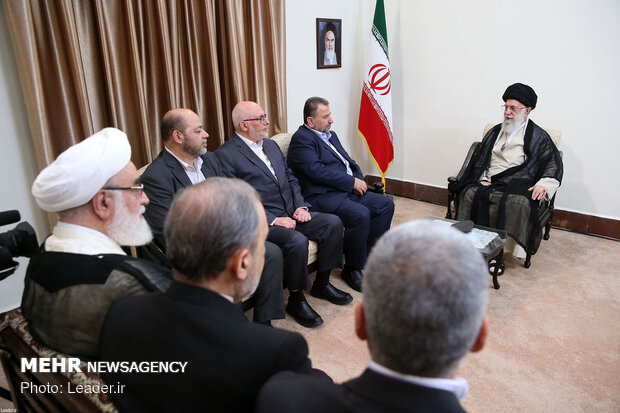
“The issue of Palestine will definitely come to an end with the Palestinians’ and the Muslim World’s triumph,” Ayatollah Khamenei made the remarks in a meeting with a Hamas delegation, headed by the deputy chairman of the movement, Saleh al-Arouri, in Tehran on Monday.
“Victory will not be achieved without resistance and struggle, and we believe according to the indubitable divine promise that the issue of Palestine will definitely be in the interest of the Palestinian people and the Islamic world,” the Leader said.
During the meeting, Al-Arouri submitted a letter from Ismail Haniyeh, Chairman of the Hamas Political Bureau, to the Leader.
Thanking the important and welcoming positions of Haniyeh in the letter, Ayatollah Khamenei said, “Hamas stands at the core of the Palestinian movement, as Palestine stands at the core of the Muslim World's movement.”
The Leader emphasized that when it comes to the Palestinian cause, the Islamic Republic of Iran does not observe any reservations or ceremonies in dealing with any country of the world, and added, "We have always clearly and plainly announced our viewpoints regarding Palestine, and even on the international arena, our friends with who we do not see eye to eye on the issue of Palestine, know that the Islamic Republic is absolutely serious regarding the Palestinian cause.”
The Leader of the Islamic Revolution stressed that according to the divine tradition, the victory of the Palestinian people and the return of this holy land to the Islamic world are not strange and unrealistic, saying that “40 years ago, no one believed that in Iran—which was the center of US's influence and aspirations—a religious government would be launched and the Israeli embassy in Tehran would be turned into a Palestinian Embassy. However, this unbelievable matter happened, hence it is possible to make the things which may seem strange come true.”
Elsewhere in his remarks, Ayatollah Khamenei said, “Sayyed Hassan Nasrallah’s saying that ‘God willing, I will say my prayers in al-Aqsa Mosque’ is a completely practical and realizable hope for us.” 
He touched on the "treacherous" initiative proposed by US President Donald Trump, dubbed as the "deal of the century", saying there is need for promotional, cultural and intellectual work to confront it. 
"The goal of this dangerous conspiracy is to eliminate the Palestinian identity among the people and youth. There is need to confront this main goal and not allow them to eradicate the Palestinian identity with the use of money."
The Leader was apparently referring to a two-day conference held in Bahrain last month, aimed at rallying support for an "investment" plan in the Palestinian Territories as the first part of the "deal of the century".
The plan has met broad disdain from Palestinians and others in the Arab world although regional US allies such as Saudi Arabia discreetly support it. 
"Another way of resisting this conspiracy is to make the people of Palestine feel progress that this has happened altogether, thanks to God," Ayatollah Khamenei said.

Iran-Hamas relations growing: Kharrazi

Liberation of Palestine is a great ideal of Iran, Kharrazi reiterates

TEHRAN - Kamal Kharrazi, chairman of Iran’s Strategic Council on Foreign Relations, said on Sunday that liberation of Palestine, especially the noble Quds, is among the greatest causes of Iran.
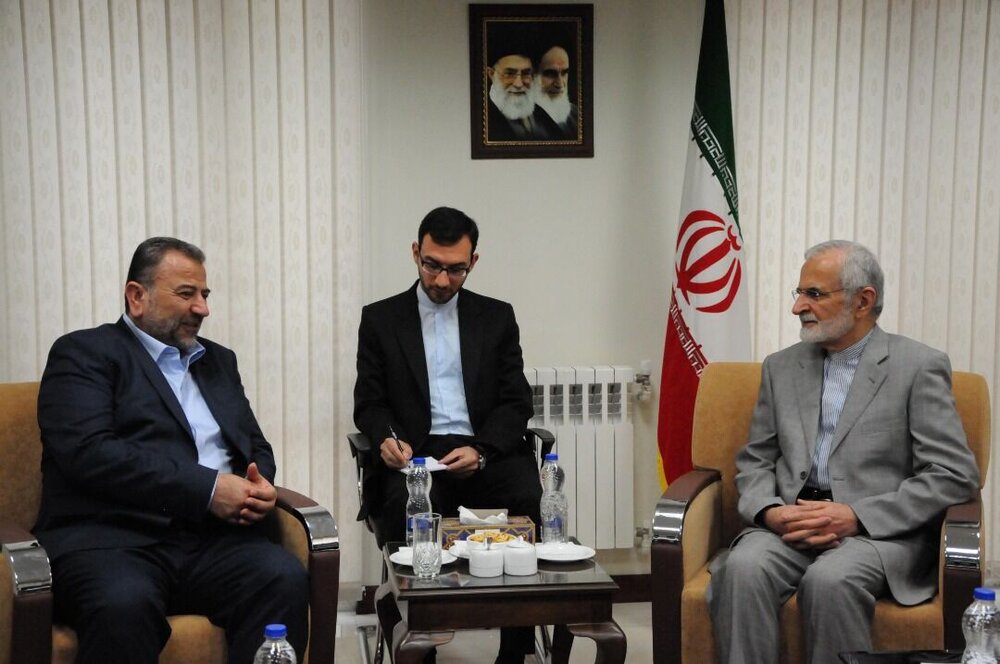
During a meeting with Saleh al-Arouri, the deputy leader of Hamas, Kharrazi said that Iran has supported Palestine since the victory of the Islamic Revolution in 1979.
For his part, Arouri, who was accompanied by a delegation to Tehran, praised Iran’s position in supporting the Palestinian issue.
Talking to reporters after the meeting, Kharrazi said relations between Iran and Hamas are growing.
“Policies of the enemies of Islam and Palestine in supporting occupant Israel are obvious. The Palestinians are aware of these policies and have come to the conclusion that they should stand against the foreigners’ plots,” stated Kharrazi, who was Iran’s foreign minister from 1997-2005.
Pointing to the U.S. proposed “deal of the century”, he said that the Palestinian people countered the plot and all the Muslims condemned it.
Under the deal of the century, U.S. President Donald Trump has proposed to limit Palestine’s land to around half of the West Bank.
The International Quds Day, which falls on the last Friday of the holy month of Ramadan, was marked on May 31. This year’s demonstrations revolved around the slogan of “The International Quds Day, failure of deal of the century and stabilization of the Palestine cause”.
A Hamas delegation headed by Musa Abu Marzouq also met with Russian Deputy Foreign Minister Michael Bogdanov in Moscow, the Middle East Monitor reported on July 17.
Abu Marzouq briefed the Russian official on the political developments of the Palestinian issue including the U.S. “deal of the century”, stressing that all Palestinian people reject it.
The senior Russian official confirmed that Moscow is interested in following up on the political developments in Palestine and the region.
He stressed that Russia supports the Palestinian rights and rejects the deal of the century, highlighting that Moscow’s absence during the Bahrain workshop was evidence of this.
The Hamas delegation reiterated that the movement is eager to achieve reconciliation with other Palestinian factions by holding general elections, forming a unity government and agreeing on a comprehensive national program.
Russian Deputy Foreign Minister Mikhail Bogdanov told the visiting delegation that national unity should be a priority for all Palestinian factions, expressing his rejection of the “punitive policy” adopted by Palestinian Authority President Mahmoud Abbas.
Hamas highlighted the difficult conditions under which Palestinians in the Gaza Strip, the West Bank and al-Quds (Jerusalem) live, as well as the situation for those in the diaspora.
Abu Marzouk said he believes Russia could be a “strong player” in achieving internal Palestinian reconciliation.

Monday, June 17, 2019

Iran’s intel. minister, Hamas delegation discuss ‘Deal of the Century’

TEHRAN, Jun. 17 (MNA) – Iranian Intelligence Minister Seyed Mahmoud Alavi and a high-ranking Hamas delegation have conferred on bilateral ties as well as US plots in the region.
According to the Intelligence Ministry, Hamas deputy leader Salah al-Aruri, a member of Hamas Political Bureau Hessam Badran, Hamas’s foreign relations chief Osama Hamdan, and its Lebanon representative Ahmed Abdul Hadi were present in the meeting with the Iranian minister. The report doesn’t specify the date or place of this meeting.
The two sides discussed ways to counter US-Israeli threats in the region, especially those against Palestine.
They also conferred on bilateral relations and agreed to continue such meetings to counter the dangers arising from US-proposed ‘Deal of the Century’.
Both sides highlighted that the deal is in favor of Zionists and aggressors in the region and that no Palestinian or regional country would accept it.
Pointing to US President Trump’s decisions to relocate embassy to al-Quds and support Zionists’ settlements in the West Bank and Golan, the two sides also noted that 'Deal of the Century', a plan proposed by the US and Zionist regime and supported by Saudi Arabia, is a preface to normalization of Arab-Israeli relations. In this plan and future negotiations, the issue of refugees will be solved with an ‘alternative land’ outside Palestine and the right of Palestinian refugees to return to their country will be abolished forever.

Friday, June 14, 2019

Scorn for US peace plan brings Hamas, Hezbollah closer

Ahmad Melhem

RAMALLAH, West Bank — As confidence in the Donald Trump administration's Middle East peace plan appears to be faltering, even in the United States, cooperation for challenging the deal seems to be growing among Palestinian factions, Lebanese Hezbollah and other critics.
The United States has scheduled an “economic workshop” for June 25-26 in Manama, Bahrain, where aspects of the so-called deal of the century are to be presented. The Palestinians, who were not consulted on the meeting or on the peace plan generally, plan to boycott it. The list of attendees remains tentative.
In a May 31 speech marking International Quds (Jerusalem) Day, the annual event initiated by Iran to show support for the Palestinians, Hezbollah Secretary-General Hassan Nasrallah remarked, “It is possible to push the deal of the century to failure, and we are pushing for this outcome. The axis of resistance will stand against the deal of the century.”
Days earlier, in a May 25 speech on Lebanon's Liberation Day, Nasrallah had called for a Palestinian-Lebanese dialogue to oppose the peace plan. He stated, “There is a common interest at the Lebanese national level as the Lebanese people reject naturalization [of Palestinians in Lebanon]. This is a shared sentiment, as the Palestinians are also opposed to naturalization and want to preserve their right to return.”
Hamas has welcomed Nasrallah’s statements. In a May 26 statement, Hamas spokesman Rafat Mubarak said, “A Lebanese-Palestinian dialogue is the best and the strongest tool to fight the deal of the century and the plan to resettle [Palestinian refugees in Lebanon] and deny them the right of return.”
It appears that the yet-to-be-unveiled US proposal has become an opportunity for the strengthening of ties between Hamas, Islamic Jihad and Hezbollah. Osama Hamdan, Hamas representative in Lebanon, told Al-Monitor, “The relationship between Hamas and Hezbollah was and will remain excellent. The most important achievement we could accomplish as Trump pursues his peace plan is to reestablish the importance of the Palestinian cause in the Arab and Muslim world.”
Hamdan further asserted, “Nasrallah’s call goes hand in hand with [his] movement’s decision to reunite Arab and Islamic efforts, irrespective of their disagreements.” According to Hamdan, “[Answering the call will require] some research into the measures, tools and coordination efforts needed through work with Palestinian factions and Hezbollah.”
Husam Badran, a Hamas political bureau member and the movement's lead on international relations, told Al-Monitor, “It's important to face the deal of the century with an Arab-Palestinian consensus based on a strategy of unifying all efforts. Nasrallah’s call falls within this context, and we welcome it. This is the decision expressed by the different Palestinian factions.”
Badran emphasized, “Responding quickly and preparing for a Lebanese-Palestinian meeting [is important], especially since the deal of the century aims to annul the right to return.”
Palestinians have already begun working toward such a meeting. Ihsan Ataya, Islamic Jihad's representative in Lebanon, told Al-Monitor that various Palestinian political forces in Lebanon have been discussing a common vision for taking on the US plan.
The Lebanon-based Alliance of Palestinian Forces — comprised of Hamas, Islamic Jihad, the Palestinian Communist Party and the Popular Front for the Liberation of Palestine — recently requested a meeting with Hezbollah. According to Ataya, the process is at a preliminary stage, but is being pursued. The goal will be to agree on practical measures to resist Trump's plan and protect Lebanese and Palestinian interests. He remarked that converting Palestinian and Lebanese rejection of naturalization into practical steps will require brainstorming on the political and legal dimensions of the issue.
In a speech marking International Quds Day, Yahya al-Sinwar, Hamas' leader in Gaza, noted that Iran has supplied the Palestinian resistance with missiles and asserted, “The deal of the century aims to integrate Israel into the Arab and Islamic region. Whoever supports the [Palestinian] liberation of Jerusalem and the resistance is a friend, but anyone who [sells out] Jerusalem is an enemy.”
Among the chorus of critics opposing the peace plan, Iran's supreme leader, Ayatollah Ali Khamenei, recently called the deal an “evil plot” that will fail. During marches on International Quds Day, protesters in Gaza praised Iran while condemning the plan.
Ahmad Melhem is a Palestinian journalist and photographer based in Ramallah for Al-Watan News. He writes for a number of Arabic outlets.

Monday, May 27, 2019

‘Bahraini regime contributing to liquidation of Palestinian cause’

TEHRAN- Bahrain’s main Shia opposition group, the al-Wefaq National Islamic Society, says the ruling Al Khalifah regime is contributing to the liquidation of the Palestinian cause through hosting a Washington-led conference in support of U.S. President Donald Trump’s controversial proposal for “peace” between the Israeli regime and Palestinians, dubbed “the deal of the century.”
“The Manama regime, through hosting a U.S.-Zionist conference next month, is helping the obliteration of the Palestinian cause in favor of the Zionist regime (of Israel), and according to Israeli conditions,” the deputy secretary general of al-Wefaq, Sheikh Hussein al-Daihi, said on Thursday.
He added, “It’s not the first time that the Bahraini regime stabs Muslims and reneges on their major issue of concern, which is Palestine. The regime has rushed to normalize ties with the Zionist entity.”
The opposition figure further noted that the Manama conference scheduled for June 25-26 is a “failed step to establish a new Middle East” according to U.S. standards.
“The hypocrisy of those fooling with the Palestinian cause and Palestinians’ sufferings has been unmasked. Their intentions and schemes aimed at liquidation of the Palestinian cause have now been exposed,” Daihi pointed out.
The Palestine Liberation Organization (PLO) and the Hamas resistance movement have called for an Arab boycott of the Bahrain confab.
According to Press TV, Hamas, in a statement issued on Monday, also called on Arab countries to provide the Palestinian people with every support to confront and frustrate the U.S. “deal of the century.”
“We are following with great concern the American announcement about holding an economic workshop next June in the Bahraini capital of Manama,” Hamas said, describing it as the first American confab in support of the so-called deal of the century.
The movement also denounced any Arab participation in adopting and executing the deal, saying any attendance in the American-led Bahrain conference would be considered a deviation from Arab and Islamic values.
Trump’s “peace plan” has already been dismissed by Palestinian authorities ahead of its unveiling at the end of the holy fasting month of Ramadan and the formation of the new Israeli cabinet, most likely in June.
Speaking in the occupied West Bank city of Ramallah on April 16, Palestinian Prime Minister Mohammad Shtayyeh lashed out at the initiative, asserting it was “born dead."