Showing posts with label Iran and Turkey. Show all posts

Sunday, June 16, 2019

Rouhani holds separate meetings with regional leaders in Dushanbe

Rouhani holds separate meetings with regional leaders in DushanbeIranian president on the second and final leg of his tour to the Central Asia attended the summit of Conference on Interaction and Confidence-Building Measures in Asia (CICA) held in Tajikistan’s capital and met with several leaders of the regional countries.
During a meeting between Iranian President Hassan Rouhani and the president of the host country Emomali Rahmon, both officials stressed that they will do their best to further boost ties between the two countries in all fields.
Rouhani said Iranian companies are ready to have more active presence in Tajikistan to offer technical-engineering services and transfer experiences to cooperate in the Central Asian country projects.

Economic ties with Turkey

The Iranian president also held a separate meeting with Turkish President Recep Tayyip Erdogan.
Rouhani and Erdogan expressed their willingness to cement bilateral economic and political relations.


Rouhani said, “In recent years, valuable steps have been taken for the development of relations between Iran and Turkey, and this trend needs to continue”.
He also described regional cooperation between Iran and Turkey effective, successful and important, saying, “Bilateral and trilateral cooperation, including the one with Russia regarding regional issues and the Astana Process, fighting terrorism and the stability of Syria, are very important for strengthening peace and stability in the region.”
Both also voiced their opposition to any kind of sanctions and unilateralism in international relations.

Resolving regional disputes

Speaking in a meeting with the emir of Qatar, President Rouhani described development of relations with neighboring countries, especially Qatar, as one of the principles of Iran’s foreign policy and stressing that stability and security of the regional countries are intertwined.
“Bilateral and multilateral cooperation is the only way to settle discords and resolve regional problems and Iran is always ready to cooperate in this regard”, Rouhani said.


“There are many opportunities for further development of economic relations between the two countries that need to be taken advantage of”.
Emir of Qatar Sheikh Tamim bin Hamad Al Thani said Qatar believes that settlement of all disagreements in the region is only possible through dialogue, cooperation and political ways.
He also said Doha is ready to deepen relations with Tehran in all fields of mutual interest.

Fighting drug trafficking, terrorism

In his meeting with Chief Executive of the Islamic Republic of Afghanistan Abdullah Abdullah, Rouhani stressed the importance of fighting drug trafficking, adding, “In addition to social damage, a major portion of terrorism funding is supplied through drug trafficking, and this fact underscores the necessity of comprehensive fight against drug trafficking.”


Abdullah appreciated Iran for supporting the people of Afghanistan, saying,  “Iran has always been alongside the Afghan people and government, and we are always grateful for the help and support.”
He also referred to Iran’s efforts in fighting terrorism and drug trafficking, calling for more cooperation between Kabul and Tehran in these fields.

Saturday, September 08, 2018

US concerned about formation of Islamic power: Iran's Leader


US concerned about formation of Islamic power: Iran's Leader
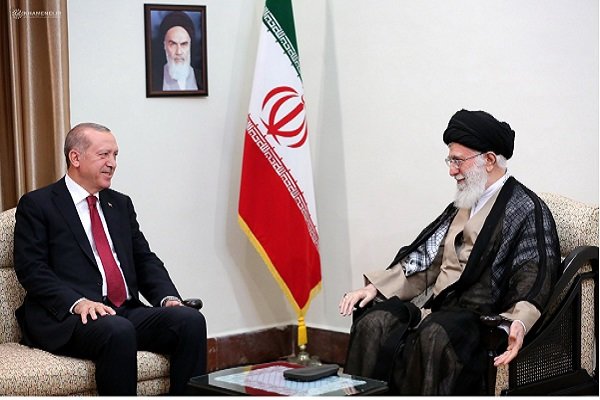
TEHRAN, Sep. 07 (MNA) – Following the end of Tehran trilateral summit on Syrian settlement, Iranian Leader Ayatollah Khamenei received Turkish President Erdogan, calling for more unity among Muslim nations.
“Unity and cooperation between Islamic countries can pave the way for resolving regional problems and that is why the Arrogance, and at the head of it the US, is worried about cooperation and closeness between Islamic countries and the formation of an Islamic power,” said Iranian Leader Ayatollah Seyed Ali Khamenei at a meeting with Turkish President Erdogan in Tehran on Friday. 
"Iran and Turkey are two powerful and reputable countries in the region with common intentions for the Islamic world, therefore cooperation between the two sides needs to further expand in the political and economic sectors," the Leader added. 
He also commended Erdogan's position on Myanmar, and highlighted the significance of the Palestinian cause.
President Erdogan, for his part, blamed the current situation on lack of unity among Muslim countries, calling for closer relations between Iran and Turkey in the face of the West's particular hostile behavior toward independent Muslim nations. 
Turkish President Erdogan and Russian President Putin were hosted by Iranian President Rouhani at Tehran trilateral summit on Syrian crisis where the three countries reached some agreements and issued a joint statement voicing their firm opposition to terrorism in Syria.

Monday, September 03, 2018

No, it’s not the strongly cruel who survive in the longer run

By Martin Love


“The weak crumble, are slaughtered and are erased from history while the strong, for good or for ill, survive. The strong are respected, and alliances are made with the strong, and in the end peace is made with the strong.”
This is a direct quote of a Twitter submission by Benjamin Netanyahu this past week. It’s been copied (and condemned) by a variety of people on the Internet, and if anything has ever been written that shows the true face of the Zionist regime, this has to be it. It is fascist, and could have been written by a Nazi in Germany at the start of World War 2. “Might makes right” is apparently Netanyahu’s only thought. And, it seems, the only thought of the Trump Administration Neocons, too, who are directing US foreign policies and sanction activity worldwide.
One hardly knows how to respond, practically, to such an assertion, except to wonder what this dangerous man has been smoking, but it is entirely in line with Revisionist Zionism promulgated by Vladimir Jabotinsky as early as the 1920’s in Palestine. It was Natanyahu’s father who was for a time secretary to Jabotinsky, and thus Israel’s current Prime Minister was even as a child infused with an ideology that was anything but peaceful.
You can’t teach a bad man new tricks. It’s awfully clear what Iran has been up against in the Mideast since the 1979 revolution, and given the US refusal to balance its policies in the Mideast, matters have only gotten worse, especially under Trump.
One can read every day of new atrocities in Gaza and the West Bank such that it appears the Zionists want to literally wipe out any Palestinian identity. This is genocide. And Trump has withheld funds from UNWRA and also wants to reclassify the number of Palestinian refugees from about six million in the Mideast to 500,000, forcing millions to give up any notion of equity and justice. The hard-right Zionists are going for complete domination of the region along with the US, despite the fact that quite a few better thinking Jews in Israel are protesting the Likud government under Netanyahu.
The statement above is fraught with error. For one thing, few anywhere in the world, except other Zionists, respect Netanyahu. He and his country are almost universally despised. He has no real alliances to speak of except with the US government and some among the Saudis and perhaps others in the UAE. Any kind of real “peace” is not made with the “strong” since there is no real strength in militarism and cruelty.
It was the humble and meek and long persecuted Christians, for example, who in the three centuries after Jesus felled the mighty Roman Empire as it had been. It was humble but determined Prophet Mohammad who eventually overcame his naysayers, the recalcitrant and initially disbelieving tribes in Arabia in the early 7th century, which led to the ascent of Islam, a religion of brotherhood and peace in concept at least like no other.
The one thing that might be said about the U.S. government and the Pentagon and the all the various groups that comprise the so-called “Deep State”, even if is not much solace to emerging market countries like Iran and Turkey, or to Russia and China, and to those others in the Islamic world and Mideast who are suffering because of U.S. and Zionist actions and postures, is that they reek of complete desperation -- by doubling down on previous failures by doubling or tripling up on aggression and militancy. Perhaps these operators know they are not holding a winning hand? It’s like a person in a boxing match with an adversary, but the adversary looks like the eventual winner and in desperation the loser changes the game entirely – by drawing a gun on the unarmed opponent.
It may be that Trump is the culmination of America and Netanyahu is the culmination of the Zionist state. It hardly looks that way right now, but stranger things have happened. It really does depend on countries like Iran, Russia, China and Turkey, and even Germany, finding effective ways to carry on business despite U.S. sanctions and threats from both the U.S and the Zionists. Otherwise, there will be Hell to pay for a refusal to try to stand strong in spirit and at the same time, exactly what the U.S and Israel are not in desperation – cool headed.

Monday, August 21, 2017

Israel authors a neo-Balfour declaration for Kurds

By: Adam Garrie


TEHRAN, – Israel, having no allies in the region, is advocating establishment of a Kurdish state in the Middle East that could reasonably amount to a client state.

One of the most controversial documents of modern history is also one of the shortest. This was the Balfour Declaration issued on 2 November 1917. This document pledged the British Empire’s support for the establishment of a Jewish state in Palestine which in 1917 was the sovereign territory of Ottoman Turkey.
The text of the document, drafted as a letter, reads as follows:
“Dear Lord Rothschild,
I have much pleasure in conveying to you, on behalf of His Majesty's Government, the following declaration of sympathy with Jewish Zionist aspirations which has been submitted to, and approved by, the Cabinet
His Majesty's Government view with favor the establishment in Palestine of a national home for the Jewish people, and will use their best endeavors to facilitate the achievement of this object, it being clearly understood that nothing shall be done which may prejudice the civil and religious rights of existing non-Jewish communities in Palestine or the rights and political status enjoyed by Jews in any other country.
I should be grateful if you would bring this declaration to the knowledge of the Zionist Federation.
Yours,
Arthur James Balfour”.
This document continues to haunt the Middle East as Israel remains a state whose borders were not only forged during a time of foreign colonization of the Middle East but far more importantly, it is the only state in the Middle East that permits the de-facto settlement of contemporary colonials to land which rightfully belongs to its indigenous inhabitants, the Palestinians of all religious faiths.
One would think that with global popular opinion turning against the Israel project, that its leaders would know a thing or two about being discrete about neo-colonial rhetoric, but this is not the case.
Recently, Israeli Prime Minister Benjamin Netanyahu stated that he is positively in favor of the establishment of a Kurdish state in the Middle East and further called Kurds “brave, pro-Western people who share our values”.
The gushing language used by Netanyahu is eerily similar to that used by Balfour in 1917. What’s more is that both statements totally disregard the fact that the only people who can legally allow for Kurdish autonomy, let alone a Kurdish state are those who are the legal sovereigns of the territory that Kurds seek to annex. These countries are in no particular order, Iraq, Syria, Iran and Turkey.
Each of these states is firmly opposed to Kurdish annexation of their territory just as Palestinians were firmly opposed to the British and later UN annexation of Palestine in order to make a state for foreign Jews who were overwhelmingly European.
The thinking behind Netanyahu’s statement is clearly similar to that behind the British elites of the early 20th century.  Just as the British Empire was a colonial regime facing decline, so too is Israel a colonial regime whose plans to annex its neighbors have been met with fierce resistance, most recently when in 2006, Hezbollah liberated southern Lebanon from the last vestiges of Israeli occupation.
In 1982, the Zionist publication Kivunim revealed the Yinon Plan, a long term goal for geo-strategic expansion of the Israeli state to cover territories of Egypt, Lebanon, Iraq, Saudi Arabia and Syria.
The only analogous plan in modern history is the comparatively recent plan for Greater Albania, a plan which would see the existing Albanian regime in Tirana annex parts of Serbia, Montenegro, Macedonia and Greece.
Like many colonial powers preferring divide and rule techniques to outright conquest, it would appear that Israel has decided to do with the Kurds what the British once did with the Zionists: support their claims to someone else’s land. The main difference being that Kurds are settled residents in Middle Eastern nations whereas the European Jewry who made up Israel’s early population had no real connection to Palestine other than those justified by pseudo-scientific Zionist ideology.
It boils down to Israel having no allies in the region and increasingly beyond and therefore advocating for the creation of a state that could reasonably amount to a client state just as Israel remains dependent greatly on money and immigration for Europe and North America to sustain its military and economy.
But just as many colonial plans backfire, so too could this. A would-be Kurdish state in the Middle East would have Israel as a lone regional ally (with the speculative possibility of Saudi Arabia as a kind of semi-ally) and it would likely have an ally in the United States. Russia’s position would most likely evolve into one of agnostic acceptance, but again this depends a great deal on how Turkey’s burgeoning alliance with Russia pans out. At the end of the day, no one in Russia would trade Turkey for a Kurdistan, even in spite of an historical record which might point to the contrary but which bears no relationship to present economic and geo-strategic realities.
Because of this, it is wise to remember that although America is the world’s number one supporter of Israel, not all American Presidents have friendly relations with Israel leaders. Nixon, Clinton and Obama often had a great deal of difficulty working with intractable Israeli leaders.
And this is where a Kurdish state might work to Israel’s disadvantage. If a would-be Kurdistan and Israel remained America’s two satellites in the Middle East, America would have the distinct advantage of being able to pick a ‘flavor of the month’ or even year.
All it would take is a difficult Israeli leader to appear less attractive to moderates in Washington vis-à-vis a Kurdish leader desperate for US aid to make Kurdistan America’s number one friend in the region.
With all things colonial, it is well advised to be careful what you wish for. The law of unintended consequences which exists in all geo-political relations is always magnified when the powers that be start to re-draw the geo-political map.