Showing posts with label Achaemenid. Show all posts

Wednesday, October 16, 2019

Apadana Staircase leads you to mythical arts of Persia

TEHRAN – Apadana Staircase is one of the most striking sections of the UNESCO-registered Persepolis, southern Iran.
The lavishly decorated monument draws hundreds of domestic and foreign visitors every single day, showing them off scenes of mighty Achaemenid Empire (550 –330 BC) and grandeur of its fabled arts.
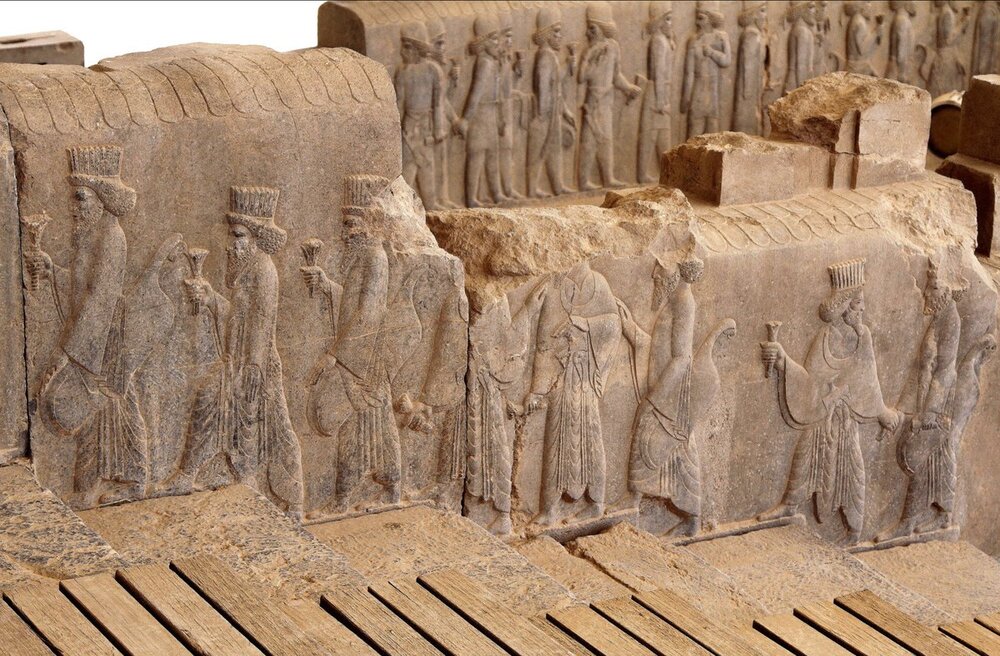
Visitors can observe finely crafted friezes along three major panels each divided into several tiers depicting sovereigns, dignitaries and the then visitors to Persepolis.
The northern panel itself is divided into three tiers of well-preserved bas-relief figures of Persian nobility including the Imperial Guard and the Immortals.
On the upper tier, according to the Lonely Planet, the figures are followed by the royal procession, valets and horses of the king’s chariot; on the lower two tiers these figures precede Persians wearing feather headdresses and Medes in their round caps.
The central panel of the staircase is dominated by traditional symbol of Zoroastrianism which is flanked by two winged lions with human heads.
Elaborate panels at the southern end of the staircase depicts a record of nations, showing 23 delegations bringing their gifts to an Achaemenid king. The Ethiopians begin the frieze in the bottom left corner and are joined by Arabs, Thracians, Kasmiris, Parthians and Cappadocians. The Elamites, Egyptians and Medians occupy the panel at top right. Accompanying this pantheon of guests are an assortment of delicately carved sheep with ram’s horns and curled wool, two-humped Bactrian camels, oxen and mules.
On the northern panel exists inscriptions with fairly stereotypical texts by king Xerxes; one in Old Persian and others in Elamite and Babylonian.
According to livius.org, a website on ancient history written and maintained since 1996 by the Dutch historian Jona Lendering, parts of the inscriptions read:
“A great god is Ahuramazda, who created this earth, who created that heaven, who created man, who created happiness for man, who made Xerxes king: the king of many kings, one ruler of many rulers.”
“I am Xerxes, the great king, king of kings, king of all nations, having various kinds of people, king in this great earth far and wide, the son of king Darius, an Achaemenid.”
In 330 BC, the staircase was miraculously survived the sack of Persepolis by the soldiers of Alexander the Great. The staircase is currently protected by a permanent shelter.
Here is a comment that “R0hanL” from Jordan have posted to TripAdvisor, one of the most popular travel websites in the world:
“Stunning ancient ruins”
The ruins at this site are stunning. Some of the ruins have been covered, which gives you a sense of the shape of buildings-especially when you view the site from up the hill from one of the tombs. On the ground, it does take some imagination to "see" the 100 column palace for example, but a good guide book helps a lot to aid that process. The exceptionally carved friezes on the Apadana Staircase, Xerxes Gateway and Royal Apartments were exquisite. We also walked to both the tombs up on the hill, which were very similar to the tombs I had seen in Jordan at Petra. It was very hot the afternoon we were there, so ensure you bring plenty of water as the place to buy water in the site was very removed from the main part of the ruins itself. In all, we thoroughly enjoyed walking through this timeless place.

Wednesday, October 02, 2019

Achaemenid-era clay tablets returned home after 84 years

TEHRAN – A total of 1,783 Achaemenid-era clay tablets, which were on loan from Iran to the Oriental Institute of the University of Chicago since 1935, have been returned home.
The fourth batch of the Achaemenid objects, composed of 1783 clay tablets, entered the country from the Oriental Institute after 84 years, CHTN reported.
They are part of thousands of clay tablets and related fragments, which were kept at Chicago’s Field Museum of Natural History and the University of Chicago’s Oriental Institute.
The artifacts were recuperated with great deal of efforts made by the Ministry of Cultural Heritage, Tourism and Handicrafts and the presidential office for legal affairs, tourism minister Ali-Asghar Mounesan said.
The tablets were handed over to the National Museum of Iran, where they are supposed to be put on show as of tomorrow. 
“These treasured documents decipher an important segment of recorded history of Achaemenids during the reign of Darius I (Darius the Great who reigned from 522 to 486 BC),” said Jebrael Nokandeh, director of the National Museum of Iran.
Last December, Mounesan announced that over 11,000 flawless [Achaemenid-era] clay tablets and a large number of fragments of their kind will be back home.
“Of the cited number, 1784 clay tablets have been endorsed by the U.S. Department of the Treasury in order to be shipped to Iran, in the first stage… and they are currently being packed by the Oriental Institute of the University of Chicago,” Mounesan said.
In February 2018, and following years of ups and downs, the fate of those ancient Persian artifacts, was left in the hands of a U.S. Supreme Court, which ruled in favor of Iran.
Archaeologists affiliated with the University of Chicago discovered the tablets in 1930s while excavating in Persepolis, the ceremonial capital of the Persian Empire. However, the institute has resumed work in collaboration with colleagues in Iran, and the return of the tablets is part of a broadening of contacts between scholars in the two countries, said Gil Stein, director of the Oriental Institute at the University of Chicago.
The tablets reveal economic, social and religious history of the Achaemenid Empire (550-330 BC) and the larger Near Eastern region in the fifth century BC.
Darius I, byname Darius the Great, (born 550 BC—died 486), king of Persia in 522–486 BC, one of the greatest rulers of the Achaemenid dynasty, who was noted for his administrative genius and for his great building projects. Darius attempted several times to conquer Greece; his fleet was destroyed by a storm in 492, and the Athenians defeated his army at Marathon in 490.
The Achaemenid [Persian] Empire was the largest and most durable empire of its time. The empire stretched from Ethiopia, through Egypt, to Greece, to Anatolia (modern Turkey), Central Asia and to India.

Saturday, August 31, 2019

A glance at essential elements of traditional architecture in Iran

TEHRAN - Persian architecture has a long and complex history. The Elamite, Achaemenian, Hellenistic, and other pre-Islamic dynasties left striking stone testaments to their greatness, such as Chogha Zanbil and Persepolis—both designated as UNESCO World Heritage sites in 1979. 
Three monastic ensembles central to the Armenian Christian faith were collectively recognized as a World Heritage site in 2008. Their architecture represents a confluence of Byzantine, Persian, and Armenian cultures. 
From the Islamic period the architectural achievements of the Seljuq, Il-Khanid, and Safavid dynasties are particularly noteworthy. During that time Iranian cities such as Neyshabur, Isfahan, and Shiraz came to be among the great cities of the Islamic world, and their many mosques, madrasahs, shrines, and palaces formed an architectural tradition that was distinctly Iranian within the larger Islamic milieu, according to Encyclopedia Britannica. 
There are some elements that are common among most of the monuments constructed upon Persian architecture.
The usage of iwans (porticos)
An iwan is a vaulted space that opens on one side to a courtyard. The idea of iwan developed in pre-Islamic Iran where it was used in monumental and imperial architecture. 
Extensive use of arches
The two famous monuments, the Taj Mahal for the Mughal architecture and the Great Mosque of Isfahan for the Persian architecture displays the example of this fact. It is built for aesthetic reasons, as well as to place windows and to lessen the extent of sunlight to pour into the building.
Gardens, fountains, and pools
Water plays a particularly central role in Iranian design: millennia before the invention of the first water pump, Persian agricultural experts created the qanat (subterranean aqueduct) based on their hydraulic laws.
Spacious gardens and pools with fountains have always been a main feature of Persian architecture over time. In a traditional mosque, madrasa, house, it is used for ablutions, aesthetics or both.
Domes 
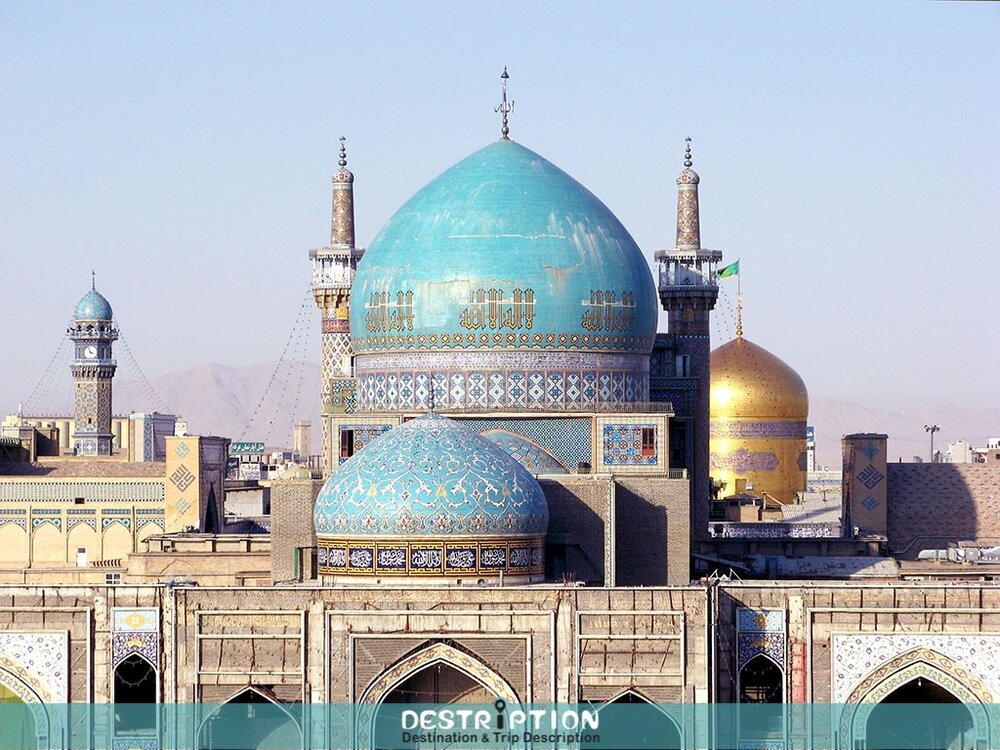
The Persian tradition of dome-building dates back to the earliest Mesopotamian architecture when domes became an integral part of buildings due to the scarcity of wood in many areas of the Iranian plateau.
In Ancient Persia, domes were associated with the divine side of life, as their circular shape represented perfection, eternity and the heavens, according to Press TV. 
Domes moved to the forefront of Persian architecture during the Sasanian period (224 to 651 CE) and they evolved through different eras until the Safavid dynasty (1501–1732) when the last generation of Persian domes were characterized by a distinctive bulbous profile and astonishing tileworks.
In the Persian urban designing, domes in places of worship and public places, including traditional bazaars, caravansaries, schools and baths, are designed in such a way that can be seen from different parts of urban or rural area.
The domes are normally double-shelled. While the interior shell is designed to carry the weight of the structure, the exterior shell serves as both a decorative element and as insulation against the elements. The aerodynamic shape of the domes also makes the structures more sustainable.
 
Symmetry 
Iranian architecture makes use of abundant symbolic geometry, using pure forms such as the circle and square, and plans are based on often symmetrical layouts featuring rectangular courtyards and halls.
Sassanid architecture is decorated with carved stone or stucco reliefs and makes use of colorful stone mosaics. Beautiful gold and silver dishes, bowls, and ewers, often decorated with hunting scenes or animals in high relief, and textiles with symmetrical heraldic designs also remain.
Usage of Muqarnas
Muqarnas is typically applied to the undersides of domes, pendentives, cornices, squinches, arches, and vaults and is often seen in the mihrab of a mosque. They can be entirely ornamental, or serve as load-bearing structures. The earliest forms of muqarnas domes, found in the Mesopotamian region, were primarily structural.
Calligraphy
 Iranians’ passion for using the script as an artistic impression goes back to pre-Islamic times but it is the work of Islamic era calligraphers and illuminators that elevated its use into the high art we appreciate today. Encouraged by the Islamic preference for the art of calligraphy over representational arts, it developed from epoch to epoch and from style to style.