Showing posts with label 2015 nuclear deal. Show all posts

Wednesday, October 09, 2019

Trump enjoyed destroying nuclear deal as Obama’s major foreign policy success: professor

TEHRAN - Roy Licklider, an adjunct senior research scholar at the Saltzman Institute for War and Peace Studies and adjunct professor of political science, says Donald Trump was happy to kill the 2015 nuclear deal which was President Barack Obama’s major foreign policy success.
“Trump enjoyed destroying President Obama’s major foreign policy success,” Licklider told ILNA in an interview published on October 6.
Licklider said like other academics he was a strong supporter of the nuclear pact, officially called the Joint Comprehensive Plan of Action (JCPOA).
“I strongly approved of the Joint Agreement, like most academics I know, and I saw it as President Obama’s major foreign policy achievement,” Licklider remarked.
‘Trump enjoys overriding experts’
 
The professor said Trump did not heed warnings by politicians and academics to avoid abandoning the JCPOA.
“The fact that many observers thought this was a mistake did not deter him; he enjoys overriding ‘experts’.”
He also applauded efforts by the Europeans and Iran to keep the deal alive, “but I doubt that they will succeed”.
According to the Associated Press, the Spaniard set to become the European Union's point-man in Iran says the nuclear deal with Tehran must be preserved.
During a parliamentary confirmation hearing to become the next EU foreign policy chief, Josep Borrell said Monday that "we have to keep this agreement alive in order to defend our interests, our security and avoid something worse."
Borrell, who is currently foreign minister in Spain's caretaker government and set to take over in Brussels from Federica Mogherini on Nov. 1, says "the political unity of the Europeans will be crucial" in keeping the agreement going.
‘Trump notoriously willing to change positions but not on JCPOA’
The academic also said Trump is infamous for changing position on issues but not the multilateral nuclear agreement.
“President Trump is notoriously willing to change positions on issues, but it seems unlikely that he will do so with this one.”
On his prediction of U.S. foreign policy in the post-Trump era, Licklider said, “If Trump’s successor returns to a more traditional foreign policy, I suspect most allied governments will be relieved and encourage the change.”
He also said it is unlikely that sanctions pressure will force Iran to change policy, noting that massive academic literature over the past several decades concludes that sanctions don’t change important policies.
Iran has said that it is adopting “maximum resistance” in the face of Trump’s strategy of “maximum pressure”.
Professor Licklider said the United States exerts economic pressure on people with the hope of inciting them to rebel against the ruling system.
“They are supposed to work by making a population so miserable that it will pressure its government to change policy, but target governments can usually deflect this process by appealing to nationalism and blaming the sanctioning state.”
On the unrest and conflicts in certain Middle Eastern states, he said, “There are many different violent conflicts in the region, each with its own distinctive issues.  Many of these are due to weak economies, bad governance, and outside involvement, all of which can be fixed in principle.”

Wednesday, October 02, 2019

Iran will continue reducing nuclear commitments: Leader

Ayatollah Khamenei says U.S. policy of maximum pressure has failed 

TEHRAN - Leader of the Islamic Revolution Ayatollah Seyyed Ali Khamenei said on Wednesday that Iran will continue to reduce commitments under the 2015 nuclear deal, known as the Joint Comprehensive Plan of Action.
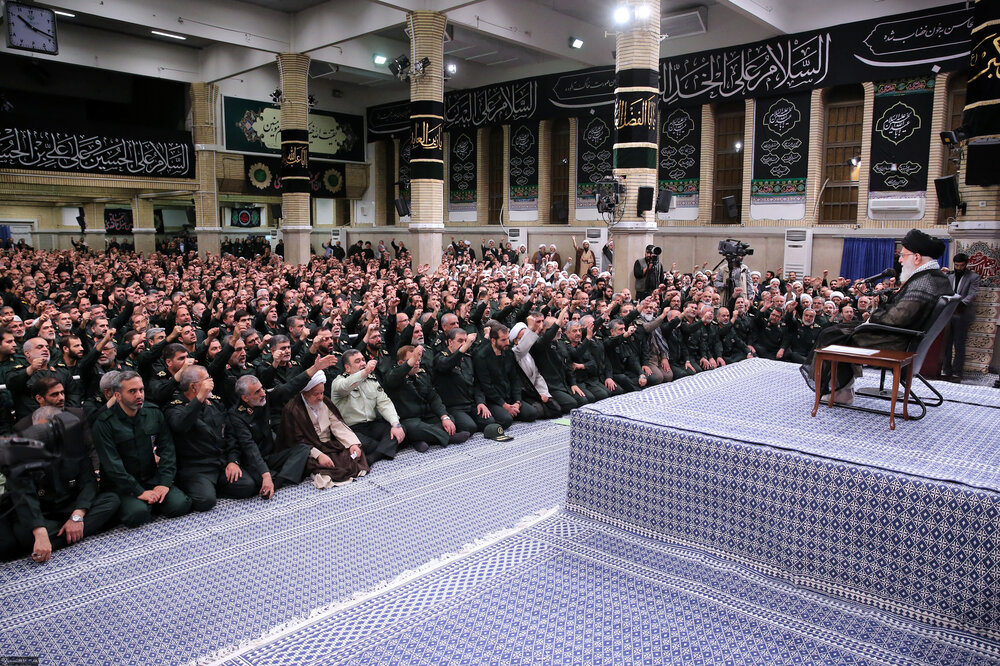
“Reducing nuclear commitments, for which the Atomic Energy Organization is responsible, should continue seriously and precisely as it was announced by the government till it reaches favorable result and it will definitely reach the result,” Ayatollah Khamenei said during a meeting with the High Council of the Commanders of the Islamic Revolutionary Guard Corps.
The Leader also said the United States’ policy of “maximum pressure” against Iran has ended in failure.
“They imagined Iran would be forced to show flexibility if they applied policy of maximum pressure. With the help of God, they understand that the maximum pressure has caused problems for themselves,” the Leader stated.
The Leader describes sanctions on Iran’s oil sale as a “short term problem”.Referring to President Hassan Rouhani’s visit to the annual UN summit in New York last week, the Leader said, “Recently, they (the U.S.) made unfruitful efforts with the help of their European friends to form a symbolic show of Iran’s surrender and to make the Iranian president to meet with them. However, Iran will continue reducing nuclear commitments seriously and determinedly till reaching favorable result.”
U.S. President Donald Trump, who quit the nuclear deal in May 2018 and imposed the harshest ever sanctions on Tehran, has been repeatedly calling for dialogue with Iran.
On May 8, exactly one year after the U.S. abandoned the deal, Tehran began to partially reduce its commitments to the agreement at bi-monthly intervals.
In the first stage, Iran announced that it will not limit its stockpile of the nuclear fuel to 300 kilograms allowed under the deal. However, on that date (May 8) Iran’s Supreme National Security Council (SNSC) said if the remaining parties to the JCPOA, especially Europeans, devise a mechanism to protect it from the sanctions effect in the two-month deadline it will reverse its decision. 
But since European parties missed the deadline, on July 7 Iran announced that it has started enriching uranium to a higher purity than the 3.67%, thereby starting the second step.
As Europe missed the second 60-day deadline, Iran moved to take the third step, removing ban on nuclear research and development (R&D).
In a letter on September 5, Foreign Minister Mohammad Javad Zarif notified European Union foreign policy chief Federica Mogherini about Iran’s third step.
‘Relying on domestic capabilities is solution to problems’
Ayatollah Khamenei also said that relying on domestic capabilities is solution to economic problems.
He described sanctions on Iran’s oil sale as a “short term problem”.
If proper actions is taken, the country can reach a “long-term benefit” from this “short term problem” which is non-reliance on oil revenues, the Leader remarked.

Thursday, September 12, 2019

Rouhani to U.S.: Abandon Warmongering

Officials Dismiss Meeting With Trump
TEHRAN – Iran’s President Hassan Rouhani on Wednesday urged the U.S. to "put warmongers aside” after the dismissal of John Bolton as national security adviser, with tensions remaining high in the Persian Gulf.
Speaking at a cabinet meeting, Rouhani further urged Washington to "abandon warmongering and its maximum pressure policy” on Iran and said Tehran would cut its commitments to a 2015 nuclear deal further if necessary.
"The United States should understand that militancy has no profit and must abandon its policy of maximum pressure on Iran ... Iran's commitments to the nuclear deal is proportional to other parties and we will take further steps if necessary," he said.
Rouhani has called the use of faster centrifuges a "third step” away from the nuclear deal. On Wednesday, he said that "if necessary, we will take other steps in future”.
"Iran’s policy of resistance will not change as long as our enemy (the United States) continues to put pressure on Iran,” said Rouhani.
Rouhani’s remarks came as Iran again rejected the possibility of a meeting between him and U.S. counterpart Donald Trump, after the White House signaled it was open to such an encounter.
Two of Trump's top lieutenants on Tuesday indicated he was ready to meet the Iranian president without preconditions, after the U.S. leader sacked Bolton.
But Secretary of State Mike Pompeo and Treasury Secretary Steven Mnuchin stressed the United States would maintain its campaign of "maximum pressure" against the Islamic Republic.
Iran's representative at the United Nations reiterated that a meeting could take place only if Washington ends its "economic terrorism" by lifting all of its sanctions against Tehran.
The Iranian envoy said any meeting must also be held in the framework of the group of major powers that negotiated the 2015 nuclear deal.
"As long as the U.S. government's economic terrorism and such cruel sanctions are imposed on the Iranian people, there is no room for negotiations," he was quoted as saying by IRNA.
The diplomat said Trump's decision to dismiss Bolton -- a hardliner accused of pushing Trump towards war against Iran -- was a matter for the Americans.
"The removal of John Bolton is an internal affair and we don't take stands on domestic issues," said Takht-Ravanchi.
Asked about the impact of Bolton's sacking on long-fraught relations between Iran and the United States, he said it was "too soon" to make any judgments.
"Whether the extremist policy of the U.S. changes or not depends on various factors in US foreign policy," he told ISNA.
Bolton is a controversial figure closely linked to the 2003 invasion of Iraq and other aggressive U.S. foreign policy decisions.
He had been seen as one of the main driving forces in the White House's muscular approach to Iran, North Korea and Venezuela among others.
An Iranian government spokesman on Wednesday called Bolton "the symbol of America’s hawkish policies and its animosity toward Iran”, but said his dismissal was an internal U.S. issue.
For his part, Foreign Minister Muhammad Javad Zarif again used Twitter to write about what he calls the #B_Team, which included Bolton, Zionist PM Benjamin Netanyahu, Saudi Crown Prince Muhammad bin Salman and Abu Dhabi Crown Prince Muhammad bin Zayed Al Nahyan, all hawks on Iran.
Zarif said "the world — minus 3 or 2 panicked cohorts — was breathing a sigh of relief” after Bolton’s ouster. "Thirst for war — maximum pressure — should go with the warmonger-in-chief,” Zarif wrote.
Other officials, however, urged caution.
Gen. Mohsen Rezaee, a commander in the Islamic Revolution Guards Corps and its former chief, said in a tweet: "We will not be deceived by the sacrificing of Bolton.”
Bolton was a longtime hard-liner on Iran who favored regime change and took money for speaking engagements from the anti-Iran Mujahedin Khalq Organization (MKO), a notorious terrorist group. Bolton famously wrote in 2015, before Iran’s nuclear deal was struck, an op-ed in The New York Times headlined: "To Stop Iran’s Bomb, Bomb Iran.”
In Occupied Palestine, Zionist party leader Naftali Bennett said he was very worried about Bolton’s dismissal.
 Speaking at the Maariv-Jerusalem Post conference on Wednesday, Bennett was asked how worried he was by these recent events. Bennett responded that he was "very” worried that Trump was seeking to come to terms with Iran.
"We should be very worried. Trump is obviously a big friend of Israel, but at the end of the day our interests are not identical, he has his interests we have our interests,” said Bennett.
"Our situation is much better than it should be, in Syria and Iraq. In Lebanon it is so-so. And with Iran, the situation is not far from lost but I am very, very troubled,” the former cabinet member said.

Monday, August 12, 2019

Iran on the Precipice


Photograph Source: Tasnim News Agency – CC BY 4.0
There’s never been a full-scale war between two nuclear-armed states. If Iran one day did cross the nuclear threshold the same deterrence will apply. No one rational would want to provoke their own incineration.
Columbia University professor, Kenneth Waltz, the distinguished theorist on the conduct of war, wrote in Foreign Affairs that with Israel possessing over 200 nuclear weapons (which the US refuses to publically admit) Iran having a bomb would bring stability.
I would never go as far as Waltz on that last point. The launch of nuclear weapons can always be done by accident or by the rogue action of one or two of the members of the launch team in the silo.
It has nearly happened in the US a number of times, and probably in the Soviet Union too. Moreover, if Iran got really close to building a bomb, Saudi Arabia would follow in short order, and perhaps Egypt too somewhat later. That would really be Iran cutting off its nose to spite its face.
The arguments between Iran, the US and Europe over the supposed bomb question are becoming confused. To be frightened or not to be? If clear thinking is not quickly restored everyone will lose out.
When President Barack Obama and his team successfully negotiated a long-term freeze in Iran’s nuclear research a milestone in international cooperation on nuclear proliferation was passed.
Russia and China joined the EU and the US as negotiating partners and made a unanimous front when presenting the agreement to the UN Security Council for approval.
Donald Trump unilaterally upended this soon after taking office. In breaking apart a deal approved by the Security Council he broke international law.
The recent UK ambassador to the US, Kim Darroch, reckoned Trump’s primary motivation was not US security or anything of that ilk but was purely motivated by a gut hatred of Obama.
Now the old untruths that were churned out by the Republicans and the Israelis during the Obama-era negotiations are being recycled.
They predicted during the 1990s that Iran would have nuclear weapons by 2000. Then the estimated date was bumped up to 2005. Then to 2015. Now some are saying next year.
The CIA, for its part, has never put its name to these Iranian estimates. Apparently it still thinks that the probability is that Iran was never building a bomb.
They would have been better to focus on Brazil, now led by the extreme right wing nationalist, Jair Bolsonaro, who has close ties with the military, which is now engaged in enriching uranium to 90%, suitable for nuclear bombs, as against Iran’s just announced 5%, suitable for its Bushehr civilian power reactor and a long way from what is necessary to build a bomb.
Brazil needs this high degree of enrichment to fuel its new nuclear submarine, but it could easily be diverted to build a bomb.
There’s a danger, once removed but now back in circulation, that this negative attitude towards Iran could result in a self-fulfilling prophecy, especially if it leads to a military attack.
As two former US National Security Advisors to the president, Zbigniew Brzezinski and Brent Scowcroft, have written, “a military attack by Israel or the US “would significantly increase Iran’s motivation to build a bomb.”
An attack “would also increase the recruiting ability of radical Islamist groups, including Al Qaeda and ISIS.”
Does Trump want to attack Iran or not? Last month US planes were within ten minutes of bombing Iran before he had a last minute change of mind and called off the raid.
The last few days some smoke has been thrown into the air with the somewhat autonomous Iranian Revolutionary Guards seizing a British-owned ship steaming through the Persian Gulf.
Wisely, on the eve of a change in its leadership, the UK is not upping the ante with threats of retaliation. Trump has been careful not to get out in front of the British.
Nevertheless, these incidents go to show how a gunpowder trail can easily be laid. Meanwhile, the American sanctions that were supposed to be lifted because of the Obama agreement are being tightened.
Iran is suffering, especially the poor. Similar sanctions when used against the Iraq of Saddam Hussein resulted in over 30,000 children dying, according to UNICEF.
There are some hints that Trump wants to act as he has with North Korea- jump straight to the top of Iran’s decision making tree and make his own deal.
Never mind that a new deal might only have cosmetic changes, it would enable him to claim he had got a better deal than Obama. He did this with the North American Free Trade Area agreement.
Is it all a fuss about nothing? Only those who live inside Trump’s head know the answer. In this case he is truly master of the universe.

Thursday, March 14, 2019

Former American generals, diplomats urge Trump to return to Iran nuclear deal


More than 50 retired American generals and diplomats have called on the administration of President Donald Trump to return to the 2015 nuclear deal with Iran, now that Tehran remains fully compliant with its end of the bargain.
In a statement released on Monday, the ex-officials said Washington’s withdrawal from the agreement, officially named the Joint Comprehensive Plan of Action (JCPOA), put Tehran’s continued compliance and the benefits from the deal at risk.
They also stressed that Iran is honoring its side of the bargain as repeatedly confirmed by the UN nuclear watchdog.
“Iran is complying with the agreement. In a recent report, the International Atomic Energy Agency confirmed Iran’s compliance to the 2015 nuclear deal, despite the United States’ withdrawal from the deal and re-imposition of economic sanctions. Tehran’s continued adherence to the agreement demonstrates the Iranian government’s commitment to its initial pledge,” they said.
The retired American officials further highlighted the “firm” commitment of Washington’s European allies in the JCPOA – France, Britain and Germany -- to keeping the deal in place in defiance of US calls for them to leave it.
“In a recent statement, the Council of the European Union expressed ‘resolute commitment to and continued support’ for the Iran deal, which they consider ‘a key element of the global nuclear non-proliferation architecture and an achievement of multilateral diplomacy,’” they added.
They also emphasized that Washington’s return to the nuclear deal “advances the United States’ national interests” and enables it “to work more closely” with its European allies.
“Re-entry into the nuclear deal will contribute to establishing a broader US national strategy for the Middle East,” the statement read. “Reentering the agreement and lifting the sanctions will greatly enhance the United States’ ability to negotiate improvements and enable us to address our concerns with the existing agreement.”
The statement was organized by the American College of National Security Leaders, a network of retired admirals, generals, ambassadors, and government executives.
Last year, Trump unilaterally pulled the US out of the JCPOA and unleashed the “toughest ever” sanctions against Iran despite international objections.
Since then, the US has been trying to coerce the Europeans into following its lead and scrapping the nuclear accord.
However, the remaining signatories to the JCPOA have vowed efforts to compensate for Washington’s absence and make sure Iran will be able to collect its economic dividends of the deal, among them selling oil freely.
Iran’s European partners in the JCPOA have recently unveiled a non-dollar direct payment channel, known as INSTEX, with the aim of protecting their companies against US bans and enabling them to continue trade with Iran.
In its initial stage, INSTEX will facilitate trade of humanitarian goods such as medicine, food and medical devices, but it will later be expanded to cover other areas of trade, including Iran’s oil sales.
(Source: Press TV)

Saturday, November 17, 2018

Trump’s economic war on Iran is doomed to failure

Richard Dalton


With demand for Iranian oil holding firm and no international support for sanctions, the US’s harsh approach has no future

US secretary of state Mike Pompeo and US Treasury
secretary Steve Mnuchin announce sanctions against Iran on
5 November 2018. Photograph: Michael Reynolds/EPA


The US has declared economic war on Iran: after having pulled out of the UN security council-endorsed nuclear deal in May, the Trump administration is now unilaterally combating the right of the rest of the world to engage in legal trade with the Islamic Republic.


This policy is based on the claim that Iran is a major security threat to the American people. But that is transparently exaggerated. And the statement by Mike Pompeo that sanctions will be used to ensure Iran “behaves like a normal country” is unintentionally ironic.
The US is not a “normal” country. Complicity in a horrifying aggression against Yemen and supporting the extension of Israeli colonisation of Palestine are not acts of normality. The truth is that all who intervene in the Middle East’s regional struggles, including Iran, are doing what states always have done – trying to influence outcomes in the direction of their real or perceived interests.
Nevertheless, the US has determined that its stance towards Iran should be a belligerent one. Will that reap any strategic rewards?
As UK ambassador to Tehran in 2005, I received the country’s rejection of the first attempt by the west to strike a nuclear deal, alongside my French and German colleagues. Analysts often go wrong because we think that the fights to come will be like the fights of our day, but this is what I believe may happen.
In my view, Iran will remain basically stable despite the surge in inflation and tough recession that the IMF says are coming down the line. Discontent, and maybe protests, will significantly increase. Iran’s leaders will nevertheless try to weather the storm. The 2020 US election will be crucial for them. They could not live with a four-year extension of the crisis if Trump were to win again. Their aim will be to hunker down until then. I expect them to refrain in the meantime from provoking the US in the region or reopening closed-down parts of their nuclear infrastructure.
Ayatollah Khamenei is uncompromising. Indeed, all of Iran’s leaders are resolute. The economic damage and popular suffering over the next two years is unlikely to be sufficient to make the government move. And, crucially, there is no internationally agreed campaign against Iran this time. The EU, for example, has designed a work-around to achieve some financial flows, though the Iranians are not relying on this ever working.
For his part, Donald Trump has indicated he wants a North Korea-type breakthrough. He says that Iran is changing. Among leading US politicians, calls are growing for negotiations to deliver a supposedly better replacement deal.


But this seems improbable. Iran is open to negotiations, but only on terms that it deems acceptable. Like the US, it will try to build a position of strength from which to talk. The bottom line is that Iran will only change tack when it thinks it can expect genuine American concessions.
And all the while there are risks for the US if it does not lower its sights. Chinese, Indian and Turkish demand for Iranian oil could prompt the creation of alternative channels of exchange in world trade, leading to a fall in the standing of the dollar and of the ability of the US to weaponise it in future.
There is also a risk of war by miscalculation. Or even by intention: the US could respond to the failure of its policy by upping the ante and starting a war, with the support of some countries in the region. That said, Trump does appear to want to avoid another war of choice in the region, and launching one would not be good for his re-election chances.
Only a shift in approach, namely the dropping of many of the demands for changes in behaviour, showing a modicum of respect, and opening negotiations on realistic terms, will work. Provided Iran can be made to believe that – this time – sanctions relief will be real, it should be possible to win Iranian concessions on missiles’ range and type. An eventual successor nuclear deal and some regional pullback in conjunction with peace settlements across the Middle East is possible.
Should the US be prepared to move away from diktat to an incremental approach, the UK could work with France and Germany to reassemble the security council-based coalition that negotiated with Iran from 2013.
With its current policies, however, rather than reaping strategic rewards, the US may be putting on a show of weakness to the world. With no prospect of bringing allies to its side or forcing Iran to accept its excessive demands, it is on a hiding to nothing.
• Richard Dalton is a former British ambassador to Iran

Saturday, October 27, 2018

How Saudis Plotted With Zionists in U.S. Against Iran


By: Betsy Woodruff, Erin Banco

Gen. Ahmed al-Assiri, the Saudi intelligence chief taking the fall for the murder of journalist Jamal Khashoggi, hobnobbed in New York with Michael Flynn and other members of the transition team shortly before Trump’s inauguration. The topic of their discussion: regime change in Iran.
Muhammad bin Salman, the powerful Saudi crown prince, dispatched Assiri from Riyadh for the meetings, which took place over the course of two days in early January 2017, according to communications reviewed by The Daily Beast. The January meetings have come under scrutiny by special counsel Robert Mueller’s office as part of his probe into foreign governments’ attempts to gain influence in the Trump campaign and in the White House, an individual familiar with the investigation told The Daily Beast. A spokesperson for Mueller declined to comment.
The New York meetings were attended and brokered by George Nader, a Lebanese-American with close ties to leaders in the United Arab Emirates who is currently cooperating with Mueller’s team. Also present at the meetings was Israeli social media strategist Joel Zamel, who has been questioned by Mueller for his role in pitching top campaign officials on an influence operation to help Trump win the election—overtures that could have broken federal election laws.
Steve Bannon was involved as well in conversations on Iran regime change during those two days in January, according to the communications.
The communications show that participants in the meetings discussed a multi-pronged strategy for eroding, and eventually ending, the current Iranian government — including economic, information, and military tactics for weakening the Tehran government. Earlier this year The New York Times reported Nader was promoting a plan to carry out economic sabotage against Iran and pitched the plan in the Spring of 2017 to Saudi, UAE, and American officials. It’s unclear if that plan ever moved forward or if it was part of the larger project for regime change discussed in these January 2017 meetings.
Either way, former CIA acting director John McLaughlin told The Daily Beast, the get-togethers as described were very unusual.
"It’s concerning to me as a former intelligence official because of the fact that it smacks of covert action planning, which is the most sensitive thing the U.S. government does and is so uniquely the province of the sitting president,” he said.
The meetings in New York, which have not yet been reported, show the depth of efforts by foreign officials and power brokers to influence the nascent Trump administration on the most sensitive foreign policy decisions. The discussions in New York came at a time when the Trump team was developing its Iran strategy and looking for input from individuals who were working on plans to counter Tehran’s influence. Saudi Arabia and the UAE, whose leaders made overtures to the campaign throughout the 2016 election, were at the time developing campaigns to thwart its regional adversaries, including Iran.
"It makes complete sense that Assiri would have been meeting with the Trump team during this time,” one former Pentagon official with close ties to the intelligence community told The Daily Beast. "The team was meeting with a lot of foreign influencers and Saudi was a country that wanted in on all anti-Iran projects.”
The meetings in New York not only reveal details of one of the Trump team’s first encounters with officials from Saudi Arabia—a country that is embroiled in one of the year’s most scandalous and consequential geopolitical incidents—but also sheds more light on Trumpworld’s relationship to Zamel, a self-styled Mark Zuckerberg of the national-security world with deep ties to Israeli intelligence.
Trump’s team drew in Zamel, a young strategist and entrepreneur, during the campaign. Zamel had pitched a plan in August 2016 to Donald Trump Jr. to help Trump win the presidential election, according to The New York Times. It’s unclear if that plan was ever put into action. Trump’s lawyer has previously stated that the candidate heard Zamel’s plan but did not move forward with it.
Zamel’s lawyer has also previously denied his client’s involvement in U.S. election or campaign efforts and told The Daily Beast that he is "not a target” of the Mueller investigation.
But it appears Zamel remained close to the Trump team throughout the election and into the transition. Part of the reason? He had an easy in. He had been introduced to Nader, closely connected with the Trump campaign, years earlier by John Hannah, a former aide to Dick Cheney now working as a senior counselor at the Foundation for Defense of Democracies, a right-leaning think tank known for its anti-Iran work. Hannah is listed as a member of the advisory council of Wikistrat, one of Zamel’s companies, on the firm’s website. (Other members of that board, including former CIA chief Michael Hayden, say their involvement with Wikistrat is informal and at arm’s length.)
Hussein Ibish, senior resident scholar at the Persian Gulf States Institute in Washington, told The Daily Beast that Wikistrat doesn’t bill itself as a typical consulting firm.
"Wikistrat presents themselves as a kind of private intelligence service,” Ibish said. "If you look at the work they’ve done in Yemen, they’ve been a work for hire. It’s sort of like an intelligence-for-hire kind of thing.”
"If you have a very rudimentary conversation discussing the possibility of raising the question of regime change, then it’s not surprising to bring in a set of stakeholders including Wikistrat,” he added.
Details of the January 2017 meeting reviewed by The Daily Beast show how Zamel—already a familiar face in Trumpworld for his audacious plan to use social media influence campaigns to help beat Hillary Clinton—had ambitions beyond Trump’s election. According to communications reviewed by The Daily Beast, Zamel flew to New York to help pitch the Iran idea to Assiri and Trump's team, delivering a bound presentation full of tactics to undercut the country’s government.
"The communications show that participants discussed a multi-pronged strategy for eroding, and eventually ending, the current Iranian government — including economic, information, and military tactics for weakening the Tehran government.”
The Trump team offered a new way forward for Saudi Arabia, the UAE, and Israel, who had all grown frustrated by the Obama administration for its stance toward Iran and its brokering of the nuclear deal. Trump had campaigned, in part, on the promise that he would renegotiate the deal and take major steps against the Iranian government during his first days in office. In his first public address after taking office, Flynn said the U.S. was "officially putting Iran on notice” after it carried out a missile test and attack on a Saudi warship by Houthi fighters in Yemen. Since then, the Trump administration has pulled out of the nuclear deal and levied snapback sanctions on the country.
The meetings in New York were part of a flurry of visits from influential foreigners to Trump Tower. Weeks before, Emirati Crown Prince Muhammad bin Zayed reportedly discussed Iran policy at Trump Tower with Bannon, Flynn, and Jared Kushner. The meetings appear to be part of Saudi and Emirati efforts to lobby the incoming Trump administration against Qatar and Iran, their top regional competitors. The New York Times reported earlier this year that Nader worked with Republican fundraiser Elliott Broidy to urge the White House to take an aggressive stance against the two countries. (Nader also helped orchestrate the meeting between Blackwater founder and Trump ally Erik Prince and Moscow moneyman Kirill Dmitriev.)
Muhammad bin Salman—known by his initials, MBS— leaned on General Assiri to help carry out conversations with Western officials about Iran and the Saudi-led war in Yemen, according to two senior officials in the intelligence community. Assiri was previously the spokesperson for Saudi’s military offensive in Yemen. That effort, in concert with the UAE and backed by the United States and European countries, has drawn enormous outcry from human rights activists and members of Congress. The UN has called it the globe’s worst humanitarian crisis, and UN air chief Mark Lowcock said earlier this week that the war puts 14 million Yemeni people at risk of starvation.
-Courtesy: Daily Beast

Sunday, September 09, 2018

Why U.S. attempts to woo India would fail

By: Syed Zafar Mehdi
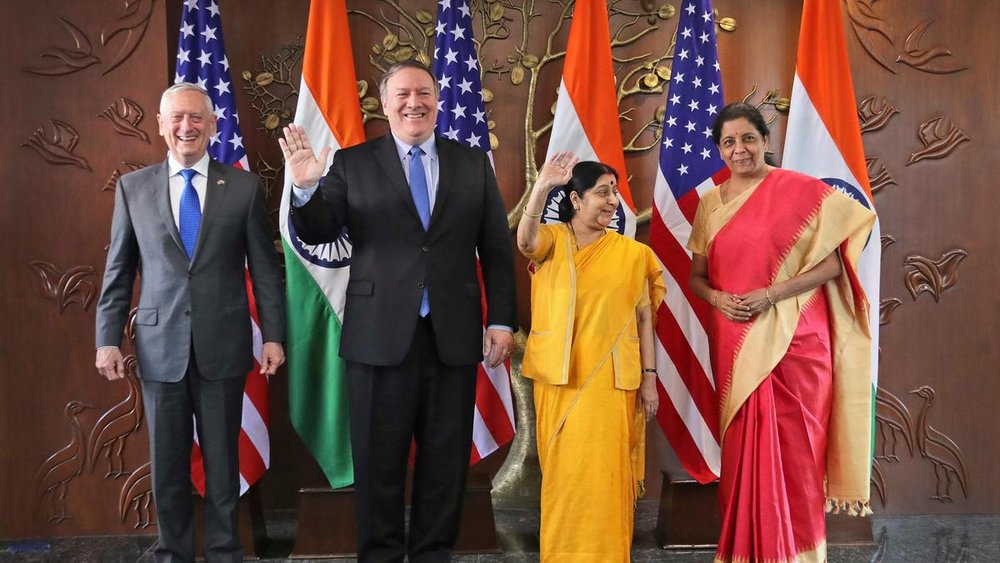
TEHRAN - After a lot of dilly-dallying, the inaugural India-U.S. ministerial 2+2 dialogue was held in New Delhi on Thursday. The high-profile U.S. delegation was led by Secretary of State Mike Pompeo and Defense Secretary James Mattis, who flew to New Delhi from Islamabad where they held deliberations with the newly-elected government led by Imran Khan on Wednesday.
The highlight of the meeting was signing of the Communications Compatibility and Security Agreement (COMCASA) that will enable India to access advanced technologies from the U.S. and enhance India's defense preparedness. While Pompeo termed the agreement a "milestone" in Indo-U.S. relationship, India’s defense minister Nirmala Sitharaman said it will bolster India's defense capability.
What they didn’t mention is how detrimental it could be for the regional peace and stability, but that is stating the obvious.
The two sides also pledged to expand their bilateral trade and economic partnership, which is interesting. In recent months, India and the U.S. have been engaged in tariff war, with Trump administration refusing any special treatment to New Delhi and Modi government retaliating with its own tariff on U.S. goods.
The new trade deal is a shrewd move by the U.S. to assure New Delhi that they can still do business with each other but on the terms and conditions dictated by the former.
The task for the visiting delegation was cut out - to appease New Delhi with lucrative defense and trade deals so that it does not go the China way. China and India are two of the fastest growing economies and protagonists of new economic and international policy. The policy wonks in Washington understand the importance of keeping India in good humor at a time when the trade war with China is escalating and relations with European countries are fast deteriorating.
Trump administration has declared a trade war against China, threatening to impose $200 billion new tariffs, which experts believe can jeopardize the global economic growth. It has also been embroiled in an ugly tariff war with European countries. At this juncture, with the U.S. finding itself increasingly cornered, it has reached out to Narendra Modi led government in New Delhi.
The U.S. government has been pushing countries to stop oil imports from Iran after unilaterally withdrawing from the 2015 nuclear deal between Iran and six world powers. India has also felt the heat although Modi government has not taken any final decision yet. India is the second largest buyer of Iranian crude oil after China and the U.S. is seeking to influence its energy-import policy, urging it to switch imports from Iran to Saudi Arabia and other U.S. allies. But, can India afford to do that? Certainly not, believe experts.
Iran is extremely critical to India’s energy security and larger geopolitical interests. Moving away from Iran and embracing U.S. and its allies is contrary to wisdom and logic. Ahead of the 2+2 talks in New Delhi, a senior US State Department official was quoted saying that the U.S. was in "very detailed conversations" with India over completely stopping India's oil imports from Iran. The U.S. delegation reportedly raised the issue with the Indian side, however, there was no categorical response.
While the U.S. wants India to bring oil imports from Iran to zero, India is treading cautiously and seeking a waiver from the U.S. sanctions on Iran. Earlier this week, India gave permission to state-owned refiners to import oil from Iran with Iranian tankers and insurance, in a sign that India may not cut off Iranian oil imports. The response from the Indian side to Pompeo-Mattis was on the same lines, sources said.
So, as it appears, the U.S. delegation failed to clinch a deal that figured prominently on their agenda - to get New Delhi to completely halt Iranian oil import. The two sides did sign deals to bolster cooperation in trade and defense fields, but it could not convince New Delhi on halting oil imports from Iran.
Since the beginning of this fiscal year, the oil purchase from Iran has surged substantially, primarily due to heavy discounts, free shipping and extended credit period for oil sales offered by Iran. The popular opinion is India is overwhelmingly in favor of India’s continued oil trade with Iran, without succumbing to the U.S. pressure. Many experts have urged the Modi government to continue importing oil from Iran, which is not only a trade partner for India, but a time-tested ally. Hence, New Delhi is adopting a cautious approach.
Meanwhile, as an indication of deteriorating relations between the U.S. and Pakistan, two former allies, the joint statement issued after the 2+2 talks said the two sides also discussed terror emanating from Pakistan. India’s foreign minister Sushma Swaraj said the two sides “agreed that Pakistan needs to do a lot more to curb terror originating from it,” which will certainly not go down well with the civilian and military leadership in Pakistan.
Last week, just before Pompeo’s visit to Islamabad, the U.S. military announced the suspension of $300 million military aid to Pakistan for its perceived failure to take decisive action against militant sanctuaries in Pakistan. The two former allies have slowly drifted away since Trump’s hyperbolic New Year tweet in which he accused Pakistan of “lies and deceit”. The new government in Islamabad led by Imran Khan has further antagonized the Trump administration by reaching out to Iran and backing Tehran’s position on the 2015 nuclear deal.
With the U.S. losing friends quickly and getting entangled in an ugly trade war with China and European countries, Trump is now banking on India - an important regional player - to be its all-weather ally. But, India has its own interests and can ill-afford to antagonize its important trade partners like Tehran, Moscow and Bangkok.
The writing is on the wall: the trade and defense deals notwithstanding, India and U.S. cannot be all-weather allies and New Delhi cannot afford to abruptly halt oil trade with Tehran. As the petroleum minister of India asserted recently, ‘national interest’ is paramount. For India, it should be energy security.