Showing posts with label foreign minister Sushma Swaraj. Show all posts

Monday, September 10, 2018

US Pressures on Iran’s Eastern Neighbours for Reducing Ties with Tehran

By: Kayhan Int’l 


To our east the US administration of the thuggish Donald Trump recently sent two of its top officials to three countries to cajole and coerce their governments into accepting whatever Washington wants from them in the uneven relationships it maintains with Islamabad, New Delhi and Kabul.
Gangster Mike Pompeo who handles the Secretary of State’s portfolio visited Pakistan to gauge the strength and weakness of newly elected Prime Minister Imran Khan, whose talk of "independent policies” and "fair” rather than "one-sided relations with the US”, drew the wrath of Washington with abrupt cutting of the 300 million dollar aid for the fight against so-called terrorism.

The tone of the talks left much to be desired, with the visitor arrogantly ruling out any resumption of the largesse and the hosts simply saying the visit helped reset ties between the two countries "hopefully with positive results”.
It is clear that negotiations did not go well, and it now largely depends on the decision-makers in Islamabad how decisively they deal with such crucial issues as US drone terrorism in Pakistan’s border areas with US-occupied Afghanistan, and the expectations from Imran Khan’s elections of implementing the long-delayed gas pipeline project with Iran.
Of course, whose aid has strings attached, is averse to both issues – no stopping of its drone terrorism on Pakistani soil and no question of gas imports from Iran.
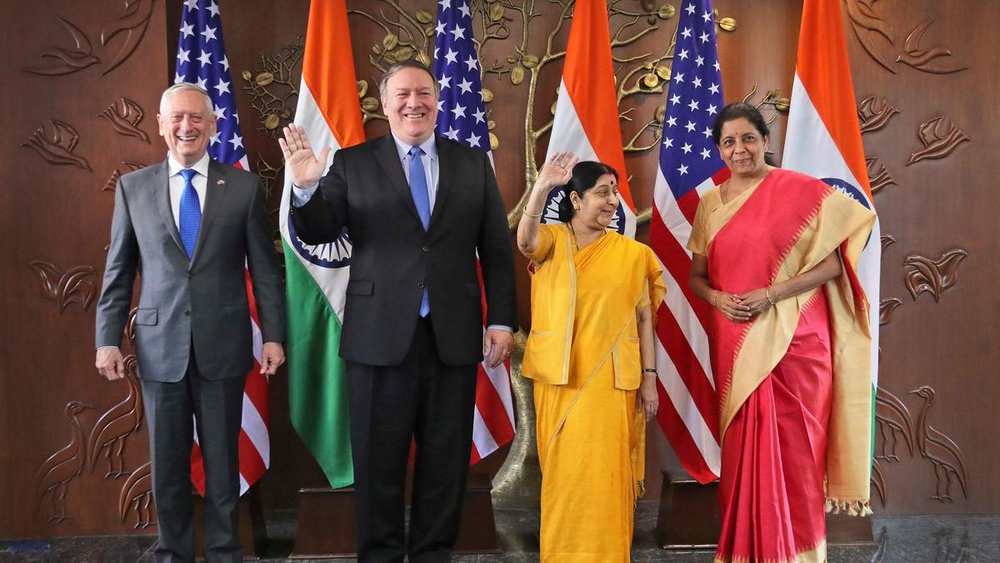
Pompeo then hopped across the border to India, where he was joined by his colleague who heads the US War Department Pentagon, ‘Mad Dog’ James Mattis, for what was labelled as the "2+2 Dialogue” between the foreign and defence ministries of the two countries. 

And since India is viewed as the "jewel” in the US policy to try to contain China, the talks, although not exactly on equal terms given the awe in which the Americans are held, led to the signing of the Communications Compatibility and Security Agreement (COMCASA) which calls for setting up hotlines between the defence and foreign ministries of India and the US.
The Americans who are never known to keep their promise, as usual tried to hoodwink their Indian counterparts with vague commitments if New Delhi desists from buying the advanced S-400 missile defence system from Russia and stops importing crude oil from the Islamic Republic of Iran, or for that matter withdraws from the strategic Chabahar port project in Iran for access to the lucrative markets of Afghanistan and the landlocked Central Asian countries.

India, which was promised the building of four nuclear plants by the then US Secretary of State Condoleezza Rice for casting its negative vote against Iran’s peaceful nuclear project a decade ago, a promise that never materialized, is advised to proceed with caution regarding the hollow and rotten carrots it is being offered this time by Pompeo and Mattis if it reduces oil purchase from Iran.
So far India has not given any open commitments to the US except for assurances to gradually reduce crude imports from Iran, but it should know that Iran is a permanent neighbour, while the US, whose power may rapidly decline in the near future as was the case with British imperialism, is neither a neighbour nor a well-wisher.
Washington only views New Delhi as something to be exploited and will go out of its way with empty promises and cosmetic measures to appease Indian officials if they turn their backs towards Iran.
Mattis then appeared in a stealth manner in Kabul and it was clear from the talks he held with Afghan officials, the US has no intention of either respecting that country’s independence nor curtailing terrorism. As a matter of fact, the Pentagon is planning to increase its support for Daesh and other Takfiri elements, both for keeping Afghanistan in perpetual turmoil and if possible threatening Iran with cross-border terrorist acts.
To sum up, regional countries, instead of allowing outsider US to meddle in their affairs, should build strong and durable ties amongst themselves, in order to be safe from the neo-colonialist designs of the Americans.

Sunday, September 09, 2018

Why U.S. attempts to woo India would fail

By: Syed Zafar Mehdi
TEHRAN - After a lot of dilly-dallying, the inaugural India-U.S. ministerial 2+2 dialogue was held in New Delhi on Thursday. The high-profile U.S. delegation was led by Secretary of State Mike Pompeo and Defense Secretary James Mattis, who flew to New Delhi from Islamabad where they held deliberations with the newly-elected government led by Imran Khan on Wednesday.
The highlight of the meeting was signing of the Communications Compatibility and Security Agreement (COMCASA) that will enable India to access advanced technologies from the U.S. and enhance India's defense preparedness. While Pompeo termed the agreement a "milestone" in Indo-U.S. relationship, India’s defense minister Nirmala Sitharaman said it will bolster India's defense capability.
What they didn’t mention is how detrimental it could be for the regional peace and stability, but that is stating the obvious.
The two sides also pledged to expand their bilateral trade and economic partnership, which is interesting. In recent months, India and the U.S. have been engaged in tariff war, with Trump administration refusing any special treatment to New Delhi and Modi government retaliating with its own tariff on U.S. goods.
The new trade deal is a shrewd move by the U.S. to assure New Delhi that they can still do business with each other but on the terms and conditions dictated by the former.
The task for the visiting delegation was cut out - to appease New Delhi with lucrative defense and trade deals so that it does not go the China way. China and India are two of the fastest growing economies and protagonists of new economic and international policy. The policy wonks in Washington understand the importance of keeping India in good humor at a time when the trade war with China is escalating and relations with European countries are fast deteriorating.
Trump administration has declared a trade war against China, threatening to impose $200 billion new tariffs, which experts believe can jeopardize the global economic growth. It has also been embroiled in an ugly tariff war with European countries. At this juncture, with the U.S. finding itself increasingly cornered, it has reached out to Narendra Modi led government in New Delhi.
The U.S. government has been pushing countries to stop oil imports from Iran after unilaterally withdrawing from the 2015 nuclear deal between Iran and six world powers. India has also felt the heat although Modi government has not taken any final decision yet. India is the second largest buyer of Iranian crude oil after China and the U.S. is seeking to influence its energy-import policy, urging it to switch imports from Iran to Saudi Arabia and other U.S. allies. But, can India afford to do that? Certainly not, believe experts.
Iran is extremely critical to India’s energy security and larger geopolitical interests. Moving away from Iran and embracing U.S. and its allies is contrary to wisdom and logic. Ahead of the 2+2 talks in New Delhi, a senior US State Department official was quoted saying that the U.S. was in "very detailed conversations" with India over completely stopping India's oil imports from Iran. The U.S. delegation reportedly raised the issue with the Indian side, however, there was no categorical response.
While the U.S. wants India to bring oil imports from Iran to zero, India is treading cautiously and seeking a waiver from the U.S. sanctions on Iran. Earlier this week, India gave permission to state-owned refiners to import oil from Iran with Iranian tankers and insurance, in a sign that India may not cut off Iranian oil imports. The response from the Indian side to Pompeo-Mattis was on the same lines, sources said.
So, as it appears, the U.S. delegation failed to clinch a deal that figured prominently on their agenda - to get New Delhi to completely halt Iranian oil import. The two sides did sign deals to bolster cooperation in trade and defense fields, but it could not convince New Delhi on halting oil imports from Iran.
Since the beginning of this fiscal year, the oil purchase from Iran has surged substantially, primarily due to heavy discounts, free shipping and extended credit period for oil sales offered by Iran. The popular opinion is India is overwhelmingly in favor of India’s continued oil trade with Iran, without succumbing to the U.S. pressure. Many experts have urged the Modi government to continue importing oil from Iran, which is not only a trade partner for India, but a time-tested ally. Hence, New Delhi is adopting a cautious approach.
Meanwhile, as an indication of deteriorating relations between the U.S. and Pakistan, two former allies, the joint statement issued after the 2+2 talks said the two sides also discussed terror emanating from Pakistan. India’s foreign minister Sushma Swaraj said the two sides “agreed that Pakistan needs to do a lot more to curb terror originating from it,” which will certainly not go down well with the civilian and military leadership in Pakistan.
Last week, just before Pompeo’s visit to Islamabad, the U.S. military announced the suspension of $300 million military aid to Pakistan for its perceived failure to take decisive action against militant sanctuaries in Pakistan. The two former allies have slowly drifted away since Trump’s hyperbolic New Year tweet in which he accused Pakistan of “lies and deceit”. The new government in Islamabad led by Imran Khan has further antagonized the Trump administration by reaching out to Iran and backing Tehran’s position on the 2015 nuclear deal.
With the U.S. losing friends quickly and getting entangled in an ugly trade war with China and European countries, Trump is now banking on India - an important regional player - to be its all-weather ally. But, India has its own interests and can ill-afford to antagonize its important trade partners like Tehran, Moscow and Bangkok.
The writing is on the wall: the trade and defense deals notwithstanding, India and U.S. cannot be all-weather allies and New Delhi cannot afford to abruptly halt oil trade with Tehran. As the petroleum minister of India asserted recently, ‘national interest’ is paramount. For India, it should be energy security.