Showing posts with label Middle East and North Africa. Show all posts

Thursday, June 27, 2019

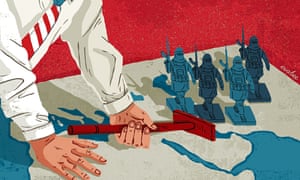
The US’s Middle East ‘peace summit’ is nonsense. Palestinians are right to boycott it

The Trump administration is notoriously biased towards Israel, and its $50bn offer to Palestinians pointedly avoids land rights
I
n the toxic history of the enduring conflict between Israel and the Palestinians, the Palestinians have often been accused of “never missing an opportunity to miss an opportunity”. This familiar charge has been repeated in the runup to an extraordinary event taking place in the Gulf state of Bahrain, convened by the US and starting on Tuesday.

The Manama “workshop” – downgraded from “conference” to lower already rock-bottom expectations – is designed to discuss the “Peace to Prosperity” plan unveiled by the White House on Saturday. The document, the result of two years’ work by Jared Kushner, Donald Trump’s son-in-law, has already been subject to a torrent of undiplomatic abuse. Palestinians have made clear that they will not attend Manama – apart from the odd businessman prepared to defy a broad national consensus that unusually unites Mahmoud Abbas’s Palestinian Authority in Ramallah and the Hamas rulers of the Gaza Strip.
Trump’s hostility to the Palestinians and blatant bias towards Israel have been clear from the moment he entered the Oval Office: the transfer of the US embassy to Jerusalem, the slashing of aid to UNRWA (the agency that assists Palestinian refugees), the closure of the PLO mission in Washington and recognition of Israel’s annexation of the Syrian Golan Heights have all been bleak and damaging landmarks. The president’s disruptive moves have undermined the longstanding international consensus that the only way to resolve the world’s most intractable conflict is to create a viable Palestinian state alongside Israel – thus finally granting equal rights to both peoples who are doomed, whether they like it or not, to share the Holy Land.
The infinitely more difficult political part of Trump’s characteristically named “ultimate deal” has yet to be published. With another election looming in Israel in October (after April’s poll failed to produce a new government) it faces further delay and may not see the light of day before the 2020 US election. But the economic element laid out in the Peace to Prosperity document presents a surreal, even fantastic vision. Its headline figure of investing $50bn (£39bn) in the infrastructure of the West Bank and Gaza (as well as Egypt, Jordan and Lebanon) is contained in a slick but superficial brochure that might be advertising a real estate deal to private equity firms.
Property rights are mentioned, but there is no reference whatsoever to the illegal Israeli settlements scattered across the West Bank and East Jerusalem. Israel appears a few times but only in a list of neighbouring countries. Palestine – as opposed to Palestinians – is not mentioned either. Nor does the word “occupation” appear anywhere, except with reference to “occupational mobility” – hampered on the ground by endless Israeli checkpoints.
Illustrations show recipients of previous US aid that has been axed by Trump, including the Bereaved Families Forum, an organisation working for reconciliation between Israeli and Palestinian victims of violence. Previous efforts to sell a vision of economic peace, by the past Quartet envoy Tony Blair or John Kerry, US secretary of state under Barack Obama, have failed – and are ignored. Dubai and Singapore are nevertheless cited as exemplary regional hubs.
The understandable fear on the Palestinian side is that this rights-free approach is a precursor to Israeli moves to annex parts of the West Bank, with that likelihood signalled on the eve of the last election by Benjamin Netanyahu and echoed by David Friedman, the controversial US ambassador to Israel who has worked closely with Kushner.
“Palestine,” as one senior PLO official quipped, “has a CEO called Mahmoud Abbas, and Trump wants to break his back. And, yes, we may have lost the Americans but we have kept everyone else.”
Unlike the Palestinians, representatives of Arab states will be in Manama – though at a low level and only after apparently insisting that Israeli officials (as opposed to businessmen) would not be invited. The Saudis, Emiratis, Qatar and Kuwait will be there, as will Egypt and Jordan, feeling that given their dependence on the US, especially as tensions soar over Iran, they had little choice. Bahrain, after all, is home to the US Fifth Fleet. “What alternative did we have?” shrugged one regional diplomat. But that is still a far cry from the fantasy peddled by Netanyahu and apparently believed by Kushner and Trump, that the Gulf states – still sensitive to popular sentiment despite their autocratic nature – would openly abandon the Palestinian cause.
Kushner himself said in an interview that “the current status quo is not a sustainable situation”. That is certainly correct. But otherwise his plan – money for peace replacing land for peace – is bizarre nonsense and as such has been widely and rightly rejected. Boycotting Bahrain is not another missed opportunity by the Palestinians, but instead signals a rare, determined and united effort to insist that their economic needs – real and urgent – do not trump their fundamental rights.
• Ian Black is a former Middle East editor of the Guardian

Tuesday, June 18, 2019

Now the truth emerges: how the US fuelled the rise of Isis in Syria and Iraq

The sectarian terror group won’t be defeated by the western states that incubated it in the first place
The war on terror, that campaign without end launched 14 years ago by George Bush, is tying itself up in ever more grotesque contortions. On Monday the trial in London of a Swedish man, Bherlin Gildo, accused of terrorism in Syria, collapsed after it became clear British intelligence had been arming the same rebel groups the defendant was charged with supporting.
The prosecution abandoned the case, apparently to avoid embarrassing the intelligence services. The defence argued that going ahead with the trial would have been an “affront to justice” when there was plenty of evidence the British state was itself providing “extensive support” to the armed Syrian opposition.
That didn’t only include the “non-lethal assistance” boasted of by the government (including body armour and military vehicles), but training, logistical support and the secret supply of “arms on a massive scale”. Reports were cited that MI6 had cooperated with the CIA on a “rat line” of arms transfers from Libyan stockpiles to the Syrian rebels in 2012 after the fall of the Gaddafi regime.
Clearly, the absurdity of sending someone to prison for doing what ministers and their security officials were up to themselves became too much. But it’s only the latest of a string of such cases. Less fortunate was a London cab driver Anis Sardar, who was given a life sentence a fortnight earlier for taking part in 2007 in resistance to the occupation of Iraq by US and British forces. Armed opposition to illegal invasion and occupation clearly doesn’t constitute terrorism or murder on most definitions, including the Geneva convention.
But terrorism is now squarely in the eye of the beholder. And nowhere is that more so than in the Middle East, where today’s terrorists are tomorrow’s fighters against tyranny – and allies are enemies – often at the bewildering whim of a western policymaker’s conference call.
For the past year, US, British and other western forces have been back in Iraq, supposedly in the cause of destroying the hyper-sectarian terror group Islamic State (formerly known as al-Qaida in Iraq). This was after Isis overran huge chunks of Iraqi and Syrian territory and proclaimed a self-styled Islamic caliphate.
The campaign isn’t going well. Last month, Isis rolled into the Iraqi city of Ramadi, while on the other side of the now nonexistent border its forces conquered the Syrian town of Palmyra. Al-Qaida’s official franchise, the Nusra Front, has also been making gains in Syria.
Some Iraqis complain that the US sat on its hands while all this was going on. The Americans insist they are trying to avoid civilian casualties, and claim significant successes. Privately, officials say they don’t want to be seen hammering Sunni strongholds in a sectarian war and risk upsetting their Sunni allies in the Gulf.
A revealing light on how we got here has now been shone by a recently declassified secret US intelligence report, written in August 2012, which uncannily predicts – and effectively welcomes – the prospect of a “Salafist principality” in eastern Syria and an al-Qaida-controlled Islamic state in Syria and Iraq. In stark contrast to western claims at the time, the Defense Intelligence Agency document identifies al-Qaida in Iraq (which became Isis) and fellow Salafists as the “major forces driving the insurgency in Syria” – and states that “western countries, the Gulf states and Turkey” were supporting the opposition’s efforts to take control of eastern Syria.
Raising the “possibility of establishing a declared or undeclared Salafist principality”, the Pentagon report goes on, “this is exactly what the supporting powers to the opposition want, in order to isolate the Syrian regime, which is considered the strategic depth of the Shia expansion (Iraq and Iran)”.
Which is pretty well exactly what happened two years later. The report isn’t a policy document. It’s heavily redacted and there are ambiguities in the language. But the implications are clear enough. A year into the Syrian rebellion, the US and its allies weren’t only supporting and arming an opposition they knew to be dominated by extreme sectarian groups; they were prepared to countenance the creation of some sort of “Islamic state” – despite the “grave danger” to Iraq’s unity – as a Sunni buffer to weaken Syria.
That doesn’t mean the US created Isis, of course, though some of its Gulf allies certainly played a role in it – as the US vice-president, Joe Biden, acknowledged last year. But there was no al-Qaida in Iraq until the US and Britain invaded. And the US has certainly exploited the existence of Isis against other forces in the region as part of a wider drive to maintain western control.
The calculus changed when Isis started beheading westerners and posting atrocities online, and the Gulf states are now backing other groups in the Syrian war, such as the Nusra Front. But this US and western habit of playing with jihadi groups, which then come back to bite them, goes back at least to the 1980s war against the Soviet Union in Afghanistan, which fostered the original al-Qaida under CIA tutelage.
It was recalibrated during the occupation of Iraq, when US forces led by General Petraeus sponsored an El Salvador-style dirty war of sectarian death squads to weaken the Iraqi resistance. And it was reprised in 2011 in the Nato-orchestrated war in Libya, where Isis last week took control of Gaddafi’s home town of Sirte.
In reality, US and western policy in the conflagration that is now the Middle East is in the classic mould of imperial divide-and-rule. American forces bomb one set of rebels while backing another in Syria, and mount what are effectively joint military operations with Iran against Isis in Iraq while supporting Saudi Arabia’s military campaign against Iranian-backed Houthi forces in Yemen. However confused US policy may often be, a weak, partitioned Iraq and Syria fit such an approach perfectly.
What’s clear is that Isis and its monstrosities won’t be defeated by the same powers that brought it to Iraq and Syria in the first place, or whose open and covert war-making has fostered it in the years since. Endless western military interventions in the Middle East have brought only destruction and division. It’s the people of the region who can cure this disease – not those who incubated the virus.

Saturday, November 17, 2018

Trump’s economic war on Iran is doomed to failure

Richard Dalton


With demand for Iranian oil holding firm and no international support for sanctions, the US’s harsh approach has no future

US secretary of state Mike Pompeo and US Treasury
secretary Steve Mnuchin announce sanctions against Iran on
5 November 2018. Photograph: Michael Reynolds/EPA


The US has declared economic war on Iran: after having pulled out of the UN security council-endorsed nuclear deal in May, the Trump administration is now unilaterally combating the right of the rest of the world to engage in legal trade with the Islamic Republic.


This policy is based on the claim that Iran is a major security threat to the American people. But that is transparently exaggerated. And the statement by Mike Pompeo that sanctions will be used to ensure Iran “behaves like a normal country” is unintentionally ironic.
The US is not a “normal” country. Complicity in a horrifying aggression against Yemen and supporting the extension of Israeli colonisation of Palestine are not acts of normality. The truth is that all who intervene in the Middle East’s regional struggles, including Iran, are doing what states always have done – trying to influence outcomes in the direction of their real or perceived interests.
Nevertheless, the US has determined that its stance towards Iran should be a belligerent one. Will that reap any strategic rewards?
As UK ambassador to Tehran in 2005, I received the country’s rejection of the first attempt by the west to strike a nuclear deal, alongside my French and German colleagues. Analysts often go wrong because we think that the fights to come will be like the fights of our day, but this is what I believe may happen.
In my view, Iran will remain basically stable despite the surge in inflation and tough recession that the IMF says are coming down the line. Discontent, and maybe protests, will significantly increase. Iran’s leaders will nevertheless try to weather the storm. The 2020 US election will be crucial for them. They could not live with a four-year extension of the crisis if Trump were to win again. Their aim will be to hunker down until then. I expect them to refrain in the meantime from provoking the US in the region or reopening closed-down parts of their nuclear infrastructure.
Ayatollah Khamenei is uncompromising. Indeed, all of Iran’s leaders are resolute. The economic damage and popular suffering over the next two years is unlikely to be sufficient to make the government move. And, crucially, there is no internationally agreed campaign against Iran this time. The EU, for example, has designed a work-around to achieve some financial flows, though the Iranians are not relying on this ever working.
For his part, Donald Trump has indicated he wants a North Korea-type breakthrough. He says that Iran is changing. Among leading US politicians, calls are growing for negotiations to deliver a supposedly better replacement deal.


But this seems improbable. Iran is open to negotiations, but only on terms that it deems acceptable. Like the US, it will try to build a position of strength from which to talk. The bottom line is that Iran will only change tack when it thinks it can expect genuine American concessions.
And all the while there are risks for the US if it does not lower its sights. Chinese, Indian and Turkish demand for Iranian oil could prompt the creation of alternative channels of exchange in world trade, leading to a fall in the standing of the dollar and of the ability of the US to weaponise it in future.
There is also a risk of war by miscalculation. Or even by intention: the US could respond to the failure of its policy by upping the ante and starting a war, with the support of some countries in the region. That said, Trump does appear to want to avoid another war of choice in the region, and launching one would not be good for his re-election chances.
Only a shift in approach, namely the dropping of many of the demands for changes in behaviour, showing a modicum of respect, and opening negotiations on realistic terms, will work. Provided Iran can be made to believe that – this time – sanctions relief will be real, it should be possible to win Iranian concessions on missiles’ range and type. An eventual successor nuclear deal and some regional pullback in conjunction with peace settlements across the Middle East is possible.
Should the US be prepared to move away from diktat to an incremental approach, the UK could work with France and Germany to reassemble the security council-based coalition that negotiated with Iran from 2013.
With its current policies, however, rather than reaping strategic rewards, the US may be putting on a show of weakness to the world. With no prospect of bringing allies to its side or forcing Iran to accept its excessive demands, it is on a hiding to nothing.
• Richard Dalton is a former British ambassador to Iran