Showing posts with label Supreme Leader. Show all posts

Thursday, November 21, 2019

In recent security issues we have repelled the enemy: Leader

"Both friends and foes should know that we have repelled the enemy in the war in military, political and security issues,” the Leader stated.
The statement by the Leader came after protests were sparked in some cities in Iran against the government’s measure in rationing gasoline and substantially increasing its price. The protests turned violent with reports of clashes between security forces and certain elements vandalizing public property.
“The recent actions were security issues, not from the people. We have repelled the enemy in various areas, and by God's grace, we will also definitely repel the enemy in the economic war,” Ayatollah Khamenei remarked.
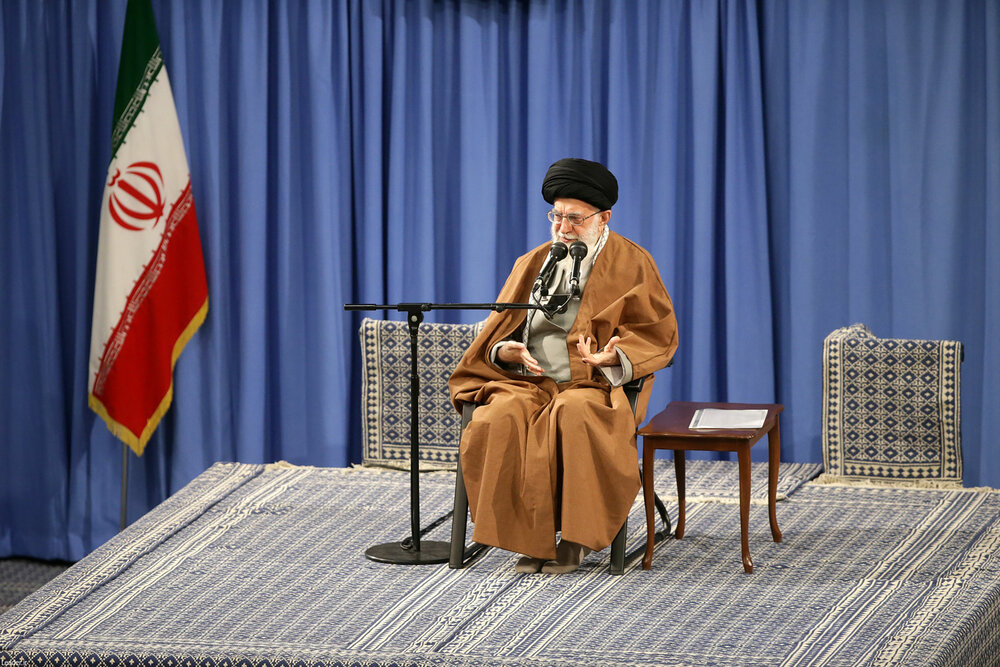
The Leader made the remarks during a meeting with a group of entrepreneurs and producers.
‘We should not wait for end of sanctions to save economy’
The Leader also said that no one should wait for end of sanctions to save the economy.
“If the Iranian people, entrepreneurs and the country’s thinkers neutralize the effects of sanctions through reliance on domestic capabilities, imposers of sanctions will stop sanctions because they will be harmed,” Ayatollah Khamenei pointed out.
He attached great importance to reducing reliance on oil revenues in order to decrease harms of the sanctions.
Ayatollah Khamenei says the current U.S. government has launched an economic war against Iran “in a brutal, hatful and criminal way”.He noted that the country should not pin hope on foreign countries.
“Fundamental strategy to immunize economy from effects of sanctions is through boosting domestic production and I back this real path of progress,” he said.
Elsewhere, he said that Islam attaches value to increase in national wealth and well-being.
He said that “producers are commanders and front runners of domestic production and economic boom and promotion of public well-being.”
The Leader also said that there have always been economic war among the countries and arrogant powers, adding, “However, during tenure of the current president of the United States, this war with China, Korea, Europe and other countries has been expanded and this war has been launched against Iran through sanctions and in a brutal, hatful and criminal way.”
‘We will turn sanctions into opportunities’
Ayatollah Khamenei also said that the country will turn sanctions into opportunities through relying on domestic capabilities and economic activities.
He noted that the policy of reliance on domestic capabilities should not be changed even if sanctions are removed.
The Leader also said that foreign countries will never transfer fundamental technologies, especially in areas of automobile, petrochemistry and oil sector, to Iran and the country must use domestic capacities to reach such technologies.
Elsewhere, he noted that the country can have good economic relations with its neighbors.

Sunday, November 03, 2019

Leader says 1953 coup marks beginning of U.S. hostility against Iran

TEHRAN – The Leader of the Islamic Revolution said on Sunday that the U.S. enmity against Tehran dates back to a Washington-sponsored coup against the legal government of Iran in 1953, noting that the U.S. in now weaker than that time but more “barbaric and flagrant”.
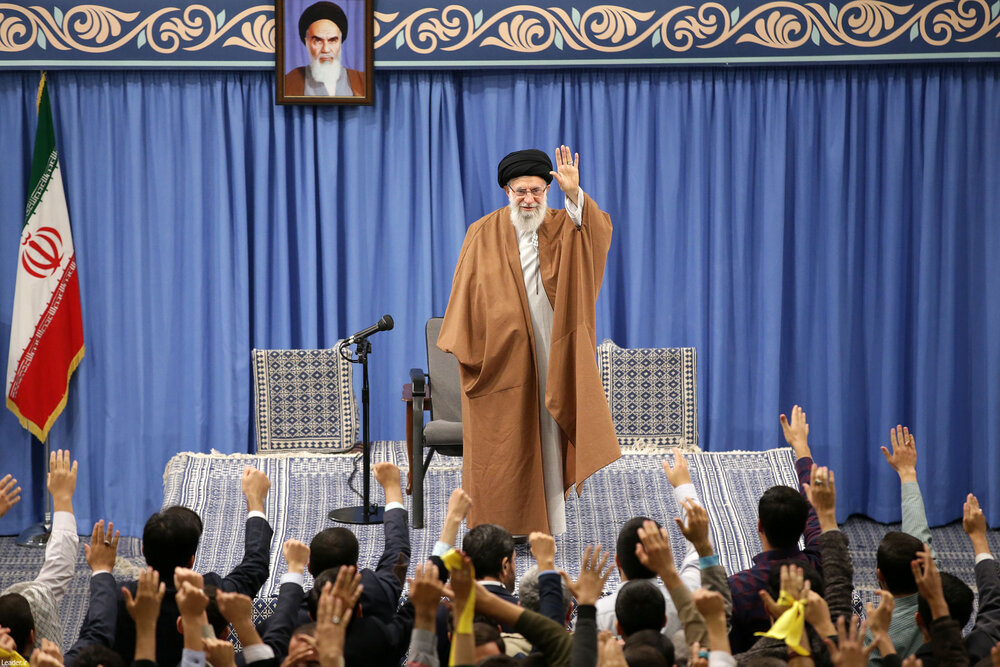
Ayatollah Seyed Ali Khamenei made the remarks during a meeting with thousands of pupils and university students one day ahead of the Aban 13, which marks the U.S. embassy seizure in Tehran by students on November 4, 1979. 
Since the takeover of the U.S. embassy, Iranians have been celebrating the occasion every year by holding rallies on the anniversary and viewing it as the national day against “global arrogance”.
“The wolfish U.S. has certainly become weaker, but in the meantime, it has become more barbaric and flagrant,” the Leader reiterated, adding, “The Islamic Republic of Iran, in response, has blocked the entire ways on U.S. return and influence via mighty defense and logical rejection of any talks (with the White House).”
Noting that the United States has never been trustworthy, the Leader said, “The government which was overthrown (in the 1953 coup), in fact, was hit by the stick of reliance on the great Satan (the U.S.).” 
Ayatollah Khamenei went on to say that today those who see dialogue with the U.S. as a remedy for problems are seriously mistaken.
“Negotiation with the U.S. is indeed fruitless. Those who consider resumption of talks with the U.S. as the only way out of the country’s problems are one hundred percent wrong. There will be no achievement from talks with the Americans, because they certainly will not give any concession to us.”
In the 1953 coup d'état (known in Iran as the 28 Mordad coup), the democratically elected government of Iran led by Prime Minister Mohammad Mosaddeq was overthrown on August 19, 1953.  The coup was orchestrated jointly by the United States (under the name “Pejak Project”) and the United Kingdom (under the name of “Operation Boot”).
The coup saw the formation of a military government under Mohammad Reza Shah Pahlavi, who progressed from a constitutional monarch to an authoritarian one who relied heavily on United States' support to hold on to power until his own overthrow in February 1979.

Wednesday, October 02, 2019

Iran will continue reducing nuclear commitments: Leader

Ayatollah Khamenei says U.S. policy of maximum pressure has failed 

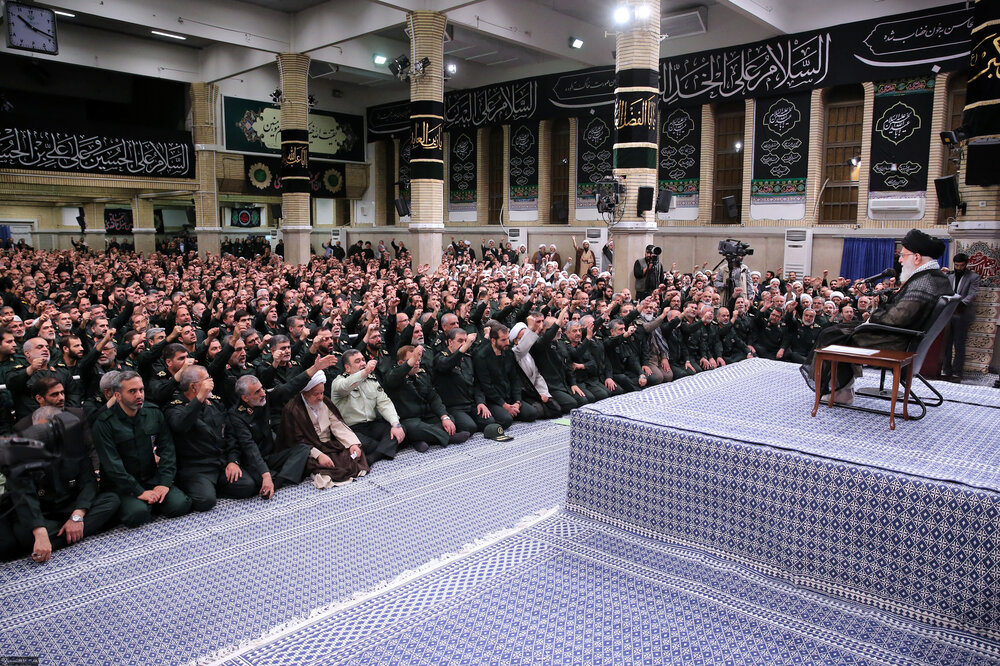
TEHRAN - Leader of the Islamic Revolution Ayatollah Seyyed Ali Khamenei said on Wednesday that Iran will continue to reduce commitments under the 2015 nuclear deal, known as the Joint Comprehensive Plan of Action.
“Reducing nuclear commitments, for which the Atomic Energy Organization is responsible, should continue seriously and precisely as it was announced by the government till it reaches favorable result and it will definitely reach the result,” Ayatollah Khamenei said during a meeting with the High Council of the Commanders of the Islamic Revolutionary Guard Corps.
The Leader also said the United States’ policy of “maximum pressure” against Iran has ended in failure.
“They imagined Iran would be forced to show flexibility if they applied policy of maximum pressure. With the help of God, they understand that the maximum pressure has caused problems for themselves,” the Leader stated.
The Leader describes sanctions on Iran’s oil sale as a “short term problem”.Referring to President Hassan Rouhani’s visit to the annual UN summit in New York last week, the Leader said, “Recently, they (the U.S.) made unfruitful efforts with the help of their European friends to form a symbolic show of Iran’s surrender and to make the Iranian president to meet with them. However, Iran will continue reducing nuclear commitments seriously and determinedly till reaching favorable result.”
U.S. President Donald Trump, who quit the nuclear deal in May 2018 and imposed the harshest ever sanctions on Tehran, has been repeatedly calling for dialogue with Iran.
On May 8, exactly one year after the U.S. abandoned the deal, Tehran began to partially reduce its commitments to the agreement at bi-monthly intervals.
In the first stage, Iran announced that it will not limit its stockpile of the nuclear fuel to 300 kilograms allowed under the deal. However, on that date (May 8) Iran’s Supreme National Security Council (SNSC) said if the remaining parties to the JCPOA, especially Europeans, devise a mechanism to protect it from the sanctions effect in the two-month deadline it will reverse its decision. 
But since European parties missed the deadline, on July 7 Iran announced that it has started enriching uranium to a higher purity than the 3.67%, thereby starting the second step.
As Europe missed the second 60-day deadline, Iran moved to take the third step, removing ban on nuclear research and development (R&D).
In a letter on September 5, Foreign Minister Mohammad Javad Zarif notified European Union foreign policy chief Federica Mogherini about Iran’s third step.
‘Relying on domestic capabilities is solution to problems’
Ayatollah Khamenei also said that relying on domestic capabilities is solution to economic problems.
He described sanctions on Iran’s oil sale as a “short term problem”.
If proper actions is taken, the country can reach a “long-term benefit” from this “short term problem” which is non-reliance on oil revenues, the Leader remarked.

Wednesday, August 14, 2019

Ayatollah Khamenei: Intra-Yemeni dialogue needed for a united Yemen

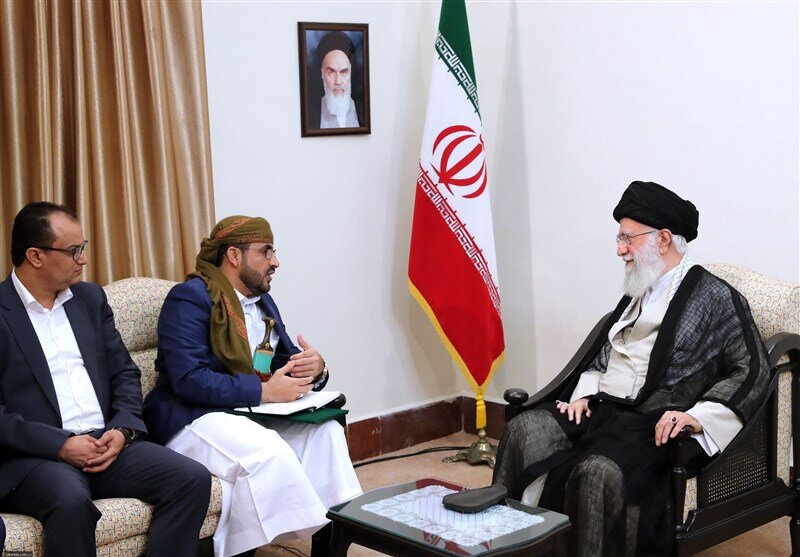
TEHRAN – Ayatollah Ali Khamenei, Leader of the Islamic Revolution, said on Tuesday Saudi Arabia and the United Arab Emirates have committed “great crimes” in Yemen.
The Leader made the remarks in a meeting with Mohammed Abdulsalam, the spokesman for Yemen’s Ansarullah and chief negotiator of the National Salvation Government.
The Leader also said Riyadh and Abu Dhabi are seeking to break up Yemen and this should be strongly resisted.
“They are after dividing up Yemen but there must be a strong resistance against this plot and (it is necessary to) support an integrated, united Yemen with its territorial integrity,” the Leader asserted.
Ayatollah Khamenei added protecting the Yemeni territorial integrity in view of its diverse religious and ethnic diversity entails intra-Yemeni dialogue.
Praising the Yemeni old and rich civilization, Ayatollah Khamenei lauded the Yemeni people’s resistance against military invasions for five years and predicted that they will win the war and succeed to form a strong government.
The Leader also referred to U.S. complicity in the war on Yemen, saying the Islamic Republic’s anti-U.S. and anti-Western position is not out of “prejudice” but because of realities and the record of rulers in the U.S. and the West.
These countries, with a superficial civil and ethical appearance, commit the “worst crimes” and constantly talk about human rights, Ayatollah Khamenei regretted.
 
The United States is the main supplier of advanced weapons to the Saudi-led military alliance against Yemen. The atrocities committed against civilians in Yemen are so awful that even Congress has voted against selling weapons to Saudi Arabia but the bill has been vetoed by President Trump.
Some European countries such as Britain, France and Germany also sell arms to the countries pounding Yemen. The United States even provides logistical support for Saudi Arabia in pounding the country.
 According to the United Nations, Yemen suffers one of the longest humanitarian crises in the world.
Yemen has been under military attack by a Saudi-led alliance since March 2015. Saudi Arabia launched war on the country with the aim of reinstating the toppled government of Mansur Hadi in a matter of weeks. However, more than four years have passed and still there is no victory in sight.
In April 2015, Iran proposed a four-point plan for the resolution of conflict in Yemen.
In a post on his Twitter post on November 2018, Iranian Foreign Minister Mohammad Javad Zarif again reminded about Tehran’s four-point plan, saying: "War on Yemen must be stopped. We urge ceasefire, humanitarian assistance, intra-Yemeni dialogue & establishment of broad-based government."

Sunday, April 28, 2019

Khan’s Iran visit significant on many counts

By Raghib Hussain

TEHRAN - Pakistan premier Imran Khan’s maiden official visit to Iran was tremendously successful and marked a significant shift in relations between the two neighbors, especially after recent turn of events. 
Khan kicked off his much-anticipated visit from the holy city of Mashhad where he paid his obeisance at the highly revered shrine of Imam Reza (as). 
The cricketer-turned-premier, who catapulted to fame as the captain of Pakistan’s World Cup winning cricket team in 90s, reaffirmed his commitment to strengthen ties between the two countries. 
The relations between Iran and Pakistan have always been marked by ambiguity, mainly due to overt pro-Riyadh tilt of successive ruling dispensations in Islamabad over the years. But since Khan took over as the Prime Minister late last year, he has clearly and categorically spoken about his desire to balance ties between Tehran and Riyadh.
However, the recent terror attack in Iran’s restive Sistan-Baluchistan province, targeting a cavalcade of Iranian security forces, threatened to derail ties between the two countries. Iranian politicians and military generals issued strongly-worded statements, urging Pakistan not to allow its territory to be used for attacks against its close ally. 
Khan’s growing proximity to Riyadh, like his predecessors, also raised concerns about Islamabad risking its relations with Iran, which made this visit more significant. 
Upon his arrival in Mashhad, Khan sought to allay the fears of people in Iran that Pakistan would not compromise its historic and time-tested ties with Iran, its key ally and a regional bulwark. 
Iran and Pakistan have more commonalities than differences. The evolution of global and regional security environment is pushing the two countries closer to each other. Further, the two countries can benefit vastly from mutual cooperation in economic, commercial, and security spheres. 
Khan’s visit to Tehran came at a critical time when the two sides can take advantage of vast opportunities to enhance bilateral cooperation in various fields.
Before taking over as the premier of Pakistan, Khan repeatedly asserted that good relations with neighboring countries are in the best interests of Pakistan. He rose to power on the slogan of ‘Naya Pakistan’ (New Pakistan). 
But, after assuming charge, he has been battling problems on multiple fronts, at domestic and international level. Many economic and security problems have engulfed him in recent months that has compelled him to change his core team. Beside, tensions with India, uncertainty in Afghanistan and constant sabre-rattling of U.S. have dominated his nine months in power.
Khan is visiting Iran at a time when the border they share has become prone to infiltration by terrorists and border regions have become safe havens of notorious terrorist groups. It has got both these friendly Muslim countries concerned about the security of their borders.
Only three days before Khan’s visit to Iran, at least 14 members of Pakistan's security forces were killed in Balochistan province of Pakistan. It is clear that the attack was carried out by those who are not in favor of stronger Iran-Pakistan ties. 
But Pakistan Foreign Minister Shah Mehmood Qureshi stirred the hornet’s nest saying that the terrorist outfits that carried out the attack have “training and logistic camps inside Iranian areas bordering Pakistan”. In such a situation, both countries should prioritize security and that was the main agenda of this visit, according to sources.  
It is an undeniable fact that the enemies of Pakistan and Iran have always tried to disrupt relations between them.  Both countries have geostrategic interests and other countries feel threatened by that. 
Pakistan believes that cordial ties with Iran are important for regional economic prosperity and security. Closer cooperation between them is a source of strength and stability not only for the two counties but also for the region. 
Khan also had a brief meeting with Sayyed Ali Khamenei, the Supreme Leader of Iran, in which the Leader indicated that the terrorist groups responsible for disturbing security on borders are backed by enemies’ money and arms. The anti-security moves at the frontiers of Iran and Pakistan seek to hurt the friendly relations between the two countries, he emphasized. 
So, at a time when the enemies are creating roadblocks for the two countries, it is an ideal time to focus on commonalities and bolster ties. In order to promote bilateral relations, it is necessary to identify the enemy and get rid of it.
Pakistan-Iran economic and political relationship would improve only if the measures are taken to ensure better border management in coming years. Both the countries’ geo-strategic locations make them crucial for each other and for the region. 
Pakistan and Iran also seem to have arrived at a common ground that a stable, independent, and economically resilient Afghanistan is important for peace and stability in the region. 
There are many areas of cooperation between Iran and Pakistan and it is expected that during Khan’s tenure, the two countries would make use of all opportunities to enhance bilateral ties. They have to be on the same page to tackle multiple challenges imperiling their relations and regional stability.
Writer is a student and researcher from Gilgit Pakistan, currently based in Tehran. 

Wednesday, April 24, 2019

Ayatollah Khamenei says Iran to export oil as much as it needs

Leader of the Islamic Revolution Ayatollah Seyyed Ali Khamenei says the U.S. administration’s hostile attempts to block Iran’s oil sales will lead nowhere, and that the country will export “as much crude as it needs and wishes” in defiance of American sanctions.
Speaking at a meeting with a large group of Iranian workers on Wednesday, Leader played down Washington’s recent decision to end exemptions from sanctions for countries buying oil from Tehran.
“In the first place, such attempts will lead nowhere, and we are capable of exporting as much oil as we need and want,” Ayatollah Khamenei said.
The Leader warned that “this act of hostility will not go unanswered,” emphasizing that the Iranian nation “will not sit idly by” in the face of its enemies.
Ayatollah Khamenei further said the enemies have recurrently failed in their attempts to bring the Iranian nation to its knees.
They are now resorting to economic pressure to achieve that end, but will once again fail to do so, the Leader added.
“They (enemies) imagine they’ve blocked [our] way, but our vigorous nation and vigilant authorities will overcome the dead-ends if they put their efforts into this,” the Leader added.
Ayatollah Khamenei, however, called for collective efforts to reduce domestic dependence on oil.
The Leader said American and Israeli officials claim that they are the enemies of the Iranian government and not of the Iranian people, “however, enmity with the Islamic Republic is enmity with the Iranian nation because the Islamic Republic is standing thanks to the support of the people.”
Ayatollah Khamenei said that although the US sanctions against Iran have caused problems, they would benefit the country if “correctly and logically” dealt with.
“Sanctions lead to reliance on domestic power, capacity, and initiatives,” he said.
The Leader said Iran appreciated a lower reliance on oil sales and considered it as “a kind of opportunity” to focus more on its domestic capabilities.
Ayatollah Khamenei said that the recent measures against Iran were the enemies’ “last breaths of enmity” and that they would “ultimately grow tired of hostility toward the Iranian nation.”
The administration of US President Donald Trump has said it seeks to stop Iranian oil sales by imposing sanctions on countries that continue purchasing Iranian crude after May 1.
In May last year, Washington unilaterally withdrew from a multilateral deal with Iran that mainly guarantees Iran’s oil sales in return for a number of concessions by Iran and the lifting of US sanctions on the country.
Tehran and the other parties to the deal, including European countries, have remained in the deal.
Previously, the US had issued waivers to its sanctions for eight major buyers of Iranian crude.

Thursday, March 21, 2019

Leader urges “Boosting Production” in new Iranian year

Tehran, March 21, IRNA – The Supreme Leader of the Islamic Revolution Ayatollah Seyyed Ali Khamenei in his message on the advent of the new Iranian year called 'boosting Production' as the pivotal issue of the new year.

The following is the full text of the message issued on March 21, 2019, by Ayatollah Khamenei—the Supreme Leader of the Islamic Revolution—on the occasion of Nowruz, the Persian New Year.

In the Name of Allah, the Beneficent, the Merciful

O’ the Conqueror of hearts and sights

O’ the Planner of night and day

O’ the Transformer of power and conditions

Transform our condition to the best of conditions!

I thank God for ordaining that I may congratulate the dear Iranian nation on this year’s Nowruz, which coincides with the auspicious birth anniversary of the Commander of the Faithful and Imam of the Pious (a.s.).

Dear compatriots, may this eid be an auspicious one for you. I hope that all of you will pass this year with happiness, with physical health, with joyful hearts and with increasing worldly and spiritual achievements, God willing.

I especially wish to congratulate the esteemed families of the martyrs, the dear disabled war veterans and their families. And I would like to send abundant greetings to the immaculate soul of our magnanimous Imam [Khomeini] and to the pure souls of the martyrs.

We experienced an eventful year. In the year that passed, the Iranian nation shone brightly in the true sense of the word. The enemies devised many plans. They had many plots for the Iranian nation. However, the solidity and insight of the nation and the determination of the youth foiled their plans. In the face of the harsh and – according to their own words – ‘unprecedented’ sanctions imposed by the United States and Europe, the Iranian nation gave a solid and powerful response both in the arena of politics and in the arena of the economy.

In the arena of politics, the manifestation of that response was the great 22nd of Bahman rally [February 11] and the people’s positions throughout the year. As for the people’s position in the economic confrontation, it was manifested through an increase in scientific and technical innovations, a substantial increase in the number of knowledge-based companies and an increase in infrastructural and fundamental products of the country, an example of which is the inauguration of different phases of the South Pars gas field just a few days ago and before that, the inauguration of the large Bandar Abbas Refinery and other such tasks.

Therefore, the people managed to show their power, their grandeur and their greatness in the face of the enmity and malevolence of the enemies and thereby - thank God - increase the reputation of our nation, our Revolution and our Islamic Republic.

The main problem of the country continues to be economic problems. Especially in recent months, people’s livelihood problems have increased. Part of these problems is related to inefficient management in the area of economic matters, which should definitely be compensated for. Certain plans and measures have been devised. By Allah’s favor, these measures should be implemented throughout this year – the year that begins from this moment: the year 1398 – and the people should feel the impact.

What I would like to mention in this regard is that the country’s urgent and serious matter and its priority in the present time is the issue of the economy. Regarding the economy, the issues that we have are many: the issue of the decrease in the value of the national currency is an important matter. The same is true of people’s purchasing power. The same condition exists regarding factories, their lowered capacity and the closing down of some of them. These are the problems. Based on research and having benefitted from the viewpoints of experts, one concludes that the key to all these problems is the expansion of national production.

I named the year 1397, “The Year of Support for Iranian Products”. I cannot say that this slogan was fully implemented, but what I can say is that it was well received to a great extent, and in many cases, the people welcomed and acted on it. This will certainly exert its influence. This year, the issue of production is of great importance. I would like to make the issue of production the pivot of our activities. By Allah’s favor, in my new year’s speech, I will explain what I mean by ‘production’. If production is boosted, it can solve livelihood problems, it can ensure the country’s independence from foreigners and from the enemies, it can eliminate unemployment and it can solve the problems related to the decrease in the value of the national currency to a great extent.

That is why I believe that the issue of production is a pivotal issue this year. Therefore, the slogan I have chosen for this year is: “The Year of Boosting Production”. Everyone should try to do what they can to boost production in the country. By Allah’s favor, from the beginning to the end of the year, this notion should be completely tangible in the country. If this happens, we hope that the solution to economic problems will be achieved, God willing.

I wish to send my heartfelt peace and greetings to the Imam of the Time (may our souls be sacrificed for his sake). I plead for the prayers of that noble personality for you dear people and I ask Allah the Exalted to bestow happiness and bliss on the Iranian nation and all those nations who celebrate Nowruz.

Greetings be upon you and Allah’s mercy and blessings!