Showing posts with label Iran and JCPOA. Show all posts

Thursday, September 05, 2019

Space Exploration, Iran’s Inalienable Right

By: Kayhan Int’l

"If you can pass through the confines of the heavens and the earth, then do pass through. But you will not pass through except by an authority [from Allah].” (Holy Qur’an 55:33)

"And He has disposed for you[r benefit] whatever is in the heavens and whatever is on the earth; all is from Him. There are indeed signs in that for a people who reflect.” (Holy Qur’an 45:13)
What a brainless idiot Donald Trump is!

The terrorist nature of the U.S. president which is fully evident in his tweets, threats, and theatrics, has now exceeded all bounds.

The fool in his obsession with sanctions now says he has sanctioned Iran’s space programme, when the fact of the matter is that, this particular project of the Islamic Republic – like several other projects – is not connected, even remotely, with any American technology, raw materials, or currency.

Iran, which has the right to explore outer space, as per the commandments of God Almighty, doesn’t need Washington’s permission.

In the words of Iran’s Minister of Information and Communications Technology Mohammad Javad Azari Jahromi:

"I can’t even locate the U.S. in this picture, let alone sanctions on Space! The universe & Bright Future belong to everyone, not to a few!”

The U.S, may have pressured certain countries to stop buying Iranian crude, after having breached the international nuclear agreement to launch economic terrorism, but even in the atomic field he has not been able to stop Iran’s progress.

Neither his military might has awed the Islamic Republic nor his various sanctions.

This is evident by the latest remarks of the Iranian government regarding the deadline it had announced a couple of months ago on its inalienable right to gradually distance itself from certain articles of the JCPOA (Joint Comprehensive Plan Of Action), as the per the clauses of the agreement signed in 2015.

The U.S. will end up as the main loser, since there is no stopping of Iran’s resolve to continue its efforts, in accordance with Divine Commandments, since it is not human power, but the authority of the Almighty Creator, as is evident by the above cited Ayahs of the Holy Qur’an, that ensures success or failure in the exploration of space, which is beneficial for all mankind.

Sunday, September 01, 2019

Helsinki Summit underscores preservation of JCPOA, strengthening Persian Gulf security

Helsinki Summit underscores preservation of JCPOA, strengthening Persian Gulf security

Tehran, Aug 31, IRNA - Two-day meeting of European Foreign Ministers in the final statement of the summit reaffirmed the preservation of Iran's nuclear agreement (JCPOA) and enhancing maritime shipping safety in the Persian Gulf.
The meeting was held on Thursday and Friday in the Finnish capital Helsinki, and the EU foreign policy chief Federica Mogherini said that Europe while continuing its efforts to maintain 2015 JCPOA agreement between world powers and Iran, also welcomed any progress beyond Iran's preservation.
Mogherini noted that her job was to protect the full implementation of the existing agreements, but the EU welcomed further measures if they were to be taken on the basis of the JCPOA and completion.
German Foreign Minister Haiku Maas also said on Friday after the meeting of the EU foreign ministers in Finland that Brussels would continue its efforts to maintain the nuclear deal with Iran.
Speaking after talks with his French and British counterparts in Helsinki, Finland, Maas went on to say that Europe would step up diplomatic efforts to maintain the nuclear deal.
Speaking to reporters, British Foreign Secretary Dominic Raab said the EU foreign ministers at the Helsinki summit called for maintaining Iran's nuclear deal and safeguarding the Persian Gulf commercial waterway.
Raab also said that the European countries were working together to persuade Iran to continue its presence in the agreement.
"We are trying to implement the provisions of the JCPOA and the diplomatic dialogue with Iran is of particular importance and priority for the European Union," said Belgian Foreign Minister Didier Reynders in Helsinki on Friday.
"We are concerned about security and the freedom of shipping and we are trying to enforce the provisions of the JCPOA," Reynders noted. Finding ways to guarantee the freedom of shipping in the region and at the same time working with Iran to implement the nuclear deal properly is our priority, the diplomat highlighted.
The Foreign Ministers of Britain, France and Germany met on Friday in a meeting in the Finnish capital, Helsinki, to discuss ways to maintain the nuclear deal with Iran.
Mogherini and the European signatories of the JCPOA (England, Germany and France) in the meeting held shortly after the Group of 7 summit in Biarritz of France discussed the issues raised during their meeting with the leaders of these countries.
However, Iran has warned that in the case of European inaction, it will take a third step to reduce its nuclear commitments by September 6. Without acceptable practical action, European countries urge Iran to continue to abide by its commitments. German Foreign Minister Haiku Maas has called on Iran to put the easing of tensions in the region on its agenda.
The United States unilaterally withdrew from the nuclear deal in 2018 to force Iran to change its foreign policy approach with maximum pressure. But these economic sanctions and Washington's pressure have fueled tensions between the two countries which its consequences are recent months' developments in the Strait of Hormuz and the Persian Gulf.

Saturday, August 31, 2019

Does Might Truly Make Right?

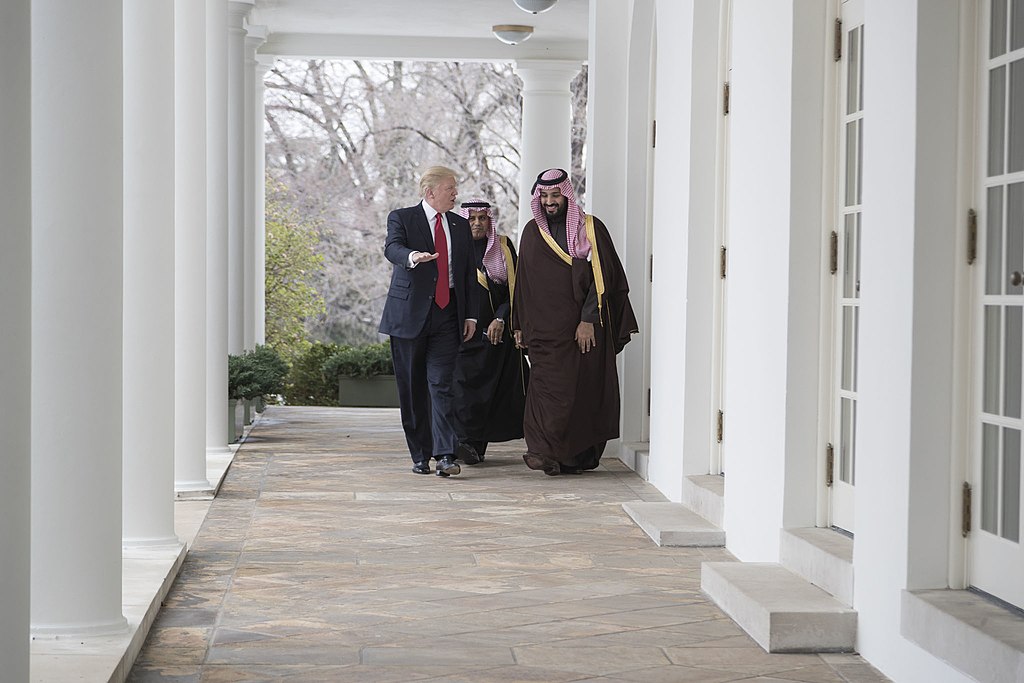
Donald Trump and Mohammad bin Salman (White House)

by Gary Sick
The Middle East has reverted to a kind of primitive savagery. The states of the region had historically treated their citizens with casual brutality, in the interest of preventing dissent, but the ferocious civil wars and interstate conflicts since the so-called Arab Spring in 2011 have introduced a new level of viciousness reminiscent of the Middle Ages.
Despite the civilized terminology of modern international relations, the old rule that “might makes right” is very much alive and well in the interactions of states. Take the word siege. It has a nice medieval ring to it, with images of armored knights planting their battle flags around some fortified town, trying to starve them into submission. But there are at least three full scale sieges going on in the Middle East today. They may lack the colorful appurtenances of the distant past, and they involve entire states rather than fortified towns, but the purpose is just as grim as any knightly undertaking.


Yemen

When Mohammad bin Salman (MbS), the 29 year old son of the newly ascendant king of Saudi Arabia, was appointed Minister of Defense in 2015, one of his first major acts was to intervene in the Yemeni civil war. His primary instrument of war was the immensely expensive, high tech Saudi air force. He also assembled a coalition of forces, starting with his neighbor in the United Arab Emirates, which provided ground forces and training for foreign fighters and tribal militias.

From the beginning, the Saudi pilots came in for intense criticism since their bombs seemed to hit almost everything except military targets. Factories, markets, dairies, and farms were hit, sometimes repeatedly, in addition to wedding parties, mosques, and apartment buildings. The Saudis insisted that they were not responsible for most of these events, even though their coalition’s planes dominated the air.

Part of this, indeed, could be attributed to pilot error and collateral damage. But a pattern emerged. Saudi Arabia and its allies established selective blockades of Yemeni ports, on the grounds of preventing Iran or others from smuggling armaments into the country. This resulted in lengthy delays of imported wheat and other foodstuffs. This, together with destruction of food production and delivery within the country resulted in near famine. Inadvertently or not, two-thirds of the Yemeni population today would be near starvation without UN assistance. Destruction of water supplies and hospitals has resulted in the greatest cholera outbreak in the world.

Regardless of the cautious and neutral language of diplomacy, it is a siege.

Qatar

Two years later, in June 2017, the UAE and Saudi Arabia suddenly announced a total boycott of the energy-rich peninsular state of Qatar. They accused Qatar of supporting the Muslim Brotherhood and sponsoring terrorist activities. By this time the two Mohammads (bin Salman, MbS, of Saudi Arabia and bin Zayed, MbZ, of the UAE) both dominant political figures in their two countries, had joined up with Donald Trump. Trump initially applauded their plot, even though the largest U.S. airbase in the Middle East was located just outside Doha, Qatar. Over time the United States has moved to a more neutral position, but the boycott has persisted. All air traffic into and out of Qatar has been reduced to a single narrow passage; all movement of goods across Qatar’s land borders has been blocked; and transshipment of goods via ports of the blockading states has been prohibited.

Qatar is a tiny state with vast financial resources. Saudi Arabia and the UAE made no secret of their expectation that Qatar would succumb to their pressure in a matter of weeks. Two years later, Qatar has adapted and seems to have weathered the crisis. However, the siege continues.

Iran

In May 2018, the United States announced its withdrawal from the JCPOA (Joint Comprehensive Plan of Action) otherwise known as the Iran nuclear deal. At the time, Iran was in compliance with the terms of the deal, which had been negotiated by the United States together with the other permanent members of the UN Security Council and Germany, and ratified unanimously by the Security Council. On Trump’s watch, the United States reimposed the sanctions that had been removed as part of the deal and then imposed a harsh additional set of sanctions, including a total ban on the Iranian oil trade and the criminalization of large parts of the Iranian government and economy.

President Trump said that the purpose of this unprecedented siege of a UN member state was to drive Iran back to the negotiating table for a more comprehensive agreement. His aides did not openly dispute the president, but they made it very clear that their objective was to remove the theocratic regime in Tehran. Secretary of State Mike Pompeo recently summarized the purpose of the Maximum Pressure campaign as follows: “We have applied enormous pressure to enable the Iranian people to change the direction of their leadership.” The president said he was prepared to meet Iranian leaders and negotiate without preconditions; his aides set some daunting conditions and said that negotiations would take place “when circumstances are right.”

On one point there is agreement. Iran’s economy is suffering. GDP is down; inflation is up; businesses that rely on imports or exports are facing collapse; and critical items, even including medicine, are in dwindling and uncertain supply. The Iranian government, however, appears to be in little danger. Demonstrations have largely ceased, and the external threat seems to have prompted some rallying around the flag. Hardliners, who take profit and vindication from external interference, are ascendant.

Who Pays the Price?

So there are three sieges presently being pursued in the Middle East. None of them appears to be accomplishing its stated purpose, and each of them could be ended tomorrow. But the siege-masters are unwilling to acknowledge any error, and they seem to believe that any sign of weakness would raise questions about their own might. 

So all three seem destined to be drawn out affairs, not unlike medieval campaigns to take a well-fortified castle. The warriors in their planes and the policymakers in their comfortable offices will make their calculations and persevere. And just like the Middle Ages, it will be the little people caught between might and right who will pay the price.

Monday, August 12, 2019

Iran on the Precipice


Photograph Source: Tasnim News Agency – CC BY 4.0
There’s never been a full-scale war between two nuclear-armed states. If Iran one day did cross the nuclear threshold the same deterrence will apply. No one rational would want to provoke their own incineration.
Columbia University professor, Kenneth Waltz, the distinguished theorist on the conduct of war, wrote in Foreign Affairs that with Israel possessing over 200 nuclear weapons (which the US refuses to publically admit) Iran having a bomb would bring stability.
I would never go as far as Waltz on that last point. The launch of nuclear weapons can always be done by accident or by the rogue action of one or two of the members of the launch team in the silo.
It has nearly happened in the US a number of times, and probably in the Soviet Union too. Moreover, if Iran got really close to building a bomb, Saudi Arabia would follow in short order, and perhaps Egypt too somewhat later. That would really be Iran cutting off its nose to spite its face.
The arguments between Iran, the US and Europe over the supposed bomb question are becoming confused. To be frightened or not to be? If clear thinking is not quickly restored everyone will lose out.
When President Barack Obama and his team successfully negotiated a long-term freeze in Iran’s nuclear research a milestone in international cooperation on nuclear proliferation was passed.
Russia and China joined the EU and the US as negotiating partners and made a unanimous front when presenting the agreement to the UN Security Council for approval.
Donald Trump unilaterally upended this soon after taking office. In breaking apart a deal approved by the Security Council he broke international law.
The recent UK ambassador to the US, Kim Darroch, reckoned Trump’s primary motivation was not US security or anything of that ilk but was purely motivated by a gut hatred of Obama.
Now the old untruths that were churned out by the Republicans and the Israelis during the Obama-era negotiations are being recycled.
They predicted during the 1990s that Iran would have nuclear weapons by 2000. Then the estimated date was bumped up to 2005. Then to 2015. Now some are saying next year.
The CIA, for its part, has never put its name to these Iranian estimates. Apparently it still thinks that the probability is that Iran was never building a bomb.
They would have been better to focus on Brazil, now led by the extreme right wing nationalist, Jair Bolsonaro, who has close ties with the military, which is now engaged in enriching uranium to 90%, suitable for nuclear bombs, as against Iran’s just announced 5%, suitable for its Bushehr civilian power reactor and a long way from what is necessary to build a bomb.
Brazil needs this high degree of enrichment to fuel its new nuclear submarine, but it could easily be diverted to build a bomb.
There’s a danger, once removed but now back in circulation, that this negative attitude towards Iran could result in a self-fulfilling prophecy, especially if it leads to a military attack.
As two former US National Security Advisors to the president, Zbigniew Brzezinski and Brent Scowcroft, have written, “a military attack by Israel or the US “would significantly increase Iran’s motivation to build a bomb.”
An attack “would also increase the recruiting ability of radical Islamist groups, including Al Qaeda and ISIS.”
Does Trump want to attack Iran or not? Last month US planes were within ten minutes of bombing Iran before he had a last minute change of mind and called off the raid.
The last few days some smoke has been thrown into the air with the somewhat autonomous Iranian Revolutionary Guards seizing a British-owned ship steaming through the Persian Gulf.
Wisely, on the eve of a change in its leadership, the UK is not upping the ante with threats of retaliation. Trump has been careful not to get out in front of the British.
Nevertheless, these incidents go to show how a gunpowder trail can easily be laid. Meanwhile, the American sanctions that were supposed to be lifted because of the Obama agreement are being tightened.
Iran is suffering, especially the poor. Similar sanctions when used against the Iraq of Saddam Hussein resulted in over 30,000 children dying, according to UNICEF.
There are some hints that Trump wants to act as he has with North Korea- jump straight to the top of Iran’s decision making tree and make his own deal.
Never mind that a new deal might only have cosmetic changes, it would enable him to claim he had got a better deal than Obama. He did this with the North American Free Trade Area agreement.
Is it all a fuss about nothing? Only those who live inside Trump’s head know the answer. In this case he is truly master of the universe.

Tuesday, July 09, 2019

Iran Seeks Nukes? The Big Lie Won’t Die

by Stephen Lendman 
The US and Israel are nuclear armed and dangerous. So are Britain and France — joined at hip with Washington’s imperial agenda, featuring naked aggression and other hostile actions.
Special forces of these EU countries operate covertly and overtly in US war theaters, their actions flagrantly violating the UN Charter and other international law. 
Compare the West’s agenda to Iran’s, at peace with its neighbors, abhorring war and nukes, threatening no one.
Israel’s Netanyahu and likeminded fascists infesting his regime push the Big Lie claim that Iran seeks nukes despite no evidence remotely suggesting it.
Earlier and again last September in addressing the UN General Assembly, Netanyahu lied claiming the JCPOA “paved Iran’s path to a nuclear arsenal,” adding:
“And by lifting the sanctions, it fueled Iran’s campaign of carnage and conquest throughout the Middle East.” 
“We oppose it because the deal was based on a fundamental lie that Iran is not seeking to develop nuclear weapons.”
Like Trump, Netanyahu is a warmongering serial liar. The world community-supported JCPOA is all about maintaining Iran’s peaceful nuclear program — with no military component it abhors and doesn’t seek.
Middle East “carnage and conquest” defines the US, NATO, Israeli agenda, not how Iran operates.
Most world community members and Israel are silent about the Jewish state’s nuclear arsenal and ballistic missile delivery systems.
In May 2018, coincidentally with Trump’s JCPOA pullout, Netanyahu claimed Israel has thousands of incriminating documents, charts, presentations, photos and videos, showing Tehran lied for years to the international community (sic).
Without credible evidence backing his announcement, he falsely claimed Iran has a secret nuclear weapons program called Project Amad – to “design, produce and test 5 warheads, each of 10 kilotons TNT yield for integration on a missile.”
He turned truth on its head, claiming Iran built a secret underground facility for developing nuclear cores and implosion systems.
Intensive IAEA inspections refuted him, an agency statement repeatedly stating that “Iran is (fully) implementing its nuclear-related commitments” according to JCPOA provisions.
Last year, Netanyahu sounded buffoon-like, saying “I’m disclosing for the first time that Iran has another secret facility in Tehran. A secret atomic warehouse for storing massive amounts of equipment and material for Iran’s secret nuclear weapons program.”
No Iranian secret atomic warehouse exists, no massive amounts of equipment for making nukes, no credible evidence suggesting it — Netanyahu’s Big Lie exposed to the light of day.
Following Iran’s announced legal JCPOA right to increase its uranium enrichment beyond the agreement’s permitted 300 kg/3.67 level, Netanyahu called for illegally imposing so-called snapback sanctions by Security Council members.
Sino/Russian veto power won’t permit it. Once again, Netanyahu repeated the Big Lie about Iran’s nuclear intentions, falsely claim it seeks nukes, roaring:
“This is a very, very dangerous step (sic). Iran has violated its solemn promise under the UN Security Council not to enrich uranium beyond a certain level (sic).” 
“I call on my friends, the heads of France, Britain and Germany – you signed this deal and you said that as soon as they take this step, severe sanctions will be imposed. That was the Security Council resolution (sic). Where are you?”
Security Council Resolution 2231 (July 2015) includes nothing about imposing sanctions on Iran for actions it’s taken in response to the US and Europe breaching their JCPOA obligations.
Multiple rounds of punishing Security Council sanctions were imposed on nonbelligerent North Korea for its nuclear deterrent, developed solely for defense over a genuine fear of US aggression.
Why haven’t Security Council members sanctioned belligerent Israel for its illegal nuclear arsenal, a nation threatened by no one — at war on Palestinians and Syria, a regional menace along with Washington’s presence!
On Sunday, hardline Iranophobic Israeli energy minster Yuval Steinitz falsely claimed Tehran is on “a slow march” toward having nukes. When repeated endlessly, Big Lies take on a life of their own.
Steinitz compounded his Big Lie, roaring Iran’s increased uranium enrichment is “very, very dangerous” — ignoring Tehran’s compliance with JCPOA provisions and real menace posed by Israeli nukes, nothing done by the world community to challenge them. 
Western and Israeli media perpetuate the myth of an Iranian desire to develop and produce nukes, never citing evidence backing the claim because none exists.
The hypocrisy overwhelms. Peaceful Iran, threatening no one, with no nukes or a desire to have them, is falsely called a regional menace by US and Israeli hardliners.
The real menace these countries and their imperial partners pose is absent from mainstream public discourse.
Stephen Lendman
Stephen Lendman was born in 1934 in Boston, MA. In 1956, he received a BA from Harvard University. Two years of US Army service followed, then an MBA from the Wharton School at the University of Pennsylvania in 1960. After working seven years as a marketing research analyst, he joined the Lendman Group family business in 1967. He remained there until retiring at year end 1999. Writing on major world and national issues began in summer 2005. In early 2007, radio hosting followed. Lendman now hosts the Progressive Radio News Hour on the Progressive Radio Network three times weekly. Distinguished guests are featured. Listen live or archived. Major world and national issues are discussed. Lendman is a 2008 Project Censored winner and 2011 Mexican Journalists Club international journalism award recipient.

Monday, July 08, 2019

Sino/Russian Solidarity with Iran

by Stephen Lendman

The world community should, but hasn't, followed Sino/Russian support for Iran's sovereign rights, a few exceptions aside.

EU nations partner with Washington's hegemonic agenda. Second deputy chairman of Iran's National Security and Foreign Policy Parliament Commission Mohammad Javad Jamali slammed Brussels, saying:

Britain, France, Germany, and other EU nations lack commitment to the JCPOA, "not from their inability but from their lack of determination. They share the same viewpoint (as) the United States on Iran in terms of strategic issues" - while pretending to support the JCPOA they effectively abandoned by their policy choices. 

Jamali believes EU countries want to withdraw from the nuclear deal, then wrongfully blame Iran for their action, how things may turn out ahead  - showing Europe's support for the deal all along was pure illusion.
China and Russia adhere to JCPOA provisions. They oppose foreign interference in Iran's internal affairs by the Trump regime, an international law breach. More on this below.

Things heading for possible war will be catastrophic for the Islamic Republic and region if launched, why it's crucial for European and other world community nations to oppose joining a US coalition for war on a nation at peace with its neighbors, threatening no one.

Most congressional members and US public sentiment oppose war on Iran. A Harvard CAPS/Harris poll found 78% of Americans believe no US military action in response to Iran's (legal) downing of a Pentagon drone (illegally) in its airspace was the right policy choice.

Most Americans oppose war on Iran preemptively. A majority also disapprove of Trump regime relations with the country. 

Only 5% of respondents want the White House to declare war on Iran - an illegal act if not authorized by Security Council members.

Under the UN Charter, it's only permissible in response to being attacked, or if aggression is clearly imminent, never preemptively for any reason with no allowed exceptions, how all US wars were launched in the post-WW II era - against nations posing no threat to the US or anyone else.

US-stoked tensions with Iran are more intense than any time since its 1979 revolution because of the Trump regime's rage to return the country to US client state status, along with gaining control over its world's 4th largest proved oil reserves, a prize Washington covets.

Last week, Trump regime envoy for regime change in Iran Brian Hook said the US will sanction any countries and enterprises buying Iranian oil, adding "(t)here are right now no oil waivers in place."

Calling Iranian oil sales "illicit" defies international law while ignoring illegal US sanctions on the country, why no nations and enterprises should respect them.

China's Foreign Ministry spokesman Geng Shuang slammed unlawful Trump regime "maximum pressure" on Iran, calling it "the root cause of the current fraught tensions."
Beijing continues to buy Iranian oil it greatly values, refusing to go along with illegal US sanctions. Russia's Foreign Ministry commented as follows about unacceptable Trump regime pressure on Iran, saying:

"Moscow has watched with concern as the US has ratcheted up tensions around Iran for over a year," adding: 

"Leveling baseless charges and withdrawing from the Joint Comprehensive Plan of Action, Washington has steadily piled on massive sanction pressure and taken actions, including actions of a military nature, intended to provoke Iran, while demanding unwarranted concessions of it, up to and including the de facto abandonment of its absolutely legitimate interests in international affairs, despite the fact that Iran's nuclear activities are exclusively peaceful and fully supervised by the International Atomic Energy Agency (IAEA)."

US actions show it's "intent on burning bridges" with Iran, one of many "example(s) of the continued US propensity to dictate its will to sovereign states." 

"Imagining itself to be the master of the fate of the world, it adopts increasingly aggressive policies and is quick to 'punish' those who refuse to submit to (its) dictates."

"Russia stands in full solidarity with the friendly people of Iran and its government." 

The Trump regime "should consider where such a reckless course of action might lead. Not only (is it) destabiliz(ing) the Middle East, it threatens to undermine the entire system of international security."

The above remarks are usually candid about Washington's imperial agenda. Its rage to rule the world could end up destroying it.

It's already threatened with ecocide because of reckless industrial policies, endorsed in the West and elsewhere.

If the Trump regime attacks Iran preemptively, the Islamic Republic will hit back hard.
If Russia intervenes to aid Iran as it did to combat US-supported terrorists in Syria, things could spin out of control, turning regional war into a global conflict.

If nuclear weapons are used for the first time in earnest, enough detonations could hasten humanity's demise far faster than environmental degradation.

Either way we're all doomed if reckless policies aren't checked and halted. No evidence suggests things may turn out this way - just the opposite. 

US hegemonic rage and lack of world community ecosanity are humanity's greatest threats.

Iran’s Commendable Step to Increase Uranium Enrichment

By: Kayhan Int’l
     
With the end of the 60-day deadline set by Iran to the European signatories of the JCPOA (Joint Comprehensive Plan of Action) to honour their commitments to the international nuclear deal, which they still have not, the Islamic Republic has decided to increase its uranium enrichment level to around 5 percent for the time being, from the 3.67 percent limit it had agreed at Geneva in 2015 under conditions that all illegal sanctions are removed.
      Unfortunately, Iran was deceived, since the West, including the US and the big three European states (France, Germany, and Britain), did not lift all the sanctions they had promised to do.
      Iran, which had increased its uranium enrichment level to 20 percent despite the assassination of several of its nuclear scientists by agents of the Mossad and CIA, and then willingly agreed to downgrade it, felt cheated, especially since the Vienna-based International Atomic Energy Agency (IAEA) had time again verified the peaceful nature of the Islamic Republic’s nuclear programme.
     Moreover, in accordance with divine injunctions, Leader of the Islamic Revolution, Ayatollah Seyyed Ali Khamenei, had issued a fatwa (edict), that production of nuclear and other weapons of destruction is religiously prohibited.
     Matters, however, took a turn for the worse with the election of the quixotic Donald Trump as president of the world’s most dangerously nuclear-armed power, and his calls for renegotiating the JCPOA, which he called a "bad deal” – an unjust demand which Iran categorically rejected.
      While all other signatories adhered to the JCPOA and advised the US president against playing spoil sport, the realtor who had no idea of either international law or of diplomacy, blatantly breached the nuclear accord in May 2018 through unilateral withdrawal, while pursuing a policy of economic terrorism against Iran by threatening countries and companies doing business with sanctions, on the assumption of browbeating the Islamic Republic into submission.
      He and his team of thugs labelled all sorts of wild accusations against Iran and started flexing their military muscles in the region, while the ‘big three’ European signatories to the JCPOA refrained from carrying out their own commitments by dragging their feet concerning the mode of international transactions and virtually violated the Geneva international deal.
     As a result, Iran had no other choice but, as per the clauses of the JCPOA, reduce its own commitments to a deal clearly heading towards the graveyard, by presenting the Europeans with a 60-day choice, either to honour their commitments or let the Islamic Republic take the lawful and legal measures of increasing the percentage and stocking of enriched uranium. 
     Thus, with the failure of France, Britain, and Germany, to make the proper choice, on July 7 Iran exercised its inalienable rights, as per JCPOA clauses, to increase uranium enrichment to 5 percent, the grade required for the Bushehr Atomic Power Plant.
      In the meantime, the Islamic Republic by shooting down last month the most expensive and sophisticated radar-evading American spy drone with missiles it was designed to dodge, the moment it violated Iranian airspace, gave the necessary warning to Washington against dreams of any military adventure in the region.
      Now, since there is no question whatsoever of talks with the notorious liar called Trump, Iran has given a further 60-day deadline to the JCPOA signatories to rectify their wrongs for working out a solution that includes the lifting of all US sanctions and military threats, or else, the Islamic Republic will continue to increase the percentage of uranium enrichment as per its requirements in the difference industries. 

Saturday, July 06, 2019

Europe Should Recall Its Commitment to The Iran Deal Instead of Enabling US Hawks

TEHRAN (FNA)- Iran has recently announced that it would gradually scale back its commitments under the nuclear agreement - as permitted by the deal itself - in view of enticing other parties to honour their obligations. In response to Iran's initiative, anti-Iran hawks in Washington are trying to push the remaining parties to the Joint Comprehensive Plan of Action (JCPOA) – or the so-called ‘Iran Deal’ - to re-impose Security Council sanctions that were lifted as part of the agreement in 2015.
For instance, Senator Ted Cruz just recently issued a statement in which he claims: “[...] it is time to take the next step and invoke the multilateral ‘snapback’ in United Nations Security Council resolution 2231.” But what is the “snapback” mechanism?
The JCPOA is characterised by the fact that it was negotiated in an environment of complete distrust between the parties. This is why the negotiators on both sides devised mechanisms within the deal that would deter the other party from breaching its commitments.

One such mechanism, which was meant to be used by Iran's counterparts, was dubbed the "snapback" mechanism. This rather unusual procedure was meant to allow an aggrieved party to the deal to reinstate previously lifted Security Council sanctions against Iran without a vote on the Council. This means, in the event that one participant to the JCPOA believed in good-faith that Iran is in violation of its commitments in a significant manner, it could submit its concerns to a dispute resolution panel. If those concerns remained unresolved, it could then single-handedly force the re-imposition of prior Security Council sanctions.

But, since in practice, Iran could not resort to this conflict-resolution mechanism without taking the risk of reviving previously lifted Security Council sanctions against itself, another mechanism - or counter leverage - was devised within the deal to allow Tehran, to keep its counterparts in compliance.

The other mechanism is enshrined in Article 36 of the JCPOA. Under this provision, if Iran deems an unresolved issue to constitute "significant non-performance" by its counterparts, it can treat it as ground "to cease performing its commitments under the JCPOA in whole or in part" until others are brought back to order.

This is precisely the mechanism Iran resorted to this month in response to the United States' withdrawal from the deal and the remaining parties' inability (or unwillingness) to compensate and normalise trade and economic relations with the country within a year, as per their obligations.

Indeed, exactly one year after the United States withdrew from the JCPOA, Iran suspended some of its commitments in accordance with the terms of the deal, giving a 60-day moratorium for the rest of the signatories to fulfil their part of the bargain.

The right course of action - in fact, the only course of action - would be for European powers to take their commitments seriously and take decisive steps to normalise trade and economic relations with Iran.

Reza Nasri 

International law expert

Now, the question is, can the remaining parties to the JCPOA - in practice, the so-called E3 powers (Germany, France and the UK) - trigger the “snapback” mechanism is response to Iran's reaction?

The answer - which Europe and hawks in Washington should bear in mind - is a simple “no” for the following reasons:
Firstly, the “snapback” mechanism was intended to keep Iran - and not the United States or other parties - in check. In other words, the “snapback” provision was solely drafted in anticipation of a situation where Iran would be the initial defector. With US defection in May 2018 and the remaining parties inability to stick to their obligations, Iran can no longer, under any circumstances, be deemed as the initial defector. This means that the US withdrawal - and the remaining parties' inability to compensate it and normalise economic relations with Iran as per their obligations - has effectively rendered the “snapback” provision irrelevant and inoperative for all remaining parties. In other words, the "snapback" was not a mechanism meant to deter Iran from taking lawful measures within the framework of the deal in view of assuring the other parties' compliance; it was meant to deter Iran from initiating a significant violation.

Secondly, even if we assume that the "snapback" mechanism is still relevant, the fact is that in order to trigger the process, the JCPOA provides that a participant must notify the Security Council of “an issue that the JCPOA participant State believes constitutes significant non-performance of commitments” by Iran.

However, the truth is that the remaining parties to the JCPOA would have no good-faith basis for believing Iran to be in “significant non-performance of commitments” if Iran’s so-called “non-performance” stems from measures implemented in response to other parties' non-compliance. In other words, if Iran's measures are conducted within the framework of the conflict-resolution mechanism in-built within the deal, they cannot, by any means, be perceived as “significant non-performance.”

The fact is that if the remaining parties (i.e. Europe) insist on resorting to the "snapback", they can only do so by going through a compulsory dispute settlement procedure, as laid out by the agreement. At the relevant stage of the dispute settlement procedure, Iran would then simply reiterate that it would reverse its decision and return to the full implementation of the deal only if its counterparts implement their own obligations and operationalise Iran's rightful demands. This reasonable condition would ipso facto prevent Europe from going any further toward triggering the "snapback" mechanism unless it is willing to show an absolute disregard for principle, fairness and procedure. In other words, the fact is that Europe is not entitled to, and cannot in practice, obtain any remedy by resorting to the "snapback" if it does not itself enter the dispute settlement phase with “clean hands.” Indeed, the legal adage, “those seeking equity must do equity,” would also apply to the JCPOA's dispute settlement mechanism.

Thirdly, it would be a mockery of international law and the United Nations' collective security system for European countries even to try subjecting Iran to Security Council sanctions. By attempting this, Europe would be effectively trying to punish Iran for using a leverage it was duly given by an international agreement in view of compelling other parties to remain in compliance. In fact, if Europe went ahead with triggering the “snapback,” it would be the first time the Security Council would have been employed to punish a state for its legal attempts to bring other states into compliance with a multilateral agreement that was endorsed through a unanimous resolution (Res. 2231) by the Council itself.

If Europe were to punish Iran for playing by the rules, it would be no less pernicious to the international legal order - and to the credibility of the Security Council - than the Trump administration.

Fourth, European powers' attempt to reinstate Security Council resolutions against Iran – which would not just be unlawful - would most certainly escalate tensions to a whole new level, dealing a fatal blow to the international non-proliferation regime and embolden those in Washington that are relentlessly pursuing military confrontation with Iran. A hostile act like this would most likely prompt Iran to leave the JCPOA altogether, withdraw from the Non-proliferation Treaty (NPT) and abandon the “maximum restraint” policy it is currently pursuing.

By misusing the Security Council mechanism, Europe would also give people like John Bolton a new tool to exploit in order to advance their case for war. European leaders are fully aware that the current US administration is comprised of people who invoked a decade-old expired Security Council resolution to justify military action against Iraq. Therefore, it would not be difficult for them to imagine what this crew would do if they were given half a dozen resolutions to misinterpret and exploit. Europe should know that by enabling the hawkish elements within the Trump administration, it must own the consequences of their actions.

Fifth, in order to accuse Iran of a “wrongful act” and take measures accordingly, Europe must first establish Iran's “ill intention” or at least show a semblance of a mens rea. However, European leaders, like the rest of the international community, know full well that such ill intention doesn't exist. In fact, they are fully cognisant of the fact that, by taking lawful measures, Iran's sole intention is to keep their mutual agreement alive. Penalising Iran for attempting to push other parties to honour a Security Council-endorsed agreement would leave a stain on Europe's image and moral authority - and render any future diplomatic engagements much more difficult.

With all this in mind, Europe should refrain from taking any action that would make Iran pay the cost of the other parties' transgressions. On the other hand, Europeans should also know that they cannot be entitled to the fruits of the United States’ unlawful acts and their own lack of resolve in fulfilling their own part of the bargain.

European powers should recall that their commitment was to make Iran fully benefit from the tangible dividends of the lifting of sanctions lifting, not to merely observe the administrative formalities and then disengage. So, the right course of action - in fact, the only course of action - would be for European powers to take their commitments seriously and take decisive steps to normalise trade and economic relations with Iran. Going down any other path would only make matters worse.

By Reza Nasri 

Reza Nasri is an international lawyer, foreign policy analyst and frequent commentator on the nuclear agreement (JCPOA) in Iran and international media.

Friday, June 28, 2019

Iran’s Strategy Of Reversible Escalation


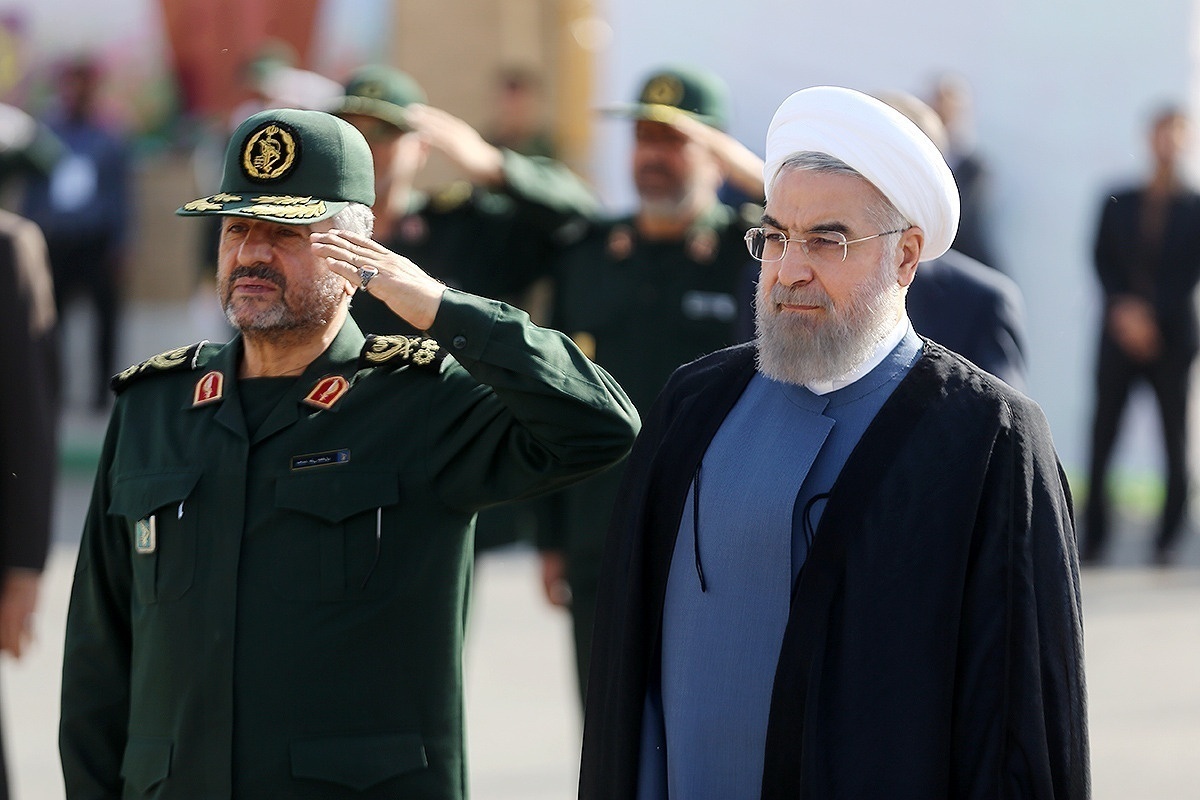
General Mohammad Ali Jafari of the Revolutionary Guards and Iranian President Hassan Rouhani
by Eldar Mamedov
In case anyone thought Iran was bluffing with its threats to respond robustly to U.S. “maximum pressure,” recent developments should have disabused them of that notion. Not only did Iran down a highly sophisticated American drone near its borders in the Persian Gulf, but it also announced plans to reduce its commitments under the nuclear deal (the Joint Comprehensive Plan of Action or JCPOA). The phase of strategic patience Iran exercised in the year after the United States violated the agreement has come to an end. It is now being replaced by an assertive action phase. That action will develop on two main fronts: the nuclear agreement and regional security.
Contrary to a popular view in the West, this shift is not the result of “hard-liners” displacing “moderates.” There is a job division within the Iranian system: diplomats deal with the nuclear dossier while the Revolutionary Guards lead on military deterrence. There is, however, an overarching unity of purpose: to strike back, with all means available, at what Iran sees as an economic war waged by the United States and its regional allies Saudi Arabia, the United Arab Emirates, and Israel.
Far from being an act of suicidal defiance by some irascible religious fanatic, Iran’s decision to respond to U.S. pressure follows from a set of careful strategic calculations and domestic political imperatives. After respecting fully their JCPOA commitments and being denied economic dividends, Iranians decided that they should not be the only ones paying the price of the American decision to violate that agreement.
On the nuclear file, the decision to surpass the stockpiles of 300 kilograms of low enriched uranium (LEU) permitted by the JCPOA by July 2019 is designed to pressure the Europeans to deliver on their commitments to provide economic benefits to Iran. Although the EU insists on full implementation of the JCPOA, reduced compliance is the best that Iran can offer at this stage. Such a decision is the result of a national compromise among different forces, including those calling for pulling out of the JCPOA and possibly even the Nuclear Non-Proliferation Treaty (NPT) as well.
The purpose of this move, according to Iranian officials, is not to destroy the JCPOA but to save it. As soon as Iranians get the promised sanctions relief, the process can be quickly reversed to a stockpile below 300 kilograms of LEU.  To get back to that point, a practical solution has to be found on Iranian oil exports. If European companies refrain from buying Iranian oil out of a fear of heavy American sanctions, officials in Tehran insist that the EU issue credit lines: make money available to Iran to cover its needs in exchange for oil deliveries after the lifting of the sanctions in the future. Iranians reason that if the EU indeed sees the JCPOA as essential to its security, as its officials often claim, it should put its money where its mouth is.
On the military side, Iran is increasing pressure on the United States to abandon its “maximum pressure” policy by seeking to impose real costs. Tehran’s downing an American drone should be seen in this context, not as an unprovoked hostile act. Although American drones reportedly violated Iranian territorial integrity in the past, the current context obliges Iranians to respond, at some point, publicly and visibly, as both a deterrent and a demonstration of their ability to defend their people and territory.
Trump’s announcement that he stopped a retaliatory strike and now looks forward for “negotiations without preconditions” with Iran might appear as an opportunity to arrest the slide to war. Not so in the eyes of the Iranian Revolutionary Guards. This, again, is not a sign of some pathological stubbornness or ideological anti-Americanism. It is simply because negotiating now would validate the basic premise of the “maximum pressure” campaign: that suffocating Iran economically has forced it to the negotiating table to make further concessions—this time also on ballistic missiles and regional policies, deliberately excluded from the JCPOA. Trump´s imposition of sanctions on top Iranian officials, including Ayatollah Khamenei and foreign minister Javad Zarif, only underscores the hollowness of his offer to talk.
So, as Washington doesn´t appear to be serious about lifting the economic siege of Iran, Tehran will seek to coerce it to do so. The downing of the drone is a message that Iran means business. Absent changes in American behavior, this may not be the last step in the series of Iranian escalations. Officials in Tehran have repeatedly warned that, if they are unable to export oil, no one else in the Persian Gulf will either.
Just like with the nuclear issue, however, this escalation is reversible if the United States takes steps to stop its economic war against Iran. That, and not more sanctions, could even open the door for the talks Trump claims to seek.  Ayatollah Khamenei made it clear that Iran would not negotiate “under pressure”—not that it would not do so under any circumstances. Potentially, that could even lead to broader talks on regional issues and ballistic missiles. But then all other issues will have to be brought to the table too, such as region-wide non-proliferation, covering Israel´s nuclear arsenal, Western arms sales to Saudi Arabia and the United Arab Emirates, the war in Yemen, and so on.
Although Iran’s strategy of reversible escalation enjoys a consensus among the elite, it is a risky one. Reducing commitments under the JCPOA may push Europeans closer to Trump, instead of stimulating them to deliver on their commitments to Iran, and increase Iran´s diplomatic isolation.
When it comes to United States, Iranians, particularly in the conservative camp, seem to be too sanguine about Trump not willing to start a war in order not to harm his re-election prospects in 2020. Despite the restraining influence of such figures on the American right as Senator Rand Paul and Fox TV anchor Tucker Carlson, Trump may still be painted into a corner by his hawkish advisers and lash out militarily at Iran.
When confronted with these doubts, Iranian officials seem to concede that their strategy is a gamble. However, a strong sense of being a wronged party, Iranian nationalism, and the regime´s revolutionary resistance ideology are preventing them from blinking first in their confrontation with the Americans. Whatever one thinks of the wisdom of such a posture given the existing balance of power, if the standoff ends up in a war, it will be America’s fault, not Iran’s.