Showing posts with label Mahmoud Abbas. Show all posts

Sunday, December 15, 2019

Hamas celebrates its 32nd anniversary in Gaza

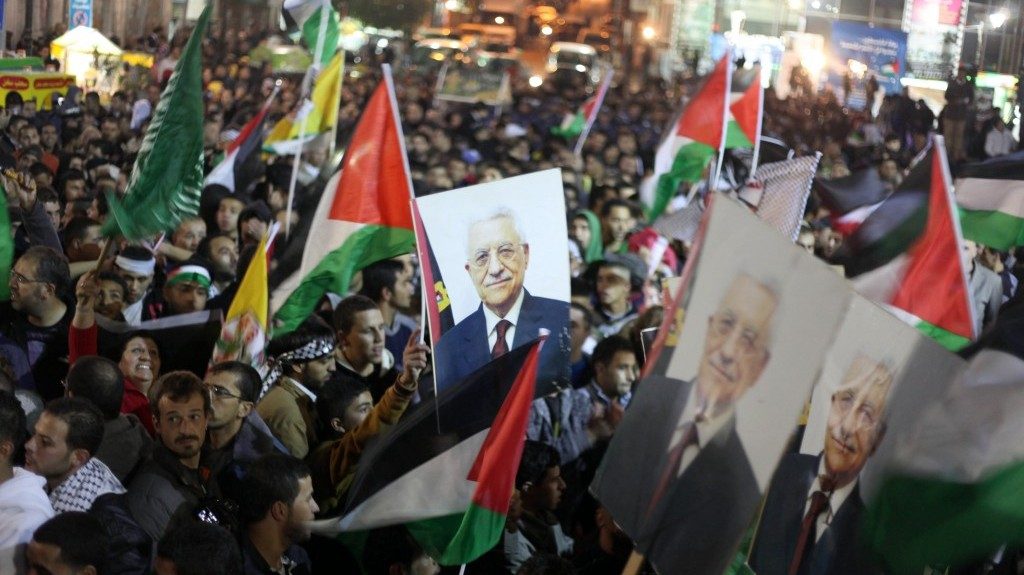
Thousands of Palestinians took to the streets on Friday in the north of the Gaza Strip, to celebrate the 32nd anniversary of the Palestinian Islamic Resistance Movement Hamas.
Hamas gave the name ‘The Edge of the Sword’ to this year’s celebrations of its anniversary. This name was attributed to the Hamas military wing’s operation, when it foiled a plan by an Israeli special unit aimed at the Palestinian resistance last year.
For the first time, Hamas did not organise a central rally in the city of Gaza for its supporters, where leaders from other parties usually deliver speeches and artists perform folkloric shows, glorifying the Palestinian resistance.
In order to deal with the financial crisis, this year Hamas planned marches across the different cities along the Gaza Strip.
Participants and Hamas supporters raised Hamas flags and pictures of late Hamas founders and leaders, as they listened to the speeches of Hamas leaders.
During the march organised in the city of Jabalia, north of the Gaza Strip, member of Hamas Political Bureau, Fathi Hammad, announced: “Our people will not give up resistance until the Israeli occupation has ended.”
He added: “The time for imposing solutions has gone, and if the Israeli occupation rejects all proposed solutions and does not stop its violations against our people under the pressure of popular resistance, we will resume armed resistance.”
The senior Hamas leader hailed the Joint Operations Room of the military wings of the Palestinian factions in Gaza, stressing: “The Joint Operations Room will remain the highest body for popular and armed resistance.”
Commenting on the issue of Israeli prisoners captured by the Palestinians resistance, Hammad disclosed: “It seems that the Israeli occupation is not interested in the release of its captive soldiers. We will never release them without the release of our prisoners.”
Regarding national unity and the elections, he elucidated: “Hamas does not have any sanctions on the achievement of national unity. It is also ready for the elections and we call for President Mahmood Abbas to issue the election decree as soon as possible.”
Meanwhile, Hamas spokesman, Hammad Al-Reqib, informed a march in the city of Khan Younis, in the south of the Gaza Strip, that his movement “has no problem with political plurality and insisted on forming a government from the different Palestinian factions when it won the elections in 2006, which the Palestinian factions rejected.”

Monday, August 05, 2019

Abbas’s la-la land and the evolution of the American love affair with Israel


Palestinian president Mahmoud Abbas (R) and US President Donald Trump (L) hold a joint press conference following their meeting on 23 May, 2017 in Bethlehem, West Bank
Palestinian Authority President Mahmoud Abbas is ready to “go to the White House and continue what [he] started with [US President] Donald Trump.” With this and other confusing statements, Abbas tried to articulate the new Palestinian political agenda to foreign reporters in Ramallah last month.
According to Abbas, the PA is ready to return to negotiations with Israel if two conditions are met: Washington is to reverse its stance on East Jerusalem, thus recognising it as an occupied Palestinian city; and there is a renewed commitment to the so-called two-state solution. “I will not accept a one-state solution because one state will be an apartheid state,” Abbas insisted.
Aside from the Palestinian leader’s insubstantial logic, the official Palestinian discourse emanating from Ramallah these days seems oblivious to the massively changing political reality in Washington over the past two years or so. Remarks by Abbas, his recently-appointed Prime Minister Mohammed Shtayyeh or other PA officials are apparently based on the logic of a bygone era, one in which the US claimed, however falsely, to be an honest broker for peace; a period that lasted for nearly 25 years and during which PA officials benefited from the massive “peace process” racket, bankrolled by the US and other countries. 
However, the jig is up. The PA has ceased to serve any useful purpose for the Israelis and their American benefactors, apart from the continued and shameful “security coordination” aimed largely at suppressing any Palestinian resistance to Israel’s brutal occupation.
Everyone seems to acknowledge this seismic change, except the PA. While failing to understand the nature of the new challenge and redeem its past mistakes, the PA insists on remaining a major stumbling block to a new Palestinian strategy, one that should counter relentless US-Israeli efforts aimed at circumventing international law and, as a result, dismissing all Palestinian rights entirely.
Listening to PA officials speak makes one wonder if they are truly aware that the language coming out of Washington has shifted unmistakably, not only in its degree of bias towards Israel, but also in its complete adoption of the Israeli narrative in terms of nuances, religious fervour and political priorities. US officials now speak as one with members of Israeli Prime Minister Benjamin Netanyahu’s right-wing extremist coalition. The following examples illustrate the new US rhetoric that requires a complete Palestinian departure from their tired and clichéd language of the past.
On 6 December, 2017, Donald Trump said in a White House statement: “Jerusalem is not just the heart of three great religions, but it is now also the heart of one of the most successful democracies in the world. Over the past seven decades, the Israeli people have built a country where Jews, Muslims, and Christians, and people of all faiths are free to live and worship according to their conscience and according to their beliefs. But today, we finally acknowledge the obvious: that Jerusalem is Israel’s capital. This is nothing more, or less, than a recognition of reality. It is also the right thing to do.”
Graffiti depicting US Donald Trump when he visited Jerusalem’s Western Wall, which Jews claim as their holiest site. [AsafRonel/Twitter]
Graffiti depicting US Donald Trump when he visited Jerusalem’s Western Wall, which Jews claim as their holiest site, is seen on the illegal Separation Wall in the occupied West Bank.
Trump’s infatuation with Israel is paralleled by complete disrespect and disregard for Palestinians. On 2 January 2018, he tweeted: “We pay the Palestinians HUNDRED OF MILLIONS OF DOLLARS a year and get no appreciation or respect. They don’t even want to negotiate a long overdue peace treaty with Israel. We have taken Jerusalem, the toughest part of the negotiation, off the table, but Israel, for that, would have had to pay more. But with the Palestinians no longer willing to talk peace, why should we make any of these massive future payments to them?”
US Vice President Mike Pence concurs. On 15 May last year, Pence said in celebration of Israel’s independence that Trump had done more to bring the US and Israel “closer together in a year than any president in the past 70 years.” He referred to him as “the greatest defender the Jewish state has ever had.” According to Pence, “President Trump made history now.”
For her part, former US Ambassador to the United Nations Nikki Haley played a major role in trying to marginalise Palestinians on the international stage. On 6 October last year she insisted that, “The Palestinians are not a UN Member State or any state at all. The United States will continually point that out in our remarks at UN events led by the Palestinians.”
US Ambassador to Israel David Friedman, meanwhile, has the perfect blend of Pence’s religious fanaticism and Haley’s political opportunism. In an interview with the New York Times published on 8 June, he said that, “Under certain circumstances, I think Israel has the right to retain some, but unlikely all, of the West Bank.”
Friedman’s open support for Israeli colonialism was matched by comments made by US Middle East “peace” envoy Jason Greenblatt two weeks later: “We might get there [to a peace deal] if people stop pretending settlements, or what I prefer to call ‘neighbourhoods and cities’, are the reason for the lack of peace.” He brushed aside the fact that all of Israel’s colonial-settlements are illegal under international law since they have been built on Palestinian land under Israeli military occupation since 1967.
When the PA dared to protest against such political bullying, Trump’s son-in-law and top adviser Jared Kushner lashed out on 3 July at the “hysterical and erratic” Palestinian leadership. “The door is always open for the Palestinian leadership… If they stop saying crazy things,” he added.
According to the new American political lexicon, Palestinians have absolutely no rights; international law has no relevance; and supposedly democratic Israel is a model state incapable of erring. In Washington’s la-la land, there can be no room or tolerance for discussions about military occupation, illegal settlements, genocidal wars, sieges and apartheid if they involve even the slightest criticism of Israel.
Considering America’s complete and unconditional adoption of the Israeli agenda, Abbas should stop talking about negotiations and conditions. Instead, he should revitalise and unite the Palestinian front to counter the US-Israeli menace and its political lackeys across the Middle East.

Thursday, May 16, 2019

'Deal of the Century' to offer more problems to region

TEHRAN, May 15 (MNA) – Professor of Sultan Mehmet Vakif University in Turkey believes that the ‘Deal of the Century’ does not create peace in the region, just sends message of war.
The US President Donald Trump’s ‘Deal of the Century’ project has been one of the main issues in the region during last two years.
To shed more light on the issue we discussed the issue with Dr. Zekeriya Kurşun, Professor of Sultan Mehmet Vakif University in Turkey.
Here is the text of interview with him:
The details of US President Donald Trump’s suggestive plan of ‘Deal of the Century’ have recently been leaked by Zionist media. What’s your opinion about the goals of this plan?
The plan of ‘Deal of the Century’ neither creates peace nor solves the problems but it will lead to new tensions and anxieties in the regions.
The main goal of the plan is to intimidate the Palestinian people and consequently to force them to accept the plan. This will provide the Zionists with an opportunity to create a great Israeli state.
Under the terms of the deal, the Israeli and Palestinian sides will sign an agreement to establish a Palestinian state called "New Palestine." Do you think such a compromising plan can be implemented with these details?
Generally, in order to reach an agreement, all elements of a plan which suggests peace, should be in accordance with the interests and consent of both parties. In this plan, Israel is the only side that is satisfied.
Saudi Arabian Crown Prince Mohammed Bin Salman is said to have offered $ 10 billion to Palestinian President Mahmoud Abbas to accept Donald Trump’s ‘Deal of the Century’." Why is Saudi Arabia supporting this plan?  
If it is true, Saudi Arabian Crown Prince is going to secure his future by offering money to Mahmoud Abbas.
In recent years, US is threatening Saudi Arabia by the Justice Against Sponsors of Terrorism Act (JASTA). in return for the US’ support to Saudi Arabia in the Yemeni war, Trump whose main goal is to strengthen Israel wants support of Saudi Arabia and the Persian Gulf states to ‘Deal of Century’.
How do you see the future of the region regarding ‘Deal of the Century’?
It is not possible to create peace in the region by ‘Deal of the Century’. This plan has caused many tensions since it was proposed. The instability of the Middle East in past two years shows that the implementation of this project is not possible and is even a message of war in the region.
As a result, the plan will create instability in the Middle East  also will lead to tensions in the international community.

Wednesday, April 17, 2019

New government formation in West Bank is great betrayal

TEHRAN, Apr. 17 (MNA) – Co-founder of Hamas and member of the Hamas leadership Mahmoud al-Zahar stressed that the Palestinian Authority doesn't belong to the Palestinian people and also does not represent them.
The new Palestinian Authority cabinet, headed by Mohammad Shtayyeh, recently swore before Palestinian President Mahmoud Abbas.
Formation of the cabinet by  Mahmoud Abbas's order and without the Palestinian National Consensus has been opposed by the majority of the Palestinian factions. In the new Palestinian Authority cabinet, 16 new ministers came to power and five ministers from the former government headed by prime minster Rami Hamdallah remained in Power.
On the other hand, we witnessed the Knesset election 2019 in Israel and the victory of Likud party under the leadership of Benjamin Netanyahu which was also required to form a new cabinet of the regime.
Accordingly, Mehr News Agency had an interview with Mahmoud Al-Zahar, a senior member of the Hamas leadership as follows.
* What is the effect of formation of a new administration in the West Bank on the internal conflicts of Palestine?
The Palestinian Authority has not naturally belonged to Palestinian people and also does not represent them. The organization separated Gaza from the West Bank and the occupied territories from the Palestinian issue. In fact, this is a major project for betraying Palestine, which began with the Oslo Accords (a set of agreements between the Government of Israel and the Palestine Liberation Organization (PLO): the Oslo I Accord, signed in Washington, D.C., in 1993; and the Oslo II Accord, signed in Taba, Egypt, in 1995) and led to the formation of this administration in the West Bank.
This administration is not even dominant over the entire West Bank and does not manage areas that are becoming Zionist settlements.
* What is your analysis of the outcome of the Israeli regime's parliamentary election and its impact on Gaza?
First of all, the enemy's nature is aggression, and this is the case with the criminal attacks of this regime over the past ten years, four consecutive wars on Gaza. Accordingly, in the future the occurrence of conflict and war is not unlikely between us and Israel. In particular, this spectrum of Zionists has taken place among Israeli citizens over the past four years so they are not concerned about the general or partial failure in the election. Of course, at the next stage, all Israeli regime parties will work on making coalition.
*How do you evaluate the implementation process of the so-called 'Deal of the Century’?
When we reject this project, the project will actually be cancelled. They are going to solve the problem of Gaza in this way, which means that the West Bank has no problem?! or Occupied lands and camps of the Palestinian refugees in Syria and Lebanon don’t make difficulties for them? Their problem is Gaza, and if Gaza opposes it, it will certainly not be implemented.
* What is your position toward US designation of IRGC as a terrorist group?
Labeling an organization as a terrorist group is totally rejected by us. IRGC is part of the Iranian government. Is the Iranian government a terrorist?! If they are  terrorist, why did the former US administration (Barack Obama) agree with Iran on the nuclear issue?
So labeling IRGC as a terrorists group is a lie and it’s for satisfying the Zionist regime. People and even some Europeans oppose this move. IRGC is a genuine part of the Iranian establishment and has challenged the Zionists' projects in the region.

Wednesday, March 20, 2019

Chasing Mirages: What Are Palestinians Doing to Combat the ‘Deal of the Century’?

By Ramzy Baroud
US President Donald Trump and Palestinian Authority
President Mahmoud Abbas in the White House on
Wednesday, May 3, 2017
Save for a few symbolic ‘victories’ at the United Nations and UN-related bodies, Abbas has done little by way of a concrete and unified Palestinian action.


More US measures have been taken in recent weeks to further cement the Israeli position and isolate the Palestinian Authority (PA), before the official unveiling of President Donald Trump’s so-called ‘deal of the century’. But while attention is focused on spiteful US actions, little time has been spent discussing the PA’s own responses, options and strategies.
The last of Washington’s punitive measures came on March 3, when the US shut down its Consulate in Jerusalem, thus downgrading the status of its diplomatic mission in Palestine. The Consulate has long served as a de-facto American embassy to the Palestinians. Now, the Consulate’s staff will merge into the US embassy in Israel, which was officially moved to Jerusalem last May—in violation of international consensus regarding the status of the occupied city.
Robert Palladino, US State Department spokesperson, explained the move in a statement, sayingthat “this decision was driven by our global efforts to increase the efficiency and effectiveness of our diplomatic engagements and operations.”
Diplomatic hogwash aside, ‘efficiency and effectiveness’ have nothing to do with the shutting of the Consulate. The decision is but a continuation of successive US measures aimed at “taking Jerusalem off the table”—as per Trump’s own words—of any future negotiations.
International law, which recognizes East Jerusalem as an occupied Palestinian city, is of no relevance to the Trump administration, which has fully shed any semblance of balance as it is now wholly embracing the Israeli position on Jerusalem.
To bring Palestinians into line, and to force their leadership to accept whatever bizarre version of ‘peace’ Trump’s son-in-law, Jared Kushner, has in mind, the US has already taken several steps aimed at intimidating the PA. These steps include the cutting of $200 million in direct aid to Gaza and the West Bank, and the freezing of another $300 million dollars that were provided annually to the UN agency for Palestinian refugees (UNRWA).
That, and the shutting down of the Palestine Liberation Organization (PLO) office in Washington DC, on September 10, were all the signs needed to fully fathom the nature of the US ultimatum to the Palestinian leadership: accept our terms or face the consequences.
It is no secret that various US governments have served as the financial and even political backers of the PA in Ramallah. While the PA has not always seen eye-to-eye with US foreign policy, its survival remained, till recently, a top American priority.
The PA has helped Washington sustain its claim to being an ‘honest peace broker’, thus enjoying a position of political leadership throughout the Middle East region.
Moreover, by agreeing to take part in assisting the Israeli military in policing the Occupied Territories through joint US-funded ‘security coordination‘, the PA has proved its trustworthiness to its US benefactors.
While the PA remained committed to that arrangement, Washington reneged.
According to the far-right Israeli government coalition of Benjamin Netanyahu, PA leader, Mahmoud Abbas, is simply not doing enough.
‘Doing enough’, from an Israeli political perspective, is for Palestinians to drop any claims to occupied East Jerusalem as the future capital of Palestine, accept that illegal Jewish settlements in the West Bank would have to remain in place regardless of the nature of the future ‘peace agreement’, and to also drop any legal or moral claims pertaining to Palestinian refugees right of return.
While the PA has demonstrated its political and moral flexibility in the past, there are certain red lines that even Abbas himself cannot cross.
It remains to be seen how the PA position will evolve in the future as far as the soon-to-be announced ‘deal of the century’ is concerned.
Yet, considering that Trump’s blind support for Israel has been made quite clear over the course of the last two years, one is bewildered by the fact that Abbas and his government have done little by way of counteracting Washington’s new aggressive strategy targeting the Palestinians.
Save for a few symbolic ‘victories’ at the United Nations and UN-related bodies, Abbas has done little by way of a concrete and unified Palestinian action.
Frankly, recognizing a Palestinian state on paper is not a strategy, per se. The push for greater recognition has been in the making since the PLO Algiers conference in 1988, when the Palestine National Council declared a Palestinian state to the jubilation of millions around the world. Many countries, especially in the global south, quickly recognized the State of Palestine.
Yet, instead of using such a symbolic declaration as a component of a larger strategy aimed at realizing this independence on the ground, the PA simply saw the act of recognizing Palestine as an end in itself. Now, there are 137 countries that recognize the State of Palestine. Sadly, however, much more Palestinian land has been stolen by Israel to expand on or build new Jewish-only colonies on the land designated to be part of that future state.
It should have been clear, by now, that placing a Palestinian flag on a table at some international conference, or even having a Palestine chair at the G77 UN coalition of developing countries, is not a substitute for a real strategy of national liberation.
The two main Palestinian factions, Abbas’ own Fatah party and Hamas, are still as diverged as ever. In fact, Abbas seems to focus more energy on weakening his political rivals in Palestine than on combating the Israeli Occupation. In recent weeks, Abbas has taken yet more punitive financial measures targeting various sectors of Gaza society. The collective punishment is even reaching families of prisoners and those killed by the Israeli army.
Without a united front, a true strategy or any form of tangible resistance, Abbas is now vulnerable to more US pressure and manipulation. Yet, instead of moving quickly to solidify the Palestinian front, and to reach out to genuine allies in the Middle East and worldwide to counter the bitter US campaign, Abbas has done little.
Instead, the Palestinian leader continues to chase political mirages, taking every opportunity to declare more symbolic victories that he needs to sustain his legitimacy among Palestinians for a while longer.
The painful truth, however, is this: it is not just US bullying that has pushed the PA into this unenviable position, but, sadly, the self-serving nature and political bankruptcy of the Palestinian leadership itself.


Ramzy Baroud is a journalist, author and editor of Palestine Chronicle. His latest book is The Last Earth: A Palestinian Story (Pluto Press, 2018). His latest book is The Last Earth: A Palestinian Story (Pluto Press, 2018). He earned a Ph.D. in Palestine Studies from the University of Exeter, and is a former Non-Resident Scholar at Orfalea Center for Global and International Studies, UCSB.

Friday, March 08, 2019

Normalizing Ties with Israel Aimed at Paving Way for ‘Deal of Century’: Lebanese Analyst

TEHRAN (IQNA) – A senior Lebanese political analyst said attempts by certain Arab countries to normalize ties with the Zionist regime are aimed at paving the way for implementation of the so-called “deal of the century”

Speaking to IQNA, Talal Atrissi said they want to put an end to the issue of Palestine by such a plot.
He said the first objective behind recent visits and meetings of officials and of some Arab states and Israeli officials is making it look like a normal and ordinary occurring.  
The ultimate objective though is to set the ground for implementing the so-called deal of the century which would involve denial of Palestinians’ right of return and announcement of Quds (Jerusalem) as the permeant capital of the occupying regime, he added.
The so-called deal, a backchannel plan to allegedly reach a peace settlement between Israel and the Palestinians, was proposed by the US administration late last year. Although the plan has not been released, leaks signal it will consist of the same tried and failed ideas.
While little is known about the controversial deal, leaks have suggested that it regards Quds entirely as Israeli territory, whereas Palestinians view the eastern sector of the occupied city as the capital of their future state.
Palestinians also believe that the US-drafted plan calls for keeping borders and security under Israeli control, while it keeps Israeli settlements’ final borders to be discussed in later negotiations.
In November, Palestinian President Mahmoud Abbas rejected the plan and decried what he called efforts to separate the West Bank from the Gaza Strip.
“The ‘deal of the century’ will not pass and the fate of the land of Palestine will be decided by the Palestinian people,” Abbas said in a recorded speech aired on Palestine TV on Nov. 10.
Abbas has described US President Donald Trump’s plan as “the slap of the century" and boycotted the US administration since December 2017 when Trump recognized Quds as Israel’s capital.
In Gaza, Hamas official Sami Abu Zuhri said the resistance movement would never allow the “deal” to be implemented.
He said weekly protests held near an Israeli fence separating the occupied territories from Gaza would be held with the aim of thwarting the “deal of the century”.

Thursday, January 24, 2019

False ‘Victories’: Is the PA Using the ‘State of Palestine’ to Remain in Power?

The ‘State of Palestine’ has officially been handed the Chairmanship of the G-77, the United Nations largest block. This is particularly significant considering the relentless Israeli-American plotting to torpedo Palestinian push for greater international recognition and legitimacy.
It is now conclusive that the main mission for former United States Ambassador to the UN, Nikki Haley, was an unmitigated failure.
When Haley gave her infamous speech before the pro-Israel lobby, AIPAC, in March 2017 – declaring herself the ‘new sheriff in town’ on behalf of Israel – the US-Israeli designs were becoming clearer: never again will the US shy away from defending Israel at the UN as the previous Obama Administration had done in December 2016.
In retrospect, Haley’s tactics – the aggressive language, the constant threats and outright political bullying – amounted to nothing. Her short stint of two years at the UN has only managed to, once again, accentuate US dwindling power and influence on the international stage.
Instead of isolating Palestinians, the US ended up joining Israel in its own isolation. Unable to make any tangible ‘achievements’ in favor of Israel, a frustrated US administration carried out its threats as it quit crucial UN bodies like UNESCO, Human Rights Council, among others. In doing so, the US is now imprudently dismantling the very international order it helped create following World War II.
The Palestinian Authority, on the other hand, has taken full advantage of the obvious shift in world order. Being voted to the helm of the G77 – which bonds 134 countries from the South in a massive economic order – is an extraordinary event.
But what does this mean in terms of the Palestinian quest for statehood?
The PA seems to operate within two separate – and often contradictory – political spheres.
On the one hand, it is in full cooperation with Israel in terms of ‘security coordination‘, at times serving as if Israel’s policeman in the Occupied West Bank. Its constant crackdown on Palestinian dissent and its monopolization of Palestinian decision-making have been major obstacles before the Palestinian people in their fight for rights, justice and freedom.
On the other hand, the PA has been pursuing a determined path towards international recognition, starting with its successful bid to obtain a non-member observer status for the State of Palestine in November 2012.
That momentous event, which took place despite US-Israeli strong rejection and protests, opened up the door for Palestine to join various UN organizations such as the International Criminal Court.
Palestine is yet to acquire full UN membership, a pursuit that is being renewed at the moment. However, as of August 2015, the flag of Palestine has been fluttering at the UN headquarters, along with those of 193 other nations.
So how is one to reconcile between these two realities?
It goes without saying that the international support that Palestine is receiving at the UN is an outcome of existing solidarity and sympathy with the Palestinian people and their rightful struggle for human rights and independence. It has preceded the PA by decades, and will be there for many years to come.
The PA, however, has tactfully translated this international support and validation to political assets among Palestinians at home.
Indeed, much of the support that the PA and its dominant Fatah party continue to enjoy among ordinary Palestinians is driven by the following logic: every symbolic diplomatic ‘victory’ achieved by the PA abroad is followed by massive celebrations in Ramallah, fiery speeches of an imminent freedom and statehood.
But freedom, of course, remains elusive, partly because the PA is yet to develop a real strategy for resisting Israeli military Occupation and colonization. Its determination and vigor to acquire more international recognition is juxtaposed with utter laxity and disinterest in developing a unified national strategy in Palestine itself.
This points to an unmistakable conclusion: The PA’s strategy is merely focused on the very survival of the PA as a political apparatus, and on ‘Palestinian independence’ within an immaterial diplomatic sphere, without any tangible evidence of that ‘independence’ on the ground.
How else can one explain the fierce fight, in the name of Palestine and those suffering in Gaza, put up by PA President, Mahmoud Abbas, and his Ambassador, Riad al-Maliki at the UN, while the PA continues to withhold salaries from besieged Palestinians in the Gaza Strip?
The sad truth is that the fight for Palestinian recognition at the UN is, at its core, a fight for Abbas and his Authority to remain relevant, and solvent, in a changing international political order.
Meanwhile, for Palestinians, Abbas’ diplomatic achievements represent the proverbial morphine shots injected in the collective vein of an occupied and suffering people, desperate for a ray of hope.
According to the General Federation of Palestinian Trade Unions, poverty in the Gaza Strip has exceeded 80 percent, coupled with a 54.9% level of unemployment. The West Bank, too, is suffering, with the Israeli army and violent illegal Jewish settlers terrorizing the Palestinian population there. Thousands of Palestinian men and women languish in Israeli jails, hundreds of them held without trial.
Not only has the PA done little to challenge – or, at least, attempt to reverse – that reality, it has, at times contributed to it. Yet, oddly, the PA’s pitiful political discourse in Palestine is contrasted with a well-defined, articulate and purportedly courageous language outside.
“We will go to the Security Council for submitting our application,” to obtain full Palestinian membership at the UN, Palestinian Ambassador, al-Maliki, told reporters on January 15. “We know that we are going to face a US veto but this won’t prevent us from presenting our application”.
In fact, this is the crux of the PA strategy at the moment. Knowing that it has little legitimacy among ordinary Palestinians, the PA is desperate to find an alternative source of legitimacy somewhere else.
While a greater support for the ‘State of Palestine’ is a positive sign indicating a changing world order, it is, sadly, used by the Palestinian leadership to sustain its own oppressive, futile and corrupt political gambit.
Ramzy Baroud is a journalist, author and editor of Palestine Chronicle. His latest book is The Last Earth: A Palestinian Story (Pluto Press, London, 2018). He earned a Ph.D. in Palestine Studies from the University of Exeter and is a Non-Resident Scholar at Orfalea Center for Global and International Studies, UCSB.

Wednesday, January 16, 2019

The PA’s Concept of Security Only Offers Oppression for Palestinians


As Palestinians in the occupied West Bank face the violence of Israeli military raids and the Palestinian Authority’s security services, PA leader Mahmoud Abbas has again invoked the two-state paradigm as the means through which to supposedly put an end to violence.
Once again, the killed and injured Palestinians are being marginalised to accommodate a failed diplomacy.
According to Wafa, the PA stated, “the climate created by the policy of repeated incursions into the cities, incitement against the President, and the absence of a horizon for peace” contributed to the current violence. There is no mention of the fact that the PA called upon Palestinians to protest and failed to offer the necessary protection from the Israeli military. On the contrary, the PA’s security services have brutally beat protestors in the street.
Neither has the PA acknowledged its contacts with Shin Bet, asking for security coordination after claims that it would halt the agreement.
The PA differs in its dissemination of the latest protests in the occupied West Bank. It has focused on state and settler violence while eliminating its role in sustaining the oppression of Palestinians. Palestinians have protested against all forms of oppression, including that of which is coming from within the internationally-recognised leadership of the PA – the reason being that the Palestinian people’s concept of liberation is far removed from that imposed by the international community and endorsed by the PA.
Similar tactics were displayed by Palestine’s Permanent Observer to the UN Riyad Mansour, where he urged the UN Security Council to halt Israel’s violence and organise the protection for Palestinians while excluding the PA’s role.
Just as these statements for the benefit of the press and the UN will not hold any promise for Palestinians, neither does the constant amalgamation of Palestinian protest to the two-state compromise. The PA is doing Palestinians a major disservice by misrepresenting the aims of Palestinian resistance. At an international level, the danger increases to the point that the PA’s narrative facilitates the promotion of an imposed vision of Palestine that is far from what Palestinians envisage as their right.
The two-state compromise is obsolete, no matter how much it is touted as the only solution for Palestinians. In addition, any hypothetical implementation of the two-state imposition implicitly endorses colonialism. It prioritises Israel’s existence and security above the imaginings of a Palestinian state, which means that if implemented, the Palestinian people will still be subjected to Israeli and PA violence.
Why then, is Abbas attempting to equate security with the two-state rhetoric? The answer is found in the type of security the PA would be advocating for in such circumstances. The absence of decolonisation would mean that security remains a prime concern, as is stated in the regurgitated definition of how the two-state solution would work out. However, this form of security does not entail protection for Palestinians. The PA has agreed to too many concessions to be able to push for a deal that seeks to protect Palestinians. Rather, mechanisms would be set in place to ensure that the current security coordination is replicated, as assurance that there will be no organised opposition to the PA’s rule.
Indeed, the current protests already indicate as much. Palestinians are aware of the collaboration between the PA and Israel, hence the reason why the protests against Israel incursions ultimately also drew attention to the PA’s authoritarian rule. The two-state does not damage the PA’s prospects; it eliminates the Palestinians’ aim of liberation.
Therefore it suits Abbas to conflate security with protection for Palestinians. It is easy to assume that security results in protection. However, the security that the PA advocates for shackles the Palestinians to unwanted outcomes and puts no pressure on the international community; the reason being it guarantees Israel’s colonial existence and the PA’s continuation.