Showing posts with label Leader of Islamic Revolution. Show all posts

Tuesday, December 17, 2019

No power can persist on coercion, interference, domination: Ayatollah Khamenei

No power can persist on coercion, interference, domination: Ayatollah Khamenei


TEHRAN, (MNA) – Leader of Islamic Revolution Ayatollah Seyyed Ali Khamenei says no power can persist based on domination and interference in other countries’ affairs.
“We also believe that the US is declining. A power built on the basis of coercion, interference in other countries’ affairs and domination over other nations won’t persist,” the Leader's official English-language Twitter account quoted him as saying on Monday.
The Leader’s remarks came to mark the anniversary of the conviction of the deceased French philosopher Roger Garaudy at a court in Paris for questioning the Holocaust.
“#RogerGaraudy has an accurate and precise prediction about the US regime, which we confirm, too,” the Leader added.
Garaudy was a French philosopher, resistance fighter and a prominent author who was convicted and fined in 1998 for Holocaust denial under French law.
In his book, The Founding Myths of Modern Israel, Garaudy asserted that the allegation about “six million" Jews having perished through the Holocaust was a myth, prompting the French judicial system to ban any further publication of his book and fining him 240,000 French francs on February 27, 1998, Press TV reported.
Ayatollah Khamenei also criticized the Western countries' claims of being advocates of freedom of speech by bringing up Garaudy’s case, who was also given a suspended prison term of several years for denying the Holocaust.
The Leader noted that in response to Garaudy’s academic criticism of the Holocaust, instead of giving convincing answers or allowing unbiased research, “the French govt. not only banned his book, but also brought Garaudy to trial.”
“These are the claimants of advocating #FreedomOfSpeech,” Ayatollah Khamenei added.

Tuesday, November 26, 2019

Commemoration of Basij Day


On the 5th of the Iranian month of Azar of the Iranian solar calendar year 1358, corresponding to November 26, 1979, the Founder of Islamic Republic of Iran, late Imam Khomeini (God's mercy upon him), called for the nationwide military training, and the establishment of the 20 million-strong army.
Late Imam, in a keynote address to members of Islamic Revolution Guards Corps located in Tehran, put emphasis on unity and preparedness against the undergoing threats posed against Islamic Iran, underscoring that the entire Iranian nation should undergo military training and the 20 million-strong army should be established in Islamic Iran.
The Basij Commemoration Week marks the countless selfless efforts of Basij Mobilization Force, which have been carried out for the elevation and honor of Iran. It would be wrong to image that Basij Mobilization Force is the sole outcome of the Iraqi imposed war, or the Islamic Revolution. In fact, Basij reflects the true understanding of the unity, indomitable resolve, and purity of Muslims, which came into existence upon the advent of Islam, and has grown within Muslim nations.
Basij Mobilization Force is one of the five forces of Islamic Revolution Guards Corps, which maintains the responsibility of collection, management, and organization of popular volunteer forces, in line with the elevated goals of Basiji forces. Basij Mobilization Force was founded upon the order of late Imam on November 26, 1979; and upon the approval of Majlis on 28th of the Iranian month of Dey in the Iranian solar calendar year 1359, corresponding to January 18, 1981, joined the Islamic Revolution Guards Corps. In accordance with the 13th Article of Islamic Revolution Guards Corps Recruitment Act, Basiji is a volunteer who joins the Islamic Revolution Guards Corps for the materialization of the 20 million-strong army. Based on this Article, Basijis are divided into three groups, namely ordinary Basijis, active Basijis, and especial Basijis. Throughout the Iraqi imposed war, Basijis mainly volunteered and were organized for presence within warfronts.
The Leader of Islamic Revolution notes: "In short, Basij is an organization which is comprised of the purest, most selfless, and most prepared Iranian youths, who have gathered for the sake of fulfillment of the high and elevated goals of the Iranian nation, and the perfection and prosperity of this country. Basij is an establishment, within which individuals shape a huge, coherent, vigilant, and committed group, that is insightful toward the country's topics of importance, and the needs of the Iranian nation. Basij instils fear among the enemies, and instils hope and assurance among friends. In fact, all of the faithful, vigilant, insightful, and committed individuals who are interested and aware of the tasks, in all scenes, and who are beneficial for the Iranian nation, are part of the Basij. Therefore, Basij is a sacred name."
Upon the break out of the Iraqi imposed war; nationwide military training, and formation of Basij Mobilization Force solved many of the problems of the country, while the trained Iranian people flocked to warfronts.
The major missions of the Basij Mobilization Force in the campaign against foreign enemies, and domestic mercenaries, coupled with the simple lifestyle of Basiji forces, were praised and lauded by late Imam on several occasions. The Founder of Islamic Republic of Iran always pointed out that Islamic Iran is indebted to selfless efforts of Basijis, and Basij Mobilization Force is the best supporter of the grand Iranian nation, and the sacred Islamic system. The Leader of Islamic Revolution, Ayatollah Seyed Ali Khamenei, named Basij Mobilization Force as the main, most valuable, and ever-lasting legacy of late Imam.
Basij Mobilization Force has always played an effective role in supporting and safeguarding the goals of Islamic Revolution. Basijis also played an effective role within warfronts throughout the Sacred Defense era.
Throughout natural disasters, Basijis have solved people's problems, and have been a source of hope for people and officials of the sacred Islamic system.
A glance at Iran's history in recent centuries shows that no movement and development has begun in the absence of leadership of clerics or popular support for clergy. Campaign against injustices, and administration of justice has always been an integral part of the duties of Muslim clerics. Basij is an organization which is rooted in masses of people. Combatant clerics have always been highly active members of Basij Mobilization Force. Numerous Basiji clerics courted martyrdom throughout the imposed war, for the sake of protection and elevation of the honor and dignity of Iranian nation. Furthermore, many clerics are currently actively present in different sections of Basij, including the ideology, military, and political sections of Basij Mobilization Force.
Women constitute a large segment of any given community, and they play the main upbringing and educational role in human community. In fact, women highly contribute to formation and development of culture of any given nation. The sacred religion of Islam attaches significant importance to status of women, and puts emphasis on women's active presence in the society.
The especial status of women in the Iranian society has led to embodiment and growth of Basiji thoughts among them. Women's Basiji forces, upon recruiting, training, and organizing Iranian women, have made relentless efforts for the growth and development of Basiji culture.

Thursday, November 21, 2019

Rouhani lauds people’s vigilance in foiling enemies’ plots

Rouhani lauds people’s vigilance in foiling enemies’ plots

TEHRAN, (MNA) – President Hassan Rouhani lauded the Iranian nation’s unity in thwarting enemies’ most recent plot, which was aimed at undermining the country’s security under the disguise of fuel price hike protests.
"Today, I want to thank the great Iranian nation for its vigilance and bow before them because of their patience and timeliness,” Rouhani said at the cabinet meeting on Wednesday.
“The people of Iran passed another historic test and proved that despite economic problems and discontent they may have with the management of the country, they will never let enemies to take advantage of the situation,” he added.
Noting that the government wants the lower-income classes take advantage of the fuel subsidies more than those who do not need it, he said, "The goal was to pay an amount to 18 million lower-income and middle-class households.”
Rouhani said, "In these incidents, people proved that they know the conspiracies of the enemies and terrorists, and are not deceived by them.”
“The number of people who had taken to the streets was determined and it turned out that only a few hooligans were among them; but the hooligans were well organized and armed, acting on behalf of the regional reactionaries, the Zionists and Americans,” he said.
The president added, "As the Leader said, our people have foiled the enemies’ plots in face of different incidents, and they became victorious in the recent plots that the enemies had hatched.”
"Despite the enemies’ pressures this year and last year, people showed that they are sensitive towards their national interests and security, as well as their integrity and solidarity,” he said.
It turned out that the Iranian nation’s enemies have hired mercenaries to inflict damages on people’s lives and livelihood, and they did not even show mercy towards children, he said, adding, "This shows that this small group have acted against the country, homeland and national interests”.
“The Iranian nation always show the world their vigilance, unity and solidarity with the entire state, and we should always give ear to people’s criticisms,” he continued.
Appreciating the people of Iran and the Supreme Leader, he said, "The Leader guided people and unveiled the truth with his wise remarks. The government will continue to cooperate and consult with the other two branches in important affairs.”
Rouhani also went on to appreciate the efforts of the Ministry of Interior, governor generals, governors and ministries that have been working hard to serve people.
“Our country’s devoted forces showed that they do not hesitate to sacrifice their lives for the security and protecting people’s properties and peace,” he said.
Rouhani stressed that "we should act decisively against mercenaries who act against our security so that our country moves towards excellence and development and security.”

Wednesday, September 18, 2019

Leader rules out possibility of Iran-US talks on any level

Leader rules out possibility of Iran-US talks on any level

TEHRAN, (MNA) – Leader of the Islamic Revolution Ayatollah Seyyed Ali Khamenei highlighted that there will be no talks between Iranian and American officials "neither in New York nor anywhere else."

Making the remarks during his teachings in a class of advanced Islamic Jurisprudence (kharej–e Fiqh) on Tuesday, Ayatollah Khamanei touched upon US ‘maximum pressure’ policy against Iran.
Referring to the deep and admirable awareness of the Iranian people in face of the conspiracies of the enemies in the past four decades, Ayatollah Khamenei considered the only cure for the country's problems relying on the people and youth and taking the internal capacities seriously, this morning (Tuesday), September 17, 2019.

The Supreme Leader of the Revolution tapped on the new offer by U.S. officials for negotiating and stressed that by negotiations, the U.S. seeks to impose their demands on Iran and showcase the impact of maximum pressure on Iran. His Eminence added: The policy of maximum pressure on the Iranian nation is of little importance, and all the officials in the Islamic Republic unanimously believe that there will be no negotiations at any level with the United States.
Ayatollah Khamenei opened his Dars-e Kharij Fiqh session, marking the commencement of the seminaries’ academic year, by considering the mourning ceremonies for Imam Hussain (a.s.) in Muharram this year, more thriving than the previous years, and noted: This significant fact shows that the people's connection with the Ahlulbait (a.s.) is strong. So, despite numerous propaganda by enemies against the religion and despite the variety of entertainment and attractions for the youth, with the advent of Muharram, huge waves of people, often young people, move towards the tent of Hussein bin Ali (a.s.), and our nation advances under the patronage of Imam Hussain (a.s.).
Ayatollah Khamenei emphasized that the improvement of the affairs of the country and the solving of various problems lie in the hands of the people, and maintained: We should not incline to the foreigners, we should not place hope on foreign governments, we should not rely on relations with others.
The leader of the Islamic Revolution added: Of course, I do not mean that we should cut relations with other governments around the world; we favour relations and talks, yet, the affairs of the country should not be dependent on our foreign relations. Benefit from the facilities of the world, as much as you can, but the cure is inside the country, and the problems can only be solved by the people.
Referring to the new discourse and the new way that the Islamic Republic of Iran has opted for in the world, His Eminence called it impossible that the foreigners and the agents of the rotten Western capitalist system would welcome this honourable way, and added: They have done and continue to do everything they can to oppose us, but by God’s grace and power, their actions have had and will have no results; and the Iranian nation will overcome the enemies, especially the United States.
Ayatollah Khamenei cautioned everyone about the U.S.’s intention from proposing negotiations with Iran again and held: Everyone should know and notice that this is a trick.
Ayatollah Khamenei referred to the different positions by the U.S. officials regarding the negotiation and asserted: Sometimes, they say negotiations without prerequisites, other times, they say negotiations with 12 conditions. Such remarks are either due to their turbulent politics or a trick to confuse the other party. Of course, the Islamic Republic won’t be confused, because our path is clear, and we know what we are doing.
The Leader of the Islamic Revolution described the U.S.'s goal by negotiation not as a just solution, but as a means to impose blatant demands, stating that: I’ve been repeating that the U.S. seeks is to impose, but they have become so insolent today that they are confessing to it themselves.

Referring to the recent remarks by a U.S. official who said ‘we should negotiate with Iran, and we should say so and so, and Iran must agree’, the leader of the Islamic Revolution held: For such negotiations, they should go to those who act as their ‘milking cows’. The Islamic Republic is the believers’ Republic, the Muslims’ Republic and the Republic of dignity.
Ayatollah Khamenei further elaborated on the United States’ goals in pursuing the maximum pressure policy and at the same time, trying to lure Iran to the negotiating table, saying: The U.S. pursues a policy of maximum pressure on Iran through various embargoes, intimidation, and distorted claims, because the current U.S. government believes that the Islamic Republic cannot be brought to its knees, humiliated, and made to submit, through any indirect approach.
Pointing out that the Americans and their allies have recognized that the maximum pressure policy has failed to bring Iran to its knees, Ayatollah Khamenei said: their goal of pursuing negotiation is to prove to everyone that maximum pressure has been effective, and the Islamic Republic officials were forced to sit at the negotiating table despite claiming that they would not negotiate. Thus, the only way of dealing with Iran is through maximum pressure.

Ayatollah Khamenei insisted: if the enemy succeeds in proving that maximum pressure is the only effective way of dealing with Iran, then Iran and our dear nation will never be left in peace. Because, this policy will become the default basis of every other oppressive policy of the US, and after that every time they make a new outrageous demand to the Islamic Republic, we would either have to accept and be done with it or say no and be subjected to maximum pressure anew.
He assessed the U.S.'s insistence on meeting and negotiation and the mediation by some Europeans regarding this matter as being part of the same policy and added: I will, of course, speak about the Europeans at another time, but they are insisting that a meeting with the U.S. President would solve all our problems, because they want to prove that the maximum pressure policy has been effective in dealing with Iran, and this policy must be pursued.
The Leader of the Revolution stressed: In return, we must prove that the maximum pressure policy has absolutely no value in the eyes of the Iranian nation.

Ayatollah Khamenei summarized his speech regarding negotiation with the U.S. in 2 points:

1) negotiating with the U.S. would mean accepting their terms being forced on the Islamic Republic;

2) negotiation would amount to a show of success for the U.S.'s maximum pressure policy.

His Eminence further held: It is for this reason that the country's officials, from the President to the Foreign minister and others, have unanimously announced that we would not take part in talks, be it bilateral or multilateral, with the United States.
The Leader of the Islamic Revolution went on to assert: If the U.S. backs off and repents, and implements the nuclear deal from which they have withdrawn, then the U.S. can also take part in and talk during negotiations between Iran and the countries that are part of this deal. Otherwise, there will be absolutely no negotiation between the officials of the Islamic Republic and the U.S. at any level; neither in New York and not anywhere else.

Stating that for the past 40 years, the Islamic Republic has faced every possible conspiracy, and the enemies have not succeeded in defeating dear Iran, Ayatollah Khamenei pointed out: their policies have been overcome by the policies of the Islamic Republic one after another, and in the future too, the Islamic Republic will defeat them by God's grace, and will gloriously come out of the battlefield victorious every time.

Monday, July 22, 2019

Ultimate victory will certainly be for Palestine: Ayat. Khamenei

Ultimate victory will certainly be for Palestine: Ayat. Khamenei

TEHRAN, Jul. 22 (MNA) – Leader of the Islamic Revolution Ayatollah Seyyed Ali Khamenei says Iran will never back away from supporting Palestine, stressing that freedom of Palestine and their victory of resistance will certainly happen.
“The issue of Palestine will definitely come to an end with the Palestinians’ and the Muslim World’s triumph,” Ayatollah Khamenei made the remarks in a meeting with a Hamas delegation, headed by the deputy chairman of the movement, Saleh al-Arouri, in Tehran on Monday.
“Victory will not be achieved without resistance and struggle, and we believe according to the indubitable divine promise that the issue of Palestine will definitely be in the interest of the Palestinian people and the Islamic world,” the Leader said.
During the meeting, Al-Arouri submitted a letter from Ismail Haniyeh, Chairman of the Hamas Political Bureau, to the Leader.
Thanking the important and welcoming positions of Haniyeh in the letter, Ayatollah Khamenei said, “Hamas stands at the core of the Palestinian movement, as Palestine stands at the core of the Muslim World's movement.”
The Leader emphasized that when it comes to the Palestinian cause, the Islamic Republic of Iran does not observe any reservations or ceremonies in dealing with any country of the world, and added, "We have always clearly and plainly announced our viewpoints regarding Palestine, and even on the international arena, our friends with who we do not see eye to eye on the issue of Palestine, know that the Islamic Republic is absolutely serious regarding the Palestinian cause.”
The Leader of the Islamic Revolution stressed that according to the divine tradition, the victory of the Palestinian people and the return of this holy land to the Islamic world are not strange and unrealistic, saying that “40 years ago, no one believed that in Iran—which was the center of US's influence and aspirations—a religious government would be launched and the Israeli embassy in Tehran would be turned into a Palestinian Embassy. However, this unbelievable matter happened, hence it is possible to make the things which may seem strange come true.”
Elsewhere in his remarks, Ayatollah Khamenei said, “Sayyed Hassan Nasrallah’s saying that ‘God willing, I will say my prayers in al-Aqsa Mosque’ is a completely practical and realizable hope for us.” 
He touched on the "treacherous" initiative proposed by US President Donald Trump, dubbed as the "deal of the century", saying there is need for promotional, cultural and intellectual work to confront it. 
"The goal of this dangerous conspiracy is to eliminate the Palestinian identity among the people and youth. There is need to confront this main goal and not allow them to eradicate the Palestinian identity with the use of money."
The Leader was apparently referring to a two-day conference held in Bahrain last month, aimed at rallying support for an "investment" plan in the Palestinian Territories as the first part of the "deal of the century".
The plan has met broad disdain from Palestinians and others in the Arab world although regional US allies such as Saudi Arabia discreetly support it. 
"Another way of resisting this conspiracy is to make the people of Palestine feel progress that this has happened altogether, thanks to God," Ayatollah Khamenei said.

Wednesday, June 26, 2019

When a businessman is US President

TEHRAN, Jun. 26 (MNA) – Donald Trump, the 45th US President, is not the first US President who is a businessman but for sure he is the first one who is more a businessman than a man of policy.
The proof is his attitude towards US diplomatic ties with the world and the international face that he has dedicated to US as of taking the office. This does not mean Trump does not care about political issues but he interprets international political issues under the shadow of his own economic calculations.
When he put forward the idea of ‘America Frist’ and decided to construct Mexico-US border wall, when he levied tariffs on Chinese goods, his interference with oil market via increasing US shale production and etc. all and all verify his calculative mind and business intelligence to secure his country’s benefits even at the price of altering the course of U.S. foreign policy and disrupting the world order.
The highlight of Trump’s Presidency, for sure, is his stance and decisions towards Iran.
Withdrawing from the JCPOA, the deal that was achieved after long and tough negotiations between Iran and 5+1 and had brought its signatories satisfaction, Trump disrespected initially his own country besides proving himself as unreliable.
By pulling out of the deal in the name of stopping Iran from achieving a nuclear weapon, the issue which was fully considered in the JCPOA, the US president ignited a new round and a chain of instabilities in the international relations besides uncertainty about future and lack of trust among the US, Europe and Iran.
Taking further steps off the beaten track, Trump started to put draconian economic embargo on Iran to force the country back to negotiation table for packing a new deal, the one that would match his own taste. Faced with the Islamic Republic's resistance, he continued trying his chance with further sanctions. To fasten the tightest knot and put the maximum pressure on Iran, in his final step he put the Leader of the Islamic Revolution and Iranian Foreign Minister in the sanctions list.
“Sanctions come off Iran, and they become a productive and prosperous nation again - The sooner the better!” he wrote on Twitter.
His thirst for levying sanctions goes on, while according to U.S. Secretary of State Mike Pompeo the US has sanctioned more than 80% of the Iranian economy.
That is exactly the point where diplomacy is missed. In fast, Trump is entrapped, harvesting the fruit of his own mistakes. He was the first one who killed diplomacy and left the negotiations table. Now, he has no other way to reach what he wants except acting as the big bully, which will augment tensions in the region and threat international political relations.
However, as a businessman, he is taking advantage of presenting Iran as a big threat to regional security. He sells weapons to the regional Arab states. Without Iran, earning money from Arab leaders would not be as easy as it is now. He drew back American troops from the Middle East due to the costs imposed on the US and now he is earning from the region without paying on war or having troops here! As the US President who boasts about the economic achievements he brought for his country, Trump cannot enter a war with Iran and in fact he does not need to do that.
Creating a war game with Iran has been a lucrative business for the US President.
Addressing a large “Make America Great Again” (MAGA) rally in Green Bay, Wisconsin, Trump said in late April that he would like to keep Saudi Arabia as a close partner because of the Riyadh regime’s extravagant purchases from American companies.
"They [Saudis] have nothing but cash, right?" he told the exuberant crowd. "They buy a lot from us, $450 billion they bought."
"You had people wanting to cut off Saudi Arabia... I don't want to lose them," he said.
Trump is putting a spanner on the regional peace wheel. Acting a tradesman, he tries to seem negligent and indifferent about the outcomes of what he is making to occur in the Middle East. He calls on regional countries and some other ones including China to take care of their security in the Persian Gulf, telling that the US is not in charge for the issue. In fact, he wants them to rely on the US and via US’ hegemony he wants these countries to rely on Americans to guarantee their security. Trump wants to persuade them accompany the US in imposing maximum pressure on Iran.
Meanwhile, Trump tries to suggest that no instability in the Middle East, can make the US incur financial losses. The US President has even announced that the US is not in need for the Persian Gulf oil thanks to its oil resources, which is a false claim, since no one can deny that any shock in global oil prices can make the gasoline prices and imports costs skyrocket in the US.
The US President has ‘Hawks’ and ‘doves’, of course, but his administration is the first one that is on the strategic offensive against Iran in 39 years. As he has confirmed, “his top foreign policy adviser wants to embroil the US in multiple international conflicts.” No one can say how the unpredictable US President can resist against such pressures.
Trump is in war against Iran but a war of his own type, an economic one.
Presently, the major concern of the US President are the security US’ biggest ally in the region, Israel and the upcoming US presidential elections. In addition, enlisting the Leader of Islamic Revolutions has put an end to any probability for Iran-US negotiations, according to Iranian officials. Iran says it does not want war neither negotiations with US but it will respond harshly to any threat. On the other sides, Trump underlines that he is not a fan of war, either but boats about US military powers.  

Thursday, June 13, 2019

5 Trump's requests from Leader of Islamic Revolution, Leader’s straight answers

TEHRAN, Jun. 13 (MNA) – In his meeting with the Leader of the Islamic Revolution Japanese Prime Minister conveyed five requests of the US president, to all of which the Leader had straight answers.
Political experts and media believed that Abe is having Trump’s confidential message to the Iranian Leader and it came out true after the content of that letter was revealed on Thursday.
However, in their joint meeting in Tehran on the same day, the Leader of the Islamic Revolution told Japanese PM that he doesn't consider US President Trump worth sending a message, stressing that Iran won't negotiate with the US.
In reaction to Abe’s remarks saying “I am here to convey Trump’s message to you,” Leader of the Islamic Revolution said that “I do not consider Trump, as a person, deserving to exchange messages with. We will not negotiate with the United States.”
Here are Trumps’ five requests and the Leader’s direct answers to them:
Trump: The US is not intended to change the regime in Iran.
Leader: This is a lie for if the US could do that it would but this is what US is not capable of doing.
Trump: We want to re-negotiate nuclear issues.
Leader: Iran held talks with the US for five to six years over nuclear issues and reached a conclusion but the US withdrew from the deal. This is not reasonable to re-negotiate things with a country who has ruined all the agreements.
Trump: The US seeks to prevent Iran from achieving nuclear weapons
Leader: We disagree with nuclear weapons and I have announced it Haram in a Fatwah but you should know that if we wanted to make nuclear weapons the US could not prevent us.
Trump: The US is ready to start honest negotiations with Iran.
Leader: We do not believe in that, since honest negotiations are far from a person like Trump. Honesty is rare among American officials.
Trump: Holding talks with the US will make Iran improve.
Leader: Under the mercy of God, we will improve without having negotiations with the US and despite the imposed sanctions.

Tuesday, June 04, 2019

Imam Khomeini’s biography

Imam Khomeini’s biography

TEHRAN, Jun. 04 (MNA) – Here you can read the biography of Islamic Revolution founder Imam Khomeini. The text is being republished from the official website of Islamic Revolution Leader Ayatollah Khamenei 'Khamenei.ir'.
Introduction
Imam Ayatollah Seyed Ruhollah Musavi Khomeini (May 17, 1900 – June 3, 1989) was a Muslim cleric and Marja, and the political leader of the 1979 Islamic Revolution of Iran which overthrew Mohammad Reza Pahlavi, the last Shah of Iran. Following the Revolution, Imam Khomeini became Grand Leader of Iran — the paramount figure in the political system of the new Islamic Republic — until his demise.
Imam Khomeini was considered a Marja-e taqlid to many Muslims, and in Iran was officially addressed as Imam rather than Grand Ayatollah; his supporters adhere to this convention. Imam Khomeini was also a highly-influential and innovative Islamic political theorist, most noted for his development of the theory of velayat-e faqih, the "guardianship of the jurisconsult."
Early Years
Family and early years
Ruhollah Mousavi was born to Ayatollah Seyyed Mostafa Musavi and Hajieh Agha Khanum, also called Hajar, in the town of Khomein, about 300 kilometers south of the capital Tehran, Iran, possibly on May 17, 1900 or September 24, 1902. He was a Seyyed from a religious family that are descendants of Prophet Mohammad, through the seventh Imam, (Imam Mousa Kazem). His paternal grandfather was Seyyed Ahmad Musavi, whose third wife, Sakineh, gave birth to Mostafa in 1856. Imam Khomeini's maternal grandfather was Mirza Ahmad Mojtahed-e Khonsari, a high-ranking cleric in central Iran whose Fatwa for banning usage of Tobacco in opposition to a monopoly granted by Shah to a British company, led to cancellation of the concession.
Imam Khomeini's father was murdered when he was five months old, and he was raised by his mother and one of his aunts. Later, when he was 15, his mother and aunt died in the same year. At the age of six he began to study the Quran, Islam's holy book. He received his early education at home and at the local school, under the supervision of Mullah Abdul-Qassem and Sheikh Jaffar, and was under the guardianship of his elder brother, Ayatollah Pasandideh, until he was 18 years old. Arrangements were made for him to study at the Islamic seminary in Esfahan, but he was attracted, instead, to the seminary in Arak, which was renowned for its scholastic brilliance under the leadership of Ayatollah Sheikh Abdol-Karim Haeri-Yazdi (himself a pupil of some of the greatest scholars of Najaf and Karbala in Iraq).
In 1921, Imam Khomeini commenced his studies in Arak. The following year, Ayatollah Haeri-Yazdi transferred the Islamic seminary to the holy city of Qom, and invited his students to follow. Imam Khomeini accepted the invitation, moved, and took up residence at the Dar al-Shafa school in Qom before being exiled to the holy city of Najaf in Iraq. After graduation, he taught Islamic jurisprudence (Sharia), Islamic philosophy and mysticism (Irfan) for many years and wrote numerous books on these subjects.
Although during this scholarly phase of his life Imam Khomeini was not politically active, the nature of his studies, teachings, and writings revealed that he firmly believed from the beginning in political activism by clerics. Three factors support this suggestion. First, his interest in Islamic studies surpassed the bounds of traditional subjects of Islamic law (Sharia), jurisprudence (Fiqh), and principles (Usul) and the like. He was keenly interested in philosophy and ethics. Second, his teaching focused often on the overriding relevance of religion to practical social and political issues of the day. Third, he was the first Iranian cleric to try to refute the outspoken advocacy of secularism in the 1940s. His now well-known book, Kashf-e Asrar (Discovery of Secrets) was a point by point refutation of Asrar-e Hezar Saleh (Secrets of a Thousand Years), a tract written by a disciple of Iran's leading anti-clerical historian, Ahmad Kasravi. Also he went from Qom to Tehran to listen to Ayatollah Hassan Modarres —the leader of the opposition majority in Iran's parliament during 1920s.
Imam Khomeini became a Marja in 1963, following the death of Grand Ayatollah Seyyed Hossein Borujerdi.
Early Political Activity
In this time he could represent his religious-political ideas openly. Because the deaths of the leading, although quiescent, Shia religious leader, Ayatollah Seyyed Mohammad Borujerdi (1961), and of the activist cleric Ayatollah Abol-Ghasem Kashani (1962) left the arena of leadership open to Imam Khomeini, who had attained a prominent religious standing by the age of 60. In addition, although ever since the rise of Reza Shah Pahlavi to power in the 1920s the clerical class had been on the defensive because of his secular and anticlerical policies and those of his son, Mohammad Reza Shah, these policies reached their peak in the early 1960s with "White Revolution."
Opposition to White Revolution
Imam Khomeini first became politically active in 1962. When the White Revolution proclaimed by the Shah's government in Iran called for land reform, nationalization of the forests, the sale of state-owned enterprises to private interests, electoral changes to enfranchise women, profit sharing in industry, and an anti-illiteracy campaign in the nation's schools. Most of these initiatives were regarded as dangerous, Westernizing trends by traditionalists, especially the powerful and privileged religious scholars (Ulama) who felt keenly threatened. The Ulama instigated anti-government riots throughout the country. They found the White Revolution a sustainable ideological framework to support a particular relation of domination, in this case the monarchy of Mohammad Reza Shah Pahlavi. This was above all a hegemonic project intended to portray the Shah as a revolutionary leader through the utilization of social and historical myths reinterpreted through the prism of contemporary, often conflicting ideological constructs, such as nationalism and modernism.
In January 1963, the Shah announced a six-point program of reform called the White Revolution, an American-inspired package of measures designed to give his regime a liberal and progressive facade. Imam Khomeini summoned a meeting of his colleagues (other Ayatollahs) in Qom to press upon them the necessity of opposing the Shah's plans. Imam Khomeini persuaded the other senior Marjas of Qom to decree a boycott of the referendum that the Shah had planned to obtain the appearance of popular approval for his White Revolution. Imam Khomeini issued on January 22, 1963 a strongly worded declaration denouncing the Shah and his plans. Two days later Shah took armored column to Qom, and he delivered a speech harshly attacking the ''ulama'' as a class. Imam Khomeini continued his denunciation of the Shah's programs, issuing a manifesto that also bore the signatures of eight other senior scholars. In it, he listed the various ways in which the Shah allegedly had violated the Constitution, condemned the spread of moral corruption in the country, and accused the Shah of comprehensive submission to America and Israel. He also decreed that the Nowruz celebrations for the Iranian year 1342 (March 21, 1963) be cancelled as a sign of protest against government policies. In the afternoon of Ashura (June 3, 1963), Imam Khomeini delivered a speech at the Feiziyeh Madreseh seminary in which he drew parallels between Yazid and the Shah and warned the Shah that if he did not change his ways, the day would come when the people would offer up thanks for his departure from the country.
Following Imam Khomeini's public denunciation of Shah Mohammad Reza Pahlavi as a "wretched miserable man" and his arrest, on June 5, 1963 (Khordad 15, on the Iranian calendar), three days of major riots erupted throughout Iran with nearly 400 killed. Imam Khomeini was kept under house arrest for 8 months and was released in 1964.
Also this was a turning point in political viewpoint of Islam. The clergies had supported Shia monarchy since establishment of Safavids and this was the main source of legitimacy of monarchs. Shia clergies had advised them to be just and obey Ja'fari jurisprudence. Also monarchs didn't enforce religious rules which restricted or threatened religious life and institutions and defended the Shia territory of Iran. But Reza Shah transformed the Iranian monarchy into a modern dictatorship. The modernizing programs of Pahlavi dynasty restricted and threatened religious life and made clergies be against monarchy and finally Imam Khomeini decide to fight with them and build another state comparable to religious rules.
Opposition to capitulation
During November of 1964, Imam Khomeini made a denunciation of both the Shah and the United States, this time in response to the "capitulations" or diplomatic immunity granted to American military personnel in Iran by the Shah. In Nov. 1964 Imam Khomeini was re-arrested and sent into exile.
Life in exile
Imam Khomeini spent over 14 years in exile, mostly in the holy city of Najaf in Iraq. Initially, he was sent to Turkey on 4 November 1964, where he stayed in the city of Bursa for less than a year. He was hosted by a Turkish Colonel named Ali Cetiner in his own residence, who couldn't find another accommodation alternative for his stay at the time. Later in October 1965 he was allowed to move to Najaf, Iraq, where he stayed until being forced to leave in 1978, after then-Vice President Saddam Hossein forced him out (the two countries would fight a bitter eight year war 1980-1988 only a year after the beginning of Imam Khomeini’s leadership in Iran and the start of Saddam Hussein’s term in Iraq) after which he went to Neauphle le Château in France.
Logically, in the 1970s, as contrasted with the 1940s, he no longer accepted the idea of a limited monarchy under the Iranian Constitution of 1906-1907, an idea that was clearly evidenced by his book Kashf-e Asrar. In his Islamic Government (Hokumat-e Islami) — which is a collection of his lectures in Najaf published in 1970 — he rejected both the Iranian Constitution as an alien import from Belgium and monarchy in general. He believed that the government was an un-Islamic and illegitimate institution usurping the legitimate authority of the supreme religious leader (Faqih), who should rule as both the spiritual and temporal guardian of the Muslim community (Umma).
In early 1970 Imam Khomeini gave a lecture series in Najaf on Islamic Government which later was published as a book titled variously Islamic Government or Guardianship of the Islamic Jurists (velayat-e faqih). This was his most famous and influential work and laid out his ideas on governance (at that time): 
  • That the laws of society should be made up only of the laws of God (Sharia), which cover "all human affairs" and "provide instruction and establish norms" for every "topic" in "human life."
  • Since Sharia, or Islamic law, is the proper law, those holding government posts should have knowledge of Sharia (Islamic jurists are such people), and that the country's ruler should be a faqih who "surpasses all others in knowledge" of Islamic law and justice, as well as having intelligence and administrative ability. Rule by monarchs and/or assemblies of "those claiming to be representatives of the majority of the people" (i.e. elected parliaments and legislatures) have been proclaimed "wrong" by Islam unless approved by the faqih.
  • This system of clerical rule is necessary to prevent injustice: corruption, oppression by the powerful over the poor and weak, innovation and deviation of Islam and Sharia law; and also to destroy anti-Islamic influence and conspiracies by non-Muslim foreign powers.
A modified form of this Velayat-e Faqih system was adopted after Imam Khomeini and his followers took power, and he became the Islamic Republic's first "Guardian" or Grand Leader.
In the meantime, however, Imam Khomeini was careful not to publicize his ideas for clerical rule outside of his Islamic network of opposition to the Shah which he worked to build and strengthen over the next decade. Cassette copies of his lectures fiercely denouncing the Shah as, for example, "the Jewish agent, the American snake whose head must be smashed with a stone," became common items on the markets of Iran, helped to demythologize the power and dignity of the Shah and his reign.
As protest grew, so did Imam Khomeini’s profile and importance. During the last few months of his exile, Imam Khomeini received a constant stream of reporters, supporters, and notables, eager to hear the spiritual leader of the revolution.
Return to Iran
Only two weeks after the Shah fled Iran on January 16, 1979, Imam Khomeini returned to Iran triumphantly, on Thursday, February 1, 1979, invited by the anti-Shah revolution which was already in progress.
Conservative estimates put the welcoming crowd of Iranians at least three million. When Imam Khomeini was on plane on his way to Iran after many years in exile, a reporter, Peter Jennings asked him: "What do you feel?" and surprisingly Imam Khomeini answered "Nothing!"
In a speech given to a huge crowd on the first day of returning to Iran, Imam Khomeini attacked the government of Shapoor Bakhtiar promising "I shall punch their teeth in." He also made a variety of promises to Iranians for his coming Islamic regime: A popularly elected government that would represent the people of Iran.
Establishment of new government
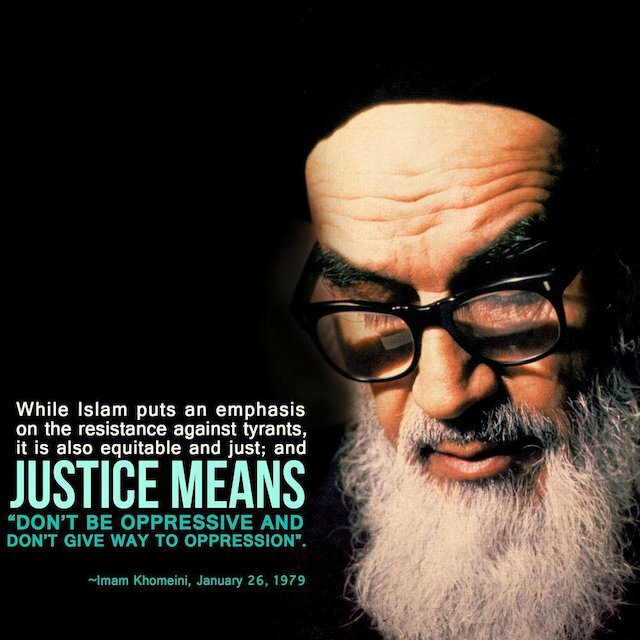
On February 11, Imam Khomeini declared a provisional government. On March 30, 1979, and March 31, 1979, the provisional government asked all Iranians sixteen years of age and older, male and female, to vote in a referendum on the question of accepting an Islamic Republic as the new form of government and constitution. Through the ballot box, over 98% voted in favor of replacing the monarchy with an Islamic Republic. Subsequent elections were held to approve of the newly-drafted Constitution. Along with the position of the Grand Leader, the constitution also requires that a president be elected every four years, but only those candidates approved indirectly by the Council of Guardians may run for the office. Imam Khomeini himself became instituted as the Grand Leader for life, and officially decreed as the "Leader of the Revolution." After assuming power, Islam was made the basis of Iran's new constitution and obedience to Islamic laws made compulsory.
Relationship with other Islamic nations
Imam Khomeini intended to reconstruct Muslim unity and solidarity, so he declared the birth week of Prophet of Islam (the week between 12th to 17th of Rabi'al-Awwal in Islamic Hegira calendar) as the Unity Week. Then he declared the last Friday of the fasting month of Ramadan as the International Day of Quds in 1979.
But because of Islamic ideology of Islamic Republic of Iran, most rulers of other Muslim nations turned against him and supported Iraq in the imposed war against Iran, even though most of Islamic parties and organizations supported his idea.
Iran-Iraq War
Saddam Hussein, Iraq's secular Arab nationalist Ba'athist leader, was eager to take advantage of Iran's weakened military and (what he assumed was) revolutionary chaos, and in particular to occupy Iran's adjacent oil-rich province of Khuzestan and undermine attempts by Iranian Islamic revolutionaries to incite the Shia majority of his country.
With what many believe was the encouragement of the United States, Saudi Arabia and other countries, Iraq soon launched a full scale invasion of Iran, starting what would become the eight-year-long Iran-Iraq War (September 1980 - August 1988). A combination of fierce patriot resistance by Iranians and military incompetence by Iraqi forces soon stalled the Iraqi advance and by early 1982 Iran regained almost all the territory lost to the invasion. The invasion rallied Iranians behind the new regime, enhancing Imam Khomeini's stature and allowed him to consolidate and stabilize his leadership.
Although outside powers supplied arms to both sides during the war, the West (America in particular) became alarmed by the possibility of the Islamic Revolution spreading throughout the oil-exporting Persian Gulf oil and began to supply Iraq with whatever help it needed. The war continued for another six years, with 450,000 to 950,000 casualties on the Iranian side and the use of chemical weaponry by the Iraqi military.
As the costs of the eight-year war mounted, Imam Khomeini, in his words, "drank the cup of poison" and accepted a truce mediated by the United Nations. As the war ended, the struggles among the clergy resumed and Imam Khomeini’s health began to decline.
Rushdie Fatwa
In early 1989, Imam Khomeini issued a fatwa calling for the killing of Salman Rushdie, an Indian-born British author. Imam Khomeini claimed that Rushdie's murder was a religious duty for Muslims because of his alleged blasphemy against Prophet Mohammad in his novel, The Satanic Verses. Rushdie's book contains passages that some Muslims — including Ayatollah Imam Khomeini — considered offensive to Islam and the Prophet. Though Rushdie publicly apologized, the fatwa was not revoked, Imam Khomeini explaining that "even if Salman Rushdie repents and becomes the most pious man of all time, it is incumbent on every Muslim to employ everything he has got, his life and wealth, to send him to Hell."
Letter to Mikhail S. Gorbachev
In December 1988 (before the fall of the Berlin Wall), Ayatollah Imam Khomeini sent a letter to USSR President Mikhail Gorbachev predicting the fall of Communism and inviting him to study and research Islam. In his historical letter he wrote: "It is clear to everyone that Communism should henceforth be sought in world museums of political history."
Life under Imam Khomeini
Under Imam Khomeini's rule, Sharia (Islamic law) was introduced, with the Islamic dress code enforced for both men and women. Women had to cover their hair, and men were not allowed to wear shorts.
Life for religious minorities has been mixed under Imam Khomeini and his successors. Shortly after his return from exile in 1979, Imam Khomeini issued a fatwa ordering that Jews and other minorities (except Bahai) be treated well. By law, several seats in the Parliament are reserved for minority religions. Imam Khomeini also called for unity between Sunni and Shia Muslims (Sunni Muslims are the largest religious minority in Iran).
Death and funeral
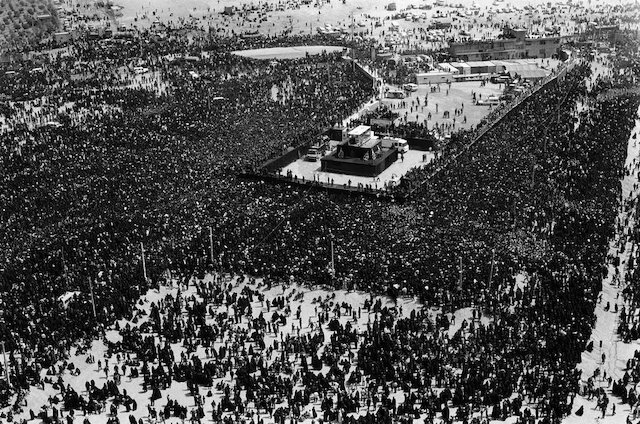
After eleven days in a hospital for an operation to stop internal bleeding, Imam Khomeini died of cancer on Saturday, June 3, 1989, at the age of 89. Many Iranians mourned Imam Khomeini's death and poured out into the cities and streets. More than 10 million people from across the country attended Imam Khomeini’s funeral to form one of the largest ever funerals in the world.
Following Imam Khomeini’s demise, Ayatollah Seyyed Ali Khamenei came to be selected on June 4, 1989 by the Assembly of Experts to be his successor, in accordance with the Constitution.
Political thought and legacy
Imam Khomeini adamantly opposed monarchy, arguing that only rule by a leading Islamic jurist would insure Sharia was properly followed (Velayat-e Faqih).
Imam Khomeini believed that Iran should strive towards self-reliance. He viewed certain elements of Western culture as being inherently decadent and a corrupting influence upon the youth. His ultimate vision was for Islamic nations to converge together into a single unified power, in order to avoid alignment with either side (the West or the East), and he believed that this would happen at some point in the near future.
Imam Khomeini expressed support for the Universal Declaration of Human Rights; in Sahifeh Nour (Vol. 2, page 242), he states: "We would like to act according to the Universal Declaration of Human Rights. We would like to be free. We would like independence."
Imam Khomeini led an ascetic lifestyle, being deeply interested in mysticism, and was against the accumulation of land and wealth by the clergy.
Many of Imam Khomeini's political and religious ideas were considered to be progressive and reformist by leftist intellectuals and activists prior to the Revolution.
Imam Khomeini's definition of democracy existed within an Islamic framework. His last will and testament largely focuses on this line of thought, encouraging both the general Iranian populace, the lower economic classes in particular, and the clergy to maintain their commitment to fulfilling Islamic revolutionary ideals.
Family and descendants
In 1929, Imam Khomeini married Batol Saqafi Khomeini, the daughter of a cleric in Tehran. They had seven children, though only five survived infancy, 3 daughters and 2 sons. His sons entered into religious life. The elder son, Mostafa, was murdered in 1977 while in exile with his father in Najaf, Iraq and SAVAK (the Imperial-era secret police) was accused of his death by Imam Khomeini. Ahmad Khomeini, the younger son, died in 1995.
Imam Khomeini's grandson Seyyed Hassan Khomeini, son of the late Seyyed Ahmad Khomeini, is also a cleric and the trustee of Imam Khomeini's shrine.
Works:
Velayat-e Faqih
Forty Hadiths (Forty Traditions)  
Adab-e Salat (The Disciplines of Prayers)       
Jihad-e Akbar (The Greater Struggle)
Tahrir al-Wasilah
Interpretation of Surah Fatihah
Serr al-Salat (Secrets of Prayers)
Interpretation of Dawn Pray
Interpretation of Forces of Reason and Negligence Tradition 
Hajj
Source: Khamenei.ir

Sunday, April 28, 2019

Security requisite for economic prosperity: Leader

TEHRAN, Apr. 28 (MNA) – In a meeting with Iran’s police commanders, the Leader of the Islamic Republic Ayatollah Khamenei stressed the need for ramping up the fight against smuggling in line with the objective of ‘Boosting Domestic Production’ as well as the fight against cyber crimes.
According to the official website of the Leader of the Islamic Republic ‘Khamenei.ir’, Law Enforcement commanders and directors met with the Leader Ayatollah Khamenei on Sunday afternoon during which he stressed the need for fulfilling the slogan of the year 1398, which is ‘Boosting Domestic Production.’
The Commander-in-Chief of Iran’s Armed Forces Ayatollah Khamenei stressed the need to persist with the current movement of the Police Forces towards the ideal Police Force as set by the Islamic Republic, and asserted “the Police Forces should seriously counter smuggling and confront those who disturb the security of the cyberspace.”
Regarding as significant the Police Forces’ role in the realization of the year’s motto, that is ‘Boosting Domestic Production’ as well as providing security on the cyberspace, the Leader called sovereignty and compassion the two complementing characteristics of the Police Forces.
Ayatollah Khamenei referred to the 24-hour services and endeavors of the hard-working Police staff during ‘Eids and holidays and went on to say that “in the event of recent floods, the Police Forces performed luminously by serving the affected populations and securing the flood-stricken regions.”
The Leader of the Islamic Revolution described the achievements by the Police Forces in recent years as a valuable reality and went on to say “yet, it does not mean that the Police Force is already at the esteemed status desired by the Islamic Republic. That status should be achieved by continuous work; and any factor that might make the people question the virtues and honors of the Police Force, be it an unqualified officer in a police station, should be corrected.”
Ayatollah Khamenei stressed that profit is not the only reason behind the illegal trafficking of products and warned of possible conspiracies by stating that “it is not only a quest for profit that motivates some of these [smugglings]; rather, there is a plot, a plan with evil intentions involved in some case and the Police must confront with utter vigilance.”
The Leader pointed out to cybersecurity as another important issue and maintained “today the cyberspace is widely present in people’s life and despite its benefits and potentials, it also poses grave risks”
He added that a lack of security on the cyberspace is harmful to people and reiterated the duty of the Police in providing cybersecurity.
Ayatollah Khamenei referred to ‘the prohibition of arms trade’ as another important duty to be fulfilled by the Police Forces and stated “in some countries like the United States, the sale and purchase of weapons are allowed due to the profit arm manufacturers win; nevertheless, it causes problems for the people. In our country, however, this is not allowed and the prohibition must be enforced.”
Pointing out to a recent tragedy wherein a clergy was murdered in Hamadan, the Leader of the Revolution insisted on preventing the sale of arms on the cyberspace and held “the person who murdered a clergy in Hamadan yesterday had previously published his photos with 4 different handguns and rifles, and confronting such matters falls under the responsibility of the Police Forces.”
Before the Leader of the Islamic Revolution commenced his statements, Brigadier General Ashtari, the Commander-in-Chief of the Police Force, reported on some of the services offered by the Police Forces including active involvement in and providing security at different events such as the Arbaeen pilgrimage, identifying and confronting economic corruption, special planning for Nowruz holidays to reduce accidents and road casualties, mobilization of forces and facilities to help flood victims and providing security in those regions, and said, "During the second phase of the Revolution, with great resolution, administrative transparency, sincerity, and offering unconditional service to the people, our goal will be to achieve a Police Force in the same status as desired by the Revolution and the Islamic Civilization."