Showing posts with label Palestinian Authority (PA). Show all posts

Sunday, December 15, 2019

Hamas celebrates its 32nd anniversary in Gaza

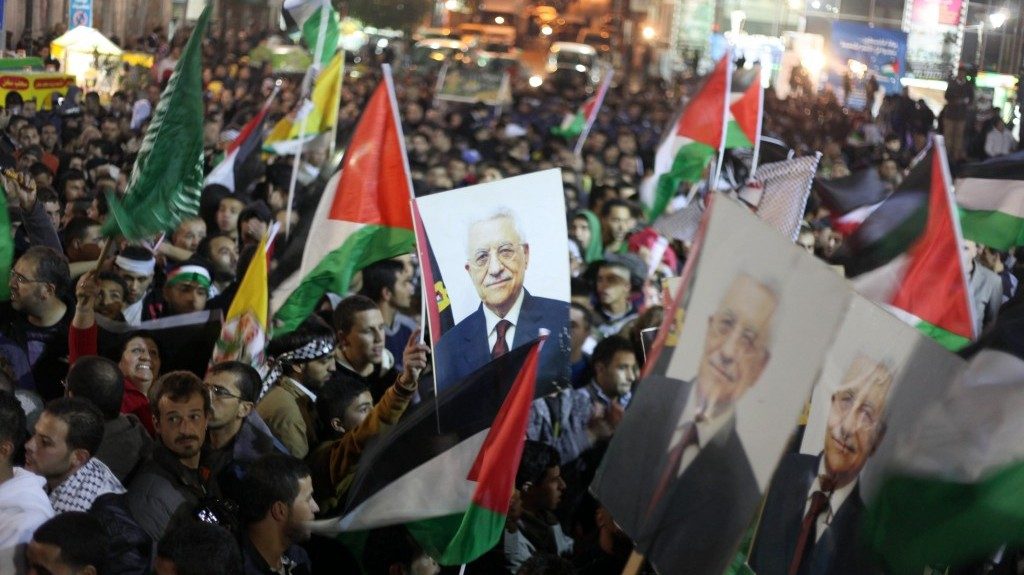
Thousands of Palestinians took to the streets on Friday in the north of the Gaza Strip, to celebrate the 32nd anniversary of the Palestinian Islamic Resistance Movement Hamas.
Hamas gave the name ‘The Edge of the Sword’ to this year’s celebrations of its anniversary. This name was attributed to the Hamas military wing’s operation, when it foiled a plan by an Israeli special unit aimed at the Palestinian resistance last year.
For the first time, Hamas did not organise a central rally in the city of Gaza for its supporters, where leaders from other parties usually deliver speeches and artists perform folkloric shows, glorifying the Palestinian resistance.
In order to deal with the financial crisis, this year Hamas planned marches across the different cities along the Gaza Strip.
Participants and Hamas supporters raised Hamas flags and pictures of late Hamas founders and leaders, as they listened to the speeches of Hamas leaders.
During the march organised in the city of Jabalia, north of the Gaza Strip, member of Hamas Political Bureau, Fathi Hammad, announced: “Our people will not give up resistance until the Israeli occupation has ended.”
He added: “The time for imposing solutions has gone, and if the Israeli occupation rejects all proposed solutions and does not stop its violations against our people under the pressure of popular resistance, we will resume armed resistance.”
The senior Hamas leader hailed the Joint Operations Room of the military wings of the Palestinian factions in Gaza, stressing: “The Joint Operations Room will remain the highest body for popular and armed resistance.”
Commenting on the issue of Israeli prisoners captured by the Palestinians resistance, Hammad disclosed: “It seems that the Israeli occupation is not interested in the release of its captive soldiers. We will never release them without the release of our prisoners.”
Regarding national unity and the elections, he elucidated: “Hamas does not have any sanctions on the achievement of national unity. It is also ready for the elections and we call for President Mahmood Abbas to issue the election decree as soon as possible.”
Meanwhile, Hamas spokesman, Hammad Al-Reqib, informed a march in the city of Khan Younis, in the south of the Gaza Strip, that his movement “has no problem with political plurality and insisted on forming a government from the different Palestinian factions when it won the elections in 2006, which the Palestinian factions rejected.”

Thursday, January 24, 2019

False ‘Victories’: Is the PA Using the ‘State of Palestine’ to Remain in Power?

The ‘State of Palestine’ has officially been handed the Chairmanship of the G-77, the United Nations largest block. This is particularly significant considering the relentless Israeli-American plotting to torpedo Palestinian push for greater international recognition and legitimacy.
It is now conclusive that the main mission for former United States Ambassador to the UN, Nikki Haley, was an unmitigated failure.
When Haley gave her infamous speech before the pro-Israel lobby, AIPAC, in March 2017 – declaring herself the ‘new sheriff in town’ on behalf of Israel – the US-Israeli designs were becoming clearer: never again will the US shy away from defending Israel at the UN as the previous Obama Administration had done in December 2016.
In retrospect, Haley’s tactics – the aggressive language, the constant threats and outright political bullying – amounted to nothing. Her short stint of two years at the UN has only managed to, once again, accentuate US dwindling power and influence on the international stage.
Instead of isolating Palestinians, the US ended up joining Israel in its own isolation. Unable to make any tangible ‘achievements’ in favor of Israel, a frustrated US administration carried out its threats as it quit crucial UN bodies like UNESCO, Human Rights Council, among others. In doing so, the US is now imprudently dismantling the very international order it helped create following World War II.
The Palestinian Authority, on the other hand, has taken full advantage of the obvious shift in world order. Being voted to the helm of the G77 – which bonds 134 countries from the South in a massive economic order – is an extraordinary event.
But what does this mean in terms of the Palestinian quest for statehood?
The PA seems to operate within two separate – and often contradictory – political spheres.
On the one hand, it is in full cooperation with Israel in terms of ‘security coordination‘, at times serving as if Israel’s policeman in the Occupied West Bank. Its constant crackdown on Palestinian dissent and its monopolization of Palestinian decision-making have been major obstacles before the Palestinian people in their fight for rights, justice and freedom.
On the other hand, the PA has been pursuing a determined path towards international recognition, starting with its successful bid to obtain a non-member observer status for the State of Palestine in November 2012.
That momentous event, which took place despite US-Israeli strong rejection and protests, opened up the door for Palestine to join various UN organizations such as the International Criminal Court.
Palestine is yet to acquire full UN membership, a pursuit that is being renewed at the moment. However, as of August 2015, the flag of Palestine has been fluttering at the UN headquarters, along with those of 193 other nations.
So how is one to reconcile between these two realities?
It goes without saying that the international support that Palestine is receiving at the UN is an outcome of existing solidarity and sympathy with the Palestinian people and their rightful struggle for human rights and independence. It has preceded the PA by decades, and will be there for many years to come.
The PA, however, has tactfully translated this international support and validation to political assets among Palestinians at home.
Indeed, much of the support that the PA and its dominant Fatah party continue to enjoy among ordinary Palestinians is driven by the following logic: every symbolic diplomatic ‘victory’ achieved by the PA abroad is followed by massive celebrations in Ramallah, fiery speeches of an imminent freedom and statehood.
But freedom, of course, remains elusive, partly because the PA is yet to develop a real strategy for resisting Israeli military Occupation and colonization. Its determination and vigor to acquire more international recognition is juxtaposed with utter laxity and disinterest in developing a unified national strategy in Palestine itself.
This points to an unmistakable conclusion: The PA’s strategy is merely focused on the very survival of the PA as a political apparatus, and on ‘Palestinian independence’ within an immaterial diplomatic sphere, without any tangible evidence of that ‘independence’ on the ground.
How else can one explain the fierce fight, in the name of Palestine and those suffering in Gaza, put up by PA President, Mahmoud Abbas, and his Ambassador, Riad al-Maliki at the UN, while the PA continues to withhold salaries from besieged Palestinians in the Gaza Strip?
The sad truth is that the fight for Palestinian recognition at the UN is, at its core, a fight for Abbas and his Authority to remain relevant, and solvent, in a changing international political order.
Meanwhile, for Palestinians, Abbas’ diplomatic achievements represent the proverbial morphine shots injected in the collective vein of an occupied and suffering people, desperate for a ray of hope.
According to the General Federation of Palestinian Trade Unions, poverty in the Gaza Strip has exceeded 80 percent, coupled with a 54.9% level of unemployment. The West Bank, too, is suffering, with the Israeli army and violent illegal Jewish settlers terrorizing the Palestinian population there. Thousands of Palestinian men and women languish in Israeli jails, hundreds of them held without trial.
Not only has the PA done little to challenge – or, at least, attempt to reverse – that reality, it has, at times contributed to it. Yet, oddly, the PA’s pitiful political discourse in Palestine is contrasted with a well-defined, articulate and purportedly courageous language outside.
“We will go to the Security Council for submitting our application,” to obtain full Palestinian membership at the UN, Palestinian Ambassador, al-Maliki, told reporters on January 15. “We know that we are going to face a US veto but this won’t prevent us from presenting our application”.
In fact, this is the crux of the PA strategy at the moment. Knowing that it has little legitimacy among ordinary Palestinians, the PA is desperate to find an alternative source of legitimacy somewhere else.
While a greater support for the ‘State of Palestine’ is a positive sign indicating a changing world order, it is, sadly, used by the Palestinian leadership to sustain its own oppressive, futile and corrupt political gambit.
Ramzy Baroud is a journalist, author and editor of Palestine Chronicle. His latest book is The Last Earth: A Palestinian Story (Pluto Press, London, 2018). He earned a Ph.D. in Palestine Studies from the University of Exeter and is a Non-Resident Scholar at Orfalea Center for Global and International Studies, UCSB.

Saturday, October 27, 2018

Netanyahu in Oman: Another Step toward Palestinian Betrayal

Crescent International


Why would the rulers of Oman welcome the war criminal Benyamin Netanyahu in their midst?
The surprise visit and meeting with Oman’s Sultan Qaboos late on Thursday (October 25), was kept secret until Netanyahu’s return home. The two countries have no diplomatic ties but that has not deterred such meetings between Arabian rulers and the Zionists.
Instead, Omani TV showed Netanyahu being warmly welcomed and walking with Sultan Qaboos.
Accompanying Netanyahu was his wife Sara and his delegation included Mossad intelligence chief Yossi Cohen and National Security Adviser Meir Ben-Shabbat.
The visit occurred at the invitation of the Omani ruler, according to Netanyahu’s office. Why were the Omanis so keen to shake hands with a war criminal?
On October 27, Omani Foreign Minister Yousuf bin Alawi bin Abdullah offered a tepid excuse telling a security summit in Bahrain’s capital Manama that the sultanate would not act as a ‘mediator’ in the Israeli-Palestinian dispute.
It was only offering ideas to help Israel and Palestinians to come together, he said.
If so, why was it necessary to allow Netanyahu to set foot in Oman and given a lavish welcome by the sultan himself? This could have been done without meeting face to face.
The Omani minister then made a Freudian slip admitting that the sultanate had also decided to surrender. He said Israel was “present in the region, and we all understand this, the world is also aware of this fact and maybe it is time for Israel to be treated the same and also bear the same obligations.”
Unlike other Arabian regimes, Oman had so far followed a fairly balanced policy and has not been railroaded into the disastrous policy of surrender to the Zionists.
This, however, may be changing despite the unraveling of America’s Middle East policy. In Syria, the warmongers have been defeated after seven years of blood letting.
President Bashar al Asad is still in power in Damascus and his army is close to liberating the last province—Idlib—from the clutches of the takfiri terrorists.
Similarly, the brutal murder of Jamal Khashoggi has exposed the Saudi crown prince Muhammad bin Salman as a monster, not as a ‘moderate’ that the West has tried to project him.
Donald Trump’s ‘deal of the century’ that is being imposed on the Palestinians through the Arabian rulers has also not made much headway. It has in fact received a setback following Bin Salman’s brutal tactics.
Not surprisingly, Netanyahu was pleased with his visit. “A special visit in Oman — we’re making history!” Netanyahu wrote on Twitter, posting a video of his reception and meeting.
The Zionist ruler discussed the Middle East peace process “and other issues of shared interest” with Sultan Qaboos, Netanyahu’s office said in a statement.
Mahmud Abbas, illegal head of the Palestinian Authority (PA), had also visited Oman before Netanyahu’s visit. This was confirmed by the Palestinian news agency Wafa.
The US plan is so outlandish that even Abbas has renounced it. He says it has been devised without consulting the Palestinians.
The American plan would reduce Palestinians to live on tiny Bantustan-type enclaves with few rights.
They would be in charge of cleaning garbage but little else and will have to live at the non-existent mercies of the Zionists.
Trump has already declared Jerusalem as the “capital” of Israel without much of a response from the Arabian regimes or even the broader Muslim world.
Instead, last June Saudi Arabia, the United Arab Emirates, Egypt, and Jordanassured Washington of their support for the plan during visits to those countries by Trump’s senior adviser and son-in-law Jared Kushner, and Jason Greenblatt, the US envoy to the region.
Palestinian resistance groups—Hamas and Islamic Jihad—both condemned Netanyahu’s visit to Oman. They urged the Arabian rulers to support the oppressed people of Palestine, instead.

Hamas warned about the dangerous consequences of Netanyahu’s visit for the people of Palestine. Islamic Jihad movement also censured the visit, saying Oman acquitted Netanyahu of the crimes committed against innocent Palestinians by welcoming him to the country.

Thursday, September 13, 2018

What Lies Beneath: The US-Israeli Plot to ‘Save’ Gaza


By Ramzy Baroud


Children in the Gaza Strip. Gazans have suffered from the devastation of
three major Israeli military operations and Israel's ongoing illegal blockade.

Why would the US manufacture a major humanitarian crisis in Gaza while engaging in discussions about the urgent need to end Gaza’s humanitarian woes?
Israel wants to change the rules of the game entirely. With unconditional support from the Trump Administration, Tel Aviv sees a golden opportunity to redefine what has, for decades, constituted the legal and political foundation for the so-called ‘Palestinian-Israeli conflict.’
While US President Donald Trump’s foreign policy has, thus far, been erratic and unpredictable, his administration’s ‘vision’ in Israel and Palestine is systematic and unswerving. This consistency seems to be part of a larger vision aimed at liberating the ‘conflict’ from the confines of international law and even the old US-sponsored ‘peace process.’
Indeed, the new strategy has, so far, targeted the status of East Jerusalem as an Occupied Palestinian city, and the Right of Return for Palestinian refugees. It aims to create a new reality in which Israel achieves its strategic goals while the rights of Palestinians are limited to mere humanitarian issues.
Unsurprisingly, Israel and the US are using the division between Palestinian factions, Fatah and Hamas, to their advantage. Fatah dominates the Palestinian Authority (PA) in Ramallah while Hamas controls besieged Gaza.
A carrot and a stick scenario is being applied in earnest. While, for years, Fatah received numerous financial and political perks from Washington, Hamas subsisted in isolation under a permanent siege and protracted state of war. It seems that the Trump Administration—under the auspices of Trump’s senior adviser and son-in-law, Jared Kushner—are turning the tables.
The reason that the PA is no longer the ‘moderate’ Palestinian leadership it used to be in Washington’s ever self-serving agenda is that Mahmoud Abbas has decided to boycott Washington in response to the latter’s recognition of all of Jerusalem as Israel’s capital. True, Abbas’ subservience has been successfully tested in the past but, under the new administration, the US demands complete ‘respect’, thus total obedience.
Hamas, which is locked in Gaza between sealed borders from every direction, has been engaging Israel indirectly through Egyptian and Qatari mediation. That engagement has, so far, resulted in a short-term truce, while a long-term truce is still being discussed.
The latest development on that front was the visit by Kushner, accompanied with Middle East envoy, Jason Greenblatt, to Qatar on August 22. There, Gaza was the main topic on the agenda.
So, why is Gaza, which has been isolated (even by the PA itself) suddenly the new gate through which top US, Israeli and regional officials are using to reactivate Middle East diplomacy?
Ironically, Gaza is being particularly suffocated these days. The entire Gaza Strip is sinking deeper in its burgeoning humanitarian crisis, with August being one of the most grueling months.
A series of US financial aid cuts has targeted the very socio-economic infrastructure that allowed Gaza to carry on, despite extreme poverty and the ongoing economic blockade.
On August 31, Foreign Policy magazine reported that the US administration is in the process of denying the UN Palestinian refugees agency, UNRWA—which has already suffered massive US cuts since January—of all funds. Now the organization’s future is in serious peril.
The worrying news came only one week after another announcement, in which the US decided to cut nearly all aid allocated to Palestinians this year, $200 million, mostly funds spent on development projects in the West Bank and humanitarian aid to Gaza.
So why would the US manufacture a major humanitarian crisis in Gaza—which suits the right-wing government of Benjamin Netanyahu well—while, simultaneously, engaging in discussions regarding the urgent need to end Gaza’s humanitarian woes?
The answer lies in the need for the US to manipulate aid to Palestinians in order to exact political concessions for Israel’s sake.
Months before rounds of Egyptian-sponsored indirect talks began between Israel and Hamas, there has been an unmistakable shift in Israeli and U.S. attitudes regarding the future of Gaza:
On January 31, Israel presented to a high-level conference in Brussels ‘humanitarian assistance plans’ for Gaza at a proposed cost of $1 billion. The plan focuses mostly on water distillation, electricity, gas infrastructure and upgrading the joint industrial zone at the Erez crossing between Gaza and Israel. In essence, the Israeli plan is now the core discussion pertaining to the proposed long-term ceasefire.
The meeting was attended by Greenblatt, along with Kushner who is entrusted with implementing Trump’s unclear vision, inappropriately termed ‘the deal of the century.’
Two months later, Kushner hosted top officials from 19 countries to discuss the humanitarian crisis in Gaza.
Clearly, there is a common thread between all of these activities.
Since the US decided to defy international law and move its embassy from Tel Aviv to Jerusalem last December, it has been in search of a new strategy that will circumvent the PA in Ramallah.
PA President, Abbas, whose political apparatus is largely reliant on ‘security coordination’ with Israel, US political validation and financial handouts, has little with which to bargain.
Hamas has relatively greater political capital—as it has operated with less dependency on the Israeli-US-western camp. But years of relentless siege, interrupted by massive deadly Israeli wars, have propelled Gaza into a permanent humanitarian crisis.
While a temporary truce between Israel and Hamas-led Palestinian groups in Gaza went into effect on August 15, a long-term truce is still being negotiated. According to the Israeli daily Haaretz, citing Israeli officials, the truce would include a comprehensive ceasefire, opening all border crossings, expansion of the permitted fishing area off the Gaza coast, and the overhauling of Gaza’s destroyed economic infrastructure—among other stipulations.
Concurrently, Palestinian officials in Ramallah are fuming. ‘Chief negotiator,’ Saeb Erekat, accused Hamas of trying to “destroy the Palestinian national project,” by negotiating a separate agreement with Israel. The irony is that the Fatah-dominated Palestine Liberation Organization (PLO) and PA have done just that for over 25 years.
However, delinking the future of Gaza from the future of all Palestinians can, indeed, lead to dangerous consequences.
Regardless of whether a permanent truce is achieved between Israel and the Hamas-led Gaza factions, the sad truth is that whatever grand illusion is harbored by Washington and Tel Aviv at the moment is almost entirely based on exploiting Palestinian divisions, for which the Palestinian leadership is to be wholly blamed.