Showing posts with label Great March of Return. Show all posts

Friday, November 01, 2019

70 years of shooting refugees

Jake Batinga
Despite Israel’s brutality, Palestinians have insisted for seven decades that the right of refugees to return home be upheld. 
Ashraf AmraAPA images
Since March 2018, weekly protests – known as the Great March of Return – have been held in Gaza.
The demonstrators are insisting that people uprooted by Zionist forces during the Nakba – the 1948 ethnic cleansing of Palestine – be allowed to go home. This right of return has been recognized by United Nations General Assembly resolution 194, passed in December 1948.
Israel has responded brutally to demands that this basic right be upheld. More than 210 Palestinians have been killed during the Great March of Return and more than 9,000 have been injured by live fire.
As well as insisting that the right to return be respected, Palestinian refugees have occasionally attempted to exercise that right over the past seven decades. In doing so, they have been treated with extreme violence.
In the years following the adoption of UN resolution 194, large numbers of people living in Gaza tried to cross the boundary with Israel, a newly established state. In an Orwellian turn of phrase, the Israeli authorities designated these returning refugees as “infiltrators.”
In his book Israel’s Border Wars, the historian Benny Morris writes that the so-called infiltration was “a direct consequence of the dispossession of hundreds of thousands of Palestinians.”
Refugees sought to reunite with family, tend crops, recover lost possessions and, of course, see their old homes.

Firing “at anything that moved”

Israel’s Border Wars was published in 1997 – seven years before Morris argued that Zionist forces should have expelled all Palestinians in the 1940s. Despite his attempts to defend ethnic cleansing, Morris has never repudiated the important facts he had previously unearthed.
And we can continue to learn a considerable amount from his work about crimes committed in the name of Israel and its state ideology Zionism.
He recounts, for example, how Israel operated a “free fire” policy on refugees seeking to return home. According to Morris, Israeli forces “fired at anything that moved” and often executed injured refugees “on the spot.”
Between 2,700 and 5,000 refugees were killed under the free fire policy, the vast majority of whom were unarmed civilians, from 1949 to 1956. Furthermore, “no Israeli soldier, policeman, or civilian was ever tried for shooting and killing an unarmed Arab infiltrator,” Morris writes.
While Palestinian refugees were slaughtered for attempting to exercise their right of return, Israel’s parliament, the Knesset, passed the cynically titled “Law of Return” in 1950. It granted Jews from around the world the right to gain Israeli citizenship and live in Israel.
Immigrants to Israel, many of whom were Holocaust survivors, often settled in the vacant homes of Palestinian refugees.
Another policy implemented against Palestinian refugees seeking to go home was known as “retaliation.”
Israel “retaliated” by raiding villages in Jordan, Egypt, Gaza, and Syria. These raids were meant to punish communities that had allegedly helped returning refugees.
In his book The Iron Wall, the historian Avi Shlaim writes that the reprisals were effectively “a form of collective punishment against whole villages.”
One notable case of “retaliation” occurred during October 1953 in the Jordanian village of Qibya.
According to Shlaim’s book, Israeli commandos raided Qibya, forced the residents to stay in their homes, then blew up the houses with everyone still inside. At least 69 people were killed, most of them women and children.
The leader of this raid was a young commander named Ariel Sharon, who would later be dubbed the “butcher of Beirut” for his role in the 1982 mass slaughter at Sabra and Shatila, Palestinian refugee camps in Lebanon.

Shifting the blame

Israel has consistently sought to shift the blame for its own violence.
In the 1950s, the Israeli government blamed Arab governments and Palestinian refugees themselves. According to Shlaim, Israel claimed that the killing of civilians was a “legitimate form of self-defense.”
Identical – or almost identical – words are used by Israel’s political leaders today.
Benjamin Netanyahu, Israel’s prime minister, has invoked “self-defense” to try and justify the killing of unarmed protesters in Gaza. After one Israeli massacre in Gaza last year, Netanyahu claimed the state was acting “to protect its sovereignty and the security of its citizens.”
When a video was broadcast which showed Israeli troops gleefully cheering and laughing as a sniper shoots a protester, Israeli politicians rushed to defend the troops.
Avigdor Lieberman, then Israel’s defense minister, stated that the sniper in the video “deserves a commendation.” Naftali Bennett, also a government minister at the time, said that “judging soldiers because they are not expressing themselves elegantly while they are defending our borders is not serious.”
Today, the Israeli government smears Gaza protesters as “terrorists.” Benny Morris has noted how “infiltrator” – the term applied to Palestinian refugees seeking to go home – quickly became synonymous with “terrorist.”
And just as the Israeli authorities tried to evade responsibility for its attacks on Arab neighbors in the 1950s, today’s politicians try to blame Hamas for the deaths of protesters in Gaza.
Lieberman has alleged that “no innocent civilians” have taken part in Gaza’s protests, which he has nicknamed the “march of terror.” All the protesters, according to Lieberman, have been Hamas members.
Another pattern can be discerned. Palestinians fought for their rights in the years immediately following the Nakba, as they are doing in the 21st century.
Israeli brutality continues – and so does the struggle against it.
Jake Batinga is a California-based writer and activist. He lived in the occupied West Bank city of Hebron, while working with the International Solidarity Movement, documenting human rights abuses by the Israeli army and settlers.

Friday, August 30, 2019

Mazin Qumsiyeh: Gaza Used as Testing Laboratory for Israel’s Weapons Marketing Campaign


Mazin Qumsiyeh: Gaza Used as Testing Laboratory for Israel’s Weapons Marketing Campaign
TEHRAN (FNA)- Palestinian author and activist Mazin Qumsiyeh says the besieged Gaza Strip is used as a laboratory for the Israeli regime to test its new weapons and to boost Tel Aviv’s arms industry.
Mazin Qumsiyeh, in an exclusive interview with FNA, said that Israel’s grand strategy of colonialism is shared by all Zionist parties and they only differ in their techniques to employ that strategy.

Mazin Qumsiyeh is a Palestinian scientist, author and activist. He is the author of “Sharing the Land of Canaan: Human Rights and the Israeli-Palestinian Struggle”.

FNA has conducted an interview with Mazin Qumsiyeh about Israel’s brutal crackdown on Palestinian protesters, the Israeli legislation known as the Nation State Law and also Trump’s so-called "deal of the century.”

Below you will find the full text of the interview.

Q: It seems that killing scores of people and maiming thousands more over the past several months is no indication of what Israel thinks is enough to keep Gaza in check. Do you think Israel’s deadly clamp down on Palestinian protesters is going to end anytime soon?

A: Israel’s grand strategy is now well known and is based on typical colonial systems: separate natives from their land, destroy their economy, and build a new economy using the resources stolen. That strategy is shared by all Zionist parties but they differ on techniques. The so called “right wing” which dominated Israeli politics in the past two decades and which the US government fully supports (due to the lobby) believes in using maximum force to keep the Palestinian pacified/docile. In the case of besieged/blockaded Gaza, there is another tactic in work which is needed to boost the arms industry in Israel: new weapons have to be tested to boost sales, so Gaza acts as laboratory. This will continue unless either the International community wakes up and ensures human rights and international laws are respected OR the local resistance costs Israel significant price tag to restrain its trigger-happy leaders

Q: It’s been a year since the start of the protests known as the ‘Great March of Return.’ What do you think the march has accomplished so far?

A: Yes, these protests achieved much: pressure on the apartheid regime and on the international community in ways that are the only ways available to a captive population. But regardless of levels of success, in any case these are natural outbursts of desperate population whom much of the world governments (under pressures of strong Zionist lobbies) simply ignore.

Q: How do you think the US and some Arab states are complicit in crimes against the Palestinians especially in light with the discreet links between Israel and Saudi Arabia and other Persian Gulf states?

A: The complicity is deeper than even the strongest claims in social media and published articles occasionally expose. There are books written on this for example Noam Chomsky’s “The Fateful Triangle”. For example, the Saudi Regime was complicit with Britain in allowing Zionists to take a foothold in Palestine as early as 1916-1917.

Q: In July 2018, the so-called nation state law was adopted by Israeli Knesset. What do you think the legislation shows about the nature of the regime in Tel Aviv?

A: It is added to 65 other laws that discriminate against “non—Jews” in the Jewish state. The remaining Palestinians in historic Palestine suffer various degrees of discrimination. The 1.5 million who hold Israeli blue ID card have these 66 laws that discriminate against them. We in the West Bank and Gaza also get hundreds of racist apartheid laws in the form of military orders. It is expected in a racist settler colonial state to have racist laws.

Q: Many believe that the continuing illegal Israeli settlement activities have hammered nail after nail into the coffin of a diplomatic solution. What do you think about that?

A: I think people need to think of paradigms of outcomes for colonial anti-colonial struggles. Diplomacy has little to do with it. There are only three possible outcomes for such struggles: The Algeria model, the Australia/New Zealand model (genocide), and (the most common) the Latin America/South Africa model. The third model is the most common outcome of colonialism and the one that the vast majority of native people always support whether in South Africa or Palestine. Colonial settlements are integral to colonial mindsets and are not obstacles to “peace” since no such peace is possible unless colonialists either abandon colonial mentality or commit genocide against the natives.

Q: The current administration in the US has been boasting about its new plan for Palestine and even calling it the deal of the century. What do you think would be in the new deal for the Palestinians?
A: The so called deal of the century is the plan that is ongoing and has been ongoing for decades: ethnic cleansing, destruction, murder of natives, and normalizing colonial structures in the world. Trump and company have nothing new but to implement the Israeli wishful thinking of liquidating the Palestinian cause.

Wednesday, April 03, 2019

Zionist War Crimes in Gaza

Editor
That Israeli rulers — civilian and military — are war criminals is well known. They are also racists and bigots based on their own statements and conduct. Zionist apologists living outside the racist entity in Colonized Palestine vehemently protest when Zionist crimes are exposed. Mention Israel’s crimes and they trot out the vicious allegation of anti-Semitism. This is wearing thin as increasing numbers of people are becoming aware of the Zionist entity’s true nature.
If anybody still harbors any illusions about Zionist Israel’s ugly and atrocious conduct, the Independent Commission of Inquiry established by the UN Human Rights Council’s report should dispel them. Tasked with investigating the killing of Palestinians in Gaza, the UN Inquiry Commission released its report on March 18. As an official body, it couched its findings in carefully phrased diplomatic language but the message was clear.
The report said that Israel may be guilty of war crimes in Gaza. The Commission investigated Israeli snipers shooting unarmed Palestinian protesters participating in the Great March of Return that was launched a year ago (March 30, 2018). The Palestinians demand the right of return for all Palestinians including refugees scattered in different parts of the world in accordance with UN Resolution 194 of 1948.
While the UN Inquiry Commission covered the period from March 30 to December 31, 2018, the number of deaths is exceedingly high and also extremely disturbing. Based on the testimony of eyewitnesses, video footage, photographs, as well as hospital records, the Inquiry Commission found that Israeli snipers deliberately directed indiscriminate fire at unarmed civilians. These, according to the Commission, “may constitute war crimes or crimes against humanity.”
In the nine-month period, more than 250 Palestinians have been killed, including 48 children. Further, more than 26,000 have been injured, many hit with high velocity bullets that shatter bones leaving the victims permanently disabled. The Zionist occupiers have continued their murderous onslaught on Gaza as well as the West Bank in complete disregard for the sanctity of life.
The Inquiry Commission had given a preview of its findings at a press conference in Geneva on February 28. Its spokesperson said that by shooting unarmed civilians in Gaza, Israel “may have committed war crimes and crimes against humanity.” Israeli Prime Minister Benjamin Netanyahu trotted out old clichés and worn out allegations about bias against Israel but was unable to refute the very serious charges contained in the report.
And to underscore his total disregard for Palestinian lives, Israeli warplanes bombed the besieged Gaza Strip again on March 9. A day later, Netanyahu reaffirmed the racist nature of the Zionist entity by openly declaring that Israel is home only for the Jewish people, ignoring Arab citizens who make up 20% of its population.
In a copycat move of that other racist ensconced in the White House, Donald Trump, Netanyahu also resorted to Twitter and wrote, “Israel is not a state of all its citizens… According to the basic nationality law we passed, Israel is the nation state of the Jewish people — and only it.” This confirms, if confirmation indeed were needed, that the Zionist entity is racist; it is an apartheid state that does not represent all its citizens. No amount of protests or obfuscations can hide this ugly reality.
Let us return to the plight of the people in Gaza, the tiny sliver of land measuring 10 miles by 25 miles. It has been described as a large “open air prison.” Its healthcare system has virtually collapsed. While the Zionists have besieged it from three sides, including the sea, the Egyptian regime — a Zionist puppet — has blocked the outlet at Rafah Crossing.
Nothing can go in or out of Gaza: no medicine, no food and, of course, no spare parts to repair the water treatment plants or electricity grid. With raw sewage flowing in the streets, 90% of Gaza’s water is contaminated, adding to diseases that cannot be treated because of lack of medicines. In Gaza’s hospitals, doctors often have to amputate children’s limbs without anesthesia.
The UN Inquiry Commission report says investigators are in possession of the names of those responsible for crimes against the Palestinians. These include the names of snipers who actually killed people, of senior Israeli military officers who adopted the barbaric “shoot to kill” policy and, of course, the war criminals in Tel Aviv who gave the order to do so.
The Commission “found reasonable grounds to believe that Israeli snipers shot at journalists, health workers, children, and persons with disabilities, knowing they were clearly recognizable as such.” Israeli soldiers “have intentionally shot children, they intentionally shot people with disabilities, they intentionally shot journalists,” said Sara Hossaini, a member of the Commission, at the February 28 press conference in Geneva. Since the Inquiry Commission has identified those who committed these criminal acts, it is theoretically possible to bring them to trial before the International Criminal Court (ICC). Even while the Commission has requested the UN High Commissioner for Human Rights, Michelle Bachelet, to share the report’s findings with the ICC, whether anything will come of it is doubtful.
The reason is that international institutions are controlled by the US, and the Zionist entity is protected from legal action because the Washington warlords would not allow this to happen. Even so, the UN Inquiry Commission report is welcome if only to shine light on the horrible nature of Zionism and the war criminals that masquerade as leaders of a state.

Sunday, March 31, 2019

Gaza, Stonewall: Izzy Mustafa on Why People Rise Up

by 

Photo courtesy of Izzy Mustafa.
Every Friday since March 30, 2018, in what’s known as the Great March of Return, Palestinians in Gaza come to the Israeli border fence to protest nearly twelve years of a blockade that has made Gaza into what’s often called the world’s largest open-air prison. They also come to invoke UN Resolution 194, their right to return in peace to their homes, from which they were expelled in 1948 when Israel was created. Last year alone, some 189 Palestinians – including children, journalists, and the disabled – were killed at the border, most by Israeli live ammunition; 23,000 have been injured. One year later, the protests continue. Why?
Izzy Mustafa is a Palestinian-American trans man who grew up in New Mexico and moved to New York, where he works at the Adalah Justice Project. Two years ago, I interviewed Izzy about Islam and Gay Pride. Recently, I interviewed him about the Great March. I started by asking him what he’s been doing lately.
IM:   I’ve been going back and forth between here and Palestine. I was in touch with folks in Gaza. It’s as if my mind’s been in both Gaza and New York City. When the Great March began, I reached out to journalists, bringing pictures, stories to push out onto social media, to help lay the context of what the Great March of Return is about.
SD:   What is the Great March about?
IM:   For the first time in decades, Palestinian civil society has come together in this mass mobilization to demand their human rights. Because the circumstances in Gaza are dire. Gaza is one of the most impoverished places in the world. Since 2007, people are not allowed to move in or out of Gaza freely. They’re limited to only four hours a day of electricity. In Gaza, 95% of the water is unclean and unfit for drinking. People know that they need to bring their demands to the world because nobody is listening.
The banner everyone walks under is the banner of freedom and justice and return. Men, women, children, grandparents, students, teachers – you have bricklayers, shop owners, every segment of Palestinian society in that March. Because everybody is impacted by this horrific siege.
SD:   How has this affected you personally?
IM:   On April 6 of last year, a week after the first Gaza mobilization, I helped organize a protest in Union Square to let people in New York City know what was happening in Gaza. Hundreds of people came out. It was a very emotionally driven protest.
I asked Palestinians from Gaza to tell their stories. One of them was a really good friend. She was a journalist herself when she was in Gaza two years ago. We were on the train to the protest and both of us were on WhatsApp. Right before the Union Square stop, we got this message about a journalist in Gaza we were working with. It said he was shot in the stomach by Israeli snipers. He was being rushed to the hospital.
I told her, “He’ll be OK. He had a Press vest on.”
We got to the protest, and she started to speak. She said something like, “My friend Yaser Murtaja is currently in the hospital. He was shot. He was wearing a Press vest. He’s somebody who’s dedicated to bringing the story of Gaza to the world.”
As she was speaking, a man from Gaza came up to me and said, “Yaser is dead.” And my heart dropped.
Then I had to go up to speak. My friend had gone into the crowd and as I was speaking I was looking for her, because I knew she was going to find out the news. Three minutes into me speaking, I see my friend rush toward me. She grabs me with tears in her eyes. “They killed Yaser. Yaser is dead.”
Yaser Murtaja was like a brother to her; she grew up with him. He died at 31, without ever leaving Gaza. He made a film about her family – it’s going to be screened here in April. But in that moment, I made a commitment to help amplify the voices from the ground in Gaza to U.S. audiences.
SD:   A few years ago, a UN report said that by 2020 Gaza would be unlivable.
IM:   Gaza is already unlivable. You have rising death rates from starvation, poverty, from not being able to go to a decent hospital, suicides because people can’t find jobs. People are putting their bodies in front of these snipers because they know they have nothing to lose. What’s the last step in creating an unlivable situation? It’s the breaking down of a population’s social fabric. Soon, because there’s so much anger and desperation and lack of power, Israel is going to watch Palestinians in the Gaza Strip cannibalize themselves.
SD:   You’ve worked with Ahmed Abu Artema, a poet and journalist in Gaza, who was one of the organizers of the Great March. He believes in “peaceful resistance”?
IM:   Ahmed Abu Artema is one of the most inspirational people I’ve ever met. Yeah, he helped make the Great March essentially peaceful. Just by being Palestinian, people mark us as terrorists, mark us as violent people, as savages, barbaric. Palestinians knew that, in order to appeal to the international community, they had to march in a peaceful way for the world to see us as somewhat human.
SD:   What about differences between Palestinians who support Hamas as opposed to other groups?
IM:   I think most of the population, whether on the West Bank or in Gaza, are becoming jaded with political parties and leadership that claim to represent Palestinians. Fatah and Hamas aren’t the legitimate leaders of our people. They create this media idea that it’s an equal playing field, that the occupier and the occupied are equal because there are two governments. But there’s really one legal regime – Israel, which controls everybody. Any uprising has to come from the grassroots, has to come from the most vulnerable, the most marginalized. Palestinian refugees in Gaza are that.
SD:   Do you see new political groups forming now?
IM:   I think it’s more like a change of spirit. What’s great is you can be Palestinian and be in an organization that works on queer rights. Actually, we should be working toward other struggles – other forms of liberation, as well as our own. That’s how you build communities. You work with other people who might not understand your background but do understand oppression; understand we’re all in this life together. Whether you’re an indigenous queer woman from the Navajo Nation or a Palestinian queer in Palestine…
SD:   If there was one thing you could say to the U.S. queer community, what would that be?
IM:   We’re all human. If you see my humanity as a trans person, you should also be able to see my humanity as a Palestinian. And, as a queer person in the U.S., you should understand the importance of mass mobilization. The tradition of Pride comes from Stonewall, when people rose up. In Gaza people are rising up. So we must stand with each other; stand for liberation for everybody. Gaza isa ticking time bomb and if we don’t do something now, in my opinion, we have failed all humanity.
© Susie Day, 2019.
References
UN Resolution 194, Right of Return (“refugees wishing to return to their homes and live at peace with their neighbours should be permitted to do so at the earliest practicable date…”):
Yaser Murtaja:
Murtaja film screening, April 6, NYC:
Ahmed Abu Artema:
Abu Artema Speaking in NYC March 14, 2019:
EXTRAS.
Commemoration of one-year anniversary of Great March:
Israel Starts Building Massive Fence on Gaza Border:
UN condemns Israel:

Wednesday, November 28, 2018

Sabrin al-Najjar meets Dr. Zahra Mostafawi


Sabrin al-Najjar meets Dr. Zahra Mostafawi


Shahid Razan al-Najar's mother said: “I was invited to attend three conferences before traveling to Tehran, but to see Iran closely, I canceled my trips to other countries and I am very pleased to travel to Iran.”
According to Qods News Agency (Qodsna) Sabrin al-Najar, mother of the Palestinian nurse martyr Razan al-Najjar, who was recently martyred by Zionist Regime military gunshot, while she was nursing the demonstrators who participated in the Great March of Return, participated in the Islamic Unity Conference in Tehran and today she met Dr. Zahra Mostafavi the secretary-general of the Society for the Defense of Palestinian Nation.

At the beginning of the meeting, secretary-general of the Society for the Defense of Palestinian Nation welcomed the mother of Shahid Razan and said: "First of all, I would like to welcome you to Iran as well as the headquarters of the Society for the Defense of Palestinian Nation, please accept my condolences of martyrdom of your daughter, Ms. Razan, please feel at home in Iran.

“I have seen many victories over my life, the last of which was the victory of the Islamic Revolution of Iran,” she said. The people of Iran, with unity and support to a great leader, were able to win a victory against Shah’s brutal regime. Unity and leadership in Iran are two major reasons that the United States and Israel not only failed to do anything against our nation, but they also suffered a lot of failures.”

Mostafavi said: “What can lead Palestinian brothers and sisters into a victory against the Israeli regime is unity; you must also have a single leader in order to free Palestine.”

She added: “since Imam Khomeini (PBUH) was exiled from Iran, it took 13 years until the victory of the Islamic Revolution when Imam Khomeini returned to the country; during all these years he constantly did his best to inform people about the inside and outside the country. By the time Imam Khomeini realized that people had come to understand the conditions of their lives, he returned to Iran and the nation's revolution also became victorious.

Addressing to Shahid Razan al-Najar's mother,she said: “You as a Palestinian woman, you can enlighten and expose the crimes of the Zionist regime so that the world will know the nature of this regime, then the whole world will come to your aid and I hope that as soon as possible, the respectful nation of Palestine witness peace.”

Following to the meeting Saberin al-Najjar, mother of the martyr Razan al-Najjar, expressed her pleasure for meeting Imam Khomeini’s daughter and said: “I was invited to attend three conferences before traveling to Tehran, but to see Iran closely, I canceled my trips to other countries and I am very pleased to travel to Iran.”

Al-Najjar added: "Before traveling to Iran, all my information about Iran was as much as a word, because of the severe censorship and propaganda of the Zionist regime; from Iran we only had information that the country is always a subject to US sanctions. But now, in my short trip, I realized the magnificence capabilities of your country and I feel obligated to myself, despite all the difficulties and punishments that I may be faced with, I will do my best to inform my people about Iran and all the support for the Palestine issue and resistance In the Islamic world, I will do this by establishment of a cultural institution in Gaza, and I hope God Almighty will help me in this mission.”

During the meeting, Mehdi Shakibaii, the deputy of secretary- general of the Society for the Defense of Palestinian People and the chairman of the Qods News Agency, also spoke to Shahid Razan's mother. After he introduced the capabilities of the Society for the Defense of Palestinian Nation and Qods News Agency, he expressed that he is ready to do anything to help the Palestinian Struggle.

At the end of the meeting, Dr. Mostafavi gifted Sabrin al-Najjar with a memorial tablet for her efforts to rise up a great martyr such as Razan al-Najar. Sabrin al-Najjar also visited Qods News Agency newsroom.

Razan Al-Najar (September 11, 1996-June 2018) was a Palestinian nurse operating in Gaza. She lived in a village near the Occupied Palestinian Territory. On June 1, 2018, while struggling to help injured Palestinians in a rally of the Great March of Return despite wearing nursing clothes, she was targeted by Israeli occupation military and shot her in the chest and soon after that she was martyred.

Friday, November 02, 2018

Israeli Apartheid, Palestinian Resistance

Apartheid thrives where the dominant power culture allows it to


By Nwabisa Sigaba

South Africa’s liberation struggle reveals an important fact: the vital role the youth played in fighting against apartheid. There are many other struggles in the world that resemble such youth activism. Young people took it upon themselves to fight for freedom and stand up against an overbearing system that sought to suppress their identity, usurp their land, and barricade them in the confines of Bantustan in an attempt to stifle their struggle for political and economic emancipation.
The 1976 uprisings in Soweto witnessed thousands of youth as young as 12 years old fighting military police with nothing but their pride in black consciousness, stones, and petrol bombs. They were fighting against a vicious system that denied their humanity; they were treated as non-beings. The rise of the Black Consciousness Movement (BCM) and the formation of South African Students Organization (SASO) raised the political consciousness of many students while others joined the wave of anti-apartheid sentiment within the student community.
On June 16, 1976, between 3,000 and 10,000 students mobilized by the South African Students Movement’s Action Committee supported by the BCM marched peacefully to protest against the government’s changed language policy on Afrikaans as a medium of instruction. The uprising took place at a time when liberation movements were banned throughout the country and South Africa was in the grip of apartheid. The Soweto protest started peacefully but it turned violent when the police opened fire on unarmed students. By the third day, the unrest had gained momentum and spread to townships around Soweto and other parts of the country.
The class of 1976 bravely took to the streets and overturned the simplistic notion that workers were the only essential force to challenge the apartheid regime, but that a formidable unity was capable of shaking the foundations of the power structure.
The official death toll was put at 23 but the real figure was higher than 200 because the incident triggered widespread violence throughout South Africa, which claimed more lives. The first student to be shot that fateful day was 15-year old Hastings Ndlovu. However, the killing in the same incident of 12-year-old Hector Pieterson gained the movement worldwide attention and evoked widespread condemnation of apartheid.
Let us focus on another locale where people face an equally ruthless system of apartheid, this time operating under the label of Zionism. Almost nine months have passed since the start of a massive wave of protests known as the “Great March of Return,” organized by the Palestinians in the Gaza Strip, protests that are very similar to those of the 1976 uprising in Soweto. The protests commenced on March 30, in commemoration of Land Day, which marks the events of 30 March 1976 (a few months before the Soweto Uprising in South Africa), when Israeli police shot and killed six Palestinians living in Israel as they protested against the Israeli regime’s expropriation of their land.
The scenes of the current conflict between the Palestinians and Zionist Israel are reminiscent of the 1976 Uprisings where we see insurgent youth in Gaza taking to the streets in a desperate attempt to regain their humanity and protect their land. Young people were among those leading the protests, demonstrating their frustration against the continued stifling of their hopes and dreams in their occupied land.
The Great March of Return protests made a rallying call for the right of return of Palestinian refugees, a right enshrined in international law, to their homelands and end to the siege imposed on the Gaza Strip by Israel and Egypt for over a decade. This blockade has caused suffering to the Palestinians living in Gaza as well as other parts of Palestine.
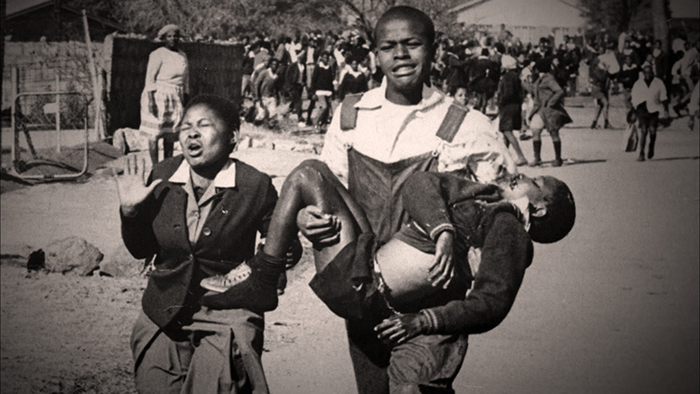
Against the backdrop of buildings and other students, the image captures Hector Pieterson, his sister, Antoinette Pieterson, and the fellow student, Mbuyisa Makhubo, who was carrying Pieterson, 6-16-1976. Many people today forget that among the very last nations to officially reject apartheid and sanction South Africa were the United States and Israel, who held out until it was a fait accompli. Before the Zionist-controlled media in both countries was finally forced to acknowledge Mandela as a liberator and freedom fighter, they had officially condemned him as a terrorist.
The living conditions of Palestinians are truly appalling and inhumane. The UN has reported that the Gaza Strip will be unlivable by 2020. The lives of Palestinians do not matter to Israelis and they are treated as a cheap trade-off by Israel for their continued apartheid rule. According to al-Mezan Center for Human Rights, 194 Palestinians have been killed and more than 18,000 people wounded in the Gaza Strip since the commencement of protests on March 30.
The protests escalated further when Israel demonstrated its utter disregard for the Palestinian people. Abandoning even the fiction of the peace process, Zionist Israel together with the US, decided to name Jerusalem as its capital. To mark this decision, Donald Trump announced relocation of the US embassy from Tel Aviv to Jerusalem.
This sparked outrage among the Palestinians ahead of the annual commemoration of Nakbah Day. This marks the day when Zionist terrorist gangs drove Palestinians out of their homes, villages and land as the Zionist entity was founded in the aftermath of the Second World War. The establishment of Israel in 1948 came about following a scandalous vote in the United Nations General Assembly in November 1947 when the Palestinians were not even consulted. Such was the arrogance of the colonial powers. When the Palestinians rejected such brazen theft of their land under the figleaf of the UN assembly vote, the Zionist marauders grabbed more land.
This coincided with the institutionalization of apartheid as a system of domination in the same year. The lives of native Palestinians and native Africans began to change for the worse in the years that followed, with Palestinians still experiencing the catastrophe of segregation. While there is much talk against discrimination globally, the Palestinians continue to suffer Zionist racism, brutality, and dehumanization in full view of the entire world.
Israel has continued its apartheid policy toward the Palestinian people. Zionist Israel continues to treat Palestinians like non-humans, caging them like animals, restricting and surveilling their movement in the land of their birth. Through mass demonstrations, the Palestinians are displaying their abhorrence and rejection of a system that seeks to obliterate their identity, heritage, and indeed their very existence as human beings. Much like the Soweto Uprising, Palestinians have used these demonstrations as a way of regaining their agency as citizens and inheritors of the Holy Land.
Palestinian resistance is indicative of the continued struggle against colonialism in the world and there are many historical struggles that resemble the fighting spirit of Palestinians from which all oppressed people draw inspiration. The apartheid regime in Israel, like the one before it in South Africa, must be dismantled. This can occur through a collective effort globally through such actions as Boycott, Divestment and Sanctions (BDS) as well as exposing the ugly face of Zionist colonialism. This colonial monstrosity must be dismantled so that all the inhabitants of Palestine — Muslims, Christians and Jews — can live as equal citizens under the law. The people of Palestine can and must be free.
Welcome to “modern India” with Delhi becoming the rape capital of the world and the country earning the reputation with the most HIV/AIDS cases in the world.
Nwabisa Sigaba is with the Media Review Network in Johannesburg.