Showing posts with label Ismail Haniya. Show all posts

Friday, December 13, 2019

Haniyeh’s foreign tour: Between Egyptian approval and the expected agenda

Finally, after many attempts, Egypt has agreed to allowing the head of the Hamas Political Bureau, Ismail Haniyeh, to leave its lands, after holding talks with its senior security officials. They have allowed Haniyeh to carry out a regional tour, including Turkey, Malaysia, Qatar, Lebanon, and possibly Iran, among other countries. This comes despite the fact that Egypt has refused, more than once, to allow him to take this tour, fearing his visit to Iran due to the Saudi and Israeli pressures on Egypt.
The following lines discuss Haniyeh’s new tour around the region, what he will discuss, his agenda and files – the truce with Israel and the Palestinian elections – and why Egypt has allowed him to conduct his tour this time, after having refused many times before. I will also discuss which countries he will visit, how the tour affects the strengthening of Hamas’s relations with Egypt and the region’s countries, the accuracy of the information regarding Haniyeh living abroad for many months, as well as the truth behind Egypt’s request for him not to visit Iran, due to the pressure from Israel and Saudi Arabia.
On 2 December, Haniyeh left the Gaza Strip to Egypt, on a visit that was supposed to last a few days, to hold extensive discussions with Egyptian intelligence on the future of the security in Gaza, to stop the Israeli attacks against Palestinians, on holding Palestinian elections, achieving reconciliation and ending the division.
It was surprising that Haniyeh ended his intensive dialogue with Egyptian officials, including the intelligence minister, Abbas Kamel, heading to Cairo International Airport to start a regional and international tour, instead of the Rafah crossing back to Gaza, as was customary in his many visits to Egypt over the past years. It was most surprising due to the fact that in recent years, Hamas has made several formal requests to Egypt to allow Haniyeh to execute this tour, but the requests were not granted.
This current tour by Haniyeh may be of exceptional importance because, since his election as head of the Hamas Political Bureau in May 2017, he has not made any foreign tours, with his visits being limited only to Egypt . These visits took place in September 2017, February 2018, May 2018 and February 2019, during which he discussed easing the suffering of the besieged Gaza Strip and their bilateral relations. However, his last tour before leading Hamas lasted five months, between September 2016 and January 2017, and included Egypt, Saudi Arabia and Qatar.
From time to time, Hamas circles have disclosed that Haniyeh would conduct a foreign tour including Arab and Muslim countries, such as Qatar, Egypt, Turkey, Iran and Algeria, alongside Lebanon, Kuwait, Mauritania, Malaysia, Indonesia and Morocco, but at the last minute, the tour did not take place. Russian deputy foreign minister, Mikhail Bogdanov, even announced in late December 2018, that Haniyeh would visit Moscow in January 2019, in response to their invitation, but the visit did not occur due to the Egyptian veto.
In the past, Hamas has not given a clear and specific explanation for the repeated postponements of Haniyeh’s tours, and it has not accused anyone of preventing it. This is so as not to strain relations with any party, especially Egypt, because the movement seeks to restore its regional relations. Therefore, it favoured silent diplomacy with these parties to facilitate Haniyeh’s tours, which were postponed several times, despite the importance of these tours, whether to arrange the movement’s files, to meet its branches abroad or to hold meetings with other factions in a number of Arab and Muslim countries.
I worked tirelessly to obtain reactions from Hamas regarding the repeated Egyptian rejection of Haniyeh’s departure to regional and international tours, and the reason for this recent approval. However, the movement’s leaders and speakers have expressed clear reservations about giving a convincing explanation. This leads to employing our own diligence to attempt to identify the reasons behind Haniyeh’s tours not taking place.
The Israeli escalation against Gaza, from time to time, is a primary reason for Haniyeh’s desire to remain in Gaza and to follow its developments. A second reason is the security situation in Sinai, and the inability to secure a safe exit route from Gaza to Egypt. While the third reason is related to the internal conditions of some countries that have postponed, not cancelled, the visits for some time. A fourth reason is Egypt’s stalling to give Hamas the final approval.
There have been increasing Palestinian predictions that Cairo’s prevention of Haniyeh from organising a regional, and perhaps international tour for over two years, lies in the fact that it is not an Egyptian decision. There are beliefs that these are Israeli, American and Saudi decisions, as all of these parties are relying on Egypt to restrict Haniyeh’s movements and limit him to Gaza because his visits to Qatar, Iran, and Turkey harm Israel. Meanwhile, keeping Hamas leaders abroad and distributing them among several countries, gives them ease of movement, rather than their concentration in Gaza, and it gives Egypt the right to place a veto on the travel of its leaders.
Preventing Haniyeh from his regional tour aims to restrict Hamas from strengthening its legitimacy in front of the region and the international community, while the Arab states, with Israeli-American agreement, put pressure on Hamas and suffocate it by boycotting it, politically and diplomatically. They also pressure other countries to prevent them from meeting with Hamas, with the exception of a few countries that have deviated from the US. There has also been major diplomatic efforts made by the Palestinian Authority to prevent Haniyeh from visiting some countries, such as Russia, for example.
The repeated postponement of Haniyeh’s tour represents a model for making Hamas, again, forcibly pay the price for Arab disputes. Every country is seeking to make the movement close to it, and far from its opponents, despite Hamas’s rejection of this political action, because it does not want to be in anyone’s pocket.
It is increasingly clear that Hamas is paying these prices just by looking at Haniyeh’s expected agenda, in the event that he can organise his foreign tour. The tour includes Qatar and Turkey first, who share poor relations with Egypt and near-complete estrangement. This may allow Egypt to justify their prevention of Haniyeh’s tour, because their control of major Palestinian issues, such as the international national reconciliation or the relationship with Israel, gives them strong cards of influence, both regionally and internationally.
Consequently, denying Haniyeh access to these capitals, makes Hamas, at least in Cairo’s view, immune to any regional external pressures that disturb the Egyptian political track of the Palestinian cause. This is despite the fact that Hamas continuously asserts that it has its own policy, and that it is not affected by intimidation nor pressure from any country.
People come out in support of Egypt's efforts to end divisions and support Palestinian reconciliation on 25 September 2017. [Moahmmed Asad/Middle East Monitor]
People come out in support of Egypt’s efforts to end divisions and support the Palestinian reconciliation on 25 September 2017. [Moahmmed Asad/Middle East Monitor]
Egypt’s recent approval of Haniyeh’s foreign tour, after continuous refusal and rejection, does not hide its desire to seek to impose its guidance on Hamas, determining who it visits and who it boycotts. This did not happen with the other countries that the movement has dealt with, such as Jordan, Syria and Qatar.
Today, after Haniyeh’s tour commenced, Hamas hopes it results in an improvement of its regional relations, developing friendly ties with allied countries and mending the tension and estrangement with other countries. The movement wants its leader to visit certain countries to obtain financial support and closer political relations, although countries influencing Egypt, such as Saudi Arabia and Israel, have a firm hostility with the countries that Haniyeh intends to visit, and they do not want to give them a card to interfere in the Palestinian cause, by meeting with the leader of Hamas. They are seeking to prevent him from visiting these countries.
In this round, which has just begun, we are hearing frequent news that the Egyptian approval of Haniyeh’s foreign tour came after stipulation that he should not visit Iran, in particular. This is a significant request in the political relations between the parties, and does not imply wise diplomacy. However, it is clear that the Egyptian request is accompanied by Israeli and Saudi’s insistence to deny Tehran any foothold in the Palestinian arena, that may be strengthened by Haniyeh’s supposed meetings with Tehran’s leaders, who are locked in an invisible struggle with Riyadh and Tel Aviv.
It is still unknown whether Haniyeh will respond to the supposed Egyptian request, because it hurts the independence of the movement’s decision, and may negatively affect its relationship with its most important ally, Iran, if he does not visit it. This is especially true if he visits a number of other countries in the region, and refrains from visiting Iran, rendering Hamas’s position very difficult. Its decision will be sensitive and probably costly either way, whether it responds to Egypt’s request or chooses to ignore it.
In the same context, it does not seem that Haniyeh will appear to be hasty to return from his foreign tour. Predictions from inside Hamas are that he will remain abroad for several months, to conduct internal discussions with the movement, for foreign discussions with friends and allies and accomplish some of the leadership tasks that only he can complete.
Perhaps this issue, again, indicates the suitability that part of the Hamas leadership remains outside of the Palestinian territories, away from the siege and restrictions of movement – something that the current Hamas leadership may not have paid attention to when it placed all its political and military leaders in the Gaza Strip. This has put the movement, and its leaders, under the mercy of the Egyptian decision-maker, which allows Hamas to travel when relations are good, but when there is tension, it closes the Rafah crossing until further notice.

Monday, August 05, 2019

Will Hamas return to Damascus?

A few days after visiting Moscow last month, the Palestinian Islamic Resistance Movement, Hamas, headed to Tehran with a bigger and higher-level delegation. The visit lasted several days, hinting at its importance, the greatest indicator of its significance being the number of Hamas officials in the delegation and their meeting with the Supreme Guide Ali Khamenei and other senior officials.
The replacement of Hezbollah mediation by a personal delegation also suggests that Hamas is attempting to re-establish relations with the Syrian regime, an ally of Iran. Is Hamas planning to return to Damascus by normalising its relations with the regime?
It seems natural to ask this question, as there was apparently a close relationship between Hamas, Damascus and Tehran before the Syrian revolution. It is also a natural given the wave of normalisation of relations recently between a number of countries and the Assad regime in Syria.
It should be noted that a number of Hamas officials, both political and military, believe that leaving the Syrian capital was very costly for the movement on a political, economic and security level. Hamas is currently at a loss because neither Qatar nor Turkey are able to host its officials openly, as Damascus did before the start of the conflict there in 2011. Diplomatic statements by the movement have always claimed that leaving Syria did not affect the course of its work.
Hamas has been negotiating with the Syrian regime through Tehran since 2017 in order to return to Damascus, and based on the movement’s current political and security situation, it is said to be keen on going back to Syria. However, it seems that the regime of Bashar Al-Assad is being difficult about the matter, as it believes that Hamas has not supported it enough during the crisis, and thus did not “pay it back” properly. Hence, it seems that even if the regime is convinced about the return of Hamas — or is “persuaded” to be so by Iran — it is difficult to imagine things being as they were pre-2011.
In terms of timing, the geopolitical situation in Syrian is based on the rearrangement of all regional and international agendas in a manner conducive to it having influence equal to that of the opposition forces. This implicitly generates “geographical allocation” in which Hamas seeks to benefit from Tehran’s share. In what some observers describe as “political realism”, the movement is trying to return to Syria on the back of Tehran’s influence to ensure a suitable location for its ambitions to be realised.
Despite the Assad regime’s resentment towards Hamas and its position on the Syrian conflict, Tehran desperately needs a strong relationship with the Palestinian movement, not least so that it can still promote itself as being at the apex of the “axis of resistance”.
Moreover, Hamas’s pre-emptive step is being taken in the context of its concerns that Russia might give in to Israel’s demands for Hamas to be prevented from returning to Syria. This may happen if Iran’s influence in Syria is reduced, so Hamas is seeking to achieve what it needs before it is too late.
The visit to Tehran also addressed the current confrontation with the US in order to rescue whatever Palestinian rights might be possible in the face of the “deal of the century”. Hamas believes that cooperation with Russia and Iran will create an important axis to challenge US hegemony around the world. Another issue discussed was the mechanism for maintaining Iran’s support for the movement given the possibility of this declining due to US sanctions imposed on Tehran.
In conclusion, Hamas and the “axis of resistance” have mutual interests that prompt them to seek to maintain strong relations with each other. Hamas needs financial, political and geographic support in light of the harassment that the movement and the Palestinian cause are subjected to, while the “axis of resistance” cannot succeed in promoting itself as such without having a good relationship with the major Palestinian resistance group. On the basis of the mutual benefits available, therefore, the return to an open and strong relationship, as was the case in the past, is not all that difficult to imagine.

Saturday, June 29, 2019

U.S. Pushes Middle East Economic Plan, Palestinians Reject It

MANAMA – Palestinians poured scorn on a $50 billion economic formula launched by the Trump administration for Zionist-Palestinian plan as the United States sought on Wednesday to win support for the plan it claims is a foundation to ending the decades-old conflict.
U.S. President Donald Trump’s senior adviser and son-in-law Jared Kushner opened a meeting in Bahrain on Tuesday evening by urging Palestinians, whose leadership is boycotting the event, to think outside the "traditional box” for an economic pathway that he said was a precondition for peace.
Neither the Zionist regime nor Palestinian government attended the event, which the Palestinians and many other Arabs dismiss as pointless without a political solution. 
Several thousand Palestinians demonstrated in the Gaza Strip and burned posters of Trump and Netanyahu. "No to the conference of treason, no to the conference of shame” read one banner.
Top leader of the Palestinian Hamas resistance movement has censured the U.S.-led conference in Bahrain, saying Palestine is neither for sale nor for deals and conferences that seek to consecrate the expropriation of occupied lands.
"Today, we (the Palestinian nation) stand at a historic turning point. I say it clearly and plainly that Palestine is neither for sale nor for any deals and conferences that want to sanctify occupation. Our people stand absolutely united in the face of such deals,” Ismail Haniyeh, the head of the Hamas political bureau, said as he addressed the Palestinian National Conference in Gaza City.
The so-called "Peace to Prosperity” workshop opened in Bahrain on June 25 and ran through June 26.
He added, "The Palestinian people are united against the Bahrain conference,” warning that "the Palestinian cause is undergoing an unprecedented strategic threat.”
Haniyeh pointed out that the Bahrain conference is a political meeting with an economic cover, and that the United States, which has failed in all its plots and schemes against the Middle East region, will not succeed to advance the so-called deal of the century.
"Bahrain meeting and the deal of the century aim to liquidate the Palestinian cause, give the green light to Israel to consolidate its occupation and control over the West Bank, open the door for Arab normalization of ties with the occupying regime, rearrange the matrices of enemies in the region on the basis of integrating Israel into the Arab world and install an enemy from within us as if it is the enemy of our nation,” the senior Palestinian official pointed out.
He noted that the Bahrain conference comes at the same time as Palestinian resistance movements, spearheaded by the Ezzedine al-Qassam Brigades, are countering U.S. plots and warning against the repercussions of its unwise moves.
Meanwhile, Secretary-General of the Palestinian Islamic Jihad resistance movement, Ziad al-Nakhala, stressed the need for resistance and reconciliation among Palestinian factions to counter the controversial proposal for the so-called "peace”.
Addressing the Palestinian National Conference in Gaza City, Nakhala said the Palestinian nation will remain united in the face of the much-touted American plan, spearheaded by Trump’s son-in-law and senior advisor Jared Kushner.
"Today, we have a historic opportunity to re-establish our calculations and open up prospects for our people and our future generations. This Zionist project … must be dealt with. This poison which the West has injected into the body of the Palestinian nation must not be given the chance to spread as it will kill us, all Arabs and Muslims. Those who know what al-Quds and Palestine mean, know that this region is valued not only in size but also in essence,” he pointed out.

Monday, June 24, 2019

Iran hoisting Palestinian flag: Lebanese analyst


Iran hoisting Palestinian flag: Lebanese analyst


Beirut, June 24, IRNA – Iran has kept the Palestinian flag flying, which has cost dearly, the head of the director of the Lebanese International Center for Media and Research said on Monday.
"The economic meeting in Manamah about the 'Deal of the Century' is bound to fail," said Rafic Nasrallah in an interview with IRNA.
The meeting will be held in Bahrain on June 25-26.
The Deal of Century tries to deprive the Palestinians of the right to return to their motherland in return for a 25-billion investment in the West Bank and Gaza Strip, which is mostly to be provided by the Arab oil-rich states.
US President Donald Trump’s aide and son-in-law, Jared Kushner, who devised the scheme, has announced that a political plan will follow.
Nasrallah said that all the deals to remove Palestine off the map have failed and the Manamah plan is no exception.
"Iran is the main player in the region and has tried hard to keep the Palestinian flag flying. Iran is now at the front of the Resistance and has been trying to counter the US and Israel to safeguard its values."


Islamic Revolution Supreme Leader Ayatollah Seyyed Ali Khamenei and former Palestinian Prime Minister Ismail Haniyeh  in Tehran
 Islamic Revolution Supreme Leader Ayatollah Seyyed Ali Khamenei and former Palestinian Prime Minister Ismail Haniyeh  in Tehran

In the past few days, Iran foiled the US plots and made Trump regret his decisions, which roots in Iran's power that will change the political map of the region, said Nasrallah.
"Unfortunately, there are some neocons in some Arab states that plot against Palestine; however, Manamah meeting is bound to fail as long as the Palestinians and Arab nationalist do not attend it."    
The head of the Lebanese International Center for Media and Research added that Manamah meeting failure will pave the way for defeating the Deal of the Century.
"Our nations know how to resist and we take hope in Palestine, Resistance, and the Intifada."
Expressing sorrow about the fact that some Arab states are "relying on the US and plotting against the Islamic World," he added, "Counting on the US will lead them nowhere."
Rafic Nasrallah assured that one day Egypt and other Arab states will come back to Palestine.

Monday, December 17, 2018

Half a Million Gazans Pledge Allegiance to Hamas

: On 31st Anniversary of Its Founding


GAZA -- Nearly half a million Palestinians gathered for an afternoon rally on Sunday to commemorate the 31st anniversary of the founding of Hamas, the Islamic government in the Gaza Strip.
They packed out Al-Katiba square in the center of Gaza, waving flags as chants and a military parade were held on the main stage.
Ismail Haniyeh, Hamas' political chief, said in a speech at the rally that a technological device had been seized from the Israeli military after an undercover operation in Gaza was exposed last month.
The device, Haniyeh said, exposed the Zionist military’s operational method in Gaza. 
"The times when the Israeli Special Force entered into and left Gaza are precisely known to (Hamas's military wing) al-Qassam. Moreover, al-Qassam leaders know how many hours the Israeli Special Force stayed in Gaza," he said.
"A trove of technical and security information was collected by al-Qassam after the Israeli Special Force's Infiltration into Gaza. The information will be used to reveal the work mechanisms of the Israeli special forces in West Bank, Arab states and other countries."
Undercover Israeli special forces infiltrated into the territory in a civilian car near Khan Yunis, opening fire and killing local commander Noor Baraka when they were discovered.
The unit was chased by Hamas fighters who killed a ranking Zionist officer. The occupying regime then launched dozens of airstrikes on Gaza, drawing Hamas retaliation. During a two-day flare-up, more than 500 rockets were fired at Zionist targets, forcing Tel Aviv to accept a hasty declaration of a ceasefire.
The Hamas leader also commented on the two attacks in the West Bank this week, where two Zionist troops were killed in drive-by shootings.
"I will also respond to the Zionists who are saying what is happening in the West Bank is based on directives and arrangements from Gaza. This is an accusation that we do not deny… because it is a source of pride reigning over all of us,” Haniyeh said.
Hamas was established in 1987 soon after the first Palestinian Intifada or uprising broke out against the Israeli occupation. The movement has been administering Gaza since 2007 when it scored a surprise parliamentary victory. 
On Saturday, Hamas marked the anniversary of its foundation with a military parade featuring the Palestinian resistance movement’s new rockets. 
"After 31 years since the start of the Hamas movement, the occupation is no longer the only one that controls the balance of the battle,” Hamas said in a statement leading up to the rally. 
"Rather, the resistance has become the most powerful… This is proof of the growth of the resistance and its increase in all forms, day after day, and soon the day will come when the resistance will uproot the occupation from our land.”
He also criticized the Oslo agreement, signed in 1994 as the basis of a "peace” settlement that has not materialized and under which Zionist forces are not allowed to operate in Palestinian cities.
U.S. President Donald Trump plans to unveil his own plan described as the "deal of century” which reportedly strips Palestinians of most of their rights, including their claim to Jerusalem al-Qaeda. 
All Palestinian groups, including the Fatah party of Palestinian Authority chief Mahmoud Abbas, have rejected the proposal which is reportedly backed by Saudi Arabia and the UAE.  

Saturday, November 24, 2018

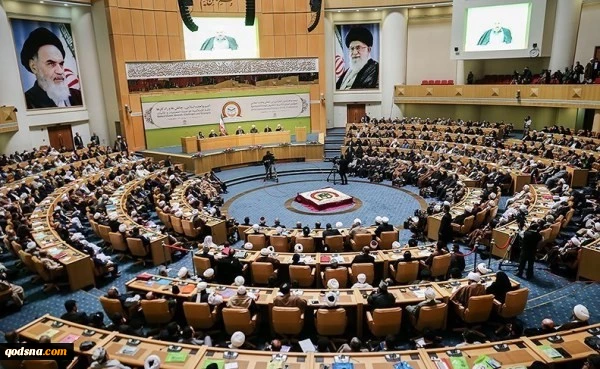
Opening ceremony of 32nd international Islamic Unity Conference convened

Opening ceremony of 32nd international Islamic Unity Conference convened

The opening ceremony of 32nd International Islamic Unity Conference was convened today morning (23rd November 2018) in Tehran with the presence of 350 foreign guests from 100 countries.
As reported by Qods News Agency (Qodsna) the opening ceremony of 32nd International Islamic Unity Conference was convened today morning (24th November 2018) in Tehran with the presence of 350 foreign guests from 100 countries.

According to the report the conference is due to last for 3 days, the conference which is held annually, this year is convened with a slogan of tribute to Quds as “Quds, Axis of Unity Among Ummah”.

The conference started by a speech delivered by Iranian President Hassan Rohani.

Ayatollah Araki Secretary General of World Forum for Proximity of Islamic Schools of Thought welcomed the guests, the conference is then scheduled for the speeches of some prominent Shia Clerics such as Ayatollah Makarem Shirazi and Ayatollah Noori Hamedani.

Ayatollah Araki Secretary General of World Forum for Proximity of Islamic Schools of Thought welcomed the guests, the conference is then scheduled for the speeches of some prominent Shia Clerics such as Ayatollah Makarem Shirazi and Ayatollah Noori Hamedani.

Reading the message of Ismail Haniya, head of the political office of the Hamas movement, speeches by former Afghan President Hamid Karzai, former Iraqi Prime Minister Nouri al-Maliki, Sheikh Naim Qassem, Vice-President of the Secretary-General of Hezbollah Lebanon, Mohammed al-Hendi, Deputy General Secretary of the Palestine Islamic Jihad, Syrian Grand Mufti Ahmed Badr al-Din Hassoun, Zahra Mostafavi, Secretary-General of the Women's Organization of the Islamic Republic, and Secretary-General of the Society for the Defense of Palestinian Nation, are scheduled for the first day of the Islamic Unity Conference.
 
Syrian Grand Mufti Sheikh Badr al-Din Hassan will be the Imam of today’s prayers.

The closing ceremony will be convened with the speech of Ali Larijani Iranian Parliament Speaker.

Following the announcement of the unity week by the Islamic Republic of Iran, a decision was made to hold an Islamic Unity Conference.

The conference has ten committees in which the Palestinian committees has three sub-groups; the resistance and the right to return, the role of Palestine and al-Quds in the Islamic civilization, and the struggle against the compromise and the Deal of Century.

The conference guests are prominent personalities, ministers of Islamic countries, scholars and Muftis, university professors and other scientific and cultural associations both inside and outside the country.

Hundreds of thinkers, scholars participated in the conference and presented articles, speeches and expressions of their views, and this conference played a decisive role in increasing the unity and sympathy among Muslims and scholars.