Showing posts with label JCPOA (Joint Comprehensive Plan of Action). Show all posts

Wednesday, August 28, 2019

It’s shameful that Pompeo talks about JCPOA provisions

By M.A. Saki

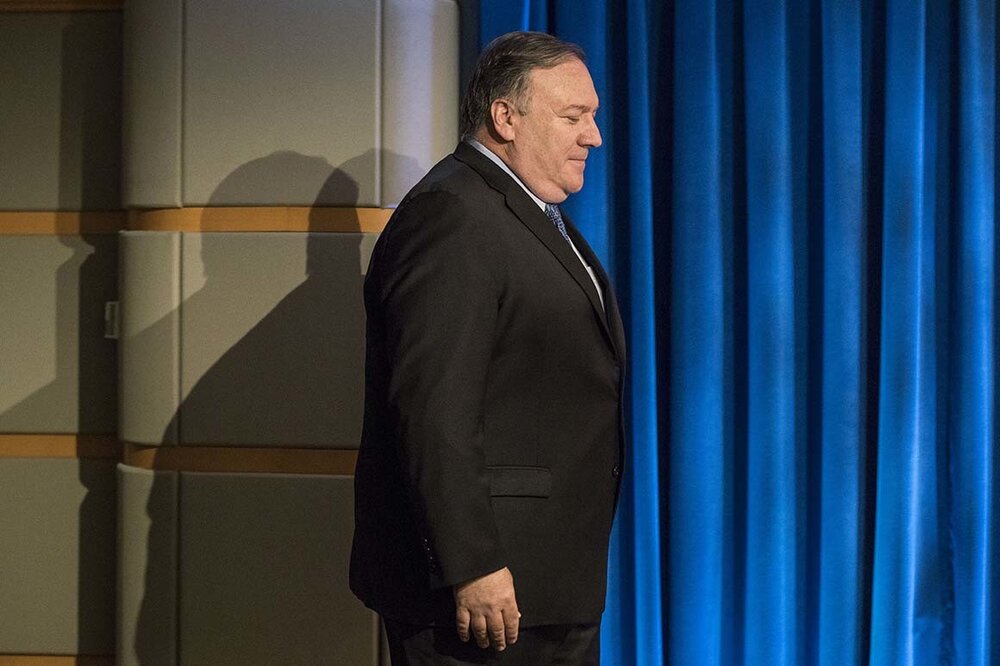
TEHRAN – Speaking at a United Nations Security Council Session on Middle East Peace and Security on August 20, U.S. Secretary of State Mike Pompeo said Washington is concerned about the approaching end of some of the UN arms embargo and other sanctions against Iran based on the JCPOA.
“We are already tracking very closely the JCPOA provisions expiring in October of 2020, namely the UN arms embargo,” Pompeo said in part of his speech.
It is extremely ridiculous that Pompeo is talking about the provisions of the JCPOA, the same landmark international nuclear agreement endorsed by the UN Security Council Resolution 2231, but revoked by his master Donald Trump.
 
Pompeo, Trump and other hawks have harshly denounced the JCPOA but the fact of the matter is that they seem to be worried that some of its provisions are coming to an end. 
Since Trump has blown up the JCPOA, his secretary of state is not in a position to talk about the JCPOA and its provisions. It is pure hypocrisy.
If the JCPOA, according to the Trump is “horrible”, “flawed”, “decaying” and “defective at its core”, then in their view its provisions must also be obsolete. 
While the entire world, except Israel’s Netanyahu, was urging the U.S. to remain committed to the JCPOA, the Trump administration bullyingly abandoned it and illegally imposed the harshest ever sanctions on Iran, a move which has been rightly called “economic terrorism”.
In May 2018, when Trump officially abandoned the JCPOA, Pompeo said the U.S. will impose “the strongest sanctions in history” on Iran. Also in November 2018, John Bolton, the White House national security advisor, said, “It’s our intention to squeeze them (Iranians) very hard… until the pips squeak.”
In view of such bitter facts and remarks, the Trump administration’s officials are not morally in a position to talk about the JCPOA provisions.
In the same remarks at the UN on August 20, Pompeo said, “Iran continues to threaten further expansions of its nuclear program in defiance of its international commitments.”
It is comical that Pompeo uses the term “international commitments” with regard to the JCPOA. 
It is true that Iran made commitments to put limits on its nuclear activities in exchange for termination of economic and financial sanctions. But did the U.S. stick to its obligation? The U.S. has even threatened to punish any country or company that enters economic dealings with Tehran. It has also introduced a total ban on Iran’s oil exports. It is trying to strangulate Iran.
Iran has taken steps to reduce its commitments, not abandoning it, after waiting for a year. It has also unequivocally announced that it will reverse its decision immediately after the remaining members to the JCPOA protect it from the impacts of sanctions.  
 
In the viewpoint of Pompeo, Iran must remain committed to its obligations but the United States is an exemption.
Pompeo is making himself a laughing stock by talking about the provisions of the JCPOA and commitments that Iran needs to observe. Moreover, he is showing contempt to the wisdom of the world by such ridiculous and shameful remarks.

Monday, July 08, 2019

EU may be a sweet-talker, but it’s full of empty promises

BY: Ebrahim Fallahi

It was more than a year ago when U.S. President Donald Trump formally pulled the United States out of the nuclear deal that was struck between Iran and world powers in July 2015.
Trump decision received waves of criticism from other signatories of the deal, namely China, France, Germany, Russia, the United Kingdom and the European Union.
In January 2019, France, Germany and Britain (known as the E3) introduced an Instrument in Support of Trade Exchanges (INSTEX) which was meant to facilitate legitimate trade between European economic operators and Iran in order to convince Iran to stay in the 2015 nuclear deal.
Shortly after Europe’s announcement, welcoming the idea, on March 20, Central Bank of Iran (CBI)’s Governor Abdolnaser Hemmati announced that a mechanism similar to INSTEX has been registered in Iran, officially called the Special Trade and Finance Institute (STFI).
STFI was established to ease INSTEX implementation and at the time, Iranian government announced that Iran has no problem with getting the Europe’s financial instrument operational any time that Europeans decided make INSTEX operational.
Since then, several rounds of talks were held and hundreds of hours of discussion were done on the subject. The Europe claimed many times that “the mechanism will be operational soon”, however so far the EU claims have been no more than a bunch of empty promises.
The Europeans’ repeated false promises finally worn Iran’s patience thin, so that on Sunday, Iran officially announced it will take the second step in reducing its commitments to the JCPOA, as the deadline Tehran set for the Europeans to protect Tehran against the U.S. sanctions ended on July 7.
The long road to INSTEX
In the last day of January 2019, French Foreign Minister Jean-Yves Le Drian, German Foreign Minister Heiko Maas, and British Foreign Secretary Jeremy Hunt introduced the SPV (a special purpose vehicle) also called INSTEX (Instrument in Support of Trade Exchanges) in a joint statement.
A mechanism which was claimed would enable Iran to keep doing business with the rest of the world despite the sanctions imposed by the Trump administration.
Registered in France and run by a German banker, INSTEX was financed jointly by the E3. It is in accordance with E3 resolute commitment and continued efforts to preserve the JCPOA endorsed by United Nations Security Council resolution 2231.
According to the initial statements, the European side intended to use the channel initially only to sell food, medicine and medical devices in Iran. However, it claimed that it will be possible to expand it in the future.
Immediately after the news on establishment of the INSTEX, the Trump administration warned the European Union against trying to sidestep sanctions on Iran.
In late January, the U.S. State Department said it was "closely following" reports on the European mechanism.
EU Foreign Policy chief Federica Mogherini, on the other hand welcomed the registration of the SPV. 
Implementation of the mechanism
Nearly six months after the first negotiations on the INSTEX started in Europe, in late June Mogherini announced that INSTEX has become operational and is processing the first transactions.
“Together with the three countries that set it up – France, Germany and the UK – another seven European countries will join the mechanism. On Friday (June 28) we also gathered the Joint Commission that works to guarantee the deal’s implementation,” she said in an announcement published on her website on June 29.
In a joint statement earlier on the same day, Austria, Belgium, Finland, the Netherlands, Slovenia, Spain and Sweden, also said they were working with the E3 to develop trade mechanisms.
The announcement came after Iran whose two-month ultimatum for the EU was reaching its end, threatened to take new steps in reducing its commitments under the 2015 nuclear deal “more strongly”.
In early May, Iran's Supreme National Council (SNSC) declared Tehran's exit from "certain" obligations under the landmark 2015 agreement and gave a 60-day deadline to JCPOA signatories to protect Iran's interests against U.S. sanctions, or it will restart high-level uranium enrichment.
All words and no actions
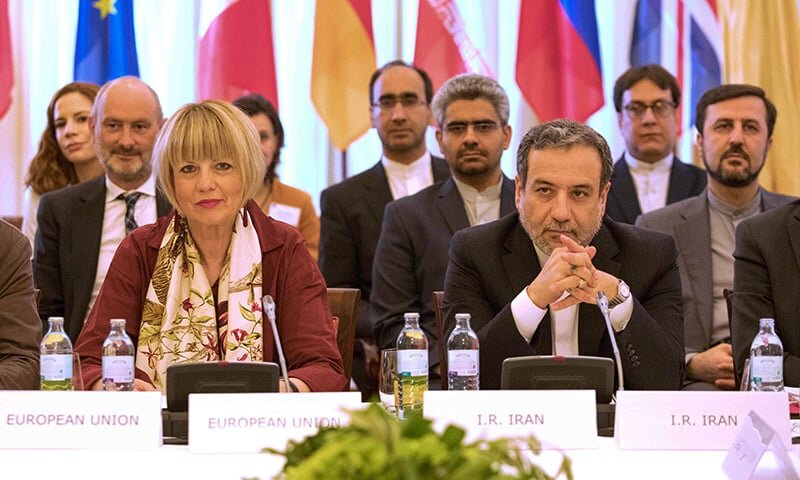
More than a week has passed after the European side of the nuclear deal gathered in Vienna to celebrate the news of INSTEX going operational, but there is still no sign of any real transaction being conducted through INSTEX.
On Sunday, with the 60-day deadline to JCPOA signatories ending, Ali Rabiee, the government’s spokesperson, announced that Iran will take the second step in reducing its commitments to the JCPOA.
“As of today, our uranium enrichment will surpass the current 3.67 percent and enriching to further purity will be based on our needs,” he said in an official statement.
Last week, Kamal Kharrazi, chairman of Iran's Strategic Council on Foreign Relations, had warned that INSTEX does not go further than a "claim" and Iran would leave the JCPOA if the situation didn’t change.
Kharrazi, who was Iran’s chief diplomat from 1997 to 2005, said there were no definitive assessments of the Vienna meeting, but with only several millions of euros of credit that the Europeans had allocated to INSTEX, business would definitely be impossible.
Clearly the Europe needs far more time than only six months to figure out a way to realize their promises (if they are to be even realized!!).
With Iran’s announcement on Sunday, we should wait and see what the EU’s reaction would be. Would they finally go through with their promises?! 

Saturday, May 18, 2019

Future of the JCPOA does not look good: Paul Pillar

By Javad Heirannia

TEHRAN – Professor Paul Pillar, who was CIA intelligence analyst for 28 years, tells that the future of the JCPOA does not look good. 
Pillar says “The Europeans so far have simply not given much indication of implementing an economically significant arrangement that would be sufficient for Iranians to say that the deal is meeting their expectations.”  
He also adds that “The economic clout of the United States is such that the U.S. administration can still scare and intimidate businesses and governments from having much to do with Iran.”
Following is the text of the interview:
Q: Given that Iran's needs were not met by the Iran nuclear deal, by which I mean removing the sanctions, and as the result of the U.S. withdrawal from that agreement and Europe's passivity, Iran has announced that it is stopping the sale of enriched uranium and heavy water. This action will be held for 60 days to bring the parties to the negotiation table. How do you assess this issue?
A: Iran is saying its patience is not unlimited.  It has complied with its obligations under the JCPOA for an entire year, despite the U.S. reneging on its own obligations.  President Rouhani is saying that must change.  Iranian leaders have given up on the Trump administration.  They still are hoping for a change in U.S. policy as of January 2021, but it has become politically and economically untenable for Iranian leaders simply to keep waiting for U.S. policy to change. Rouhani is challenging the Europeans in particular to do more to make up for the economic shortfall from the U.S. reneging.  
Q: The Iranian nuclear deal is an agreement based on the clarity and commitment of both sides. Paying attention to the important role that the U.S. plays on the other side and the passivity of European countries towards the U.S., Iran remains committed to this agreement. Bringing into consideration the current situation, how do you assess its future?
A: The future of the JCPOA does not look good.  The Europeans so far have simply not given much indication of implementing an economically significant arrangement that would be sufficient for Iranians to say that the deal is meeting their expectations.  The economic clout of the United States is such that the U.S. administration can still scare and intimidate businesses and governments from having much to do with Iran.  If the agreement collapses, it would be difficult to piece it back together even after a change of administration in the United States.  
Q: After the failed coup in Venezuela, it seems that John Bolton's role in Trump's decision-making process will be reduced. Is there any possibility that in the result of Bolton's aggressive activities which were not successful, the role of the aggressive party in the Trump administration will be reduced?
A: The aggressive nature of U.S. policy, specially toward Iran, does indeed depend heavily on Bolton's future.  That in turn depends on impulsive and hard-to-predict decisions by Donald Trump.  Bolton may have lost some favor with Trump because of differences on both Venezuela and North Korea.  Bolton's job might be in jeopardy if Trump, who right now probably does not want a war with Iran, sees Bolton as leading him into one.  But Trump might not see things that way, or Trump himself, faced with more domestic political problems, might himself come to welcome a military clash with Iran as a distraction.    
Q: President Rouhani called the Iranian nuclear deal a win-win or lose-lose game. What's the point of this message for the other side?
A: Rouhani is saying that if everyone observes the JCPOA, everyone benefits. And if the agreement breaks down, that will benefit no one.  Iran clearly would lose economically, but the United States and others also would lose by having an avoidable nuclear crisis on their hands. Rouhani's perspective is far different from that of Donald Trump, who seems to see every agreement as a matter of one side winning and the other side losing.