Showing posts with label Ebrahim Fallahi. Show all posts

Monday, July 08, 2019

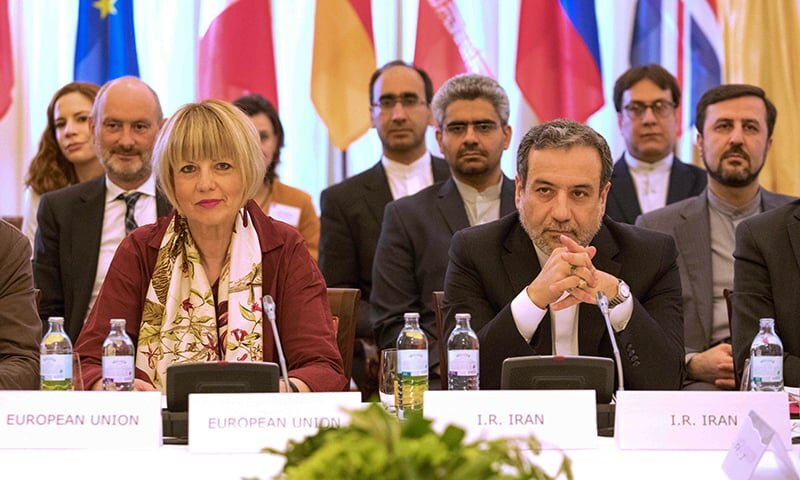
EU may be a sweet-talker, but it’s full of empty promises

BY: Ebrahim Fallahi

It was more than a year ago when U.S. President Donald Trump formally pulled the United States out of the nuclear deal that was struck between Iran and world powers in July 2015.
Trump decision received waves of criticism from other signatories of the deal, namely China, France, Germany, Russia, the United Kingdom and the European Union.
In January 2019, France, Germany and Britain (known as the E3) introduced an Instrument in Support of Trade Exchanges (INSTEX) which was meant to facilitate legitimate trade between European economic operators and Iran in order to convince Iran to stay in the 2015 nuclear deal.
Shortly after Europe’s announcement, welcoming the idea, on March 20, Central Bank of Iran (CBI)’s Governor Abdolnaser Hemmati announced that a mechanism similar to INSTEX has been registered in Iran, officially called the Special Trade and Finance Institute (STFI).
STFI was established to ease INSTEX implementation and at the time, Iranian government announced that Iran has no problem with getting the Europe’s financial instrument operational any time that Europeans decided make INSTEX operational.
Since then, several rounds of talks were held and hundreds of hours of discussion were done on the subject. The Europe claimed many times that “the mechanism will be operational soon”, however so far the EU claims have been no more than a bunch of empty promises.
The Europeans’ repeated false promises finally worn Iran’s patience thin, so that on Sunday, Iran officially announced it will take the second step in reducing its commitments to the JCPOA, as the deadline Tehran set for the Europeans to protect Tehran against the U.S. sanctions ended on July 7.
The long road to INSTEX
In the last day of January 2019, French Foreign Minister Jean-Yves Le Drian, German Foreign Minister Heiko Maas, and British Foreign Secretary Jeremy Hunt introduced the SPV (a special purpose vehicle) also called INSTEX (Instrument in Support of Trade Exchanges) in a joint statement.
A mechanism which was claimed would enable Iran to keep doing business with the rest of the world despite the sanctions imposed by the Trump administration.
Registered in France and run by a German banker, INSTEX was financed jointly by the E3. It is in accordance with E3 resolute commitment and continued efforts to preserve the JCPOA endorsed by United Nations Security Council resolution 2231.
According to the initial statements, the European side intended to use the channel initially only to sell food, medicine and medical devices in Iran. However, it claimed that it will be possible to expand it in the future.
Immediately after the news on establishment of the INSTEX, the Trump administration warned the European Union against trying to sidestep sanctions on Iran.
In late January, the U.S. State Department said it was "closely following" reports on the European mechanism.
EU Foreign Policy chief Federica Mogherini, on the other hand welcomed the registration of the SPV. 
Implementation of the mechanism
Nearly six months after the first negotiations on the INSTEX started in Europe, in late June Mogherini announced that INSTEX has become operational and is processing the first transactions.
“Together with the three countries that set it up – France, Germany and the UK – another seven European countries will join the mechanism. On Friday (June 28) we also gathered the Joint Commission that works to guarantee the deal’s implementation,” she said in an announcement published on her website on June 29.
In a joint statement earlier on the same day, Austria, Belgium, Finland, the Netherlands, Slovenia, Spain and Sweden, also said they were working with the E3 to develop trade mechanisms.
The announcement came after Iran whose two-month ultimatum for the EU was reaching its end, threatened to take new steps in reducing its commitments under the 2015 nuclear deal “more strongly”.
In early May, Iran's Supreme National Council (SNSC) declared Tehran's exit from "certain" obligations under the landmark 2015 agreement and gave a 60-day deadline to JCPOA signatories to protect Iran's interests against U.S. sanctions, or it will restart high-level uranium enrichment.
All words and no actions
More than a week has passed after the European side of the nuclear deal gathered in Vienna to celebrate the news of INSTEX going operational, but there is still no sign of any real transaction being conducted through INSTEX.
On Sunday, with the 60-day deadline to JCPOA signatories ending, Ali Rabiee, the government’s spokesperson, announced that Iran will take the second step in reducing its commitments to the JCPOA.
“As of today, our uranium enrichment will surpass the current 3.67 percent and enriching to further purity will be based on our needs,” he said in an official statement.
Last week, Kamal Kharrazi, chairman of Iran's Strategic Council on Foreign Relations, had warned that INSTEX does not go further than a "claim" and Iran would leave the JCPOA if the situation didn’t change.
Kharrazi, who was Iran’s chief diplomat from 1997 to 2005, said there were no definitive assessments of the Vienna meeting, but with only several millions of euros of credit that the Europeans had allocated to INSTEX, business would definitely be impossible.
Clearly the Europe needs far more time than only six months to figure out a way to realize their promises (if they are to be even realized!!).
With Iran’s announcement on Sunday, we should wait and see what the EU’s reaction would be. Would they finally go through with their promises?! 

Sunday, March 17, 2019

One belt-one road, a path to economic resilience

By Ebrahim Fallahi

The history of Iran and China’s economic and cultural relations goes back to the ancient times, when positioned at the heart of the Silk Road, Iran linked the Asian country to the nations in Europe. Now, centuries later, the two countries have still maintained those strong ties and the economic relations between the two sides are seemingly on a new path to growth.
Now, centuries later, the two countries have still maintained those strong ties and the economic relations between the two sides are seemingly on a new path to growth.
In December 2013 when Chinese President Xi Jinping proposed that China and Central Asian countries build an "economic belt along the Silk Road", a new chapter was begun in the global economy and consequently in Iran and China’s all-out ties.
In February 2016, with the arrival of a cargo train from China to Iran, a milestone was marked in the economic relations between the two sides and the ancient "Silk Road" was once again revived.
What follows is a brief look at the One Belt One Road (OBOR) initiative, its pros and cons and the impact it could have on Iran’s economy.
The initiative
The Belt and Road Initiative (BRI), also known as the One Belt One Road (OBOR) or the Silk Road Economic Belt and the 21st-century Maritime Silk Road is a development strategy adopted by the Chinese government involving infrastructure development and investments in 152 countries and international organizations in Europe, Asia, Middle East, Latin America and Africa.
"Belt" refers to the overland routes for road and rail transportation, called "the Silk Road Economic Belt"; whereas "road" refers to the sea routes, or the 21st Century Maritime Silk Road.
The Chinese government calls the initiative "a bid to enhance regional connectivity and embrace a brighter future". Some observers see it as a push for Chinese dominance in global affairs with a China-centered trading network.
OBOR: pros and cons
Although clearly the OBOR initiative entails great merits for the global economy, especially for the involving countries, there are some people who believe it could act as a double-edged sword.
They argue that with the Chinese large-scale investment and growing presence in the involved countries, there is the risk of A “China hegemony” replacing the notion of “U.S. and EU” dominated economy.
It is said that one of the most important aspects of the OBOR project is that it is aimed to reduce the domination of U.S. and Europe over international relations system which has been formed during the past 500 years, but isn’t it going to start another form of yuan dominance?
In March 2018, a study by the Washington-based Center for Global Development (CGD) reported that China’s ambitious Belt and Road infrastructure initiative could raise the sovereign debt risks in eight countries involved in the plan.
According to CGD, of the 68 countries identified as potential borrowers in the Belt and Road Initiative (BRI) 23 were found to be already at a “quite high” risk of debt distress.
“Those countries include Pakistan, Djibouti, the Maldives, Laos, Mongolia, Montenegro, Tajikistan and Kyrgyzstan.” The study said.
Advocates of the plan, on the other hand, argue that aside from regional stability and security as a result of close cooperation between the involved countries, Industrial structure improvement, energy security and development of infrastructure for the countries in the way of the new Silk Road are just few of the great advantages that the huge project has to offer.
Iran and OBOR
As I mentioned before, Iran has been a major gateway to ancient Silk Road, and thanks to its strategic position among the Arabian Peninsula, Central Asia and South Asia, the country is still a critical crossroad in the region.
In realization of its ambitious plan for implementing the OBOR initiative, China inevitably needs Iran’s support in the process. Of course the project is executable even without Iran’s participation but the costs won’t be justifiable, both literally and figuratively. Considering the two countries’ political and economic agendas and interests, the two sides need each other to move forward and that is a known fact.
On Iran side, the U.S. withdrawal from Iran’s nuclear deal (known as the Joint Comprehensive Plan of Action or JCPOA) and re-imposition of sanctions on the country has made Iran more determined to pursue forming a resilient economy in which the dependence on U.S. dollar is minimized. In this regard, once again the significance of the economic ties with China comes to focus.
China could be Iran’s biggest source of the capital it needs to finance infrastructure projects in the absence of global banks which are intimidated by the U.S. sanctions.
As Advisor to Iranian Transport Minister Asghar Fakhrieh Kashan said, the Chinese initiative would do much more than just provide a channel for transporting goods. “Think infrastructure, city planning, cultural exchanges, commercial agreements, investments and tourism,” he said. “You can pick any project, they are all under this umbrella.”
As for China, since the country is heavily reliant on Iranian energy imports and more importantly one of the key issues for China to implement the OBOR initiative in the Middle East is to maintain regional stability and build trust among the involved countries, Iran, as one of the major players in the region which has deep ties with countries like Iraq, Syria, Yemen and Afghanistan can play a key role in realizing this goal.
Final thoughts
China’s Belt and Road Initiative (BRI) hopes to deliver trillions of dollars in infrastructure financing to Asia, Europe, and Africa.
With the project coming into force, more and more countries in the region are upgrading their infrastructure to get ready to fully benefit from the potentials of this huge economic opportunity.
Among Iran’s neighbors, Russia, Afghanistan, Azerbaijan, Turkmenistan, Georgia and Turkey have already inked an agreement on customs cooperation to facilitate transit from Asia to Europe.
Russia has invested $850 million on the railway projects in the Caspian region and Pakistan is benefiting from a $46 billion investment from the Chinese in Gwadar port.
On the other hand, there are numerous uncompleted transportation projects in Iran which require funding and attention if the country is willing to advance with other rivals.
Iran is currently developing Chabahar port which is the biggest competition for Pakistan’s Gwadar.
Based on Chabahar’s project development plan, this port is going to be linked to the transit routes of Afghanistan, Turkmenistan, Turkey and Azerbaijan via rail through a series of railway projects called North-South Corridor.
Now, considering China’s strong support in development of Gwadar port, the future of Chabahar is completely dependent on its development speed.
Iran should place greater importance on its transportation infrastructure and allocate more funds in this area and not to rely heavily on the Chinese financial support, in order to be able to take full advantage of the platform that OBOR initiative is providing for boosting the country’s economy.

Sunday, September 09, 2018

Petrochemical industry, a pillar for Iran’s resilient economy

By Ebrahim Fallahi


Inaugurating three major petrochemical projects in Assaluyeh petrochemical zone in southwestern Iran was the headline of almost all Iranian energy related and economic news agencies across the country on Monday.
These petchem projects were officially inaugurated by President Hassan Rouhani which signifies their importance for Iran’s economy in the new era of sanctions and economic pressure imposed by the U.S.
Since, as stated by President Rouhani in the inauguration ceremony, petrochemical industry is one of the most important pillars of the country’s resilient economy and “one of the main suppliers of foreign currency especially euro for the country”.
According to Iranian Oil Minister Bijan Namdar Zanganeh, Iran’s export of petrochemical products is anticipated to reach $14 billion in the current Iranian calendar year (started on March 21).
“The country is currently producing 62 million tons of petrochemical products annually and with the new projects going on stream the number will jump to 65.5 million tons further cementing the Islamic country’s stance as a major petrochemical supplier to the world markets” Zanganeh said at the opening ceremony in Bushehr Province.
At the top of the world
The third phase of developing Pardis Petrochemical Company was one of the inaugurated projects which was implemented at the cost of €502 million secured from the income of the first and second phases of the company.
This phase will make Pardis the largest producer of urea and ammonia in the Middle East and world with an annual production capacity of 5.265 million.
Iran is currently exporting urea to Turkey, India, China, Europe and many countries in Latin America. The country exported over 4 million tons of urea in 2017.
Increasing methanol production
Marjan Petrochemical Complex, a producer of methanol, with the annual capacity of 1.65 million tons was another project which officially started operating on Monday. Construction of this complex was started some six years ago and $914 million has been invested for this project.
Iran is planning to have the world's largest methanol production capacity in the upcoming years. With 11 other methanol complexes underway, the country’s methanol capacity is due to increase to 19.1 million tons.

Kaveh Petrochemical complex with a capacity of 2.3 million tons and Bushehr Petrochemical Complex with 1.65 million tons capacity of methanol production are among the country’s top methanol producers.
Supplying power for the region’s petchem plants
The first phase of Damavand Petrochemical Company’s power plant with the capacity of 1,900 MW and at the cost of $366 million was the third project inaugurated by the president.
This phase of the power plant is going to supply electricity and steam to 24 petrochemical complexes located in Phase 2 of the Assaluyeh petrochemical zone.
The power plant includes two main boilers and an auxiliary thermal recovery boiler and has the capacity to produce 780 tons of steam per hour, providing the required steam for Petrochemical Complexes of Mehr, Morvarid, Kavian and Marjan.
Signing deals for flare gas recovery
On the sidelines of the inauguration ceremony, National Iranian South Oil Company (NISOC) also signed two separate contracts with Persian Gulf Holding and Marun Petrochemical Company on recovery and utilization of flare gas from Iran’s South Pars gas fields.
The contracts which cover the upgrading and modernization of the South Pars flare gas recovery utilities, include 32 projects estimated to cost a total of $1.2 billion.
Aiming to prevent the daily burning of around 22 million cubic meters of gas (760 million cubic feet), these projects are scheduled to be implemented in the next 2.5 years.
The port city of Assaluyeh is home to a number of petrochemical complexes which receive gas and gas condensate feedstock from the giant South Pars gas field, which Iran shares with Qatar in the Persian Gulf.