Showing posts with label Bin Salman. Show all posts

Saturday, November 30, 2019

A Tale of Two Princes


Patrick COCKBURN
Prince Andrew and Crown Prince Mohammed bin Salman of Saudi Arabia have both had a bad week.
On the very same day that Prince Andrew was giving his disastrous interview explaining his relationship with the sex offender Jeffrey Epstein, the crown prince – often referred to as MbS – was hearing from international bankers about the failure of his bid to sell part of Aramco, the state oil company, for a high price on the international markets. The sale had been heralded as the moment when Saudi Arabia would use its oil wealth to exalt its status as a world power.
The two princes have many characteristics in common: both have a reputation for arrogance, ignoring expert advice and showing startlingly poor judgement in taking decisions. The result has been a dismally unsuccessful record for both men.
In the case of Prince Andrew, these failures have been on a limited scale thanks to his relative powerlessness beyond his immediate circle. But ever since his elderly father became king of Saudi Arabia in January 2015, MbS has been the effective ruler of his country.
And it is his performance in this role, his power enhanced by his appointment as crown prince in 2017, that explains in part why international investors baulked at buying even a small piece – only 1.5 per cent was on offer – of Aramco, the largest oil company in the world, at the high overall valuation of $2 trillion placed on it by the Saudis.
One factor fuelling their caution will be their perception that foreign investment in Saudi Arabia faces an enhanced political risk under MbS. His radical measures at home and abroad, so very different from traditional Saudi policies, have seldom succeeded and have sometimes ended in calamity.
These new departures introduced by MbS start in 2015 when, as defence minister, he launched a war in Yemen that was supposed to swiftly defeat the Houthi movement that held the capital Sanaa and much of the country.
Almost five years later, the Houthis are still there, but 100,000 Yemenis have been killed and 24 million of them – 80 per cent of the population – need humanitarian assistance. Lack of clean water sources, and the collapse of the medical system, both allegedly targeted by Saudi bombers, has led to 700,000 suspected cholera cases. The UN describes the food and health crisis in Yemen as the worst humanitarian crisis on the planet.
At home, MbS had claimed that he would reform Saudi Arabia’s medieval and oppressive social norms, producing a more tolerant and freer society. But such modernisation as there has been, such as allowing women to drive, has turned out to be cosmetic, while repression has been all too real.
A planned expansion in the rights of women was well publicised abroad, but a Human Rights Watch report issued earlier this month, entitled The High Cost of Change: Repression Under Saudi Crown Prince Tarnishes Reforms, tells a different and much grimmer story, saying that “authorities had tortured four prominent Saudi women activists while in an unofficial detention centre, including by administering electric shocks, whipping the women on their thighs, forcible hugging and kissing and groping.”
As the price of their release, the activists were asked to sign a document and appear on television saying they had not been tortured.
Other reforms have followed the same pattern. In April 2016, MbS launched Vision 2030, an ambitious scheme to modernise the Saudi economy that attracted international plaudits. But the reality of the economic changes to be introduced became clear in November 2017 when leading businessmen and royal family members were confined, some being reportedly abused, as part of an alleged corruption inquiry in the Ritz Carlton Hotel in Riyadh.
A few are still detained, while others were only released after handing over part or all of their business interests.
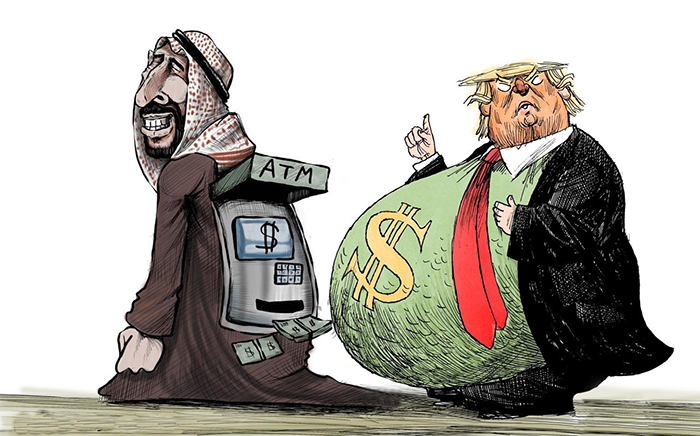
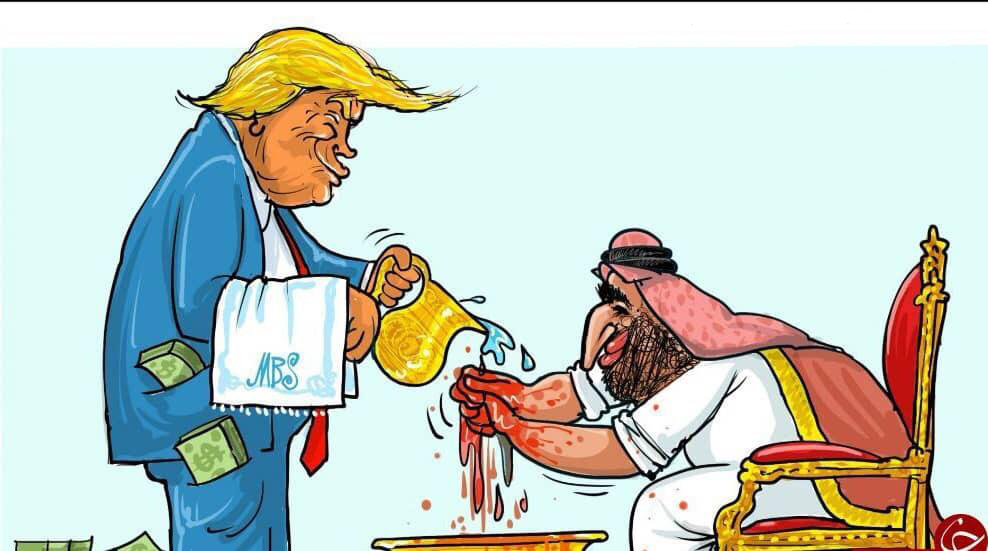
For a long period, MbS was treated gently by foreign governments greedy for Saudi contracts and by the foreign media, which bought into a PR picture of MbS as breaking the bonds of an archaic society. President Trump made a triumphal visit to Riyadh soon after his election and frequently tweeted his approval of all that MbS was doing – including his incarceration of the businessmen.
In terms of publicity, all went well enough until 2 October 2018 when a Saudi death squad murdered the Saudi journalist Jamal Khashoggi in the Saudi consulate in Istanbul. The crime is now admitted by the Saudi authorities, though they deny that MbS knew about the killing in advance – something asserted to the contrary by US senators briefed by US intelligence.
The Khashoggi killing and the grisly dismemberment of his body released a flood of criticism from which MbS has yet to recover. The dead journalist had said the year before his assassination that the crown prince had “promised an embrace of social and economic reform… but all I see now is the recent wave of arrests”.
The tainting of Saudi Arabia’s reputation by the Khashoggi affair, and the torrent of criticism that followed, played a role in deterring foreign investors from buying into Aramco at the price the Saudis wanted.
But what really undermined Saudi Arabia’s reputation for stability was the surprise Iranian/Houthi drone and missile attack on the Abqaiq and Khurais oil facilities in September. As significant as the attack itself was Mr Trump’s refusal to retaliate against Iran. What had for so long seemed like a gold-plated US guarantee of Saudi security turned out to be nothing of the sort.
MbS is not going to be displaced because of these mistakes and miscalculations: when he was appointed heir to his father in 2017, the royal court purged and took over the entire Saudi security apparatus. On the other hand, the long list of self-destructive actions by the Saudi authorities in the last five years has left the country much less stable than it once appeared.
Prince Andrew’s take on the career of his fellow royal in Saudi Arabia would make interesting reading. Perhaps he looks on MbS’s absolute power and gigantic wealth with envy; he may even approve of the rigour with which his counterpart asserts his authority. This is not pure guesswork.
Andrew used to be a regular visitor to Saudi Arabia’s near neighbour and de facto protectorate, Bahrain, praising it as “as source of hope for many people in the world”. These kind words contrast with the report of an independent inquiry into the crushing of the Arab Spring protests there in 2011 which details 18 different torture techniques inflicted on detained protesters.
A British diplomat stationed in Bahrain at the time of a Prince Andrew visit later wrote that the thank-you letters he sent to his hosts after one visit to Bahrain – comparing the size of his plane to theirs – made for cringe-making reading.
In one significant respect, however, Prince Andrew is setting a good example for MbS by standing down from his public duties. Doubtless, the Saudi crown prince will be wondering, after the failures and fiascos of the last five years, if he should consider following the same path.

Thursday, October 03, 2019

MbS’ Quivering Lower Lip

Impetuousness and dual-loyalty: the stuff has-beens are made of


Yusuf Dhia-Allah
When Saudi Crown Prince Muhammad bin Salman (MbS) is nervous, his thick lower lip begins to quiver uncontrollably. People’s nervousness shows in different ways. His American master Donald Trump narrows his eyes and twitches them when nervous while Narendra Modi constantly licks his lips with his snake-like tongue.
Whatever the particular form of nervousness of an individual, there are plenty of reasons why MbS feels nervous these days. Those around him say that MbS’ quivering lower lip makes him resemble a camel. The beast of the desert has reason for its lips to quiver — it wants to grab food and is part of its physiological makeup — but what about MbS, the beast of the palace?
His list of troubles is long and he has only himself to blame. At home he has disrupted all the old equations that had served Bani Saud well for more than eight decades even if it was detrimental to the people of the Arabian Peninsula. Abroad, he has made too many enemies from Islamic Iran, Yemen, Syria, and Turkey to Qatar. Perhaps, the United Arab Emirates (UAE) may also be added to this list now.
Bin Salman simply does not have the mental capacity to deal with all these challenges at once. He is not even able to manage one of these on his own. After bombing dirt-poor Yemen for more than four years, killing nearly 100,000 people and destroying much of the country’s infrastructure, the Yemenis have struck back with a vengeance.
The September 14 Yemeni drone strikes on the Kingdom’s oil facilities in Abqaiq and Khurais have knocked the bottom out of Saudi Arabia’s oil-based economy. And the US-supplied missile defence shield at the cost of billions of dollars was exposed as useless against $15,000 drones.
The entire Saudi establishment that essentially revolves around one man — MbS — is in turmoil. They have scurried to the Americans for help. The hundreds of billions of dollars worth of weapons the Saudis have purchased, mostly from the US, simply cannot protect them from inexpensive drones.
The Americans have offered the same old solutions that have already failed: more weapons worth billions of dollars and a few hundred soldiers. The US-built billion-dollar-a-piece Patriot anti-missile batteries have not proved too patriotic. If they cannot intercept $15,000 drones, what use are these fancy missiles? But MbS is now totally under the thumb of the Americans and the Zionists. Unless he keeps forking out more billions, the Americans will abandon him and he will be toast. His shelf life is in any case, close to expiring.
At home he is in a race against time aware that his father, King Salman is in poor health and could drop dead any day. MbS wants to consolidate his position by eliminating all rivals, real or imagined, as long as his father is alive, even if in a severe state of dementia. With the king around, other members of the family who are much senior to MbS will not raise objections. All decisions, while taken by MbS, are presented in the name of the king. Based on the long established tradition, other members of the family defer to seniority. So the king’s mere presence, even in a state of dementia, prevents other members of the family from challenging MbS.
Once the king is dead — how long can he last — all bets are off. There is bound to be opposition to MbS from different quarters. The upstart crown prince has rubbed far too many princes and others the wrong way. He is also placing loyalists in sensitive positions in hopes they will serve and protect him. This may be misplaced optimism.
It is, however, his troubles abroad that are beginning to have serious repercussions for developments at home. The daring drone strikes launched by Yemen’s Ansarullah revolutionaries at the financial nerve centre of Saudi Arabia — Aramco — has shaken MbS to his slippers. Aramco was about to be offered for International Public Offerings (IPO) and MbS had hoped to garner $1.5 to $2 trillion. With its refineries reduced to smoldering wreckage and its oil exports slashed by 50%, Saudi Arabia is heading for trouble despite optimistic statements made on its behalf by American officials and media.
The war on Syria, in which Saudi-backed mercenaries played a leading role, is on the verge of ending. The US-Zionist-Saudi-Turkish instigated regime change conspiracy in Syria has been defeated. While others may be able to withstand the consequences of this defeat, for the Saudis, the blowback will be severe. Coupled with their defeat in Yemen, it is not difficult to envision the looming crisis. Even their Emirati cousins have abandoned them in Yemen. MbS must be spending sleepless nights these days.
What Saudi Arabia means to the United States; the latter has no permanent friends, no enduring loyalties. So long as you can service its greed and insatiable appetite for power and privilege, you are useful, but if you become too feeble or unreliable to do that, then you are expendable. It will look for others but the days of easily finding sellouts are becoming fewer and far between. The blindest of all are the ones who, despite all possible historical evidence to the contrary and countless warnings from the All-Seeing and All-Hearing, can’t see the obvious. They bought the American Iraq war delusion that overwhelming air power, state of the art signal intelligence, shock and awe, scorched earth, and a civilian horror show would make quick work out of those “back in the Stone Age” Yemenis. But now, they are seeing the end of their own delusion.
And then there is the artificially-created crisis with Qatar. Again, MbS was the architect of this foolish policy aimed at bringing tiny Qatar to its knees. Instead, Qatar has not only stood its ground, thanks to timely help from Iran and Turkey, MbS has got egg all over his face. Foolishness, however, has no limits especially when underpinned by unbridled power.
It is, however, the Ansarullah drone strikes on Aramco facilities that have caused great panic in Saudi ruling circles. They thought they were invincible against lowly Yemen. The strikes have exposed Saudi vulnerability. By their own public statements, they have been shown to be American puppets. Here is a September 18 tweet from Khalid bin Salman, younger brother of MbS and also deputy defence minister of the Kingdom (MbS being defence minister),
We appreciate the United States’ longstanding position on defending its allies and core interests in the region against unprovoked acts of aggression as affirmed today by the President and Vice President as well as former Presidents including Obama.
The Saudi deputy “defence” minister admits the Kingdom cannot defend itself. It is totally dependent on the US for protection, hence his profuse appreciation of “the United States’ longstanding position on defending its allies and core interests in the region against unprovoked acts of aggression…” The young and equally inexperienced deputy defence minister even resorted to outright lies by claiming the region is subjected to “unprovoked acts of aggression.”
What have Bani Saud been doing in Yemen since March 2015, a war launched by Khalid’s older brother MbS? They have murdered nearly 100,000 Yemenis, most of them civilians, and have caused a cholera epidemic that has afflicted at least one million children — the worst cholera epidemic in history, according to the UN. Almost the entire Yemeni population of 24 million is on the verge of starvation.
Bani Saud, and especially the Bin Salmans expect the Yemenis to surrender to their genocidal policies. The Yemenis refuse to do so and have shown that they are prepared to hit back their tormentors hard. No amount of Saudi propaganda, even if amplified by their paid agents in the US, can obfuscate the fact that MbS and his cohorts are guilty of war crimes.
The rest of the world may overlook these war crimes for material interests but the Yemeni victims are not prepared to suffer in silence. It is payback time and the Saudis are going to pay big time. We may be witnessing the twilight zone of Bani Saud rule.

The Khashoggi Saga and Saudi Brazenness

Grisly murder reveals Western double standard — again


Tahir Mustafa
Last year’s brutal murder of the Saudi insider Jamal Khashoggi had a mixed impact on the Bedouin kingdom. His crime was that he had turned on his masters in Riyadh who feared he might spill more beans about their misdemeanors than the tidbits he had revealed in his media columns.
From the regime’s perspective, the cost of Khashoggi’s brazenly barbaric murder was worth it. This is not because the journalist was a champion of free speech until his fallout with the regime. Khashoggi was one of the principal apologists and justifiers of the Saudi regime’s crimes on the international scene.
Provided a platform by the Washington Post for which he wrote a weekly column, Khashoggi did not pose any serious threat to the regime. Instead, he was seen as a threat because his example could motivate other insiders to turn against the brutal and corrupt royal family.
Many people have wondered why the Saudi regime killed Khashoggi in such a brazen manner by chopping him to pieces after luring him to the Saudi Consulate in Istanbul on October 2, 2018. He could easily have been killed in a staged hit-and-run operation with plausible deniability. Or, the Saudis could have secured the help of their bosom-pals, the Zionists, who are masters at carrying out such operations. But they chose to carry out this dastardly crime on their own.
Many analysts explain Khashoggi’s murder by attributing it to Saudi stupidity and arrogance. While there is some truth to this, it does not accurately reflect the whole picture. Based on Crescent International’s decades of experience in reporting the regime’s affairs and talking to people both distant and close to the regime’s circles, our assessment is that the Saudis deliberately murdered Khashoggi in the manner they did. It was meant to send a message to potential defectors and the Saudi society at large.
Some people argue that the murder greatly damaged the Saudi regime’s reputation in terms of global public opinion. This is true. The regime’s survival, however, is not dependent on global opinion. It is backed and sustained in power primarily through Western military and political support, along with instilling fear in its own population.
Bani Saud rightly surmised that Western regimes would not use the human rights card against them as was the case, for instance, against Mu’ammar al-Qadhdhafi of Libya. The Saudi assessment was that it did not really matter what the BBC or Amnesty International (AI) said about their human rights abuses. These would only matter if such reports were utilized by Western regimes to launch a military operation against Riyadh. That is highly unlikely. Therefore, murdering their ex-insider pays off. It acts to discourage opponents inside the country and will discourage other insiders from defecting, seeing Kha-shoggi’s horrible fate.
The above analysis about Saudi brutality can be traced to Muhammad bin Salman’s (MbS) assumption of power. The case of prominent Saudi scholar, Shaykh Salman al-‘Awdah offers a clear example. Once MbS decided to impose a siege on Qatar in 2017 in order to punish the tiny shaykhdom, he expected every public figure to back his ill-conceived policy. When Shaykh Salman al-‘Awdah wrote on Twitter that he prayed to Allah (swt) to reconcile the hearts of the Qataris and Saudis and reconcile their differences, he was immediately arrested. It is highly unlikely that MbS follows al-‘Awdah’s Twitter account. What is more likely is that the crown prince had issued instructions to the Kingdom’s security services to immediately arrest anyone who dares to deviate even slightly from his policies.
Trump: You understand that our media will have to condemn you in public, you know, for appearances sake… but we’re good. How much will you pay us to maintain this charade… you know it won’t be easy for us… we have a reputation to maintain, and our Israeli friends won’t be able to have all that free healthcare and free education without your generous support?
MbS: We have more money than God.
A little birdie: But what about the Palestinians, the Ummah…
Trump, MbS: We know how to make people shut up, don’t you know?
Has this Saudi policy paid off? In the short term, the Western-backed Saudi kingdom’s brutal murder of Khashoggi has brought some benefit. There is no visible sign of any serious domestic dissent and dissidents abroad feel they are within the reach of Saudi security operatives and could be abducted. There have been several kidnapping cases of high profile dissident Saudi royals from Europe. They have simply disappeared.
In the long run, however, if the Kingdom faces internal instability, which is only a matter of time, the Khashoggi case will be used as leverage to ramp up the opponents’ media campaign against it. Once the Saudi kingdom begins to experience domestic disturbances, its brutal tactics will also limit the Western regimes’ from providing open support to a regime that chopped-up a journalist in its own diplomatic mission.
At the moment though, the backing of Western regimes to the Saudi brutes still brings in the much-needed cash to their semi-war economies. For example, last year at the peak of the Khashoggi case when it was still on everyone’s mind, the “Davos in the desert” economic event still went on, even if some Western executives stayed away. A year after the Khashoggi saga, Western countries and corporations are continuing to do business with the dark Kingdom. In May 2019, business insider reported that “global index giants FTSE Russell, S&P, Dow Jones Indices, and MSCI are folding Saudi Arabia’s stock market into accessible emerging-market indexes this year.” This and other economic indicators clearly show that the Khashoggi case did not have any significant negative economic impact on the Saudi regime. For Western regimes and their corporate affiliates, making money takes priority over all other considerations.
At present, it seems the primary challenge to the Saudi regime does not come from its domestic crimes, but from external misadventures. The Saudi humiliation in Yemen, its blunder with Qatar, and its poor relations with Turkey and Iran will sooner or later converge with the negative internal dynamics present in the Kingdom. Once external instability factors converge with internal ones, Riyadh will become a battle zone from which the royal family will not be able to escape unscathed.
MbS has created too many complex problems for the regime both internally and externally. Neither the US or Israel — patron saints of Bani Saud — can solve these easily. Thus, the Saudis are left virtually alone to clean the mess they have created. And they simply do not have the wherewithal to do so.
They have one royal mess on their hands!

A Kingdom that is Self-centered is Off-centered

Abu Dharr

The hour of reckoning is fast approaching. After eight years of Zio-Euro-American proxy wars in virtually all the Arabian republics, the mass-media-produced civil wars are winding down. Notice that the Arabian kingdoms were spared such civil conflict. The takfiri project, founded on the Wahhabi creed that was considered their ace, is becoming a spent force. Saudi Arabia, the Zio-Euro-American front man, has been exposed like never before. Its diplomats have proven that they are the subordinates of their controllers — particularly their bosses in Washington and Tel Aviv. Saudi officials, if they could think straight, would realize that they have placed themselves internally in a pickle and externally in a tight spot.
The ruling nucleus family, descending from King Salman to his children, is tightening its grip on power: Muhammad bin Salman (MbS) is minister of defense; his younger brother Khalid (KbS) is deputy minister of defense. For the first time since 1960, another son of Salman — stepbrother of MbS — is running Aramco. Comfortable times have gone and Saudi decision makers are grabbing the major levers of power in the Kingdom because they sense that they are approaching turbulent times.
For the first time, Hamas has come out and stated that its representative in Saudi Arabia has been detained for over five months now. Saudi detention policies have also rounded up other Palestinians living in that worried Kingdom. September, two years ago, is when these family royals arrested scores of their most famed ‘ulama’. One year ago this October is when MbS’ gangs choked and chopped up the journalist Jamal Khashoggi — an ex-confidant of theirs.
The Saudi imposed war in Yemen has been dragging on now for over four-and-a-half years — sapping Saudi morale and draining its treasury. Now the US, after its failed Yemeni military intervention on behalf of the Saudis, is interfering diplomatically to extricate the Saudi fumbling family from its mini-Vietnam. American officials have contacted Ansarullah to find a way out for the slowly disintegrating Saudi kingdom. The ballistic missiles being launched from Yemen into the Kingdom of Saudi Arabia have inflicted immense below-the-radar damage on Saudi military bases and their civilian supportive infrastructure.
The Saudi playboy politicians are crying uncle in their private meetings and their classified diplomatic communiqués. MbS’ right-hand man, Sa‘d al-Qahtani who supervised the gory dismemberment of Jamal Khashoggi is said to have committed suicide. We don’t know if that is really the case; there is always the possibility that he is still alive and has been given a new identity and sent off to some distant place where he will “live happily ever after.” The trial of that squad of Saudi assassins who literally slaughtered Khashoggi is forgotten and they are nowhere to be seen or heard of. It’s only a matter of time before the proverbial executioner’s sword decapitates the criminals in high office belonging to the downcast Saudi criminal kingdom. The Saudi deep-state — if we can call it that — is run by the CIA and Mossad, relying on their boy Bandar bin Sultan, whose daughter has become the Saudi ambassador in Washington, DC.
Why is this happening to the wretched royals in Arabia? The short answer is that they were brainwashed by Israel-firsters to fear the Shi‘is and programmed to purchase and amass as much military hardware as possible, thereby hemorrhaging their economy and draining their potential. If the Saudi imbeciles were confident of their “Islamic superiority,” something they teach in their self-centered textbooks, they could have easily sat down with their Shi‘i neighbors and worked things out. But their Wahhabi-cum-Salafi dogma placed them in a hollow ivory tower that now has no escape route except for them to jump to their death.
In the meantime, and it is the best kept secret in town, the Saudis have reached the end of their line because of the incremental buildup over the years of the Islamic Resistance in Lebanon in particular and, generally speaking, in a geographical tract that extends from Kashmir to Palestine. Some of these battle-ready areas are soft while others are hardened due to the imposed wars upon them from — you guessed it — the Zio-Euro-American axis. The more this growing Islamic Resistance trains and arms, the more the weakest component of that axis will give in — and in this case the weakest member of that axis is the crumbling kingdom of shaytani Arabia. The royal morons of Arabia have dug their own grave: by pretending to be superior to other Muslims and by affirming their inferiority to their Yankee and Likudnik masters.
The Muslim East is approaching a new age. The months and years ahead will prove this Islamic Resistance to be correct. The more the military pressure increases on Israel, the closer the Saudi royals will get to the abyss. The Islamic Resistance in Lebanon is beginning to shoot down Israeli UAVs over (south) Lebanon. Northern Israel is going on high alert due to the firepower and potential outbreak of hostilities between Islamic liberation forces and Zionist colonization forces. The war criminal Netanyahu is huffing and puffing that he will go to war against the Islamic Resistance in Ghazzah — little does he know that he will be blowing his own house down. The Islamic Resistance in Ghazzah has fired off its first explosive drone against the Zionist belligerents. Iraq has closed off its airspace to prevent Zionist airstrikes against the Islamic Resistance in Iraq. The cross-border fire across the Lebanese-Israeli demarcation line has new rules of engagement: if Israel strikes at Lebanon, forces in Lebanon will no longer turn the other cheek; they will strike back in accordance with the mutual commandment: an eye for an eye…
The civil war that was imposed by the Zio-American war axis in Syria and Iraq throughout the past two decades will eventually mission-creep into Israel. Israel succeeds when its wars against its enemies are massive in firepower and short in duration. But who says that Israel’s enemies are going to prosecute a war on Israel’s terms? What if the next outbreak of hostilities between a nuclear Zionist Israel on one side and an Islamic paramilitary force alongside a revolutionary irregular force on the other continue for months and years. Will the Zionist ice-cream military recruits and potato-chip regular forces be able to defeat populations that have graduated from economic sanctions and adapted to austerity living conditions?
The Israeli soldiers are cowards. Their military and civilian establishments are in a weak position. To demonstrate this helpless condition, the Israeli foreign ministry suspended most of its diplomatic activities around the world because of budget restraints: they don’t have enough money! The Times of Israel as well as other Israeli newspapers reported this.
There is a serious deficit in the ministry’s budget. This comes at a time when the Islamic Resistance is riding high and the annual meeting of heads of state at the United Nations is underway. This diplomatic paralysis means that diplomats cannot shuttle around the globe as they used to, initiatives and new diplomatic arrangements have to be postponed, foreign diplomats and journalists cannot be accommodated as was the case in years past. Even some maintenance projects are put on hold. All of this pressure building up on a stressed ethno-racist nation state is awaiting the final push to take down that evil Zionist tribal-state.
Don’t think for one moment that the sacrifices of the Muslim populations are in vain. The Zio-Euro-American master plan to fight and kill the Muslims into submission is backfiring on them. The Muslim injured body is rising from the Himalayas to the Mediterranean. Future Muslims owe those who fell in war and those unknown soldiers a tribute. Their legacy lives on…
For with Allah rests all power of decision, first and last, and on that day [of victory] will the committed Muslims have cause to rejoice in Allah’s support, for He gives support to whomever He wills, since He alone is Almighty, Very Merciful (30:4–5).

Tuesday, September 03, 2019

Rise of Fascism

Editor


It was bad enough to have nasty creatures like Benjamin Netanyahu and Donald Trump in power. Add to that such other obnoxious creatures as Narendra Modi, Muhammad bin Salman, and Boris Johnson, and we truly are in the age of vicious monsters.
There are others in Europe, Latin America, Asia, and Africa but our concern is with the evil trio comprising rulers of the US, Zionist Israel, and Hindu India because they affect Muslims directly. We must also add to this list Muhammad bin Salman, appropriately dubbed “Mr. Bone Saw” after he ordered the dismemberment of Jamal Khashoggi’s body in the Saudi consulate in Istanbul last October.
What they all have in common is their extreme hatred of Islam and Muslims. Netanyahu has been murdering Palestinians — Muslims and Christians — for decades. He makes no bones about it. As soon as Trump was elected president in 2016, he banned people from several Muslim countries branding them a threat to the United States. That the US has murdered more than five million Muslims since 2001 is a trifling matter.
And now we have Modi, the Hindu fascist who was first elected prime minister of India in 2014, after presiding over the coldblooded murder of more than 2,000 Muslims in Gujarat in February 2002. He was Gujarat chief minister at the time. This was the right qualification to become India’s prime minister. He has emerged from the ranks of the Rashtriya Swayamsevak Sangh (RSS), a Hitlerite organization with a Hindu twist. Its avowed aim is to turn India into a Hindu state where there is no room for any other religious groups, especially Muslims.
And Muhammad bin Salman has made sure that anyone even mildly oriented toward Islam or opposed to his idiotic policies is killed. Scores of religious scholars are languishing in Saudi Arabia’s notorious prisons where they face the death penalty. Why? Because they prayed for reconciliation and unity among Muslims!
These monstrous thugs are also closely aligned with each other. Trump, Modi, Netanyahu and Bin Salman are all bosom pals. Their reasons may be different. For instance, Trump embraces the Zionist thug because he knows the Israeli lobby in the US can help him get re-elected next year. He is the lobby’s slave.
Trump embraces Bin Salman because he wants the Bedouin’s wealth. He has made no secret of this. Netanyahu and Modi embrace each other because of their shared hatred of Muslims. Besides, India is the largest purchaser of weapons from Israel. And now Bin Salman has also embraced the Hindu — yes, imagine the Wahhabi obscurantists that brand other Muslims as kafirs but have no problem embracing idol worshipers like Modi as a friend and ally. What does Bin Salman want from Modi? The medieval kingdom has just announced investment of $75 billion in India, at a time when Modi has launched a genocidal war on Muslims in Kashmir. Bin Salman is not going to lose any sleep over it.
There is a common misconception that India is an emerging power. It is nothing of the sort. Here is why. A number of Indian banks have either gone bankrupt or are on the verge of doing so. Hindustan Aeronautical Limited (HAL), India’s flagship aeronautical company, has a debt of more than $75 billion and is on the verge of bankruptcy.
During Modi’s first run for prime minister in 2014, he had said 550 million people in India do not have toilets. He promised to build 10 million toilets in his first term. He failed to fulfill this pledge as he did providing jobs for tens of millions of unemployed Indians. More than 400 million Indians live in absolute poverty earning less than $1/day. Hundreds of millions have no shelter. Entire families live on sidewalks or in sewers.
Far from addressing these pressing economic problems, Modi has embarked on an anti-Muslim crusade. There is nothing like stoking hatred of “the other” to arouse the jingoistic tendencies of the masses. And with the exception of Saudi Arabia, the other three — the US, Israel, and India — claim to be democracies. This is what democracy delivers. Adolf Hitler had also come to power by winning an election.

Tuesday, August 20, 2019

The Deeper Meaning in a Lost War

Alastair CROOKE
It’s pretty clear. Saudi Arabia has lost, and, notes Bruce Riedel, “the Houthis and Iran are the strategic winners”. Saudi proxies in Aden – the seat of Riyadh’s Yemeni proto-‘government’ – have been turfed out by secular, former Marxist, southern secessionists. What can Saudi Arabia do? It cannot go forward. Even tougher would be retreat. Saudi will have to contend with an Houthi war being waged inside the kingdom’s south; and a second – quite different – war in Yemen’s south. MbS is stuck. The Houthi military leadership are on a roll, and disinterested – for now – in a political settlement. They wish to accumulate more ‘cards’. The UAE, which armed and trained the southern secessionists has opted out. MbS is alone, ‘carrying the can’. It will be messy.
So, what is the meaning in this? It is that MbS cannot ‘deliver’ what Trump and Kushner needed, and demanded from him: He cannot any more deliver the Gulf ‘world’ for their grand projects – let alone garner together the collective Sunni ‘world’ to enlist in a confrontation with Iran, or for hustling the Palestinians into abject subordination, posing as ‘solution’.
What happened? It seems that MbZ must have bought into the Mossad ‘line’ that Iran was a ‘doddle’. Under pressure of global sanctions, Iran would quickly crumble, and would beg for negotiations with Trump. And that the resultant, punishing treaty would see the dismantling of all of Iran’s troublesome allies around the region. The Gulf thus would be free to continue shaping a Middle East free from democracy, reformers and (those detested) Islamists.
What made the UAE – eulogised in the US as tough ‘little Sparta’ – back off? It was not just that the Emirs saw that the Yemen war was unwinnable. That was so; but more significantly, it dawned on them that Iran was going to be no ‘doddle’. But rather, the US attempt to strangulate the Iranian economy risked escalating beyond sanctions war, into military confrontation. And in that eventuality, the UAE would be devastated. Iran warned explicitly that a drone or two landed into the ‘glass houses’ of their financial districts, or onto oil and gas facilities, would set them back twenty years. They believed it.
But there was another factor in the mix. “As the world teeters on the edge of another financial crisis”, Esfandyar Batmanghelidj has noted, “few places are being gripped by anxiety like Dubai. Every week a new headline portends the coming crisis in the city of skyscrapers. Dubai villa prices are at their lowest level in a decade, down 24 percent in just one year. A slump in tourism has seen Dubai hotels hit their lowest occupancy rate since the 2008 financial crisis – even as the country gears up to host Expo 2020 next year. As Bloomberg’s Zainab Fattah reported in November of last year, Dubai has begun to “lose its shine,” its role as a center for global commerce “undermined by a global tariff war—and in particular by the US drive to shut down commerce with nearby Iran””.
An extraneous Houthi drone landing in Dubai’s financial zone would be the ‘final nail in the coffin’ (the expatriates would be out in a flash) – a prospect far more serious than the crisis of 2009, when Dubai’s real estate market collapsed, threatening insolvency for several banks and major development companies, some of them state-linked – and necessitating a $20 billion bailout.
In short, the Gulf realised MbS’ confrontation project with Iran was far too risky, especially with the global financial mood darkening so rapidly. Emirati leadersfaced off with MbZ, the confrontation ideologue – and the UAE came out of Yemen formally (though leaving in situ its proxies), and initiated outreach to Iran, to take it out of that war, too.
It is now no longer conceivable that MbS can deliver what Trump and Netanyahu desired. Does this then mean that the US confrontation with Iran, and Jared Kushner’s Deal of the Century, are over? No. Trump has two key US constituencies: AIPAC and the Christian Evangelical ‘Zionists’ to ‘stroke’ electorally in the lead up to the 2020 elections. More ‘gifts’ to Netanyahu in the lead into the latter’s own election campaign are very likely also, as a part of that massaging of domestic constituencies (and donors).
In terms of the US confrontation with Iran, it seems that Trump is turning-down the volume on belligerence toward Iran, hoping that economic sanctions will work their ‘magic’ of bringing the Islamic Republic to its knees. There is no sign of that however – and no sign of any realistic US plan ‘B’. (The Lindsay Graham initiative is not one).
Where does that leave MbS in terms of US and Israeli interests? Well, to be brutal, and despite the family friendships … ’expendable’, perhaps? The scent of an eventual US disengagement from the region is again hanging in the air.
The deeper meaning in the ‘lost Yemen war’, ultimately, is an end to Gulf hopes that ‘magician’ Trump would undo the earlier Gulf panic that the West would normalise with Iran (through the JCPOA), thus leaving Iran as the paramount regional power. The advent of Trump, with all his affinity towards Saudi Arabia, seemed to Gulf States to promise the opportunity again to ‘lock in’ the US security umbrella over Gulf monarchies, protecting these states from significant change, as well as leaving Iran ‘shackled’, and unable to assume regional primacy.
A secondary meaning to Yemen is that Trump and Netanyahu’s heavy investment in MbS and MbZ has proved to be chimeric. These two, it turned out were ‘naked’ all along. And now the world knows it. They can’t deliver. They have been bested by a ragtag army of tough Houthi tribesmen.
The region now observes that ‘war’ isn’t happening (although only by the merest hair’s breadth): Trump is not – of his own volition – going to bomb Iran back to the 1980s. And Gulf States now see that if he did, it is they – the Gulf States – who would pay the highest price. Paradoxically, it has fallen to the UAE, the prime agitator in Washington against Iran, to lead the outreach toward Iran. It represents a salutary lesson in realpolitik for certain Gulf States (and Israel). And now that it has been learned, it is hard to see it being reversed quite so easily.
The strategic shift toward a different security architecture is already underway, with Russia and China proposing an international conference on security in the Persian Gulf: Russia and Iran already have agreed joint naval exercises in in the Indian Ocean and Hormuz, and China is mulling sending its warships there too, to protect its tankers and commercial shipping. Plainly, there will be some competition here, but Iran has the upper hand still in Hormuz. It is a powerful deterrent (though one best threatened, but not used).
Of course, nothing is assured in these changing times. The US President is fickle, and prone to flip-flop. And there are yet powerful interests in the US who do want see Iran comprehensively bombed. But others in DC – more significantly, on the (nationalist) Right – are much more outspoken in challenging the Iran ‘hawks’. Maybe the latter have missed their moment? The fact is, Trump drew back (but not for the stated reasons) from military action. America is now entering election season – and it is fixated on its navel. Foreign policy is already a forgotten, non-issue in the fraught partisan atmospherics of today’s America.
Trump likely will still ‘throw Israel a few bones’, but will that change anything? Probably, not much. That is cold comfort – but it might have been a lot worse for the Palestinians. And Greater Israel? A distant, Promethean hope.

Monday, March 11, 2019

Saudi Arabia, Pakistan, and the Bomb

by 

Drawing by Nathaniel St. Clair
On February 19, the Democratic majority of the House Oversight and Reform Committee released an eye-opening interim report.  Based on testimony from “multiple” whistleblowers, the report reveals that the Trump Administration is engaged in a frenzied dash to push through a sale of nuclear reactors to Saudi Arabia without consulting Congress.
Several of the individuals who are promoting the deal, including our old friend General Michael Flynn, are Trump cronies both inside and outside the administration who stand to make a killing if the deal goes through.  If only Iran had had the sense to buy nukes from friends of Trump, it would never have faced sanctions or the threat of a US invasion.
Selling nuclear reactors to the Saudis should cause alarm.  The kingdom claims that it needs nuclear reactors (it has none currently) in order to meet its rising energy needs.  However, the House interim report states that “experts worry that transferring sensitive U.S. nuclear technology could allow Saudi Arabia to produce nuclear weapons that contribute to the proliferation of nuclear arms throughout an already unstable Middle East.”  The Saudis are insisting that the agreement give them the right to enrich uranium and reprocess plutonium from spent nuclear reactor fuel.  Enrichment and reprocessing capability would enable the Saudis to go in a short time from a peaceful, civil nuclear program to producing a bomb.  During an interview which aired on the March 18, 2018 “60 Minutes,” Crown Prince Mohammad bin Salman (“MBS,” as he is known), said: “Saudi Arabia does not want to acquire any nuclear bomb, but without a doubt if Iran developed a nuclear bomb, we will follow suit as soon as possible.”
There is no sign that any of this troubles Trump.  Nothing the Saudis do gets a rise out of the president.  (Maybe Trump just likes anyone in white robes.)  Congress, however, including many Republicans, has had enough of the Saudis.  Like most of us, Congress was appalled by the October 2, 2018 murder of Washington Postwriter Jamal Khashoggi, apparently on Bin Salman’s personal orders.  Trump, on the other hand, retains his doglike fidelity to the crown prince.  One suspects Trump would defend the crown prince even if Bin Salman had shot Khashoggi in the middle of New York’s Fifth Avenue.
On February 13, in a stunning rebuke to the president, the House voted 248-to-177 to invoke the War Powers Resolution and end US support for the Saudis’ genocidal war on Yemen. The measure now goes to the Senate.
Congress may tighten the requirements for nuclear cooperation agreements such as Trump’s prospective reactor sale to the Saudis.  Nuclear cooperation agreements (“123 agreements”) are regulated by the Atomic Energy Act of 1954.  Unfortunately, the Atomic Energy Act does not actually require Congress to assent to a nuclear transfer.  Congress, however, can veto a transfer.  New legislation, pointedly named the Saudi Nuclear Proliferation Act, would change that.  The bill, introduced in the Senate on Feb. 28, strengthens the Atomic Energy Act by requiring that transfers of US nuclear technology to Saudi Arabia be approved by Congress.
If Trump’s nuclear deal dies, as it should, Russia, China, South Korea, and France have also submitted bids to build the Saudi reactors.  Each one of these alternate suppliers has fatal drawbacks.  Henry Sokolski, Executive Director of the Nonproliferation Policy Education Center, writes that “If Saudi Arabia buys Russian, it is all but asking Moscow to let Iran know exactly what the kingdom is doing in the nuclear realm.” Reactors which China and France are building overseas are behind schedule and over-budget.  South Korea’s reactors incorporate American technology, which means that Congress has the power under the Atomic Energy Act to block a Saudi-Korean reactor sale.
The New York Times‘ Nicholas Kristof observes:
Trump seems to believe that the Saudis have us over a barrel: If we don’t help them with nuclear technology, someone else will. That misunderstands the U.S.-Saudi relationship.  The Saudis depend on us for their security, and the blunt truth is that we hold all the cards in this relationship, not them.
The Pakistan Connection
There may be an easier way for the Saudis to acquire nuclear weapons than building their own. I ran across these paragraphs in a postby an Indian blogger:
The Saudis are virtually bankrolling the Pakistani economy — $3 billion in cash, another $3 billion in oil (with deferred payment facility) and anywhere around $20 billion in investments — which makes Pakistan a vassal state.
Besides, the UAE, which is closely aligned with Saudi Arabia, is chipping in with another $6.2 billion aid package.
That’s a lot of cabbage. How will Pakistan pay it back?  One way is by giving Saudi Arabia a bomb.
Rumors of an arrangement or understanding under which Pakistan would transfer nuclear weapons to the kingdom go back to the 1970s when Saudi Arabia provided funding for Pakistan’s nascent nuclear bomb project.  On November 22, 2018, in a story titled “Saudis Want a U.S. Nuclear Deal. Can They Be Trusted Not to Build a Bomb?” the New York Times noted that
The Saudi government provided the financing for Pakistan to secretly build its own nuclear arms…. That financial link has long left American intelligence officials wondering if there was a quid pro quo: that if Saudi Arabia ever needed its own small arsenal, Pakistan could provide it….
The Times goes on to say that there may be an understanding that if Saudi Arabia requests troops from Pakistan, those troops will bring nukes with them.
Some reports allege the RSAF [Royal Saudi Air Force] keeps a couple of aircraft permanently deployed in Pakistan to be able to deliver the bomb to Riyadh on short notice if the King asks for them [sic]. It is impossible to know if these reports have any veracity but the idea makes sense.
Pakistan and Saudi Arabia deny that they have a nuclear agreement.  However, Simon Henderson, an energy expert with the Washington Institute for Near East Policy, agrees that
Saudi Arabia probably already has a nuclear weapons capability, courtesy of Pakistan.  The assumption is that Pakistan’s nuclear-tipped missiles could be sent to the kingdom, either to boost Saudi deterrence against Iran or to safeguard part of Pakistan’s strategic force in time of crisis with India….
Pakistan is currently in a crisis with India, one which may escalate to nuclear war.  For decades, Pakistan has trained, equipped, and given safe haven to jihadi groups which it uses as proxies for attacks on India. On February 13, an attack by militant group Jaish-e-Mohammad in Indian-occupied Kashmir killed 40 Indian paramilitary police.  India has accused Pakistan of backing Jaish-e-Mohammad.
Since then, each side has carried out air attacks on the other’s territory, and each nation has claimed to have shot down the other’s warplanes.  There has been firing across the Line of Control that divides Kashmir between Pakistan and India.  Pakistan Prime Minister Imran Khan has met with the country’s National Command Authority, which controls Pakistan’s nuclear arsenal.  The crisis could spiral into a full-scale war. [1]
The Man with the Golden Gun
Christopher Clary and Mara E. Karlin predicted in 2012 that it is “likely that Pakistan will provide nuclear weapons technology [to Saudi Arabia] if it is seeking to replace U.S. aid following a possible future rupture in the relationship [with the US].”  Complaining that the Pakistanis “don’t do a damn thing for us,” President Donald Trump slashed $300 million of aid to Pakistan in September.  Like his predecessors in the Oval Office, Trump has wearied of Pakistan’s empty promises to crack down on militant groups which attack NATO forces in Afghanistan. Bush and Obama tried using financial pressure to force Pakistan to sever its ties with militants.  Now it’s Trump’s turn to try what has never worked in the past.  The danger is that US pressure could backfire, driving Pakistan closer to Riyadh.
Contrast the royal treatment Pakistan is receiving from Riyadh.  MBS made a state visit to Pakistan in February.  During his two-day visit, the Pakistanis treated the Saudi crown prince like a rock star.  Pakistan lavished MBS with gifts, including—no joke—a gold-plated submachine gun.  Pakistan’s jubilance is understandable.  Bin Salman has promised Pakistan $20 billion in Saudi investments, throwing a lifeline to Pakistan which is in one of its recurrent fiscal crises.  Commentators say that MBS has cemented Pakistan’s membership in the Sunni alliance against Iran.
We are left with a puzzle.  Suppose it’s true that Saudi Arabia can get nukes from Pakistan at any time just like ordering a pizza.  Does that mean that the Saudis are telling the truth and only want nuclear reactors in order to generate electricity?  Then why is Riyadh insisting on ENR as part of a nuclear cooperation agreement with Washington?  Is the Saudis’ rumored “understanding” with Pakistan bogus?  Maybe, maybe not.  If Riyadh does have an understanding with Pakistan it’s in order to hedge against Iran going nuclear.  Riyadh may now have decided to build its own bomb in order to hedge against a possibly unreliable Islamabad—hedging on top of hedging.
The Saudis cannot be trusted with nuclear reactors.  Yet despite the revelations from the House Oversight Committee’s report, the Trump Administration appears still to be moving ahead with the sale.  As recently as February 12, President Trump personally met with representatives from America’s nuclear industry.  This is only to be expected from a president not given to playing anything safe.  Or smart.
Notes.
[1]  Pakistan-backed militants are also making trouble for Iran.  A suicide attack on February 13 killed 27 members of Iran’s elite Islamic Revolutionary Guard Corps.  This was “one of the deadliest attacks in years to strike Iran,” according to the New York Times.  The Pakistan-based Jaish al Adl(“Army of Justice”), which the Timeswrites has ties to Al Qaeda, has claimed responsibility for the attack.  Iran’s Sistan-Baluchestan Province, where the attack took place, borders Pakistan.
Charles Pierson is a lawyer and a member of the Pittsburgh Anti-Drone Warfare Coalition.